This CE Center article is no longer eligible for receiving credits.
Multifamily living remains very popular across the country as reflected in rising rental rates and robust competition between properties. Designing living units means that they can be part of low-rise, mid-rise, or high-rise buildings that are either wholly residential or contain mixed uses. Construction materials, building envelopes, and enclosures can be selected from a wide range of choices. All these aspects need to come together in a manner that is appealing, durable, and competitive. At the same time, sustainability has become an expected attribute of building owners and occupants. This course delves into these issues with an eye toward some current options to help successfully achieve a balance between these multiple design criteria.
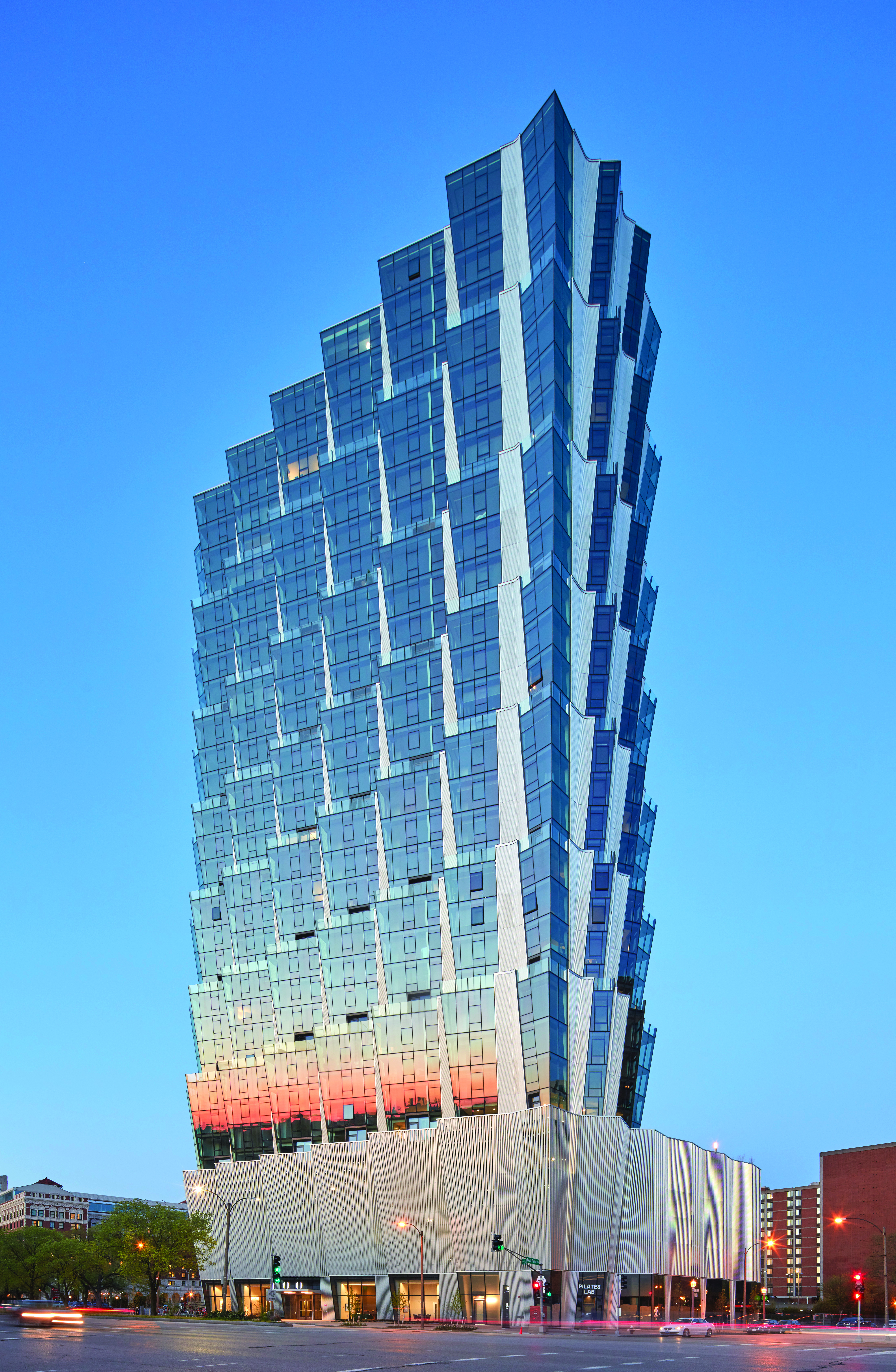
Photo courtesy of Tom Harris and CRL
The design of multifamily buildings needs to meet many different criteria to meet the needs of owners, occupants, location, and operations, such as the “One Hundred” residential tower in St. Louis, Missouri, designed by Studio Gang.
LARGE-SCALE FENESTRATION FOR VIEWS AND THERMAL CONTROL
Multifamily designs often seek to provide occupants with expansive views and a visual connection to the surrounding landscape or cityscape. Manufacturers of larger format fenestration recognize this design need and offer products that are easily incorporated into a variety of building design schemes. The expansive views that some glass fenestration systems offer serve to enhance the occupant experience, which is why they are a sought-after feature in many of today’s multifamily developments.
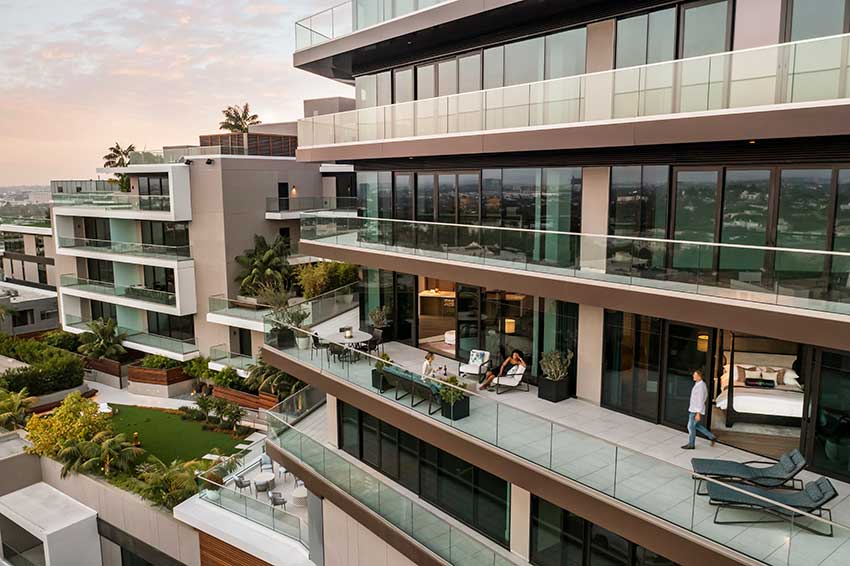
Photo courtesy of Here and Now Agency and CRL
Large-scale fenestration systems are commonly used in multifamily projects to connect building interiors to outdoor spaces, views, daylight, and ventilation.
Architects however must be careful when specifying fenestration systems that offer all-glass visuals. The reason is that more glass typically means lower thermal performance—a key aspect to sustainable design. Fortunately, manufacturers of architectural glazing systems have caught on. Innovations in product engineering have produced large, movable glass wall systems with ultra-slim frames that offer virtually uninterrupted views while effectively mitigating heat transfer using thermal breaks and insulating glass. Maintaining comfortable interior temperatures places less strain on heating and cooling systems throughout the year, thus enhancing the energy efficiency of multifamily developments.
From a total building design standpoint, multifamily units often have fenestration limited to one or two sides of the units. In some cases, the building is designed so windows or views are similarly focused on only one or two sides of a building. That means the total amount of fenestration in a building can be controlled for overall energy performance, but a living unit can appear to have large scale, dramatic openings.
Mark Suehiro is Technical Director of the CRL Entrances & Partitions Group and has been deeply involved in this issue. He points out “When it comes to fenestration systems in modern multifamily building design, architects must find a balance between aesthetics and thermal performance.” He notes that the fenestration industry is able to find this balance with two types of large-scale fenestration systems: sliding and bi-folding movable walls. These have multiple applications in contemporary multifamily developments, but the most common include large upper-level units with wide openings to exterior balconies, and as interior/exterior space dividers in social spaces like community clubhouses, rooftop pools, and gyms. When specified correctly, these systems can enhance the building’s visual appeal, durability, and sustainability.
Sliding Operable Walls
New exterior sliding door systems act as movable walls and offer a grand scale and sophisticated design that makes a visual statement. They are typically custom manufactured to suit a particular project, with panel heights up to 13 feet and widths up to 7 feet. That means they can provide an elegant solution that fits seamlessly with contemporary project designs. They are also offered with a minimal profile using an ultra-slim 1-5/16” panel frame.
Among the available thermal performance features of these sliding glass walls, thermally broken frames with 1-inch insulating glass are common and can achieve a U-factor of 0.38. This configuration also has the capability to provide sound attenuation with ratings on the order of STC-33. The frames can be finished in a range of standard colors. Custom colors are also available from some manufacturers.
Despite the large sliding panels, this type of door is engineered to provide fairly effortless, one-handed operation. Panel loads, up to 700 pounds, are evenly distributed across a bottom rolling system with stainless steel wheels resulting in a fluid, frictionless glide. Precision-engineered stainless-steel tracks further facilitate panel movement. Operation can be automated or manual using a built-in door handle or groove. Due to the larger size of the doors, the locking mechanism is typically a multi-point system. The door sills can be flush to provide a seamless floor transition between the inside and outside of the doors or raised for greater protection against weather conditions. It’s important to note the cycle testing of these systems since they speak to its long-term durability. A 40,000 cycle test is as good as it gets for these types of sliding door systems.
Altogether, expansive sliding doors provide an attractive and efficient solution for large format fenestration in multifamily buildings.
Large Scale Bi-Folding Glass Doors
In addition to large-scale sliding doors, the latest bi-folding glass door systems also offer advancements in aesthetics and thermal performance. These systems are characterized by multiple hinged panels that can stack to one side to allow for a complete opening between rooms or between interior and exterior environments. This is particularly appealing for designs that seek to create seamless transitions between interior and exterior spaces while maximizing ventilation and daylighting. When closed, bi-folding door systems offer minimal obstruction to preserve views and can seal up tightly to effectively protect against air and water infiltration. They can feature thermally broken frames and 1” double-pane insulating glass that together produce standard U-factors of 0.36 to help keep interior temperatures at a comfortable level year-round, which puts less strain on air conditioning systems.
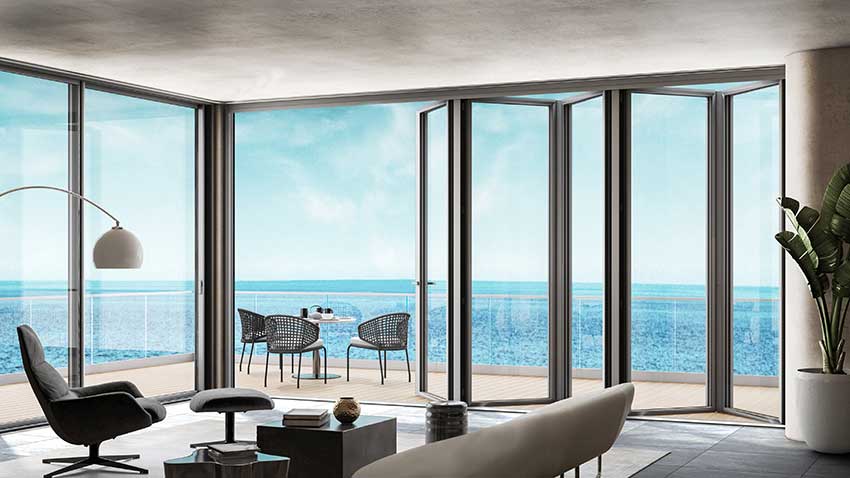
Photo courtesy of CRL
Bi-folding glass doors create large scale operable walls that allow ample daylight and views while meeting needed thermal performance criteria.
On the aesthetic side, the latest bi-folding doors feature 12-foot frame heights, slim 4-3/4” vertical sightlines, and ultra-narrow 1-7/16” panel rails. Together, this lessens obstructions to help preserve views. When closed, door hinges are completely concealed to deliver a minimal, streamlined look.
Similar to sliding doors, bi-folding door systems are engineered to provide easy operation. Panel loads can be mounted on a bottom rolling system to eliminate strain on overhead beams. The panel widths are typically four feet with a maximum height of 12 feet. The sills for bi-folding door systems can also be flush to provide a seamless floor transition between the interior and exterior or raised to provide better resistance to water and air infiltration.
Overall, sliding and bi-folding movable walls represent two innovative solutions to enhancing the energy efficiency and aesthetics of contemporary multifamily buildings. All in all, these systems elevate the resident experience and benefit a multifamily building’s long-term sustainability.
Fenestrations Performance Standards
The most widely recognized and relevant standard for fenestration is the North American Fenestration Standard (NAFS), which governs windows, doors, and skylights. Known as AAMA/WDMA/CSA 101/I.S.2/A440, this standard is familiar to many specifiers and fenestration manufacturers and includes four Performance Grade categories. Classification of products is based on independent testing on the design pressure of wind forces acting on the fenestration (measured in pounds per square foot—psf) at a stated pressure difference (measured in pascals Pa). The entry level, or “gateway,” criteria for tested fenestration units in each of the Performance Grades is as follows:
- R Class (Residential) Fenestration: 15 psf (720 Pa) This class is commonly used in one- and two-family dwellings.
- LC Class (Light Commercial) Fenestration: 25 psf (1200 Pa) This class is the minimum designation appropriate for low- and mid-rise multifamily dwellings and other buildings where larger sizes and higher loading requirements are expected.
- CW Class (Commercial) Fenestration: 30 psf (1,440 Pa) This newest class is better suited to low- and mid-rise buildings where larger sizes, higher loading requirements, limits on deflection, and heavier use are expected.
- AW Class (Architectural) Fenestration: 40 psf (1,920 Pa) This is geared toward mid- and high-rise buildings to meet increased loading requirements and limits on deflection in buildings where frequent and extreme use of the fenestration products is expected.
Multifamily living remains very popular across the country as reflected in rising rental rates and robust competition between properties. Designing living units means that they can be part of low-rise, mid-rise, or high-rise buildings that are either wholly residential or contain mixed uses. Construction materials, building envelopes, and enclosures can be selected from a wide range of choices. All these aspects need to come together in a manner that is appealing, durable, and competitive. At the same time, sustainability has become an expected attribute of building owners and occupants. This course delves into these issues with an eye toward some current options to help successfully achieve a balance between these multiple design criteria.
Photo courtesy of Tom Harris and CRL
The design of multifamily buildings needs to meet many different criteria to meet the needs of owners, occupants, location, and operations, such as the “One Hundred” residential tower in St. Louis, Missouri, designed by Studio Gang.
LARGE-SCALE FENESTRATION FOR VIEWS AND THERMAL CONTROL
Multifamily designs often seek to provide occupants with expansive views and a visual connection to the surrounding landscape or cityscape. Manufacturers of larger format fenestration recognize this design need and offer products that are easily incorporated into a variety of building design schemes. The expansive views that some glass fenestration systems offer serve to enhance the occupant experience, which is why they are a sought-after feature in many of today’s multifamily developments.
Photo courtesy of Here and Now Agency and CRL
Large-scale fenestration systems are commonly used in multifamily projects to connect building interiors to outdoor spaces, views, daylight, and ventilation.
Architects however must be careful when specifying fenestration systems that offer all-glass visuals. The reason is that more glass typically means lower thermal performance—a key aspect to sustainable design. Fortunately, manufacturers of architectural glazing systems have caught on. Innovations in product engineering have produced large, movable glass wall systems with ultra-slim frames that offer virtually uninterrupted views while effectively mitigating heat transfer using thermal breaks and insulating glass. Maintaining comfortable interior temperatures places less strain on heating and cooling systems throughout the year, thus enhancing the energy efficiency of multifamily developments.
From a total building design standpoint, multifamily units often have fenestration limited to one or two sides of the units. In some cases, the building is designed so windows or views are similarly focused on only one or two sides of a building. That means the total amount of fenestration in a building can be controlled for overall energy performance, but a living unit can appear to have large scale, dramatic openings.
Mark Suehiro is Technical Director of the CRL Entrances & Partitions Group and has been deeply involved in this issue. He points out “When it comes to fenestration systems in modern multifamily building design, architects must find a balance between aesthetics and thermal performance.” He notes that the fenestration industry is able to find this balance with two types of large-scale fenestration systems: sliding and bi-folding movable walls. These have multiple applications in contemporary multifamily developments, but the most common include large upper-level units with wide openings to exterior balconies, and as interior/exterior space dividers in social spaces like community clubhouses, rooftop pools, and gyms. When specified correctly, these systems can enhance the building’s visual appeal, durability, and sustainability.
Sliding Operable Walls
New exterior sliding door systems act as movable walls and offer a grand scale and sophisticated design that makes a visual statement. They are typically custom manufactured to suit a particular project, with panel heights up to 13 feet and widths up to 7 feet. That means they can provide an elegant solution that fits seamlessly with contemporary project designs. They are also offered with a minimal profile using an ultra-slim 1-5/16” panel frame.
Among the available thermal performance features of these sliding glass walls, thermally broken frames with 1-inch insulating glass are common and can achieve a U-factor of 0.38. This configuration also has the capability to provide sound attenuation with ratings on the order of STC-33. The frames can be finished in a range of standard colors. Custom colors are also available from some manufacturers.
Despite the large sliding panels, this type of door is engineered to provide fairly effortless, one-handed operation. Panel loads, up to 700 pounds, are evenly distributed across a bottom rolling system with stainless steel wheels resulting in a fluid, frictionless glide. Precision-engineered stainless-steel tracks further facilitate panel movement. Operation can be automated or manual using a built-in door handle or groove. Due to the larger size of the doors, the locking mechanism is typically a multi-point system. The door sills can be flush to provide a seamless floor transition between the inside and outside of the doors or raised for greater protection against weather conditions. It’s important to note the cycle testing of these systems since they speak to its long-term durability. A 40,000 cycle test is as good as it gets for these types of sliding door systems.
Altogether, expansive sliding doors provide an attractive and efficient solution for large format fenestration in multifamily buildings.
Large Scale Bi-Folding Glass Doors
In addition to large-scale sliding doors, the latest bi-folding glass door systems also offer advancements in aesthetics and thermal performance. These systems are characterized by multiple hinged panels that can stack to one side to allow for a complete opening between rooms or between interior and exterior environments. This is particularly appealing for designs that seek to create seamless transitions between interior and exterior spaces while maximizing ventilation and daylighting. When closed, bi-folding door systems offer minimal obstruction to preserve views and can seal up tightly to effectively protect against air and water infiltration. They can feature thermally broken frames and 1” double-pane insulating glass that together produce standard U-factors of 0.36 to help keep interior temperatures at a comfortable level year-round, which puts less strain on air conditioning systems.
Photo courtesy of CRL
Bi-folding glass doors create large scale operable walls that allow ample daylight and views while meeting needed thermal performance criteria.
On the aesthetic side, the latest bi-folding doors feature 12-foot frame heights, slim 4-3/4” vertical sightlines, and ultra-narrow 1-7/16” panel rails. Together, this lessens obstructions to help preserve views. When closed, door hinges are completely concealed to deliver a minimal, streamlined look.
Similar to sliding doors, bi-folding door systems are engineered to provide easy operation. Panel loads can be mounted on a bottom rolling system to eliminate strain on overhead beams. The panel widths are typically four feet with a maximum height of 12 feet. The sills for bi-folding door systems can also be flush to provide a seamless floor transition between the interior and exterior or raised to provide better resistance to water and air infiltration.
Overall, sliding and bi-folding movable walls represent two innovative solutions to enhancing the energy efficiency and aesthetics of contemporary multifamily buildings. All in all, these systems elevate the resident experience and benefit a multifamily building’s long-term sustainability.
Fenestrations Performance Standards
The most widely recognized and relevant standard for fenestration is the North American Fenestration Standard (NAFS), which governs windows, doors, and skylights. Known as AAMA/WDMA/CSA 101/I.S.2/A440, this standard is familiar to many specifiers and fenestration manufacturers and includes four Performance Grade categories. Classification of products is based on independent testing on the design pressure of wind forces acting on the fenestration (measured in pounds per square foot—psf) at a stated pressure difference (measured in pascals Pa). The entry level, or “gateway,” criteria for tested fenestration units in each of the Performance Grades is as follows:
- R Class (Residential) Fenestration: 15 psf (720 Pa) This class is commonly used in one- and two-family dwellings.
- LC Class (Light Commercial) Fenestration: 25 psf (1200 Pa) This class is the minimum designation appropriate for low- and mid-rise multifamily dwellings and other buildings where larger sizes and higher loading requirements are expected.
- CW Class (Commercial) Fenestration: 30 psf (1,440 Pa) This newest class is better suited to low- and mid-rise buildings where larger sizes, higher loading requirements, limits on deflection, and heavier use are expected.
- AW Class (Architectural) Fenestration: 40 psf (1,920 Pa) This is geared toward mid- and high-rise buildings to meet increased loading requirements and limits on deflection in buildings where frequent and extreme use of the fenestration products is expected.
In the case of large format glass doors, both sliding and bi-folding versions, CW class units are now available from select manufacturers. That means that they have been independently tested and shown to meet the criteria to qualify for this preferred class of fenestration. This helps design professionals when selecting and specifying such products, but ultimately it means it benefits the owners and occupants of multifamily buildings. The ratings reflect performance features that help achieve the goal of reducing energy use while still meeting design intents. This adds to a building’s overall sustainability and visual appeal.
BETTER BUILDING INTERIORS
Multifamily buildings include private living spaces and an increasing number of more public or commonly used amenity spaces. Such spaces are often subject to heavy use in the form of people gathering, furnishings being moved in and out, equipment and supplies being moved, etc. That means that the surfaces need to be durable and resistant to damage.
Additionally, recent public health events have increased concerns for cleanliness as building owners and managers seek to comply with health regulations and curtail the spread of disease. As a result, walls and other surfaces have been subjected to more frequent cleanings and sometimes with more powerful cleaning agents. That is all good if the materials on those surfaces are durable enough and easily cleaned. This is true not only for the basic surface material, but also for the trim that is usually required along all the edges too.
Considering these needs for greater durability and cleanability, as well as the need to protect edges and base conditions from damage, a trim material of choice is extruded aluminum. This approach is particularly true for designs that promote clean, contemporary lines on wall surfaces. Aluminum trim profiles have been used on building exteriors to hold and surround exterior cladding panels for quite some time. This same basic technique is available for use on interior surfaces in multifamily buildings as well.
Extruded Aluminum Trim for Interior Walls
Extruded aluminum trim works well to frame and hold fast drywall panels, millwork, acoustic ceilings, and even composite panels. The durability of the extruded aluminum is good for the protection of the edges of all those materials and makes them easier to clean. Extruded aluminum products are readily available and are designed to be used with 5/8" to ½”- thick drywall to provide continuous edge protection for drywall edges and corners. In some cases, the profile of the trim creates a recessed reveal which offers an understated but elegant design while keeping corners and edges protected.
Similarly, aluminum trim can be used in conjunction with wrapped surface finishes such as fabric or vinyl wall coverings. Such trim pieces are available in a variety of traditional, contemporary, and modern looks to create subdued, elegant looks or emphatic three-dimensional appearances. Since aluminum is highly durable, recyclable, lightweight, and noncombustible, it is a popular and logical choice for interior trim. In addition, the design options, variability, and cost effectiveness of this trim make it very well suited for both public and private spaces in multifamily buildings.
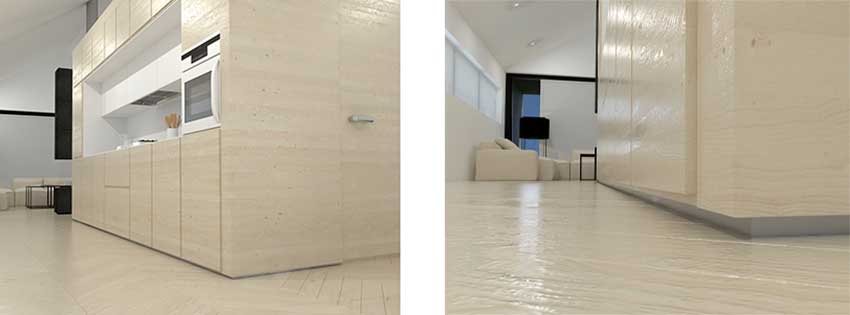
Photo courtesy of Tamlyn
Extruded aluminum trim can be used on interior wall surfaces to provide custom looks, durable protection, and easy-to-clean surfaces for public and private areas in multifamily projects.
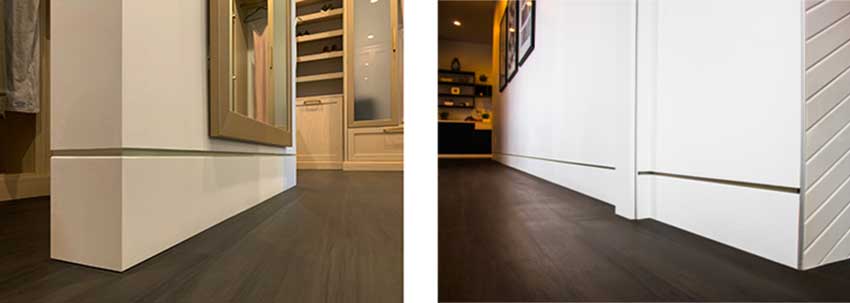
Photo courtesy of Tamlyn
Fire-rated extruded aluminum trim uses a strip of intumescent material along the back of the profile allowing for enhanced fire resistance performance.
Design Attributes of Aluminum Trim
The general trend in modern designs includes minimalist lines and the intentional absence of traditional wood moldings for doors, windows, ceilings, and base conditions. Many interior designs, therefore, lean toward a simpler, more elegant wall solution with a clean, modern look. Others may be focused on a more traditional or three-dimensional appearance for wall corners, base, and ceiling conditions. Still others may select certain walls to feature with added detailing and trim to create a total design appearance. All these different styles or looks are readily achievable using manufactured trim pieces made from aluminum extrusions.
The profiles of aluminum trim are varied but seamless across its full length. Complex shapes can be realized in one-piece extruded aluminum sections without having to employ mechanical joining methods. The resultant profile typically is stronger than a comparable assemblage and less likely to loosen over time. Manufacturers offer numerous standard and custom trim profiles that allow architects to create cohesive wall designs using a product that offers greater durability and protection of the surface materials. It is even possible to create custom profile details specific to a particular project or group of projects where desired.
Most extruded shapes for architectural use are fabricated from 6063 aluminum alloy, with magnesium and silicon as the alloying elements. Type 6063-T5 Aluminum, commonly referred to as the architectural alloy, has a very smooth surface and is the best alloy suited for anodizing applications. The T5 designation indicates it has been artificially aged and moderately heat-treated. Aluminum extrusion is a highly versatile metal-forming process that has a wide array of physical characteristics. In all cases, extruded aluminum is a sustainable material, commonly with 75 percent to 100 percent postindustrial and post-consumer content. As such, extruded aluminum trim can contribute to LEED points for buildings seeking certification or green building status.
Of course, the color and finish of the trim is an important design consideration, regardless of the location. Fortunately, there are many different finish options available including mill finish aluminum, anodized aluminum, standard prefinished color palettes, ready-to-paint finishes or custom finishing. Extruded aluminum trim can be specified in anodized aluminum in standard colors such as clear, champagne, bronzes, and black. Factory prefinished trim can include liquid paint (i.e., acrylics, alkyds, polyesters, and others) or powder coatings—any of which reduces onsite labor needs. At least one manufacturer can provide custom pattern matching on the aluminum to include logos, match wood panels, match stone walls, or even create a wood grain look. Alternatively, it can be specified simply with a paint primer ready to receive final finish coats in the field of virtually any color. With this variety of choices, the trim can appear to blend in with the adjacent wall panels, or it can be used to highlight all or some of the visual lines it creates.
This flexibility using familiar and long-lasting finish options means that both the design and the performance level can be controlled.
Fire-Rated Aluminum Trim
A new addition to the market of aluminum trim products is the offering of fire-rated profiles to enhance the already extensive selection of extruded aluminum trim. The fire rating is achieved through the addition of a factory applied intumescent strip along the back wall of the profile. This enables certain drywall designs to achieve 1 hour and 2-hour fire ratings without the requirement of an extra layer of drywall. The intumescent strip expands when exposed to increased heat during a fire and will completely seal off the gap in drywall preventing the passage of fire.
Fire-rated profiles are independently fire tested per ASTM E119 “Standard Test Methods for Fire Test of Building Construction and Materials.” Under this test, a sample wall panel is subjected to a large-scale vertical exposure furnace. During the test, no flames can pass through the assembly and the average ambient temperature on the outside of the wall cannot pass 139 degrees Celsius, nor a single point temperature of 181 degrees Celsius. Following the direct heat exposure, the test then calls for a water hose stream to be sprayed onto the fire-exposed panel to simulate a firefighting condition. The hose stream flows for 2-1/2 minutes and must not permit the projection of water from the hose stream beyond the unexposed surface. Fire-rated interior trim has been successfully subjected to this test for 120 minutes as part of an overall wall assembly and sprayed with water at 30 psi and met all of the testing requirements. Therefore, it has been certified for a 120-minute (2 hours) fire rating.
Aluminum trim products can create a minimalist shadow line with simple reveal space that allows installation vertically, horizontally, or diagonally. They can be used in conjunction with 5/8” drywall, panel installation, and wrapped surface finishes such as approved fabric or vinyl wall coverings. They commonly include ridged faces for tape & float connections with gypsum board finishing. They can also include prepunched holes for easy installations, although hole placement may vary between profiles and products. Fire-rated extruded aluminum trim is generally available in standard lengths of 10 feet. The product is made from 6063 T5 aluminum with standard clear, anodized, or primed finish. Anodized color and powder coating finishes are also available with custom color matching.
COILED WIRE FABRIC
In the quest for better and more innovative multifamily buildings, architects often look to innovate using proven materials that can be used to enhance a design, provide a needed function, or improve building performance. One such innovative material is architectural coiled wire fabric. This is a versatile product with wide-ranging applications and functions. It is a durable, thin material that is lighter in weight than traditional wire mesh and offers more design flexibility. It is available with a range of attachment systems allowing for different building conditions and finish treatments. The material can be left to hang (i.e., flowing freely) or it can be secured at both the top and bottom and pulled taut to create a semi-rigid condition. Because of its fabric nature, curved and undulating shapes are easily achieved, providing more character and vitality than rectilinear shapes alone.
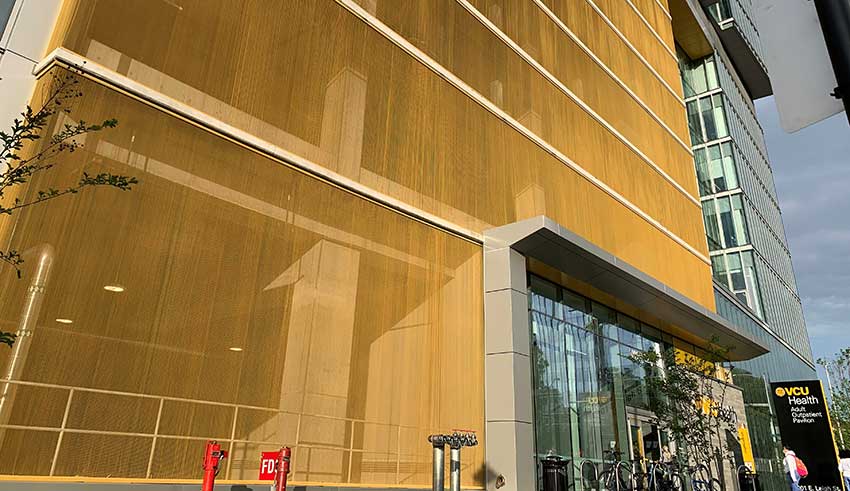
Photo courtesy of Cascade Architectural
Coiled wire fabric can be used to create innovative and functional designs on building interiors or exteriors, such as the VCU Heath Outpatient Pavilion in Richmond, Virginia.
Coiled Wire Fabric Traits
When selecting a coiled wire fabric system for a project, it is important to recognize that there are a lot of different choices in the details of how it can be specified. Manufacturers will readily work with architects and designers to review the specific project requirements and suggest standard options or even engineer a custom solution. Here are some things to keep in mind when designing and specifying this innovative material.
- Material Makeup Coiled wire fabric systems begin with a base metal wire in varieties of steel, aluminum, brass, copper, or stainless steel. The choice of the wire material and its gauge impact the weight, functionality, and aesthetics of the final fabric. By altering the base material, wire gauges, weave pattern, and finishes, the strength, rigidity, and appearance can all be chosen to meet the design or performance characteristics being sought. It is worth noting that the fabric is available in virtually unlimited widths and up to 40 feet in length, so large installations can be achieved with a single panel in many cases. For projects needing more than a 40-foot-span of fabric, multiple coils can be spliced together at the job-site in a routine fashion and still create a continuous appearance.
- Light Transparency The nature of the woven wire fabric is such that it will allow light to pass through, which is often desirable for many interior design applications. How much light and how visually transparent a certain product appears will be based directly on the make-up of a particular fabric. Those with thicker wires and tighter weaves will obviously allow less light than those with thinner wires and more open weaves. Architects and designers can play with the material’s level of transparency by altering these factors to suit their needs to create a material that is simultaneously open and closed at the desired levels. As such it is sometimes used over windows, as a diffuser for natural daylight, or as room separators where light is intended to be shared. “Fullness” is another factor that designers can alter which will vary the level of light able to pass through the coiled wire fabric. By using more material than is required to cover a given area, a billowing drapery effect may be achieved, causing the mesh to overlap which can be used to allow in more or less light.
- Formability As with any fabric type of product, coiled wire fabric is free flowing and flexible. That means it can be formed and shaped to create undulating or curved surfaces, flat taut surfaces, or a combination of any of these. This creates three-dimensional texture and spatial interest in rooms, making for innovative and dynamic interior designs. That allows for a high degree of creativity in how spaces are defined and articulated, both for walls and ceilings.
- Color Coiled wire fabric is available in either a natural, uncoated state or with resilient powder-coating finishes for a sharp, long-lasting aesthetic. That means the color choices are broad, allowing it to be a successful part of virtually any design scheme. Further, the finishes can be specified with low-VOC content to protect against that exposure when used on interiors.
- Performance Traits As a material added to a building, coiled wire fabric is a long lasting and durable product requiring minimal, if any, maintenance. The open nature of the fabric supports its use for solar shading and the associated energy savings. It can also be used for light diffusion to further enhance the interior ambient lighting of a space. In appropriate strengths, it can provide partitioning for safety, fall protection, blast mitigation, and security. Further, if there is an interest in extending its use to the exterior, the material is durable enough to withstand those rigors as well.
- Sustainability Coiled wire fabric carries many sustainability traits. Made from metal, it creates a low carbon footprint by using domestically sourced materials that are durable and easy to maintain. It can contain up to 90 percent recycled content and is 100 percent recyclable when it is removed from service. As an interior product it is worth noting that no toxic chemicals are used in the material’s manufacturing process. Those products that carry Declare labels with the International Living Future Institute or are Living Building Challenge Red List Free indicating the degree to which human health and the environment are protected by the products.
- Cost Effectiveness Compared to the full construction of rigid partitions or other separation elements, coiled wire fabric is a very affordable option. It is also more economical than commercial woven wire mesh that is typically designed for other purposes. This affordability lets architects and designers flex their creativity, produce signature interior and exterior designs, and turn projects with modest budgets into something unique, innovative and responsive to project needs.
All these traits of coiled wire fabric make it quite suitable for both new and existing construction.
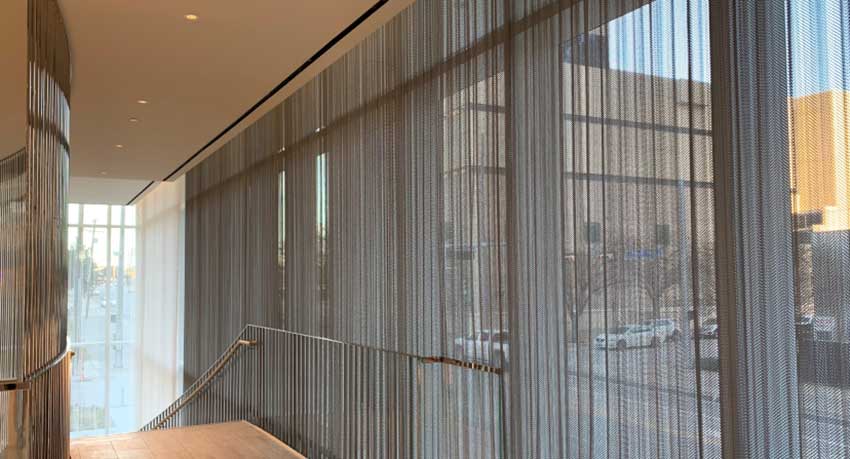
Photo courtesy of Cascade Architectural
Coiled wire fabric is used as a decorative shading system at the Hall Arts Residences and Hotel lobby in Dallas, Texas.
Coiled Wire Fabric Uses in Multifamily Buildings
Coiled wire fabric can be used in new or existing multifamily buildings in a variety of ways, described as follows.
- Sustainable Sun Control Coiled metal wire fabric offer significant building performance and environmental benefits. Both internal and external applications significantly increase occupant comfort by mitigating sunlight, reducing glare, and controlling interior temperatures. Energy performance analysis done through independent testing shows up to 5.7 percent energy consumption savings for interior applications and 21.3 percent for exteriors. As such, it is particularly effective for retrofitting buildings that lack high-performance glazing.
- Interiors For interiors, architects and designers can use coiled wire fabric for curtains, ceiling treatments, wall coverings, security gates, and even as complete partitions, all adding elegance and purpose to the spaces where they are used. By combining material strength and durability with functional benefits and custom high-end aesthetics, this innovative material allows design professionals to get creative and deliver signature interior creations.
- Security Coiled wire fabric can be fashioned into pre-engineered security gates and screens, taking a new approach to securing spaces without sacrificing the aesthetic appeal of the common space or entrance that they’re installed to protect. As a high-quality design solution, they can be used to secure spaces while concurrently allowing views. Perfect for security in public common areas, storefront closures in mixed use/retail settings, etc., they are cost efficient and well suited to new or retrofit construction. These systems are fireproof and easy to install and do not require heavy support or large storage pockets. They allow free airflow for HVAC, are acoustically transparent, and allow signage, media, products, and advertisements to remain visible while secured.
Overall, coiled metal wire fabric is worthy of consideration for many interior and exterior applications in both new and existing multifamily buildings.
ELEVATOR CAB INTERIORS
Among the most used interior spaces in a multistory, multifamily building are the elevator cabs. Over time, elevator interiors can get damaged … especially if the cab is used for both passengers and other purposes like moving furniture, equipment, etc. Even with the best padded intentions, furniture movers and delivery drivers can ding up, gouge, and scuff walls with dollies, carts, and crates.
Building owners often spend significant amounts of money on a major elevator renovation. If that only includes elevator equipment upgrades, riders will not notice anything new and will still feel like they are in an “old” elevator … they can’t tell that money was spent replacing the jack, power unit, controller, and door operator. Hence, when thinking about elevator renovation, it is worth considering both mechanical and interior upgrades.
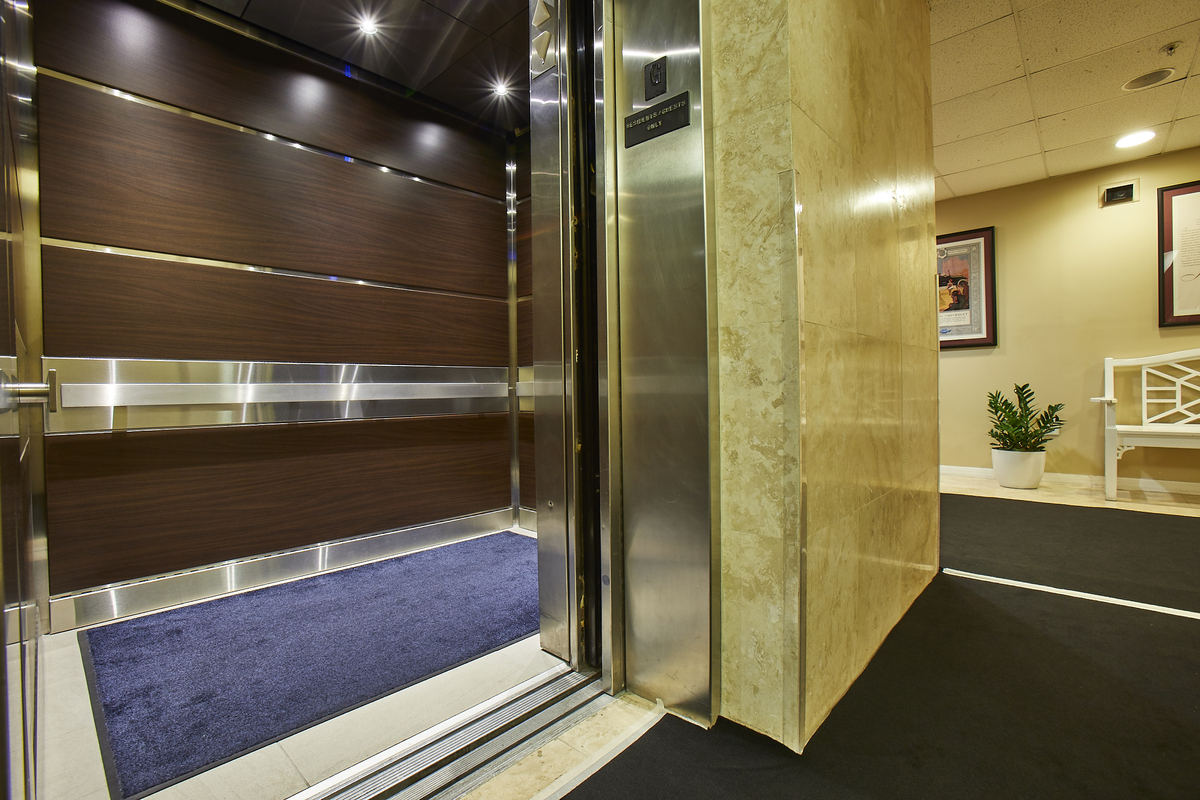
Photo courtesy of Inpro
Renovated elevator cabs complete the interior design of a building, offer opportunities to make a better first impression, and can include durable, protective materials.
Some of the main reasons to renovate the cab interior are to update the appearance and make it more appealing by giving it a refreshed look. There may also be an interest in making the cabs more energy efficient with LED lighting or adding extra protection to the cab walls. Another reason to enhance the cab appearance is that some people are terrified of elevators and suffer serious anxiety when riding in one. Interior upgrades can help ease those few minutes they spend riding the elevator by providing a more comfortable and appealing experience.
The most cost-effective and innovative way to carry out such an elevator cab upgrade is to use preconfigured elevator cab renovation systems from a manufacturer that has a specialty line of products to address these needs. This system can include any or all of the following elements.
- New Wall Panels: The elevator panels that line the walls are what primarily make up the appearance of the cab. These panels also typically take quite a beating - from hospital beds to luggage carts, tenant move-ins and outs, construction equipment, vandalism, and whatever else may come their way. Fortunately, the panels can be made of durable and rugged materials that can be made to look like any range of materials from wood to metal to stone or custom choices.
- New Ceilings and Lighting: Elevator ceilings come in many different styles and can be selected to suit an overall design concept. Lighting in elevator cabs can be chosen from among common lamping options such as halogen, incandescent, fluorescent, or energy-efficient LED. Keep in mind that people tend to be more comfortable in a well-lit interior, so combining a brighter ceiling with increased lighting output can help people feel more relaxed inside, not to mention creating a newer and cleaner look. The energy efficiency of elevator cab lighting is notable since these lights typically stay on 24 hours a day/7 days a week, meaning they are running for 8,760 hours a year. Further, selecting energy efficient LED lighting means the lamps have a much longer service life, notably reducing maintenance costs for replacements.
- New Handrails: Handrails in elevators get attention for ADA or accessibility code requirements, but they also provide stability for users (i.e., something to grasp) while the elevator stops and starts. This is particularly true for elderly, disabled, or injured people who need help to reduce the risk of a fall. Beyond the people aspect of handrails, they provide a means for a complete look to the cab and can act as a wall guard, too. By providing a stand-off surface from the wall of the cab, they can reduce the chance of equipment or furniture striking the wall panels. As part of a total system for elevator cabs, handrails come in different shapes, sizes, and finishes.
Paying attention to both the appearance and durability of elevator cabs can clearly pay off in terms of creating successful, innovative interiors and better experiences for users.
EXPANSION JOINTS
Architectural expansion joints are necessary, predetermined gaps in large structures that are designed to absorb environmental movement in buildings. When done right, they tend to be integrated with their construction such that they blend in with a design and almost disappear. In large multifamily buildings, they are a necessity, particularly where buildings are segmented into different sections, or if they attach to another structure, such as a parking garage commercial use.
Building sections can move due to several common reasons. When it comes to expansion control in buildings, there are three types of movement that need to be accommodated:
- Thermal Forces This type of movement is most typical and is caused by daily environmental temperature changes in and around the structure. Thermal movement is primarily “one-directional” in nature and is the result of the expansion and contraction of structural elements as they are affected by heat, cold and humidity levels. The amount of thermal movement is typically approximately 10-25 percent of the nominal joint size. That means the maximum cold temperature size (i.e., when the building contracts and the joint expands) should be 10-25 percent more than the nominal joint size and the minimum warm temperature size (i.e., when the building expands and the joint contracts) should be 10-25 percent less than the nominal joint size. If expansion joints aren’t put in, then thermal expansion and contraction can cause buckling of surfaces in place like roofs and interior floors.
- Seismic Activity This involves the shifting of the earth’s tectonic plates (i.e., earthquakes, tremors, etc.) and shifts along fault lines is the source of seismic activity. Seismic movement may be horizontal, vertical, in shear, or a combination of all three. Seismic expansion joint widths may need to increase with higher floor levels to accommodate the additional, cumulative movement that needs to be addressed. These joints must have the capacity for movement of plus or minus 50-100 percent of the nominal joint size associated with them. Note that minor earthquakes are far more prevalent than severe mega-quakes like the 1994 magnitude 6.7 Northridge quake in California, or the 9.1 Christmastime earthquake (and tsunami) off the coast of Sumatra in 2004. When it comes to expansion joint systems, it is important to select systems that can “reset” themselves after a minor seismic event and allow workers to reposition panels easily.
- Wind-Loads Movement induced by high winds can force the structure to sway. This movement is normally perpendicular and/or parallel to the joint. This is common where a low horizontal building span meets with a taller vertical element, such as the lobby of a multifamily or mixed-use building is adjacent to a high-rise building section. Movement in these joints is typically on the order of 50 percent. Over time, the near-constant effects of wind pressure on the sides of buildings can lead to serious issues such as aerodynamic instability, torsion or swaying, erosion of certain building materials, and cladding failure due to wind load or impact of debris. In extreme cases, it can lead to structural failure and damage to people and property. Therefore, when designing a structure, that structure must be able to both withstand high wind loads, but also work with them. As with seismic activity, expansion joint systems should be able to “flex” and yet remain in place as the building sways or torques.
By properly addressing all of these conditions, the building can be protected from the movement that will invariably occur and avoid the resulting damage that is possible.
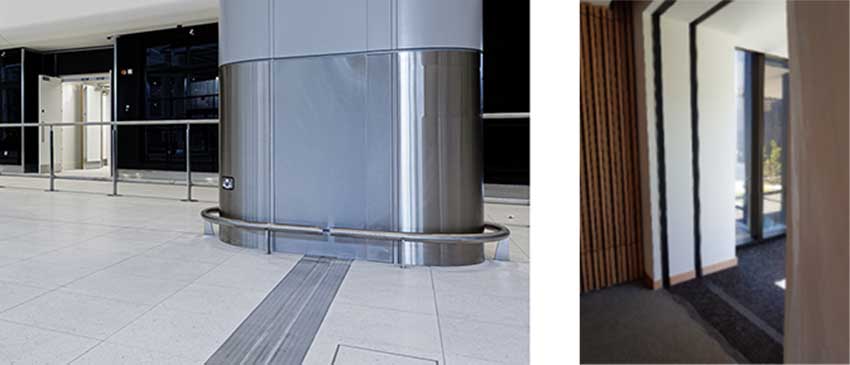
Photo courtesy of Inpro
Different types of forces on a building require different types of expansion joints to protect people and property from damage.
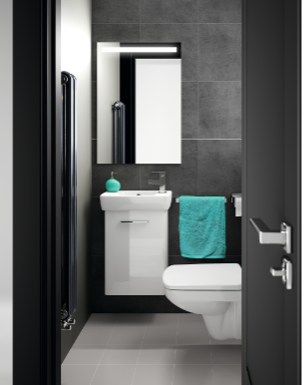
Photo courtesy of Inpro
In-wall toilet systems conceal the supports and plumbing in the wall and allow for a clean, elegant appearance when projects are completed.
Expansion Joint Applications and Location
The design of a multifamily building will often dictate the number, type, and location of expansion joints that are needed. A few of the most common locations where expansion joints are found include:
- Building additions in order to segregate the addition from the original structure.
- Long buildings will need a joint approximately every 200 linear feet or so as determined by the structural engineer.
- L-shaped building footprints can often require separation of the two wings at the central knuckle.
- Any dramatic changes in height may require an expansion joint to allow movement both vertically and horizontally.
Typically, the joints need to run continuously through all adjacent planes to fully separate building sections and allow independent movement. That means that any given project scope could include interior joints, exterior joints, or both, in things like walls, roofs, floors, building veneers, soffits, parking decks, patios, roofing systems, etc.
It is easy to assume that exterior expansion joints are subjected to more harsh conditions than interior, but that may not be the case, particularly for joints that cross floors. Interior joints on floors are subject to loading from foot traffic, light maintenance vehicles, or more. Therefore, when determining load requirements, consider what type of traffic will take place. All joint covers are engineered to accommodate a fairly wide range of typical building loads, but it may be important to dig a little deeper to ensure the best cover plate solution is selected. For example, does the owner utilize equipment such as scissors lifts for lighting changes in high ceiling areas? Are heavy loads of furniture and dollies going to be routinely rolled over the floor for tenant move-in and move-out situations? It is usually best to ensure the worst-case scenarios are considered when specifying systems. A slightly higher front-end cost may alleviate an ongoing facility maintenance headache for years to come.
BALANCED BATHROOM DESIGN
In multifamily buildings, sanitation, safety, and sustainability are important considerations for residents and operation staff, particularly in bathrooms. There is also the market desire in many cases to provide elegant, well-designed, and upscale bathrooms that work with the overall design intent of the project. In many cases, there is a need to provide accessible bathrooms, too, with the need to provide proper clearances and spaces around bathroom fixtures. This all needs to be balanced with an efficient layout that doesn’t chew up extra square footage, particularly when budgets are being scrutinized.
In-Wall Fixture Systems
A common European style solution to address bathroom design in multifamily units is to use fixture systems based on locating many of the functional parts behind a finished wall. Such in-wall systems improve the look of any bathroom because they remove unsightly hardware—for example, the toilet tank—from view so that they no longer interfere with the aesthetics of the overall design. In-wall systems for toilets, urinals, bidets, and washbasins are based on a concealed steel frame that attaches inside the wall and supports wall-hung plumbing fixtures. As a result, the fixtures seem to “float” in the bathroom, creating visual appeal and some added practicalities.
Photo courtesy of Geberit
In-wall fixture systems can provide the design appearance of “floating” above the floor.
In-wall fixture systems open up the entire floor for easy floor cleaning under the “floating” fixture. These fixtures also stay clean longer since there are fewer seams and crevices than traditional fixtures for dirt and germs to accumulate. Since some of the fixture is moved into the wall, greater accessibility can be achieved - there are fewer obstructions and more clear floor space than in a standard bathroom setup. Of particular importance in multifamily buildings, the system is designed to operate more quietly than a standard floor-mounted toilet, reducing noise transfer from space to space.
Water Efficiency
An in-wall toilet system offers special water efficiency benefits in a multifamily building. According to the U.S. Environmental Protection Agency (EPA), the highest percentage of water use comes from the domestic restroom. This makes the design of flushable toilets particularly important. In this case, it is the design of the flow mechanism and the controls that actuate it which are critical.
Traditionally, floor-mounted toilets with a manual flush have been the norm in many multifamily settings. However, toilets with dual-flush controls are becoming more common, since they allow the user to determine how much water is used for each flush appropriate to the need. Commonly, there are two choices for a standard and reduced water flow per flush, instead of being limited to only one standard choice. With such dual-flush technology built in, a household can reduce their water usage by thousands of gallons of water per year. In-wall toilet systems typically include such dual-flush technology activated by touch (or touchless) panels flush-mounted on the wall above the toilet. This provides a clear, elegant solution for the flush controls that help produce the dramatic water savings.
In-Wall Design
While some may think that a high-performance toilet needs to look clinical or austere, the reality is that there are contemporary design alternatives. That means architects do not have to lose their design concepts to achieve critical performance features. Rather, there are innovative products for bathrooms that meet the demand for sanitation, safety, and sustainability while also providing a high level of design. In order to accommodate a range of different project types, there are multiple fixture options to bring a design vision to life. Beyond these aesthetic benefits, there are also clear space savings achieved by recessing the toilet tank system into the wall, allowing for more usable space in restrooms in many cases.
In-Wall Performance
In addition to better water control that is available from dual-flush actuators, in-wall systems are a reliable and high-quality solution for designing contemporary bathrooms that meet the demands of all involved. Overall sanitation and safety are achieved by having less of the toilet system exposed and the bowl raised up from the floor. This adds to the comfort and convenience for users as well as ease of cleaning. In terms of maintenance, all working parts remain easily accessible, although the high reliability of this type of unit reduces the need for maintenance crews to access it in the first place. Commonly, the support frame is based on solid steel construction with a seamless, one-piece tank made of durable, leak-free, high-density polyethylene. Units are commonly tested and proven to support up to 880 lbs. (400 kg) without deforming the frame or the wall.
Together the in-wall systems and wall-mounted flush actuators are clearly greater than the sum of their parts in terms of the benefits provided for building owners and occupants.
CONCLUSION
Creating well-designed multifamily housing is a multifaceted task. Fenestration is required in all buildings to provide views and daylights but still achieve targeted thermal performance. Interiors need to be attractive and durable, including the interior of elevators. Innovative materials can be used to enhance the building exterior and interior. Bathroom designs need to be easy to clean and space efficient. Large buildings require expansion joints to protect against inevitable movement. The strategies discussed in this course can help architects and designers address these multiple design criteria to meet the needs of the building owner, the occupants, and the environment.
Peter J. Arsenault, FAIA, NCARB, LEED AP is a nationally known architect and a prolific author advancing positive acoustical experiences through better building design. www.pjaarch.com, www.linkedin.com/in/pjaarch