This CE Center article is no longer eligible for receiving credits.
Every building has a site and the act of putting a building on it necessarily creates outdoor spaces that are used for access, parking, congregating, recreation, or other activities. The impact of those spaces is reflected in both the people who ultimately use these spaces and the natural environment which is either disrupted or enhanced. In both cases, it is the design of these outdoor spaces that can produce a sense of an outdoor place and directly influence how truly sustainable the site is. This continuing education article explores ways in which both private and public outdoor spaces can be transformed for placemaking, comfort, safety, and sustainability. In particular, LEED Sustainable Sites and the separate, but closely aligned, SITES rating systems are referenced. It is worth noting that any LEED v4 project can now automatically earn all of the points in the Sustainable Sites credit category in LEED when they achieve SITES v2 Gold certification or higher. In addition to general principles of design, several specific strategies are reviewed with case study examples of successful installations.
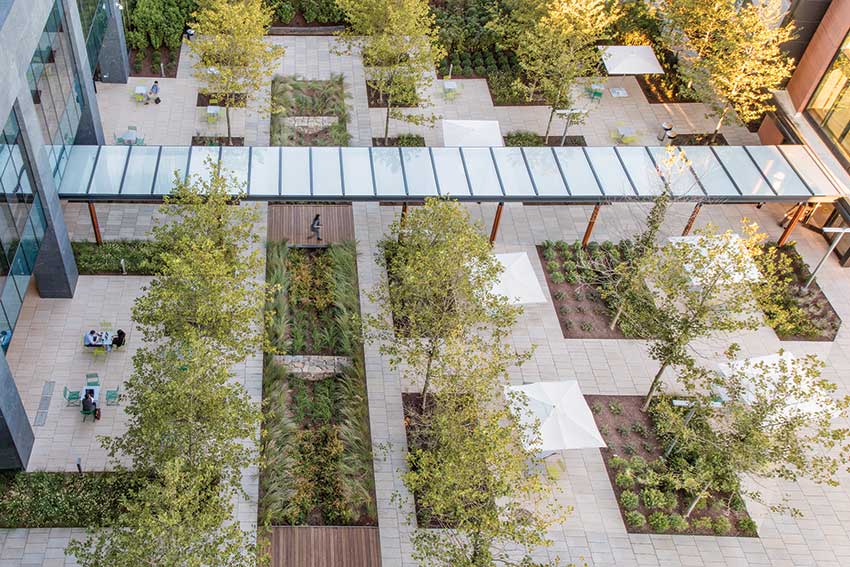
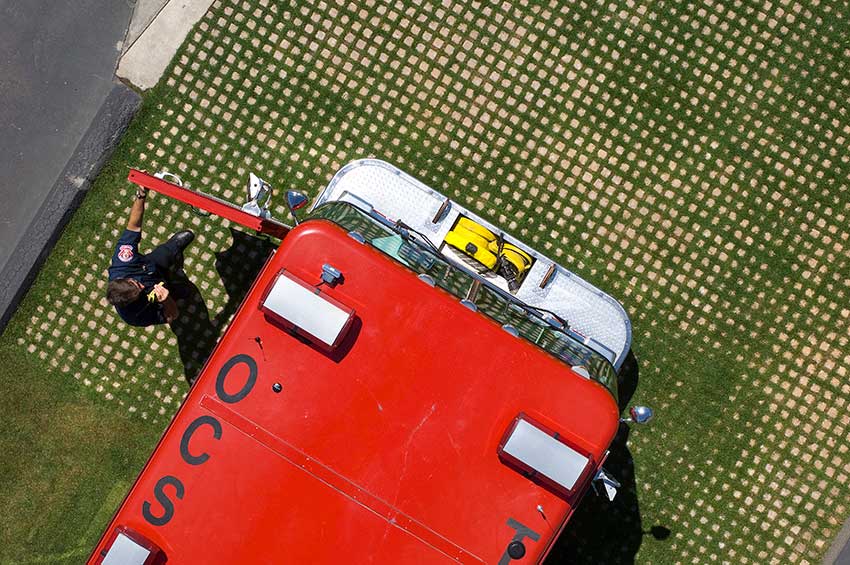
Photo: Kyle J Caldwell; courtesy of Bison Innovative Products
Outdoor spaces that are usable, appealing, and sustainable require attention to multiple design factors and a
number of related details.
Permeable Paving
Asphalt or concrete paving is common to many building sites but, as surfaces that don’t allow water to permeate, design issues of water runoff, retention, and drainage become significant. Not only is it a matter of managing the water, but there is also a legitimate concern about the things transported by the water runoff, such as petroleum products from parked cars, chemicals from landscaping, or other harmful compounds. In fact, the Environmental Protection Agency (EPA) considers “stormwater runoff in urban and developing areas to be one of the leading causes of water pollution in the United States.”
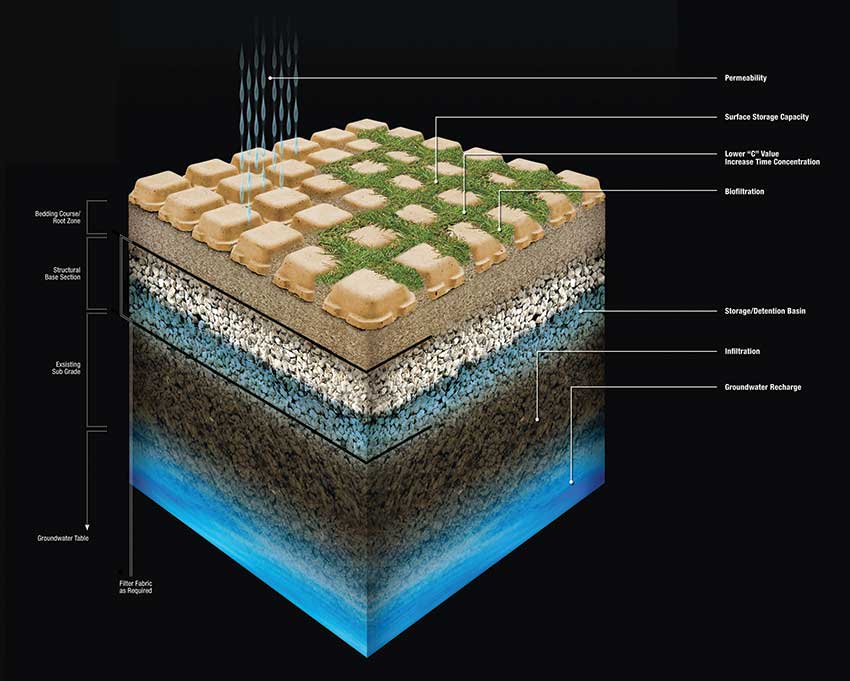
Photo courtesy of Soil Retention Products, Inc.
In a permeable pavement system, water penetrates the surface and moves through a variety of layers including sand which acts as a natural filter.
In response to this situation, alternatives have been developed in the form of permeable paving systems to replace traditional hard surfaces. These systems use a range of sustainable materials and techniques that allow the movement of stormwater through the surface down into the underlying base and subbase. A variety of plantable and non-planted systems are available that have been shown to help reduce the carbon footprint of buildings, improve water quality, diminish flooding and erosion, and reduce urban heat islands all while creating attractive open spaces. A 2007 study at the North Carolina State University (NCSU) Permeable Pavement Research Lab showed that “all permeable pavements significantly and substantially reduced surface runoff volumes and peak flow rates when compared to asphalt.”
Part of the beauty of permeable pavement is that it reduces the need for other mitigation measures. Neil Weinstein, executive director of the nonprofit Low Impact Development (LID) Center in Washington, D.C., has noted that “The primary motivation for using permeable pavement is that it doesn’t eat up the land like surface retention basins, bioswales, and filtration basins do. This is especially important in urban areas where sites are smaller and must meet stormwater regulations.” All of these aspects of such systems bode quite well for projects seeking LEED certification or using the SITES rating system for Sustainable Sites.
Flexible Concrete Pavement Systems
Among the different types of systems available, an increasingly popular one is not just a rigid “turf block” but is a flexible system. Notably, this type of system is available in 2-by-2-foot mats made of wet-cast concrete squares that are connected by a grid. Holes in the grid allow for water infiltration and root penetration if the design calls for a vegetated infill. There are also several non-planted infill options available, such as gravel, pre-cut artificial turf, or decomposed granite, which makes the system versatile. The polymer grid embedded in the mats allows them to flex and conform to uneven ground surfaces without coming apart. Hence, the mats maintain the characteristics of a drivable, natural surface while minimizing wheel rutting even when saturated. The lattice-style grid structure allows water to flow right through it and vegetation to grow if desired. The small concrete squares provide a solid surface comparable to more common paving materials such as asphalt and poured concrete. This configuration eliminates sharp edges common in other systems, plus it is less prone to crack and break like rigid concrete or pop up like plastic systems.
Flexible concrete pavement systems are well suited for a variety of residential and commercial outdoor spaces that might otherwise be paved with impermeable materials. Commonly, these include spaces that are infrequently driven on such as fire lanes, utility easements, and drainage ways. In addition, driveways, parking stalls, RV parking, and bioswale protection are all ideal uses. Hydraulic performance in drainage channels has also been tested and these products have performed well. When any of these conditions are paved with conventional paving, a vacant, underutilized outdoor space is created. With the flexible pavement, the area looks more inviting and allows for a more natural, controlled drainage. While these systems are suitable for a variety of scales, they are not commonly used for major streets, except for areas with very limited traffic, such as median turnarounds and erosion control areas.
Design Considerations
Commonly, the design of a permeable pavement system is a multidisciplinary effort. The first step is to clarify the objectives of the system. Is it focused on flood mitigation or water retention/detention? Or is the objective primarily to filter the water for improved water quality? What about water collection and reuse possibilities? And of course, what is the intended site traffic that the system needs to carry?
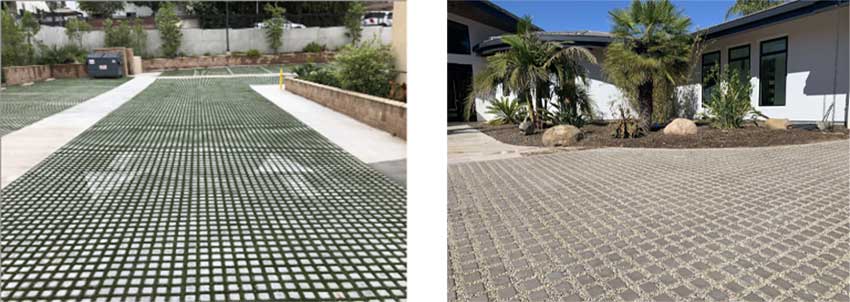
Photo courtesy of Soil Retention Products, Inc.
Flexible, permeable pavement systems can be used with a variety of infill materials including pre-cut artificial turf (shown on left), gravel, (shown on right), or vegetation, thus allowing for unique looks and applications.
Once all of these questions are answered, the design will next be influenced by the composition of the subgrade (i.e., the native soils below the paving section) and the corresponding infiltration rate. On top of these soils, the structural subbase will be placed and has the potential to collect and store some rainfall, depending on the materials used. With the native soils and the subbase working together, it is possible to even store other runoff from the site, thus avoiding the need for separate detention and storage. In cases where the soils provide low infiltration, some use of excess stored water may have to be considered. For example, excess water could be piped away with an elevated underdrain and used for irrigation or other useful purposes.
In Los Angeles, Eric Owen Moss Architects incorporated a flexible, plantable concrete pavement system into a high-profile project there. Specifically, it was incorporated into an exterior patio and vehicular driveway. Project Director Dolan Daggett was very pleased with the results stating, “The beauty and performance of the product speaks for itself.”
Turfgrass Considerations
If a vegetated permeable paving system is desired, then the plantable part of the system is typically some form of turf or grass. When used in areas of light pedestrian traffic, such as parks or ballfields, the planting of turf or even sod is fairly conventional. However, when used for vehicle traffic, the first thing to be aware of is the need for a bedding course which is defined as the underlying sandy material between the pavement and the compacted subbase material. This is the layer that will promote vegetative growth and is important to the health of the turf.
In order for the turf to remain healthy and functional, the pavement system needs to prevent soil compaction so that the living root zone of the plants is both porous and permeable to air and water. Successful permeable paving products provide the reinforcement needed to bear the vehicular weight, transfer the loading to the subbase, and allow the spaces between paving cells to provide the needed root zone conditions for the vegetation to thrive. If the void spaces of the system are too large and overfilled with soil and growth, soil compaction will occur which cuts off the air and water needed for plant growth. Conversely, applying turf by seed and not overfilling the void spaces gives greater protection to the root system.
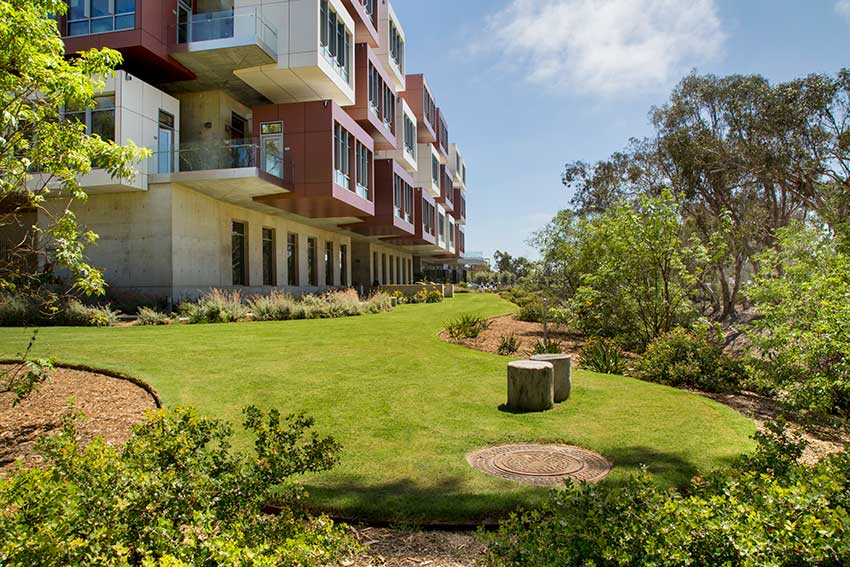
Photo courtesy of Soil Retention Products, Inc.; Photo by Allen Carrasco
Seeded Bermuda Grass, shown here after 10 years of use for occasional utility access and pedestrian/patio use, is a testament to turf grass performance with a flexible concrete grid paver used with a bedding course.
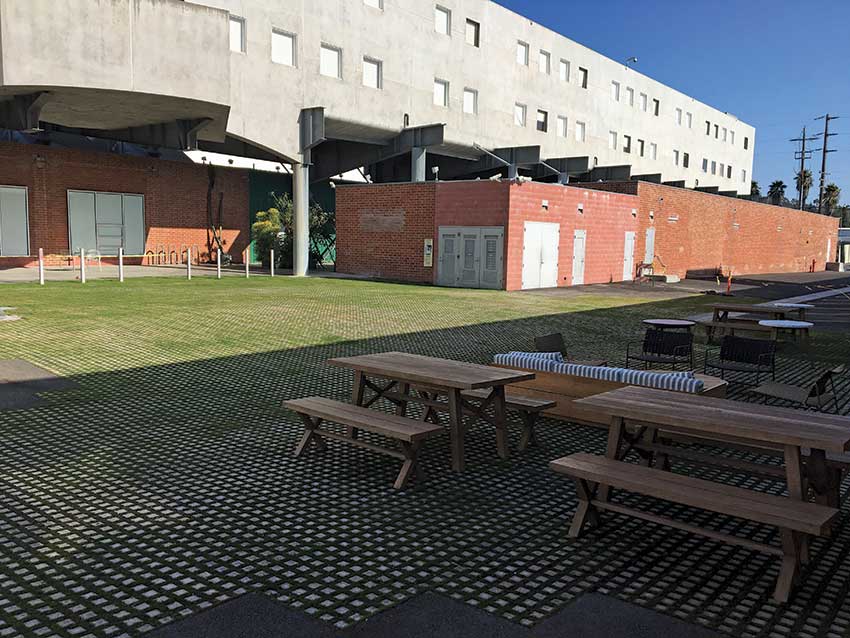
Photo courtesy of Soil Retention Products, Inc.; Eric Owen Moss Architects
This Los Angeles project uses a flexible, plantable concrete pavement system for an exterior patio and vehicular driveway. Dolan Daggett, project director with Eric Owen Moss Architects, states “the beauty and performance of the product speaks for itself.”
The type of grass species or groundcover to be planted is very much a localized decision. Some locations will likely never need to consider irrigation while others may only survive with it. The temperature cycles and ability of the vegetation to survive different climate conditions come into play. Local site conditions of predominant shade or sun in different spaces will directly impact growth. There may be reasons to consider a warm-season grass or a cool-season grass, a bunchgrass or a spreading grass type, or grasses that are tolerant of deicing salts or other local conditions. Resources to determine the best or most appropriate planting choices for specific sites include local cooperative extension agents, state agricultural offices, nurseries, and landscape architects.
Every building has a site and the act of putting a building on it necessarily creates outdoor spaces that are used for access, parking, congregating, recreation, or other activities. The impact of those spaces is reflected in both the people who ultimately use these spaces and the natural environment which is either disrupted or enhanced. In both cases, it is the design of these outdoor spaces that can produce a sense of an outdoor place and directly influence how truly sustainable the site is. This continuing education article explores ways in which both private and public outdoor spaces can be transformed for placemaking, comfort, safety, and sustainability. In particular, LEED Sustainable Sites and the separate, but closely aligned, SITES rating systems are referenced. It is worth noting that any LEED v4 project can now automatically earn all of the points in the Sustainable Sites credit category in LEED when they achieve SITES v2 Gold certification or higher. In addition to general principles of design, several specific strategies are reviewed with case study examples of successful installations.
Photo: Kyle J Caldwell; courtesy of Bison Innovative Products
Outdoor spaces that are usable, appealing, and sustainable require attention to multiple design factors and a
number of related details.
Permeable Paving
Asphalt or concrete paving is common to many building sites but, as surfaces that don’t allow water to permeate, design issues of water runoff, retention, and drainage become significant. Not only is it a matter of managing the water, but there is also a legitimate concern about the things transported by the water runoff, such as petroleum products from parked cars, chemicals from landscaping, or other harmful compounds. In fact, the Environmental Protection Agency (EPA) considers “stormwater runoff in urban and developing areas to be one of the leading causes of water pollution in the United States.”
Photo courtesy of Soil Retention Products, Inc.
In a permeable pavement system, water penetrates the surface and moves through a variety of layers including sand which acts as a natural filter.
In response to this situation, alternatives have been developed in the form of permeable paving systems to replace traditional hard surfaces. These systems use a range of sustainable materials and techniques that allow the movement of stormwater through the surface down into the underlying base and subbase. A variety of plantable and non-planted systems are available that have been shown to help reduce the carbon footprint of buildings, improve water quality, diminish flooding and erosion, and reduce urban heat islands all while creating attractive open spaces. A 2007 study at the North Carolina State University (NCSU) Permeable Pavement Research Lab showed that “all permeable pavements significantly and substantially reduced surface runoff volumes and peak flow rates when compared to asphalt.”
Part of the beauty of permeable pavement is that it reduces the need for other mitigation measures. Neil Weinstein, executive director of the nonprofit Low Impact Development (LID) Center in Washington, D.C., has noted that “The primary motivation for using permeable pavement is that it doesn’t eat up the land like surface retention basins, bioswales, and filtration basins do. This is especially important in urban areas where sites are smaller and must meet stormwater regulations.” All of these aspects of such systems bode quite well for projects seeking LEED certification or using the SITES rating system for Sustainable Sites.
Flexible Concrete Pavement Systems
Among the different types of systems available, an increasingly popular one is not just a rigid “turf block” but is a flexible system. Notably, this type of system is available in 2-by-2-foot mats made of wet-cast concrete squares that are connected by a grid. Holes in the grid allow for water infiltration and root penetration if the design calls for a vegetated infill. There are also several non-planted infill options available, such as gravel, pre-cut artificial turf, or decomposed granite, which makes the system versatile. The polymer grid embedded in the mats allows them to flex and conform to uneven ground surfaces without coming apart. Hence, the mats maintain the characteristics of a drivable, natural surface while minimizing wheel rutting even when saturated. The lattice-style grid structure allows water to flow right through it and vegetation to grow if desired. The small concrete squares provide a solid surface comparable to more common paving materials such as asphalt and poured concrete. This configuration eliminates sharp edges common in other systems, plus it is less prone to crack and break like rigid concrete or pop up like plastic systems.
Flexible concrete pavement systems are well suited for a variety of residential and commercial outdoor spaces that might otherwise be paved with impermeable materials. Commonly, these include spaces that are infrequently driven on such as fire lanes, utility easements, and drainage ways. In addition, driveways, parking stalls, RV parking, and bioswale protection are all ideal uses. Hydraulic performance in drainage channels has also been tested and these products have performed well. When any of these conditions are paved with conventional paving, a vacant, underutilized outdoor space is created. With the flexible pavement, the area looks more inviting and allows for a more natural, controlled drainage. While these systems are suitable for a variety of scales, they are not commonly used for major streets, except for areas with very limited traffic, such as median turnarounds and erosion control areas.
Design Considerations
Commonly, the design of a permeable pavement system is a multidisciplinary effort. The first step is to clarify the objectives of the system. Is it focused on flood mitigation or water retention/detention? Or is the objective primarily to filter the water for improved water quality? What about water collection and reuse possibilities? And of course, what is the intended site traffic that the system needs to carry?
Photo courtesy of Soil Retention Products, Inc.
Flexible, permeable pavement systems can be used with a variety of infill materials including pre-cut artificial turf (shown on left), gravel, (shown on right), or vegetation, thus allowing for unique looks and applications.
Once all of these questions are answered, the design will next be influenced by the composition of the subgrade (i.e., the native soils below the paving section) and the corresponding infiltration rate. On top of these soils, the structural subbase will be placed and has the potential to collect and store some rainfall, depending on the materials used. With the native soils and the subbase working together, it is possible to even store other runoff from the site, thus avoiding the need for separate detention and storage. In cases where the soils provide low infiltration, some use of excess stored water may have to be considered. For example, excess water could be piped away with an elevated underdrain and used for irrigation or other useful purposes.
In Los Angeles, Eric Owen Moss Architects incorporated a flexible, plantable concrete pavement system into a high-profile project there. Specifically, it was incorporated into an exterior patio and vehicular driveway. Project Director Dolan Daggett was very pleased with the results stating, “The beauty and performance of the product speaks for itself.”
Turfgrass Considerations
If a vegetated permeable paving system is desired, then the plantable part of the system is typically some form of turf or grass. When used in areas of light pedestrian traffic, such as parks or ballfields, the planting of turf or even sod is fairly conventional. However, when used for vehicle traffic, the first thing to be aware of is the need for a bedding course which is defined as the underlying sandy material between the pavement and the compacted subbase material. This is the layer that will promote vegetative growth and is important to the health of the turf.
In order for the turf to remain healthy and functional, the pavement system needs to prevent soil compaction so that the living root zone of the plants is both porous and permeable to air and water. Successful permeable paving products provide the reinforcement needed to bear the vehicular weight, transfer the loading to the subbase, and allow the spaces between paving cells to provide the needed root zone conditions for the vegetation to thrive. If the void spaces of the system are too large and overfilled with soil and growth, soil compaction will occur which cuts off the air and water needed for plant growth. Conversely, applying turf by seed and not overfilling the void spaces gives greater protection to the root system.
Photo courtesy of Soil Retention Products, Inc.; Photo by Allen Carrasco
Seeded Bermuda Grass, shown here after 10 years of use for occasional utility access and pedestrian/patio use, is a testament to turf grass performance with a flexible concrete grid paver used with a bedding course.
Photo courtesy of Soil Retention Products, Inc.; Eric Owen Moss Architects
This Los Angeles project uses a flexible, plantable concrete pavement system for an exterior patio and vehicular driveway. Dolan Daggett, project director with Eric Owen Moss Architects, states “the beauty and performance of the product speaks for itself.”
The type of grass species or groundcover to be planted is very much a localized decision. Some locations will likely never need to consider irrigation while others may only survive with it. The temperature cycles and ability of the vegetation to survive different climate conditions come into play. Local site conditions of predominant shade or sun in different spaces will directly impact growth. There may be reasons to consider a warm-season grass or a cool-season grass, a bunchgrass or a spreading grass type, or grasses that are tolerant of deicing salts or other local conditions. Resources to determine the best or most appropriate planting choices for specific sites include local cooperative extension agents, state agricultural offices, nurseries, and landscape architects.
Pedestal Deck Systems
In some cases, the best way to create outdoor spaces is to look at balconies and rooftops as well as on-grade applications. These types of outdoor spaces allow for an extension of indoor areas or can be seen as an outdoor place all on its own. Through design, such spaces can be completely customized to contain outdoor kitchens, fire pits, bars, living areas, gardens, or other amenity areas.
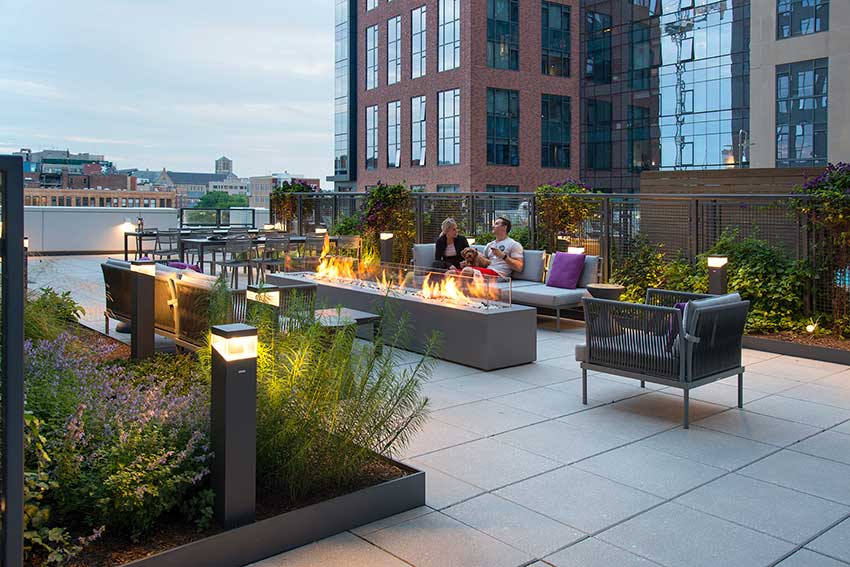
Photo: Bill Horsman; courtesy of Bison Innovative Products
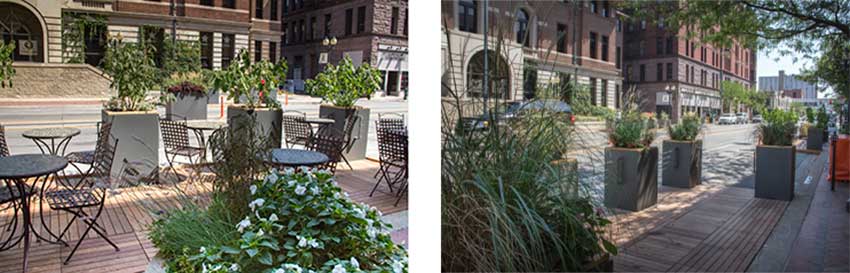
Rooftops are an ideal location to create outdoor places and pedestal deck systems offer modular, complete solutions.
One successful means to accomplish this type of outdoor space is to use a pedestal deck support system with wood or other tiles laid on top to create the outdoor floor surface. This allows outdoor decks to help connect people to the natural environment using natural materials, such as wood and stone, and incorporate vegetation and greenery using planter cubes and pots. This can allow for regular interactions with the outdoors which has been proven to have positive health benefits, such as lower blood pressure, reduced stress, expedited healing, and improved mood and focus. Further, such pedestal decks can help to reduce a building’s carbon footprint through a reduction in a roof’s ambient temperature, increased potential for green space, rainwater collection initiatives, and/or reduced need for roof replacement.
Pop-Up Parks
An emerging trend is to create an outdoor space in the form of a “pop-up park.” These are commonly used to reclaim car-designated zones (i.e., parking spaces or extra traffic lanes) for pedestrian use. Pop-up parks vary in size and could encompass a one-car parking space, many spaces linked together, a reclaimed portion of a lot, a whole block, or a full lane. Many parks offer seating areas, gardens, bike parking, exercise machinery, and other amenities. They were first recognized in San Francisco and New York in programs like “Pavement to Parks.” Some manufacturers offer all the built elements required for a pop-up park installation. This creates a smooth installation and offers a consistent warranty for the entire system.
To create pop-up-parks, level platforms, such as modular pedestal decks, are built on top of existing pavement and are populated with planters, railing, benches, furniture, and other accessories. This allows for low installation costs since they can be installed in a way that does not require reconfiguring the streetscape, doing much, if any, demolition, or altering utilities.
Regardless of where or how they are used, adjustable deck systems commonly incorporate three types of components as described in the following sections.
Deck Supports
Fixed or adjustable height pedestals are the fundamental support system for the deck and have become recognized as one of the most labor- and cost-efficient methods of creating a level deck over a moderately sloped surface. High-density polypropylene plastic that is 100 percent recyclable is a common material used to manufacture the supports. This makes them impervious to water, mold, and freeze-thaw cycles. Their adjustability offers tremendous design flexibility compared to traditional deck building materials and methods. Using a gravity system, the supports do not penetrate, but rather protect, roofing and waterproofing membranes thus causing no damage or harm to the surface below.
The location of the pedestals is typically based on a modular layout that follows the size of the material used on the deck surface. Commonly, this is a 2-by-2-foot square grid, although many other sizes are possible as well. Adjustable pedestals are available in a range of heights and weight-bearing capacities to suit a variety of conditions or needs. Those decks carrying more weight or requiring more height to achieve a level condition will need a higher grade of pedestal. Adjustable pedestal systems can support decks over occupied space, allowing space for electrical systems, duct work, and irrigation.
Deck Surfaces
The versatility of adjustable pedestal deck supports means that they can be used to elevate a variety of decking surface materials. The common options include pavers made from concrete or stone, such as granite or travertine. Similarly, structural porcelain tiles, fiberglass grating, composite materials, or conventional wood decking systems can be used in a grid pattern to meet different design requirements. Typically, a galvanized steel paver tray is installed on top of the pedestals to support structural porcelain pavers or other materials prone to breakage. Surface materials can be removed for routine maintenance, repairs to the roof, or to gain access to other systems.
If a lighter weight surface material is preferred or needed, then wood tiles, weighing only one-third as much as concrete tiles, are a good alternative. Typically made from hardwoods in a variety of species, wood tiles are commercial grade, responsibly harvested, and available in standard and FSC Certified hardwood options for sustainability. If maintaining the wood color is desired, wood tiles can be periodically cleaned and sealed. Left to weather naturally, the wood tiles will develop a silvery-gray patina.
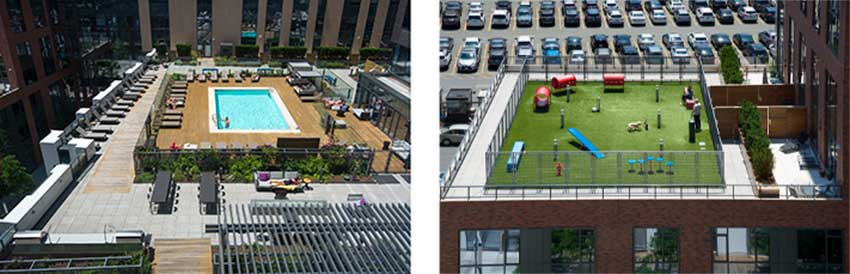
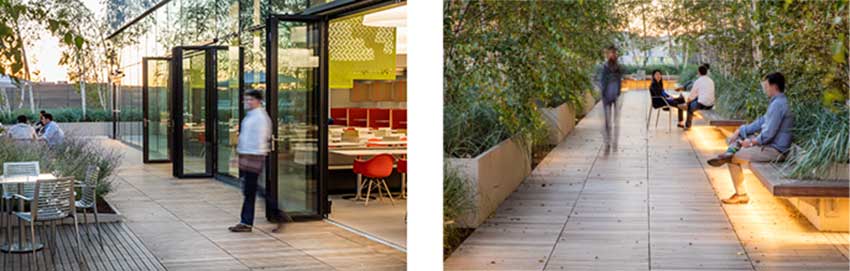
Photos: Bill Horsman; courtesy of Bison Innovative Products
Different types of surfaces can be used on rooftop decks to address the specific needs of a variety of building projects.
Site Furnishings
Manufacturers of pedestal deck systems also offer coordinated, modular elements that are designed to integrate with their deck systems while giving the architect complete design flexibility. Modular wood cubes are available with an array of design options to incorporate seating, storage, and planters. Such cubes are available with a polyurethane lining and drainage holes to host plant life. At other times of the year, the cubes can be repurposed for seating and storage of seasonal items (i.e., cushions and pillows) by placing a manufactured hardwood top on the cube.
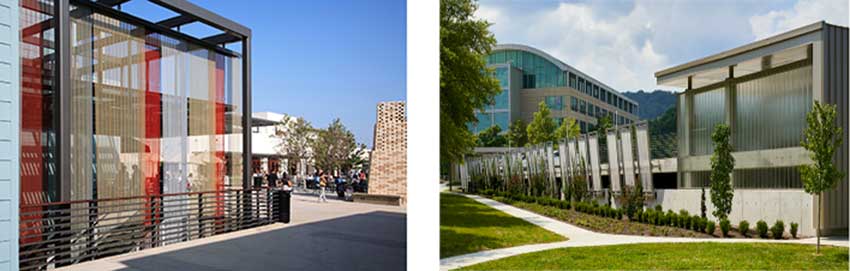
Photos courtesy of Paul Turang (left) and Collaborative studio (right); Cascade Architectural
Coiled wire fabric can be used to enhance the outdoor spaces around buildings by adding a durable, fabric-like material as a feature or a surface that can support plant growth on the side of a building.
If a different look is desired, aluminum cubes are also an option. Designed to withstand temperature extremes, these low-maintenance, durable planters are constructed of lightweight, partially recycled aluminum. Some use an industrial strength powder-coated finishing process that is applied electrostatically and cured under heat, creating a more resilient finish than conventional paint. There are a variety of size and color choices available.
Overall, complete coordinated modular deck systems as described here, can be designed and specified to create attractive, durable, and sustainable outdoor spaces.
Designing With Coiled Wire Fabric
Outdoor spaces often require defined perimeters using the edges of a building or alternatively, a central focal point for activity or congregating in the space. Often the materials used in these situations may be a need to provide a limited degree of separation without the use of a solid surface. In fact, it may even be desirable to provide some controlled connectivity between spaces for light, air flow, sound, or other reasons. Several different products have been used to achieve this effect, but an innovative choice is the use of coiled wire fabric. Such products are different from traditional metal mesh materials in that they are designed as architectural products for use in a variety of ways.
Coiled wire fabric is a durable, thin material that is lighter in weight than traditional wire mesh and offers more design flexibility. On building exteriors, it can be used for sun shading, security protection, resilience enhancements, or aesthetic facade treatments. When those building exteriors face onto an outdoor space, it can provide additional color, texture, or artistic effects. Under the right circumstances, it can also be used as a base for vegetation to grow and create an outdoor “living wall” surface. It is available with a range of attachment systems allowing for different building conditions and finish treatments. The material can be left to hang (i.e., flowing freely) or it can be secured at both the top and bottom and pulled taut to create a semi-rigid condition. Because of its fabric nature, curved and undulating shapes are easily achieved providing more character and vitality than rectilinear shapes alone.
As a material made from metal, coiled wire fabric is a durable product with a long service life. It can contain recycled content and is 100 percent recyclable when it is removed from service. It is worth noting that no toxic chemicals are used in the material’s manufacturing process. Some even carry Declare labels from the International Living Future Institute indicating the degree to which human health and the environment are protected by the products. Declare labels gives consumers full transparency on the product, including where it comes from, what it is made of, and where it goes at the end of its life cycle.
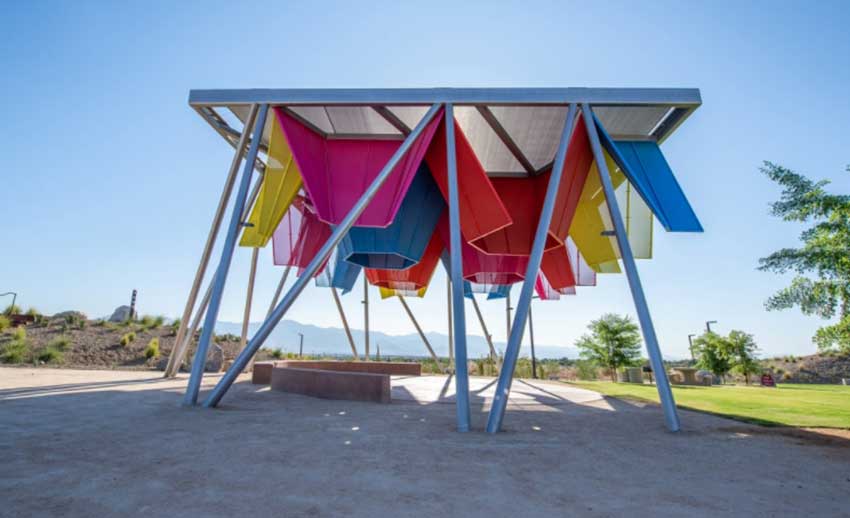
Photo courtesy of Cascade Architectural
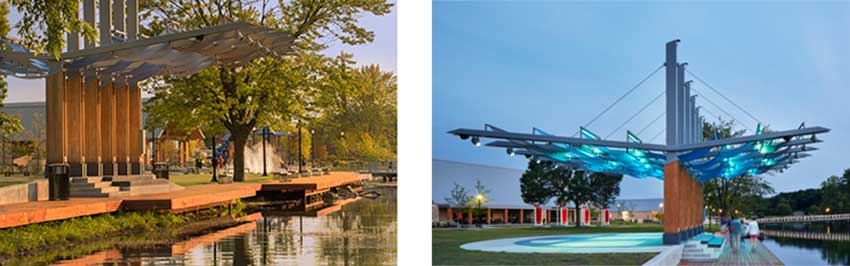
The use of coiled wire fabric for outdoor settings, such as this park pavilion, is a creative way to use a durable, flexible, light-transmitting, and readily customizable material in creative ways.
Specifying Coiled Wire Fabric
When selecting a coiled wire fabric system for an outdoor space, there are a many different choices of how it can be specified. Here are some things to keep in mind when specifying and designing with this innovative material.
Material makeup. Coiled wire fabric systems begin with a base metal wire in varieties of steel, aluminum, brass, copper, or stainless steel. The choice of the wire material and its gauge impact the weight, functionality, and aesthetics of the final fabric. By altering the base material, wire gauges, weave pattern, and finishes, the strength, rigidity, and appearance can all be chosen to meet the design or performance characteristics being sought. It is worth noting that the fabric is available in virtually unlimited widths, and up to 40 feet in length or height, so large installations can be achieved with a single panel in many cases. For projects needing more than a 40-foot span of fabric, multiple coils can be spliced together at the job site in a routine fashion and still create a continuous appearance.
Light Transparency. Coiled wire fabric will allow light to pass through, but how much and how visually transparent it appears will be based directly on the specified make-up of a particular fabric. Those with thicker wires and tighter weaves will obviously allow less light than those with thinner wires and more open weaves. Architects and designers can vary the level of transparency or sun shading by altering these factors to suit their needs. “Fullness” is another factor that designers can alter which will vary the level of light able to pass through the coiled wire fabric. By using more material than what is required to cover a given area, a billowing drapery effect may be achieved, causing the mesh to overlap which can be used to allow the desired amount of light penetration.
Formability. As with any fabric type of product, coiled wire fabric is free flowing and flexible. That means it can be formed and shaped to create undulating or curved surfaces, flat taut surfaces, or a combination of any of these. That allows for a high degree of creativity in how spaces are defined and articulated, both for walls and ceilings.
Color. Coiled wire fabric is available in either a natural, uncoated state, or with resilient powder-coating finishes for a sharp, long-lasting aesthetic. The color choices are broad, allowing it to be a successful part of virtually any design scheme. Further, the finishes can be specified to match any RAL color code or specified to comply with Declare labels from the International Living Future Institute to protect human health when used on interiors.
Performance Traits. It can be used for light diffusion or shading to enhance or control the ambient lighting of a space. It also serves very nicely as a surface to receive nighttime lighting. In appropriate strengths, it can provide partitioning for safety, fall protection, blast mitigation, and security. Further, when used in outdoor spaces, the material is durable enough to withstand those rigors as well.
Cost Effectiveness. Compared to the full construction of rigid partitions or other separation elements, coiled wire fabric is a very affordable option. It is also more economical than commercial woven wire mesh that is typically designed for other purposes. This affordability lets architects and designers flex their creativity, produce signature designs, and turn projects with modest budgets into something unique, innovative, and responsive to project needs.
Designers who recognize the innovative uses of this product and its sustainability traits can achieve successful outcomes when used in outdoor settings.
Redwood Lumber And Timbers
One very legitimate concern about creating outdoor spaces is the choice of materials to be used. Anything specified needs to be able to handle the constant exposure to sun, wind, rain, and other weather conditions. It also needs to be strong and durable enough to handle the activity and operations of the people who use the space. In addition, the aesthetics must be right, and the sustainability of the material needs to be accounted for.
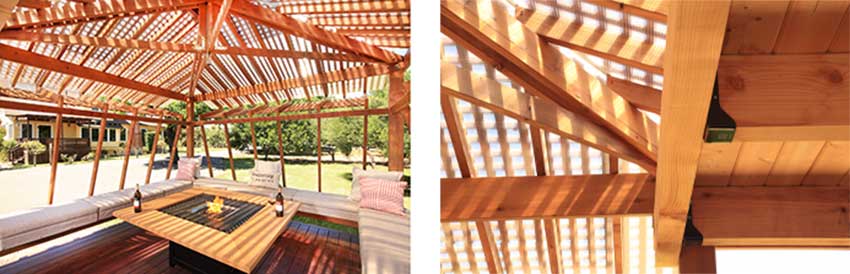
Photos courtesy of Humboldt Sawmill Company
Natural redwood lumber and timbers have long been prized for their warm appearance coupled with their natural traits of durability and longevity.
Considering all of these criteria, redwood lumber and timbers are seen as an excellent option for landscape architecture and design. Natural redwood is regarded as one of nature’s finest and strongest building materials. Structurally, redwood has a shear strength up to five times greater than plastic and composite decking. From a durability standpoint, redwood, in particular the heartwood from the center of the tree, is known to be naturally resistant to decay and termites. This was first discovered in redwood forests in California where fallen trees were found to have been laying on the ground for decades with no visible sign of any significant decay,─very unlike other trees that can decay naturally quite quickly.
Regarding the appearance, many designers agree that no other decking material mimics the natural beauty and warmth found in real redwood deck boards and accessories. It’s rich, warm color and grain pattern look great when installed and maintains its appeal even with age. Redwood can be left untreated due to its natural resistance properties and allowed to patina over time, or it can be stained or finished to preserve a particular color and look. Either way, it is a lightweight wood that is easy to work with, which helps control overall construction costs.
When redwood is used for decking, it naturally achieves a Class B flame spread. That means it is approved for use in California’s Wildland Urban Interface (WUI) fire hazard severity zones without restriction. For situations where a higher degree of fire resistance is needed, it can be treated to achieve a Class A flame spread using proven and tested processes that are registered with state agencies and building codes. The design flexibility and performance characteristics of redwood decking means it can be used in either renovation projects or new construction. Redwood decking also works well with innovative, newer deck components such as glass panel railing systems or cable railings. The warmth of the wood complements a variety of the other materials, like glass and metal.
Aesthetic Safety Railings
Anytime an outdoor space is used by people, it brings some safety considerations. For example, the International Building Code requires guardrails to protect people from falls anytime a deck or platform is raised up more than 30 inches above the ground. Similarly, if an outdoor space is adjacent to vehicular traffic, it is considered a best safety practice to use some method to prevent people from accidentally walking into harm’s way. The design issue often becomes how to provide the needed safety while incorporating an aesthetic solution or one that does not detract from natural features, such as views or vegetation.
One popular solution to this need for a functional yet aesthetic railing is the use of cable rail systems. Commonly, such systems use horizontal, stainless-steel cables spaced no more than 4 inches apart (to meet code requirements) and held in place with primary and intermediate uprights. A solid top rail is also common made from wood or aluminum. Such manufactured products are durable and have long use cycles, thereby reducing replacement costs and maximizing material usage efficiency. They are typically very low maintenance and require no treatments, stains, solvents, varnishes, or preservatives that may contain contaminating chemicals. The materials and products tend to be strong yet lightweight, using less raw material and allowing easier handling, lower shipping costs and lower fuel consumption. They are also available with high recycled content, making them inherently sustainable.
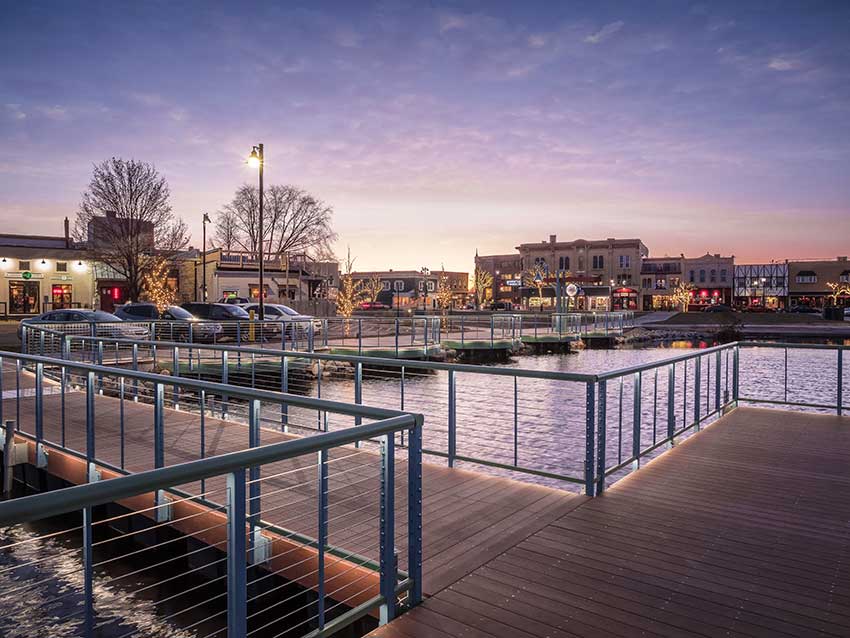
Photo courtesy of Feeney, Inc.
Cable rail systems combine posts and rails with stainless steel cables that minimize the obstruction of views and are made from sustainable materials.
Cable Rail Systems
The successful design of a cable railing is about more than just the stainless steel cables. Like most construction products, there are several components that need to be coordinated. From a design standpoint, that also means there are numerous options for custom or standardized installations. The fundamental design considerations include the following:
Post Material: The vertical posts provide the stability and connection to the deck or platform structure. There are three common choices of post material. The first is wood, or whatever variety may be desired, that can be stained or left natural as the species may allow. Second is metal, which is most commonly aluminum with an anodized or powder coated finish. Other metals are possible as well. Third is a composite material that may or may not match a composite decking material for a particular application. The distinctions between these three post types go beyond the visual and the structural, since each will have implications for the way that cables are attached or pass through them.
Corner Design: The corner of a deck or platform can be treated with either a single corner post or a double post. In the case of a single post, the cables typically terminate at the corner such that one set of cables attaches on one face of the post and the other set on an adjacent face (i.e., 90 degrees from each other). In order to properly address the connection and the imposed tension, the cables in this design are offset slightly from each other (on the order of a half inch). If that offset is not desired, two posts can be used in the corner such that each post is secured to a different face of the deck (still 90 degrees from each other). This will allow all of the cables to be in line with each other. In fact, the cables could be continuous around the corner, or they could each terminate on a different post as desired.
Top and Bottom Rails: A strong and rigid top rail that is securely fastened to the posts provides the necessary strength to the overall system and helps to support the tension loads from the cable. Underneath the top rail, it is often recommended that 1-by-4-inch wood blocking is installed between posts to provide additional lateral reinforcement to the posts. The material for the top rail can be the same as the posts or different at the discretion of the designer. Along the same idea, a bottom rail can be installed as an optional means to provide additional rigidity to the railing. It can also be an attractive and functional footrest addition to the overall railing design.
Intermediate Pickets: As a means of keeping the cable properly aligned, an intermediate vertical picket can be placed between each set of posts. Slender aluminum or stainless steel pickets are available as part of an overall system to achieve a visually open design while maintaining proper cable alignment.
Cables: The usual means of purchasing the stainless steel cable needed for the railing, is in a spool. The cable is unwound and cut to length for the multiple parallel rows (9 – 15) needed for a particular railing. For most residential and light commercial installations, 1/8-inch diameter cable is sufficient. For a bolder look and extra strength, 3/16-inch cable can be specified. In high traffic areas or for special architectural railings, ¼ inch cable may be required. In all cases the common cable construction types include 1x19 or 7x7 configurations. In the 1x19 construction, 19 individual wires are twisted into a single semi-flexible strand. This is an excellent choice for most railings, fences, and trellises with straight runs or slight bends. The 7x7 cable uses 7 groups of 7 wires (for a total of 49 individual wires) that are woven into a flexible strand. This type is best suited to conditions that require tighter bends or for designs where a more woven wire appearance is desired.
Connection Hardware: Consultation with a manufacturer is recommended to understand the range of current available choices for the hardware used to connect the cable railing to the posts. Some are specifically designed for the type of post material used. Others are designed for more visual concealment than others. Some are appropriate for stair railings. In all cases, the proper hardware is needed in order to assure that the installation is done properly and will not suffer from connection failures.
LED Rail lighting: An available option on some systems is the opportunity to have an upper and/or lower rail that incorporates linear LED lighting within it. This places the light where it is often most needed, at the edges or perimeters of a space, while also providing ambient light to the outdoor space. Electrical connections need to be factored in, of course, but can terminate at convenient locations to optimize construction efficiency.
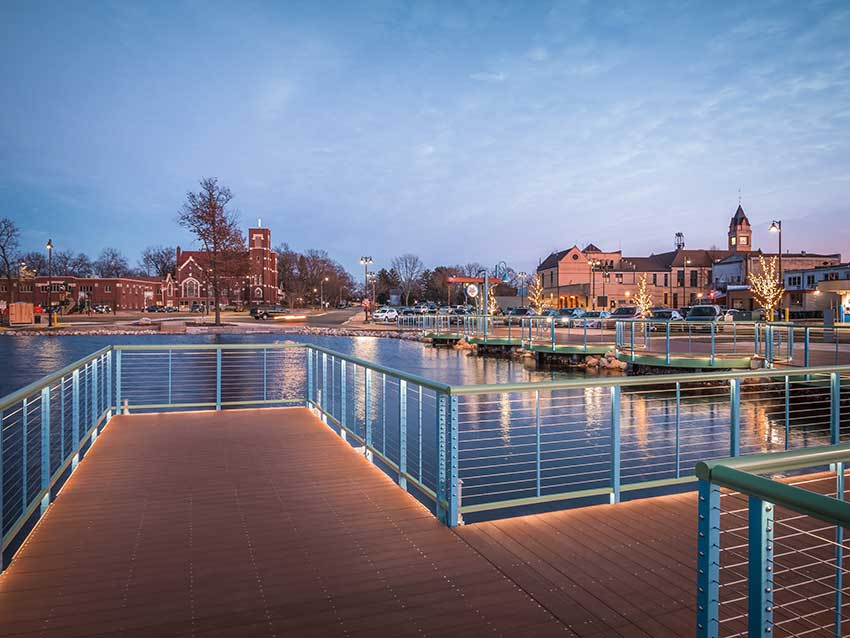
Photo courtesy of Feeney, Inc.
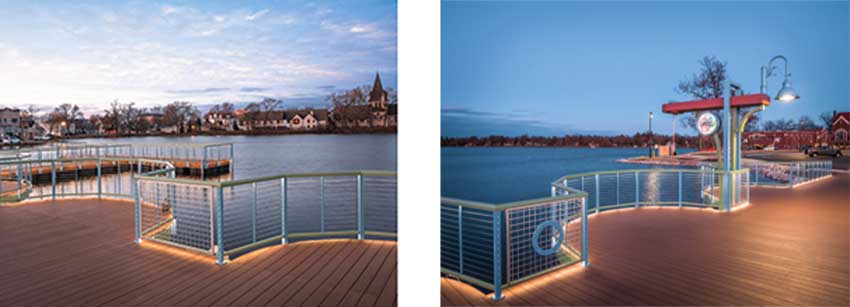
The use of LED lights in a cable rail system provide a welcoming way and energy efficient way to illuminate outdoor spaces.
Sustainability and Redwood Decking
For a period of time in the 20th century, there was a concern that different species of wood, including redwood, were being over harvested and that their use was not sustainable. That concern has led to the creation of organizations like the Forest Stewardship Council®(FSC®) and others who have developed processes to assure that wood as a natural resource is treated sustainably and responsibly. FSC® is recognized by LEED and SITES as a means of certifying the sustainable use of wood such as Forest Stewardship Council® (FSC®C013133) for a certified redwood forest.
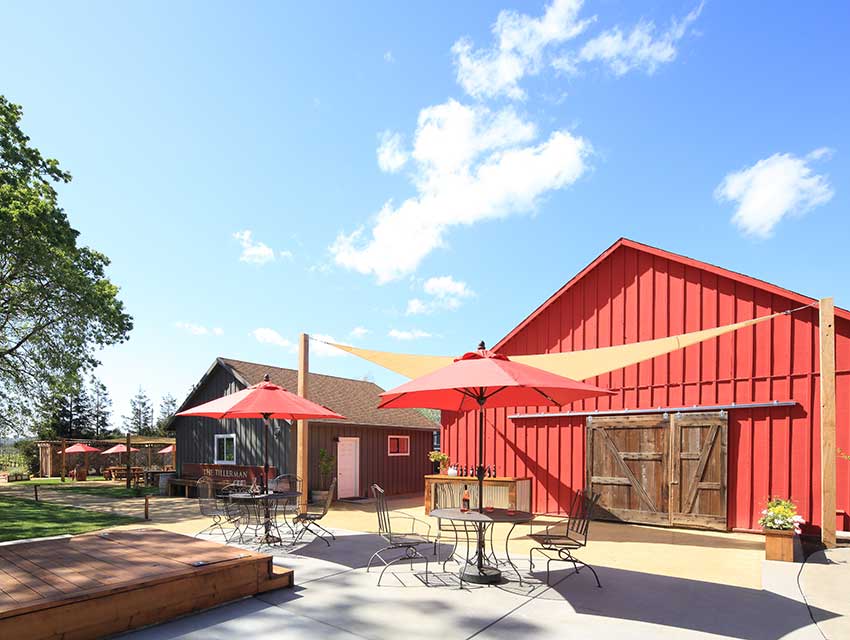
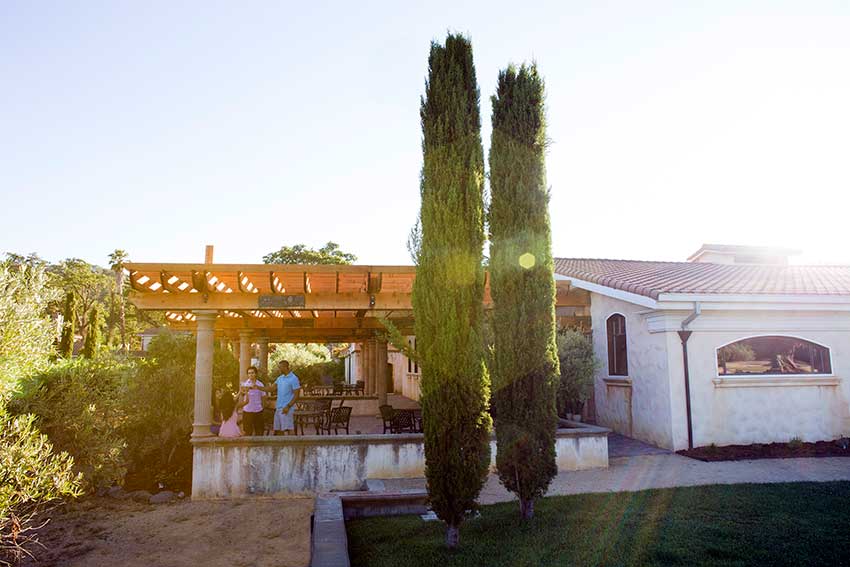
Photo courtesy of Humboldt Sawmill Company
Redwood is a very sustainable material to use for outdoor spaces, such as the deck and posts shown here at a California winery.
FSC® offers several different types of certifications for companies that grow, harvest, process, and deliver sustainably produced wood, including redwood. These certifications include:
Forest Management Certification: In order to receive FSC forest management certification, ten principles must be adhered to by a forest operation. Those principles include things like maintaining high conservation values, community relations, and workers’ rights. There are also requirements for monitoring the environmental and social impacts of the forest being managed. Each principle has criteria, which are the practical means of determining whether the principles are being complied with.
Chain of Custody Certification: FSC chain of custody certification is a standard used to verify that materials harvested from a certified forest have been identified and separated from noncertified and noncontrolled material. This is important because wood moves through a supply chain, from the forest to the market, and can change hands and ownership multiple times along the way. Having a process to differentiate FSC certified material from noncertified material helps assure that the products used on a construction project are in fact sustainable.
These certification processes are an important step in verifying that wood products used in construction are sustainable. Therefore, any design professional or homeowner concerned about the environment, or those with a preference for all-natural materials, are well served by specifying FSC certified redwood.
Environmental Product Declaration
The use of Environmental Product Declaration (EPDs) in the construction industry has become recognized as a means of providing total environmental transparency in building products so that architects, owners, and others can compare different products and make the best decisions on which products to use. What is the environmental performance of redwood decking vs. other non-wood alternatives? Based on the findings of an independent Life-Cycle Assessment (LCA) and associated EPD, it is generally much better to specify redwood.
Since redwood trees, like all other trees, consume carbon dioxide and emit oxygen, they naturally sequester carbon dioxide and thus remove it from the atmosphere. This directly helps to offset the global warming issues caused by excess carbon dioxide emissions from other sources. As such, it is common to see wood products, including redwood, listed in an EPD with a negative number for global warming potential. In fact, the amount of carbon stored in redwood decking is equivalent to about 10 times the total carbon dioxide emissions released during the manufacturing process.
Regarding the other impact categories redwood performs favorably as well, particularly compared to other building products such as composite or petroleum-based plastic decking. Low carbon emissions during the manufacturing process and carbon storage during the service life of redwood lumber are positive environmental attributes that should be considered when selecting lumber and timber products.
Conclusion
Outdoor spaces require attention to design and are a key component of achieving project sustainability. By understanding different options for materials, systems, and strategies, the overall design and performance of these outdoor spaces can support and enhance their intended use and benefits to the people who use them.
Peter J. Arsenault, FAIA, NCARB, LEED-AP is a nationally known architect and a prolific author advancing sustainable residences through better design.www.pjaarch.com, www.linkedin.com/in/pjaarch