This CE Center article is no longer eligible for receiving credits.
The USGBC LEED Green Building Rating System™ is recognized as the leading nationally accepted benchmark for the design, construction, and operation of a growing family of high-performance green building types, including healthcare facilities. While LEED for Healthcare promotes a whole-building approach to sustainability, a significant supporting component can be found in high-performance commercial doors and their related opening elements. All LEED systems currently recognize performance in the seven key areas of sustainable sites, water efficiency, energy and atmosphere, materials and resources, indoor environmental quality, innovation in design, and regional priority credits. High-performance door openings can contribute to credits in at least three of them: energy and atmosphere, materials and resources, and indoor environmental quality.
The Green Standard for Healthcare
The LEED for Healthcare rating system represents a culmination of seven years of close collaboration between the USGBC and the Green Guide for Healthcare (GGHC). The GGHC developed the first voluntary, self-certifying toolkit of green building best practices customized for the healthcare sector. GGHC has helped to streamline the LEED for Healthcare's development schedule by aligning with the LEED for New Construction rating system's organizational structure.
LEED for Healthcare begins by recognizing that the needs of healthcare facilities are very unique. Healthcare buildings often have strict regulatory requirements, 24/7 operations, and specific programmatic demands that are not covered in other LEED rating systems. Hence, the LEED for Healthcare rating system acknowledges these differences by both modifying existing credits and creating new, healthcare-specific credits. The goal is to help promote healthful, durable, affordable, and environmentally sound practices in these healthcare-centered projects.
 |
Green building design for healthcare facilities is enhanced by proper attention to all aspects of door openings.
Photo courtesy of ASSA ABLOY |
LEED for Healthcare is geared towards inpatient and outpatient care facilities plus licensed long-term care facilities. It can also be used for medical offices, assisted living facilities, and medical education and research centers. Projects that meet certain criteria are often required to use LEED for Healthcare such as licensed and federal inpatient and outpatient care facilities and licensed long-term care facilities.
LEED for Healthcare addresses design and construction activities for both new buildings and major renovations of existing buildings. A major renovation involves major HVAC renovation, significant envelope modifications, and major interior rehabilitation. For a major renovation of an existing building, LEED for Healthcare is the appropriate rating system. If the project scope does not involve significant design and construction activities and focuses more on operations and maintenance activities, LEED for Existing Buildings: Operations & Maintenance is more appropriate because it addresses operational and maintenance issues of working buildings.
 |
Energy and Atmosphere credits in LEED for Healthcare are dramatically affected by door openings in the building envelope.
Photo courtesy of ASSA ABLOY |
As with all LEED rating systems, earning LEED for Healthcare certification requires that the applicant project must satisfy all the prerequisites and qualify for a minimum number of points to attain the certification level being pursued. Having satisfied the basic prerequisites of the program, applicant projects are rated according to their degree of compliance within the rating system up to a total of 100 base points available plus 6 possible Innovation in Design and 4 Regional Priority points:
• Certified: 40-49 points
• Silver: 50-59 points
• Gold: 60-79 points
• Platinum: 80+ points
The three primary certification categories where high-performance doors and hardware can have a meaningful impact are:
• Energy and Atmosphere (EA)
• Materials and Resources (MR)
• Indoor Environmental Quality (IEQ)
We will discuss each of these at length as we look at how door opening solutions can assist LEED Healthcare projects in achieving points within the applicable credits.
Energy and Atmosphere (EA) and Door Openings
Energy-efficient buildings under the LEED for Healthcare items are addressed in a similar manner to other buildings in that the building envelope and total building performance are critical elements of demonstrating energy efficiency.
Relevant LEED EA Credits
The areas where high-performance door openings can make an energy impact include the following:
EA Prerequisite 2 – Minimum Energy Performance. This is the entry level of energy performance mandated by the rating system with three options to show compliance.
• Under option 1, Whole Building Energy Simulation, the computer-modeled performance of the design of new building projects must demonstrate a minimum 10% improvement in energy efficiency compared to a calculated baseline building using ASHRAE 90.1-2007. For major renovations to existing buildings, a 5% improvement must be demonstrated compared to the ASHRAE 90.1-2007 baseline.
• Option 2 allows for demonstrating minimum energy performance by using a Prescriptive Compliance Path based on the ASHRAE Advanced Energy Design Guide (AEDG) for Small Hospitals and Healthcare Facilities. To use this option, a few criteria must be met: Buildings must be 90,000 square feet or less; project teams must fully comply with all applicable criteria as established in the AEDG for the climate zone in which the building is located; the specific limits in AEDG Small Hospitals must be met for U-factors and air leakage including those for exterior doors in different climate zones.
• Option 3 is also a Prescriptive Compliance Path but based on the Green Guide for Health Care (GGHC) v2.2 – Prescriptive Path for Energy Improvements in Hospitals. In order to use this option, buildings must be over 90,000 square feet; the mandatory provisions of Sections 5.4, 6.4, 7.4, 8.4, 9.4 and 10.4 in ASHRAE Standard 90.1-2007 must be met; and all relevant Energy Efficiency Measures (EEMs) listed in the GGHC must be met including specific requirements for high-performance window and door glazing, frame, and panels.
 |
LEED for Healthcare® is appropriate for use in new or renovation projects for inpatient and outpatient care facilities as well as long-term care facilities.
Photo courtesy of ASSA ABLOY |
EA Credit 1 – Optimize Energy Performance (1 – 24 points). Energy and Atmosphere Credit 1 represents up to 24 out of the 100 possible total base points in LEED and rewards increasing levels of energy performance beyond the prerequisite standards. For new buildings, that means demonstrating energy savings of greater than 10 percent. For every 2 percent increase in savings, 1 or 2 points are earned. Hence, a demonstrated 12 percent savings earns 1 point, 14 percent earns 2 points, 20 percent earns 7 points and so forth up to a maximum of 48 percent savings that earns 24 points. For existing buildings, the process is similar, but since the prerequisite level is 5 percent, the first point is earned at 8 percent energy savings, with a scale up to a maximum of 44 percent earning the maximum 24 points. Clearly, the more energy-reducing strategies employed in a building design, the more points that are earned. Designs that exceed the stated maximums may be eligible for additional points under innovation credits.
EA Credit 3 – Enhanced Commissioning (1 – 2 points). This credit is in addition to EA Prerequisite 1: Fundamental Commissioning of Building Energy Systems. Among the things addressed to earn points under EA Credit 3 is commissioning of the building envelope in accordance with the LEED Reference Guide for Green Building Design and Construction, 2009 Edition Healthcare Supplement. One point is available under this credit for designating an independent commissioning authority (CxA). An additional point is available if that CxA commissions the building's thermal envelope systems. The building thermal envelope entails all exterior wall assemblies separating a building's conditioned spaces from outdoor ambient conditions, including: roof assemblies, vapor barriers, air barrier systems, flashings, cladding and siding, windows, curtain-wall assemblies, and of course exterior door openings.
Optimizing thermal performance requires careful consideration of the entire building envelope. MasterFormat Division 8 specifications should therefore reflect the need to create a sealed barrier that prevents air infiltration and unnecessary energy loss. Each opening component—the proper-sized door closer, insulated doors, thermal break frames, gasketing, as well as alternatives like revolving doors—must be carefully chosen to ensure maximum energy savings are achieved. Doors, frames, and hardware are examples of building components that, although small in the scope of the overall project, can have a big impact on the energy efficiency of buildings. With all of the aforementioned in mind, the following basic strategies related to door openings come into play to achieve the desired performance levels.
Thermal Control Strategies
Just as proper attention to insulation in wall assemblies improves energy performance, properly insulated doors lower the U-factor of an opening. Thermal imaging of exterior walls with doors reveals just how dramatic a difference may exist between a well-insulated wall assembly and a door system. Hollow metal doors commonly used in commercial building envelopes are usually constructed from sheet metal in 20-, 18-, 16-, and 14-gauge thicknesses. The core or interior space between the metal faces provides support and integrity to the door but it is only when this core is filled with insulating material that improved energy performance occurs. Door manufacturers have traditionally promoted the calculated R- and U-values for their products as determined by a formula, rather than a performance test. Unfortunately, the calculated core is not usually indicative of real-life performance. ASTM C1363 is the most current test standard for operable thermal transmittance, replacing ASTM C236. Testing a door under this method will result in an “operable value” which gives a more realistic estimate of the total performance of a door opening assembly including the door, frame, and gasketing performance as a unit. Generally speaking, a thermally broken door filled with polyurethane insulation in the core, coupled with a thermally broken frame, will perform the best with an operable U-value of U-.29 compared to a calculated value of U-.09.
 |
When accounting for thermal performance in exterior doors, the tested operable thermal value is more accurate than calculated values.
Image courtesy of ASSA ABLOY |
 |
|
Image courtesy of ASSA ABLOY |
Advocate Lutheran General Hospital is the first LEED Gold Hospital in the Midwest
|
|
Widespread use of sustainable construction practices and building products made with recycled content and other green materials enabled the Advocate Lutheran General Hospital in Park Ridge, Illinois, to achieve LEED Gold certification.
Sustainability and security go hand-in-hand at Advocate Lutheran General Hospital. A recent addition at the healthcare facility achieved LEED Gold certification, making it the first hospital in the Midwest to attain this lofty ranking offered by the United States Green Building Council (USGBC). Among the building components used in the new addition are door and hardware products that played a notable role in the Gold certification.
 |
|
Photo by James Steinkamp Photography, courtesy of Cannon Design |
The healthcare conglomerate is committed to improving patient outcomes by creating environments that are therapeutic, efficient and restorative. These values weighed heavily in the design of the 192-room patient tower completed in 2009. The tower includes innovative safety and comfort features, a focus on family-centered care and an environmentally friendly design that includes the use of building products made with high percentages of recycled material and low-VOC (volatile organic compound) interior finishes. Hollow metal doors and frames were made in nearby Mason City, Iowa, and are produced with roughly 40 percent recycled steel. The doors also meet stringent GREENGUARD testing for VOC requirements and exceed operable thermal transmission and air leakage requirements of LEED, providing Lutheran General with an extremely energy-efficient building envelope.
The hinges and door closers are made with over 50 percent recycled content, while flat goods and trim products contain between 56-90 percent recycled materials. From a security perspective, the facility incorporated 180 pin pad locks that require a security code to gain entry to the doorway in addition to exit devices and a central key system.
Visitors to Lutheran General’s patient tower can learn more about the hospital’s LEED journey by stopping in the “Why Green Gallery” on the first floor of the patient tower. The gallery highlights the many ways the building respects the environment while providing healthier, more comfortable surroundings for patients, their families, and the staff. The gallery also describes what Lutheran General is doing to help the community and environment stay healthy. |
Beyond the door panel itself, the details of the door frame are important. Consider that when addressing energy performance of windows, thermal breaks are pretty much standard practice for metal window frames. Since door frames are also made of metal, a thermal break consisting of an insulated material is needed to stop or at least slow heat transmission through the frame. Thermal break door frames can improve an opening's overall U-factor since they provide a positive thermal break within the frame profile, thus inhibiting heat transfer. In cold climates, they deliver the maximum protection against condensation and potential frost build-up. Further, many designs allow for weatherstripping to be easily inserted and removable both initially and for future replacements as needed.
Air Infiltration Strategies
Unwanted air infiltration dramatically affects the energy performance of a building as much as direct thermal transfer—sometimes even more so. Typically 40 percent of this air infiltration comes from leakage in the building envelope with 11 percent alone identified as coming from exterior doors. The door opening leakage is attributed to small gaps and creases in the areas where the door panels meet the surrounding frame and floor. Left untouched, these gaps allow free passage of air and are a significant source of energy loss.
 |
|
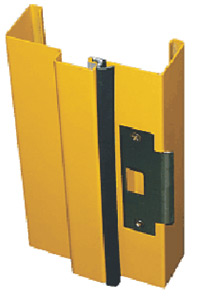
A Kerf door frame allows for reduced air infiltration by allowing for weather stripping and gaskets to be easily and readily installed and maintained.
Image courtesy of ASSA ABLOY |
The most effective air sealing strategy around doors is to use gaskets and weatherstripping and door bottoms to create a sealed barrier to control this unwanted air infiltration. Gaskets are commonly used to fill seams around the jambs and door head while a bottom seal and threshold is used to eliminate the gap under the door.
An effective approach to install head and jamb gaskets is to use a kerf frame. These are specially designed frames that feature a groove along the frame section that comes in contact with the door edge. As such, they simplify installation of weatherstripping by serving as a convenient channel to install weatherstripping without using additional fasteners. The grooved kerf frame also means that weatherstripping is easily removable for maintenance or replacement when needed.
Openings with a pair of doors also require gasketing to seal the meeting stile. Gasketing is available in several materials that are flexible and do not impede the operation of the door. They are available in varying grades to meet the conditions of different climate zones. Common products include silicone, santoprene (100 percent recyclable), vinyl, and polypropylene. From an environmental standpoint, chloroprene or neoprene should be avoided. When specifying gasketing, look for products that meet or exceed ANSI 156.22 Door Gasketing and Edge Seal Systems. You should also look for products that show results of ASTM E283 which is the common laboratory testing standard that provides guidelines for air infiltration performance. For field based testing, ASTM E783 is the protocol that is commonly used.
 |
Thermal imaging looking from the interior side of two exterior doors exposed to cold. The door on the left is a traditional door and frame with the blue (cooler temperature) indicating high heat loss. The image on the right is a high-performance door that includes weatherstripping and gaskets with notably warmer interior temperatures and less heat loss around its perimeter.
Image courtesy of ASSA ABLOY |
Access Control Strategies
Electronic Access Control (EAC) systems have become very common in many buildings. They provide a degree of building security by limiting and controlling which people can or cannot pass through exterior or interior doors. This is commonly achieved through the use of badges or cards that are inserted or passed by a card reader. While this technology has been a boon to building operations, particularly in healthcare settings, the downside is that they require electricity. Traditionally, these systems included many discreet components which collectively create a larger environmental impact. They require additional wiring, some degree of energy use, more processing and packaging and a 120V outlet with a power supply drawing between 4 – 20 amps at every door to power such things as an access controller, optical request to exit device, and a reader device–all tied back to a power supply and main electronic access control system computer. The good news is that newer lower voltage and extremely energy efficient options are currently available.
An energy-efficient approach for EAC systems is to specify one that integrates all of the traditional components into a single, integrated, door mounted lockset thus eliminating the myriad of parts installed at each door. These integrated, door mounted locksets can then be connected directly to a central access control system or panel using conventional wiring. Generally, these hardwired devices can be expected to use about 15.4 watts at each opening. In existing buildings, or where wiring is not desired, then IP-Enabled WiFi locks can be used. These battery powered devices (on the order of 6 AA household batteries) leverage existing EAC infrastructure to reduce environmental impact even further and completely eliminates the need for any additional wiring or components. The best overall option is to use Power over Ethernet (PoE) locks that can leverage an existing PoE system on an existing computer network to reduce components and minimize energy usage. This type of PoE lock uses a maximum of 7 watts per activation at each lock, 50% less than typical PoE installations. PoE locks also use 85 percent less standby power than traditional access control. Because of their very low energy use, they have been likened to have done to EAC systems what LED bulbs have done to lighting systems.
In terms of energy usage overall, it's important that we look at all parts of the assembly to specify high performance door openings. Insulated core doors, especially sprayed polyurethane, deliver some of the best insulation values. Kerf and Thermal Break frames are a key factor in better U values and air infiltration. Thermally broken thresholds, door bottoms and sweeps along with gasketing are key to performance. Finally, don't forget the importance of specifying high grade hardware, hinges and closers to guarantee the long term performance and durability of the opening.
Material and Resources (MR) Related to Door Openings
LEED for Healthcare addresses a range of material and resource items, many of which are common to other LEED rating systems and some which are not. In a healthcare facility with many door openings, appropriate design and selection of those products can contribute notably to the total of 16 possible points in this category.
Building Reuse Strategies
MR Credit 1.2 Building Reuse – Maintain Existing Interior Non-Structural Elements (1 point). Doors are included in non-structural elements that can be re-used in existing buildings. The goal is to reuse elements of buildings that are salvageable where possible. Since doors and hardware generally have a long service life, their re-use on LEED projects, should be simple, especially when they are of good quality to begin with. It is possible to utilize manufacturer facility surveys to determine materials that can be reused. Doors in particular are smooth flat surfaces that can be re-used as a desk, storage platform, etc. or can be donated to a cause like Habitat ReStores.
Sustainably Sourced Product Strategies
MR Credit 3 Sustainably Sourced Materials & Products (1 – 4 points). The intent behind this credit is to reduce the environmental burdens of materials and products acquired to construct buildings and to upgrade building services. One point and up to a maximum of four will be awarded for each 10 percent of the total value of all building materials and products used in the project (based on cost) that meet any of the criteria below.
- Salvaged, refurbished or reused materials: As mentioned above, doors, frames, hardware, and related items are commonly able to be salvaged, re-furbished, or re-used.
- Recycled content: In the door and hardware industry recycled content ranges from 20 percent to 95 percent, depending on the product so it can be very valuable to run calculations. Most recycled content percentages are now available by manufacturer and product line.
- Regionally sourced/manufactured materials and products that have been extracted, harvested or recovered, as well as manufactured within 500 miles of the project site: This will obviously be location dependent and may be difficult to achieve in some cases.
- Building materials or products shipped by rail or water have been extracted, harvested or recovered, as well as manufactured within a 500 mile total travel distance of the project site using a weighted average: The formula for showing compliance with this point recognizes the possibility of using sustainable sources of transportation such as rail and water transportation making many door opening products eligible.
- Rapidly renewable materials: Interior doors can be specified and manufactured with agrifiber wheat based cores or from bamboo veneer surfaces that are each made from material that has a 10 year or shorter harvest cycle. In some cases, these doors can be specified to achieve a 45 minute fire rating.
- Wood certified, in accordance with the Forest Stewardship Council's (FSC) Principles and Criteria: Wood doors are available that meet all of the FSC criteria including the required Chain of Custody numbers.
- LEED for Healthcare further requires that all wall, ceiling and flooring systems and finishes, composite wood, agrifiber and fiberglass products, both exterior and interior adhesives, sealants, coatings, roofing, and waterproofing products must meet the relevant IEQ Credit 4: Low-Emitting Materials requirements to contribute toward this credit. That means, among other things, that wood doors containing composite wood and agrifiber must contain no added urea formaldehyde to contribute credit in this section.
- Door openings may be considered part of the wall systems requirements of this section and must meet the requirements of CA01350 testing, as shown by GREENGUARD Indoor Air Quality Testing to contribute credit in this section.
 |
Different door materials can contain different levels of recycled content but represent a significant dollar value in many building projects.
Photos courtesy of ASSA ABLOY |
Clearly, then, it is worthwhile to consider the components of door openings as a potential significant contributor to responsible Materials and Resources specifications and design, as well as insure that they meet the required Low Emitting Materials credits.
Indoor Environmental Quality (IEQ) Impacts of Door Openings
Indoor Environmental Quality is a concern in all buildings but often receives even more attention in health care settings. In the case of door openings, there are once again numerous ways that specifying high performance products can contribute to the 18 possible points in this category.
Environmental Tobacco Smoke Control Strategies
The intent of this IEQ Prerequisite 2 is to prevent or minimize exposure to environmental tobacco smoke. The first option is simply to prohibit smoking in the building and the immediate surroundings. However, there is also a second option for residential healthcare occupancies where accommodation for resident smoking is programmatically mandated. In those cases, designated smoking rooms need to be isolated from other spaces in the building both by physical separation and by air pressure differential. All doors in smoking rooms or in residential healthcare units where smoking is allowed therefore need to be gasketed or weather stripped to prevent the transfer of environmental tobacco. There is no exact specification for weather stripping called out in LEED, however, weather stripping that meets UL 1784-2001, Air Leakage Tests of Door Assemblies and meet the performance criteria for allowable air leakage as specified in NFPA 105-99 Installation of Smoke Control Door Assemblies, should meet the intent of this LEED credit.
Acoustic Environment Strategies
IEQ credit 2 recognizes the effect of unwanted sound (i.e. noise) on the indoor healing environment and seeks to provide building occupants with spaces that are free of such intrusive or disruptive levels of sound. It is common to address sound control in wall assemblies, but obviously any openings in those walls need to be addressed as well. Door opening solutions can therefore play a big role in controlling sound transfer and help spaces achieve the available 1 point under Option 1–Sound Isolation. Doors, frames, and seals can be combined to achieve sound isolation that assures speech privacy, acoustic comfort and minimal annoyance from noise producing sources. Toward that end, door opening solutions are available with Sound Transmission Class ratings that range from STC 28–55.
Indoor Air Quality Management Plan Strategies
IEQ credit 3.2–Construction Indoor Air Quality Management Plan–Before Occupancy is intended to reduce indoor air quality (IAQ) problems resulting from construction or renovation to promote the comfort and well-being of construction workers and building occupants. There are two options to demonstrate compliance with this requirement, either to conduct a full building Flush Out or to conduct actual Air Testing. IEQ 3.2 is applied to all wood products and laminated wood products in a building including wood or laminated doors if they are used. These wood products cannot contain any added urea formaldehyde and must not contribute to the presence of other contaminants such as particulates, VOCs, or carbon monoxide (CO) among others. This is not based on a percentage as just one product in the building with high concentrations of any of these could negate the ability of the building to achieve this credit. Hence, the specification of doors that are free of contaminants in the first place is important to achieving satisfactory IAQ ratings. GREENGUARD Gold testing shows products that are below this IAQ threshold.
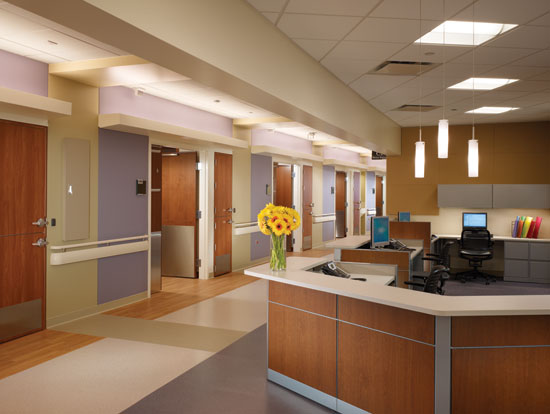 |
Indoor environmental quality is impacted by the choice of materials used for wood doors in healthcare settings such as the Advocate Lutheran General Hospital.
Image by Craig Dugan Photography, courtesy of Cannon Design |
Low-Emitting Materials Strategies
IEQ credit 4 has its intent clearly stated to reduce the quantity of indoor air contaminants. The requirements apply to the application of adhesives, sealants, finishes, and other products that are field installed within the enclosed building. In particular, wall and ceiling finishes and coverings, including those on doors, that are installed in the building interior must meet the testing and product requirements of the California Department of Health Services Standard Practice for the Testing of Volatile Organic Emissions from Various Sources Using Small-Scale Environmental Chambers, including 2004 Addenda (CA 01350). By specifying doors that are factory finished and have factory installed glazing, no contaminants are released into the building during finishing and glazing. Rather, they can meet the stated requirements at the factory in a controlled manner. Of particular concern to doors, composite wood and agrifiber products used on the interior of the building (i.e. inside the weatherproofing system) shall contain no added urea-formaldehyde (NAUF) resins. Composite wood and agrifiber products are defined as particleboard, medium density fiberboard (MDF), plywood, wheat board, strawboard, panel substrates and door cores. Therefore, it is appropriate to specify wood doors containing NAUF resins.
As an added strategy, it is also appropriate to specify GREENGUARD Indoor Air Quality certification (or similar). This independent product certification helps to demonstrate that door opening products meet IAQ standards at the point of manufacture.
Indoor Chemical & Pollutant Source Control Strategies
IEQ credit 5 is intended to minimize building occupant exposure to potentially hazardous particulates and chemical pollutants. This begins with controlling the possibility of contaminants entering the building at entrances and other locations. Hence the first requirement is to address the regularly used exterior entrances in several ways. First, a walk-off system on the floor needs to be integrated with the main entrance areas. Further, at high volume entrances, a pressurized vestibule or similar enclosure needs to be included. Both of these rely on designing and specifying door opening solutions that are suitably integrated into the building entrance areas and function as intended. Attention to weatherstripping and sealing is particularly important to help assure that any contaminants are in fact controlled and kept from the interior as intended. The use of vestibules in this manner can also help enhance the energy performance of the entry. Similarly, the choice of revolving doors may also satisfy the pollution control and energy efficiency of an entry and may be worth considering.
Once inside a healthcare facility, the requirements continue to apply where hazardous gases or chemicals may be present or used in such as garages, soiled utility areas, sterilization and disinfection areas, housekeeping/laundry areas and copying/printing rooms. The strategy is to exhaust each space sufficiently to create negative pressure with respect to adjacent spaces with the doors to the room preferably closed. Therefore, for each of these spaces, it is critical to specify closers on all door openings in order to provide self-closing doors that maintain the intended separation of air.
Daylight and Views Strategies
IEQ credit 8.1 and 8.2 address the provision of daylight and views into healthcare spaces respectively. The intent is to provide building occupants with a connection to the outdoors through the introduction of daylight and views into the regularly occupied areas of the building. The fact that there are up to five points available between these 2 credits indicates the recognized importance of this outdoor connection, particularly in healthcare settings. Points for daylighting are earned by first earning at least 2 points for views and then following calculated or prescriptive methods to indicate the daylighting has been achieved. When it comes to views, the LEED for Healthcare criteria goes on to differentiate between inpatient units and non-inpatient areas with different criteria for each. Ninety percent of inpatient areas, including patient rooms, staff areas, and public areas must be within 20 feet (or twice the window head height, whichever is smaller) of the perimeter with specified unobstructed views. Non-inpatient areas are addressed by calculating the square footage of the perimeter extending 15 feet inward compared to perimeter area requirements that then qualify for either 1 or 2 points. Door openings can contribute to this strategy since adding glazing, toplights and sidelights to door openings are recognized by LEED for Healthcare. Specifically, the language for IEQ Credit 8.2 – Views states that for both in-patient and non-inpatient areas, portions of side lit areas beyond the 15 feet view area boundary that meet the requirements of IEQ Credit 8.1: Daylight may be included in the qualifying areas of this credit. Hence, designing glazing into interior door openings can be an effective tool to provide both daylight and views to spaces that otherwise may not benefit from either.
 |
Daylighting and views are possible in more spaces through the use of side lights in doors that give access to perimeter windows.
Photo courtesy ASSA ABLOY |
Special Healthcare Applications
Hospital and healthcare settings have a number of special needs when it comes to door openings that should be mentioned here. These special needs are related to the operation and use of doors by staff and patients in unique settings and situations but don't detract from the overall ability to contribute to LEED certification. A short listing of some of the things available to make healthcare doors easier to use include the following:
- Medical bearing hinges: These are self-lubricating hinges with high resistance to wear making them ideally suited to doors with a lot of traffic or daily use. These hinges are uniquely designed to provide clean and quiet hinge operation also helping with acoustic control.
- Multi-point hold open closer with swing-free arm: This is a rather sophisticated door closer that allows the door to operate as if no closer were installed. They are suitable for patient rooms, corridors, and stairwell use and can remain in a variety of hold open positions until moved or otherwise triggered to close. For example, they can be provided with or without smoke detector or tied in to a building fire detection system so that in case of fire, the door automatically closes from any position.
- Door closer with motion sensor: This type of specialized closer/door operator minimizes tactile contact from multiple occupants passing through the opening. It is also a low energy alternative to automatic operators.
 |
A coordinated approach that addresses all the parts and pieces of successful door opening solutions can also contribute to the overall green building certification of a healthcare facility.
Photo courtesy of ASSA ABLOY |
Conclusion
In the process of pulling together the myriad of elements into one cohesive green building design, it is also very critical to similarly assemble all of the components of a total door opening (e.g., frame, door, hardware, exit devices, card readers, etc.). In green healthcare buildings in particular, this all comes together by properly addressing the various aspects of the door openings. Energy efficiency includes door assemblies that are rated for their actual operable U-factor/R-value. It also includes specifying appropriate door frames to include weatherstripping and gasketing to restrict air leakage. Products used for door openings can be specified from highly sustainable materials and contribute to long-lasting use and re-use. Properly selecting the materials and finishes also addresses indoor air quality while the design of the total door opening can address other aspects of overall indoor environmental quality such as acoustic control, contaminant control, and daylight and views. In short, successful green healthcare facilities can be greatly enhanced by paying proper attention to all of the aspects of total door opening solutions.
Peter J. Arsenault, FAIA, NCARB, LEED AP, practices, consults, and writes about sustainable design and practice solutions nationwide. www.linkedin.com/in/pjaarch
 |
ASSA ABLOY is the global leader in door opening solutions, dedicated to satisfying end-user needs for security, safety, and convenience. Their architectural representatives and specification consultants assist with specification writing and LEED consultation. Their products address doorway-related green building needs, including energy efficiency, materials and resources, and indoor environmental quality. www.assaabloydss.com/sustainability |
This course earns LEED BD+C credits