This CE Center article is no longer eligible for receiving credits.
The Design and Construction Process
Incorporating modular custom plaster panels into a building design is best done through collaborative efforts. The typical process begins when the design and basic specifications developed by the architect or designer are reviewed with the fabricator to be sure that all custom and special requirements can be met. This includes a review of panel sizes, shapes, textures, colors and installation needs. A joint review early in the design process may uncover potential cost savings or design enhancements not otherwise apparent that can be worked into a final design solution.

Photo courtesy of ArmourFX, a division of Armourcoat Surface Finishes, Inc.
Modular plaster panels can be designed to meet a full range of needs and be readily incorporated into a standard construction process.
Once the design is finalized, the order placed and scheduled, then skilled workers create the layout for all of the modular pieces. The appropriate substrate is laid out and sized to meet the exact design requirements, including coordination with installation systems. The specified plaster is then applied according to the design and custom specifications. Once cured and finished, the panels are prepared and packaged for shipping to the construction site. Quite often, the installation system is included as part of the total panel system based on either exposed fasteners, direct applied mounting or a concealed hanging system. The most common installation system uses a concealed “Z” clip system similar to many millwork installations that rely on hanging or securing items to a wall or partition.
The benefits of this modular process begin with greater design control, particularly if collaboration begins early and the end product is properly detailed and specified. By using a manufacturer who provides ongoing skilled labor to execute critical design work, there is no need to seek such skilled labor local to the building project, which may not exist in many cases. From a time schedule standpoint, the plaster panel work can be concurrent with on-site construction work, allowing for overlapping schedules without overlapping tradesman and expediting the work overall, since on-site labor time is reduced. This is further helped by the fact that the time-consuming finishing and cleaning tasks are done off site ahead of installation. For large-scale or multi-location designs, products can be created and timed for repetitive installations without sacrificing the potential for customized variations. In all, the modular plaster panels improve the overall design and construction process with the real potential for superior results all around.
Design Considerations
We have seen how modular plaster products can expand the possibility of incorporating the time-proven benefits of plaster by using modern construction techniques to create labor and time savings. Let’s take a closer look at some of the specific design considerations and options available when deciding to incorporate this system into a particular building design.

Photo courtesy of ArmourFX, a division of Armourcoat Surface Finishes, Inc.
Modular plaster wall panels can be very successfully used across a full range of building types and in a variety of building locations.
Building Types
The design and construction benefits of modular plaster panel systems can be realized in decorative solutions across virtually all building types. The inherent strength and durability of the products means that they are well suited for high use areas and locations where easy care and maintenance are a concern. Beyond that, commercial buildings such as retail, offices, healthcare, hotels, bars and restaurants can benefit from the ability to easily create specialty shapes or corporate logos plus the ability to replicate product designs across multiple properties. Institutional buildings such as religious facilities, cultural centers, government buildings, museums and educational establishments can use plaster panels to accent or enhance public areas within budget constraints. Residential and retirement living centers can benefit from incorporating three-dimensional, artistic features into the design. Even specialty installations such as movie and TV sets, exhibitions and special event structures, can benefit from easy-to-assemble modular panels that can be fashioned to suit a full range of visual and functional needs. From a visual standpoint, with the ability to specify an almost unlimited range of shapes and design treatments in a huge range of finishes, architects and designers have great artistic scope to meet the needs of virtually any building.
Plaster Finish Options
The hand-crafted, custom nature of modular plaster panels means that there are many surface finish choices available to suit different design conditions. Manufacturers offer over 400 standard colors and finishes as a starting point. Custom colors and thematic effects are also readily available to match or enhance other design elements or existing conditions. For example, the plaster surface can appear smooth and uniform in color or be mottled and variegated. The final sheen can be high, medium, or low gloss or a matte finish. Stone or other natural material appearances can be formed by mixing colors and patterns to emulate natural stone such as travertine, limestone or highly polished marble. Alternatively, the panels can look like poured concrete for urban buildings seeking that look. Overall the color, pattern, and gloss level are all customizable based on the plaster make up and finishing process used.
Plaster Texture
While most plaster panels are made from “polished plaster” recall that this term does not necessarily mean that a smooth surface texture is the only option. Rather it is entirely possible to also specify rough, textured surfaces, striated surfaces, pitted appearances and surfaces with natural materials to emulate nature itself. For the most part, any texture option is available with almost any coloring scheme or pattern.

Photos courtesy of ArmourFX, a division of Armourcoat Surface Finishes, Inc.
The plaster can be finished in a variety of textures including smooth, rough, or even wood grained as shown here.
Another texture choice is the creation of wood grain or timber effect panels. These pre-cast products are made as planks cast in a polymer-modified gypsum resin mix. Their design is intended to emulate natural wooden planks with an exposed grain detail and to be used for decorative wall cladding—ideal for interior theming and branding. Two commonly available designs include an original wood grain look or a more rugged look, both of which are typically created from actual Douglas Fir timber planks. The rugged finish is achieved from further hand-distressing of the timber. Available in a range of base wood grain colors, they can be further enhanced once installed with waxes to create a final coloration and finish. Typically, this type of wood grained plaster planks are simply cut on-site as required and then adhered to the wall using a large format tiling adhesive.
Artistic or Custom Shaped Panels
Whether a simple color match, a complex geometric design or an intricate combination of different textures, custom fabricated plaster panels can be used to achieve the desired end result. Manufacturers offer custom color matching used in combination with decorative techniques to create an artistic or creative range that is limited only by the imagination. This can include two-tone effects, multi-color patterns, or the emulation of natural materials. Beyond the color, the shape of panels can be cut or formed as needed to create logos or wall mounted pieces of artwork.


Photos courtesy of ArmourFX, a division of Armourcoat Surface Finishes, Inc.
Custom art shapes, corporate logos, or other three-dimensional shapes can all be custom fabricated in plaster to suit a particular building.
Another creative approach is to use stencils with a designed pattern to add a whole new dimension to plaster surface finishes. Intricate, ornate designs or more geometric repeat patterns can be overlaid to create seamless wall effects, decorative borders or motifs. Textured plaster finishes can form the background that is overlaid through a stencil with a highly polished plaster coat in the same or contrasting color providing a sophisticated or dramatic wall finish. Stenciled designs can be standard or custom made typically using professional grade vinyl. This can have the effect of intricately chiseled or carved stone for a permanent and enduring corporate look. Vinyl stencils can also be used to create applied images such as company logos or free-form wall branding. Color-matching is possible, using Pantone swatches or similar, to ensure a true brand representation.

Photo courtesy of ArmourFX, a division of Armourcoat Surface Finishes, Inc.
Stenciled applications of different plasters and colors can create artistic and varied designs.
Installation
Incorporating modular plaster panels of any type or style into a building design is streamlined when the panels are provided with finished edges and made ready for hanging. Depending on the design and type of panel, modular panel systems can be fitted using high strength tile adhesive, aluminum rail system, or French cleats/Z-clips. We have commented already how wood grain planks are often directly adhered to walls, and this may be suitable for other panels too in some cases. It is more common to use an aluminum mounting system, however with the Z-clip system being the most popular.
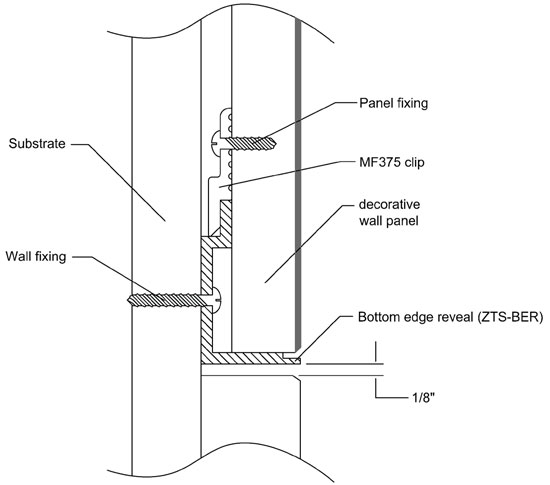
Z-clips provide fast installation and ease of hanging the modular panels. Two sets of aluminum members are used. The first is secured along the wall to receive the panels usually with pre-drilled holes for quick and easy attachment. The second set of aluminum members is secured to the back of the panels, sometimes in the factory. The panels are then hung in the field by simply aligning the two sets of clips over each other allowing them to come to rest on each other. Note that in this manner, the panels aren’t actually fastened to the wall directly. This means they are also demountable for access to the wall and any mechanical, electrical, plumbing or other services contained there. It also means that panels can be installed and adjusted laterally and vertically for a proper fit. Once in their final position, the aluminum Z-clips are all hidden by the panel with just a quarter inch space between the back of the panel and the wall. In order to be sure that the final appearance is properly displayed, it is important to note on the construction documents whether the panel is intended to hang horizontally or vertically.

Images courtesy of ArmourFX, a division of Armourcoat Surface Finishes, Inc.
Modular plaster panels can be installed using concealed fasteners in the form of Z-clips or channels with varying degrees of separation possible between the panels (e.g. narrow, wide, etc.).
Plaster has been a traditional interior finish material for centuries. It can be used to create surfaces that are smooth or textured, bold or subtle, white or colored, all while offering excellent performance characteristics over the life of a building. However, it often requires skilled labor in a trade that is increasingly hard to find in the United States. In response, pre-manufactured, modular panels are now available that can readily meet the design quality requirements of architects, interior designers and building owners. It is based on using skilled designers and artisan plasterers who work in a central, controlled location to create custom wall panel systems, artwork pieces or 3D display items and ship them directly to the building site. To complete the process, installation can be expedited by using a coordinated, integrated hanging system that allows a joiner or millworker to install the finished product in a matter of a few hours. Altogether, this type of complete modular system offers a total design solution that is fully customizable to suit any building design project.
Plaster Products Overview
Plaster is known historically for covering ancient Egyptian, Greek and Roman structures with simple (whitewash) or decorative finish coverings. From early times through the Renaissance, plaster was used for frescoes, where pigments, diluted in water, were applied to the still wet plaster forming a durable and permanent image. In this process, the pigments sink into the wet layer so that the plaster itself becomes the medium holding them, accounting for the excellent durability of fresco. In the United States, plaster over wood or metal lath was the predominant interior finish method for interior walls and ceilings until the late 1950s when gypsum board products (drywall) began to replace it. Today, plaster is still used as an integral part of some of the world’s most prestigious architectural interiors including luxury hotels and resorts, boutique retail and luxury goods brands, large-scale commercial and high-end residential buildings.
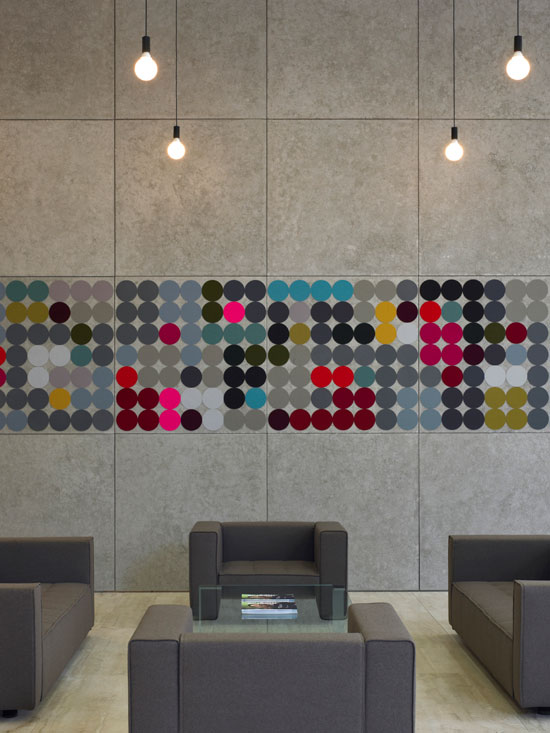
Photo courtesy of ArmourFX, a division of Armourcoat Surface Finishes, Inc.
Modular plaster panels create a finished interior wall that takes advantage of the timeless properties of plaster and the benefits of a contemporary, complete, construction system.
Common Plaster Materials
Plaster is a manufactured product made from lime and different cementitious or stone-based materials depending on the type. It is mixed into a paste or putty by slaking it with water which causes a reaction generating heat through crystallization. In this state it can be worked fairly easily using metal trowels, tools or molds. Ultimately, the hydrated and formed plaster hardens into a strong, durable finish.
The term plaster can refer to several common types including lime plaster, cement plaster, gypsum plaster (also known as Plaster of Paris) and polished style plaster.
Lime plaster:
To make lime plaster, limestone (calcium carbonate) is heated to produce quicklime (calcium oxide) which is then mixed with sand (or other inert fillers). Water is added to the mix to produce slaked lime (calcium hydroxide). Prior to use, additional water is added to form a workable paste. When exposed to carbon dioxide in the atmosphere, the calcium hydroxide very slowly turns back into calcium carbonate, causing the plaster to increase in strength. Whitewash is based on the same chemistry. The plaster used in most lath and plaster construction was mainly lime plaster, with a cure time of about a month.
Gypsum plaster:
An alternative to lime-based plasters is the use of gypsum-based plasters that have a faster curing time. This newer form of plaster grew in popularity primarily because it could speed up the building process. To stabilize lime plaster during curing, small amounts of gypsum plaster (Plaster of Paris) were incorporated into the mix. Because it sets quickly, "retardants" were actually used to slow setting time enough to allow workers to mix large working quantities of lime plaster putty. Today gypsum plaster is used to manufacture gypsum board or “drywall”—so named because it eliminates the need for water on site to mix the plaster. A primary advantage of gypsum and lime plaster is that it is resistant to fire helping to meet building code requirements, reduce potential damage and help protect occupants.
Cement plaster:
Cement plaster is a mixture of suitable plaster, sand, portland cement and water. Instead of covering lath, it is normally applied over masonry on the interior or exterior of a building to achieve a smooth, finished surface. Interior surfaces may sometimes receive a final layer of gypsum plaster for a preferred appearance. Normally, plaster covers less expensive stock bricks while face brick walls are not plastered. Various cement-based plasters are also used as proprietary spray fireproofing products that may use vermiculite as lightweight aggregate. Cement plaster was first introduced in America around 1909 and was often called by the generic name adamant plaster after a prominent manufacturer of the time. The advantages of cement plaster include its strength, hardness, quick setting time and durability.

Photo courtesy of ArmourFX, a division of Armourcoat Surface Finishes, Inc.
Polished plaster can be made from lime and marble powder producing a finished appearance like stone.
Polished plaster:
Polished style plaster combines lime plaster with marble dust or powder to create a natural stone look. The term polished plaster actually refers to a whole range of decorative plaster finishes—from very highly polished stone to the rugged look of textured stone. Polished plaster is mainly used on interior walls and ceilings to produce a finish that looks like marble, travertine or limestone. Such plasters are usually applied over a primer and basecoat base in thin, multiple (from 1 to 4) layers. They are then finished (burnished) with a specialized steel trowel often to a smooth glass-like sheen giving it the illusion of depth and texture. Polished plaster is also usually sealed with a protective layer of wax. When left un-burnished, polished plaster has a matte finish that is rough and stone-like to the touch which is less durable and can be damaged rather easily. However, when applied correctly, polished plaster can be used to create a rock-hard, marble-like finish. This makes it especially useful on surfaces where marble panels could not be installed easily, and on surfaces that would be too expensive to have carved from real marble such as columns, corbels and curved walls. Polished plaster can be tinted, or colored using natural or synthetic colorants, making it particularly desirable when a specific marble color is being sought or when a color that does not exist naturally is wanted.
Marmorino is a type of polished plaster commonly used as decoration on walls. It was used as far back as Roman times, but was made popular during the Renaissance in Venice. It is made from crushed marble and lime putty, which can be tinted with ground terra cotta or other materials to produce a wide range of colors. It can be used to create various textures, from polished marble to coarser natural stone effects. Widely used in Italy, its appeal has spread through North America and even worldwide due to its use by contemporary architects. Because of the hours of workmanship required, however, its pricing often places it in high-end applications, although it is less expensive than cut stone. Nonetheless, many examples can be seen in public buildings, bars, restaurants, etc. Its water-resistant and bacteria-resistant qualities combined with good visual effects have also made it very desirable for luxury bathrooms and other wet areas.
Modern Modular Plaster Panels
The history and quality of plaster as a finish material has generated a renewed interest in using it for more building interior designs. However it can be challenging to find local skilled labor who can work with ‘wet’ plastering on site. Fortunately, overcoming this need for skilled labor and eliminating a wet process from the on-site work has been successfully addressed and solved through the use of custom fabricated, modular, plaster panels.
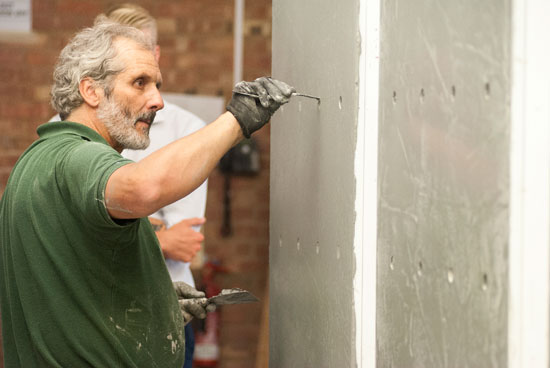
Photo courtesy of ArmourFX, a division of Armourcoat Surface Finishes, Inc.
Modular plaster panels are fabricated in a central location using skilled craftsmen avoiding the need to find local plasterers.
Plaster Panel Fabrication
The use of offsite construction in general is a growing trend that is fast becoming the construction method of choice for both contractors and their clients seeking to meet shorter time schedules, reduce delays and control cost. Modular plaster panel systems fit with this approach quite well since they can be skillfully fabricated to suit a project design, be sent directly to site, and then be readily installed by a local joiner or millworker. This is true whether they are part of a multiple panel array covering large wall areas or are part of a focused statement using single artwork or 3D display pieces.
Modular plaster panels are actually a composite product that uses a wide range of polished plaster finishes applied to a substrate panel. Common substrates are moisture-resistant or fire-rated medium density fiberboard (MDF) or plywood. The solid nature of these types of board stocks assures that a flat, precisely sized panel can be produced. Polished plaster finishes are applied over the substrate and crafted by hand in a climate-controlled setting to assure proper working and curing conditions. The polished plasters are either made from aged lime plaster or pre-hydrated lime plaster with other minor additives used to control working characteristics. Since each panel is custom made, the polished plaster panels are available in a huge range of textures and finishes.
The modular panels aren’t limited to flat finished surfaces. In the tradition of plaster building details, moldings, and art pieces, sculptural and three-dimensional panels can also be made. Gypsum plaster may be used in a mold to achieve quick setting pieces that can have stunning 3D surface textures and effects. Sculptural pre-cast panels are often created by combining computer-aided design with traditional hand sculpting to produce precise designs that still retain the essence of being hand crafted. Design options range from natural flowing patterns to more abstract designs or even corporate logos. When cured, these panels can be finished with standard paint or enhanced with the use of polished plaster or architectural coatings. This type of molded or cast plaster can also be used to create pieces that look and feel like stone. The material and manufacture process are ideally suited to creating shapes and designs that might otherwise be too complex for a hand applied finish of polished plaster.
The Design and Construction Process
Incorporating modular custom plaster panels into a building design is best done through collaborative efforts. The typical process begins when the design and basic specifications developed by the architect or designer are reviewed with the fabricator to be sure that all custom and special requirements can be met. This includes a review of panel sizes, shapes, textures, colors and installation needs. A joint review early in the design process may uncover potential cost savings or design enhancements not otherwise apparent that can be worked into a final design solution.
Photo courtesy of ArmourFX, a division of Armourcoat Surface Finishes, Inc.
Modular plaster panels can be designed to meet a full range of needs and be readily incorporated into a standard construction process.
Once the design is finalized, the order placed and scheduled, then skilled workers create the layout for all of the modular pieces. The appropriate substrate is laid out and sized to meet the exact design requirements, including coordination with installation systems. The specified plaster is then applied according to the design and custom specifications. Once cured and finished, the panels are prepared and packaged for shipping to the construction site. Quite often, the installation system is included as part of the total panel system based on either exposed fasteners, direct applied mounting or a concealed hanging system. The most common installation system uses a concealed “Z” clip system similar to many millwork installations that rely on hanging or securing items to a wall or partition.
The benefits of this modular process begin with greater design control, particularly if collaboration begins early and the end product is properly detailed and specified. By using a manufacturer who provides ongoing skilled labor to execute critical design work, there is no need to seek such skilled labor local to the building project, which may not exist in many cases. From a time schedule standpoint, the plaster panel work can be concurrent with on-site construction work, allowing for overlapping schedules without overlapping tradesman and expediting the work overall, since on-site labor time is reduced. This is further helped by the fact that the time-consuming finishing and cleaning tasks are done off site ahead of installation. For large-scale or multi-location designs, products can be created and timed for repetitive installations without sacrificing the potential for customized variations. In all, the modular plaster panels improve the overall design and construction process with the real potential for superior results all around.
Design Considerations
We have seen how modular plaster products can expand the possibility of incorporating the time-proven benefits of plaster by using modern construction techniques to create labor and time savings. Let’s take a closer look at some of the specific design considerations and options available when deciding to incorporate this system into a particular building design.
Photo courtesy of ArmourFX, a division of Armourcoat Surface Finishes, Inc.
Modular plaster wall panels can be very successfully used across a full range of building types and in a variety of building locations.
Building Types
The design and construction benefits of modular plaster panel systems can be realized in decorative solutions across virtually all building types. The inherent strength and durability of the products means that they are well suited for high use areas and locations where easy care and maintenance are a concern. Beyond that, commercial buildings such as retail, offices, healthcare, hotels, bars and restaurants can benefit from the ability to easily create specialty shapes or corporate logos plus the ability to replicate product designs across multiple properties. Institutional buildings such as religious facilities, cultural centers, government buildings, museums and educational establishments can use plaster panels to accent or enhance public areas within budget constraints. Residential and retirement living centers can benefit from incorporating three-dimensional, artistic features into the design. Even specialty installations such as movie and TV sets, exhibitions and special event structures, can benefit from easy-to-assemble modular panels that can be fashioned to suit a full range of visual and functional needs. From a visual standpoint, with the ability to specify an almost unlimited range of shapes and design treatments in a huge range of finishes, architects and designers have great artistic scope to meet the needs of virtually any building.
Plaster Finish Options
The hand-crafted, custom nature of modular plaster panels means that there are many surface finish choices available to suit different design conditions. Manufacturers offer over 400 standard colors and finishes as a starting point. Custom colors and thematic effects are also readily available to match or enhance other design elements or existing conditions. For example, the plaster surface can appear smooth and uniform in color or be mottled and variegated. The final sheen can be high, medium, or low gloss or a matte finish. Stone or other natural material appearances can be formed by mixing colors and patterns to emulate natural stone such as travertine, limestone or highly polished marble. Alternatively, the panels can look like poured concrete for urban buildings seeking that look. Overall the color, pattern, and gloss level are all customizable based on the plaster make up and finishing process used.
Plaster Texture
While most plaster panels are made from “polished plaster” recall that this term does not necessarily mean that a smooth surface texture is the only option. Rather it is entirely possible to also specify rough, textured surfaces, striated surfaces, pitted appearances and surfaces with natural materials to emulate nature itself. For the most part, any texture option is available with almost any coloring scheme or pattern.
Photos courtesy of ArmourFX, a division of Armourcoat Surface Finishes, Inc.
The plaster can be finished in a variety of textures including smooth, rough, or even wood grained as shown here.
Another texture choice is the creation of wood grain or timber effect panels. These pre-cast products are made as planks cast in a polymer-modified gypsum resin mix. Their design is intended to emulate natural wooden planks with an exposed grain detail and to be used for decorative wall cladding—ideal for interior theming and branding. Two commonly available designs include an original wood grain look or a more rugged look, both of which are typically created from actual Douglas Fir timber planks. The rugged finish is achieved from further hand-distressing of the timber. Available in a range of base wood grain colors, they can be further enhanced once installed with waxes to create a final coloration and finish. Typically, this type of wood grained plaster planks are simply cut on-site as required and then adhered to the wall using a large format tiling adhesive.
Artistic or Custom Shaped Panels
Whether a simple color match, a complex geometric design or an intricate combination of different textures, custom fabricated plaster panels can be used to achieve the desired end result. Manufacturers offer custom color matching used in combination with decorative techniques to create an artistic or creative range that is limited only by the imagination. This can include two-tone effects, multi-color patterns, or the emulation of natural materials. Beyond the color, the shape of panels can be cut or formed as needed to create logos or wall mounted pieces of artwork.
Photos courtesy of ArmourFX, a division of Armourcoat Surface Finishes, Inc.
Custom art shapes, corporate logos, or other three-dimensional shapes can all be custom fabricated in plaster to suit a particular building.
Another creative approach is to use stencils with a designed pattern to add a whole new dimension to plaster surface finishes. Intricate, ornate designs or more geometric repeat patterns can be overlaid to create seamless wall effects, decorative borders or motifs. Textured plaster finishes can form the background that is overlaid through a stencil with a highly polished plaster coat in the same or contrasting color providing a sophisticated or dramatic wall finish. Stenciled designs can be standard or custom made typically using professional grade vinyl. This can have the effect of intricately chiseled or carved stone for a permanent and enduring corporate look. Vinyl stencils can also be used to create applied images such as company logos or free-form wall branding. Color-matching is possible, using Pantone swatches or similar, to ensure a true brand representation.
Photo courtesy of ArmourFX, a division of Armourcoat Surface Finishes, Inc.
Stenciled applications of different plasters and colors can create artistic and varied designs.
Installation
Incorporating modular plaster panels of any type or style into a building design is streamlined when the panels are provided with finished edges and made ready for hanging. Depending on the design and type of panel, modular panel systems can be fitted using high strength tile adhesive, aluminum rail system, or French cleats/Z-clips. We have commented already how wood grain planks are often directly adhered to walls, and this may be suitable for other panels too in some cases. It is more common to use an aluminum mounting system, however with the Z-clip system being the most popular.
Z-clips provide fast installation and ease of hanging the modular panels. Two sets of aluminum members are used. The first is secured along the wall to receive the panels usually with pre-drilled holes for quick and easy attachment. The second set of aluminum members is secured to the back of the panels, sometimes in the factory. The panels are then hung in the field by simply aligning the two sets of clips over each other allowing them to come to rest on each other. Note that in this manner, the panels aren’t actually fastened to the wall directly. This means they are also demountable for access to the wall and any mechanical, electrical, plumbing or other services contained there. It also means that panels can be installed and adjusted laterally and vertically for a proper fit. Once in their final position, the aluminum Z-clips are all hidden by the panel with just a quarter inch space between the back of the panel and the wall. In order to be sure that the final appearance is properly displayed, it is important to note on the construction documents whether the panel is intended to hang horizontally or vertically.
Images courtesy of ArmourFX, a division of Armourcoat Surface Finishes, Inc.
Modular plaster panels can be installed using concealed fasteners in the form of Z-clips or channels with varying degrees of separation possible between the panels (e.g. narrow, wide, etc.).
Green Building Contributions
The U.S. Green Building Council (USGBC) has developed the LEED® rating system for green buildings which has been recognized as the leading green building standard in this country. The LEED 2009 system is in place through the year 2015 which overlaps with LEED version 4 introduced late in 2013. Since buildings are currently being designed under both systems, credits and points may vary depending on the LEED version selected. Nonetheless, there are some inherently good characteristics in modular plaster panels that can contribute to green building design. Environmental Product Disclosures (EPDs) are available from some manufacturers or are in the making and can be requested.
We have noted already that the primary raw ingredient of polished plaster finishes is natural lime. This is mixed together with recycled marble powder which is crushed and graded as a by-product of marble slab and tile manufacturing. This mixture can account for up to 60 percent of the plaster make-up allowing it to contribute to recycled content credits. The result is a positive environmental impact by intervention, ensuring that hundreds of tons of pre-consumer crushed marble each year is re-used rather than sent to a land fill.
In terms of indoor environmental quality, most plaster products have low or zero volatile organic compounds (VOCs) meaning they do not introduce any into the indoor air. Similarly, the plaster finishes are applied to formaldehyde-free substrates such as MDF avoiding the use of that most common VOC. When water-based color coatings are used in the plaster finishing process, they commonly have anti-bacterial and hygiene properties to prevent the build-up of mold, mildew or bacteria. In all, the use of the plaster panels carries little if any impact on the quality of the indoor air.
Specifying Modular Plaster Panel Systems
When specifying modular plaster wall panels, the various choices and specification details need to be properly identified. Coordination with manufacturers during the design phases of a project will help gain insight into details, cost drivers, installation requirements and fabrication lead times. Some of the relevant items to address in a standard 3-part specification format are highlighted as follows, some of which can be verified or coordinated with information available from manufacturers.
Part 1 - General
Quality assurance is often addressed by citing specific national testing and standards for products. In the case of modular plaster wall panels, there are several that are particularly relevant:
• Mold/Mildew Resistance ASTM D 3273/3274
• Pencil Hardness Samples ASTM D 3363 - Shore D Hardness
• Scrub Resistance ASTM D 2486 – 79
• Impact Resistance ASTM D 2794
• VOC levels ASTM D3960
• Fire Test ASTM E84 – 98 - Interior panels should be tested for surface burning characteristics and rated accordingly.
Other key General specification information includes the appropriate request for submittals and shop drawings that confirm that the correct wall panels are being ordered and fabricated. Further a full warranty should be called for and submitted that demonstrates coverage for a reasonable period of time.


Photos courtesy of ArmourFX, a division of Armourcoat Surface Finishes, Inc.
Specifying modular plaster panels should include color, texture, and installation systems to assure a complete interior design and construction solution.
Part 2 - Products
Identifying the specific modular wall panel products that are desired requires covering several items. If multiple product types are selected for a building, then obviously they each need to be specified and their locations identified on the drawings.
• Panel shape and size: Size and shapes of the panels are generally shown on the drawings, but parameters for minimum and maximum sizes can be addressed in the specifications.
• Panel type and finish: Fundamental to the panel appearance is the choice of texture and finish being used. The choice should be influenced based on interior design requirements or the overall design properties being sought. The specific color and finish of the panel should be identified based on either standard manufacturer choices of custom specifications.
• Substrate: The type of substrate used to receive the plaster should be identified (MDF, plywood, etc.) including the thickness and other characteristics as appropriate to define its strength and rigidity.
• Adhesives: If an adhered installation is anticipated the specific type of adhesive should be called out that is compatible with both the substrate and wall materials. All adhesives must also meet code and testing requirements.
• Attachments: Concealed fastening with Z-clips is often part of a manufacturers system. As such, it should be specified to be provided by the same company that provides the panels as a complete, integrated system.
• Accessories: Fasteners and joint sealers may be recommended by the manufacturer but need to be addressed to be sure they are appropriately suited to the particular building application.
Since some aspects of products vary between manufacturers, using the specification items above will aid in product to product comparisons during design and assure appropriate installations during construction.
Part 3 - Execution
Installing pre-fabricated modular wall panels is fairly straight forward but requires appropriate attention to detail to assure the desired outcome is achieved. It is important to note that hand crafted processes produce a beauty and appeal that comes in part from variations in the surface and appearance. Everyone involved should expect this variation within the normal range of tolerances for any given finish.
• Examination and Preparation: The interior wall system that is receiving the panels needs to be in place and accessible. It should all be inspected for completeness and conformance with the building design and adequacy for correct attachments before the wall panels are installed.
• Installation and Field Quality Control: Since it is the installation of the fastening system that can determine if the panels end up appropriately aligned, level, and plumb, special attention should be paid to aligning clips or channels properly. Installers should definitely follow manufacturers’ instructions and approved shop drawings and comply with allowable tolerances.
• Repairs: In the event of any minor damage or blemishes, consult the manufacturer of the panel. It is likely that simple field repair may be possible instead of returning and re-fabricating a particular panel.
• Cleaning and Protection: The nature of most panel finishes is to be fairly smooth and easy to clean. Consult manufacturer’s instructions to avoid the use of anything that would harm or deteriorate the finish.
Conclusion
The historical appeal of plaster surfaces has been married with modern construction techniques to allow the creation of beautiful and durable interiors that can help with green building designs. Emulating natural stone, urban concrete, highly polished marble, wood grain planks, or a host of other finishes, modular plaster panel products are competitively priced, lightweight, and do not require a specialist for mounting or installation. Design-led modular surface solutions include decorative wall panels and 3D display items that can be used to create unique branding or artistic statements. A complete integrated system can be supplied by manufacturers who can be strong collaborators during the design and construction process. When complete, the finished products provide a durable, appealing, and easy to maintain interior surface for a wide range of building types.
Peter J. Arsenault, FAIA, NCARB, LEED AP, is an architect and green building consultant who has authored over 100 continuing education and technical publications as part of a nationwide practice www.linkedin.com/in/pjaarch
 |
Armourcoat now offer custom-made modular surface solutions, evolved from their renowned range of applied seamless wall finishes – introducing ArmourFX.
A team of specialist designers and artisan plasterers can create integrated custom wall panel systems, design statement single artwork pieces or 3D display items. Whether you are looking for a sculptured form, or a creative stencil technique to overlay exquisite hand-applied Venetian or polished plaster, ArmourFX can provide a unique - but competitively priced – solution. www.armourfx.com |