This CE Center article is no longer eligible for receiving credits.
The One World Trade Center Spire...the Salvador Dali Museum...the Cotton Bowl...Faneuil Hall—all modern signature projects that have incorporated hot-dip galvanizing. Used in industrial applications for more than a century where corrosion protection was critical, the process of hot-dip galvanizing—steel coated with zinc—is being used increasingly by architects to achieve sustainable, aesthetic results. Though corrosion resistance is implicit in any specification of galvanizing, designers are also recognizing that the process affords low initial and life-cycle cost, durability, longevity, and versatility. This article will introduce hot-dip galvanizing as a sustainable process, outlining the environmental and economic benefits, the design considerations, and aesthetic possibilities. Also highlighted will be case studies where hot-dip galvanizing has helped achieve these goals.
Hot-Dip Galvanizing: Steel + Zinc
Hot-dip galvanizing is the process of coating fabricated steel by immersing it in a bath of molten zinc. The process is part of a green solution for today's buildings and offers a cost-effective, low-maintenance method of enhancing steel performance by providing superior corrosion protection. Although corrosion is a naturally occurring phenomenon, it has significant consequences, financial and otherwise. Every year, corrosion costs an estimated 3 percent of the gross domestic product in the U.S./Canada, and $2.2 trillion worldwide. Beyond that, corrosion wastes natural resources and can result in loss of structural integrity and outright structural failure—scenarios that can be reduced by effective protection systems that are best deployed at the start of a project. While protective coatings for steel differ widely in terms of cost, performance, sustainability, and durability, hot-dip galvanizing is one sustainable system that has proven real-world performance in combating corrosion for decades.

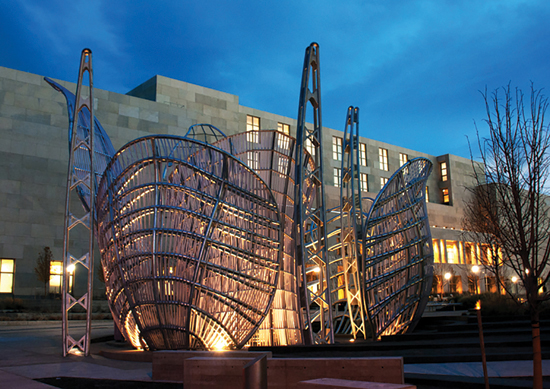
Photo courtesy of American Galvanizers Association
A duplex system was selected for the Salvador Dali Museum in coastal Florida.
The Materials—Common, Safe, Sustainable
In hot-dip galvanizing, the two main materials, zinc and steel, are sustainable—they are nontoxic, abundantly available, and 100 percent recyclable without any loss of chemical or physical properties.
Zinc is the 27th most abundant element in the earth's crust, zinc exists naturally in air, water, and soil, and is present in rocks and many minerals in varying amounts. Plants and animals as well as rainfall and other natural activity cycle some 5.8 million tons of zinc annually through the environment. Ever since the beginning of time, organisms have adapted to the zinc in their environment and use it for specific metabolic processes. Zinc is essential for all life, in the areas of digestion, reproduction, kidney functioning, breathing, diabetes control, taste, smell, and other areas. The World Health Organization (WHO) estimates 800,000 people in developing nations die annually because of insufficiency of dietary zinc, symptoms of which range from immune dysfunction and mental lethargy to vision issues and fertility problems, respiratory and skin allergies, and premature aging. Zinc's healing properties are evidenced in the medicinal substances that are taken regularly. Is there anyone of a certain age who doesn't remember putting zinc on their nose to guard against sunburn? In addition to blocking more UV rays than other substances, zinc is widely used in treating many skin conditions, including sunburn, diaper rash, acne, cold sores, dandruff, wounds, burns, and surgical incisions. Zinc is also used in cosmetics and, in tablet form, has been recognized as a treatment for symptoms of the common cold.
Steel has a high strength/weight ratio and is known for its structural integrity. Its inherent strength facilitates design flexibility, accommodates a variety of aesthetics, and enables functional designs with long spans and curves. Because it is produced in accordance with national standards, there is no regional variation, hence hot-dip galvanized steel provides a consistent material quality. Steel is fire resistant, and does not burn or fuel a fire. As an inorganic material, it will not rot, split, or crack, twist or warp. Steel is light and easy to transport, and has a relatively rapid construction period. It creates minimal raw material waste, and at the end of its long life, steel can be fully recycled—in fact, it is among the world's most recycled materials.
As steel, like all building materials, corrodes when exposed to the atmosphere, it is important to deploy corrosion protection methods when steel is used in projects. To meet the demands of the long design lives of large modern development projects, many of which target a 50- to 100-year service life, hot-dip galvanizing offers corrosion protection in three levels—barrier protection, cathodic protection, and the zinc patina.
Barrier protection is the basic line of defense. The hot-dip galvanized coating isolates the steel from electrolytes in the environment, much like paints do. The protection is stable insofar as this barrier is not breached; however, corrosion will occur once the barrier begins to deteriorate. To ensure the integrity of the barrier, the coating must possess two critical properties: It must adhere to the base metal and it must be resistant to abrasion. With regard to these two parameters, zinc is an ideal barrier coating. Its corrosion rate is a fraction of steel's, so that a thin coating of zinc becomes similar to a significantly thicker steel element. Zinc's tightly bonded, impervious nature is far preferable to that of coatings like paint, which have pin holes that allow penetration of the elements, causing rapid spread of corrosion.
The Galvanic Series of Metals lists metals in order of electrochemical activity in seawater. Zinc is higher on the list than steel, meaning it is anodic to steel and thus offers cathodic or sacrificial protection. In cathodic protection, zinc will corrode to protect the steel beneath. Should the hot-dip galvanized coating be damaged so that the steel is exposed, corrosion will only begin after all the zinc is eroded. In “sacrificial” action, zinc will protect the steel even where cut edges, drill holes, scratches, surface abrasion suffered during steel erection, and the like may have exposed small spots of underlying steel. That said, bare spots do lessen the life of the coating, so it is best to touch up those exposed areas. The zinc will prevent underfilm corrosion, which spreads across a piece, much like under a paint coating.
Lastly, zinc patina, or zinc corrosion on the steel surface, offers a third level of protection. Like all metals, zinc corrodes when exposed to the atmosphere. But the naturally occurring corrosion of zinc produces by-products— zinc oxide, zinc hydroxide, and zinc carbonate—that result in a patina that, when fully developed, actually slows zinc's corrosion rate to about 1/30th the rate of steel in the same environment.
The Process
The galvanizing process consists of three basic steps: surface preparation, galvanizing, and inspection, with surface preparation representing the most important step in the application of any coating. In most instances, coating failure is due to incorrect or inadequate surface preparation. In the galvanizing process, the surface step has its own built-in quality control. Zinc will not react with unclean steel, and any failures or inadequacies in this step are obvious—when the steel is removed from the zinc bath, unclean areas remain uncoated, enabling timely action to correct the situation.
Three steps are involved in preparing the surface: degreasing, pickling, and fluxing. In the first step, dirt, grease, and oil are removed by a hot alkali solution, mild acidic bath, or biological cleaning bath; however, epoxies, vinyls, asphalt, or welding slag may require stronger methods such as grit-blasting, sand-blasting, or alternative mechanical means. In pickling, mill scale and rust are removed from the steel surface via diluted and heated sulfuric acid, and ambient hydrochloric acid. Lastly, fluxing is the final surface preparation step. A zinc ammonium chloride solution both eliminates residual oxides and deposits and creates a protective layer on the steel to prevent further formation of oxides before the steel is dipped in the molten zinc bath.
In the galvanizing phase, steel is immersed in a zinc bath heated to at least 815 degrees F. A crane hoist lowers the steel at an angle so air can escape from pockets in the steel, to be replaced by the molten zinc. In the kettle, zinc reacts with the iron in the steel to form a series of zinc-iron intermetallic alloy layers. The galvanized steel is then slowly removed and inspected primarily for coating thickness and coating appearance. Generally speaking, visual inspection is considered adequate, although basic physical and laboratory tests can establish whether thickness, uniformity, adherence, and appearance of the coating are consistent with long established and approved standards of ASTM.
The Benefits
Hot-dip galvanizing confers numerous benefits that are important to architects and owners.
▶ Durability. Because of its superior ability to stand up to harsh environments, hot-dip galvanizing has been widely utilized in such demanding fields as the petrochemical, industrial, and power/utility industries and on bridge and highway projects. The durability is a function of abrasion resistance, uniform protection, and complete coverage. A unique characteristic of the hot-dip galvanized coating is the development of metallurgically bonded, abrasion-resistant intermetallic layers with high bond strengths up to 3,600 psi developed naturally during a metallurgical reaction between the iron in the steel and zinc in the kettle. The top layer is pure zinc, which has the ductility to minimize damage to the coating. Compared to other coatings with lower bond strengths, many of which range between 300-600 psi, hot-dip galvanizing's abrasion resistance protects against damage from transport, erection, and service.
Hot-dip galvanizing also provides uniform protection. During the metallurgical diffusion reaction in the galvanizing kettle, the galvanized coating grows perpendicular to all surfaces, providing the same thickness throughout—on flat surfaces as well as corners and edges, where damage is typically experienced. Other coatings, particularly those applied by brush or spray, can thin at corners and edges, which become weak points for corrosion. Further, the steel is fully submerged, with molten zinc coating all surfaces, even the interior of hollow and tubular structures, where corrosion can accelerate as humidity and condensation occur. Hollow structures that are painted have no corrosion protection on the inside at all. Further, the immersion process fully coats all fasteners which, because they are used at connection points, are particularly critical to structural integrity.
It is important to note that while galvanizing is commonly used to connote all types of zinc coatings, this is an erroneous assumption. Not all zinc coatings have the same properties, and physical, chemical, and corrosion resistance can vary widely. Compared to metallizing, zinc-rich painting, sheet galvanizing, electroplating, and zinc (mechanical) plating, hot-dip galvanizing provides more uniform coverage and a significantly higher metallurgical bond.
▶ Versatility. Complex fabrications and forms of virtually any shape and size from bolts to beams can be hot-dip galvanized. Unlike other corrosion protection systems, the process is factory controlled and not dependent on temperature or humidity. There are no curing delays as zinc solidifies upon withdrawal from the bath, and the entire hot-dip process can be completed, and the elements shipped and erected in a day's time. Alternatively, galvanized steel can be stored on site for years as the coating is not susceptible to UV degradation or damage from the elements, enabling owners to maintain an inventory for easy replacement, saving time and often, money.
▶ Low maintenance. More than a hundred years of third-party testing of hot-dip galvanized steel in industrial, rural, suburban, tropical marine, and temperate marine environments together with statistical methods, and neural network technology enabled Dr. Gregory Zhang of Teck Metals Ltd. to formulate the Zinc Coating Life Predictor (ZCLP) to approximate the service life of hot-dip galvanized coatings. This predictor allows users to plug in parameters for their specific environment to determine an estimated time for first maintenance, considered at 5 percent rusting of the base steel surface, which means 95 percent of the zinc coating is still intact—the point at which initial maintenance is recommended. As can be seen in the accompanying chart (see the online version of this course), hot-dip galvanized structural steel provides 72-73 years of life to first maintenance even in the most corrosive atmosphere—industrial.

▶ Efficiency. Uncomplicated steel structural frame designs can be developed quickly and cost efficiently. Pre-fabricated and galvanized off-site at indoor plants, the steel members move quickly through the galvanizing process without interruption by inclement weather for a quick production phase. Their light weight relative to materials like concrete makes steel beams less costly to transport and reduce on-site crane and caisson requirements. Generally speaking, steel-framed systems can be constructed at 10 to 20 percent savings over concrete alternatives.1
Design Considerations
When considering a structural system, architects will want to consider a number of factors to ensure a proper specification decision.
Aesthetics
Hot-dip galvanized steel offers a natural gray finish consistent with a clean, contemporary aesthetic. As galvanized steel weathers and the zinc patina forms, the material assumes a uniform matte gray color that blends unobtrusively in wooded areas and offers the non reflectivity desirable in more densely populated areas. When color is preferred, powder coating can be added—a scenario that achieves both visual effect and added protection. In fact, architects are increasingly recognizing the value of combining hot-dip galvanizing with a powder coating in what is known as a duplex system. In this arrangement, painting or powder coating is applied over hot-dip galvanized steel, offering a synergistic protection system that is far superior to either system alone. The paint provides an added protective layer that prevents degradation of the zinc and the galvanized steel maximizes the life of the paint by preventing underfilm corrosion and cracking.
European studies2 indicate that the zinc-paint combination will last 1.5 to 2.3 times longer than either system alone, meaning that a 70-year galvanizing life and a 10-year paint life will produce coating with a life of 120 to 220 years. The synergistic effect increases the life of the paint 1.5 to 2.0 times vs. application over black steel. Eliminating or minimizing the need to regularly repaint saves significant costs, too. To ensure effectiveness of the duplex system, particular attention must be paid to proper surface preparation with coordination among the designer, fabricator, galvanizer, and painter/coater recommended throughout the process.
Duplex systems have been incorporated in many high-profile projects. One example is the Salvador Dali Museum in St. Petersburg, Florida, a work of art reflective of the artist's characteristic juxtaposition of classical and fantastic elements. The structure, designed by Yann Weymouth and Novum Structures, features an undulating, abstract 75-foot glass structure that flows from the plaza up and around the cubist “treasure box” museum. Located in the highly corrosive Floridian coastal environment, designers faced several challenges. While a durable, low-maintenance corrosion protection system for the steel was a given, the steel substructure had to meet the highest aesthetic standards without distracting from the glass structure. The scale and complexity of the architectural elements meant that the steel elements had to be fabricated, processed, and delivered to the jobsite in a well-thought-out sequence to minimize loss and downtime. Incorporating a duplex system of powder coating over hot-dip galvanized steel for corrosion protection proved to be the ideal solution for addressing these issues—the powder coated finish enabled color selection that would blend with the facility, while the galvanized steel beneath ensured long-lasting corrosion protection.
Designers of Boston's Chinatown Park also opted for a duplex system to afford corrosion-resistant protection and to incorporate brilliant colors that express a modern take on traditional village festival spaces, contemplative gardens, gateways, garden walls, flowing water, and Asian plantings. A stylized sampan sail, fabricated in stainless steel and LEDs, and the duplex coated steel gateway in vermillion are striking elements of the park.

Photo courtesy of American Galvanizers Association
In Boston’s Chinatown Park, the duplex system provided striking color and corrosion resistance, creating long-lasting iconography for area residents and visitors.
Hot-dip galvanized steel also facilitates complex projects. Designers of the 3,000-space parking facility at the rapidly growing Charlotte Douglas International Airport, for example, wanted to depart from the traditional parking “box,” preferring a structure more like a curved airplane wing. Accordingly, architect and engineer formulated a design that attaches stainless steel cladding to a galvanized structural steel frame. Three hundred tons of hot-dip galvanized steel were used in the project including bow-string trusses, embed plates and anchors, stair towers, stairways, hand rails, and castellated beams. Galvanized steel was specified for its overall aesthetic appearance, its maintenance-free service life that will enable the structure to remain corrosion free well into the future, and its compatibility with stainless steel. When used together, galvanized and stainless steel provide a uniform appearance and an economical alternative to specifying stainless steel for the entire structure.

Photo courtesy of American Galvanizers Association
The Charlotte International Airport parking garage was a complex project involving 300 tons of hot-dip galvanized steel.
ASTM Standards
Three specifications pertain to the coating thickness, adherence, and finish for hot-dip galvanized coatings: ASTM A123, A153, and A767. Of the three, ASTM A123 is the primary specification, and references galvanized products except fasteners and small parts, which are governed by A153, and reinforcing steel bars, covered by A767. A few supporting specifications referenced in these specifications cover design practices, repair and touch-up, and painting over galvanizing, notably ASTM A143, ASTM A384, and ASTM A385. Further, ASTM A780 covers touch-up and repair and ASTM D6386 and ASTM D7803 refer to hot-dip galvanizing for paint or powder coating. A compilation of these specifications appears in Selected Specifications for Hot-Dip Galvanizing.
Profiles
In designing steel elements for hot-dip galvanization, architects must consider the capacity of the galvanizing kettle. The average kettle length in North America is 40 feet, and there are many kettles between 50-60 feet. If larger-scale design elements are specified they can almost always be accommodated by fabricating modules geared to available kettle facilities—a scenario that often generates savings as smaller modules simplify handling and transportation, and can be connected on-site by field-welding or bolting. Alternatively, if an item is too large for total immersion in the kettle, but more than half of the item will fit into the kettle, the piece may be progressively dipped; consultation with the galvanizer is recommended during the design process. Weight is another consideration as hoists and overhead cranes move the steel elements through the kettle. While elements less than 30 inches long are often galvanized in perforated baskets, larger assemblies are usually supported by chains or other lifting fixtures. Any marks from these fixtures can usually be touched up if desired for aesthetic reasons. Best practice is to discuss the weight-handling capacity with the galvanizer to ensure lifting capacity and the best places for lifting points.
Sustainability
Many architects and owners are interested in pursuing accreditation from the U.S. Green Building Council's Leadership in Energy and Environmental Design (LEED), the premier green rating system for building design and performance. While LEED v4 was approved in 2013, architects can select either that system or LEED 2009 through June 2015.
In LEED 2009, galvanizing can contribute to points primarily through credits for recycled content. Specifically, two points can be earned in the Materials & Resources Credit 4: Recycled Content as more than 20 percent of the total value of the material comes from recycled sources. With their ultra high recycling rates, zinc and steel allow the galvanizing process to score an “extra credit” point under Innovations in Design Credit 1: Path 2 Exemplary Performance because the recycled content actually exceeds 30 percent. Other possible points can be earned under MR Credit 5: Regional Materials, MR Credit 3: Materials Reuse, and ID Credit 1: Path 1 Innovation in Design and ID Credit 1: Path 2 Exemplary Performance.
LEED v4 is different than its predecessors in that it has moved from a prescriptive checklist to a more holistic measure of environmental impact and greater transparency with regard to materials. There is an emphasis on Environmental Product Declarations (EPDs) which detail the materials used in a building and their economic impact (such as an LCA), the environmental impacts all along the supply chain, and material ingredient lists. Currently, EPDs, and material ingredient lists and supply chain information are in the works for the hot-dip galvanizing industry.
Cost
Contrary to the long-standing misconception that hot-dip galvanized steel is cost prohibitive on an initial basis, the process offers savings both in upfront and life-cycle expenses. Technological advancements have made galvanized steel competitive and even less costly than alternative systems.
Using the galvanizing cost data3 obtained through a 2014 survey of North American hot-dip galvanizers and, most importantly, paint cost data taken from paint manufacturers, an online life-cycle cost calculator4 (lccc.galvanizeit.org) was developed that can track comparative costs of various coating systems. Consider the following example that compares hot-dip galvanizing to paint systems, a metallized solution, and duplex system for a hypothetical 50,000-square-foot project—which could represent a bridge, a light rail station, or a stadium—with a 75-year design life in a moderately industrial environment.
The example incorporates first costs of the material, the number of coats required, and the cleaning system, including labor costs. All systems were cleaned to their relevant standards. The figure for galvanizing is an all-inclusive price, as galvanizer quotes include surface preparation, material and labor costs, though not the fabricator mark up which tends to vary widely. A typical mix of structures was used, which may result in galvanizing cost savings over paint, as galvanizing can more efficiently bundle steel elements. Yet even comparing medium or large elements, galvanizing still comes out less expensive or within a few cents per square foot of the alternative systems. Further, as the cost of these alternatives has risen over the past decade, hot-dip galvanizing has shown price stability.
Comparative Cost Analysis
Even when life-cycle costs are considered, hot-dip galvanizing ranks ahead of the other systems. In a comparative analysis5, galvanizing came out as the most cost effective followed by the duplex system, a galvanized plus painted system. The analysis presumed a 75-year lifetime as a realistic timeframe before modification, as opposed to an ideal maintenance cycle that would be far more costly for those systems that require regular maintenance.
The results, also summarized in the accompanying table, are as follows:
• Hot-dip galvanizing—cost increase 105 percent
• Duplex system (galvanizing/epoxy/polyurethane)—cost increase 300 percent
• Inorganic zinc/epoxy—cost increase 1,150 percent
• Inorganic zinc/epoxy/polyurethane—cost increase 818 percent
• Epoxy/epoxy—cost increase 1,675 percent
• Epoxy/polyurethane—cost increase 1,738 percent
• Metallizing—cost increase 650 percent
Hot-Dip Galvanizing: Making Steel Sustainable
While it is a naturally occurring phenomenon, corrosion is costly to repair and can have disastrous effects on the structural integrity of a building. Sustainable, cost-effective corrosion protection systems are critical for all buildings with steel elements, and particularly those in marine or other harsh environments. Hot-dip galvanizing is one such system that has been used for more than a century with maintenance not required for up to 75 years. Traditionally used in such demanding industries as power and petrochemicals, today's architects are using hot-dip galvanizing, and duplex systems that combine this process and paint, to aesthetic effects in buildings of all types, ensuring that they remain durable and visually appealing for decades. As sustainability continues to dominate the global agenda, architects and owners will increasingly rely on solutions like hot-dip galvanizing to meet green building goals within an aesthetic, economical framework.
Endnotes
- American Institute of Steel Construction (AISC). Innovative Solutions in Steel: Open-Deck Parking Structures. 2003.
- Duplex Systems, J.F.H van Eijnsbergen, Elsevier, 1994, p. 7
- KTA Tator, Inc Paper No. C2014-4088 Expected Service Life and Cost Considerations for Maintenance and New Construction Protective Coating Work (2014)
- ASTM A1068-10 Standard Practice for Life-Cycle Cost Analysis of Corrosion Protection Systems on Iron and Steel Products.
- Ibid.
 |
| The American Galvanizers Association is a non-profit trade association that serves as the unified voice of the North American hot-dip galvanized steel industry. The AGA provides architects, engineers, specifiers, fabricators, contractors, and galvanizers technical support on today's innovative applications and state-of-the-art technological developments in hot-dip galvanizing for corrosion control. www.galvanizeit.org |