This CE Center article is no longer eligible for receiving credits.
Constructing exterior walls using framing systems, whether metal or wood, continues to be a very common and popular technique across the United States. Materials that are readily available and construction methods that have been well understood for decades allow lightweight walls to be easily constructed in residential, commercial, and even industrial buildings. However, exterior framed walls are an important part of the building envelope and if they are not designed and installed to address all of the forces at play in them, serious problems can arise. Breaches in thermal insulation, air barriers, or vapor/water barriers can cause water, air, and moisture to penetrate the wall system, causing deterioration. Further, if the conditions are right, then mold can form which has been widely identified as a health hazard. In severe cases, structural failure can occur. Hence, design professionals must address framed exterior walls as part of the larger building envelope. They also need to have knowledge of some of the science behind exterior framed walls, particularly how materials will integrate and perform in a given wall assembly. Through an informed design process and discriminating product selection, architects and other professionals can then produce effective, functional, and long-lasting exterior framed walls, avoiding the problems of poor wall design.
Framed Exterior Walls Overview
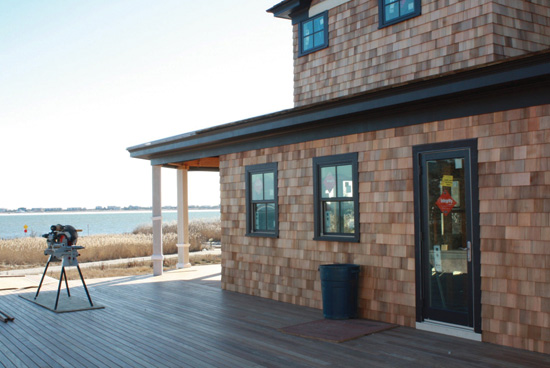
At the most basic level, exterior framed walls are part of the building envelope that define the boundary between inside and outside. Inside, buildings contain conditioned space, meaning that the air is heated, cooled, or at least filtered. Outside, the weather and other environmental conditions dominate. The wall provides the separation between the two. The opaque wall areas provide the full degree of separation while openings (e.g. doors, windows, etc.) are used to allow passage of people, air, light, etc. as needed or desired.
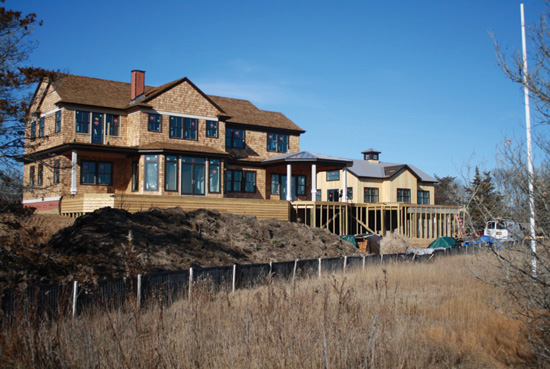
Photo courtesy of CertainTeed Insulation and Sunset Green Home, Southampton, New York
Framed wall construction has been commonly used in a variety of locations and climates and needs to address multiple factors related to building science.
In creating this building envelope separation, we impose a lot requirements on a framed wall assembly. First, it needs to provide the appropriate degree of strength and rigidity, whether in response to imposed building loads, wind loads, or use requirements. This is usually achieved by a combination of framing member size, sheathing, and structural reinforcing as required. But we all know that other materials are required to create the full separation. To address interior needs, insulation is required to control heat flow, air barriers are needed to restrict unwanted air flow, and vapor barriers are required to prevent airborne moisture from entering into the wall assembly. On the exterior, the wall assembly needs to provide complete rain and weather protection. Throughout, building codes and standards will dictate material performance requirements including fire containment and control in some cases. And of course, the owner and design team will care about the economics of the system not to mention the final appearance and other considerations such as wall thickness and how that integrates with the rest of the building construction. Altogether, a framed wall assembly is a collection of a lot of different materials that need to come together to meet all of these different requirements and will directly impact the long-term comfort of the occupants, energy use of the building, and even the quality of the indoor environment.
Photos courtesy of CertainTeed Insulation
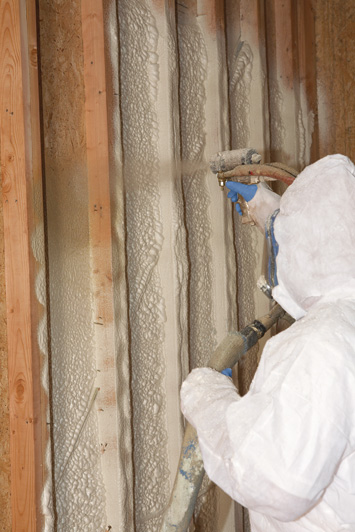
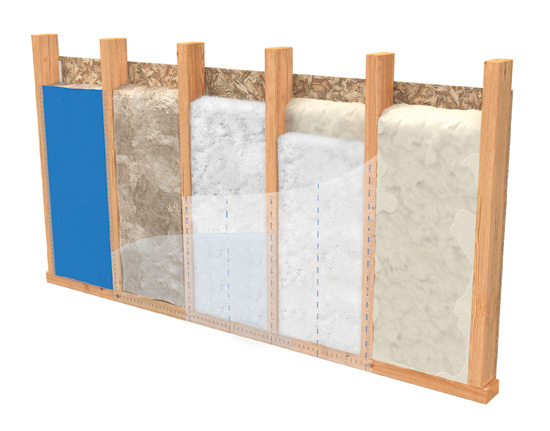
Different types of insulation are available to restrict thermal flow in framed walls including batts, blown in, and spray foam insulation products.
A properly designed and specified framed wall assembly delivers on the promise of overall integrity through a scientific analysis of materials and an understanding of the compatibility of different components of the assembly. Among the more significant factors is the clear continuity of each of the needed barriers (thermal, water, air, vapor) so that breaches do not occur and undermine the performance or integrity of the wall. But we are probably all too aware that defects and even failures in wall systems can and do occur. Why? There are known causes in both the design of walls and in their construction. For a designer, a lot of technical information has become available in recent years that can seem contradictory at times, making a clear design decision seem difficult to discern. Sometimes new or unproven systems or materials are specified without fully reviewing them only to discover too late that they do not live up to expectations. In other cases, failures may occur because different materials were incompatible or not properly integrated or interfaced into other construction systems. And there is also the thought that a single product can take care of a particular need without providing any back up or contingency in the design in case something does go awry.
There is another more basic, and common, mistake that can be made by design professionals too, namely to ignore climate differences found in different locations. A framed wall assembly that works just fine in one location may produce significantly different results in another. That is why energy codes and standards, along with government agencies, have identified and adopted climate zones as the basis for building envelope design across the United States. There are eight identified climate zones ranging from very warm and humid in the south to much colder and dryer in the north, and plenty of variations in between. Before any design, construction, or permitting processes start, the proper climate zone must be identified for a given building and the assembly developed to match that zone accordingly.

Image courtesy of CertainTeed Insulation
The eight climate zones of the United States have been adopted by energy codes and standards as the basis for determining building envelope needs.
Once bidding and construction begin, there is often the temptation to “value engineer” alternatives into the constructed building. Now in some cases value engineering can be a legitimate and useful tool. But improperly applied to frame wall assemblies, it may only save short-term construction costs at the expense of reduced long-term performance and potential cost exposure later on. During construction, quality control of the installed work is needed to achieve the intended results of any wall assembly and the only way to assess that is through routine inspection of the work as it progresses. This can help eliminate any questionable construction practices or work that is inconsistent with the contract documents, but it can also reveal any installation or procedural errors that can create defects that impact the performance of the wall.

Photo courtesy of CertainTeed Insulation
Numerous demands are placed on exterior framed wall construction to provide structure, protection from the elements, and integrity of materials over time.
Beyond routine field observation and inspections, building envelopes are increasingly subject to commissioning just as mechanical and electrical systems are. The logic behind this is simple since, in the broadest sense, commissioning helps ensure that building systems are designed, installed, tested, and capable of being operated and maintained according to the design intent and the owner's operational needs. Independent, objective, and qualified commissioning agents are typically used to perform this service which helps to assure that the review is impartial and appropriate. Informed by building science, and often motivated by avoiding potential problems, the use of commissioning agents for building envelopes, including framed exterior walls, is becoming more common.
Framed Wall Building Science
Simply put, the term building science describes the observation and application of scientific principles to buildings. The National Institute of Building Sciences (NIBS) offers a more complete insight in their publication the Whole Building Design Guide (WBDG, www.wbdg.org/resources/buildingscienceconcepts.php): “Building science is a field of knowledge that draws upon physics, chemistry, engineering, architecture, and the life sciences. Understanding the physical behavior of the building as a system and how this impacts energy efficiency, durability, comfort, and indoor air quality is essential to innovating high-performance buildings.” Since the nature of buildings is broad and diverse, it is not surprising that this definition is too. When it comes to framed exterior walls, however, there are four key elements of building science that are more focused which are summarized as follows:
Heat Flow
The fundamental rules of physics tell us that heat energy radiates in all directions from a source. If air or water is heated by that source, the warmed air or water will become less dense and rise which can cause convection currents to occur. If a heat source is in contact with a solid material then that material can conduct the heat directly through it. In all cases, once released, heat will always flow from a warm location to colder one, striving to achieve equilibrium between the two. The ability and time required to do that will depend on the degree of either connection or thermal separation between the two locations, for example inside and outside of a wall.
Air Pressure and Flow
In the natural environment, air pressure will vary based on things like weather, climate, altitude, etc. In man-made situations, such as airplane cabins and buildings, air pressure will also vary either by circumstance or by design. Once again the rules of physics tell us that equilibrium is the natural condition that is sought. In this case that means that higher pressure air will move or flow to an area of lower pressure air until the pressure is balanced between the two locations. That is why tires go flat on cars or bicycles and it is why air moves into or out of buildings. We can influence that movement passively by how tightly we seal rooms or walls or actively through the use of HVAC equipment that can create higher or lower pressure in selected areas.

Image courtesy of CertainTeed Insulation
Air flow in a building carries heat and moisture with it which can infiltrate exterior wall assemblies, causing unwanted consequences.
Moisture Movement
Water is not only among the most abundant substances on earth, it is one of the few that we experience regularly in three forms—as a liquid (water), a solid (ice), or a gas (vapor). While all three forms can have an impact on buildings, it is airborne water vapor, also called moisture, which can be the most troubling. The amount of moisture in the air for a given location is measured in terms of the relative humidity (RH) of the air. It is usually expressed as a percentage of the amount of moisture that is in the air compared to the maximum amount that the air can hold at its current temperature. Fundamentally, warm air can hold a higher maximum amount of moisture than cold air meaning that the RH can change as the temperature changes, even though the moisture content remains the same. So a body of air that has a fixed amount of moisture in it will see its RH fall as the temperature rises since its capacity to hold more moisture increases with the temperature rise. Similarly, RH will increase as the temperature falls.
There is a point, however, where the temperature and RH will coincide to allow for the airborne vapor to cool and condense into liquid form. We know this as the dew point and can observe it in action on a chilled drink container on a hot summer day. In a concealed wall system, we may not be able to observe it, but the same condensation will occur if the dew point is reached inside that wall. How does that happen? First, moisture has to penetrate into the wall assembly. Since the movement of moisture is directly related to the movement of the air which it inhabits, that means that any openings in the wall assembly that allow air to move into it, allow the moisture in that air to move into it too. Further, since warm air will want to move toward cool air, the temperature of the air will influence the rate and direction of air flow. The vapor in the air could also directly penetrate the surface material of the wall in a process known as diffusion. Materials are rated on their ability to allow or prevent this diffusion by a permeability rating or perm rate. However the moisture enters a wall system, the combination of RH and temperature need to combine to create a dew point condition which will then cause condensation to occur.
Climate Variations
The eight different climate zones noted earlier each have their own characteristics and implications as they relate to building science. The zones are based on the 45-year average number of annual degree-days. A degree day is determined by calculating the number of days that a location is above or below a baseline temperature (65°F in this case) times the number of degrees that it is above or below that base. They are separated into heating and cooling degree-days to indicate how hot or cold a location is relative to the base on an annualized basis. The differences in zones reveals the variations in heating and cooling requirements that exist in different parts of the country. The significance is that heat flow, air pressure, and moisture movement are all affected by differences in climate since they are all affected by differences in temperature and other factors represented in those climates. Places that experience colder temperatures with lower relative humidity will have different patterns of heat, air, and moisture flow than places that are warmer and more humid. Hence, climate differences are a significant and relevant factor in understanding the building science of framed walls.

Image courtesy of CertainTeed Insulation
Heat, air pressure, and humidity all seek equilibrium between inside and outside of a building. The direction of flow is directly influenced by the building location (climate zone) and the temperature conditions experienced.
Design and Construction Considerations
The prior discussion illustrates why the successful design of a properly performing framed wall is directly related to properly applying the relevant building science. Informed by an understanding of these principles, materials can be selected and wall assemblies designed that use the building science as an advantage for performance rather than a set of obstacles to overcome. Following are some design approaches and considerations to incorporate building science into framed wall assemblies:
Design for Thermal Control
Fundamentally, maintaining the building interior at a different temperature than the outdoor environment sets up a system of causes and effects. Heat will seek to flow from the warm side to the cool side which of course will vary by location (climate zone) and time of year. But it can also vary by time of day and local weather conditions. Hence, no wall is commonly only trying to restrict heat flow in one direction, but usually in both at different times. The best and most common way to reduce heat flow is to use building insulation between the framing members. Recognizing that those framing members interrupt the insulation and can be a contributor to thermal bridging, continuous insulation across the inside or outside of the framing is also becoming more common and even required by code in certain climate zones. This can be accomplished using rigid or spray foam insulation or other types of board insulation intended for this purpose.
Design for Air Flow Control
The use of materials that provide an air barrier is the first line of defense on both the inside and outside of wall assemblies. Building codes require an air and water barrier be located behind the finish or cladding on the outside to prevent any air and water from penetrating there. This can be accomplished with a sheathing or other material that has been certified as an air and or water barrier or through the use of an add-on material such as a building wrap. Either way, sealing the seams and connections are as important as the material itself. On the inside, solid materials will prevent air flow but so will vapor barriers that are required by energy codes. The prevention of air flow will not only inhibit heated air transfer in the wall, but also moisture transfer from vapor. For that reason, it is important to pay attention to gaps, breaks, and openings not only in the barrier materials of the wall assembly, but of the framing too. Sealing around all framing joints and openings will stop air from entering the cavities particularly if a first line barrier should fail or become compromised. The cavities in the framing system can also be prime ground for convection currents of air to be created within it. A warm surface temperature on one side of the wall will cause air within the cavity to heat and rise while cooler, denser air on the other side will fall, setting up an unintended short circuit of heat transfer. Using an insulation material that does not let air pass through it will help prevent this from happening. Beyond material selection and wall design, attention to detail will help minimize openings wherever possible so the materials of the wall assembly aren't breached to begin with and allow air flow.
Design for Moisture and Water Control
While it would be good to assume that moisture and water can be perfectly sealed out of wall assemblies, the reality is that wall construction is not based on perfection but on reasonable good quality. Hence, it is more prudent to assume that some moisture intrusion and migration will likely occur within a framed wall and plan for it to escape accordingly. Failure to do so could lead to condensation and accumulation which will rest on wood and metal framing, potentially causing deterioration and damage not only to the wall but to the building.
It is worth pointing out that computer simulation or energy modeling is commonly used to look at the performance of a wall assembly in one or more climate conditions. This is very useful and can help identify locations in the wall where dew points can occur in different situations that could lead to condensation and water build up. However, moisture accumulation due to air flow into the wall is more difficult to model since the number of variables are excessive. Hence, such computer modeling can help inform the design of a wall system for heat transfer, mass, and other quantifiable items, but should not be expected to predict moisture and water accumulation.

Photo courtesy of CertainTeed Insulation
Moisture that condenses in framed wall assemblies or leaks in from the outside is the leading cause of material damage and, if conditions are right, can promote the growth of mold.
In practice, moisture problems account for up to 80 percent of damage in building envelopes. Beyond air flow, moisture problems can occur if materials are used that are moisture-sensitive (i.e. absorb and retain moisture or water with a loss in performance), or if older systems and components are in use that are not designed to resist any moisture. In cases where wetting and drying are either anticipated or allowed, problems can still exist when the rate of wetting exceeds the rate of drying, creating an ongoing wet or moist condition.
With the above in mind, a common consequence of not allowing water and moisture to leave a wall assembly is the creation of mold. Mold is a naturally occurring organism which requires three things to grow—moisture, temperatures that are favorable (moderately warm), and a food source, meaning some organic material. In a framed wall assembly, moisture laden air or direct water penetration that settle in an insulated area of a moderate temperature provide the ideal setting. If the moisture is in contact with organic materials such as some insulation, wood framing, or wood based sheathing then mold can grow. If any of the three ingredients are eliminated, then mold will not grow. Eliminate more than one and the chances are even better that problems resulting from mold growth can be controlled or eliminated.
Why worry about mold? Numerous sources have linked it to significant health effects in people such as illnesses like asthma and other respiratory disorders, which have an obvious impact on productivity and well-being regardless of the building type or location. Signs that mold may exist in a wall include rotting of wood studs and exterior trim, efflorescence, spalling, and discoloration of material. Some signs can be temporary, such as observed water leakage after a rain storm, or icicle formation during cold periods. What matters is that the design of the wall must minimize moisture entry and maximize exit so that no component stays too wet for too long. What makes it a bit more insidious is that hidden mold may exist even if physical signs are not readily visible. If water damage exists in a building or if occupants are reporting odors or health problems, then there is good cause to suspect mold is hidden in an assembly somewhere. The common places to check for mold growth include behind wallpaper, paneling, or furniture; around plumbing pipes, in drywall, or above ceiling tiles; inside ductwork or roof materials; any other place that moisture, moderate temperatures, and organic materials are believed to be present.
So how do we design framed wall assemblies to overcome these issues? There are three general strategies to always incorporate. The first is to control wetting of materials from both inside and outside the building. On the exterior, water can be deflected or minimized by limiting rain exposure from overhangs, eaves, or other protective measures. On the inside, framed wall assemblies need to be protected as much as possible from air transport and vapor diffusion through the use of vapor barriers, air barriers, control of air pressure, and mechanical controls for ventilation and humidity. The second strategy is to provide a means for any moisture that does enter the wall assembly to drain away. The means to do this will vary depending on the wall assembly type. The third strategy is to use components or materials that allow any moisture to be repelled or escape, thus drying the materials and preventing any impact on performance.


Photos courtesy of CertainTeed Insulation
Installation of vapor barriers is required by building codes because they are critically important for keeping moisture out of exterior framed wall assemblies.
Of course specific strategies will depend on climate conditions. In cold climates, vapor and air barriers need to be located toward the interior of the assembly since most heat and air flow will be driven from inside to outside. The exterior will still need an air and water barrier for weather and wind driven conditions. If low permeance exterior sheathings are used, they will require temperature control on the outer, cooler, surfaces where condensation can occur. In mixed climates, permeable building materials on both the interior and exterior surfaces allow water vapor to flow-through suggesting that air barriers are needed that limit movement in both directions. Insulating sheathing or external continuous insulation can help control the temperature of surfaces where condensation may occur. In hot and humid climates, vapor barriers need to be located at the exterior of building assemblies to keep moisture and air from flowing from the warmer, moister outside to the presumably cooler and drier air conditioned inside. Air barriers are still needed in the wall assembly and dehumidification of the interior air not only helps with human comfort but with building longevity as well. In these predominantly hot, humid locations, specific measures such as insulating cold water piping and cold duct distribution systems can help avoid condensation in walls. And in these locations, drying should be directed toward the interior where the moisture will be treated, not the exterior where it may cause further infiltration.
Wall Assembly Options
While framed walls have things like studs and sheathing in common, there are many variations and options on how to insulate, protect, and finish those walls. In all cases the different components of the wall must be integrated into the rest of the building envelope so a complete and continuous system of enclosure is achieved. Nonetheless, there are four common types of assemblies described as follows in terms of how they incorporate the building science and design concepts discussed.
Face-Sealed Wall Assemblies
This traditional approach relies on the outermost wall surface material to be sealed to resist weather-related water. The surface may be solid concrete, masonry, solid wood, or others, but the important point is that it is designed to achieve primary water and air tightness at the face of the cladding. That means that joints in the outer surface and interfaces with other wall components must be sealed since the exterior face of the wall is the primary drainage path. Over time, it also means that the wall must be constructed and maintained in nearly perfect condition to control rain water intrusion. In reality, most are good at shedding water on the face, but some water can penetrate the wall where it needs to be released as water vapor or condensed liquid. Weep holes in masonry construction, for example, are designed for this purpose. Generally, this type of wall construction is only recommended in low-risk situations since face seals can fail and allow more water or moisture into the wall than may have been anticipated. (i.e. wetting will exceed drying). Buildings with deep roof overhangs located in dry climates are good candidates for this type of system.
Rainscreen Assemblies
This type of system is gaining in popularity in part because it allows for great flexibility and redundancy of protection. Essentially, a rainscreen anticipates and plans for weather penetration. The outer surface (cladding) can be virtually any material but it is intentionally not sealed the way a face-sealed assembly would be. Instead, a water and air barrier is placed over the substrate to create a continuous drainage plane. The cladding is then held away from this drainage plane to create an intentional air space that allows moisture or water to drain away harmlessly. The air space also promotes ventilation and drying of the wall assembly. Insulation is contained behind the drainage plane either in the stud cavities or in a continuous layer or both. In practice, there are two types of systems—simple rainscreens and pressure-equalized rainscreens (PERs). Simple systems allow differences in air pressure due to wind or other conditions to be absorbed by the cladding or support system and transferred to the building. PERs allow rapid air pressure equalization between the outside of the cladding and the drainage space behind by using generous ventilation spaces, compartmentalization, or even porous cladding. Both types allow the cladding to take the brunt of weathering conditions and protect the air and water barrier behind it to create a fairly watertight and airtight condition. Hence, they are appropriate for use in virtually any climate zone or weather condition if properly designed and detailed.
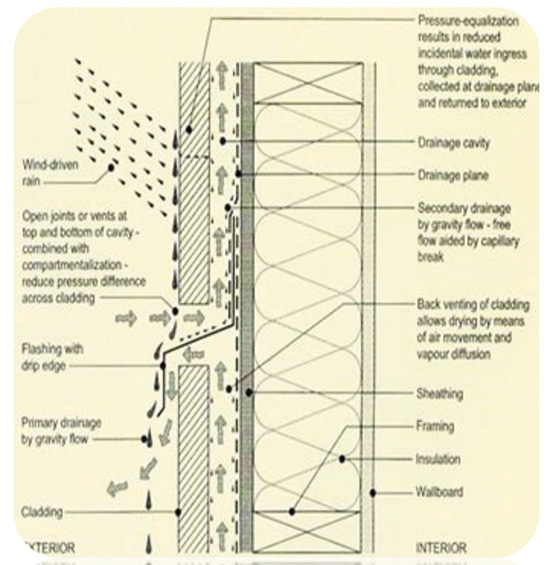
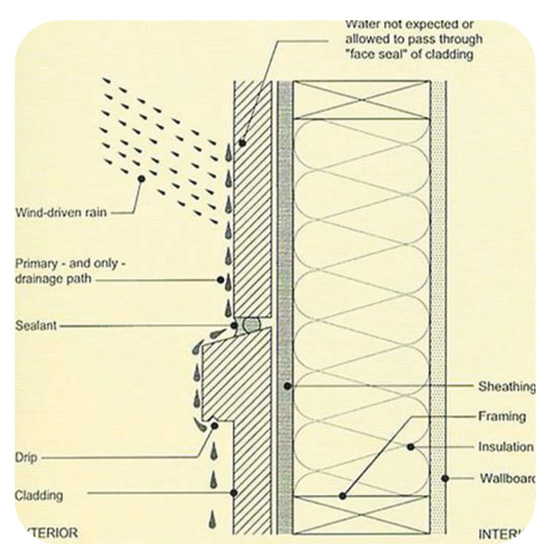
Images courtesy of CertainTeed Insulation
Rainscreen wall assemblies (top) intentionally allow more air and water to penetrate, drain, and dry between the cladding and the air/water barrier systems (bottom).
Concealed Barrier Assemblies
Wall systems that rely on a mixed approach to cladding and protection can be referred to as a concealed barrier assembly. In this case the cladding or siding is not face sealed, meaning that it anticipates some water or moisture penetration. However, it is not a full rainscreen since the amount allowed or anticipated is limited and expected to be minimal. The cladding is expected to shed or deflect most of the water and wind, but a secondary barrier, concealed behind the cladding, acts as back-up protection. As such it creates a minimally vented drainage plane that is intended to allow any moisture to flow down to flashing or other appropriate outlets. Most residential framed walls use this type of system with an air and water barrier behind siding of some sort. It can also be used behind other types of cladding or finishes. It is most appropriate for areas that receive moderate levels of wind and rain.
Stucco and EIFS Systems
There are different types of finished wall systems that use a layered finish system over a an exterior substrate on a framed wall (with or without stud cavity insulation). Traditional stucco-based wall assemblies rely on using a drainage plane and air and water barrier between the stucco and the substrate as a safeguard against breaks or failures in the cementitious outer surface. Exterior insulation and finish systems (EIFS) use an outer layer of rigid insulation over the substrate which is good from a continuous insulation standpoint but may or may not be good from a moisture standpoint depending on the details of the system. The insulation needs to allow for drainage behind it to avoid moisture issues in the wall which might result from improper drying of the wall. Regardless of the system used, careful attention to detail is required since different systems yield different performance related to thermal, moisture, and air movement. Proper treatment of joints, junctions, thickness changes, etc. include appropriate flashing and an understanding of the capabilities of a manufacturer's system. Manufacturer's information should be consulted for the most appropriate climate and weather conditions for a particular system.
Specifying Framed Exterior Wall Products
With an understanding of the building science and a decision made on the type of wall system to use for a particular building, specifying products for framed exterior walls needs to include all of the component parts and pieces of that assembly. The framing will be a matter of preference or code requirements for steel or wood appropriately sized for the application. The exterior surface cladding will be selected based on multiple design factors and needs to carry the appropriate ability to seal or be penetrated depending on the wall type. The remaining materials and products in the assembly will be very important for proper performance.
Exterior substrates or wall sheathing can be selected from a wide variety of choices including solid or processed wood panels, cement board, foam insulation, or exterior gypsum board. Of these, exterior gypsum board with fully embedded glass mat and water-resistant core and faces have become the most preferred choice for many applications. It provides very good water resistance, mold and mildew resistance, fire resistance, superior strength compared to other options, weathers very well during construction, and is easy to handle and install. Next, the air and water barriers required by building codes are usually placed directly over the selected substrate. They can take several forms including integral to the sheathing (with seams sealed/taped), sheet or roll products, or spray on type of materials. The most appropriate choice will depend on the type of wall assembly being used.
Vapor barriers as mandated by energy codes and critical for good wall performance can vary by product type and perm rate. Some are attached directly to batt insulation products and allow varying degrees of protection in a fairly static state. Some advanced products have become available, however, that change their perm rating as the relative humidity changes. This means that they restrict moisture from penetrating the barrier in low humidity conditions, but if the humidity level rises within the wall, it allows the moisture to pass through and drain away harmlessly. This type of membrane is also available as roll material, and although it looks like a common PVC vapor barrier, it is in fact a very different material with superior capabilities.
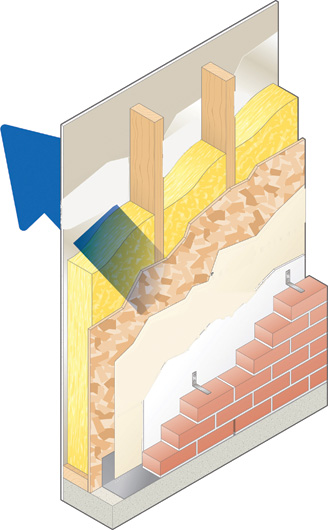
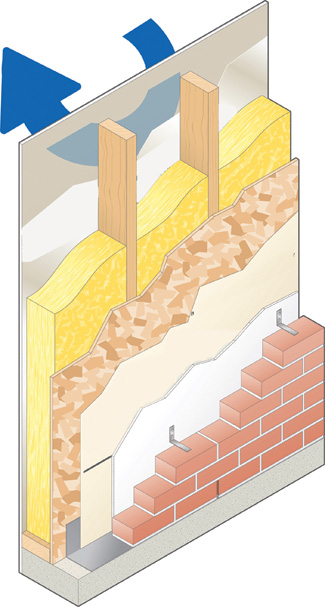
Images courtesy of CertainTeed Insulation
The latest generation of vapor barriers is made to prevent moisture from penetrating in cold and dry periods, but allow it to escape in wet and humid conditions.
Insulation needs to be specified based on the overall thermal performance that is desired for a given wall. Different insulation products such as batt-type, blown-in, or spray foam all have different thermal and physical properties so selecting the most appropriate one will depend on the particulars of the building and wall design. Some provide air and moisture sealing as part of their single product make-up such as spray foam insulation. Others, like batt type insulation can be specified with or without an integral vapor barrier.
Conclusion
Framed exterior walls are likely to continue being used in design and construction projects for years to come. As long as we are using them in our buildings, we might as well design them to perform to their highest potential. This is best done by using the principles of building science to understand the forces and conditions that directly influence the movement of heat, air, water, and moisture. With this knowledge, architects can design and specify exterior walls that will perform consistently well for the entire life of the building and avoid problems associated with poor wall design.
Peter J. Arsenault, FAIA, NCARB, LEED AP, is an architect and green building consultant who has authored over 100 continuing education and technical publications as part of a nationwide practice. www.linkedin.com/in/pjaarch
 |
With more than 100 years of experience, CertainTeed Insulation is the only insulation manufacturer with a truly comprehensive offering to help you achieve optimal comfort, with fiberglass Sustainable Insulation®, blowing wool,
spray polyurethane foam, smart vapor retarder and air barriers, and mold protection. www.certainteed.com/insulation
|