This CE Center article is no longer eligible for receiving credits.
Door hardware is a critical element that
provides passage, access, and security but whose operations
we take for granted. The aesthetics of hardware design have
strong influence on our perceptions of the space we are in
or the building we are entering. The architect and designer's
selection, application, and specification of door hardware
will make a strong contribution to the project's success.
Hardware has evolved from crude, handmade attachments and
closure pieces to machine-made, industrialized mechanisms
of great precision and design distinctiveness. Most recently,
there is a trend in high-end hardware toward distinctive design,
which combines highlighting the natural properties of the
brass or bronze from which hardware is cast, with its sculpture
sense and precision-engineered properties. Hardware, which
typically consumes approximately five percent of a building's
construction budget, represents an annual construction value
of $10 billion to $12 billion.
This article concentrates on high-end hardware for residential,
commercial, and hospitality locations. It will familiarize
you with the trends, the criteria, and the design decisions
that enable the correct selection and specification of hardware
for these locations.
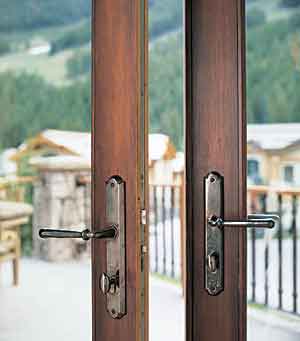
Patio doors with
lever handles and thumb-sets. Cast bronze
with patina.
Photo courtesy of Rocky Mountain Hardware
|
|
|
Trends in Hardware
Hardware as a definer of residential design status has become
a deeply entrenched value. Over the past 20 years, people
have begun to devote more time and money to transforming their
home into showplaces of their design and style. Propelled
by this increasing demand, hardware manufacturers began producing
door hardware and accessories to meet the needs of architects,
designers, and sophisticated homeowners to complement the
aesthetics of their design choices. Some manufacturers have
responded by combining traditional techniques, such as investment
(also known as lost wax casting), and sand casting, with state-of-the-art
manufacturing equipment to produce the detail and quality
of precisely engineered hardware with a traditional and natural
look and feel.
The architectural style choices available today cover a broad
spectrum, spanning from modern and post-modern to period,
rustic, and traditional. Each style and design vocabulary
requires details that work together to provide a harmonious
appearance. Unlike the 19th century, when knobs were routine,
lever handles have assumed greater prominence. Ease of use,
adaptability to meet the Americans with Disabilities Act (ADA)
requirements, and a sleek appearance are among the reasons
contributing to their popularity.
More natural and organic products, like wood and stone, are
being incorporated as major design elements into residential,
commercial, and hospitality projects. Hardware, in turn, needs
to reflect the natural properties of these materials. This
design sympathy with natural products has trended hardware
away from manufactured, finished appearances toward living
finishes like bronze and patinas, which change naturally over
time.
"Designers have embraced newer hybrid styles, such as
‘mountain modern' and ‘coastal contemporary',"
notes Patsy Nickum, owner of Rocky Mountain Hardware. These
styles combine the clean lines of modern design while integrating
the warmth and character of organic materials and colors such
as stone, wood, and structural steel. All are materials used
in a raw state, were frequently covered with more finished
materials, and now they are exposed and aged with time. Designers
have begun to reflect the living and changing aspects of materials
in their designs.
Increasingly, security hardware and devices are being adapted
to many different applications. This high technology trend,
combining traditional latch and lock mechanisms with IT systems,
represents a design and coordination challenge for both architects
and manufacturers.
Basic Issues Guiding Hardware Design
and Selection Choices
Typically, the driving force behind selecting different hardware
is based on the necessary function, and the basic distinction
is between indoor and outdoor applications. Most exterior
doors lock, and in many cases the doors are larger in scale
(taller, wider, heavier, and carry more hardware) than interior
doors. This is especially true of entry doors. In order to
hold larger and sturdier locking mechanisms, such as a mortise
lock, selecting doors with larger stiles, which provide more
room for the trim, is fundamental to having more options in
hardware selection. The mortise lock, which integrates the
locking and latching mechanisms into a single cartridge style
lock, is inset within the width of the door and is set within
the stile, the vertical structural member of the door.
Many interior doors contain a locking mechanism, but these
tend to be smaller than those that secure homes. This varies
based on residential and commercial applications. Another
broad assumption is that interior doors are not required to
meet all of the stringent impact codes, especially relating
to hurricanes and high wind conditions that exterior doors
are often subject to. This also varies with application, particularly
for interior doors in commercial and hospitality settings.
Intensity of Use
High-traffic areas demand lock mechanisms with high tolerance
for use. If doors require locking mechanisms, mortise locks
are generally recommended. Fewer working parts will assure
better operation if it fits the need. For example, in a busy
location, a push/pull device, instead of a lever or knob lockset,
is preferable. This is typical for doors that do not require
latches.
Low-use doors can employ many different mechanisms because
the function will not be tested as much as on high use doors.
Nevertheless, design professionals should determine the potential
use and regulations of the door before specifying hardware.
Available options depend on whether the door will be used
primarily for security or passage.
Basic Materials
The most common metals used in hardware trim are brass, stainless
steel, aluminum, and bronze. Selecting the proper hardware
material for a project depends on aesthetics, durability,
and availability in all necessary lock functions and sizes
for the project.

The bronze sand
casting process.
Photo courtesy of Rocky Mountain Hardware
|
|
|
Brass, which is most commonly drop or hot forged, has been
popular for many years. This metal begins in a rod form, is
heated until it is malleable, and is then pressed with extreme
pressure into a mold. This technique forges a product free
of blemishes or pockmarks. Brass is often highly polished
and then lacquered as a protective coat. Sometimes manufactures
plate brass to look like other finishes such as nichel then
lacquer coat again for protection. These lacquered finishes,
like anything that is touched and used on a regular basis,
can crack, chip or peel, thus allowing the base metal to tarnish
with time.
Forging tends to result in more highly finished, polished,
blemish-free surfaces. Reverting to casting techniques yields
finer detail products with a warm texture. Many products can
be poured using the sand casting process but the lost wax
process can be used to make products that have finer details,
while still retaining the desired texture of casting.
Iron, which is still very common in Europe, is also a forged
metal. If untreated, iron will bleed or rust, depending on
the environment. In most cases, iron is powder coated to retard
this natural occurrence. The black finish for which iron is
often associated is popular for a rustic or barn-like appearance.
Stainless steel is typically a high-end, modern, or contemporary
choice for door hardware. Like forged brass, it has a very
smooth, clean-lined surface, and has been a popular material
used by Italian- and German-based companies. This metal is
often used in coastal environments, where salt-water air tarnishes
most metals quickly. When selecting stainless-steel hardware,
it is important to research products to be sure the lock mechanisms
will not corrode. Not all stainless-steel hardware is appropriate
for coastal conditions. Price typically dictates quality of
finish.
Selecting & Specifying Hardware
Hardware choices and selections are governed by the function
of the door, the style and type of hardware that most suitably
meets the door's operating requirements, and both the
appearance and the tacit signals the designer wishes to convey,
such as push, pull and turn.
Hardware selection begins with lock functions. Important
conditions and considerations include the following:
Entry−This refers to an
exterior door with keyed access, which can be provided in
single cylinder or double cylinder functions.
- Mortise Lock−Recommended for use with heavy or high-use
doors. Specific trim selections require this type of lock.
It is an integrated lock (see Glossary). Technical attributes
of a mortise lock include saw proof inserts in the deadbolts,
push button locking capacity, and emergency egress function
(single operation exit). Highly recommended for use with
grip handle and thumb latch application.
- Deadbolts−Usually combined with a lever or knob function
or a push/pull plate.
Patio−This is an exterior
door that does not require key access, but requires lock function,
and is typically used on doors that access a balcony or patio.
The same lock choices as entries apply, mortise lock or deadbolt.
In most cases, exterior doors have keyed access from the outside
in, to overcome potential redundancy-of-locking situations.
This occurs when several doors are in close proximity to each
other or when external access is directed towards a single
door.
Privacy−This function
has three locking options, all with varying levels of security
and use.
- Mortise lock−The most secure locking feature for
high-use areas.
- Mortise bolt−Although this locking mechanism is not
substantially stronger than the push-button locking spring
latch, it offers a more identifiable locking feature. For
example, this may be used for a bathroom door so that it
is more obvious that the door is locked, as opposed to a
push button mechanism.
- Spring latch (locking)−This is the most affordable
locking mechanism. It is not necessarily weaker than the
mortise bolt, but it is less obvious that the mechanism
is actually locked.
Passage−This is a non-locking
mechanism with operable handles. It is used on doors that
do not need to be secured.
- Spring latch−This is a latch operated by a handle.
- Mortise lock box−While there is no locking capacity,
it has the same mortise box as a locking mechanism, and
functions as a latch.
Dummy−This refers to a
set of inoperable handles on one or both sides of a door.
This could also be the inoperable side of a double door condition.
Dummies are often used with a roller catch or another latching
mechanism.
Multi-point−Originally
developed in Europe, this mechanism latches the doorframe
in three or more places. Many American window companies have
adopted this system.
Miscellaneous Functions:
- Corridor−This function allows the inside handles
on both sides of the door to be open and functioning. One
side has a locking turn piece or push button, such as a
mortise lock or locking spring latch. This is typically
used to lock an office or room that is not in a public area.
- Classroom−This function allows the inside handle
to always be free while the outside handle can either be
free or be lockable with a key via a mortise lock or a locking
knob or lever. This restricts the locking function to the
key holder.
- Store room−The inside handle is always open or free
and the exterior handle is always locked. The locking mechanism
is keyed from the exterior side.
- Hotel entry−Similar to the storeroom, except that
there is an emergency egress deadbolt on the interior, allowing
guests the ability to secure their room from the inside.

Residential entry
doors with mortise lock-set, thumb piece,
and pull. Cast bronze with patina.
Photo courtesy of Rocky Mountain Hardware
|
|
|
Doors−The size, construction,
and proportion of doors are important factors when selecting
hardware.
- Stile width−Choosing the width of the escutcheon,
the back plate that attaches to the door, depends on the
available surface, or stile width, while factoring in the
overlap of the stop. These dimensions are critical. The
goal is to fit the hardware on the door with an accommodation
for ease of operation, thus allowing room to grab the lever
or grip without hitting the knuckles. Matt Ostmann, Technical
Director at Rocky Mountain Hardware observes, "A common
problem that arises often is that the selected stile is
too narrow to carry the standard escutcheon. Choosing a
narrow stile may severely limit the designer's hardware
options."
- Door Size−Typically, the height of the escutcheon
is directly proportional to the door height. This is a subjective
choice.
- Handing−This is the convention that indicates where
the door is hinged and in what direction it swings. The
diagram in the Glossary reflects the hardware industry standard.
It is important to use the convention as illustrated when
handing is specified.
- Backset−This defines the length from the edge of
the door to the center of the lock. Standard lengths for
tubular or spring latches are 2-3/8 inches and 2-3/4 inches.
Standard lengths for mortise locks are 2-1/2 inches and
2-3/4 inches. These can have options for custom backsets
but stile and hardware choices may limit the available options.
Design and Style Choices−This encompasses material,
finish, and lever, and knob choices, as determined by the
aforementioned criteria. Selecting the best hardware material
that can function under varied climatic conditions, while
maintaining basic design characteristics, has become increasingly
challenging. Steel, stainless steel, and aluminum all have
their applications, but none can combine resistance, durability,
a natural aging process, and a natural appearance as well
as bronze.
Bronze has several favorable properties when used for hardware.
It is non-ferrous, neither powder-coated nor lacquered, and
will not rust. Bronze interacts and ages well, working in
coordination with time, touch, and climate. Over time, the
material distinctly reflects its surroundings. It ages naturally,
but is quite durable and robust. Additionally, bronze can
be tempered by various applied patinas, which can speed the
aging process to create unique hues to complement any style.
Code Considerations
The American Society for Testing and Materials (ASTM) has
a grading scheme for security ratings for doors and hardware
(on a scale of 10 to 40) utilizing impact tests. These are
becoming more prevalent in areas subject to hurricanes and
high winds. Doors need to be engineered correctly to withstand
most of these tests. The lock mechanism helps, but it cannot
compensate for an inherent weakness in the door itself.
Some national codes, including ADA, are vague and are open
to interpretation. For example, ADA 4.13.9 Door Hardware,
governs the performance characteristics of door handles, and
states "…handles, pulls, latches, locks, and other
operating devices on accessible doors shall have a shape that
is easy to grasp with one hand and does not require tight
grasping, tight pinching, or twisting of the wrist to operate.
Lever-operated mechanisms, push-type mechanisms, and U-shaped
handles are acceptable designs. When sliding doors are fully
open, operating hardware shall be exposed and usable from
both sides…."

Patio door with
escutcheon, lever handles and turn piece.
Cast bronze with patina.
Photo courtesy of Rocky Mountain Hardware
|
|
|
Increasingly, codes are driven by counties and municipalities,
acting in response to local conditions. For example, Dade
County in Southern Florida is a leader in drafting and mandating
stricter hurricane and flood code provisions, many of which
have been adopted in Florida, Gulf Coast states, and coastal
states along the Atlantic seaboard. Much of Florida's
building code provisions are influenced by "weather bands,"
based on historic studies within the state. Where wind forces
are strongest, stricter codes prevail.
Insurance companies are also investing a significant amount
of money and resources toward increasing the stringency and
rigor of codes. The Texas Department of Insurance is among
the most active. Design Pressure (DP) testing is also becoming
an industry standard.
Handicapped Accessibility & Ergonomic
Compliance
The Americans with Disabilities Act is the national legislation
that demands specific handicapped accessibility standards
be used in most buildings, whether they be public or private
facilities. These requirements have been widely adopted. Individual
states may have additional codes which overlay ADA. All of
these codes reference door hardware. Therefore, design professionals
must be familiar with the codes governing their projects.
For the elderly or disabled, selecting hardware that functions
smoothly and with ease is an important consideration. This
generally necessitates lever handles and minimum clearances
between hardware and adjacent walls. Even in projects where
ADA is not a governing factor, levers are typically a better
option due to ease of use.
Heavy doors or areas with high winds and inclement weather
are also best served by hardware that functions well based
on conditions. This generally means that doors should open
easily and without the need to apply excessive force. These
doors are frequently equipped with automatic door openers.
Considerations in Selecting a Hardware
Manufacturer
Selection of a hardware manufacturer with the ability and
the technologies to implement the design is vital to a successful
application. The manufacturer should offer a range of options
in cohesive styles, materials, and design appearances, thus
allowing the design professional to create the desired aesthetic
look. The choices for lever, knob, escutcheon, patina, in
various sizes to work with the size and scale of the project,
contribute to an integrated end result.
Ideally, hardware manufacturers should possess custom capabilities,
allowing each piece to be as individual as the spaces they
complement and the people who design and use them. Design
professionals should consider manufacturers with in-house
engineering and design teams, capable of collaborating with
architects to translate design ideas into aesthetic and functional
spaces. Additionally, manufacturers offering other complementary
accessories, such as hinges, doorstops, surface and cane bolts,
doorknockers, and doorbell buttons, will simplify implementation
of the design concept throughout the project.

Hand etching and
carving to create a custom pattern for a mould
for casting or forging.
Photo courtesy of Rocky Mountain Hardware
|
|
|
Conclusion
Design options for hardware have expanded dramatically in
recent years. The complexity of hardware functions and technology
has also been evolving to meet the conflicting requirements
of the public and private realms. It is vitally important
for architects and designers to remain aware of this basic
area of design, and stay closely acquainted with what the
hardware industry and hardware manufacturers are doing to
meet these challenges.
|
|
| Creating architectural hardware for
discriminating clients since 1994, Rocky Mountain
Hardware continues to offer the finest quality in
the industry. Each piece is handmade and sand-cast
with the beauty and integrity of solid art-grade
bronze. Accenting its durable construction is your
choice of patina, which enhances the individual
nature of the hardware; no two pieces look alike.
Yet, it is the sophisticated textures inherent in
our hardware that our clients continually seek.
Select any item from our line or customize a piece
from your own idea and enjoy a unique style that
endures throughout generations. |
|
Commercial and Hospitality Applications
High traffic, constant use, and security considerations are
the main characteristics of commercial and hospitality hardware
applications. Selecting the correct hardware in these areas
is important in terms of safety and longevity of the hardware
and doors. In areas such as train stations, ski lodges, country
clubs, and office buildings, design professionals should choose
hardware that is consistent with the durability required by
the occupancy loads. The simpler the hardware is in operation,
the more durable it will be. If a locking function is needed,
doors may be secured using deadbolts, flush bolts, and surface
bolts. The ability of the door and the hardware to accept
security devices, such as card readers, is critical for these
applications. Finishes are also important features. Metals
that are powder coated or lacquered tend to peel, crack or
scratch. Selecting a solid base metal, like bronze, will withstand
use and naturally age with time.
 |
 |
High traffic
area entry door (hotel) with cast bronze pulls
and escutcheons (left). Hotel room corridor
door, cast bronze with lever handle, and with
card key application (right).
Photos courtesy
of Rocky Mountain Hardware |
|
|
In response to increased hurricane activity, coastal codes
are becoming more stringent. It is important for design professionals
to select hardware and door manufacturers who can meet all
code demands without compromising design continuity.
Considerations for Specifying Hardware
Many factors come into play when selecting and specifying
hardware. The following checklist will assist design professionals
in determining the information needed to write the specification,
and to enable manufacturers to provide all of the necessary
components. This is a list of features that will need to be
pre-determined in order to write a thorough specification:
- Lock function and mechanisms (including mortise lock,
dead bolt, and spring latch)
- Door thicknesses
- Backsets
- Handing
- Style (including interior/exterior escutcheon, interior/exterior
handle)
- Finish
- Clear keying of doors on plans, elevations, and schedules
that will allow the manufacturer and other related vendors
to make accurate quantity take-offs by location and type
of hardware set.
Differences between European and U.S.
Practice
European and Asian hardware requirements vary from the U.S.
However, most of the differences lie in the lock mechanism.
Selecting a hardware manufacturer with advanced custom capabilities
allows design professionals to specify the country-approved
mechanism by custom fitting trim. Depending on the country,
mechanisms will be approved for use, and provide a comfort
level for users. Building owners should be confident that
their local locksmith could fix any problems.
As with hardware codes, European lock mechanisms cannot be
grouped together. Country practices and regulations vary from
one to the next, and sometimes this varies within borders.
Each country and region uses a specific type of lock mechanism,
commonly a profile cylinder or one using a bit key. Regardless,
it is this mechanism that they are comfortable with and continue
to use.
For example, many U.S. window and door manufacturers have
adopted the "European Multi-Point" three-point locking
system for their U.S. products. Matt Ostmann, Technical Director
at Rocky Mountain Hardware, observes that, "For many
users this has been, and continues to be, a difficult mechanism
to adopt because it simply functions differently than a typical
U.S. locking system. Lifting up on a lever handle to release
the three locking points is not well understood or natural
for Americans to conform to, even though it is a technically
effective approach to opening and closure."
One system is not necessarily better than another, but depends
upon what users are accustomed to. Therefore, any hardware
manufacturer must go through a significant amount of research,
trial, and error testing, before globalizing a product.
Stanley Stark, FAIA, is a Managing Partner
at HLW International LLP. He frequently writes and lectures
on technical issues related to design and practice.
Glossary of Terms
The following table defines critical hardware terms relating
to lock functions, lock trim, lock mechanisms, and additionally
related functions, features, and practices.
LOCK FUNCTIONS
ENTRY (SINGLE CYLINDER)
This is a locking set with operable handles that has a keyed
cylinder on the exterior side of the door and a turn piece
on the interior side (typically used on primary exterior doors).
ENTRY (DOUBLE CYLINDER)
This is a locking set with operable handles that has a keyed
cylinder on both sides of the door (typically used on primary
exterior doors).
DUMMY − SINGLE
This is a set with an inoperable handle on one side of the
door (typically in conjunction with roller catches, flush
bolts or surface bolts).
DUMMY − FULL
This is a set with inoperable handles on both sides of the
door (typically in conjunction with roller catches, flush
bolts or surface bolts).
PASSAGE
This is a non-locking set with operable handles (typically
used on doors that do not require security or privacy such
as closets, laundry or utility rooms, pantry, mechanical rooms
and so on).
PATIO
This is a locking set with operable handles that is locked
by a turn piece from the interior side, but has no keyed access
from the exterior (typically used on secondary exterior doors).
PRIVACY (MORTISE BOLT OR MORTISE LOCK)
This is a locking set with operable handles that is locked
by a turn piece from the interior side and can be unlocked
by an emergency release key from the exterior side (typically
used on bedroom and bathroom doors).
PRIVACY (SPRING LATCH)
This is a locking set with operable handles that is locked
by a push button on the escutcheon from the interior side
of the door and can be unlocked by an emergency release key
from the exterior side (typically used on bedroom and bathroom
doors).
PUSH / PULL
This is a set with inoperable grip handles and/or escutcheons.
The set can have locking capacity in single cylinder, double
cylinder or patio applications and is available in full or
single dummy as well (typically used for commercial applications).
|
LOCK TRIM
This is the portion
of the set usually attached to the surface of
the door and consists of these parts:
|
|
|
|
ESCUTCHEON
Back plate that attaches to the door.
HANDLE
The portion of the set you grab to pull or rotate. The handle
options are grips, levers, knobs or ring pulls.
SWING COVER
The flap that covers the cylinder or the emergency release
access.
THUMB PIECE
This piece retracts the latch bolt on a thumb latch entry
lock set.
TURN PIECE
This piece operates the dead bolt on the interior side of
a locking set.
LOCK MECHANISMS are the portion
of the set operated by the handles, cylinders, thumb latches
and turn pieces:
|
DEAD BOLT
A locking mechanism
that is separate from the latching mechanism in
a door set. A dead bolt can be locked by a key
or turn piece. Manufacturer can provide separate
dead bolt trim that is used above a handle set
or can incorporate the dead bolt and handle trim
onto the same escutcheon.
|
|
|
|
|
MORTISE
BOLT
A locking mechanism
that is separate from the latching mechanism and
is operated by a turn piece. It is usually used
for interior applications to provide privacy on
bedroom and bathroom doors.
|
|
|
|
|
MORTISE
LOCK
This mechanism
integrates the locking and latching mechanisms
into a single cartridge style lock. The mortise
lock is available in a variety of functions such
as entry, patio, privacy, passage and so on.
|
|
|
|
MULTI-POINT LOCK MECHANISMS
Mechanisms that latch the door at several points along the
length of the door instead of a single point in close proximity
to the handle. Multi-point locks are provided with the French
doors made by most of the major window manufacturers. Due
to the variety of multi-point sets available, it is recommended
that a copy of the existing lock trim or a factory drawing
be available so the trim can be machined correctly to match
the lock in the door.
|
SPRING
LATCH
A latching mechanism
operated by the handles.
|
|
|
|
CYLINDERS are the portion of
a lock where the key is inserted to lock or unlock the set.
There are several different kinds common to entry sets:
|
MORTISE
CYLINDERS
Mechanisms that are
threaded into mortise locks secured by a set screw
through the edge of the lock and vary in length
for different door thicknesses.
|
|
|
|
|
RIM CYLINDERS
Mechanisms used in dead
bolts and are mounted with screws from the opposite
side of the door. They do not vary in length,
but the mounting screw and tailpiece length varies
according to the door thickness.
|
|
|
|
|
AMERICAN
or U.S. CYLINDERS
Refers to the type of
cylinder used with several types of multi-point
lock sets. These cylinders are attached to the
escutcheon and do not vary in length, but the
tailpiece length varies according to the door
thickness.
|
|
|
|
|
EUROPEAN
PROFILE CYLINDERS
The other type of cylinder
used with multipoint lock sets. These cylinders
slip through the exterior escutcheon, the door
and the interior escutcheon and are held in place
by a set screw through the edge of the lock and
vary in length for different door thicknesses.
|
|
|
|
ADDITIONAL TERMINOLOGY
ACTIVE DOOR
The primary door in a pair of doors and typically has an operable
handle set.
BUTT HINGES
Hinges with one leaf mortised to the jamb and one leaf mortised
to the edge of the door.
CABINET ROSES
The back plates behind the cabinet knob or pull.
CLAVOS
Decorative nails typically applied to the surface of the door.
EDGE PULLS
Used to retrieve a pocket door from the pocket.
EMERGENCY RELEASE
This term refers to the capability of a lock to be unlocked
from the exterior side in case of an emergency situation.
This is an aspect of most interior privacy lock sets.
FLUSH PULLS
Recessed pulls used on sliding doors such as pocket or bypass
doors.
|
HANDING
Indicates where the
door is hinged and the direction it swings. Please
see chart below.
|
|
|
|
INACTIVE DOOR
The secondary door in a pair of doors. The inactive door is
often secured with flush or surface bolts and typically has
inoperable handles.
ORNAMENTAL HINGE STRAP
A decorative piece of metal applied to the surface of the
door to mimic a strap hinge.
STRAP HINGES
Hinges that have one leaf applied to the surface of the jamb
and one leaf attached to the surface of the door.
SPRING ASSIST
Each handle has an additional spring attached to the handle
and the escutcheon that returns the lever, knob or ring to
the neutral position; this mechanism eliminates sagging handle.