This CE Center article is no longer eligible for receiving credits.
According to the 2010 Census, 81 percent of the U.S. population now live in urban areas, and that number is steadily on the rise. Similarly, the United Nations report “State of World Population 2007” projected that the world's urban population is expected to rise from 3.3 to almost 5 billion by 2030. Despite efforts to increase the utilization of mass transit, many urban dwellers still want to own an automobile. The swelling urban population and desire to own an automobile have combined to make the provision of adequate parking supply a major problem for developers and planners.
The most popular solution for increasing parking density to date has been the construction of ramp-access self-park garages. Despite the fact that some experts feel the parking garage “defines how people live and what industrialized society has become,”1 the economic and structural realities of building ramp-access garages have historically relegated them into a “blind spot” within urban design. The major reason being that in order for ramp-access garages to be cost effective, they require construction methods that make them unattractive and difficult to conceal. When faced with the task of designing a ramp-access parking structure, many architects have taken great pains to make their garages attractive, but this is not easy to do.
It appears this may need to change soon. Since it is so difficult to integrate enough shops and restaurants into highly efficient parking structures, their use creates “dead zones” in the city. Devoid of natural foot traffic, these massive ramp-access parking structures often fall into disrepair, becoming magnets for crime. Many municipal governments have realized how disruptive ramp-access garages are to the urban fabric of our cities, and are looking for ways to mitigate their negative impact.
Mechanical vs. Automated Parking Systems
Automated parking systems represent a practical and affordable solution to increase parking density since they use up to 50 percent less volume to park the same number of cars as a typical ramp-access self-park garage. As a result, more architects are becoming aware of new developments in parking technology and the significant benefits they offer.
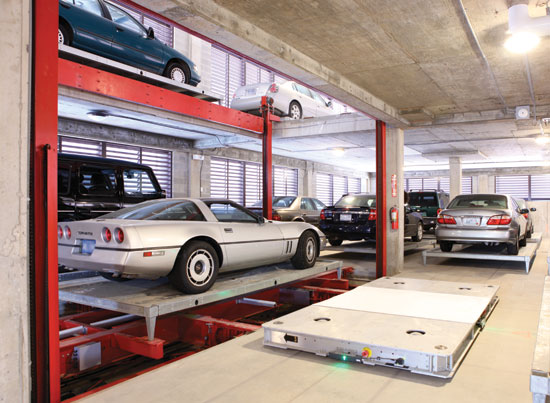 |
Robots store and retrieve cars on steel trays in this latest-generation automated parking system in Crystal Springs Resort, Hardyston, New Jersey.
Photo courtesy of Boomerang Systems, Inc. |
When the topic of automated parking systems is raised, many in the design community will call to mind images of the open-air steel framed parking systems found on the streets of Manhattan. While these systems, commonly referred to as “stackers,” are highly space efficient, they are not considered to be fully automated parking systems. They are instead considered to be “mechanical parking systems” simply because they require a trained valet driver to remove cars one by one to reach the uppermost vehicle.
Conversely, a fully automated parking system is distinguished from mechanical parking systems (such as those pictured on the right) by the automated parking system's ability to store and retrieve vehicles within a multi-level garage without human intervention. Thus many developers turn to fully automated parking systems in order to maximize parking density while minimizing the expense and difficulties inherent with employing a team of valet drivers.
Additionally, automated parking systems often only require one driveway, parking several cars deep on each side of the transit aisle, whereas mechanical systems require a lot of space for driveways to allow drivers to access each system.
Three-Dimensional Movement
Automated parking systems are capable of moving cars along three dimensions (i.e. vertically, laterally, and longitudinally) within a parking structure. As a result, they are sometimes referred to as three-dimensional (or 3D) automated parking systems, as opposed to the one-dimensional (vertical) and two-dimensional (vertical and lateral) movements of mechanical parking systems.
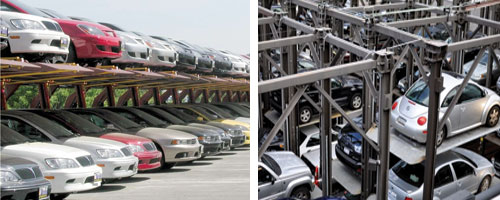 |
Left: Cantilever or “stacker” systems use hydraulics to park one car over another. These mechanisms require a trained valet driver to operate safely. Right: Four-post stackers use hydraulics to store up to five cars on top of each other. These mechanisms require a trained valet driver to operate safely.
Photos courtesy of Boomerang Systems, Inc. |
To guide this unaided movement through three-dimensional space, automated parking systems use advanced computer systems to control electro-mechanical systems and an array of sensors to measure the dimensions and guide the movement of the vehicles. As a result of this complex interaction, these automated parking systems are also often referred to as “robotic” parking systems.
The primary reason for choosing 3D automated parking systems is that the use of precision robotics to transport the vehicles allows the vehicles to be parked closer together and eliminates the need for ramps and most of the internal driveways required for circulation within a conventional ramp garage. In fact, a typical automated parking system can park anywhere from 30 percent to 110 percent more cars in the same volume of space than is possible in a conventional ramp-access garage.
Since accessory parking is mandated by almost all local governments for all new construction projects, and space is becoming increasingly scarce in urban environments, automatic parking systems could very well be a critical factor in determining the viability of many future projects. Moreover, projects that were once thought not to be viable due to difficulties meeting the parking requirements will now become viable.
Historical Perspective
The oldest mention of a mechanical parking system is a two-floor structure in Paris by architect Auguste Perret, a specialist in reinforced concrete construction. Constructed in 1905, the garage had a surprisingly similar layout to today's automated systems. Later, in 1956, Krupp built a mechanical system for the Deutsche Bank in Munich, Germany.
Since then, advances in computer and automation technology led to the widespread adoption of automation for use in moving palletized goods in warehouse storage and retrieval systems. The maturing of this technology plus an increase in shortages of urban space has led to many automated parking systems being built in Japan, Korea, China, and to a lesser extent, in parts of Europe.
The use of automated parking is now accelerating. As of 2002, there was only one system in the United States. Now, a decade later there are 12 systems operating, two under construction, and at least as many more planned in the near future.
The User Experience
From a superficial perspective, most automated parking systems seem to function in a similar manner. The parker drives into an available parking bay and is guided by sensors and digital signage to park in the center of the parking bay floor. He or she exits the vehicle and walks out of the parking bay to a kiosk on the wall, where they may be asked to estimate their time of departure. Regular users can either swipe a parking pass or enter a personal code, while transient users will be issued a paper ticket for identification purposes.
At this point the parker leaves, the exterior parking bay door closes, and sensors check to make sure nobody is inside the parking bay. Once cleared for storage, the automated machinery removes the car from the parking bay, often depositing it on a lift, which carries it to the storage level, where the machinery stores the car. Vehicles will often be turned 180 degrees at some point in the process so they are ready to be driven straight out of the parking bay when exiting.
Upon returning, the customer scans his or her card, enters a code or inserts the paper ticket, which signals the system to retrieve the car. In a matter of minutes, the customer's ding-free car is delivered to a nearby parking bay, facing outwards, making it easy to drive away.
Retrieval times typically range between 1 and 5 minutes, with an average of about 2.5 minutes, which is similar to the amount of time required to retrieve a car from a conventional ramp-access garage. The actual retrieval time depends on a number of factors at the time of each retrieval request, including but not limited to: the number of paths of lateral movement, location of the target vehicle, the current occupancy level, and number of overlapping retrieval requests.
Car owners like to use automated parking systems because, instead of requiring parkers to drive around and around hunting for a space, they now have immediate access to a conveniently located VIP parking space. Other advantages include being safer for both the driver and the car; no traversing across silent, darkened, exhaust-polluted garages; no backing and turning to squeeze in and out of a tight space; no scratches, dings or dents; no theft; and, since drivers keep their keys, no worries about joyriding or privacy violations by garage attendants.
Different Approaches to Automated Parking
Given the high frequency of vehicle damage and personal assaults in ramp garages, along with the inconvenience of driving around and around hunting for a space, one would think that automated parking systems, which are far more safe and convenient, would be far more prevalent today.
The aforementioned functional description is nearly identical for all automated parking systems; however, the various systems that have evolved over time, differ dramatically in how they perform these tasks. Each approach to automated parking results in fundamental differences in cost, reliability, and performance, which must be understood before implementing this technology in a development project.
“Mono-Path” Automated Parking Systems
The first- and second-generation automated parking systems, each of which will be described in more detail, have been broadly adopted in Asia and to a lesser extent in Europe. The movement of the vehicle transportation machinery varies in each successive generation of technology and has a material impact on the capabilities and performance of the system; however, as their name suggests, “mono-path” automated parking systems are all distinguished by their having a single pair of rails through the center of the system along which machinery would ride to store and retrieve the cars (i.e. its “path”).
Advantages of all mono-path systems include:
- Vertical and visual transparency, which can create interesting designs by exposing the vehicle rack and mechanical movements.
- In a few municipalities, mono-path systems are treated as a single floor for FAR requirements much like a warehouse. (FAR or floor area ratio is the ratio of the building's total floor area to the size of the parcel of land it stands on.)
Unfortunately, mono-path systems have been slow to catch on in the U.S. because conservative developers and traffic engineers have been concerned that the mono-path design of first- and second-generation systems will cause bottlenecks to form when processing simultaneous transactions. This, in turn, limits these systems' hourly throughput, and in the event of certain mechanical failures, may take them offline altogether.
Those who were willing to ignore the fact that systemic design limitations could cause limited or no functionality, often encountered difficulties securing approvals. The open atrium typically found in the middle of many mono-path systems allows fire to spread rapidly and could represent a significant life safety hazard to firefighters who must extinguish a car fire in the upper levels of the system.
 |
First-generation “mono-path” rolling hoist systems process transactions serially (one car at a time).
Image courtesy of Boomerang Systems, Inc. |
First-Generation Mono-Path Systems
The first generation of mono-path systems use a rolling hoist that follows rails mounted in the floor and ceiling of the garage. These devices move laterally and vertically at the same time and then move longitudinally to store and retrieve the target vehicle. They are actually very fast for one transaction, but they have a number of significant limitations.
Disadvantages of first-generation mono-path systems:
- They can only process one transaction at a time, so queues form instantly.
- If the system is down for maintenance or there is a mechanical failure, the entire facility is shut down.
- The floor-to-ceiling central atrium allows fire to spread easily and poses a life safety threat to fire fighters, thus making approvals of these systems very difficult.
- Erecting the rack is complicated and requires specialty construction methods.
- If the structure shifts or the steel rail expands causing misalignment of the rails, the system may be crippled or unusable.
- This is a single-purpose structure that will be difficult to repurpose if the technology is ever obsolesced.
Second-Generation Mono-Path Systems
The second generation of mono-path systems evolved in order to increase processing capacity and limit exposure to mechanical failure by utilizing multiple retrieval shuttles. These shuttles move cars laterally along rails affixed to the front of each side of the storage area on each level of the garage. They then deposit or retrieve the cars into two or more stationary lifts to transport the cars vertically through the structure, where another shuttle will remove the car from the lift and transport it to its storage space.
Disadvantages of second generation mono-path systems:
- The use of rails to guide lateral movement means there is still one lane of lateral movement on any single level, which prevents shuttles from being able to pass by each other and thus limits the processing capacity of the system.
- While redundancy is improved over the first generation, a mechanical failure on the entry/exit level can cripple these systems since 100 percent of the cars must pass through this area on their way in and out of the garage.
- When employed, the floor-to-ceiling central atrium allows fire to spread easily and poses a life safety threat to fire fighters, thus making approvals of these systems very difficult.
- Specialty construction is required to erect the mono-path structure.
- If the structure shifts or the steel rails expand causing misalignment of the rails, the system may be crippled or unusable.
- This is a single-purpose structure that will be difficult to repurpose if this technology is ever obsolesced.
 |
Second-generation “mono-path” shuttle and lift system
Image courtesy of Boomerang Systems, Inc. |
Third-Generation Multi-Path Systems
A recently introduced third generation of automated parking systems has come on the market, using AGVs or Automated Guided Vehicles, which are omni-directional battery-powered robots, to store and retrieve cars that are parked atop steel trays. While use of AGVs is revolutionary to the automated parking industry, AGVs have been widely used in car factories and warehouses around the world for the last 30 years.
From the outside, these AGV-based multi-path systems appear to work like other automated parking systems, but when the parking bay door closes a low-profile rectangular AGV rolls under the car and uses its onboard electric motors to raise four posts and thereby lift the tray. The robot then rolls out of the parking bay carrying the tray with the car onboard following its guidance system. Since they are battery operated with four independent wheels, each AGV can move forward, backward and side-to-side, and can spin 360 degrees anywhere in the garage (provided there is room to do so). AGVs can also travel up or down between storage levels in specially designed lifts.
Since the AGVs are not constrained to move along a rail, they are free to move laterally through the garage along multiple paths, which is why they are referred to as “multi-path” automated parking systems. This multi-path functionality enables the AGVs to work around obstacles, thereby avoiding the creation of bottlenecks in the main transit aisle.
 |
Multi-path automated parking system
Image courtesy of Boomerang Systems, Inc. |
Benefits of Multi-Path Automated Parking Systems
The vehicles in a true multi-path system are supported above the concrete slab on elevated trays so the AGV can “drive” in any direction throughout the garage underneath parked cars. This ability enables AGV systems to process multiple transactions while avoiding bottlenecks that would have formed in the center transit aisle of first- and second-generation systems.
Additionally, when the ability to move laterally along multiple paths is combined with sophisticated logistics software, suppliers can add many more robots to attain a significantly higher hourly throughput than would otherwise not be possible in a mono-path system.
| Sample Layout of a Multi-Path System |
 |
The ability to move laterally anywhere in the garage, enables greater density to be achieved without impacting performance. By way of example, just imagine a grid of nine parking spaces, three across and three deep. The software that controls a multi-path system would be programmed to first park three cars deep in the left and right rows of the nine-car grid—leaving the center row empty and thereby attaining 66 percent occupancy. Since the robots can move a parked car laterally into this still-empty center row, a multi-path system can typically retrieve any car without the need to move any other cars up until this grid (and similarly, the entire garage) exceeds 66 percent occupancy. This is compared to the 33 percent occupancy threshold at which similarly designed three-deep mono-path system starts requiring cars to be moved for retrieval.
 |
 |
Mono-path automated parking systems move laterally along a rail resulting in only one lane of lateral movement, which creates bottlenecks and chokepoints.
Images by Boomerang Systems, Inc. |
Multi-path automated parking systems use omni-directional robots to move across concrete slabs (even under parked cars) creating multiple lanes of lateral movement, which enables them to move around obstacles. |
These systems offer the same environmental advantages as first and second-generation mono-path systems, but the multi-path systems provide greater density, reliability, throughput, safety, design flexibility, and are easier to integrate within a larger building.
As a result of these many benefits, these multi-path automated parking systems have been met with very positive response by government fire and building officials and real estate developers leading to a recent surge in their adoption. When compared with earlier first and second generation mono-path systems, it is easy to see why many have concluded that multi-path automated parking systems are much better suited for larger, higher-demand parking garages.
The Impact of Multi-Path AGV-Based Systems on Parking Design
Since a multi-path system's omni-directional robots move at right angles and rotate in place, they can easily park in places that would be impossible using mono-path systems. Instead of being limited to clear rectangular-shaped garages as mono-path systems are, multi-path systems can efficiently park L-shaped, triangular, and irregularly shaped garages, by creating transit aisles that intersect each other and by parking behind obstacles like building support columns, service rooms, elevator cores and staircases. This ability gives multi-path systems the advantage of being easily integrated into buildings without the need to create costly column-load transfers to make more room for the wide turning radii required by human drivers.
Additionally, since there are no drivers exiting the vehicles in the storage area, the vehicles can be parked more closely together, thereby enabling four cars to be parked across approximately the same space between columns that is required to park three cars in a conventional garage.
Summary of Capabilities of Robotic AGV Parking
- No single point of failure.
- No bottlenecks.
- Omni-directional robot rolls across solid concrete decks in multiple lanes of lateral movement without being limited to a single lane of lateral movement as in rail-based systems.
- Can realistically park five or more cars deep versus only two cars deep for mono-path systems.
- Garages have a faster turnover as more robots can be added without causing grid-lock.
- Robots can travel under parked vehicles.
- Nothing touches the vehicle; as the robots lift only the vehicle tray.
- Robots can be easily accessed, repaired and removed for servicing.
- Robots approach vehicles and pick up from front, rear or side.
- Vehicles can be transported in any direction.
- Payload capacity of a robot is approximately 8,300 lb. (7,000 lb. for a car and an additional 1,300 lb. for a tray).
- Saves space because vehicles are rotated at a convenient time without need of a separate turntable, which improves throughput by rotating cars away from the high-demand parking bays.
- Robots are battery operated and recharge automatically when not in use.
- AGV requires low maintenance compared with a mono-path system.
- Robots can travel from floor-to-floor to respond to increased demand on any given floor.
 |
|
The ideal width for ease of operation is 23.25 feet between columns for three cars (highlighted in green), whereas the most efficient is 30 feet between columns for four cars (highlighted in yellow). Source: Boomerang Systems, Inc. |
Drawbacks to AGVs
- In those few remaining municipalities that do not require fire safety measures (such as for catwalks, intumescent paint, fall protection across the entire atrium) mono-path systems can provide a cost advantage over pouring the solid cement floors required to house multi-path systems.
- While increasingly rare, some municipalities may not recognize the levels of a mono-path system as a floor, and thus may exempt them from the developer's FAR (Floor Area Ratio) calculations.
- The concrete slabs in AGV systems prevent visibility through the structure.
- While the use of trays simplifies many things by enabling the AGV to lift the same shaped object every time and protects vehicles from inadvertent damage from machinery, trays do add expense and extra work as they must be stacked when emptied and de-stacked when needed.
 |
Features of three-dimensional parking systems |
Economic Benefits of Automated Parking Systems
In addition to bringing enhanced security and convenience to parking, the increased efficiency of an automated parking system often contributes to the economics of development projects in any of the following ways:
Unlocking Valuable Air Rights
By using less volume of the building for parking, developers have more cubic footage for higher yielding development. Since automated parking systems occupy less square footage than traditional garages, they consume far less valuable air rights. Consider a hypothetical example of a 500-space residential tower in which a self-park garage and an automated garage would occupy 225,000 square feet and 112,500 square feet, respectively. By using automated parking, the increase in project value realized by the developer would range between $11.25 and $33.75 million depending upon the value of the air rights. See table below for estimates at different market values for air rights.
 |
|
1. Assumptions are for illustrative purposes only. Actual metrics will vary significantly depending on the specific circumstances of each project. Source: Boomerang Systems, Inc. |
Reducing Excavation Costs
While above-grade parking consumes valuable real estate, below-grade parking often carries with it high excavation costs due to rock formations or a high water table. Since an automated parking system requires up to half the space of a conventional garage, and since deeper floors cost more to excavate than shallower floors, the use of an automated parking system logically eliminates the most expensive-to-excavate floors from a basement garage. In the hypothetical example of an urban infill mixed-use structure, a developer could achieve average savings of $23,500 per space, by selecting an automated system. (See table of estimates for different structure costs.)
 |
|
1. Assumptions are for illustrative purposes only. Actual metrics will vary significantly depending on the specific circumstances of each project. Source: Boomerang Systems, Inc. |
Reducing Construction Costs
According to some developers' estimates, the construction cost savings for automated parking can amount to 50 percent. Compared with a conventional self-park garage, an automated parking system requires less concrete per car and the resulting structure requires no ramps, long span construction, passengers lifts, and lift lobbies. Except in the entry/exit area, there is also no need for paint on the walls, curbs, signage, speed bumps, railings, or vehicle barriers throughout the majority of the parking structure.
Lower Insurance Hazard Risks
Insurance underwriters typically assign a low hazard risk for automated parking systems due to the virtual elimination of: physical assault, theft, vandalism, dings, dents, scratches, weather hazards, and collisions. Product liability is also reduced for those automated parking systems using vehicle trays, which prevent oil or salt water dripping from higher racks.
Operation and Maintenance
Surprisingly, the ongoing electrical costs for a fully enclosed automated parking system garage are typically less than that for a fully enclosed self-park garage. This is because fully enclosed self-park garages must be well-lit 24/7 and require the ventilation system to maintain 7–10 air changes per hour throughout the entire structure to clear exhaust and other fumes. In an automated parking system garage, cars are switched off in the parking bays and nobody is permitted to enter the parking areas (exceptions are occasional visits by the maintenance crew). Lights can be left off most of the time and the ventilation system need maintain only 2 air changes per hour. (Proper lighting and 7-10 air changes per hour are still required for exit/entry and waiting areas.)
In a comparison of expenses and capital costs for a parking alternatives case study in Upper Manhattan, New York City, former N.Y. City traffic commissioner Samuel I. Schwartz, P.E., president and CEO of Sam Schwartz Engineering, PLLC, found that total expenses were $825,000 for automated parking compared with $1,750,000 for conventional parking. Schwartz concluded “When all factors are considered, the cost of operating an automated garage is less than half (-55%) that of a conventional garage. In this particular case an operator can save over $1.1 million/year with automated parking. In the current real estate climate, this is equivalent to a capital cost savings of over $15 million.”2
| Advantages of Automated Parking |
Some of the potential advantages of automated parking over conventional parking include:
- Approximately double the parking density.
- Reduced parking footprint.
- Environmentally friendly solution that can contribute to LEED® points.
– Reduced car CO2 emissions and other pollutants and greenhouse gases.
– Space gained can be used for green space and open areas.
– Reduced fuel consumption.
– Reduced power required because of minimal HVAC and lighting needs.
- Positive customer experience.
– Automated parking offers convenience and security for both individuals and cars
- Flexible design allows the automated parking garage to fit into any neighborhood or project
- Automated parking systems relieve traffic congestion by making it easier to provide parking in dense urban locations.
- Reduced construction costs through less excavation and less construction time (some AGV systems may require more construction time because of requiring cement floors and sophisticated automation systems).
- Savings on air rights.
- Reduced operating costs through lower HVAC and lighting requirements (total utility costs for AGVs are higher because of increased electricity costs for automation.
- Reduced insurance premiums
- Lower staff costs because fewer attendants are required
- Reduced land cost due to smaller footprint
- Easier to achieve ADA compliance
- Offers more design options (automated parking system are vertically transparent)
|
Sustainability and Automated Parking Systems
Reducing the impact of parking allows more area for design features, green space, and communal areas for a project.
An automated parking system also reduces the environmental footprint of parking. In the same study mentioned above comparing an automatic garage with a conventional garage, Samuel I. Schwartz, P.E., found that in an automatic garage volatile organic compounds were reduced by 68 percent, carbon monoxide by 77 percent, nitrogen oxides by 81 percent, and carbon dioxide by 83 percent. The fuel savings also averaged 83 percent.
 |
|
Comparison of expenses and capital costs for Parking Alternatives Case Study:
Upper Manhattan. New York City. Source: The Garage of the Future Must be Green, March 2009 issue of Parking, the National Parking Association’s magazine
1. See Labor Schedule
2. Includes security, legal fees, and adult fees
3. Includes license/permit fees, uniforms, office supplies, claims, etc.
4. Conventional Garage: 30% of garage repaired every 10 years at $50/sl |
 |
In a comparative study an automatic garage was found to have lower fuel consumption and to have less noxious exhaust gases than a conventional garage.
Source: The Garage of the Future Must be Green, March 2009 issue of Parking, the National Parking Association’s magazine |
LEED® Points
Parking garages can contribute to LEED–NC 2009 points in several categories with automated parking systems eligible for Gold and conventional garages eligible for Silver certifications:
Sustainable Sites
Automated garage 20 points; conventional garage: 17
Water Efficiency
Automatic and conventional garage 2 points each
Energy & Atmosphere
Automatic and conventional garage 24 points each
Materials & Resources
Automatic and conventional garage 6 points each
Indoor Air Quality
Automatic garage 6 points; conventional garage 2 points
Design Innovation
Automatic garage 2 points; conventional garage 4 points (1 point is for a management plan for car pooling)
Total points: Automated Garage: 60 points (Gold); Conventional Garage: 55 (Silver)
(For LEED category credit-by-credit details see Achieving Sustainable Design with Automated Parking by Don Monahan, Vice President, Walker Parking Consultants (http://ebookbrowse.com/)
Issues for Design Professionals
Skepticism
Despite the fact that virtually every building type requires a parking solution, architects, as earlier noted, have not expressed huge interest in new ways to deliver parking. This has not gone unnoticed by the parking industry itself. Parking engineer Leon Hamelink author of The Mechanical Parking Guide 2011, refers to “the phenomenon of skepticism” regarding automated parking. Believing that “unfounded negative attitudes” are based on gut feeling, he proposes the following positive considerations, all based on his own experience:
For the architect, he suggests pointing out that an automated parking system allows more freedom in establishing layout and routing. For the developer an increase in return on investment. For the construction engineer, more space for bearing walls and columns if the parking system is in a basement. And for the local government body, helps fulfill neighborhood parking demand and delivers less environmental impact.
Evaluating Suppliers for Automated Parking Systems
A single domestic supplier that can deliver all aspects of an integrated automated parking system is preferred over a value added re-seller that is merely synthesizing the pieces from multiple sources for the mechanical systems, software, kiosks and other components. This is important simply because there is little recourse in the event of problems. A single experienced manufacturer can provide design and engineering services, fabrication, installation, support, testing, quality control, software programming and project management, plus the legal protection of holding one party accountable for the entire project.
Case Studies
Park Terrace
|
|
 Location: West New York, NJ Location: West New York, NJ
Parking Design:
Robotic AGV on Concrete Slab
Type of Facility:
Residential Tower
Usage: Rentals
Number of Vehicles: 460
A multi-family residential building in a densely populated area of New Jersey has a garage for 460 vehicles and is sited on an odd shaped plot. The AGV system is the first known contiguous automated parking system created on an L-shaped layout. This was only possible because the AGV robot is able to move freely across the concrete, whereas all other automated parking systems are restricted to one lane of lateral movement along one set of steel rails, making it impossible for them to follow an L-shaped path. |
The Costa Hollywood,
FL: AGV System
|
 Location: Hollywood Beach, FL Location: Hollywood Beach, FL
Parking Design:
Robotic AGV/
Concrete Decks
Type of Facility: Condominium/Hotel, Restaurants and Retail
Usage: Hotel and Mixed Use
Number of Vehicles: 170
The Costa Hollywood, Hollywood Beach, Florida, will offer a mix of state-of-the-art condominium units, hotel rooms, restaurants, and an outdoor mall featuring boutique shops. “We have been careful to incorporate what we feel is an exciting and attractive building design and to utilize cutting edge technology,” says owner Moses Bensusan, CEO of Costa Hollywood. An AGV parking system for 176 vehicles was selected after carefully considering and studying multiple other systems. Ground breaking is scheduled for 2012. |
Elliott Museum, FL
|
|
Location: Stuart, FL
Parking Design: Automated parking
system Rack & Rail -Hoist / Shuttle
Type of Facility: Museum
Usage: Vehicle Display & Storage
Number of Vehicles: 55
The Historical Society of Martin County realized that their sizable collection of antique vehicles at the Elliott Museum in Stuart, Florida, needed to be stored in highly secure manner that didn’t use a lot of real estate and yet allowed the museum patrons to “interact” with the exhibit. They decided to employ a fully automated parking system, which enables cars to be retrieved to a turntable where they could be rotated in front of patrons. After an exhaustive search and competitive bidding process, the Historical Society selected a 55-car mono-path hoist/shuttle automated parking system. In addition to paying a competitive price, the Society took comfort from the fact that they chose a U.S.-based manufacturer with prior experience in Florida.  |
| Crystal Springs Resort |
Location: Hardyston, NJ
Parking Design: Concrete Decks / Robotic AGV
Type of Facility: Resort / Hotel
Usage: Employee Parking
Number of Vehicles: 40
Completion Date: 2011
The first commercial operation of a AGV parking system is at Crystal Springs Resort, a resort hotel in Hardyston, NJ. Completed in 2011, it has a capacity of 40 vehicles for employees. |
When selecting a supplier, Hamelink recommends creating a matrix that includes weighted criteria such as supplier maturity and the proposed system's speed, compactness, usability, and redundancy.
Conclusion
There are many advantages in installing automated parking systems. Compared with self- or attendant-parking garages, they have double storage capacity, allow more square footage for higher yielding development, have reduced excavation, construction and operation costs, and deliver a higher return on investment. They also have considerable appeal for car owners who are all too familiar with the hazards of conventional parking systems. Automated parking systems, including mono-path systems, have improved over the years, but new robotic Automated Guidance Vehicle (AGV)-based systems deliver more efficiency that appeals to both developers and customers and promises to further revolutionize the parking garage.
| ENDNOTES |
| 1 |
The Parking Garage: Design and Evolution of a Modern Urban Form by Shannon S. MacDonald |
| 2 |
The Garage of the Future Must be Green, March 2009 issue of Parking, the National Parking Association's magazine |

 |
Boomerang Systems, Inc. is the leading U.S. manufacturer of highly space-efficient mechanical and robotic parking systems. The Company’s RoboticValet™ is the first system to use omni-directional robots to park cars on concrete slabs, making it the easiest system in the world to approve, construct, and operate. www.boomerangsystems.com |