This CE Center article is no longer eligible for receiving credits.
From storefronts and lobbies to the most stunning
signature buildings in the world, the expanses of
glass continue to get bigger, taller, more complex and
ever more transparent. The metaphors vary - disappearing
walls, invisible structure, bringing the outside in, dissolving
the boundaries between the building and the street and sky
- but the basic desire for the most transparent structure
possible has driven the development of glass architectural
material for about two thousand years.
The current state of the art is the bolted structural
glazing system, also referred to as point supported glazing:
glass, stainless steel fittings and increasingly imaginative
support or back-up structures conceived and executed as an
integrated unit. As glass structures get clearer and buildings
more see-through, the science and skill required to implement
them gets increasingly complex. This article will outline
the still continuing evolution of bolted structural glazing
systems, the precise engineering, stringent testing and
technological innovations in each of their major elements,
particularly the glass itself, and the critical importance of
bringing together the design, engineering, manufacturing
and fabrication of these interacting elements into a single
system, a sum very much greater than its component parts.
Frame Free
Throughout the colorful history of glass in buildings, from the first
not-very-clear windows in first century Rome through the stained
glass of medieval cathedrals, the Sun King's mirrors in Versailles
and the 293,635 panes of glass in London's famous Crystal Palace
in 1851, glass was always captured in a frame. Individual panes of
glass became larger in the 19th century, with the inventions that
led to mass production, but frames of lead, steel or aluminum were
still required. Only in the 1960s, predominantly in Europe, came
the invention of the patch plate hardware fittings that could connect
individual glass lites into a matrix without frames.
These early systems were a remarkable advance in
transparency. They typically were suspended assemblies, consisting
of panels of face glass connected to vertically oriented glass fins
by sliding knuckle hinges and corner patches. The face glass hung
from adjustable steel rods along the top of the structure, and was
stiffened by the fins, which hung independently from the face glass
and were designed to take lateral loads. The vertical and horizontal
joints separating the individual lites of glass were typically sealed
with two-part epoxy.
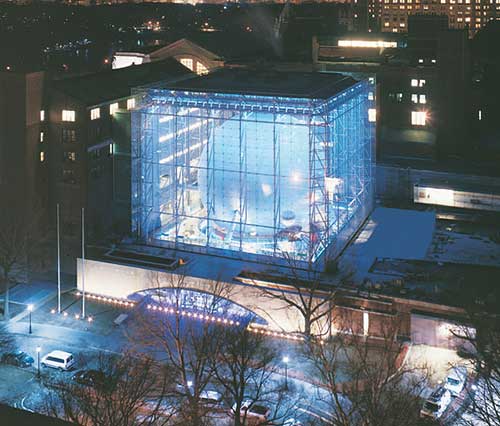 |
One of the most celebrated and spectacular examples of bolted structural glazing
systems in the world is the Rose Center for Earth and Space, American Museum of
Natural History, New York City, NY.
Architect: Polshek Partnership Architects LLP
Photo courtesy of W&W Glass, LLC |
Â
This basic system was prevalent for over 25 years, but in the
1980s, technical advances in two different areas led to the next big
step forward in transparency. Structural silicone systems began to
emerge, with properties superior to previous epoxies, more weathertight
and more able to withstand the flexing and stresses of large
glazing systems. Around the same time, in England in 1982, the use
of a countersunk hole in glass was invented and quickly recognized
as a key breakthrough. A hole about the size of a quarter was drilled
very close to the glass edge, and much smaller fittings, flush with
the exterior face, could be used. The innovation of the countersunk
hole, instead of the heavy corner patch plates used in the original
suspended systems, allowed structural glazing to be used as an entire
cladding system, in any plane, not just the vertically suspended
facades. Each lite could be fastened back to the glass fin, making
each lite independent of those adjacent. The true point supported,
bolted glass façade emerged.
The Time Warner Center |
The Time Warner Center located in New York City utilizes
state-of-the-art cable tension design at its main entrance façade
and "Prow" structure. The Prow is a three-sided transparent
glass structure specifically designed to house large electronic
signage. The large horizontal steel elements visible in this
image are in place to support signage and do not provide any
structural support for glazing. The Prow was constructed using
a combination of low-iron glass, vertically-hung double steel
cables, and horizontal glass fins. The horizontal laminated glass
fins shown below are designed to take up the lateral wind loads.
The vertically-hung double steel cables are designed to support
the dead load suspended weight of the glass wall.
The 80' wide x 180' tall entrance façade is supported
by a cable net, which consists of a series of cables tensioned
horizontally and vertically. The boundary structure is critical in
this type of design due to the large loads imparted by the cable
net. Cables are tensioned at every vertical and horizontal joint,
allowing the façade to move a full 23" in and out at its center
(46" total), under full wind load conditions. |
 |
The famous transparent glass "Prow" at the Time Warner Center,
New York City, NY.
Architect: Skidmore, Owings & Merrill, LLP
Photo courtesy of W&W Glass, LLC |
Â
Impressive buildings all over the world began to incorporate
these systems from the late 1980s on. The basic components
- glass, fittings and support structures - remain the same today.
However, as in every other technology, the pace of innovation in
each of these components has accelerated in recent years. Today's
glass is available in forms that are lighter, flatter, clearer, and highly
engineered to meet more stringent energy and building codes.
The design of fittings has been refined and expanded to include
applications for the most extreme conditions. And today's glazing
is often bolted to sophisticated steel supporting structures, including
trusses and tensioned cable riggings, which make architectural
statements of their own.
But perhaps the most important overall lesson learned has
been the recognition of how closely the performance of each
element is connected, and how carefully these relationships have
to be managed to create a single, sole source, tightly controlled,
precisely engineered, integrated system.
It's All About the Glass
The clear heart of the structural glazing system is the glass
itself. As crucial as the right fittings are to the system, steel
fittings are far simpler to engineer than glass. And even the most
sophisticated design for a support structure will only perform as
well as the glass performs.
 |
On the top, standard roller wave distortion is clearly visible. On the bottom, the perfect reflection made possible in glass controlled for roller wave, in the
extraordinary bolted structural glazing system on the facade of the Brain and Cognitive Sciences Complex, Massachusetts Institute of Technology,
Cambridge, Mass.
Photo courtesy of W&W Glass, LLC |
 |
Lead Designer: Charles Correa. Design of laboratories and research spaces:
Goody Clancy and Associates.
Photo © Anton Grassl/Esto |
Â
Glass is one of the most mysterious substances known, the
most liquid of solids and the most solid of liquids. It is technically
"perfectly elastic," which means if deflected (moved), it will return
to its original shape. But it is also technically "brittle," meaning that
it cannot bend very far without fracturing. Theoretically glass has
higher tensile strength than steel, but it does not behave in a "linear"
way. Doubling the load will not necessarily double the deflection of glass. Compare, for example, the stress and load relationships of
metal and glass. A metal coat hanger will reach its yield point (it
will bend) long before it breaks. In glass, however, the yield point
and the breakage point are exactly the same. That point is reached
with no visible warning, and not necessarily at the point where stress is highest. A small crack from an infinitesimal imperfection
or impurity will propagate at very high speed throughout the glass,
causing total failure.
In engineering glass facades, the two essential design criteria
are stress - the structural strength of the glass when subjected to
various loads; and deflection - how much the glass will move
when subjected to forces such as wind. Glass in an architectural
application will be subject to multiple and constantly changing load
factors: weather, positive and negative wind effects, temperature
effects, snow loads, seismic factors, possibly live loads from the
supporting structure, and in the case of canopies and skylights,
possible falling objects. The dynamic and static loads acting on glass
will cause it to deflect. The amount and shape of the deflection will
depend on the glass size and thickness, and the glass edge support
conditions, as well as the loads. The glass and glazing system must
be designed not only to have the strength necessary to withstand the
design load, but also to limit deflection.
ASTM E1300 "Determining Load Resistance of Glass in
Buildings" is basically a failure prediction model taking into
account the random nature of the kind of flaws and damage
that can cause fractures in glass. It is the industry standard used
for determining the load resistance of glass in buildings. It also
includes information for calculating the deflection of glass based
on its size and thickness. (ASTM E1300 specifically excludes
glass with holes and notches, so they have to be accounted for by
other analyses.)
Many other (often proprietary) complex and exhaustive
computer models have been developed to analyze the performance,
strengths and tolerance of glass. Design panel charts, for example,
allow engineers to accurately predict how a given panel of structural
glazing will perform under various loads. With this data the
engineer can design specific panel geometries and specify glazing
systems of the appropriate thickness. A typical analysis by a glass
engineer would require determining the size of the panel in square
meters (vertical axis) and the design wind load in Newtons per
meter (horizontal axis). The cross section of these two elements will
determine the appropriate thickness of glass for a given load.
So the properties of a simple pane of glass are already far
from simple to quantify and predict, but drilling countersunk holes
also creates areas of stress concentration that have to be taken into
account. The loads on glass are normally transferred at the corners
of the glass panels. Specially designed fittings that allow for
movement, as talked about more below, are critical for exactly this
reason, but toughened glass is still necessary to accommodate the
high stresses at connections.
In consequence, the glass in structural glazing systems
must be engineered and manufactured with extreme accuracy and
quality control measures. Testing and analysis must be stringent,
continuous and based on actual empirical data from the glass, the
assemblies and the existing façades and completed projects. New
building codes with higher wind and seismic requirements mean
testing and analysis are even more important for compliance.
The eventual beauty, performance and safety of glass in any
building, but particularly in bolted structural glazing systems, are
directly determined by the level of its engineering way before the
system reaches the manufacturer, and at every precise step after that.
Performance in the Making
The basic process of manufacturing very high quality float glass
begins with melting about 70 percent silica sand, 13 percent
dolomite and limestone, 12 percent soda ash and small amounts of
other materials. Often some percentage of the batch is in the form
of cullet, or cleaned and crushed glass recovered from previous
glassmaking, which lowers the melting temperature required. About
50 other elements are available to add in precise formulas to affect
performance, depending on the application. The melted mixture
produces a continuously rolling 12-foot wide glass ribbon. The
molten glass flows from the furnace and "floats" over a bed of molten
tin. It is then "annealed", a carefully controlled cooling process
to minimize internal stresses and maximize potential mechanical
resistance. For structural glazing systems, the glass is also "tempered",
to make it four times stronger than annealed glass. (The term "heat
strengthened" actually refers to a slightly different process. Heatstrengthened
glass, while twice as strong as annealed, will break into large jagged fragments, unlike tempered glass, which
breaks into small, much less dangerous fragments.)
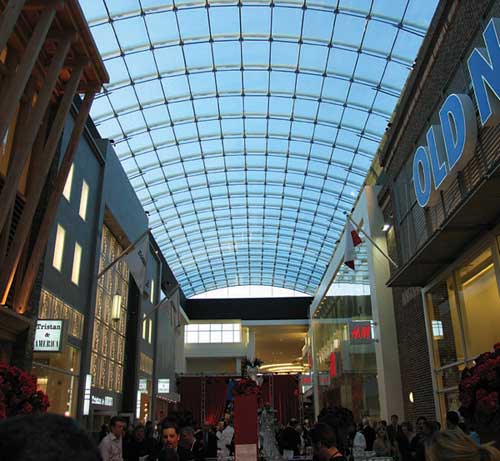 |
Transparency and performance are both enhanced with an ionoplast interlayer
in the glass roof of Yorkdale Mall, Yorkdale, Ontario, Canada.
Architect: MMM International Architects
Photo courtesy of W&W Glass, LLC |
Â
Tempering involves reheating the glass to the point
where it starts to soften followed by rapid controlled cooling
or "quenching." The outer surface of the glass cools faster
than the inner layer. As the inner layer cools it contracts and
compresses the outer layer, increasing the flexural strength
of the glass by up to four times.
All fabrication of the glass is completed before
tempering. All holes are drilled, and the other carefully
controlled polishing, edging, notching and finishing
processes completed, before tempering, because nothing
can be altered afterwards.
Not all tempering is created equal. One measure
is compressive strength. Typical furnaces average
approximately 11,500 psi (pounds per square inch, a unit of
pressure), and some of the most advanced modern furnaces
achieve minimum compressive strength of 16,000 psi. The
added strength can be especially important in structural
glazing for the added safety at countersunk hole locations
where maximum stress occurs.
Another measure is the occurrence of edge dip, roller
wave and bow. These may sound like garage bands, but
they are actually visual distortions that, although inherent
to the tempering process, can be minimized by stringently
controlled manufacturing processes. Edge dip and roller
wave are caused when the ribbon of semi-molten glass
sags even a small amount on the continuous casting roller during
the tempering process. Bowing is caused when the two sides of the
glass are cooled at even slightly different rates. These distortions
are difficult to control for and are quite visible in the wavy trees and
runny clouds reflected in many glass facades. The peak-to-valley
"waves" in glass can be measured, and the published norm is 0.05".
However, it is possible to specify a minimum 0.0008" peak to valley
wave, which virtually eliminates visual waves and results in high
clarity and the perfect reflection of the surrounding environment.
The following are some of the most important additional
analyses, tests and measurements that should be specified to ensure
safety and performance in bolted structural glazing systems:
Heat soak. Many experts consider the heat soak to be one of
the most important safety tests for tempered glass, to be specified
and performed on all structural glazing systems before they are
shipped. The heat soak process is a destructive test developed to find
and eliminate the tiny, invisible impurity nickel sulfide, naturally
present in the silica in float glass. Even a single inclusion of nickel
sulfide can cause spontaneous breakage in a piece of glass.
In the most stringent heat soak tests, glass is exposed to a
temperature of 290°C (+/-) for a period of 8 hours. In these tests
99.9 percent of the nickel sulfide impurities will be destroyed. Only
the fully heat soaked glass that has survived this process should be
specified for bolted structural glazing systems.
Strain gauge. Drilling the countersunk holes into glass creates
areas of additional stress. These effects have to be factored into the
system's overall performance parameters. The strain gauge is a
mechanical test to assess a variety of loads applied to glass panels in
horizontal or vertical orientations. Sensors translate pressure forces
into measurable electrical resistance.
Uniform load test. Tempered laminated glass is loaded past
the breaking point, and the laminate layer must support the weight
of the broken glass.
Finite element analysis. a numerical analysis to define how
a structure or material will react to loading conditions depending
on the anticipated stress levels at various points and under various
conditions. In the early 1970s finite element analysis was limited to
the most expensive mainframe computers such as those belonging
to aviation, defense and the nuclear industry. In our age, of course,
increased computer power makes it possible for 3-D computer
models to predict accurate results for all kinds of parameters and
variables, such as mass, volume, temperature, strain energy, force,
displacement and many others.
Tests for specific applications. Glass and assemblies
destined for bolted structural glazing systems typically undergo
many additional tests for specific conditions, including wind load
resistance, hurricane performance, air and water penetration, seismic
performance, impact resistance and bomb blast loading.
Layer Forward
One of the newest technological advances in glazing for structural
systems is between the panes: a new interlayer for laminated glass.
Laminated, or safety glass, was one of the key breakthroughs
in glass technology for widespread use. Although it had been
invented as early as 1910, the roots of the thin interlayer used in
today's laminated glass go back to the development of windshields
for automobiles. Clear polyvinyl butyral (PVB) was sandwiched
between two panes of glass. If the glass broke, most of the glass
fragments adhered to the plastic layer. PVB in various formulas is
still widely used today.
Most laminated glass is used within frames, like your
windshield, and safety glass is very good at keeping broken glass
within the frame. But in bolted structural glazing systems, the
framelessness is the point. Lamination, however, is still essential
in large glazed areas, sometimes at considerable heights and
in horizontal roofs or canopies. For these applications, PVB has
limitations. It doesn't react well to moisture, so it can discolor or
break down if edges are exposed. It also doesn't react well to the
silicone sealants used for weatherproofing at the butt joints between
panes in structural glazing. And there is a safety concern. With
PVB, in a frameless panel, if both pieces of glass are broken, the
glass will fall out.
The new ionoplast interlayers were originally developed
for hurricane prone areas but are now increasingly specified for
structural glazing systems. Not only is the substance not reactive
with silicone or with moisture, but it also bonds better to the glass,
is more rigid, and allows the glass to act as a composite monolithic
unit. The interlayer's structural strength allows the use of much
thinner, lighter panes, and is clearer even than clear PVBs. Sealing
the deal is its innate structural strength and stiffness. If the glass
breaks, the stiff interlayer tends to stay in place, making it much
safer when considering post-breakage performance. The strength
and stiffness also allows architects to design large, relatively thin
glass panels with minimal support systems that can handle massive
loads -whether impact from hurricane or blast, or snow and ice
loads. Loads like that normally would require extremely thick
laminated tempered glass.
The ionoplastic interlayers are being used in assemblies that
look exceptionally transparent and light, particularly when used
with low-iron ultra-clear glass, but are actually composites that
solve multiple problems. For instance, in the Yorkdale Shopping
Centre in Yorkdale, Ontario, Canada, each 7-foot by 4 -1/2 foot
panel of glass in the huge barrel-vaulted glass roof consisted of fully
tempered heat soaked clear insulated glass, a high-performance
ceramic frit for solar control, an ionoplast interlayer for structural
strength and argon gas in the air gap for insulation.
Nuts and Bolts
The choice and design of the stainless steel fittings in bolted structural
glazing systems is critical to ensure that loads are transferred to the
structural elements supporting the glass. Various load paths occur at
every countersunk hole. Fittings are designed to prevent high stress
concentration at the hole positions. (Stress analysis, including the
strain gauge testing previously noted, is crucial.) But the glass will
also expand and contract, deflect and rebound, constantly throughout
its service life. Fittings have to cope with negative and positive
wind loading, seismic loads, thermal movement, construction
tolerances, live load and dead load movements. Correctly designed
fittings incorporate movement diaphragms of stainless steel and
durable flexible discs or rotules to allow for rotation behind the
glass, at the building connection.
 |
Ruins as old as the 12th century are protected by 21st century bolted
glazing design and technology at Hamar Cathedral, Hamar, Norway.
Architect: Lund and Slaatto Arkitekter
Photo courtesy of W&W Glass, LLC |
Â
The choice of hardware is related to the specified glass,
the design of the support system, the design and function of the
building, the anticipated loads, and many other factors. All holes
in the glass have to be drilled and polished with precision accuracy
at the manufacturer, specifically for fittings specially designed for
that application. The cutting is done with highly specialized drilling
equipment, and the holes are then carefully polished. As noted
earlier, this entire process must be completed before tempering.
Thus the hardware must be matched with extremely tight tolerances,
taking into account such critical details as the thickness of the glass,
the loads the hardware must resist, the distance from the hole to the
glass edge, and the maximum distance between hole connections.
The most common fitting in bolted glazing systems is
the "spider" or star type. The highest quality are those made of
austenitic Type 316 solid stainless steel lost wax investment
castings, commonly two-point, four-point and sliding types, but
many other forms and shapes are available or can be designed for
specific applications. For example, a design with sliding arms to
accommodate large racking displacement of glass under severe
seismic events allows for movement of up to 1 inch in two directions
at each glass joint. Specific fittings are also used with each of the
basic types of supporting structures discussed below, such as pin
joints for glass mullion systems.
In the continuing search for transparent expanses and minimum
visible structure, one of the most recent innovations in fittings is
concealed bolt structural glazing, where the bolt or fitting is recessed
into the glazing. Concealed bolts are integrated into the interior
laminate through the back lite of the glass, allowing completely flush facades or canopies with all fittings entirely concealed within
the laminated panel and no visible exterior fasteners. This type of
structural glazing is a proprietary system, but it has been fully tested
for performance and safety standards.
Performance of the entire structural glazing system is a
close inter-relationship between glass and hardware. For example,
bomb resistance requires not only high strength laminates but also
specially engineered connections.
Best Performanc e in Suporting Structures
In bolted structural glass systems, the glass is fixed to support
systems, also often called back-up systems, which are in turn
fastened to the building structure itself. There are three basic types
of support systems but as can be seen in the examples below and in
many other buildings all over the world an incredibly wide range of
combinations and variations of these types are possible. Although
these complex and dramatic glass facades, walls, skylights, canopies
and other features are often associated with iconic signature
buildings they are also increasingly being used in stores, office
buildings, hotels and other smaller scale applications.
The supporting structures are the components of the glazing
system where the building's designer has the most freedom. In the
best cases, the design of the glass, the fittings and the supporting
structures are integrated seamlessly into the design of the building.
Transparent glass fins (Mullions). Glass fins have been used
continuously since the earliest suspended assembly systems in the
1960s and they are still the most common bolted structural glazing.
Glass panels are bolted to the fins, which provide horizontal support
against both negative and positive wind pressures. The weight
of the glass is transferred back to the fins, which hang from the
structure on the top of the building. Glass fins are available in a
variety of different heights and widths, depending on the particular
load criteria of the project, and are typically fully tempered and heat
soaked. Glass fin suspended assemblies have functioned well in the Northridge (Los Angeles) and Kobe earthquakes.
 |
Cable tension trusses help create the exceptional transparency of the façade of
the University of Connecticut, Stamford, CT.
Architect: Perkins & Eastman
Photo courtesy of W&W Glass, LLC |
Â
In new construction, a common fin connection is the propped
cantilever type. Movement is transferred to the building at the head
of the wall, so more steel must be located there. A second type of
mullion configuration is the pin-jointed fin, allowing absorption of
live loads and thermal expansion through rotation around a steel
pin. This type of connection requires fins to be deeper, but it is the
most common type, especially in existing buildings where it would
be too costly to add steel structure.
Glass fin systems are available for horizontal or vertical
designs, and when executed correctly are extremely transparent.
Like any tall and narrow structural member, the glass fins
used in glass façades could buckle if subjected to particularly
high negative loading. In these cases, it would be the unsupported
back edge of the glass fin that would typically buckle first. So in
order to understand the stresses and ensure proper performance
and safety every fin design should be subjected to specialized
 buckling analysis. To support higher facades, taller fins, and higher
wind loads, designers are using new anti-buckling fin technology.
Stainless steel tension rods bolted to the back edges of the glass fins
provide lateral support and prevent the fin from buckling or flipping
out of plane during load.
At the River East Center in Chicago, IL, a structural glazing
system with glass fin supports was used to create a 180' high glass
entrance façade. The glass fins were spliced to achieve the required
height; however, at 180', potential buckling still posed a serious
problem. In order to prevent buckling of the spliced glass fins,
the glass façade was designed with multiple steel support trusses
every 30'.
For the 3 Times Square building in New York City, the
architect did not want any steel to be visible within the 60-foot tall
structural glass façade. Given a glass façade of this height, potential
buckling of the glass fins was again a major concern. To avoid the
use of horizontal steel supports, small anti-buckling cables were
mounted across the back of the glass fins and tensioned
wall to wall.
Steel support structures. Steel support structures
can be used to support façades, canopies, screen walls, and
even elevator enclosures designed with structural glass.
These structures are extremely versatile, ranging from
simple systems using steel tubes to elaborate four-sided
glass boxes. The steel supports can be inside the system
and virtually invisible, or exterior and highly visible.
A steel-supported structural glazing system was
used to create a glass enclosure for the Hamar Cathedral
historic site in Norway. Because it is located in such a cold
climate, the Hamar Cathedral ruins required protection.
Steel supports were combined with structural glazing to
create this complex, sloping glass and steel structure.
Tension supported structures. Some of the most
innovative recent designs in bolted structural glazing
have utilized cable tension support structures of three
basic types: the primary steel truss, self contained and
imparting no tensile load to the boundary structure; the
bow or bow string truss, with cables at the front and back of a center mast, also imparting no tensile load to
the structure; and the cable net truss. The latter
is the most expensive type since it requires field
tensioning and heavier boundary structures.
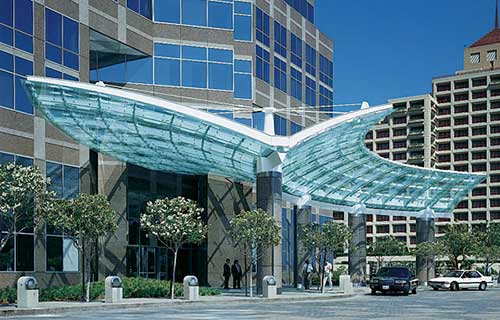 |
Advanced structural glass canopy design as well as the critical importance of heat soaking
tempered glass are both demonstrated at the Fox Plaza, Century City, CA.
Architect: Johnson, Fain & Pereira Associates
Photo courtesy of W&W Glass, LLC |
Â
One of the most famous examples of bolted
structural glazing in the United States, the luminous
Rose Center for Earth and Space in New York City,
was the first large-scale cable-supported project in
the United States. It is still regarded, as it was at its
opening in 2000, as a dramatic demonstration of an
American bolted structural glazing project every
bit the equal of spectacular projects in Europe such
as the Louvre Pyramid.
Other distinguished American examples
quickly followed. At 300-feet long and 33-feet
tall, the façade at the University of Connecticut is
one of the largest, lenticular cable-truss supported
structures in the United States. The insulated glass
façade was built using a series of cable tension
trusses. The absence of horizontal supports makes
the façade visually very light.
A cable structure was also used to create an extremely
transparent segmented curving glass façade for the NASDAQ
market site in New York City. The NASDAQ project is an excellent
example of the customized solutions available with tensionsupported
structural glazing. In this case, the structure uses a series
of horizontal loop cables tensioning against the vertical cables as a
means to support the entire glass façade.
Cables were used to create a soaring 70' structural glass façade
for a building at the Harvard Medical School in Cambridge, MA.
In this case, a mid-truss allows for the use of two separate cable
tension trusses, each approximately 35' high. Without the midtruss,
the façade would have required trusses 8' deep and would
have imparted massive loads on the boundary structure.
Clear out to Here: Skylights, Roofs and Canopies
Structural glass is ideal in horizontal applications because it can
be engineered to accept very high and complex loads and can be
very efficient in terms of heat loss and solar gain. The supports
for skylights, roofs, and canopies can be positioned either above
or below the steel structure. All overhead glazing must be
laminated in order to meet building safety codes, and some codes
may require nets in certain applications. To prevent ponding, a
3 degree minimum slope is required. But within these minimal
constraints, the sheer transparency of bolted glazing is tailor made
for skylights and other designs where maximum openness and
clarity are at a premium.
In the Yorkdale project in Canada mentioned earlier, the
architects wanted a structureless system for a large span skylight
addition, but they also needed the overhead glazing to be strong and
safe for the public in the shopping mall below in the face of frequent
heavy snow and ice loads.
The 60-foot high, 300-foot long barrel-vaulted atrium was
added to the center of the original building built in 1964. The
skylight incorporates insulated laminated double glazing that is
hung from an exterior structure with gussets supporting seismic
fittings. Additionally, it is a showcase for other high technology,
as discussed earlier, including ionoplast interlayers and argon gas
insulation.
The curved skylight created for the Brooklyn Museum of
Art consists of an extremely complex geometric, stepped design.
The curved skylight angles downward, with intermediate steps
interrupting the roof plain. These vertical glass steps are supported
from the interior by an integrated system of steel cables and glass
trusses.
At Orlando International Airport the skylights and glass roofs
were designed to combine two different types of backup structures.
Rather than use steel as a backup, the architects chose to lighten
the structure as much as possible. This was accomplished by using
laminated glass fins in conjunction with cable trusses located at 11'
on center and perpendicular to the fins.
The Imperial Bank Tower Segerstrom located in Costa Mesa,
CA involved the design of a 130' long and 20' wide barrel-vault
atrium. The biggest concern of the structural glass engineers working
on the project was that the glass barrel-vault had to be designed to
act as a seismic joint between two very different existing buildings.
As a result, the steel and cable tension system needed to be able to
support the weight of the glass and allow for movement during a
seismic event. New fittings were developed to allow for the extreme
movements required by the California Building Code. These custom
fittings have since been used on canopies, skylights, and vertical
façades in seismically-active areas throughout the world.
The structural glass canopy at the Fox Plaza in Los Angeles was
specifically designed to catch glass breaking because of nickel sulfide
inclusions and falling from the existing tower above. The canopy was
tested for structural and seismic performance, and was designed to
withstand the impact of falling glass from 150' in the air. This project
serves as a clear reminder of the importance of heat soak testing all
tempered glass in point supported structural glazing systems.
Worst Case Scenarios
Structural glazing has been successfully tested and approved for
resistance to bomb blast loading. Bomb-resistant structural glazing
is typically constructed of insulated laminated double-glazed units.
When designing bomb-resistant structural glazing systems, it is
important to introduce additional controlled flexibility at the fittings.
By understanding the severe deflections that will be induced in the
glass during a blast event, the design of the support fittings can
be enhanced to achieve significantly greater blast resistance, while
from the outside, the fitting can look identical to a conventional
support system. Blast-resistant glazing with special seismic fittings
was used to create the glass façade of the BBC Television Center
in London. Unfortunately, the system had a real-life test when
the building was bombed in 2001. Ninety percent of the glazing
remained undamaged. In contrast, a large glass curtain wall located
about 500' away from the BBC building was severely damaged by
the blast.
The Future is Clear
The most advanced current bolted structural glazing systems are
lighter, more transparent, more energy efficient, stronger, more
resistant to extreme stresses from explosions, hurricanes and
earthquakes, and able to fit into more imaginative designs than ever
before. Structural glass, when made correctly under tightly controlled
conditions, is flatter and clearer than ordinary tempered glass, and
options are proliferating in coatings, colors, decorative patterns, high
performance, energy efficiency, acoustical, low-iron (for enhanced
clarity), solar and even self cleaning glazing. Design innovation has
also accelerated in fittings and in supporting structures.
But as will be clear by now, the most important component of
the system is knowledge. With the benefits of brilliantly designed
and executed structural glazing systems come considerable risks if
testing, manufacturing, fabrication and installation are not of the
highest order. Liability issues can be especially complex when
so many professional teams are involved - project architects
and engineers, manufacturers, glass engineers, system designers,
testing specialists, skilled fabricators and installers, and many
others. The use of a single experienced source bringing together
as many services as possible, and offering a single long term
system warranty, is one way to effectively manage these risks, and
to achieve the integrated approach that marks the most successful
- and spectacular - projects to date. With the fundamental factors
necessary for long-term safety, performance and beauty ensured,
the next generation of bolted structural glazing systems should be
even more extraordinary, and even closer to that long-held vision of
perfect transparency.
|
| W & W Glass, LLC, is the NY metropolitan area's largest architectural glass and metal contractor. The company is also the
largest supplier of structural glass systems throughout the United States. The company exclusively supplies the Pilkington
Planarâ„¢ structural glass system.
www.wwglass.com |
|
Â