This CE Center article is no longer eligible for receiving credits.
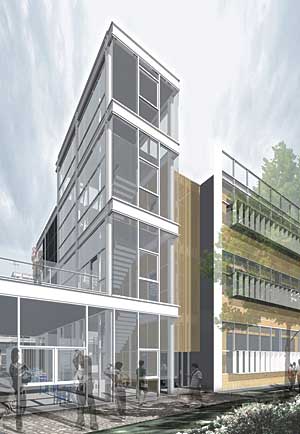
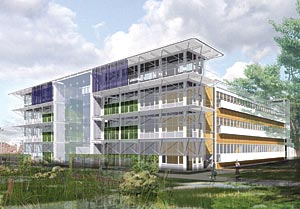
For a former industrial site in downtown Vancouver, four regional educational institutions are collaborating on an unusual experiment. The schools-the University of British Columbia (UBC), Simon Fraser University, Emily Carr, and the British Columbia Institute of Technology (BCIT)-plan to build a 64,500-square-foot "living laboratory" they call the Centre for Interactive Research on Sustainability, or CIRS. It will provide office and research space for the partner institutions and the opportunity to study building products, technologies, and systems in context. Over the lifetime of the building, much of it-including its envelope; the mechanical, energy, and water systems; and the finishes-will be treated as a research test bed. Its components will be modular, allowing them to be replaced or reconfigured in a "plug-and-play" manner as technologies improve.
Designers and center officials have ambitious performance goals. They plan a building that will require few resources from off-site to operate and will create little waste. They say CIRS will use only 17 percent of the energy of an ASHRAE 90.1 base building and will score beyond Platinum in the Canadian Green Building Council's rating system. They hope to accomplish this for about $265 per square foot, a budget typical for UBC dry-lab buildings. "If sustainable practices are to become standard operating procedure, we have to find a way to construct [high-performance] buildings at roughly the same cost as those typically built by the development industry," says UBC geography professor and former director of the school's Sustainable Development Research Initiative, John Robinson. He is considered one of the chief visionaries behind the CIRS.
|
The Centre
for Interactive Research on Sustainability
will be a flexible building that can adapt to long-term changes in use and technology. The building itself will serve
as a "living lab" where the performance of the facility's components and systems will be the focus of the research
conducted by
its occupants.
Images: Courtesy Busby Perkins+Will, except as noted. |
The project is within about $1 million of its $21 million budget, according to the architect, Busby Perkins+Will, which recently completed design development and has submitted an application for a development permit. The client is now negotiating with the city to allow the facility to provide about a third of the number of parking spaces than would typically be required for a building of its size. CIRS officials say the reduction is justified since tenants will be required to sign a sustainability charter and will encourage users to travel to the center by public transportation, by bicycle, or by other alternative modes. If city officials accept the center's parking assessment, drilling for the building's ground source heat pumps and other site work could begin as early as February, with occupancy of the 64,500-square-foot first phase slated for the middle of 2008. Two more phases of construction are planned for an eventual total capacity of 118,000 square feet.
For a former industrial site in downtown Vancouver, four regional educational institutions are collaborating on an unusual experiment. The schools-the University of British Columbia (UBC), Simon Fraser University, Emily Carr, and the British Columbia Institute of Technology (BCIT)-plan to build a 64,500-square-foot "living laboratory" they call the Centre for Interactive Research on Sustainability, or CIRS. It will provide office and research space for the partner institutions and the opportunity to study building products, technologies, and systems in context. Over the lifetime of the building, much of it-including its envelope; the mechanical, energy, and water systems; and the finishes-will be treated as a research test bed. Its components will be modular, allowing them to be replaced or reconfigured in a "plug-and-play" manner as technologies improve.
Designers and center officials have ambitious performance goals. They plan a building that will require few resources from off-site to operate and will create little waste. They say CIRS will use only 17 percent of the energy of an ASHRAE 90.1 base building and will score beyond Platinum in the Canadian Green Building Council's rating system. They hope to accomplish this for about $265 per square foot, a budget typical for UBC dry-lab buildings. "If sustainable practices are to become standard operating procedure, we have to find a way to construct [high-performance] buildings at roughly the same cost as those typically built by the development industry," says UBC geography professor and former director of the school's Sustainable Development Research Initiative, John Robinson. He is considered one of the chief visionaries behind the CIRS.
|
The Centre
for Interactive Research on Sustainability
will be a flexible building that can adapt to long-term changes in use and technology. The building itself will serve
as a "living lab" where the performance of the facility's components and systems will be the focus of the research
conducted by
its occupants.
Images: Courtesy Busby Perkins+Will, except as noted. |
The project is within about $1 million of its $21 million budget, according to the architect, Busby Perkins+Will, which recently completed design development and has submitted an application for a development permit. The client is now negotiating with the city to allow the facility to provide about a third of the number of parking spaces than would typically be required for a building of its size. CIRS officials say the reduction is justified since tenants will be required to sign a sustainability charter and will encourage users to travel to the center by public transportation, by bicycle, or by other alternative modes. If city officials accept the center's parking assessment, drilling for the building's ground source heat pumps and other site work could begin as early as February, with occupancy of the 64,500-square-foot first phase slated for the middle of 2008. Two more phases of construction are planned for an eventual total capacity of 118,000 square feet.
History as inspiration
The CIRS project is not without precedent. One earlier living lab is the Robert L. Preger Intelligent Workplace (IW), built in Pittsburgh at Carnegie Mellon University in 1997. The $4 million facility sits atop an early-20th-century building in a penthouse addition designed by architects Bohlin Cywinski Jackson and Pierre Zoelly [Record, June 1998, page 148].
|
 |
| The south facade
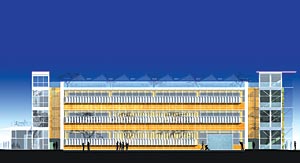
(top) has a catwalk to facilitate the change-out and testing of components such as photovoltaic panels, shading devices, and glazing. The west (above) and east facades will be more fixed, but adaptable. They will have internal and external light shelves as well as adjustable vertical shading fins. |
The IW serves as offices for the Center for Building Performance and Diagnostics (a division of Carnegie Mellon's school of architecture), and as a reconfigurable facility where the effectiveness of new building products and systems are tested and evaluated. In the nine years since its opening, architecture masters and doctoral candidates have used the IW to perform many kinds of investigations, including lighting and daylighting evaluations, ventilation studies, and acoustics research. For the first seven years, the facility relied on the university's infrastructure for power. However, researchers recently began examining the potential of on-site generated renewable energy, and have installed solar thermal collectors on the penthouse roof [see sidebar].
The university hopes to further explore distributed energy systems in a project it has dubbed "building as power plant." It plans an approximately 40,000-square-foot academic building that will be a net energy producer. The 7,000-square-foot IW has "only modest heating and cooling loads and is not big enough to support the next generation of power systems," says Vivian Loftness, FAIA, senior researcher for the Center for Building Performance and Diagnostics and former head of the architecture school. Before building this much larger living lab, Carnegie Mellon will have to conduct a national fund-raising campaign, says Loftness.
More than an experiment
Unlike Carnegie Mellon's IW, the Vancouver facility will include office space for nonacademic tenants. One of these tenants is the region's electric utility, BC Hydro. It has signed a 25-year, prepaid lease for about 8,500 square feet of office space. The funds will be used to help finance construction-a way to reap the rewards of CIRS's promised lower operating costs up front. This practice is atypical for developers, and even for long-term institutional owners, who rarely intermingle capital and operating budgets. "One of the biggest barriers to building sustainably is the operating/development cost split," says Robinson.
Spreading the gospel
The deal is also advantageous for the utility, says Bruce Sampson, BC Hydro's vice president for sustainability, who predicts that rents will rise considerably over the next quarter century. But the utility's interest in CIRS goes beyond the inexpensive rent. It shares the center's mission of community engagement and has had a long-standing program to encourage its customers to conserve electricity.
About 50 employees will occupy BC Hydro's space at the center at any one time, but on a revolving basis, predicts Sampson. "They will be exposed to the leading-edge thinking and then will bring it back to their regional offices," he says.
| click images to view larger |
|
 |
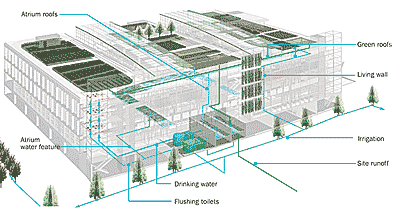
| Diagrams showing the center after the third phase of construction illustrate the facility's ventilation and air-supply system (above) and the strategy for rainwater collection and reuse (top). |
Part of BC Hydro's approximately $4.5 million prepayment will go toward sponsorship of a 100-seat visualization theater, where the general public, policy makers, and others will be able to quickly model the environmental ramifications of energy-use decisions at the regional, city, and building scale. "To hit our goals we have to be a catalyst for sustainable urban environments, infrastructure, and buildings," says Sampson.
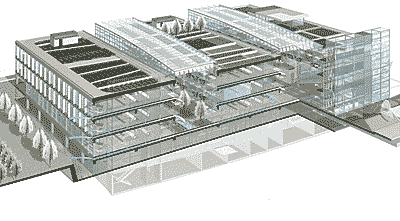
The CIRS building will be composed of two three-story office blocks connected by a central atrium that features internal light scoops and solar reflectors. The space will be covered by a saw-tooth-shaped skylight with integrated photovoltaic panels. The 36.9 megawatt-hour-per-year array is expected to supply about 20 percent of the facility's electricity needs. Power will also be provided by solar hot-water collectors, fuel cells, and an on-site cogeneration plant. "We are trying to pull the building off the grid," says Blair McCarry, a principal at Stantec, the project's mechanical engineer.
The south side of the building will serve as a "three-dimensional vertical lab" for the testing of such elements as glazing, photovoltaic panels, wall assemblies, and shading devices. On almost every floor, at the southwest and southeast corners of the building, labs for building monitoring and assessment will be located in the 13-foot-deep zone directly adjacent to the facade. These rooms will provide a controlled environment for the study of the relationship between the building envelope components and other elements, such as the heating and cooling systems, interior shading devices, or interior finishes and furnishings.
Many clients, one project
The center is the first project that Busby Perkins+Will is designing with a three-dimensional, parametric building information model. The model's interference-checking capabilities have been particularly useful for coordinating among the architectural design team and the various consultants, says Nielsen. And the 3D visualization tools have helped explain the building to its many constituents. "With four client institutions, each with its own research clusters, at times there are 30 people at the table during planning meetings," he says.
The center's designers say that the 3D model will also help the industry close the gap between predicted and actual performance. For the life of the building, CIRS's various systems and components will be "super-monitored," says Stantec's McCarry. Information regarding such factors as energy and water use, indoor air quality, and temperature will be continuously and systematically gathered from nearly 1,500 monitoring points.
Researchers will have the ability to compare this data to the information about the building's predicted performance contained in the 3D model. "Once the building is in operation, we can go back to the original assumptions with real-world feedback," says Nielsen. "Ultimately, we will be able to construct more accurate models," he says.
CIRS officials also plan to evaluate the relationship between
the building's environment and the health, productivity, and satisfaction of the occupants, using tools such as postoccupancy surveys. Jokes McCarry, "It's a scary amount of accountability."
Earlier Living Laboratory Sets Its Sights
On the Next Generation of Power Systems |
On a smaller scale, investigations similar to those planned for Vancouver's Centre for Interactive Research on Sustainability have been conducted for almost a decade in Pittsburgh, at Carnegie Mellon University's Center for Building Performance and Diagnostics [CBPD].
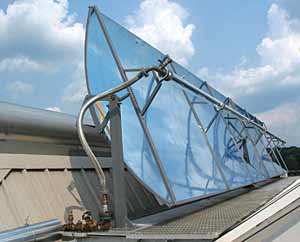
Part of the school of architecture, the CBPD built its living lab on top of the early-20th-century campus building (far right). Since its opening in 1997, students have used the facility, the Robert L. Preger Intelligent Workplace, or IW, to perform investigations such as lighting and daylighting evaluations, ventilation studies, and acoustics research. They have started exploring the potential of buildings to produce power and have installed solar thermal collectors on the roof (above and bottom right). They consist of a reflective trough and a high-temperature steam pipe, and can be used to run an absorption chiller for cooling. The temperature of the steam can also be stepped down to provide heat, explains Vivian Loftness, FAIA, senior CBPD researcher and past head of the architecture school.
The university hopes to further these explorations in a 40,000-square-foot academic building project (bottom left). It would provide the opportunity to apply, at commercial scale, a combined heat and power system using reject heat for generating electricity, heating, cooling, and dehumidification built on a fuel cell. The building would have a connection to the ground, in order to tap into geothermal energy, and would incorporate renewable sources such as photovoltaic and solar thermal power.
|
The roofs over the office wings will be vegetated, and will be monitored and evaluated. CIRS researchers plan a diverse set of projects. "We will test beyond [the usual] storm-water mitigation and thermal performance," says Maureen Connelly, program head of BCIT's Center for Advancement of Green Roof Technology. It is not clear yet if the roof's loading capacity will be adequate for an intensive green roof system, which would be appropriate for a wide variety of plant material, including small trees, flowers, or vegetables. However, Connelly has high hopes that researchers will be able to use the facility to study the capability of green roofs to support biodiversity, urban habitat, and urban agriculture.
Connelly has a particular interest in the sound-transmission characteristics of green roofs-their potential to reduce noise transmission through the building envelope, and their ability to absorb and reflect sound. She predicts that other academics will likely conduct research into areas such as the relationship between green roofs and mechanical-system performance or the therapeutic benefits of rooftop greenspace. The strength of the center's concept is that it brings these academics and their projects together, says Connelly. "At each platform of CIRS, there are many more levels of research," she notes.
|
|

Images: Courtesy The CMU Center for Building Performance and
Diagnostics, except © Karl A. Backus (middle) |
The center will be connected to Vancouver's water and sewer systems. However, CIRS officials and its designers say the municipal services will be used rarely, if ever. Rainwater runoff collected from the skylights and other clear roof surfaces will be stored, treated, and distributed for use in showers and sinks, and to supply other potable points. Any water that drains from the building's green roofs will not be suitable for these uses because of organic materials typically found in such runoff, explains Troy Vassos, president of the process engineering firm Novatec. The green roof water will be combined with wastewater from showers, lavatories, and toilets, and treated, possibly using a membrane bioreactor or a solar aquatic system, so that it will be safe for direct human contact, he says. This treated, mixed wastewater will then subsequently be used to flush toilets and to irrigate the green roofs and the site's landscaping.
Many clients, one project
The center is the first project that Busby Perkins+Will is designing with a three-dimensional, parametric building information model. The model's interference-checking capabilities have been particularly useful for coordinating among the architectural design team and the various consultants, says Nielsen. And the 3D visualization tools have helped explain the building to its many constituents. "With four client institutions, each with its own research clusters, at times there are 30 people at the table during planning meetings," he says.
The center's designers say that the 3D model will also help the industry close the gap between predicted and actual performance. For the life of the building, CIRS's various systems and components will be "super-monitored," says Stantec's McCarry. Information regarding such factors as energy and water use, indoor air quality, and temperature will be continuously and systematically gathered from nearly 1,500 monitoring points.
Researchers will have the ability to compare this data to the information about the building's predicted performance contained in the 3D model. "Once the building is in operation, we can go back to the original assumptions with real-world feedback," says Nielsen. "Ultimately, we will be able to construct more accurate models," he says.
CIRS officials also plan to evaluate the relationship between
the building's environment and the health, productivity, and satisfaction of the occupants, using tools such as postoccupancy surveys. Jokes McCarry, "It's a scary amount of accountability."
Earlier Living Laboratory Sets Its Sights
On the Next Generation of Power Systems |
On a smaller scale, investigations similar to those planned for Vancouver's Centre for Interactive Research on Sustainability have been conducted for almost a decade in Pittsburgh, at Carnegie Mellon University's Center for Building Performance and Diagnostics [CBPD].
Part of the school of architecture, the CBPD built its living lab on top of the early-20th-century campus building (far right). Since its opening in 1997, students have used the facility, the Robert L. Preger Intelligent Workplace, or IW, to perform investigations such as lighting and daylighting evaluations, ventilation studies, and acoustics research. They have started exploring the potential of buildings to produce power and have installed solar thermal collectors on the roof (above and bottom right). They consist of a reflective trough and a high-temperature steam pipe, and can be used to run an absorption chiller for cooling. The temperature of the steam can also be stepped down to provide heat, explains Vivian Loftness, FAIA, senior CBPD researcher and past head of the architecture school.
The university hopes to further these explorations in a 40,000-square-foot academic building project (bottom left). It would provide the opportunity to apply, at commercial scale, a combined heat and power system using reject heat for generating electricity, heating, cooling, and dehumidification built on a fuel cell. The building would have a connection to the ground, in order to tap into geothermal energy, and would incorporate renewable sources such as photovoltaic and solar thermal power.
|