This CE Center article is no longer eligible for receiving credits.
View course on architecturalrecord.com »
COMMUNITY ENGAGEMENT has played a long-standing part in the making of public spaces, civic buildings, and high-profile development projects. It is often a precondition for approvals or funding. But that doesn’t mean that the result responds to a neighborhood’s needs or desires. The traditional process often consists of a series of perfunctory community meetings where little genuine dialogue or evaluation occurs. Such forums, says designer Liz Ogbu, principal of Oakland, California–based Studio O, are “super-transactional. They are simply a box to check.”
PHOTOGRAPHY: © TOM FITZGERALD (TOP); ANNE HAMERSKY (BOTTOM)
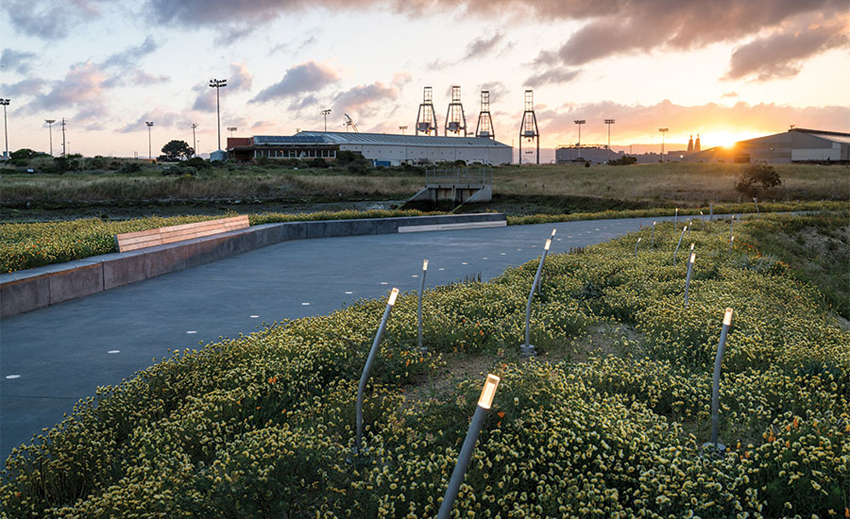
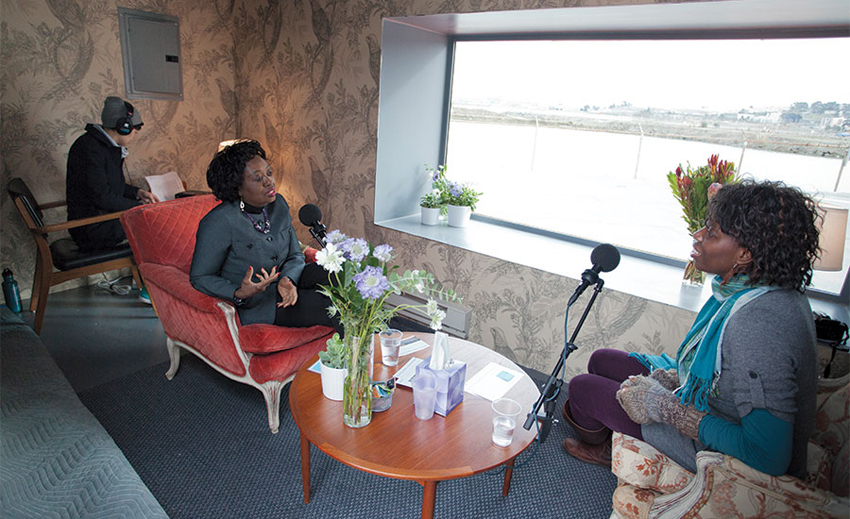
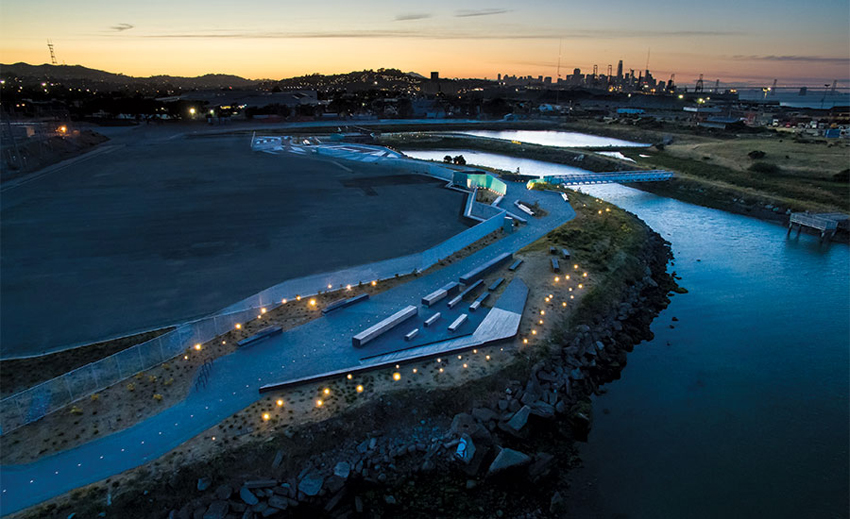
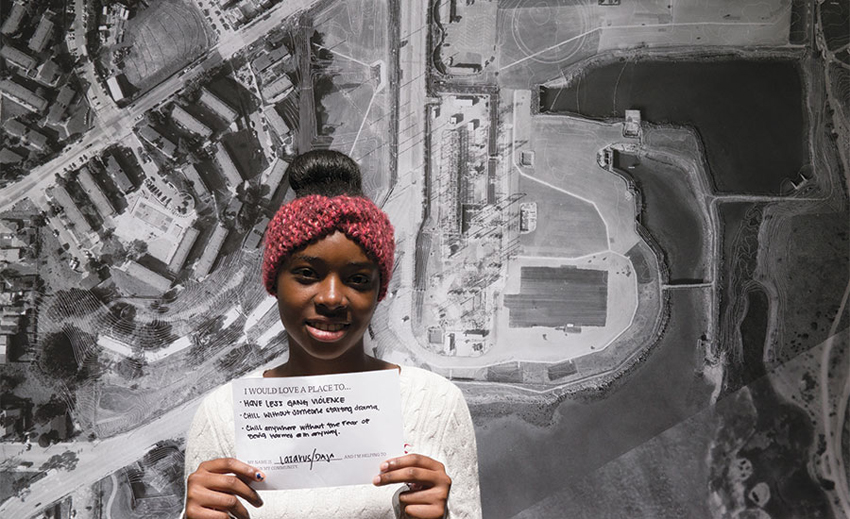
THE DESIGN of a shoreline park (top), at the edge of a former power plant site in San Francisco, was informed by data collected at the many events that the firms Envelope and Studio O have held on the empty lot, including one conducted in collaboration with StoryCorps that documented the history of the neighborhood and the reflections of residents (bottom).
What’s more, the usual engagement methods rarely work to the advantage of vulnerable or lower-income communities, say advocates of a more inclusive process. In her 2018 book, Resilience for All: Striving for Equity Through Community-Driven Design, Barbara Brown Wilson says the typical methods rarely represent greater neighborhood interests. According to Wilson, an assistant professor at the University of Virginia’s School of Architecture, “The result is irrelevant public infrastructure at best, and resident displacement at worst.”
But there are effective and equitable examples that architects and planners can look to. An inventive process is being employed in Bayview-Hunters Point, an historically blue-collar Black neighborhood on San Francisco’s southeastern shoreline. Here the utility PG&E tore down an outmoded and polluting power plant in 2008 after nearby residents fought for decades for its closure. The plant’s dismantling was a double-edged sword: though in one sense it was a victory for the community and activists, it also raised the specter of gentrification, since demolition and environmental cleanup freed up 34 acres of waterfront property for potential development.
Yet because the site could not be sold or developed immediately, neighborhood residents had an advantage. The parcel is a complex agglomeration of land entitlements, lease agreements, and easements to be untangled—which meant the utility had an immense piece of asphalt-capped land, encircled with razor wire, just sitting there. So in 2012, PG&E hired Envelope Architecture and Design, a Berkeley, California–based architecture firm, to activate a portion of the site with interim uses and to design a permanent park along the water’s edge, providing legally required access to the shoreline.
View course on architecturalrecord.com »
COMMUNITY ENGAGEMENT has played a long-standing part in the making of public spaces, civic buildings, and high-profile development projects. It is often a precondition for approvals or funding. But that doesn’t mean that the result responds to a neighborhood’s needs or desires. The traditional process often consists of a series of perfunctory community meetings where little genuine dialogue or evaluation occurs. Such forums, says designer Liz Ogbu, principal of Oakland, California–based Studio O, are “super-transactional. They are simply a box to check.”
PHOTOGRAPHY: © TOM FITZGERALD (TOP); ANNE HAMERSKY (BOTTOM)
THE DESIGN of a shoreline park (top), at the edge of a former power plant site in San Francisco, was informed by data collected at the many events that the firms Envelope and Studio O have held on the empty lot, including one conducted in collaboration with StoryCorps that documented the history of the neighborhood and the reflections of residents (bottom).
What’s more, the usual engagement methods rarely work to the advantage of vulnerable or lower-income communities, say advocates of a more inclusive process. In her 2018 book, Resilience for All: Striving for Equity Through Community-Driven Design, Barbara Brown Wilson says the typical methods rarely represent greater neighborhood interests. According to Wilson, an assistant professor at the University of Virginia’s School of Architecture, “The result is irrelevant public infrastructure at best, and resident displacement at worst.”
But there are effective and equitable examples that architects and planners can look to. An inventive process is being employed in Bayview-Hunters Point, an historically blue-collar Black neighborhood on San Francisco’s southeastern shoreline. Here the utility PG&E tore down an outmoded and polluting power plant in 2008 after nearby residents fought for decades for its closure. The plant’s dismantling was a double-edged sword: though in one sense it was a victory for the community and activists, it also raised the specter of gentrification, since demolition and environmental cleanup freed up 34 acres of waterfront property for potential development.
Yet because the site could not be sold or developed immediately, neighborhood residents had an advantage. The parcel is a complex agglomeration of land entitlements, lease agreements, and easements to be untangled—which meant the utility had an immense piece of asphalt-capped land, encircled with razor wire, just sitting there. So in 2012, PG&E hired Envelope Architecture and Design, a Berkeley, California–based architecture firm, to activate a portion of the site with interim uses and to design a permanent park along the water’s edge, providing legally required access to the shoreline.
Douglas Burnham, Envelope’s founding partner, says his pitch was to “transform the site into a beloved place from something that had been feared.” The strategy resembled his Proxy project in San Francisco’s formerly gritty Hayes Valley, where he created a group of social and commercial spaces in shipping containers on two disused lots. Conceived as temporary, Proxy has been operating for nearly a decade.
PHOTOGRAPHY: © ALBERT VECERKA/ESTO; TOM FITZGERALD ( TOP); ANNE HAMERSKY (MIDDLE); ENVELOPE (BOTTOM)
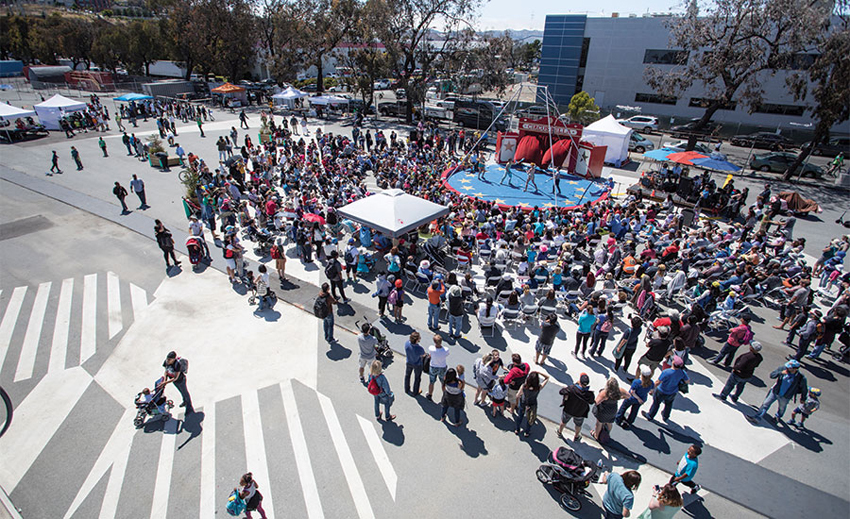
AT EVERY EVENT held on the lot where the PG&E plant once stood, including an annual circus (middle), information about the community’s desires is collected (bottom). The new waterfront trail, which is open all hours of the day, includes soft, motion-activated lighting (top).
For the PG&E project, Burnham teamed up with Ogbu, who has extensive experience in public-interest design. Almost immediately, Envelope and her Studio O began holding events on a 2.5-acre portion of the site, an area since dubbed NOW Hunters Point. An early program was conducted in collaboration with StoryCorps, the oral history nonprofit. Inside a temporary recording booth, the team documented Bayview-Hunters Point’s history and culture and the residents’ dreams for the future. The project culminated with a listening party for the whole neighborhood. Other programming—all of which is free—has included a circus, job training, movie nights, and health and wellness fairs. The designers refer to these events as prototyping or testing for future uses. “The programming makes what is possible tangible,” says Ogbu. And during every event, Envelope and Studio O gather feedback from attendees about what works and what doesn’t and ideas for the future of the site.
The collected data informed the nearly 2,000-foot-long shoreline park that they subsequently designed. Completed in 2017, it connects two existing waterfront trails and is 100 feet wide—considerably roomier than was required—allowing areas for informal gathering and organized activities, while providing an alternate circulation path, something community members said would make them feel safe and secure. The park, planted with native wildflowers, grasses, and shrubs, includes such features as a series of metal screens that recount the history of the site and the neighborhood, a zone with concrete and wood benches for outdoor religious services or for school groups to hold classes focusing on the ecology of the bay, and an overlook that doubles as a spot for fitness instruction. The path is open 24/7 and includes soft, motion-activated lighting.
While proponents of deep engagement generally prefer alternatives to community meetings, some say that such venues can be effective if they are properly structured. “You have to set the process up so that people can bring their own experiences to the table,” says Claire Weisz, founding principal of WXY Architecture + Urban Design, a New York–based firm known for its public work that addresses social and environmental concerns. She points to WXY’s replacement of a boardwalk destroyed during Hurricane Sandy in 2012 in Rockaway, a peninsula in the New York borough of Queens that separates Jamaica Bay from the Atlantic. Here the engagement process preferred by the clients—the city’s Economic Development Corporation and the parks department—were community meetings that would address stakeholders’ concerns about configuration, access to the beach, and materiality.
Completed in 2017, WXY’s boardwalk extends for 5.5 miles along the ocean side of the peninsula. To provide protection against future storms, the project team put forward what it calls a “double dune” scheme: the 40-foot-wide path for strolling, running, and cycling would be made of precast-concrete structural elements and decking. The whole would be raised 3 feet above the 100-year-flood plain and bolstered by planted sand berms to either side.
During the meetings, as Weisz recounts it, some attendees voiced concerns that the boardwalk would be little more than an elevated concrete sidewalk. Others expressed a desire for something that was uniquely suited to Rockaway, one suggesting that it be clearly identifiable to passengers in planes taking off and landing at nearby JFK Airport. Meanwhile, some wanted to make sure the designers understood that the boardwalk would be used at all times of day and all year round—not just when the beach was open for swimming. In response, WXY designed wavelike decking and, with graphic designers from Pentagram, integrated giant letters that spell out “Rockaway” into it. The words, in a font that works with the squiggly planks, are in ocean-blue so that they stand out from the other, sand-colored planks, and are legible from the air. And, through materials research, they identified a “glow-in-the-dark” aggregate that they added to the ocean-blue concrete. It emits a subtle light in the evening, evoking the bioluminescence of jellyfish and other sea life.
Adam Lubinsky, WXY’s managing principal, cites the linear nature of the project as one reason the inclusion process was effective: the boardwalk stretches through nine distinct neighborhoods, each with its own demographic. “We were able to hold meetings all along the peninsula in local venues and draw from each area,” he says. The team tapped a number of Rockaway-based nonprofits that helped with outreach, to ensure meaningful participation.
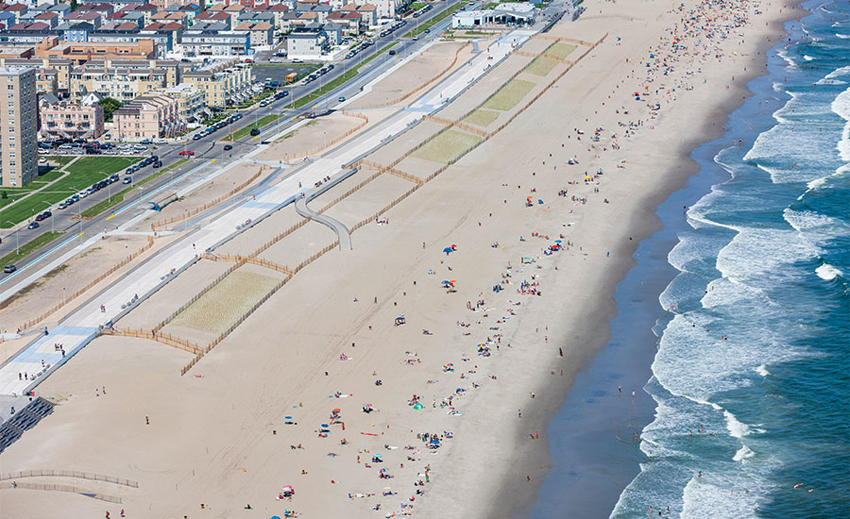
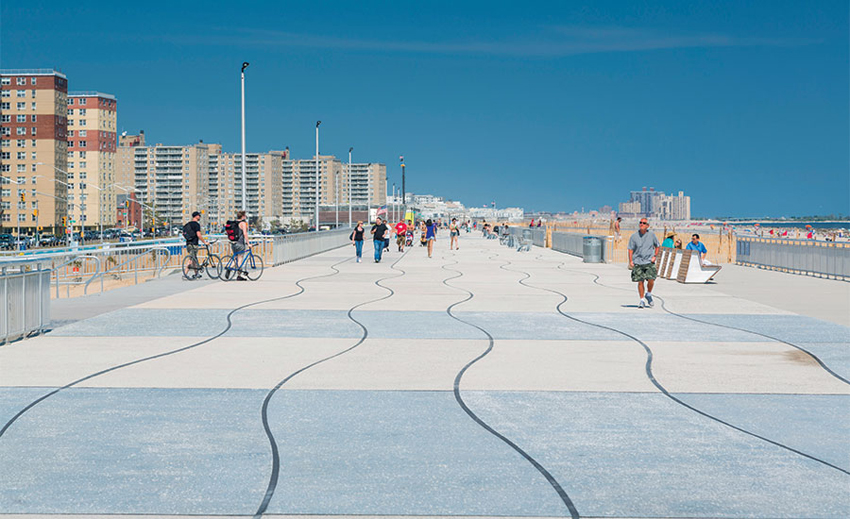
THE DECK of WXY’s boardwalk in Rockaway, New York, incorporates features that respond to community feedback, including the wavelike shape of the precast planks (bottom) and giant letters that spell out the name of the beach, visible from the air (top).
Weisz and Lubinsky say the project also benefited by pairing with another project—the firm’s conceptual plan to improve existing parks throughout Rockaway. Although that had its own dedicated community meetings, the master-planning effort meant the boardwalk was seen as part of a larger whole. “Residents could step back and consider many of the broader open-space needs, from resilience to recreation,” says Lubinsky. What is more, a kit-of-parts strategy for the precast elements and other components enabled the boardwalk’s completion for $120 million less than the $461 million budget. The savings made funds available for improvements to the local parks, many of which hadn’t seen investment in decades, says Weisz. Designs for revamping several parks are now under way by WXY and other firms.
There are, of course, other means to elicit useful information. Jeff Davis, senior principal with Architectural Nexus, a firm with offices in Salt Lake City and Sacramento, California, recommends seeking out community members at events such as children’s soccer matches or town fairs. “Go to them, find their networks, and you’ll get better feedback,” he says. By relying on this method for a combined library and recreation center about to start construction in Stockton, California, the architects found, perhaps unsurprisingly, that community members wanted a building that allowed access to the outdoors, fostered collaboration, and included a technology center. They also learned that the surrounding neighborhood was a food desert, despite Stockton’s location in the Central Valley, where most of the country’s produce is grown. So Architectural Nexus and its library consultant came up with the idea of including a demonstration kitchen for cooking classes. An edible garden and an area for a farmers market are also planned.
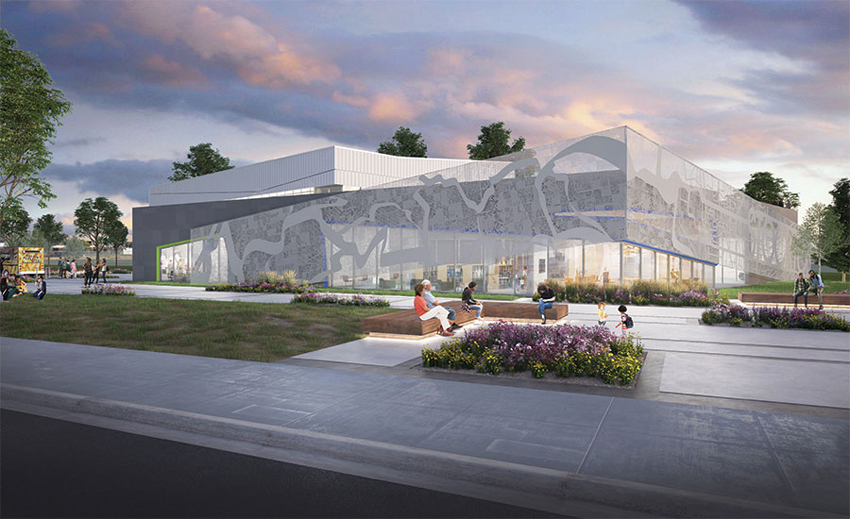
IMAGE: COURTESY ARCHITECTURAL NEXUS
A LIBRARY AND recreation center in Stockton, California, by Architectural Nexus, will have a demonstration kitchen, an edible garden, and space for a farmers market, to address a food desert problem.
In addition to such programs, there are tools that can guide project teams toward a more effective response to a neighborhood’s needs and desires. One is the Social Economic Environmental Design (SEED) Evaluator, a program of Design Corps, a three-decade-old nonprofit that aims to use architecture to make positive change in underserved communities. The Evaluator is a framework for documentation and measurement based on five principles, including advocating for those who have a limited voice in public life, promoting an inclusive design process, and conserving resources and reducing waste. The idea is not to codify those principles, explains Brian Bell, Design Corps founder, but “make them actionable.” The certification process allows teams to select three priorities critical to their project from a list of possible focus areas, such as emergency shelter, access to green jobs, and political planning and policy. They must then articulate how these will be addressed, and finally measure the outcomes. In addition to the stand-alone program, project teams can use the SEED process to comply with a social-equity pilot credit in LEED.
Still, a community-focused design process needs more than a rating system or certification tool to be successful. Positive outcomes depend on listening, building relationships, and establishing trust, which can be a long and arduous process. At NOW Hunters Point, seven years after the StoryCorps project, Burnham and Ogbu, as part of their contract with PG&E, continue with their prototyping work. (During the pandemic, they have had to pivot from their usual programming, and instead have weekly food giveaways, which residents said was needed.)
Burnham estimates that development of the full former power-plant site is still a decade away and remains optimistic that whatever is built there will incorporate ideas articulated during the ongoing engagement process—including affordable housing, a job-training facility, or a community center. “We’ve given the residents a toehold in a place that should be theirs,” he says. “Hopefully, we’ve set the stage for something that will be supportive of community.”
Supplemental Materials
Listening Now
Rockaway Boardwalk Documentary