This CE Center article is no longer eligible for receiving credits.
View course on architecturalrecord.com »
A goal without a plan is just a wish. That adage is especially true for the near-universally held goal of reducing human-caused carbon emissions. Cities—where a growing majority of the world’s population lives, where about three quarters of global emissions are generated, and where the impacts of the climate crisis are increasingly felt—have a critical role to play in developing and implementing the requisite plan. Many plans, in fact, because cities are uniquely well positioned to tailor strategies to local circumstances for maximum effect.
PHOTOGRAPHY: © VLAD GHIEA/ALAMY STOCK PHOTO
New York skyline, as seen from the west
“Cities set the trends and take the lead,” says Paul Cartwright, program manager for new-building efficiency with C40 Cities, a global network of major municipalities committed to addressing the climate crisis. “Even where cities don’t have direct powers, they still find ways to take a leadership role.” Parallel with such initiatives as the 2030 Challenge, and the AIA’s 2030 Commitment, C40’s member cities have pledged to ensure that new buildings operate at net zero carbon by 2030, and all buildings by 2050.
It’s now 2020. In this section, RECORD checks in with five of these leading cities—New York, San Francisco, Vancouver, Stockholm, and Tokyo—asking whether their climate-action plans are on track to meet these commitments, and sharing snapshots of key initiatives and achievements to date.
Within cities, buildings are one of the largest consumers of energy, often accounting for more than half—and, in highly dense urban areas where mass transit reduces pollution from the transportation sector, more than 70 percent—of greenhouse-gas emissions, according to a 2016 analysis conducted by C40 in collaboration with Arup. A 2017 study by the McKinsey Center for Business and Environment suggests that optimizing energy use in buildings can reap between 20 and 55 percent of a city’s emissions-reduction potential. Heavy-hitting measures include stringent standards for new construction, building-envelope retrofits, HVAC and water heating, lighting upgrades, and installation of building automation and controls. Add in cuts from decarbonizing the electricity grid, and these efforts can account for up to 60 percent of a city’s potential savings.
There are many tools available to catalyze these reductions. Cities have the power to set performance criteria and energy consumption limits, such as Tokyo’s cap-and-trade program (page 126), New York’s Local Law 97 (page 120), and Vancouver’s Zero Emissions Building Plan (page 122). They can demonstrate best practices in the municipality’s own real-estate portfolio, as in Stockholm’s aggressive energy-consumption limits for buildings on city-owned land (page 124) and San Francisco’s requirement that new municipal facilities depend only on electricity for power (page 121). Cities can use money—or money-equivalent mechanisms, such as density bonuses and preferential permit processing—to incentivize improvements. Vancouver’s 5 percent density allowance, for instance, ensures that developers building to Passive House standard aren’t penalized on square footage because of thicker walls. And cities have the ability, through information and communication, and through connections with higher levels of government, to influence other actors to implement additional education measures.
A critical obstacle cities often face in achieving emissions-reduction goals is a limited ability to access, manage, and analyze high-quality data. Data enable municipalities to understand the source and significance of their greenhouse-gas emissions, set appropriate mitigation targets, develop strong and cost-effective climate-action plans, and monitor progress. Leading cities have developed successful reporting and disclosure policies to generate high-quality data on building energy performance, and the analytical tools to make sense of it. Tokyo, for example, introduced energy-reporting policies for private office buildings in 2005, and has since achieved energy savings in this sector of about 30 percent. American cities such as New York are seeing results from benchmarking and disclosure schemes. And Stockholm’s showcase development, Royal Seaport, backs up its energy-consumption limit for new buildings with post-occupancy monitoring and reporting.
A 2019 survey conducted by the U.S. Conference of Mayors found that 96 percent of 182 responding cities from 39 states are feeling the impact of the climate crisis. In the last five years, nearly every one of them has experienced a climate-related incident, whether flooding, heat wave, drought, or forest fire. Over the last 12 months, 60 percent have launched or significantly expanded a climate initiative or policy, and 57 percent will launch or significantly expand a climate initiative or policy this year.
At this critical juncture in the growing climate emergency, the building-related actions highlighted in the following pages demonstrate what becomes practical and possible when cities commit to a carbon-free future. Katharine Logan
View course on architecturalrecord.com »
A goal without a plan is just a wish. That adage is especially true for the near-universally held goal of reducing human-caused carbon emissions. Cities—where a growing majority of the world’s population lives, where about three quarters of global emissions are generated, and where the impacts of the climate crisis are increasingly felt—have a critical role to play in developing and implementing the requisite plan. Many plans, in fact, because cities are uniquely well positioned to tailor strategies to local circumstances for maximum effect.
PHOTOGRAPHY: © VLAD GHIEA/ALAMY STOCK PHOTO
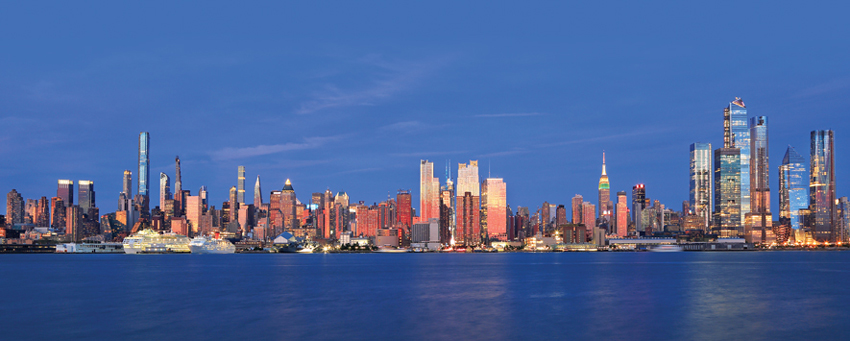
New York skyline, as seen from the west
“Cities set the trends and take the lead,” says Paul Cartwright, program manager for new-building efficiency with C40 Cities, a global network of major municipalities committed to addressing the climate crisis. “Even where cities don’t have direct powers, they still find ways to take a leadership role.” Parallel with such initiatives as the 2030 Challenge, and the AIA’s 2030 Commitment, C40’s member cities have pledged to ensure that new buildings operate at net zero carbon by 2030, and all buildings by 2050.
It’s now 2020. In this section, RECORD checks in with five of these leading cities—New York, San Francisco, Vancouver, Stockholm, and Tokyo—asking whether their climate-action plans are on track to meet these commitments, and sharing snapshots of key initiatives and achievements to date.
Within cities, buildings are one of the largest consumers of energy, often accounting for more than half—and, in highly dense urban areas where mass transit reduces pollution from the transportation sector, more than 70 percent—of greenhouse-gas emissions, according to a 2016 analysis conducted by C40 in collaboration with Arup. A 2017 study by the McKinsey Center for Business and Environment suggests that optimizing energy use in buildings can reap between 20 and 55 percent of a city’s emissions-reduction potential. Heavy-hitting measures include stringent standards for new construction, building-envelope retrofits, HVAC and water heating, lighting upgrades, and installation of building automation and controls. Add in cuts from decarbonizing the electricity grid, and these efforts can account for up to 60 percent of a city’s potential savings.
There are many tools available to catalyze these reductions. Cities have the power to set performance criteria and energy consumption limits, such as Tokyo’s cap-and-trade program (page 126), New York’s Local Law 97 (page 120), and Vancouver’s Zero Emissions Building Plan (page 122). They can demonstrate best practices in the municipality’s own real-estate portfolio, as in Stockholm’s aggressive energy-consumption limits for buildings on city-owned land (page 124) and San Francisco’s requirement that new municipal facilities depend only on electricity for power (page 121). Cities can use money—or money-equivalent mechanisms, such as density bonuses and preferential permit processing—to incentivize improvements. Vancouver’s 5 percent density allowance, for instance, ensures that developers building to Passive House standard aren’t penalized on square footage because of thicker walls. And cities have the ability, through information and communication, and through connections with higher levels of government, to influence other actors to implement additional education measures.
A critical obstacle cities often face in achieving emissions-reduction goals is a limited ability to access, manage, and analyze high-quality data. Data enable municipalities to understand the source and significance of their greenhouse-gas emissions, set appropriate mitigation targets, develop strong and cost-effective climate-action plans, and monitor progress. Leading cities have developed successful reporting and disclosure policies to generate high-quality data on building energy performance, and the analytical tools to make sense of it. Tokyo, for example, introduced energy-reporting policies for private office buildings in 2005, and has since achieved energy savings in this sector of about 30 percent. American cities such as New York are seeing results from benchmarking and disclosure schemes. And Stockholm’s showcase development, Royal Seaport, backs up its energy-consumption limit for new buildings with post-occupancy monitoring and reporting.
A 2019 survey conducted by the U.S. Conference of Mayors found that 96 percent of 182 responding cities from 39 states are feeling the impact of the climate crisis. In the last five years, nearly every one of them has experienced a climate-related incident, whether flooding, heat wave, drought, or forest fire. Over the last 12 months, 60 percent have launched or significantly expanded a climate initiative or policy, and 57 percent will launch or significantly expand a climate initiative or policy this year.
At this critical juncture in the growing climate emergency, the building-related actions highlighted in the following pages demonstrate what becomes practical and possible when cities commit to a carbon-free future. Katharine Logan
New York
Advocates of New York’s Local Law 97 refer to it as the most ambitious climate legislation for buildings enacted by any city in the world. The claim might sound like hyperbole, but John Mandyck, CEO of the Urban Green Council, a nonprofit that helped shape the regulation, points to its scope and scale. It applies to 50,000 existing buildings—any that are 25,000 square feet or larger. These structures amount to 60 percent of the city’s floor area and are responsible for 40 percent of total greenhouse-gas emissions. By 2030, the law is expected to reduce emissions from large buildings by at least 40 percent compared to a 2005 baseline, which means cutting 5.3 million metric tons of carbon dioxide from current levels, the equivalent of San Francisco’s citywide emissions.
The most consequential piece in a package of bills known as the Climate Mobilization Act, the law was passed by the City Council in April last year. It sets increasingly stringent limits for the amount of CO2 facilities can emit based on building type. The first set of regulations go into effect in 2024, targeting the most carbon-intensive 20 percent of buildings, while the 2030 limits target the most carbon-intensive 75 percent. (Subsequent limits will be set by the Department of Buildings to achieve an 80 percent reduction in emissions citywide by 2050.) These thresholds are not aspirational but statutory, points out Mandyck: owners who fail to meet the limits face steep fines.


PHOTOGRAPHY: © ED CARUSO (TOP), COURTESY ZH ARCHITECTS (BOTTOM)
A five-story condo building in Brooklyn (top) and a 55-unit rental apartment tower in Manhattan (bottom), both recently completed and designed by ZH Architects, deploy such features as highly insulated and airtight facades, triple-glazed windows, and minimized thermal bridges. Both are expected to meet Local Law 97’s anticipated emissions limits for 2050.
How can owners bring underperforming buildings into compliance? They can put new operating strategies in place, implement energy-saving retrofits, or buy green power. Work can be financed through a special low-interest loan program. Some building types—income-restricted housing or places of worship—can opt instead to complete a prescribed set of low-cost energy-saving measures, including insulating pipes, installing boiler sensors and controls, and fixing heating-system leaks.
Although the measure is aimed at upgrading existing structures, a year after a new building is completed, it is subject to the law’s stringent reporting requirements and emissions limits. Some proponents maintain Local Law 97 isn’t strict enough for new construction or projects that involve significant renovation or expansion. “New buildings should have different requirements,” says Stas Zakrzewski, principal of ZH Architects, who sits on an advisory board helping guide the law’s implementation. He points to two of his firm’s recent projects: a five-story condo building in Brooklyn that incorporates a three-story existing structure and an all-new 55-unit rental residential tower in Manhattan. The smaller building, at only 7,000 square feet, is not subject to Local Law 97. Nevertheless, it is expected to meet the anticipated 2050 emissions limits for residential construction—offering an example that other projects could emulate, with its highly insulated, airtight building envelope, triple-glazed windows, and minimized thermal bridges. Many of these strategies have been deployed on the tower, which has projected emissions far below the 2050 limits.
Some advocates of the law worry that it does not deal well with carbon-intensive uses, including those of trading floors and data centers. “This is a legitimate concern,” says Mandyck. “The carbon metric is straightforward, but it is a blunt instrument.” He suggests that a cap-and-trade scheme like Tokyo’s (see page 126) could be a remedy; his organization is involved in developing the carbon-trading implementation plan that the law requires. It would allow a building with justified high-energy uses to buy credits from another building with emissions below its target.
It is too early to know how many out-of-compliance owners will perform retrofits, buy offsets, or simply pay the fine, notes Richard Yancey, executive director of the nonprofit Building Energy Exchange. But he is optimistic about the language of Local Law 97, which includes placeholders for programs like carbon trading and allows for other future adjustments in order to meet its reduction targets. It’s “critically important” to get these modifications right, says Yancey: “Cities all over the world are looking to New York.” Joann Gonchar, FAIA
San Francisco
Over the past 30 years, San Francisco has made impressive progress cleaning up its built environment. Since 1990, carbon emissions from the operation of buildings have dropped 51 percent. And between 2013 and 2018—despite tremendous economic growth—energy use in commercial structures was reduced 11 percent. But with buildings still responsible for 2.2 million tons of greenhouse-gas emissions annually (about 44 percent of the citywide total), there is more work to do. To completely decarbonize buildings in San Francisco by midcentury, “we need to redouble our efforts,” says Barry Hooper, senior green-building coordinator with the city’s Department of the Environment. “The next 10 years will be critical.”

IMAGE: © MARCELO VINANTE/ALAMY STOCK PHOTO
One market where the all-electric typology is taking hold in San Francisco is in affordable housing.
A primary focus for San Francisco has been on greening the electrical grid while advancing all-electric buildings and moving away from the use of natural gas. Last September, the Board of Supervisors approved legislation requiring that buildings larger than 50,000 square feet depend only on renewable energy by 2030. Then, in January of this year, they adopted two ordinances. One bans gas connections in new or significantly renovated municipal facilities. A second sets a higher performance bar—above the already stringent energy code—for all buildings that opt to include gas infrastructure.
Such all-electric measures have been sweeping California. Berkeley was first, with its city council voting last July to prohibit gas hookups in new small and midsize residential buildings. Since then, 29 other jurisdictions throughout the state have adopted regulations that discourage gas or outright ban it. These policies will have a significant impact, since much of California’s grid is already carbon-free. In San Francisco, almost 70 percent of its electricity comes from renewable sources, while an astounding 81 percent of building-related emissions are attributed to natural gas.
All-electric advocates tout a number of benefits beyond reductions in climate-warming emissions: better indoor air quality as a result of eliminating combustion and avoiding the risks associated with flammable gas in a seismic region. In addition, repairing natural gas infrastructure damaged during a major quake could take many months, compared with a week for restoring electrical service.
For multifamily buildings in particular, electrification makes good sense, says Katie Ackerly, sustainability lead at David Baker Architects. Among its all-electric projects are two buildings in Hunters View, with 120 affordable units, slated to break ground in January 2021. Ackerly explains that domestic hot water is the largest single energy consumer in housing, and heat pump technology for this use is not only well established, but often works at a higher efficiency.
Anne Torney, a partner at Mithun, says a sticking point for the all-electric concept is in market-rate housing, where developers consider high-end gas ranges a selling point. “Affordable-housing nonprofits think about community benefits and public policy goals more broadly, and they don’t need to worry about marketability,” she says. Her firm has several affordable all-electric multifamily projects under way, including the 131-unit Balboa Park Upper Yard, expected to break ground early next year.

IMAGES: COURTESY DAVID BAKER ARCHITECTS (LEFT); MITHUN ( RIGHT)
Two such projects slated to break ground early next year are a pair of buildings, with a total of 120 apartments, in Hunters View, designed by David Baker Architects (left) and the 131-unit Balboa Park Upper Yard, designed by Mithun (right).
Moving all-electric new construction forward is the easy part, says Hooper. “The tougher question is, ‘What do we do with our existing buildings?’ ” How best to wean all of the city’s building stock off gas will be addressed in a zero emissions “road map” to be released in November. It has been informed by a task force that includes design professionals, developers, utilities, and community members. Hooper acknowledges that implementing these policy recommendations will require time and investment from both the public and private sectors. But, he warns, “the cost of inaction will be greater.” Joann Gonchar, FAIA
Vancouver
Like other cities with strong commitments to combating climate change, Vancouver, Canada, is targeting citywide carbon neutrality by 2050. Because half of the metropolis’s existing building stock is expected to have been replaced by then, emissions limits apply to new construction first. “Everything that’s not a solution today becomes a problem later,” says Doug Smith, sustainability director at the City of Vancouver.
Within the overall 2050 limit, the municipality’s Zero Emissions Buildings Plan (2016) establishes a finely sliced series of deadlines reflecting the degree of challenge faced by various building types. Commercial and residential projects have the lowest hurdle in reducing emissions, with plenty of successful precedents. As of 2025, zero emissions buildings—those that are highly efficient and meet their energy needs from renewable sources—will be the only new construction permitted in these two categories. More specialized buildings, such as schools, hospitals, and industrial facilities, will have a little longer to achieve the target—until 2030. “It’s important to set those limits far in advance so that industry understands what they are and when they’re coming,” says Smith, “so there are no surprises.” To date, emissions from new buildings in the city have dropped by 43 percent compared to a 2007 benchmark.
In addition to regulating, the municipal government is also leading by example. As Vancouver’s single biggest landlord, with a portfolio of over 600 buildings, the city began imposing a zero-emissions requirement on its own new construction—including libraries, fire stations, community centers, and police stations—two years ago, and is now working to bring its existing buildings to zero emissions before 2040.
For all other existing buildings, the city is developing a plan in consultation with residents and industry for a target deadline of zero emissions by 2045. Achieving zero emissions presents a bigger challenge for older buildings—and a more delicate one, says Smith. “You don’t want to create an equity issue where wealthier homeowners can afford to meet the new standards, and people just getting by can’t.” The initial approach will focus on raising awareness of emissions levels through reporting on energy consumption and encouraging the integration of reduction measures into scheduled maintenance and replacements. “Our strategy for the next three or four years is to start educating existing building owners,” says Smith. The plan is expected to go before council in October this year.


IMAGES: COURTESY PERKINS AND WILL
Canada’s Earth Tower, currently in design by the Vancouver office of Perkins and Will, aims to be, at 40 stories, the world’s tallest hybrid mass timber structure. The mixed-use building, which rises from a U-shaped podium (bottom left) and includes coworking space (bottom right) and 200 apartments, has such features as multistory winter gardens (top). The project is targeting Passive House certification and is helping inform the development of the Canada Green Building Council’s forthcoming Zero Carbon Building Standard.
As well as setting limits, providing leadership, and catalyzing change (with available tools such as regulations, funding, and density incentives), Vancouver sees education as critical. “Everything we’re doing now, we’ve never done before,” says Smith, “so we need to work with industry, to help them reduce their learning curve.” The municipality subsidizes training for trades in the techniques of zero-emissions construction, such as tight building envelopes and blower door testing. It has also instituted a Zero Emissions Building Exchange (ZEBx), which pays the developers of cutting-edge projects to hire technical and engineering students to document the process, including notes, photography, videos, and site tours, all concluding with a published report of successes and lessons learned. “The role of ZEBx is to bring together members of what’s otherwise a very competitive industry,” says Smith, “and have them learn from each other.”
As of this past February, zero-emissions projects in the city’s pipeline included 344,000 square feet approved for building permits, 909,000 square feet approved for rezoning or development, and 3.91 million square feet in inquiries and applications. Most of these projects are designed to the Passive House standard, with the remainder designed to the net zero criteria of such programs as the Living Building Challenge and Natural Resources Canada’s R-2000.
As an example of the type of project waiting in the wings, a 40-story hybrid mass-timber tower now in design at the local office of Perkins and Will is helping to inform the development of the Canada Green Building Council’s forthcoming Zero Carbon Building Standard. In addition to its zero-emissions operation, Canada’s Earth Tower, as the planned mixed-use building is called, will sequester carbon in its wood structure. “Timber buildings built to the Passive House standard are absolutely what we all should be doing to address climate change,” says Derek Newby, a Perkins and Will associate principal. With a growing number of built examples in Vancouver and worldwide, he says, “both strategies are well understood and achievable now.” Katharine Logan
Katharine Logan is an architectural designer and a writer focusing on design, sustainability, and well-being.
Stockholm
Sweden’s capital city has ambitious twin climate goals: fossil-fuel-free operations and net zero greenhouse-gas emissions by 2040. And the construction sector is critical to its success: to meet these targets, more than half of its emissions reductions must come from buildings. The greatest building-related savings will come from heating, as an already efficient citywide district heating grid (covering 80 percent of Stockholm’s structures) shifts to renewable-energy sources. At the individual-building scale, a key strategy requires almost all new construction to achieve net zero carbon by 2030. One indicator of progress to date is the city’s meeting its 2020 emissions milestone two years ahead of schedule, achieving a maximum of 2.2 metric tons per resident in 2018 (down from 2014’s 2.7 ton benchmark). “So, yes,” says Björn Hugosson, Stockholm’s chief climate officer, “the target will be achieved.”
PHOTOGRAPHY: © RUDY BALASKO
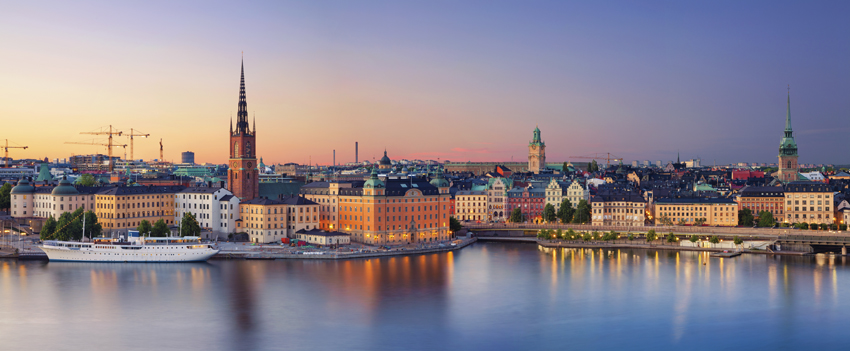
Picturesque Stockholm has set stringent energy-efficiency standards for all construction on municipal land.
Getting a head start on the 2030 deadline, Stockholm instituted a requirement eight years ago that new residential and commercial buildings on municipal land operate at a maximum 55 kWh/m2, an energy use intensity (EUI) equivalent to the Passive House standard. More than 60 percent of the city’s geographical area is owned by the municipality, and Stockholm Royal Seaport, a 585-acre brownfield development on publicly owned waterfront, represents a leading edge in sustainable urban development worldwide.
Begun in 2009, with completion anticipated in 2030, Royal Seaport will comprise at least 12,000 new homes and 35,000 workplaces, all designed to comply with the EUI 55 limit. The project’s 20-year timeline allows for iterative learning, and each building’s energy performance is assessed when two years of post-occupancy data have accumulated. “We are not just setting an ambitious standard, but we are also following up with verification,” says Christina Salmhofer, the development’s sustainability strategist. Discrepancies between the project’s predicted and actual energy consumption demonstrate the importance of that commitment. Measured performance values of completed buildings are averaging 73 kWh/m2, and, while that’s still 15 percent below Sweden’s nationally legislated target, it’s well above the EUI 55 limit that modeling shows the buildings, as designed, were capable of achieving.
The shortcomings result mainly from construction quality-assurance issues, especially in regard to thermal bridging in facades, and from inadequate testing and refinement of building systems to operate as designed, complicated by insufficient metering. “It’s really sad,” says Salmhofer, “because there was so much capacity-building during the design processes.” That capacity-building, or training, focused on developers and designers, however. So, while developers understand the effort involved and the importance of the standard, and architects and engineers are capable of designing to it, more education is needed for the construction and operations phases of projects, she says. “This is the challenge facing the industry right now.”
PHOTOGRAPHY: LENNART JOHANSSON (LEFT); ERIC CUNG DINH (RIGHT)
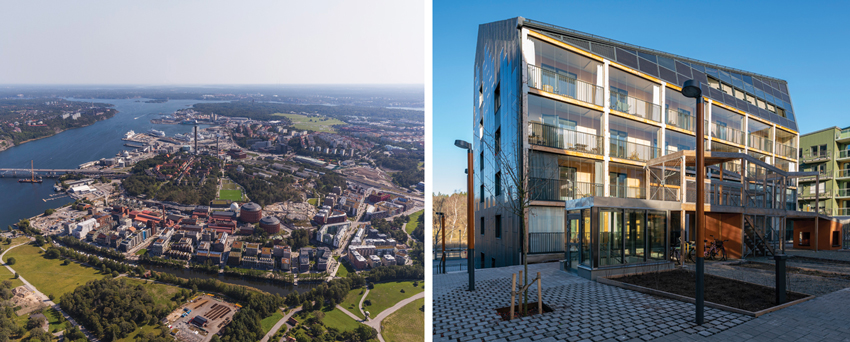
One large-scale development on 585 acres of city-owned property is the transformation of its seaport into 12,000 residences and 35,000 workplaces (left). The latest phase of the project includes apartment buildings by Dinell-Johans-son (right), designed to produce more energy than they consume. In addition to high levels of insulation, a compact form, and effective daylighting, the buildings’ balconies have a separate, self-supporting structure—a strategy that minimizes thermal bridging.
Meanwhile, the fourth phase of Royal Seaport’s build-out is under way and features residences designed to an even higher standard, net positive energy. Completed in 2019, a pair of buildings designed by local architecture firm DinnellJohansson, with energy consultant InCoord, contains 43 dwelling units with a design EUI of 14.8. Building-integrated solar panels generate 16.1 kWh/m2/year, supplemented with wastewater and ventilation heat exchangers and geothermal energy. In addition to high levels of insulation, effective daylighting, and a compact form, the project’s balconies are integral to its energy strategy while serving as an amenity for residents. As self-supporting elements that are separate from the building’s structure (thereby eliminating thermal bridging), the balconies wrap each building in its own microclimate, which can be adapted using operable external screens to take advantage of the prefabricated concrete structure’s thermal mass.
The Plus Energy houses were already complete when performance metrics from earlier buildings became available, so it may turn out that the newer buildings also suffer from construction-phase shortcomings, but the project team is working hard to control the operations and maintenance variables those earlier tests highlighted. Data will be reported after one year, with a more reliable assessment expected after two.
Looking ahead, Salmhofer says Royal Seaport’s next priority is the creation of regenerative systems throughout the development, such as heat extraction from graywater and agricultural-nutrient extraction from blackwater. “Moving from the building level to the city level—with more integration and more connection—is definitely the next step,” she says. Katharine Logan
Tokyo
A decade ago, recognizing that commercial and industrial buildings—including its iconic high-rise towers—produced almost half of the city’s total carbon emissions, Tokyo started the world’s first urban carbon cap-and-trade initiative. The mandatory program aims to reduce CO2 emissions by 30 percent and energy consumption by 38 percent, compared to 2000 levels, in 1,400 of the city’s largest carbon emitters. Although the facilities covered by the program represent just 2 percent of the total number of Tokyo’s commercial buildings, they account for nearly 19 percent of emissions, making the policy “effective and powerful,” says Satoshi Chida, Tokyo Cap-and-Trade Program (TCaTP) director, and a critical element in the city’s plan for achieving zero emissions by 2050.
Implemented in five-year phases, the TCaTP places increasingly stringent limits on emissions, while also creating a framework for trading carbon credits. Facilities with reductions in excess of the required caps receive credits, which can be banked for future use or sold to facilities with deficient reductions. To further incentivize high-performance building design, Tokyo annually recognizes “top level” and “near top level” facilities and awards them, in recognition of their early actions, a relaxation of the caps in future phases.
PHOTOGRAPHY: © SS INC.
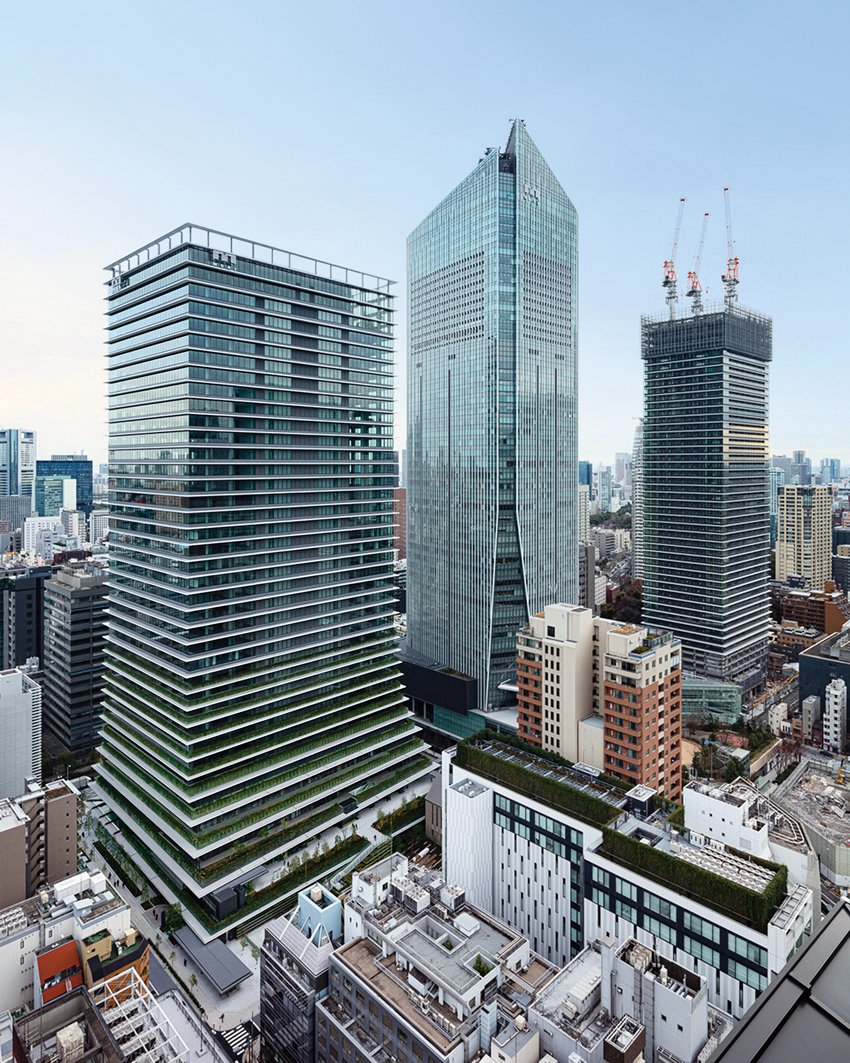
Mori Buildings’ Toranomon Hills mixed-use complex, with towers by Ingenhoven Architects (at left and at right in photo), Nihon Sekkei (at center), and eventually OMA, depends on high-performance design and 100 percent renewable energy.
Tokyo clients and architects are responding to the city’s increased emphasis on energy efficiency through state-of-the-art facilities and innovative building-management schemes. Mori Buildings, one of Japan’s largest developers, is promoting high-performance design and the use of 100 percent renewable energy throughout Toranomon Hills, a mixed-use complex rising in central Tokyo. The first building, the 2014 Toranomon Hills Mori Tower, designed by Nihon Sekkei, was certified as a top-level facility in 2018. Two subsequent structures, by Düsseldorf-based Ingenhoven Architects, are a just-finished office tower and a residential high-rise slated for completion early next year. Both are expected to achieve top-level status. With features such as planted outdoor ledges, high-performance glazing, photovoltaics, and advanced lighting and mechanical systems, firm founder Christoph Ingehoven hopes his designs “will influence the way Tokyo develops over the next 20 years, with more planted facades, more public green space, and high levels of sustainable-building certifications.” The complex’s final building, the Toranomon Station Tower, OMA’s first high-rise in Tokyo, recently broke ground and also is targeting significant reductions in energy consumption and CO2 emissions.
The program has been achieving better than expected reductions. The goal for the TCaTP’s initial phase (2010–14) was a 6–8 percent reduction from base year CO2 emissions, followed by a second phase (2015–19) goal of 15–17 percent. But the results showed a 25 percent decrease by 2014 and a 27 percent reduction by 2018.
Initial reductions were achieved in part due to stringent energy-use restrictions in the aftermath of the 2011 Fukushima nuclear power plant accident, but also through improved operations, changes to building systems and equipment, and modified tenant behavior. Chida notes that the program has made the city’s buildings more resilient. Since owners and tenants already had begun to take action to reduce energy use to comply with TCaTP, they were better prepared for the restrictions that followed the nuclear plant’s shutdown, he says. Once restrictions were lifted, reductions were still achieved, even though Japan became more reliant on carbon-intensive electricity sources, depending on imported oil, natural gas, and coal.
So far, the cuts have been brought about mainly through decreased consumption, or meeting the “caps.” Chida predicts that the “trade” part of the program will see more use in phases three and four, which each mandate an additional 10 percent reduction, as it will be increasingly difficult for existing facilities to meet these progressively stringent targets.
The trading of credits will also come into play for the 2020 Tokyo Olympic/Paralympic Games, now postponed until summer 2021. The Tokyo Metropolitan Government developed a separate Sustainability Plan for the renovated and newly constructed sports venues and is working to secure donations of credits from TCaTP to offset the Games’ emissions. After the Games, large-scale Olympic/Paralympic facilities will come under the cap-and-trade program. Mira Locher, FAIA
An educator, author, and architect working in the U.S. and Japan, Mira Locher teaches at the University of Utah and is a partner in Kajika Architecture.