This CE Center article is no longer eligible for receiving credits.
Aluminum production has recently decreased its environmental footprint dramatically, and aluminum extrusion technology has advanced considerably to make aluminum one of the most sustainable materials and aluminum windows and doors top performers. This course covers the production enhancements and developments in the design of unique aluminum extrusions that, when combined with innovative thermal barrier materials, create window and door systems that save energy, increase healthy indoor air quality, and improve safety, sustainability, and aesthetics. The course begins with case studies of buildings using high-performance windows and doors with custom extrusions.

Photo courtesy of All Weather Architectural Aluminum
The District at 2655 Bush Street is a single-tenant, mixed-use luxury condominium project on San Francisco’s Divisadero Corridor that was designed by KTGY Architecture and features high-performance aluminum windows and swing doors.
An Evolving Material
The first aluminum products can be traced back to 1852, during the reign of Napoleon III, who also served state dinners on aluminum plates to his special guests. Over the years, it has become a material with multiple complementary attributes and can be found in an array of products and structures—from national monuments to everyday residential and commercial buildings.
The Empire State Building, built in 1931, was the first building to use aluminum in both the basic structure and interior. In 1994, the 5,460 original badly deteriorated steel window frames were replaced with aluminum frames. During a major energy retrofit in 2011, all of those aluminum frames were still in excellent condition and were kept in place—just the glazing was upgraded.
Aluminum has continued to earn a reputation as a high-performance material with ever greater contributions to sustainable and healthy building projects. In the world of windows and doors, the beneficial attributes of aluminum have given manufacturers and designers a wide range of options for product innovation, process improvements, and the strength to withstand wind loads and imp
acts. This evolution can be seen in new projects—from affordable to high-end housing, demonstrating how important the material continues to be in a time when housing solutions are more important than ever.
Affordable Housing Solutions: Parcel Q
Parcel Q, designed by HKIT Architects and Y.A. Studio and built by Cahill Contractors, is the first phase of the redevelopment of Sunnyvale, San Francisco’s largest public affordable housing site. The newly constructed 5-story, Type V-A over I-A family apartment building sits at the southeast corner of Sunnydale Avenue and Hahn St. Parcel Q features studios, 1-bedroom, 2-bedroom, and 3-bedroom units, all of which have been built with all-weather aluminum windows.
The 55 affordable apartment units surround a shared community room with a full kitchen and a 6,000-square-foot courtyard. The community room also has a “teen room,” which is a quiet place to do homework or meet with friends. The outdoor courtyard has a barbeque and play structure/area for the younger kids.
Parcel Q was designed not only to provide shelter, but also to empower community. Sunnyvale residents are designing the lobby with an artwork installation by artists from the neighborhood. The project also includes a structured parking garage, laundry rooms, an employee office, and bicycle parking. Seventy-five percent of these newly constructed homes will be for existing residents. All 775 families who live in Sunnydale were entered into the lottery to determine which residents will be chosen for the new building.
The aluminum windows in this project provide the best of both worlds. They’re visually appealing, but affordable. Aluminum has the ability to provide both durability and flexibility, which gives it a kind of super-power performance value. That flexibility has allowed the Parcel Q project to custom design the windows using an artisan-built aesthetic that keeps the units feeling homey and comfortable, while still retaining their safety features.
Luxury Residential Housing: The Greenwood Residence
On a serene cul-de-sac at the end of Monte Sereno, Calif.’s most desirable street, this modern masterpiece of steel and glass strikes a balance between sleek sophistication and organic, livable warmth.
Newly constructed in late 2019, this 4 bedroom, 3.5 baths, 4,000-square-foot home with over 2,500 square feet of terraces offers breathtaking mountain and city light views. The kitchen features striking walnut and Italian lacquered cabinetry, quartzite counters, Miele, and Subzero appliances.
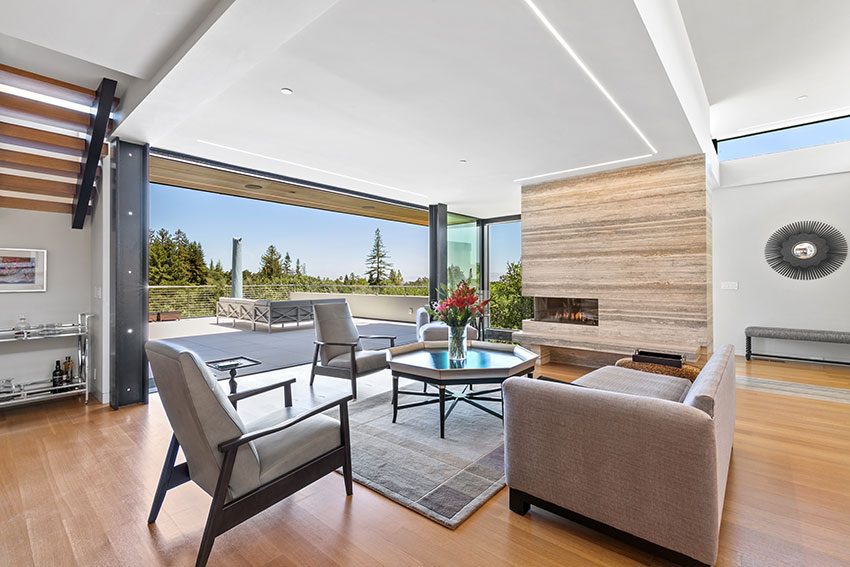
Photo courtesy of Tour Space
The Greenwood Residence, designed by Mark English Architects, features pocket sliding doors made of aluminum, which provide durability against weather, security, and elevate the design of the luxury space.
Throughout the home there are a variety of materials, styles, and textures, including French white oak floors, heated stone, and wool shag carpet. There is a floor-to-ceiling limestone master bath with two water closets and a second laundry room. There is a wine room, media room, infrared sauna, hot tub, Shou Sugi Ban fireplace, living roof, Tesla charger, Toto toilets, full house water filtration and LED lighting.
Among the many chosen features, the Greenwood Residence uses aluminum to provide durability and beauty. The amazing terrace views are framed by way of architectural aluminum doors and windows. The high-performance windows in this residence are exceptionally strong with an excellent energy-efficient rating.
The Greenwood Residence features two types of aluminum doors. One type is a swing door system that is highly durable and highly efficient, which supports comfort, safety, and well-being of the occupants. This type of aluminum door has also been created with a thermal strut system for increased thermal performance and has been optimized for acoustic insulation.
These high-performance aluminum doors have a contemporary aesthetic, but also design flexibility because of the finish color options. So, while this particular door fits the luxury feel in this project, it can also be utilized for any number of commercial or mixed-use/multifamily projects, each with their own unique style.
The Greenwood Residence also features a high-performance multi-slide door system that is highly energy efficient and can be configured in a variety of ways. For the Greenwood Residence, pocket sliding doors with automatic shades were chosen to meet its overall design.
What Is It About Aluminum?
The Parcel Q and the Greenwood Residence represent very different types of projects, which illustrates the versatility of aluminum and how it meets a wide variety of needs and desires for a range of designs. And despite their differences, all housing projects find common ground: They need to protect their occupants by supporting a comfortable, safe, and healthy environment. Aluminum is able to deliver on that front, too, providing an overall benefit to building owners and occupants when aluminum is selected for high-performance windows and doors.
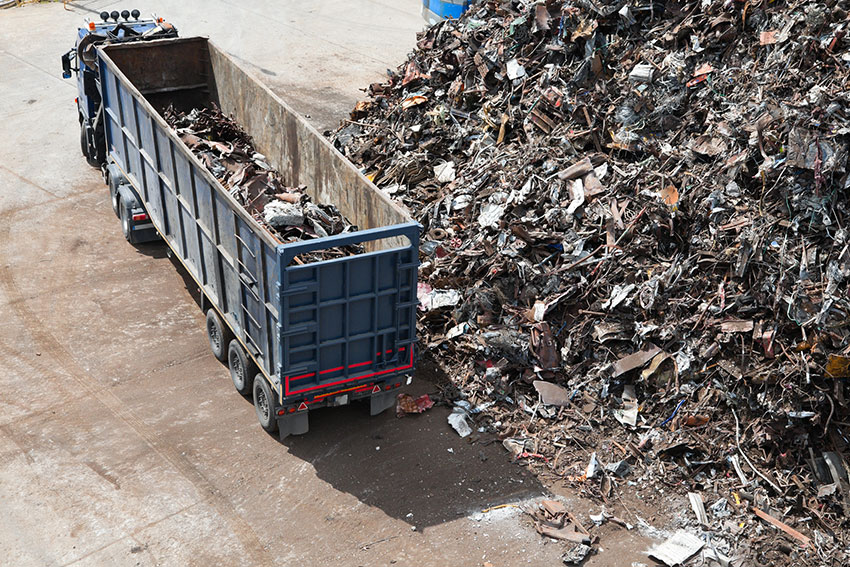
Photo courtesy of rihardzz; Getty Images
Aluminum is highly recyclable, making it an excellent material for sustainable projects.
- Lightweight and Strong Aluminum’s high strength-to-weight ratio makes it especially useful as a structural material. It weighs 65% less than steel, is 34 times stronger than vinyl, is 43 times stronger than wood, and when appropriately alloyed and treated, can be stronger than some steels, with ultimate tensile strengths as high as 80,000 to 90,000+ psi. Because aluminum structures are light, they also reduce substructure costs significantly. Modern skyscrapers could not be built without aluminum.
- Corrosion Resistant and Long-Lasting Aluminum naturally generates a protective oxide coating that resists corrosion. If this film is scratched or damaged, it reforms instantly. Different types of surface treatment can further improve this property.
- Flexible Aluminum can be made into any form, shape, size, and gauge without compromising material integrity and performance.
- Reflective Aluminum is a good reflector of visible light and heat. That makes it an ideal material for reflecting sunlight and saving energy.
- Impermeable Aluminum has an excellent barrier function that keeps out air, light, and microorganisms.
- Durable Aluminum’s unique combination of strength and corrosion resistance makes it a particularly durable material.
- Nontoxic Aluminum is not adversely affected by steam sterilizing and cleaning and will not harbor bacteria or insects.
- Safe Aluminum building products and their surface treatments do not present a hazard to occupants or the surrounding environment.
- Non-magnetic and Non-sparking These properties make aluminum a suitable material for applications where explosive vapor mixtures are present.
- Electrically Conductive Aluminum and copper are the two common metals with electrical conductivity high enough to permit their use as an electrical conductor. Although aluminum’s conductivity is just 62% of that of copper, its light weight can prove to be a great benefit; an aluminum conductor of equal current-carrying capacity weighs just half that of a copper conductor.
- Thermal Barrier and Conductor Aluminum is a good conductor of heat, but aluminum products with effective thermal breaks can also act as barriers to heat flow.
- Stiff Aluminum has greater resistance to deformation than either wood or vinyl. It is 72 times more rigid than wood and 23.2 times more rigid than vinyl.
Recycling Aluminum
In North America, it is estimated that at least 85% of all aluminum shipped to the construction sector is still in productive use today. 12% has been recycled in the form of end-of-life scrap/resource, and only 3% has been lost in the natural environment.
Annual benefits of recycling include saving about 70 million barrels of crude oil, 2.4 million acres of land, 45 million tons of fresh and sea water usage, 7.5 million tons of solid waste, and 27 million tons of CO2.
Aluminum production has recently decreased its environmental footprint dramatically, and aluminum extrusion technology has advanced considerably to make aluminum one of the most sustainable materials and aluminum windows and doors top performers. This course covers the production enhancements and developments in the design of unique aluminum extrusions that, when combined with innovative thermal barrier materials, create window and door systems that save energy, increase healthy indoor air quality, and improve safety, sustainability, and aesthetics. The course begins with case studies of buildings using high-performance windows and doors with custom extrusions.
Photo courtesy of All Weather Architectural Aluminum
The District at 2655 Bush Street is a single-tenant, mixed-use luxury condominium project on San Francisco’s Divisadero Corridor that was designed by KTGY Architecture and features high-performance aluminum windows and swing doors.
An Evolving Material
The first aluminum products can be traced back to 1852, during the reign of Napoleon III, who also served state dinners on aluminum plates to his special guests. Over the years, it has become a material with multiple complementary attributes and can be found in an array of products and structures—from national monuments to everyday residential and commercial buildings.
The Empire State Building, built in 1931, was the first building to use aluminum in both the basic structure and interior. In 1994, the 5,460 original badly deteriorated steel window frames were replaced with aluminum frames. During a major energy retrofit in 2011, all of those aluminum frames were still in excellent condition and were kept in place—just the glazing was upgraded.
Aluminum has continued to earn a reputation as a high-performance material with ever greater contributions to sustainable and healthy building projects. In the world of windows and doors, the beneficial attributes of aluminum have given manufacturers and designers a wide range of options for product innovation, process improvements, and the strength to withstand wind loads and imp
acts. This evolution can be seen in new projects—from affordable to high-end housing, demonstrating how important the material continues to be in a time when housing solutions are more important than ever.
Affordable Housing Solutions: Parcel Q
Parcel Q, designed by HKIT Architects and Y.A. Studio and built by Cahill Contractors, is the first phase of the redevelopment of Sunnyvale, San Francisco’s largest public affordable housing site. The newly constructed 5-story, Type V-A over I-A family apartment building sits at the southeast corner of Sunnydale Avenue and Hahn St. Parcel Q features studios, 1-bedroom, 2-bedroom, and 3-bedroom units, all of which have been built with all-weather aluminum windows.
The 55 affordable apartment units surround a shared community room with a full kitchen and a 6,000-square-foot courtyard. The community room also has a “teen room,” which is a quiet place to do homework or meet with friends. The outdoor courtyard has a barbeque and play structure/area for the younger kids.
Parcel Q was designed not only to provide shelter, but also to empower community. Sunnyvale residents are designing the lobby with an artwork installation by artists from the neighborhood. The project also includes a structured parking garage, laundry rooms, an employee office, and bicycle parking. Seventy-five percent of these newly constructed homes will be for existing residents. All 775 families who live in Sunnydale were entered into the lottery to determine which residents will be chosen for the new building.
The aluminum windows in this project provide the best of both worlds. They’re visually appealing, but affordable. Aluminum has the ability to provide both durability and flexibility, which gives it a kind of super-power performance value. That flexibility has allowed the Parcel Q project to custom design the windows using an artisan-built aesthetic that keeps the units feeling homey and comfortable, while still retaining their safety features.
Luxury Residential Housing: The Greenwood Residence
On a serene cul-de-sac at the end of Monte Sereno, Calif.’s most desirable street, this modern masterpiece of steel and glass strikes a balance between sleek sophistication and organic, livable warmth.
Newly constructed in late 2019, this 4 bedroom, 3.5 baths, 4,000-square-foot home with over 2,500 square feet of terraces offers breathtaking mountain and city light views. The kitchen features striking walnut and Italian lacquered cabinetry, quartzite counters, Miele, and Subzero appliances.
Photo courtesy of Tour Space
The Greenwood Residence, designed by Mark English Architects, features pocket sliding doors made of aluminum, which provide durability against weather, security, and elevate the design of the luxury space.
Throughout the home there are a variety of materials, styles, and textures, including French white oak floors, heated stone, and wool shag carpet. There is a floor-to-ceiling limestone master bath with two water closets and a second laundry room. There is a wine room, media room, infrared sauna, hot tub, Shou Sugi Ban fireplace, living roof, Tesla charger, Toto toilets, full house water filtration and LED lighting.
Among the many chosen features, the Greenwood Residence uses aluminum to provide durability and beauty. The amazing terrace views are framed by way of architectural aluminum doors and windows. The high-performance windows in this residence are exceptionally strong with an excellent energy-efficient rating.
The Greenwood Residence features two types of aluminum doors. One type is a swing door system that is highly durable and highly efficient, which supports comfort, safety, and well-being of the occupants. This type of aluminum door has also been created with a thermal strut system for increased thermal performance and has been optimized for acoustic insulation.
These high-performance aluminum doors have a contemporary aesthetic, but also design flexibility because of the finish color options. So, while this particular door fits the luxury feel in this project, it can also be utilized for any number of commercial or mixed-use/multifamily projects, each with their own unique style.
The Greenwood Residence also features a high-performance multi-slide door system that is highly energy efficient and can be configured in a variety of ways. For the Greenwood Residence, pocket sliding doors with automatic shades were chosen to meet its overall design.
What Is It About Aluminum?
The Parcel Q and the Greenwood Residence represent very different types of projects, which illustrates the versatility of aluminum and how it meets a wide variety of needs and desires for a range of designs. And despite their differences, all housing projects find common ground: They need to protect their occupants by supporting a comfortable, safe, and healthy environment. Aluminum is able to deliver on that front, too, providing an overall benefit to building owners and occupants when aluminum is selected for high-performance windows and doors.
Photo courtesy of rihardzz; Getty Images
Aluminum is highly recyclable, making it an excellent material for sustainable projects.
- Lightweight and Strong Aluminum’s high strength-to-weight ratio makes it especially useful as a structural material. It weighs 65% less than steel, is 34 times stronger than vinyl, is 43 times stronger than wood, and when appropriately alloyed and treated, can be stronger than some steels, with ultimate tensile strengths as high as 80,000 to 90,000+ psi. Because aluminum structures are light, they also reduce substructure costs significantly. Modern skyscrapers could not be built without aluminum.
- Corrosion Resistant and Long-Lasting Aluminum naturally generates a protective oxide coating that resists corrosion. If this film is scratched or damaged, it reforms instantly. Different types of surface treatment can further improve this property.
- Flexible Aluminum can be made into any form, shape, size, and gauge without compromising material integrity and performance.
- Reflective Aluminum is a good reflector of visible light and heat. That makes it an ideal material for reflecting sunlight and saving energy.
- Impermeable Aluminum has an excellent barrier function that keeps out air, light, and microorganisms.
- Durable Aluminum’s unique combination of strength and corrosion resistance makes it a particularly durable material.
- Nontoxic Aluminum is not adversely affected by steam sterilizing and cleaning and will not harbor bacteria or insects.
- Safe Aluminum building products and their surface treatments do not present a hazard to occupants or the surrounding environment.
- Non-magnetic and Non-sparking These properties make aluminum a suitable material for applications where explosive vapor mixtures are present.
- Electrically Conductive Aluminum and copper are the two common metals with electrical conductivity high enough to permit their use as an electrical conductor. Although aluminum’s conductivity is just 62% of that of copper, its light weight can prove to be a great benefit; an aluminum conductor of equal current-carrying capacity weighs just half that of a copper conductor.
- Thermal Barrier and Conductor Aluminum is a good conductor of heat, but aluminum products with effective thermal breaks can also act as barriers to heat flow.
- Stiff Aluminum has greater resistance to deformation than either wood or vinyl. It is 72 times more rigid than wood and 23.2 times more rigid than vinyl.
Recycling Aluminum
In North America, it is estimated that at least 85% of all aluminum shipped to the construction sector is still in productive use today. 12% has been recycled in the form of end-of-life scrap/resource, and only 3% has been lost in the natural environment.
Annual benefits of recycling include saving about 70 million barrels of crude oil, 2.4 million acres of land, 45 million tons of fresh and sea water usage, 7.5 million tons of solid waste, and 27 million tons of CO2.
Aluminum is 100% recyclable and retains all of its properties indefinitely. It takes just 8% of the energy required to produce products from raw aluminum to recycle aluminum, and it creates just 8% of the emissions of primary production. A 10% increase in recycling rates decreases primary energy demand and greenhouse gas emissions by 15%.
Aluminum is one of the only materials in the consumer disposal stream that more than pays for the cost of its own collection. A 2004 study by Delft University of Technology in the Netherlands concluded that roughly 95% of the aluminum collected from buildings is recycled.
Energy Usage
Energy demand for primary metal production has been reduced by 17%, and greenhouse gas (GHG) emissions have been reduced 42% in the previous two decades. For secondary metal production, energy demand has been reduced 58% and GHGs have been reduced 65%. Today’s electric power consumption per ton is about 50% of what it was 50 years ago and 7% lower than 20 years ago.
A life-cycle assessment (LCA) study by the Aluminum Association reviewed the 2010 production year of 25 companies representing 95% of U.S. production; the study found that primary production energy demand had decreased 11% since 2005 and 25% since 1995. The industry’s carbon footprint has dropped 19% since 2005 and nearly 40% since 1995, and it now uses more renewable hydropower

Photo courtesy of AscentXmedia; Getty Images
The aluminum industry’s carbon footprint uses renewable hydropower.
Window And Door Performance Considerations
Even before the pandemic hit, the architectural world was responding to the need for more holistic and healthier designs. Sustainability had been a driving force in new construction for many years, especially in terms of green materials and indoor air quality (IAQ). But a new focus on indoor environmental quality (IEQ) has brought about an awareness of the built environment as much more vital to the health, safety, and well-being of the occupant. Products and designs that could enhance daylighting, better acoustics, aesthetic comfort, and promote positive behaviors around physical and mental well-being have become integral to the conversation.
Aluminum framing is growing in popularity in North America because it has the potential to support IEQ. Its aesthetic appeal and ability to combine with other products that enhance IEQ has increased its demand. And because the healthy building concept includes sustainability within its principles, aluminum meets those needs as well, because of its environmental advantages. Commercial building developers looking for better energy-efficiency can choose high-performance aluminum windows and doors with a range of profiles and colors, allowing for design capabilities that can support overall appeal and brand.
IEQ has become a leading principle since 2020, as people return to offices or create new home-office spaces. Education, health care, and retail building project designers have also begun to understand the healthy building movement as key to their design successes. Research has shown that, for owners, these healthy buildings generally lead to financial gains and expense reductions after they have been built, through improved productivity, reduced sick days, and generally happier occupants.
Thanks to the material being lightweight, workable, recyclable, and corrosion resistant, aluminum is a great choice for healthy and sustainable buildings. Recyclable materials are important in terms of potential demolition and reducing the amount of construction waste that cannot be reused.
Advanced window insulation technology, including the use of dense inert gases such as argon, krypton and xenon in glazing cavities, prevents heat loss and increases soundproofing.
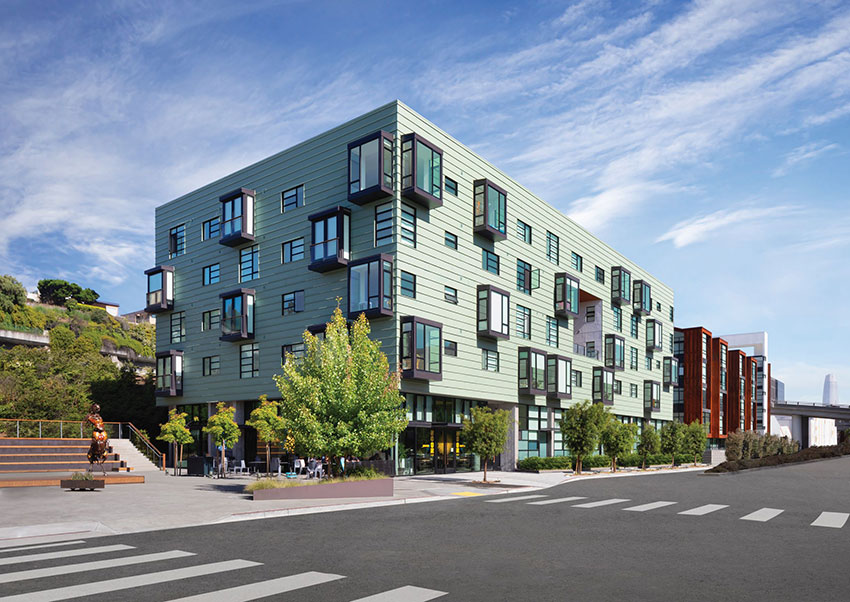
Photo courtesy of Chip Allen Photography
The O & M Indiana Street project in San Francisco is composed of two unique, mixed-use residential buildings set above a destination arts café and features high-performance aluminum windows and doors.
Thermal
When it comes to thermal comfort, aluminum windows and doors serve as part of a larger system. Because aluminum is a good conductor of heat, aluminum frames must be equipped with a thermal barrier that prevents heat from flowing inside to outside or vice versa depending on the climate, time of year, or time of day. Thermal barriers made from resins are incorporated into the aluminum profiles to allow the interior and exterior extrusions of a window or door to come together with minimum heat loss or gain.
Barriers can have thermal conductivities as much as 500 to 1,300 times lower than aluminum itself. The thermal performance of the entire window and door assembly is heavily influenced by that of the frame. Window and door design is intended to achieve the best possible daylight transmission while minimizing heat transmission. Window and door frame conductivity is a function of the frame material, geometry, and design (e.g., thermal barriers in metal frames). The thermal resistance of an aluminum frame is determined more by the surface area of the frame than by the thickness or projected area, as is the case with other frame materials.
A window or door frame profile with a simple, compact shape will perform better than a profile with fins and undulations. Aluminum can be extruded into very thin, very efficient frame profiles. The current technology with standard thermal barriers has improved aluminum frame U-factors from roughly 2.0 to about 1.0. Innovative thermal break designs combined with changes in frame design have also created high-performance frames that achieve U-factors even lower than 0.5. U-factors will be discussed later on in this course.
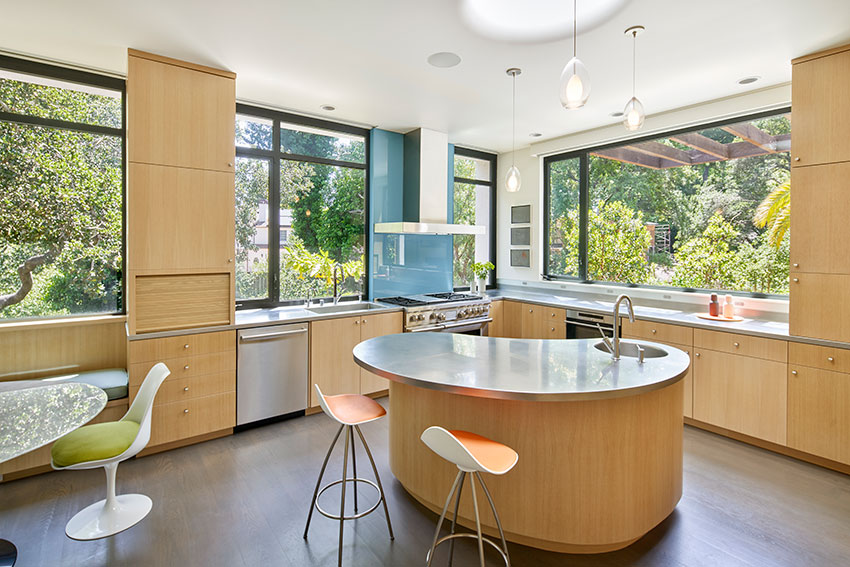
Photo courtesy of Bruce Damonte
Designed by Robert Nebolon Architects, the Hillsborough Residence features thermally strutted frames for increased energy efficiency.
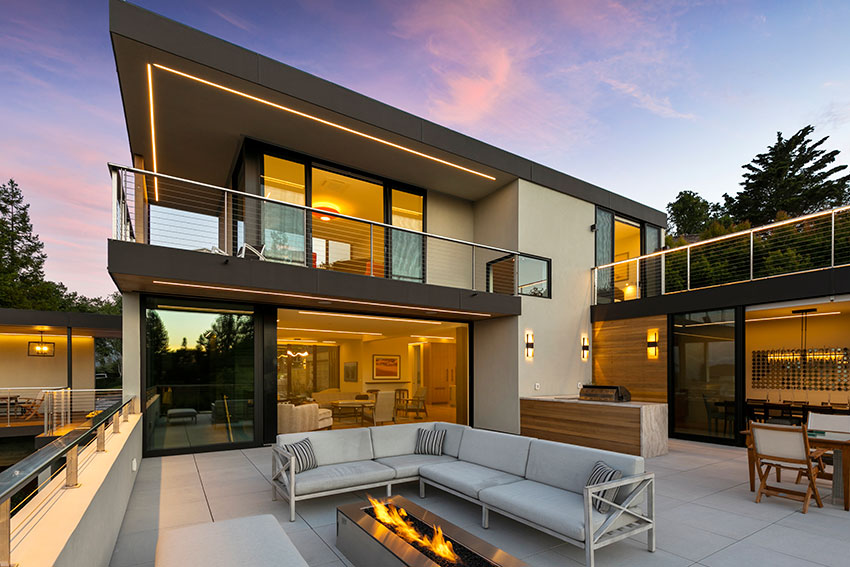
Photo courtesy of Tour Space
The Greenwood Residence windows and doors are made of 6063 extruded aluminum age-hardened to T-6 rating for strength and durability.
Moisture Resistance
Moisture resistance is key to supporting the health, safety, and well-being of occupants. Moisture resistance means better overall comfort and the ability to keep harmful molds from forming and affecting air quality. The glazing industry has made significant advances in moisture resistance and has established the basic detailing principles that should be considered when selecting and designing windows. It is important to select proven and more sustainable window design techniques, such as mitered corners stiffened by spline inserts, molded corner gaskets, vulcanized perimeter gaskets, and shop-applied perimeter collars as opposed to sealants, which can deteriorate over time.
Head Flashings
Use durable metal flashings. Window head flashings should slope to the exterior and be provided with an out-turned drip edge over the top of the window frame. They should extend several inches beyond the frame and be provided with watertight end dams. Head flashings should be sealed to both the inner face of the windows and the jamb flashings. Provide a (4 inch or 100 mm, minimum) upturned leg and counter flashing with wall waterproofing membrane adhered to the vertical leg of the metal flashing. For punched windows in openings that do not allow extension of the head flashing beyond the opening, use dual sealant joints in lieu of head flashing to capture water and direct it to the jamb flashings.
Sill Flashings
Provide sill flashings using durable metal (as opposed to flexible membranes) where they will be exposed. Slope flashings to the exterior and provide an out-turned drip edge over the face of the wall cladding. Provide an upturned leg (1 inch or 25 mm, minimum) on the interior and watertight end dams. Do not penetrate the horizontal portion of flashing with fasteners. Fasten sill frames with an inboard attachment angle through the upturned leg of the sill flashing and into the inboard leg of the sill frame. Membrane flashings may be appropriate for concealed sill flashings, which drain down into the wall cavity behind the cladding or onto sloped precast concrete or stone sills, but are less durable than metal.
Water Penetration
ASTM E1105 is the “Standard Test Method for Field Determination of Water Penetration of Installed Exterior Windows.” It is important to understand the difference between lab testing, which is to the point of failure, and field testing, which is intended to determine that the full assembly meets all ASTM and AAMA standards.
It is also important to understand whether the purpose of the test is to ensure the assembly will perform or whether it is to find the point of failure. Field testing is allowed at only two-thirds the lab test limits. When considering field testing, it is very important not to exceed the allowable stress design of the structure because it will introduce failure. If the structure is designed to withstand 110-mph wind loading, you would test at a pressure of approximately 3.5 psf.
If a window system can withstand two-thirds the lab test pressure in the field, and that equates to 5 or 6 psf, and if the building is only designed for 3.5 psf, then you would introduce failure into the structure or wall assembly. It is important that the expectations of the design team are considered prior to any field testing. Further information on this subject is available in an article entitled “A Discussion on Fenestrations Testing” by José Estrada.
Condensation Prevention
Excess condensation can support the growth of mold and mildew, which can lead to respiratory ailments and increase other health risks. In cold climates, condensation can also lead to ice buildup. Designers should check the required condensation resistance factor (CRF) based on anticipated interior humidity and local climate data and select a window with an appropriate CRF. Buildings with high interior humidity where condensation control is even more critical require project-specific thermal modeling. Thermally broken frames are the most effective means to resist or prevent condensation and ice accumulation.
Placing the thermal barrier in a position that avoids exposing the inboard aluminum frame portion to cold air prevents cold air “short circuiting.” AAMA provides guidance and testing protocols for these issues in AAMA 1503, “Thermal Transmittance and Condensation Resistance of Windows, Doors, and Glazed Wall Sections.”
Further Considerations
Durability, daylighting, and acoustic performance are among other aspects enabled by high-performance aluminum windows and doors. To select for certain IEQ properties, it’s important to understand how these aluminum profiles work and how they are best optimized for each system.
Structural Strength
The strength of aluminum enables glass-clad structures to meet wind load provisions of Minimum Design Loads for Buildings and Other Structures, Standard ASCE/SEI 7-10. (ASCE is the American Society of Civil Engineers.)
Daylighting
The slimmer profiles of extruded aluminum window and door frames increase the amount of daylight entering the window, sometimes by as much as 20%.
Acoustic Performance
External acoustic performance is measured by the outdoor–indoor transmission class (OITC), which measures the sound transmission through exterior walls from outside sound sources. This performance is affected by the design of the window and door frame, thermal breaks, gaskets, and seals, etc., inherent in all aluminum frames. Reduced sound levels reduce stress in healthcare facilities and improve productivity in workplaces.
Maintenance Requirements and Durability
Aluminum not only is extremely durable but also requires minimum maintenance after installation. In general, periodic washing with soap and water is all that is required. Manufacturers can supply further information if necessary.
Receptor Frames
Receptor frames are additional framing components that encase or surround one or more window components in a similar manner to that of stud tracks, which hold light-gauge metal studs in place. They are generally used to simplify window installation and save time and money. They will be discussed in more detail in the next section of the course.
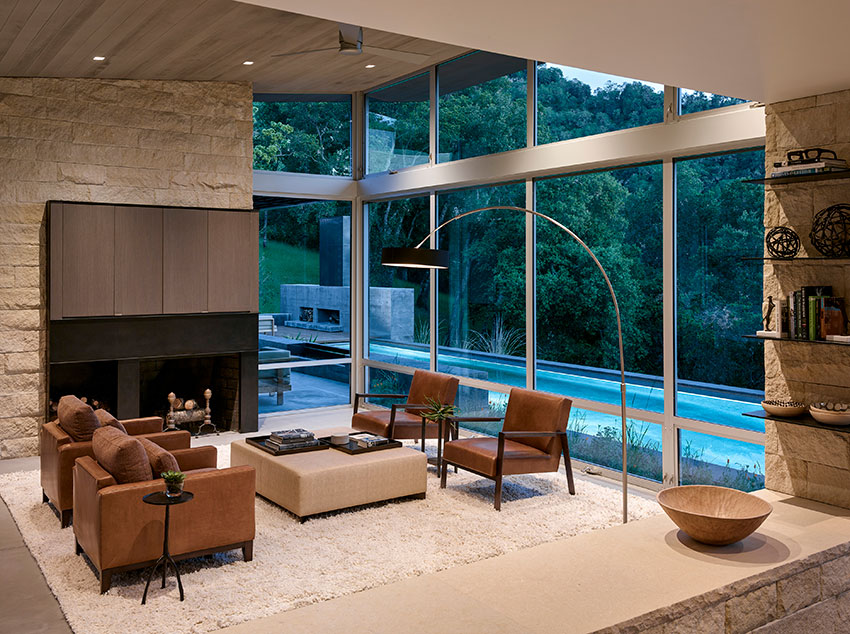
Photo courtesy of Tour Space
Designed by Feldman Architecture, the Spring Ranch residential project features floor-to-ceiling, multilite combination configuration aluminum windows for aesthetic value.
Window And Door Performance And Standards
This section explores desired performance targets, the standards that inform them, and the technologies that can be used to address and meet them.
Performance Requirements
The specification excerpt below provides a sample condensed shopping list of performance levels that should be determined during the design process.
- A. Design pressure, air infiltration, and water penetration
1. Comply with AAMA/WDMA/CSA 101/I.S.2/A440 [AW-PG80]
- B. Uniform Load Deflection and Uniform Load Structural to ASTM E330
- C. ASTM E283, Air Leakage: 6.27 psf: 0.1 cfm/ft2 maximum
- D. ASTM E547, Water Penetration: at 12.11 psf: No leakage
- E. ASTM F588, Forced Entry Resistance: Type B Grade
Type B Grade 10: Pass for No entry
- F. U-Factor [____]
- G. Solar Heat Gain Coefficient (SHGC) [____]
- H. Acoustical Performance: STC [____]
Energy codes continuously reduce the amount of energy that residential and commercial buildings can use. Window and door design must follow this trend to become more and more energy efficient. The primary driving or model codes are ASHRAE 90.1 and the IECC (International Energy Conservation Code). These codes must be adopted locally to have force.
Other relevant codes and standards include IgCC (International Green Construction Code), ASHRAE 189.1, ENERGY STAR, and DOE Zero Energy Ready Homes. The goal of DOE Zero Energy Ready Homes is that 100% of all new commercial (including high-rise residential) buildings will produce as much energy as they use by 2025. Window and door performance will be a major factor in enabling this goal, and glazing techniques may include the incorporation of photovoltaics in the building cladding system.
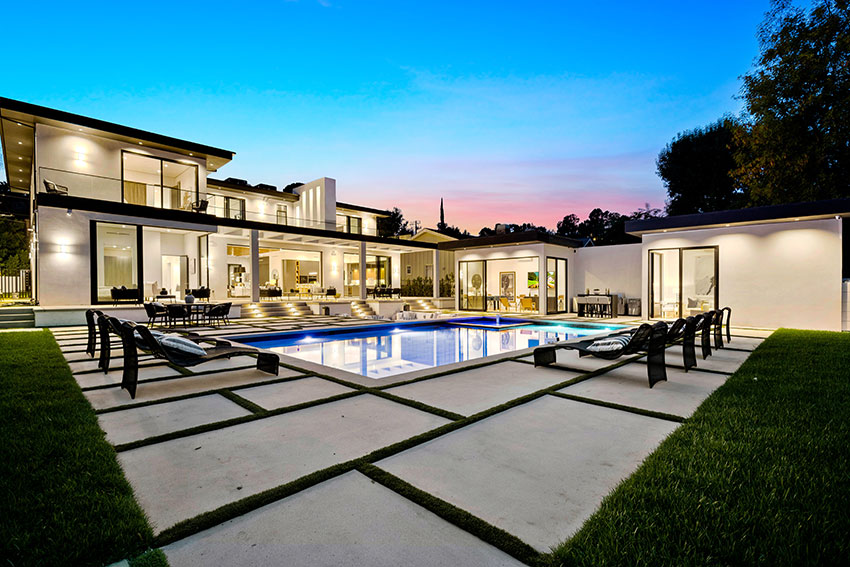
Photo courtesy of All Weather Architectural Aluminum
The Brewster Estate features an open concept floor plan with large, high-performance sliding glass doors and windows to maximize the indoor/outdoor living spaces.
U-factor, solar heat gain coefficient (SHGC), air leakage, and, possibly, visible light transmittance are critical for compliance with any code. These properties must be provided as certified ratings determined by independent laboratories in accordance with National Fenestration Rating Council (NFRC) standards. Air leakage ratings can be based on the North American Fenestration Standard (NAFS). The component modeling approach (CMA) can generate ratings for commercial fenestration. The CMA program of the NFRC is an online database of energy performance information for window, door, and skylight components, which provides the following:
- Help to nonresidential manufacturers to see how changing one component can affect overall energy efficiency
- Information on which components can be combined
- Determination of whole-product energy performance ratings for fenestration systems
U-factors for the 2021 IECC had significant changes from the 2018 version. Aluminum windows and doors can meet the thermal requirements of all these codes with an increased use of thermal breaks and upgraded glazing strategies. In addition, they can satisfy all daylighting requirements. Daylighting is also becoming a more important consideration as there is a steadily rising focus on occupant health and well-being in building design and certification.
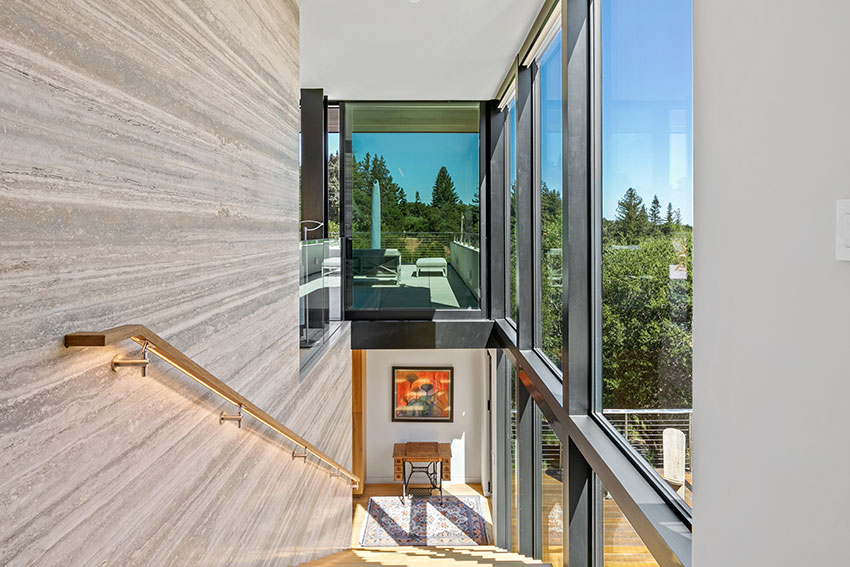
Photo courtesy of Tour Space
The Greenwood Residence features a window system with high energy-efficiency ratings and a glazed solution for residential applications and buildings of up to 12 stories.
Thermal Performance of Insulated Glass Units
There have been recent advances in thermal barriers that meet these increasingly stringent energy reduction goals. These include polyamide struts and wide-cavity, dual-pour, and debridged polyurethane thermal barriers. These types of barriers will be explained in greater detail later on in this course. In addition, aluminum thermal barrier technology is making further advances to work more closely in conjunction with glass, glazing, and envelope materials to reduce commercial building energy consumption.
Current technology with standard thermal breaks has improved aluminum frame U-factors from roughly 2.0 to about 1.0. Innovative new thermal break designs have been combined with changes in frame design to achieve U-factors lower than 0.5 but at a higher cost than current thermally broken frames. The higher capital cost of the frames, however, can be recovered over time in energy savings.
Glazing performance can be equal to or greater in importance than the frame, which should then be designed to accommodate the best glazing solution. In the Empire State Building energy retrofit described earlier, the opposite occurred. Because of the desire to retain the existing aluminum window frames, which previously held double glazing with a steel spacer, the retrofit glazing strategy created glazing to fit into these frames. The solution was double glazing with a high-performance E-coating, a suspended heat mirror film, inert gas, and warm-edge spacers to double or quadruple the overall performance of the windows within the existing frames.
Double- and triple-pane windows and doors are now often filled with inert gases such as argon or krypton to reduce convection within the units and to improve the window or door’s overall energy efficiency. These gases are often known to leak—many times at just a rate of just 1% a year, which is generally acceptable. However, sometimes if the seals are not sufficient, they will leak faster, thus ruining their contribution toward energy efficiency and necessitating an expensive replacement. Aluminum can be fabricated to extremely close tolerances to create precise forms for the insertion of glazing, weatherstripping, and thermal barriers to control this leakage.
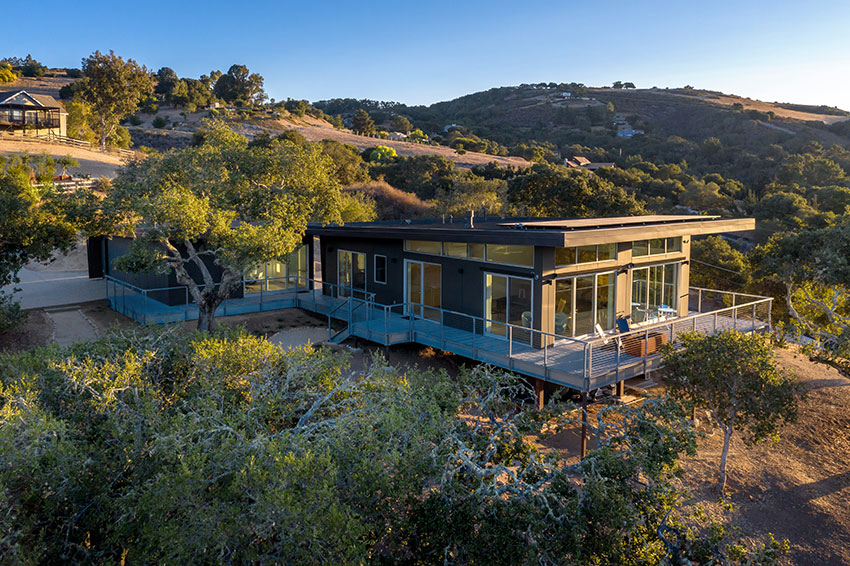
Photo courtesy of David Lalush
Packed with off-grid tech, the three-bedroom, three-bath Waterfall Residence soaks up stunning views of Carmel Valley. Andrew Goodwin Designs collaborated with the homeowners who are seasoned industrial designers on the final structure. Dual-glazed sliding doors and windows frame views of the landscape and flood the interior with natural light.
Glazing Options
It is not the intent of this course to provide a full analysis of each type of glazing material or system; the goal is simply to list the materials and describe them briefly to assist the designer in selecting the appropriate one.
Clear Glass
Clear glass is the most commonly used type of glass. It has high visible light transmittance and reasonable color neutrality. It is widely used because of its low cost, due to its use of recycled material and is an excellent substrate for high performance low-E coatings. Clear glass is essentially invisible.
Low-E Coat
Low-E (emissivity) coatings reduce heat gain from the sun and restrict the amount of ultraviolet and infrared light passing through glass without compromising the amount of visible light transmitted. In colder climates, passive coatings reflect long-wave energy from the building interior back into the building, thus minimizing the amount of heat passing through to the outside. In hot climates, low-E coated glass blocks solar heat energy and provides thermal insulation. This keeps cool air inside and hot air outside.
Safety Glass
Annealed Glass (also called nontempered, float, or standard glass) The annealing process improves the glass’s durability and helps to reduce internal stresses that could result in breakage. Annealed glass is often used in items such as tabletops, cabinet doors, and basement windows. It is not as strong as tempered glass.
Tempered Glass
Tempered glass is annealed glass that has been heat treated to harden and strengthen it. Tempered glass is one of the hardest types of glass available. It is up to five times harder than most other glasses, including annealed glass. It cleans very easily and, if installed properly, will not augment glare or affect colors, image quality, or sharpness.
Laminated Glass
This glass is one step higher as a safety glass. It is made by adhering two pieces of annealed glass together with a vinyl layer. The vinyl layer holds the glass together if the glass is broken or impaled.
Other Glass Options
Tinted Glass
Tinted glass is used to add color to projects. Tints are also beneficial for reducing glare and limiting solar heat gain when used in conjunction with low-E coatings. Tinted glass can be laminated, tempered, or heat-strengthened to satisfy strength or safety requirements.
Low-Iron Glass
Low-iron glass is made with a low-iron formulation that improves its levels of clarity, transparency, and color accuracy when compared to clear glass. This can significantly impact daylighting because it can provide the same amount of daylight in smaller areas as clear glass does in larger areas but without the same amount of heat loss/gain.
Spandrel Glass
Spandrel glass is opaque and can hide features between the floors of a building. Spandrel glass should be heat-strengthened to resist the thermal stresses associated with potential heat absorption and buildup behind it. There are various types of spandrel glass units available, and they include insulated units.
Further Performance Factors
In relation to the window or door as a whole, there are a number of other performance factors that the designer should assess in order to gauge future performance.
- U-Factor: the rate of heat transfer (heat gain or loss) through glass; the lower the U-factor, the better
- R-Value: the measure of heat resistance, the ability of a material to reduce the transfer of heat; the higher the number, the better
- Solar Heat Gain Coefficient: how well a product can resist heat gain; the lower the number, the better
- Visible Light Transmittance: how well a product will admit natural light; the higher the number, the better
- Air Leakage: how much unwanted air will enter a space through a window assembly; the lower the number, the better; less air leakage means a lower amount of drafts will be experienced and occupant comfort and health will be improved.
- Water Infiltration: how much water will infiltrate a window assembly from real-life weather events or wind-driven rain in a given amount of time, typically tested according to ASTM E1105
- Daylight Opening: the total viewing area available in any window or door, which affects daylighting, view, and energy performance as well as building aesthetics. Structural ratings are composed of two parts: deflection measurements and overload pressure.
- Deflection is measured by loading the window/door to the design pressure, and the amount of deflection at the center of the mullion is measured under wind loading..
- Overload pressure: Once the first portion of structural testing is complete, overload testing to 1.5 times the design pressure is done. The window or door must still stay intact without major deformation and be in working condition after testing is complete.
Aluminum maintains its original structural integrity over a long service life and even becomes stronger in extremely cold temperatures. Extruded aluminum building components also resist deformation caused by climate changes and building movement and retain their basic structure, strength, stability, durability, and resistance to water and air infiltration.
NFRC labels help compare energy-efficient products by breaking down a product’s energy performance into multiple categories such as those illustrated on the label. NAFS (North American Fenestration Standard) is a fenestration standard based on the design pressure (DP) concept. It defines basic performance requirements for a wide variety of styles of window, door, and skylight products, including those with aluminum or vinyl cladding. It relies on performance class and performance grade designations to guide this evaluation and selection process. Its four performance classes are R (residential), LC (light commercial), CW (commercial), and AW (architectural).
Wildfire Zones
The prime factor related to fire is the glazing, but noncombustible aluminum frames hold the glazing longer than many other framing materials. Double glazing provides better protection over single glazing. Tempered glass, which is four times stronger (more resistant) than single-pane annealed and twice the strength of a dual pane, increases the fire resistance further.
The California Building Code requires multipane glazing with at least one pane tempered and the window to be rated for 20 minutes. Rated systems must have rated glazing and frames and survive the hose stream test, NFPA 257. They must also meet the State Fire Marshal standard 12-7A-2, which requires exterior windows to meet a fire resistance test standard consisting of a 150 kW intensity direct flame exposure for an eight-minute duration.
Fire-protective glass prevents the spread of fire and smoke, but not heat transfer. When the glass heats up on one side, objects on the other side of the glass will feel the heat. vFire-resistive glass prevents the spread of fire and smoke and also stops radiant and conductive heat transfer. Objects on the protected side do not get hot enough to spontaneously combust. This is usually accomplished with a laminated assembly composed of multiple glass layers separated by heat-resistant interlayers.
Thermally Improved Extrusions
Roughly half of the current improvement to U-factors comes from recent improvements to thermal barriers. There are two principal types of thermal barriers: polyurethane poured and debridged and polyamide insulating strut.
The pour-and-debridge method involves pouring a polyurethane-based mixture into the thermal break channel of an aluminum extrusion. Once it cures, the barrier channel is debridged, which means the metal bridge from the bottom of the channel is removed to produce a structural thermal barrier between the metal surfaces. These systems are available in either single- or double-poured and debridged thermal barriers in the same aluminum extrusion. They provide a range of products to complement the glass selected and to meet specific project performance and budget needs.
While this is the older method, it is still in widespread use. Its disadvantage is that the thermal barrier width is typically limited to about 0.25 inch (6.35 mm) by the structural requirements, and the thickness of the thermal barrier is fairly large, thus limiting its effectiveness. Windows incorporating this type of thermal barrier have a general performance of about U = 0.5 Btu/(hr·ft2·°F), or R-2
The insulating strut method involves placing pre-extruded polyamide strips into the thermal break pockets of two separate (inner and outer) aluminum extrusions. After the strut is inserted, the aluminum framing member is crimped or rolled to mechanically lock the barrier in place and form a bond between the two extrusions and the insulating strip to create a structurally secure assembly.
While polyamide has higher conductivity than polyurethane, these strips are thinner and can have larger widths than pour-and-debridge systems (normally around 0.50 inch or 12 mm), which allows for better frame performance of about U = 0.35 to 0.4. The NFRC divides thermal barriers into two basic categories.
A thermally improved member enhances efficiency but may not provide the highest energy efficiency available.
A thermally broken member gains further energy efficiency.
Warm-Edge Spacers
Warm-edge spacers are built with materials whose coefficient of linear thermal conductivity is significantly lower than an aluminum spacer bar. They contribute to improving thermal performance by reducing the thermal bridges at the glass perimeter. Various kinds of materials are used: flexible foams, thermoplastics, plastic/metal hybrids, and stainless steel. They can be classified as flexible spacers, plastic/metal hybrid spacers, and stainless steel. Their benefits include energy savings, lower CO2 emissions, reduction of surface condensation on insulating glass, reduced risks of mold on the frames, and warmer contact surfaces of the window.
Receptor Frames
Receptor frames contain and drain water infiltrating the enclosed window assembly and the joints between the window and the receptor frame itself. They should incorporate mechanically attached metal end dams or end caps to prevent water from draining off the ends of the subsill into the building (or underlying flashing system), and they should be sealed to jamb receptors (if provided), so that water traveling down the jamb is directed into the subsill and out its weep holes.
Receptor frames can be used to accommodate a limited amount of structural deflection; the nesting nature of the receptor frame can allow a small amount of slab deflection without transferring loads to the window units themselves. They are often used to compensate for variations of levelness and squareness in the field. Because they are usually field assembled and, thus, not fabricated with the same precision as factory-created window components, they often rely on sealants to make them secure from water and air penetration. They can also create a continuous air loop around the window and cause convection currents, resulting in increased air leakage and condensation. If poorly fabricated, they can also increase water penetration. Receptor frames are normally not tested in the field as the window units themselves are.
Compensation Channels
Compensation channels are special extrusions that help the building achieve special design and performance criteria. They are separate frame components that allow the windows to be installed at a depth or forward to the exterior.
Capillary and Breather Tubes
Capillary tubes and breather tubes are used in insulating glass units to equalize the pressure between the sealed panes. They are used primarily for installation of windows and doors at high altitudes. Breather tubes are aluminum tubes with an inside diameter of approximately 0.125 (3 mm) and a typical length of 3 to 6 (76 to 150 mm). They are sealed after pressure equalization at the installed altitude. Capillary tubes are small stainless steel or aluminum tubes with a typical inside diameter of 0.10 to 0.020 (2.5 to 5 mm) and a typical length of 12 (300 mm). Capillary tubes are typically left open in the field to allow the IGU to equalize initially and then maintain a generally flat appearance over time.
EPDs and Green Building Certification
An environmental product declaration (EPD) is an independently verified and registered document that communicates transparent information about the life cycle environmental impacts of a product. The AEC has recently completed updating its two aluminum extrusion EPDs and the corresponding Life-Cycle Analysis (LCA). The new EPDs are based on 2020/21 data and replace the initial EPDs released in 2016. You can find the aluminum extrusion EPDs on the UL SPOT website. These are comprehensive documents that cover all aspects of aluminum extrusion production. EPDs are preceded by LCAs, whose basic findings were outlined earlier.
Aluminum fenestration systems can contribute to green building certification and third-party rating programs in a number of areas, including energy efficiency, material sustainability, and indoor environmental quality. The use of aluminum extrusions allows architects to meet the challenges of sustainable design and provides many benefits to the whole-building design concept.
Aluminum-framed products meet thermal performance requirements with increased use of thermal barriers, low-E glass, and triple glazing. Aluminum windows and doors help satisfy daylighting requirements; aluminum sunshades help meet shading requirements, and aluminum products contribute to the the sustainable material requirements.
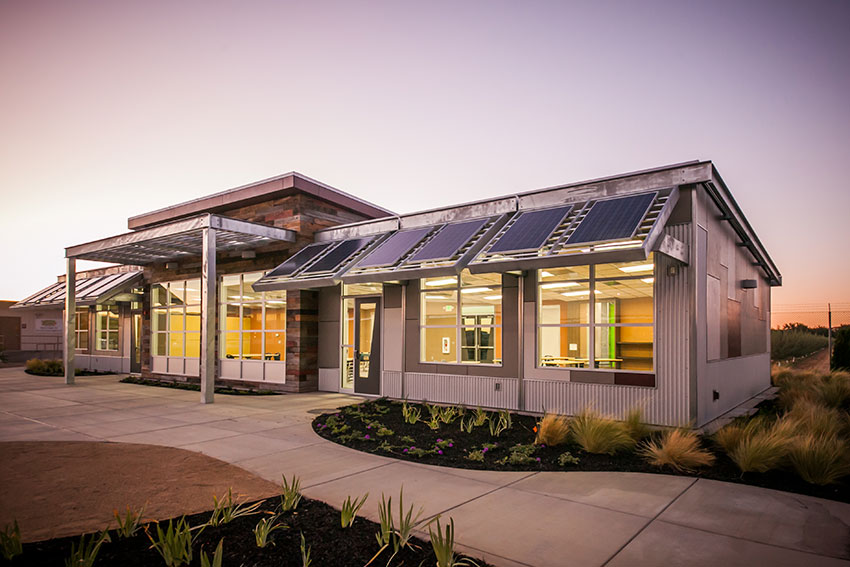
Photo courtesy of American Modular Systems
The Regional Environment Studies Center is the California Central Valley's first LEED Gold K-12 support facility and offers an energy-independent, multiuse space featuring high-performance aluminum windows that gives the Manteca community free access to environmental education.
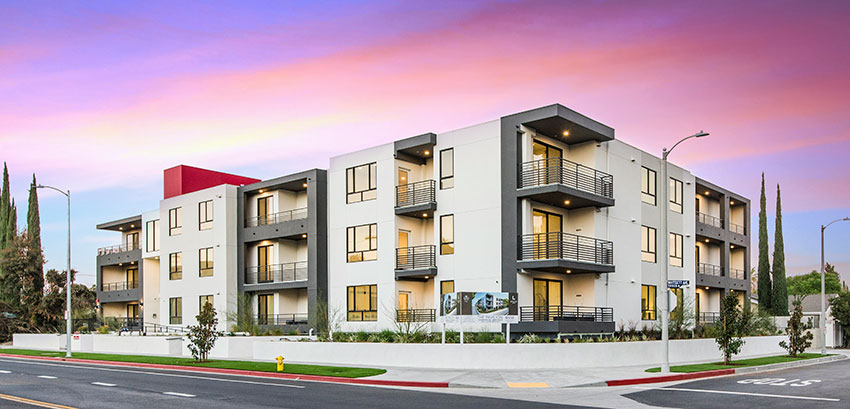
Photo courtesy of The Luxury Level
The Pavilion at Whitsett in Los Angeles’ Valley Village community features expansive floor-to-ceiling aluminum windows and doors that provide natural daylighting and a contemporary aesthetic.
The LEED Program
The Leadership in Energy and Environmental Design (LEED) green building certification program, developed by the U.S. Green Building Council is the preeminent program for the design, construction, maintenance, and operations of high-performance green buildings. LEED credit requirements cover the performance of materials as a whole and do not assess the performance of individual products or brands. Specific products or materials can only contribute toward earning LEED certification points; they cannot earn points individually themselves.
It is important to remember that green building codes and programs now look at the overall indoor environmental quality of a building in addition to energy efficiency and other issues; this includes the benefits of daylighting and views to building occupants.
LEED v4 MR Credit: Building Product Disclosure and Optimization
One applicable example is the Materials and Resources (MR) credit Building Product Disclosure
- Environmental Product Declarations (possible 2 points): The method of achieving this credit is outlined.
- Sourcing of Raw Materials (possible 2 points): The intent of this credit is to encourage the use of products and materials for which life-cycle information is available and that have environmentally, economically, and socially preferable life-cycle impacts, and to reward project teams for selecting products verified to have been extracted or sourced in a responsible manner.
- Material Ingredients (possible 2 points): The intent is to encourage the use of products and materials for which life-cycle information is available and that have environmentally, economically, and socially preferable life-cycle impacts; to reward project teams for selecting products for which the chemical ingredients in the product are inventoried using an accepted methodology, and for selecting products verified to minimize the use and generation of harmful substances; and to reward raw material manufacturers who produce products verified to have improved life-cycle impacts. It is easy to see how the positive attributes of aluminum windows and doors can contribute to credits in these categories.
v4 MR Credit: Building Product Disclosure and Optimization—EPDs
The intent of this credit is to encourage the use of products and materials for which life- cycle information is available and that have environmentally, economically, and socially preferable life-cycle impacts, and to reward project teams for selecting products from manufacturers who have verified improved environmental life-cycle impacts. We will look at achieving the first option:
Option 1. Environmental Product Declaration (1 point) Use at least 20 different permanently installed products sourced from at least five different manufacturers that meet one of the disclosure criteria below.
- Product-specific declaration
- Products with a publicly available, critically reviewed life-cycle assessment conforming to ISO 14044 that have at least a cradle-to-gate scope are valued as one-quarter of a product for the purposes of credit achievement calculation.
- Environmental Product Declarations that conform to ISO 14025, 14040, 14044, and EN 15804 or ISO 21930 and have at least a cradle to gate scope
- Industry-wide (generic) EPD: Products with third-party certification (Type III), including external verification, in which the manufacturer is explicitly recognized as a participant by the program operator, are valued as one half of a product for purposes of credit achievement calculation.
- Product-specific Type III EPD: Products with third-party certification (Type III), including external verification in which the manufacturer is explicitly recognized as the participant by the program operator, are valued as one whole product for purposes of credit achievement calculation.
- USGBC approved program: Products that comply with other USGBC approved environmental product declaration frameworks. The credit also outlines another option that uses LCAs. The industry has conducted both LCAs and EPDs. There are a few changes to this credit in the newest LEED version, v4.1.
Further Credit Categories
In LEED v4.1, a product following the product-specific declaration criteria is valued as one whole instead of one-quarter of a product; a product with an industry-wide (generic) EPD is valued as one whole instead of one-half; and one with a product-specific Type III EPD is valued as 1.5 products instead of one. There is also another EPD type:
- Product-specific Type III EPD: Internally Reviewed
- Products with an internally critically reviewed LCA in accordance with ISO 14071.
- Products with product specific internal EPDs that conform to ISO 14025, and EN 15804 or ISO 21930 and have at least a cradle to gate scope are valued as one whole product for the purposes of credit achievement calculation. There are a number of other prerequisites and credit categories in v4 where aluminum windows can contribute.
- Energy and Atmosphere Prerequisite Minimum Energy Performance
- Energy and Atmosphere Credit Optimize Energy Performance: a possible 20 points
- Materials and Resources Prerequisite Construction and Demolition Waste Management Planning
- Materials and Resources Credit Construction and Demolition Waste Management
- Materials and Resources Credit Building Life Cycle Impact Reduction
- Credits for acoustic control, indoor air quality, daylighting, and quality views
Many of the issues identified by LEED for credits are recognized by other building standards as well. The International WELL Building Institute (IWBI) is a public benefit corporation whose mission is to improve human health and well-being in buildings and communities across the world through its WELL Building Standard (WELL).
This standard also recognizes the importance of enhanced daylight access and requires projects to design spaces to integrate daylight into indoor environments in order that daylight could be used for visual tasks along with electric lighting and to provide windows and doors that connect individuals to the outdoors.
Conclusion
Aluminum has been in use for many decades in many ways and in that time has proven to be an extremely versatile and reliable building material. Since its early production in 1887 and today, the means by which its raw materials are extracted from the earth, the methodologies by which they are combined, and the manner in which aluminum products are produced has improved significantly in relation to environmental protection, emissions, the amount of recycled material used, and the reduction of energy needed.
The aluminum fenestration industry has concurrently improved the technology used to fabricate window and door frame extrusions. Current extrusion advancements have improved their resistance to heat loss or gain to the point where aluminum is now a top performer for window and door frames that must meet the increasingly stringent energy usage requirements for today’s buildings.
The positive attributes of aluminum, which include strength, stiffness, flexibility, durability, corrosion resistance, and nontoxicity, combined with its ability to be recycled and reused indefinitely without a loss of any of these attributes makes aluminum one of the most sustainable and beneficial building materials in current use. Aluminum can be finished and colored in a number of ways and thus provides designers with an extremely wide choice of design options, along with the knowledge they are using a safe, affordable, healthy, and sustainable material.
Erika Fredrickson, is a writer/editor focusing on technology, environment, and history. She frequently contributes to continuing education courses and publications through Confluence Communications.