This CE Center article is no longer eligible for receiving credits.
Daylight has a powerful effect on human health. Not only are our bodies designed to synthesize sunlight into vitamin D that aids bone growth and helps fight certain diseases, but important internal systems that regulate our physical, mental, and behavioral well-being are evolutionarily programmed and maintained by exposure to daylight. Disrupting the natural circadian rhythms of the body, which take their primary cues from the daily cycle of daylight and darkness, has been associated with increased risk for a cardiovascular event, obesity, diabetes, and neurological problems such as depression. Unfortunately, these are prevalent health issues today. Heart disease is the leading cause of death in the United States and diabetes is regularly within the top ten. The Centers for Disease Control and Prevention describe obesity as common, serious, and costly, identifying more than one-third of United States adults as obese. A study published in the February 2015 issue of the Journal of Clinical Psychiatry found that depression in the United States “is the leading cause of disability for people aged 15-44, resulting in almost 400 million disability days per year.”
Here is one more interesting statistic to add to the heap: Americans spend approximately ninety percent of their time indoors. It seems likely that for most people, in most buildings, time inside is spent under fluorescent lighting with limited access to daylight. Although the topic of incorporating daylight and views into buildings has been gaining momentum for some time, the practice of bringing a considerable amount of daylight into the built environment and managing it effectively is not yet commonplace.
This article will explore the health and productivity benefits of incorporating daylight and views into a building. It will introduce a potent glazing solution that enables architects to design more freely with glass, providing access to daylight and views, while preventing glare and unwanted solar heat gain from entering the space and negatively impacting the comfort and energy performance of the building.
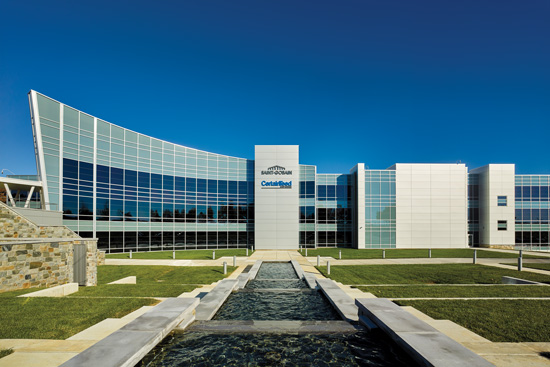
Photo ©Jeffrey Totaro 2015
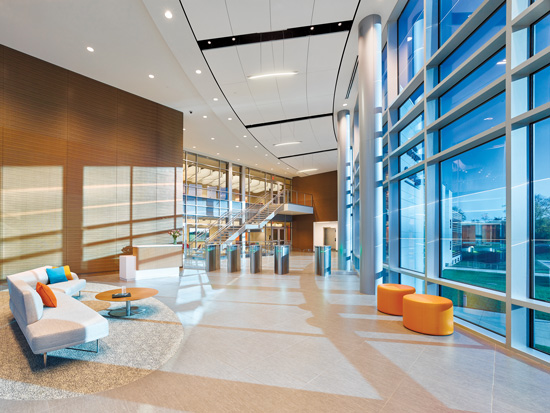
Photo ©Jeffrey Totaro 2015
Saint-Gobain North America used electrochromic glazing to help achieve points under both the Indoor Environmental Quality (IEQ) and Energy and Atmosphere credits in its quest to achieve LEED Platinum certification in its new headquarters building in Malvern, Pennsylvania. The company’s goal was to provide a comfortable, well-day-lit environment to support the health and well-being of its employees without compromising energy performance and in line with its corporate sustainable habitat strategy.
Characteristics of Daylight
Daylight is a dynamic light source that is unmatched in terms of the power, variability, and complexity of the light it provides. Daylight spans an exceptionally broad range of intensities, impacted both by the time of the day and weather conditions, with a color composition that changes regularly throughout a 24-hour cycle.
Dynamic Intensity
Time of day, time of year, and daily weather all affect the intensity of the daylight incident on a window at any given moment, giving the intensity of daylight the characteristic of constant change and a certain degree of unpredictability. Outdoor daylight illuminance can range from 120,000 lux for direct sunlight at noon, which is enough to cause eye pain, to less than 5 lux under thick storm cloud cover. The position of the sun relative to any window changes throughout the day and year as the Earth rotates around its own axis and the sun. Clear or cloudy sky conditions also influence the intensity of available daylight, as can obstructions and reflections in the immediate environment. This variability and unpredictability of solar intensity provides a challenge for the building designer in controlling the amount of the sun’s heat and light entering the building.
The Dynamic Spectrum of Daylight
Visible light has a wavelength range from 400 to 700nm. Violet, indigo, and blue light exist at wavelengths from 400 to 480nm; green light has a wavelength of around 510nm; and red and orange light have wavelengths from 590 to 700nm. White light is a mixture of all of the colors of the visible spectrum. The color of the light perceived by the human eye depends on the relative intensities of each wavelength seen. Although daylight appears essentially neutral like white light, the balance of color (or spectral power distribution) actually changes as a function of the position of the sun in the sky, on the sky conditions (cloudy sky or cloudless sky). For example, daylight has a higher blue component in the morning and a higher red component as the sun sets.

Photo courtesy of SageGlass/Phil Daubman Photography
Daylight Impacts Human Health
Studies now prove that the human body is uniquely attuned to the ever-changing presence, and absence, of daylight, and that daylight exposure at the right time of day, or lack thereof, significantly impacts the functioning of a number of important internal processes called circadian rhythms.
Circadian rhythms play a large part in regulating hormone release and body temperature. They govern sleep/wake cycles and affect the body’s blood pressure, mood, metabolism, reproduction, and immune response. Disrupted circadian rhythms can manifest feelings of grogginess and disorientation, and the general state of malaise commonly referred to as jet lag that people experience when traveling across time zones.
Daylight is a drug that effectively entrains and resets the body’s clock to the 24-hour cycle and, as Deborah Burnett, co-founder of the Benya Burnett Consultancy, says, “Nature is the dispensing physician,” providing the right type of daylight (color), in the right dose (intensity), at the right time of day.
Circadian rhythms respond primarily to the availability of light and dark in the immediate environment. They are also affected by the changes in the color spectrum of daylight. In fact, the visible light measuring between 460 and 500nm (blue) has been shown to be a powerful regulator of the circadian response in humans and has been termed circadian blue light.
Exposure to morning daylight, which has a higher blue component, increases cortisol levels to combat stress, serotonin levels to provide impulse control, and dopamine levels to increase alertness. The absence of light in the evening encourages the body to produce melatonin to aid sleep, and supports other functions geared toward lowering blood pressure and regulating metabolic and repair processes. Untimely exposure to intense light, especially blue light, in the evening can disturb the body’s circadian rhythms and cause important internal processes to be disrupted, which could cause serious health concerns. LCD screens that emit blue light can be especially problematic, and there are now applications (apps) available for phones and laptops to suppress blue light emission in order to reduce the probability of circadian rhythm disruption when these devices are used at night.
The Benefits of Incorporating Access to Daylight and Views into the Built Environment
Studies detailing the positive impact of daylight and views in the built environment now abound as the topic continues to gain momentum, making it possible to dissect the benefit of access to daylight and views across specific application types. A 2013 report released by the World Green Building Council (WGBC) titled “Productivity and Health Benefits: The Business Case for Green Building” summarizes study findings that incorporating both daylight and views into schools, office spaces, and healthcare facilities generates real and significant improvements in the function, health, and well-being of the people in the space.
Offices
In office spaces, many studies have shown double-digit improvements in productivity, significant reduction in absenteeism, and improvement in attraction and retention of staff. For example, a 2003 study by the Heschong Mahone Group exploring the impact of daylight on a California call center showed 7-12 percent faster call processing and a 16 percent improvement in cognitive tests for those with a primary view through a window. Workers with a view spent 15 percent more time on their primary task than their peers without a view who spent 15 percent more time talking on the phone or with others.
Demonstrating the positive impact on wellness and absenteeism, a 2013 study conducted by Chueng (et al) found that workers without windows have poorer quality of life scores, vitality, sleep disturbance and efficiency, and daytime dysfunction; whereas, those with windows slept 46 minutes more per night. The 2011 study Daylighting—Bias and Biophilia: Quantifying the Impact of Daylighting on Occupant Health by Elzeyadi concluded that employees whose administrative offices incorporated daylight and views took less sick leave when compared with employees whose offices did not offer them access to the outside environment.
Of significant importance to businesses today is the ability to attract and retain talent. As an example of the impact daylight can have, a study of social service groups that moved into day-lit offices found the change resulted in a 200 percent decrease in turnover and a tripling of job applicants.
Healthcare
In healthcare environments, patients with access to daylight and views have demonstrated reduced post-operative recovery times, reduced use of pain medication, and improved outcomes. Other studies point to reduced stress, sick days, and error rates in hospital staff. Given that adverse drug events cost $2 billion annually, reducing dispensing errors can have a huge impact on medical costs, as well as patient care quality. In the Economics of Biophilia, Browning suggests that $93 million could be saved in healthcare each year alone by giving patients and staff views of nature.
Education
In contrast to the belief widely held in the 1970s that views are distracting to students and disrupt the learning process (a view which led to the construction of many schools devoid of windows), it has now been shown that views and daylight are extremely important to the growth, development, learning rates, and behavior of children. As an example, a 1999 study conducted by Heschong Mahone Group found that students in classrooms illuminated by daylight achieved higher test scores and learned faster than students in settings that had little daylight.
Daylight and Views in Green Building
The debate over the contribution that daylight and views make to a healthy interior appear to be over as the inclusion of these elements is encouraged and incentivized by many of the green building rating systems used to define success in green building today. The Leadership in Energy and Environmental Design (LEED) green building rating system, created by the USGBC, is the preeminent green building standard in the United States. This standard has included credits for bringing daylight and views into the interior for years, and in its most current version, LEED v4, more points have been allocated to this area to underscore its importance.
The Daylight credit offers up to three points for achieving a minimum amount of daylight penetration in the interior while not exceeding a maximum intensity. The Quality Views credit awards one point for designs that can provide a quality view (one to two points in LEED Healthcare).
The fact that there is a requirement not to exceed a maximum sunlight exposure limit, and for the use of glare control devices, indicates that USGBC recognizes that controlled exposure to daylight is an incredibly positive and beneficial aspect of the interior environment, but that uncontrolled daylight in the interior can be destructive.
These maximum and minimum intensity requirements create a significant design challenge for architects. Given the dynamic nature of daylight intensity, it is hard to design a building that has enough glazing area to provide the requisite level of daylight and views for a large proportion of the occupied space without exceeding the maximum intensity limit, especially in the immediate vicinity of the window wall.
In addition, the increased use of glass can create challenges with meeting the energy performance requirements in the Energy and Atmosphere credit area because the insulating value and solar heat gain of a window is higher than an opaque wall.
Potential Dangers of Uncontrolled Daylight
Daylight can deliver significant light and heat energy through a window and into the interior of a building. Uncontrolled daylight can be, and often is, problematic, creating glare and disrupting the thermal comfort and energy efficiency of the environment with excessive heat gain. Unfortunately, the potential costs associated with glare and heat gain can quickly negate any potential benefit. The 2003 Heschong Mahone Californian Call Center study quantified the cost of glare, finding that it caused a 17 percent decrease in productivity. Other studies have quantified the impact that thermal discomfort can have on productivity. While performance peaks between 69 and 72 degrees Fahrenheit, increasing or decreasing temperature from this range reduces productivity. At 86 degrees Fahrenheit, productivity is reduced by 10 percent.
Glare
Glare compromises the productivity and well-being of people. It is distracting, causes discomfort, and impedes visibility, making it difficult to work. Glare can also affect well-being by causing eyestrain, headaches, fatigue, and irritability.
Glare is experienced for two different reasons. Either there is simply too much light available in a space or emitted from an object, such as a direct beam from the sun, or there is too much contrast in the intensity of the light that is visible within a field of view.
Direct beam sunlight always offers too much light, as much as 100,000 lux. This intensity causes discomfort if it is viewed without some type of shade, shield, or mechanism to modulate its intensity. It is just too bright, especially when compared to the recommended level for task lighting of 300-500 lux and the limit of 1000-3000 lux, above which daylight designers consider a space to be over-lit.
The discomfort caused by glare will motivate people to create some way to shield themselves, most often using blinds if they are available, and if not, taping of paper or cardboard to the windows is not unheard of. Neither provides the exterior aesthetic that designers envision, nor does it deliver the intended daylight and views performance.
Solar Heat Gain
Solar heat gain occurs when the light from the sun passes directly through the window and into the interior, heating it up, or when sunlight is absorbed at the window and a portion of the resulting heat is then radiated into the interior, which also heats it up. Too much solar heat gain or loss will negatively impact the load on the HVAC system and compromise the thermal comfort of occupants in the building.
Comparing Static and Dynamic Daylight Management Solutions
Today, a typical glazed facade incorporates static sun management components, such as high-performance static glass, fixed external horizontal sun-shades or overhangs for additional solar control, and interior blinds, predominantly manually controlled, for glare control.
The dynamic nature of daylight makes it difficult to manage effectively with these facade solutions, especially when design objectives demand that not only is glare prevented, but also that diffuse daylight admission in the interior and views are maximized. For example, it is particularly challenging to manage the sun on east and west elevations using exterior horizontal sunshades or overhangs, because of the low angle sun that the over-hang will not block. Occupants then pull the blinds to manage the glare, blocking the view and daylight admission, and the heat still enters the space.

While manual blinds are traditionally used to control glare, they are often left drawn long after the glare condition has passed, negating the benefits of daylight and view, increasing lighting energy usage and wreaking havoc with the architectural aesthetic.
Today, the desire to protect interiors from the glare caused by direct sunlight or overly bright conditions but incorporate daylight at all other times requires on-going management throughout the day. Paying constant attention to the windows is not something most occupants can incorporate into their daily schedules, which is why studies have shown that manual shades are often deployed during times of glare and then rarely touched again, effectively creating a permanent visual obstacle to the beneficial outdoor views and daylight admission. In two different studies, the average occlusion of the window by shades was found to be 59 percent, which has a significant negative impact on the daylighting and energy performance of the facade. Lawrence Berkeley National Laboratories (LBNL) has studied daylight management solutions for more than 20 years and advocates for the use of dynamic, automatically controlled glare and solar control solutions in order to solve these problems.
Such systems allow designers to outfit a building with a solution dedicated to the effective management of daylight. This type of system is able to modify the degree of daylight control it provides throughout the day, and is equipped to consider the ever-changing location and intensity of the sun and self-adjust accordingly.
In the past, increasing the amount of glass on a facade to provide access to daylight and views often required the addition of view-blocking blinds or shades, to provide necessary glare prevention, and had negative implications on the energy efficiency of the building and occupant thermal comfort due to the solar heat gain that would occur. These compromises are no longer acceptable in today’s view-coveting, environmentally conscious, and code-rich building climate, and, thankfully, no longer necessary due to the technological advancements in dynamic glass.
Introducing Electrochromic (EC) Glass
Electrochromic (EC) glass is electronically tintable glass that can be used for windows, skylights, and curtain walls. EC glass actively controls the amount of sunlight and heat that is allowed to pass through the glazing and into the interior of the building, without compromising the view to the outdoors, and without requiring the addition of shades or blinds to the facade.
What separates EC glass from the standard IGU is the EC coating applied to the inside, or cavity-facing, surface of the exterior pane of glass. The coating itself consists of five layers of ceramic material. Applying a low-voltage direct current to the coating causes it to gradually tint, providing an increasingly more effective barrier to light penetration and solar heat gain, while preserving the outdoor views. The effect is also easily reversed, untinting the glass and returning it to its highest transmittance state.
EC glass can provide different degrees of tint in a single pane, allowing this glass to exist in multiple stages across the range of clear to fully tinted. These tint options enable EC glass to tailor the level of light and heat control it provides to best match the conditions of the time of day or support the unique visual needs of the task at hand.
For optimum system performance, control is automated using light sensors mounted on the exterior of the building causing the glass to tint appropriately in response to environmental conditions. When automated, the control system can be programmed to maintain a constant and optimal light level on the interior throughout the day. In the presence of direct and intense sunlight, the glass can be made to tint to its lowest transmittance level, maximizing the light control at the pane, and then untints automatically when the glare condition has passed to optimize daylight admission.
Dynamic Glare Control
EC glass provides dynamic glare control by modifying the amount of visible light that it allows to penetrate the interior. Technically speaking, the visible light transmittance (VT) of a pane of glass describes the percentage of visible light that strikes the exterior surface of the window, which is then transmitted through the glass and into the interior. Higher VT values indicate that a greater percentage of the available visible light is transmitted into the building, while lower VT values indicate that the glazing is more effectively reflecting or absorbing the visible light.
At its most protective, EC glass can provide a VT value of one percent, meaning that only one percent of the available visible light is allowed to pass through the glass. At its most transparent, EC glass allows 60 percent of the available visible light into the interior space, similar to regular low-e coated clear glass products. This range of light control enables this one solution to accommodate the sun control needs of facades when receiving intense, direct sunlight, as well when they are receiving primarily low-intensity diffuse light and need to let in as much daylight as possible.
Minimum One Percent VT
The one percent minimum VT is an important and differentiating feature in the ability of dynamic glass to truly manage glare from direct sunlight.
Product solution minima for different types of dynamic glazing can range from one to over 10 percent. Studies have shown that three percent VT, and even a two percent VT, are not sufficient to control direct beam sunlight glare in office environments. A study conducted by LBNL (Bob Clear et. al. LBNL report 57125) found that spaces using EC glass with a minimum three percent VT still had more than 25 percent of occupants pulling the blinds to achieve visual comfort. This has led LBNL to state that EC glass achieving a one percent VT or less is required in order to control sunlight glare effectively, without needing additional mechanical shading.
As an example of the needed attenuation for glare control, consider the intensity that the rays from direct sunlight can possess. At its most intense, this light can exceed 100,000 lux. If the EC glass is fully tinted to allow one percent of the visible light into the building, when the pane receives an exposure of 100,000 lux, the light level at the window would remain a visually manageable 1,000 lux. At higher transmission levels, the interior becomes quickly over-lit and uncomfortable. With EC glass, the interior remains comfortable and productive, although brutally glaring conditions may exist outside.
Dynamic Solar Heat Gain Control
EC glass modulates the visible light transmission and also modulates the transmission of near infrared (NIR) radiation. This provides a large modulation of solar heat gain coefficient (SHGC) of the pane. The SHGC represents the fraction of solar radiation admitted through a window. This coefficient takes into consideration the portion of solar energy that is transmitted directly through the glass and into the interior and the portion that is absorbed by the glass and then re-radiated into the space. A lower SHGC indicates that the window pane provides a greater degree of solar heat gain control and allows less of the available solar radiation into the building. As the SHGC value rises, more solar energy is allowed into the building.
The SHGC of a typical EC glass varies from 0.41 down to 0.09, meaning that in its most tinted state, only nine percent of the solar radiation that contacts the glass pane is transmitted inside. In its most clear state, 41 percent of the available solar radiation will be allowed into the interior, similar to double silver low-e products. The dynamic nature of this control creates a year-round energy benefit. Effectively blocking intense solar radiation during the summer months reduces the cooling load the HVAC system must manage. During the winter months, EC glass can serve as a mechanism for achieving passive solar heat gain that can reduce the strain on the heating system as it tries to keep the interior warm.
The energy impact of EC glass can create interesting opportunities in the design of a project. Designers can use more glass in the envelope of a building without incurring an energy penalty and, with the ability to manage direct sunlight, designers can even incorporate glass onto east and west-facing facades and in complex geometries that are otherwise difficult to shade mechanically. EC glass can reduce peak demand so significantly that more innovative heating and cooling technologies, such as chilled beams and radiative heating and cooling systems, can be used.
Transmitting Daylight and Preventing Solar Heat Gain
EC glass is able to allow more visible light into the interior, while simultaneously providing more protection against heat gains than many of the other types of glazing currently available. Illustrated in Figure 1, when comparing the SHGC of different types of glazing at identical VT levels, EC glass provides better protection from solar heat gain than reflective glass, tinted glass, and tinted low-e glass.
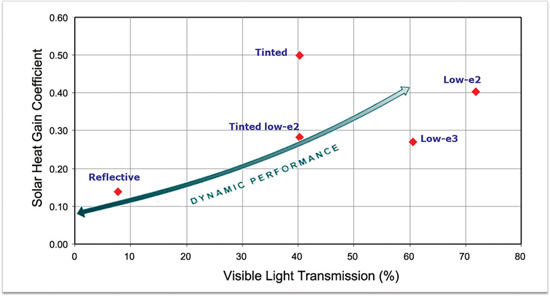
Image courtesy of SageGlass
Figure 1: EC glass performance compared to static glass products.
Balancing Act: Daylight Control and Quality Daylight Admission
As previously mentioned, the physiological and psychological benefits of daylight exposure are directly linked to a person experiencing the time-appropriate increases and decreases in levels of daylight and the natural shift in the color of daylight that occurs throughout the day.
When EC glass is fully clear, it does not impart a significant color shift to the daylight transmitted through it. However, when the EC glass tints to manage glare and solar heat gain, the tint is a blue-gray, which imparts a color shift in the daylight passed into the interior and significantly changes the color rendering in the space.
However, effective control of EC panes on a facade can provide a daylit space in which the color of the light is not significantly changed from that of the incident daylight and has good color rendering. Recent studies of EC glass, conducted by Professor John Mardaljevic et al., and summarized in the whitepaper How to Maintain Neutral Daylight Illumination with Electrochromic Glazing, have proven that the quality of daylight transmitted through EC glass remains essentially neutral as long as 10 to 15 percent of the EC glass pane remains in its highest transmittance state. This is because the majority of light reaching the interior has been transmitted through the panes at 60 percent VT. The rest of the glass area only lets one percent of the light through and thus, even though it is blue, the light transmitted through these sections of the facade only makes up a small portion of the daylight transmitted and is not enough to change the overall light color significantly. Mardaljevic’s findings indicate that a neutral and honest rendering of the color of daylight can be achieved even if the majority of the EC glass on a facade is fully tinted.
This blend of tinted and highly transmitting glass on a facade can be achieved in two ways. Whole panes can be grouped and controlled separately in zones, or segments within a single pane can be independently controlled, a functionality referred to as in-pane zoning.
In-Pane Zoning
In-pane zoning refers to the ability to apply different degrees of tint to defined areas within a single pane of glass. Essentially, the single pane can be divided into up to three uniquely controllable segments where the level of tint for each segment can be independently controlled. This is an essential feature in floor-to-ceiling glass panes, as it improves the flexibility of the glare and heat gain control that the glass is able to provide, while permitting ambient daylight into the space and maintaining the integrity of the light’s color quality.

Photo courtesy of SageGlass
Example of in-pane zoning of EC glass, which is necessary to appropriately balance the competing needs of glare control, daylight admission, energy performance, and light color quality.
Here is a practical example of how in-pane zoning works in a floor-to-ceiling window and the benefit it provides. During the day, when a window receives an intense, direct beam of sunlight, the specific area receiving the exposure tints to the lowest VT of one percent, managing glare. The remaining portions of the glass pane remain at higher transmissions, allowing the available diffuse daylight into the space and achieving the necessary ratio to maintain a neutral color quality on the interior. By contrast, blinds and shades deploy from the top, blocking all of the daylight at the pane, even if the direct beam is only incident upon the view portion of the glass.
Differentiating degrees of control within a pane of glass offers designers a better solution to promote daylight penetration, while preventing glare, than conventional blinds and shades.
Freedom to Design with Glass
EC glass enables designers to use more glass in their designs without the comfort or energy penalty so commonly associated with increasing the amount of glazing on a building envelope. This solution enables designers to think of glass in a new light. It is now a self-contained, above-code source of daylight and daylight control.
In terms of practicality, EC glass doesn’t require any additional interior shades or exterior shading devices. It can be installed on difficult-to-shade complex sloped facades (as seen in description of the Butler County Health Care facility on page 2), in non-rectangular shapes (as demonstrated on the Frost School of Music), in structural glazing applications, or in a never-before-seen architectural inspiration. EC glass enables designers to go wild with glass, without worrying about heat gain or glare showing up. It is not invited.
In addition, expanded aesthetic offerings provides designers with more options to find the perfect color to complement any design. EC glass on standard clear glass substrates is now available with an improved exterior reflected color aesthetic. The slightly reflective blue-green reflected color complements a number of static solar control glass products, such as double silver and triple silver low-e coatings on clear glass, adding an aesthetic depth and curb appeal to the building facade that was not previously possible with the first generation of EC products.

Photos courtesy of Moris Moreno
The Frost School of Music in Miami featuring 5-by-10 foot triangular-shaped EC glass with an architecturally favored exterior blue-green color aesthetic.
An EC coating can now also be applied to a range of tinted glass substrates, which can provide a variety of colors to complement the unique aesthetic of a project. Blues, greens, grays as well as the standard improved clear options are available.
The Payback of EC Glass
Building owners will always ask about the payback for investing in an EC glass system because they think the cost will be higher than the conventional solution. In order to answer that question, we first have to understand what solution would have been used to meet the sun management needs (the base case). That allows us to do an upfront capital cost comparison (shown in Figure 2). For that, we have to consider all aspects of the base case—the glass, the exterior shading, interior blinds and the cost of the HVAC system capacity. These costs are not always accounted for in the same budget areas. For example, blinds may be in the interiors budget, not in the core and shell budget. Reductions in HVAC capacity when using EC glass can amount to significant savings as well.

Image courtesy of SageGlass
Figure 2: In order to determine the payback on investing in an EC solution, the total cost of the originally considered conventional sun management solution must be determined.
When comparing an EC glass solution to a conventional solution base case containing high-performance static glass, exterior sunshades, and automated shades, the upfront installed cost of an electrochromic solution is about the same. In this case, there is little or no payback question to answer since the investment cost is the same as the base case and the owner continues to accrue all the benefits of improved occupant comfort and energy performance during the life of the building.
If the original design was only destined to feature regular static solar control glass and a manually controlled blind, a rather low-performing system, there will be an up-front cost differential. In this case, a discussion on payback is needed. When looking at the costs of running a building, consider that the energy costs are about one percent of the total, and the cost of people amounts to 90 percent. So when looking at payback, small increases in occupant productivity, attendance, attraction, and retention that providing a well day-lit, comfortable environment can certainly achieve, will quickly dwarf any financial benefits from energy savings. Increasing productive time by only two percent, which amounts to only 10 minutes more each day focused on the primary task, could save hundreds of thousands of dollars annually on human resource costs. This can make for a rapid payback on the initial investment. One could also ask the question another way: What is the cost of not investing in a dynamic solution and causing occupants to be uncomfortable and unproductive in the space?
EC glass can produce significantly higher paybacks with even small changes in productivity and absenteeism. EC glass can also generate significant energy savings through effectively managing solar heat gain and reducing the load on the HVAC system throughout the year.
Today, it is more evident than ever before that incorporating controlled daylight and views in an interior generates significant benefit to the health, well-being, and productivity of people in the space. Now, with EC glass, designers can think of glass as a self-contained manager of that valuable daylight exposure and view, enabling highly glazed spaces to be created without compromising occupant comfort or energy performance. Designing spaces to be healthy, productive, and energy efficient has never been easier.
 |
SageGlass®, a product of Saint-Gobain, is advanced dynamic glass that can be electronically tinted or cleared to optimize daylight and improve the human experience in buildings. With SageGlass you can control sunlight and glare without shades or blinds while maintaining the view and connection to the outdoors. SageGlass is manufactured in Faribault, MN, in the heart of the “Silicon Valley of the window industry,” and is a wholly owned subsidiary of Saint-Gobain of Paris, the world's largest building materials company. www.sageglass.com |