This CE Center article is no longer eligible for receiving credits.
Composite Panels Help Save a Piece of
History
The Cathedral Sainte-Cecile, originally
built in 1935 in Salaberry-de-Valleyfield, Quebec, survived
a serious fire three years ago. The ornate ceiling was made
from colorful hand-painted details cut from pressed wood fiber
panels and nailed to larger sheets that spanned the arches.
Baupré & Michaud Architects, specialists in historic
and religious buildings throughout eastern Canada, wanted
to recreate the ceiling as faithfully as possible. However,
the original material literally burned like paper in the fire,
preventing them from using most of it. They also wanted to
improve the acoustical properties of the space, and chose
a composite wood panel, medium-density fiberboard (MDF), that
met flame-spread requirements without special treatment.
First, they replaced the wooden ribs between the concrete
arches, and then installed 5/8-inch-thick MDF panels to span
the ribs. A second layer of MDF was machined into detailed
parts, hand-painted and glued to the panels to recreate the
original ornate design. Wood furring strips used between the
ribs and the panels varied the offset of the panels from nine
to 12 inches to further control reverberation.
An experienced high-end architectural millwork firm sized
and machined the MDF panels based on designs recreated by
the architect and draftsmen in the shop. They used the original
1934 shop drawings and the parts of the original pieces recovered
from the fire. Precise drawings of the structure allowed CNC
equipment to cut parts that fit perfectly when installed.
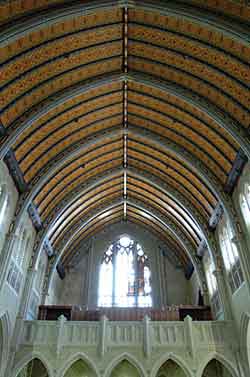
Cathedral Sainte-Cecile,
Salaberry-de-Valleyfield, Quebec, reconstruction
by Baupré & Michaud Architects.
Source: Second Wave, Composite Panel Association |
|
|
Found in myriad projects from the cathedral ceiling in Quebec
to renovated rowhouses in Philadelphia, composite wood panel
products are an essential building material. One of the great
advantages to building and fabricating with composite panels
is the materials' ability to be custom engineered for
a great range of furniture, architectural, and construction
applications.
The most commonly used composite wood panels for interior
applications are Particleboard and Medium-Density Fiberboard
(MDF). Although raw composite panels are rarely seen anywhere
on a project, they're a critical component of most interior
architecture. (Hardboard composite panels, which are manufactured
differently from particleboard and MDF, are used for exterior
siding, interior wall paneling, household and commercial furniture,
and industrial and commercial products.)
Europe and the U.S. started producing particleboard commercially
during the 1940s, when there was an insufficient supply of
wood panels available due to World War II. Today, the North
American market's annual production capacity is 7.645
billion square feet (3/4 inch basis).
MDF was developed to help fill the growing need for an economical
panel that could easily perform in the same areas as particleboard.
The first plant was built in Deposit, NY in 1965. By 1970,
production had grown to 215 million square feet (3/4 inch
basis). Today, with a U.S. annual capacity of 2.208 billion
square feet (3/4 inch basis), it is one of the most rapidly
growing composite board products to enter the world market
in recent years.
What is Particleboard?
Particleboard consists primarily of cellulosic particles
(usually wood) of various sizes that are bonded together with
a synthetic resin or binder under heat and pressure. It is
used as a substrate for many applications and is available
in many different thicknesses and panel sizes. It is also
used for case goods, store fixtures, cabinet doors, drawer
fronts, wall panels, countertop core, miter folding, ready-to-assemble
furniture, shelving, door-core, agricultural box ends, and
mobile home decking.
|
Uses for Particleboard
|
|

- Casework
- Store fixtures
- Cabinet doors
- Drawer fronts
- Wall panels
- Countertop core
- Stair treads
- Office furniture
- Upholstered furniture
- Miter-folding
- Ready-to-assemble furniture
- Shelving
- Door-core
- Agricultural box ends
- Underlayment
- Mobile home decking
- Passenger Bridge wall systems
|
|
Most particleboard manufacturers have created niches in the
market that fit their particular abilities. Using different
species of raw material and press sizes, some specialize in
thin 1/4-inch panels for drawer bottoms and cabinet backs,
while others produce 11/16-inch panels for the hardwood plywood
industry, 11/8-inch stock for office furniture or 1 1/2-inch
panels for door core, or even low-density panels (density
is measured in lbs. per cu. ft.).
Typically, particleboard has several layers of different
materials-a core and two outside layers, or faces. Face
material is fine and uniform-characteristics that lend
themselves to laminating and cutting with minimum chip-out.
The core is made from coarser and larger particles to reduce
the overall density and maintain desired physical and mechanical
properties.
A non-structural product, particleboard is generally made
from recovered and recycled wood waste. Sources range from
post-industrial waste from saw mills, planer mills, plywood
plants and so forth, to waste from pallets, construction and
demolition sites. Raw materials vary depending upon what is
available in the region-Douglas fir and Western Pine
in the west, Southern Pine in the south and southeast, and
hardwoods in the east and northeast.
Variations in the manufacturing process, such as modifying
particle geometry, resin levels, and board density, allow
production of panels suitable for a wide range of specific
end uses. Incorporating additives during manufacturing provides
greater dimensional stability, better fire retardancy, and
moisture resistance, as well as additional characteristics.
Particleboard also accepts a variety of overlays, including
high-pressure laminate, low-pressure laminate, low basis-weight
paper, veneer, vinyl, coatings and decorative metals, making
it an even more versatile product.
Because of freight costs, shipping particleboard across the
country is generally not desirable, although there are exceptions
when certain specifications are not available regionally.
Each species has different properties and requires slightly
different processing.
Benefits of Particleboard
Particleboard offers many benefits:
- Has a smooth surface
- Is available in a wide variety of panel sizes and thicknesses
- Accepts many types of laminates, veneers, and coatings
- Thin laminate can be applied without telegraphing (evidence
of bumps or color from the substrate transferred through
the laminate)
- Readily accepts most edge treatments
- Has no surface patches or core voids
- Cuts cleanly without splintering
- Specialized particleboard is available for specific applications.
- Can have resins or chemicals added to enhance fire retardancy
or moisture resistance
Manufacturing Particleboard
To achieve the desired particle geometry, raw material must
first be cleaned and sized, then mechanically resized by means
of a refiner and a series of screens. Once sized, the material
passes through a dryer and then to a storage silo. Urea formaldehyde
(UF) resin is applied prior to forming the mat. (Additives
to enhance characteristics like fire retardancy or moisture
resistance can be applied at this stage.)

Source: Weyerhaeuser
Company |
|
|
Mats are then formed on a caul plate or belt, loaded into
the press and subjected to heat, pressure and time until the
resin has cured. After the press cycle is complete, the panel
is removed from the press, transported through a board cooler,
and then hot-stacked to await sawing into finished panel sizes
and sanding. Alternatively, the master panels may be sanded
before being cut into finished sizes.
What is MDF?
Like particleboard, MDF is a composite panel product that
typically consists of cellulose fibers (usually wood) combined
with a synthetic resin or other suitable bonding system and
joined together under heat and pressure. Additives may be
introduced during manufacturing to impart additional characteristics.
Used in the manufacture of furniture, cabinets, door parts,
moulding, millwork, and laminate flooring, MDF panels are
manufactured in a variety of dimensions and densities. Like
particleboard producers, MDF manufacturers create niches for
themselves with products such as 3mm panels for the door skin
industry, 11/16-inch panels for the hardwood plywood industry,
1-1/4-inch stock for crown moulding, or 2-1/2-inch thick material
for the furniture industry.
|
Uses for MDF
|
|

- Casework
- Store fixtures
- Slot wall
- Cabinet doors
- Drawer fronts
- Wall panels
- Countertop core
- Office furniture
- Upholstered furniture
- Stiles and rails
- Miter-folding
- Ready-to-assemble furniture
- Shelving
- Picture frames
- Molding & trim
- Pianos and instruments
- Engineered Floors
- Toys
- Speaker components
|
|
Benefits of MDF:
MDF is a higher-end, non-structural interior product compared
to particleboard. It is used in the most detailed of applications
because it offers more design flexibility than particleboard.
- Its surface is flat, smooth, uniform, dense, and free
of knots and grain patterns.
- The surface features make finishing operations easier
and more consistent, especially for demanding uses such
as direct printing and thin laminates.
- MDF can be overlayed with items that include veneer, high-
or low-pressure laminate, low basis weight papers, vinyl
and hot stamp foils or treated with a powder coating. Some
MDF can be embossed.
- It can be easily routed and drilled. The homogeneous density
profile of MDF allows intricate and precise machining and
finishing techniques for finished products.
- MDF holds precise tolerances in accurately cut parts.
- It has acoustical dampening properties.
- There are specialized MDF panels for specific applications.
- MDF has the ability to take dyes and pigments, producing
colored panels.
Manufacturing MDF
MDF is made from much of the same types of recovered and
recycled wood waste as particleboard, but is "cooked"
using a different manufacturing process.
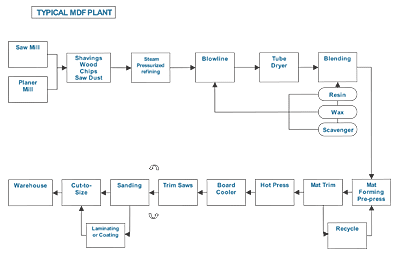
Source: Weyerhaeuser
Company |
|
|
Introduced into the high-energy refining system, the recycled
waste is literally cooked in a steam pressurized "digester."
This allows the raw material to become softened and to actually
change physically and chemically so that the fibrous material
becomes less susceptible to the influences of moisture and
less brittle as the lignin (the substance that, with the cellulose,
forms the chief part of the woody tissue) softens.
The material remains under pressure as it is processed through
rotating refiner plates, getting rubbed apart into uniform
fiber size. Resin is usually applied in the "blow line"
as the fiber exits the refiner, i.e., before drying, but it
is sometimes applied after drying (see Figure 3). The most
common binder for MDF is UF.
Other types of resins and additives can be used to provide
special properties such as moisture resistance or fire retardancy.
The wood-fiber-resin combination is dried to a uniform moisture
content, formed into a homogeneous mat or in separate face
and core layers of random fiber orientation and hot pressed
to complete the rough manufacture.
Standards, Certifications, and Codes
The American National Standard for Particleboard, ANSI A208.1
(see table 3 online), classifies particleboard by density
and class and is the voluntary particleboard standard for
the North American industry. The standard, which covers physical
and mechanical properties and dimensional tolerances as well
as formaldehyde emission limits, was developed through the
efforts of the Composite Panel Association (CPA, see sidebar),
producers, users, and general interest groups.
|
Technical Resources
|
|
The Composite Panel Association (CPA) is the
North American trade association for producers
of particleboard, medium density fiberboard (MDF),
hardboard and other compatible products. Current
membership collectively represents over 95 percent
of total North American manufacturing capacity.
As an accredited standards developer for the American
National Standards Institute (ANSI), CPA sponsors
and publishes industry product standards and participates
in the standards development work of the American
Society for Testing and Materials (ASTM) and others.
CPA collects, analyzes, and reports industry statistics
on a monthly and annual basis for such areas as
shipments, plant capacity, safety performance,
end-uses and international trade. The association
also offers extensive laboratory testing services
for both members and non-members, and coordinates
third-party certification programs through its
internationally recognized Grademark Certification
Program.
In 2003, the CPA launched the association's
Environmentally Preferable Product (EPP) Certification
Program for composite panels. All EPP-certified
products must contain 100 percent recycled or
recovered fiber content. Further, these products
must meet industry emission standards. Products
meeting the criteria are labeled with the program's
EPP certification logo.
The CPA (www.pbmdf.com)
publishes several technical bulletins. Published
semi-annually, Second Wave is the association's
magazine geared towards architects, designers,
builders and specifiers.
|
|
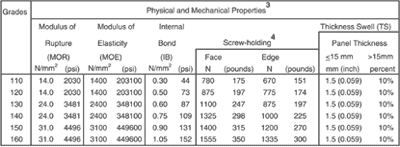
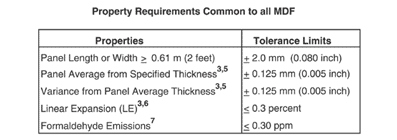
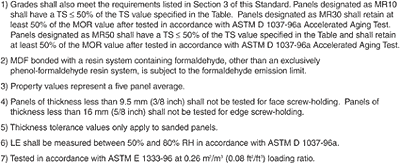
The ANSI standard for Medium Density Fiberboard, ANSI A208.2
(see Table 4 online), is the North American industry voluntary
standard for MDF and classifies MDF by physical and mechanical
properties and identifies product grades. Specifications identified
in the standard include physical and mechanical properties,
dimensional tolerances, and formaldehyde emission limits.
A summary of the ANSI Property Requirements are included
in CPA's Buyer's and Specifiers Guide to North American
Particleboard, Medium Density Fiberboard, and Hardboard Products
and Manufacturers, 2005, which is available online (www.pbmdf.com).
Copies of the complete ANSI Standards for Particleboard and
MDF are also available from CPA.
Third-party certification to ANSI Standards is required for
many applications of composite panels. For example, the U.S.
Department of Housing and Urban Development (HUD) requires
the physical and mechanical properties of manufactured home
decking to be third-party certified. Many building code jurisdictions
require the physical and mechanical properties of particleboard
underlayment and stair tread to be third-party certified.
HUD requires third-party certification of formaldehyde emissions
for particleboard used in mobile homes. The state of Minnesota
requires MDF used as a "building material" to comply
with HUD formaldehyde emissions for particleboard.
Formaldehyde in Particleboard and MDF
Approximately 80-85 percent of the typical composite panel
is wood. The rest consists of resin binders, additives, and
water. The adhesive (resin) most often used by the North American
composite panel industry is UF. This resin is strong, colorless,
economical, and provides performance criteria specified for
most interior uses. The "formaldehyde" used in UF
resins is a colorless chemical that is part of a large family
of "volatile organic compounds" (VOCs)-those
that become a gas at normal room temperature.
Over the past 15 years, technology has significantly reduced
the free formaldehyde, which contributed to emissions. Panels
produced today, on average, emit only about one-sixth as much
formaldehyde as those produced in the early 1980s.
ANSI A208.1-1999 established voluntary formaldehyde emission
limits for particleboard. These include emission limits of
0.30 parts per million (ppm) for standard industrial grades
and 0.20 ppm for flooring grades. Emission limits are based
on values determined under specified conditions in a standard
large chamber with product loading ratios of 0.425 square
meter/cubic meter (0.13 square feet/cubic feet). ANSI A208.2-2002
sets the voluntary formaldehyde emission limit for MDF at
0.30 ppm at a loading ratio of 0.26m 2/m3 (0.08 ft2/ft3).
Formaldehyde emission limits established by the U.S. composites
industry have played a major role in bringing emission levels
down. In fact, the industry average is well below the voluntary
ANSI standards for both particleboard and MDF. Some U.S. particleboard
and MDF producers are also certified by third parties as meeting
quality and environmental standards such as the International
Organization for Standardization (ISO) 9000, ISO 14000, Scientific
Certification Services (SCS), or the CPA's Environmentally
Preferable Product (EPP) Certification Program.
Various overlays and surface treatments are also known to
significantly reduce product emissions even further. Effective
barriers can reduce emission levels by 95 percent or more.
These barriers are most effective when all surfaces are treated,
i.e., for maximum emission reduction, edges, notches, and
holes also need to be edge banded, laminated, finished or
covered with hardware. For additional information about emissions,
see the CPA Technical Bulletin VOC Emission Barrier Effects.
U.S. and Canadian composite producers who are members of
the CPA voluntarily meet the EPA and ANSI standards for formaldehyde
emissions. They also use significant amounts (up to 100 percent)
of recycled and/or recovered fiber as their raw material.
Be aware, however, that safety and production standards vary
from country to country, as do raw materials sourcing practices
and requirements.
Oriented strandboard (OSB), plywood, and some specialty MDF
products use phenol-formaldehyde. However, phenol-formaldehyde
requires a different manufacturing process involving higher
employee safety and manufacturing costs. Agri-board uses a
third type of adhesive known as methyl diisocyanate adhesive,
which also involves extremely complex and expensive employee
safety precautions.
LEED Certification
As more owners become "green conscious" and seek
certification from the U.S. Green Building Council's
Leadership in Energy and Environment (LEEDâ„¢), there is
a growing interest on the part of architects to seek out products
with lower VOC emissions. Some manufacturers are offering
composite panels with no added urea formaldehyde in order
to reduce formaldehyde emissions.
At present, the majority of potential points available from
Particleboard and MDF products are in the category of materials
and resources (see Table 5 online). For example, the use of
typical Particleboard and MDF could help reach the goal of
specifying 5 percent or 10 percent recycled content for the
whole project (worth one point each). For a building in San
Francisco, specifying composite panels manufactured locally
(within 500 miles) in California or Oregon could help achieve
the project's goal of using 20 percent locally manufactured
materials (worth one point).
Specifying composite panels manufactured locally from raw
materials harvested locally could potentially help earn another
point. Other potential LEED points could be gained by specifying
certain specialty composite panels, such as agri-board or
formaldehyde-free MDF. However, designers need to be aware
there may be difficulty sourcing these specialty products
or meeting other specifications of the project.
Green Globes Rating
Green Globesâ„¢ is another "green" rating for
commercial buildings, adopted in the U.S. in 2004 from a Canadian
protocol of the same name. It is one of only two green building
rating systems recommended by the Canadian government.
|
|
| Weyerhaeuser Company (NYSE: WY), one
of the world's largest integrated forest products
companies, was incorporated in 1900. In 2004, sales
were $22.7 billion. It has offices or operations
in 19 countries, with customers worldwide. Weyerhaeuser
is principally engaged in the growing and harvesting
of timber; the manufacture, distribution, and sale
of forest products; and real estate construction,
development and related activities.
Weyerhaeuser Composite Panels, a business unit
within Weyerhaeuser Company, manufactures Duraflake®
and Ultrapine® particleboard and Premier®
and Colorburstâ„¢ medium density fiberboard
in the United States. Additional information about
Weyerhaeuser's businesses, products and practices
is available athttp://www.weyerhaeuser.com
|
|
Green Globes uses performance benchmark criteria, just as
LEED does. However, one major benefit of Green Globes is that
it compares building designs to data that reflects real building
performance vs. the performance of hypothetical structures.
It also encourages builders and designers to consider sustainability
and green elements early in the project rather than adding
expensive technologies later in the design.
Green Globes awards points for acoustical comfort, use of
an integrated design process, emissions and effluents reductions
and "minimal consumption of resources (reused, recycled,
local, low-maintenance materials, certified wood) as well
as reduction, reuse, and recycling of demolition waste."
Using composite panels contributes to potential Green Globes
points. For more information on the Green Globes rating system,
visithttp://www.thegbi.com/commercial/greenglobes/index.htm.
Flame Spread Requirements for Composite
Panels
Most code requirements for wood product interior finish materials
are expressed in terms of flame spread index numbers. These
values are determined in the standard U.S. flame spread test,
ASTM E-84, conducted by such organizations as Underwriters'
Laboratory and the Hardwood Plywood and Veneer Association.
Different maximum indices are permitted depending upon building
occupancy, location of the material in the building, and the
presence of sprinklers. The index is calibrated based on a
scale where a noncombustible material is 0 and red oak flooring
is 100. Class I or A designates flame spread range 0-25; Class
II or B, flame spread range 26-75; and Class III or C, flame
spread range 76-200.
Several composite panel manufacturers supply flame spread
ratings for fire retardant products (Class I or A), which
achieve that rating by using special treatments. Most wood
products, however, including particleboard, hardboard, and
MDF, are presumed to have a flame index of less than 200-class
III or C-making them acceptable under current building
codes for a wide range of interior finishes. Depending upon
thickness, particleboard indices range from 145 to 156, and
MDF indices range from 90 to 140. Indices for factory finished
composite panels with vinyl or paper overlaid composite panels
range from 100 to 180.
Some national and local codes require lower flame spread
ratings. To meet those requirements, designers can specify
specialty fire-retardant products from the handful of manufacturers
who offer composite panels with a Class I or A classification.
Moisture Resistance
Because composite panels are mostly organic wood material,
they are affected by the same environmental factors that affect
timber and solid lumber and are therefore susceptible to water
and moisture.
Moisture resistance is achieved through careful engineering
to address two essential properties: resistance to dimensional
change and retention of strength when exposed to water or
elevated humidity. As a general rule, wood shrinks or swells
in proportion to the volume of water lost or gained. When
wood is green, it is saturated with water in both cell cavities
and the cell walls. The water in the cell cavities is called
"free water" and the water in the cell walls is
called "bound water." Normally, free water is removed
completely during the drying process. Some bound water remains
and is in equilibrium with the relative humidity of the air.
As the relative humidity of the air changes, the moisture
content will correspondingly change. It can affect panel gluing,
finishing, and dimensional stability.
All wood species generally follow the moisture content curve
as a function of relative humidity (see chart). Composite
panels follow a somewhat modified curve and will equilibrate
at a lower moisture content for a given relative humidity
(due to additional heat treatments in the processes for these
products). Since they are made from wood fibers or particles
reconstituted in a more random orientation, the dimensional
changes due to moisture or temperature variations are more
uniform across the width and length than for solid wood.

Source: Weyerhaeuser
Company |
|
|
The ANSI MDF Standard defines three levels of moisture resistance.
The first level, designated as MR10, requires a product to
have a thickness swell performance that is equal to or less
than half (50 percent) of the grade's thickness swell
requirement. The second level, MR30, requires testing according
to the six-cycle ASTM D 1037 accelerated aging test. The highest
level, MR50, requires a product conform to the requirements
of both MR10 and MR30.
In addition to these standards, the CPA sponsors an industry-voluntary
specification for intermediate moisture resistance that includes
a test method. The CPA Voluntary Specification For Intermediate
Moisture Resistance, CPA-IMR-VS-01-2004 provides performance
requirements that differentiate standard particleboard and
MDF.
There are many applications for composite panels which may
call for enhanced moisture resistance treatment. These include
cabinetry, moulding, and countertops, especially for kitchens,
bathrooms, and labs, where incidental moisture may occur.
As in the case of reducing VOCs emission levels, the main
technology used to increase a panel's moisture resistance
revolves around the type of adhesive used to bind the wood
particles and fibers together. Melamine-fortified UF resins
and phenol-formaldehyde are frequently used to improve a panel's
moisture resistance, but can increase manufacturing costs.
Phenol-formaldehyde resins, while providing durability to
a panel, may darken its the color. The use of methyl diisocyanate
adhesives in composite panels is limited to particleboard/MDF
specialty products and agri-fiber-based panels. This adhesive
typically provides a strong, moisture-resistant bond.
It should be noted that the addition of a decorative surface
to a composite panel, particularly when the panel is "encapsulated"-covered
completely on both broad surfaces and all edges-further
enhances the moisture resistance properties of the panel.
The typical properties manufacturers improve are thickness
swell, linear expansion, residual internal bond strength and
bending strength. The goal is to provide a substrate whose
behavior in the presence of incidental moisture is known and
acceptable for the intended end use.
Handling and Storage
All types of composite panels will perform better if properly
handled and stored. Since a smooth panel surface is essential
for both particleboard and MDF, units should be protected
against exposure to water and high humidity.
- Always wear proper eye, hearing, and respiratory protection
when fabricating particleboard and MDF.
- Effective storage and handling should begin with a critical
observation of inbound shipments. Photograph any problems
before unloading and contact the panel manufacturer if necessary,
to resolve any issues.
- Unload units under cover where possible. Avoid unloading
during inclement weather. Tight straps, which may indent
the upper corners of a bundle, are an indication of built-up
stresses induced by exposure to high humidity.
- Most panels tend to absorb moisture into their edges more
rapidly than through the panel surfaces. This unequal rate
of moisture absorption can cause unequal stresses to build
in the panels that will be relieved when the panels are
cut. Strips from the outer edges may bend, creating what
is commonly called a "banana" cut. Allowing the
cut part to come to equilibrium will normally straighten
these strips.
- Do not store materials outside or in locations where they
may be exposed to water or high humidity.
- Stack units on a hard, level surface that is clean, dry,
and away from open doorways and running machinery that could
create airborne contaminants.
- Support bolsters that are misaligned, uneven or missing
may cause high bending stresses, which could result in permanent
warping or damage.
- Materials slated for gluing, laminating or other finishing
may need a week or more before coming to temperature and
moisture content equilibrium. Such materials should be "conditioned"
by separating the panels with clean, dry spacer sticks or
by placing panels in a spacing rack to provide good air
circulation across all surfaces. Adequate conditioning time
should be scheduled into the fabrication process, especially
when temperature extremes exist during shipment.
- Temperatures should be kept as close to 70 degrees F (21
degrees C) as possible. Avoid storage in extremely cold
or hot temperatures. Warming panels in winter takes just
as long as cooling them in summer. While the top few panels
may feel comfortable to the touch, the middle ones could
be either too hot or too cold. Cold panel and/or cold ambient
temperatures will slow the cure rate of laminate adhesives.
Minimizing Warp in Laminated Particleboard
and MDF
Warp is defined as the deviation of the geometry of a panel
from an initial state of flatness.
- Always select flat panels for substrates. Consider the
substrate properties, including stiffness, thickness, linear
expansion, and uniformity. These can be evaluated from the
manufacturer's specifications or standards. The greater
the thickness of the material, the better it will resist
moisture-related expansion stresses.
- A cause of warp in laminated panel products is unbalanced
panel construction.
- As different materials are rigidly bonded together, moisture
content changes may occur. In response to the changes in
moisture content, the materials attempt to change dimensions.
When that happens, stresses can accumulate. Warp results
when these stresses become excessive and are no longer balanced
on the two surfaces.
- Selection of laminates and balanced construction go hand-in-hand.
The laminates and/or coatings applied to each face of a
particleboard or MDF substrate should be similar in properties.
Generally, this is best achieved by using the same material
to cover both sides of a substrate.
- Unusually moist or dry conditions should be avoided in
the laminating and storage environments. The moisture content
of wood-based materials and laminates is dependent on the
amount of moisture in the air. When these materials are
moved from one environment to another, the moisture content
changes. Resulting dimensional changes can be substantial.
- It is unlikely that the moisture content of the laminate
and the substrate will be in equilibrium with the laminating
environment when they are delivered to the laminating shop.
Allow sufficient time for the laminate and substrate to
adapt to the laminating environment. It can take two or
more weeks to reach a satisfactory equilibrium. Seasonal
changes and air circulation around the materials will influence
the time it takes.
- Once assembled, differences in the expansion or shrinkage
characteristics of the laminate and substrate can produce
stresses, which cause warped panels.
Ideally, laminates and substrates should be stored and assembled
in conditions similar to the finished product application
environment.
- Laminates at one equilibrium moisture content condition
should not be applied to particleboard/MDF of a different
condition. If they are, as the moisture content equalizes,
the particleboard/MDF substrate may expand or contract while
the laminate seeks the opposite. When bonded with rigid
adhesives, the components cannot move in relation to each
other. This creates stresses at the substrate/laminate interface,
which can result in a warped panel.
- A well-balanced laminated panel can exhibit temporary
warp due to unequal rates of moisture gain or loss by the
face and back laminates. However, as soon as the laminates
equalize, these stresses diminish, and the panel returns
to its flat condition. This ability to equalize and return
to the flat condition at any humidity is an important attribute
of the balanced panel.
Installation
Even with a perfectly balanced panel, installation conditions
can cause moisture unbalance that results in warp. The laminated
panel should not be exposed to extreme variations in humidity
during final installation.
- Changes in humidity at the installation site can result
in stresses that cause warp as the entire panel equalizes
to the new service environment. Panel conditioning prior
to final installation improves product reliability.
- The design of laminated panel applications must also consider
the service environment. Applications that expose one surface
of a panel to a warm humid atmosphere and the other to a
dry atmosphere will result in moisture unbalance that can
cause warp. Long expanses of panels, such as display cases
or walls, may warp if they do not include expansion joints,
reveals or other design considerations allowing for dimensional
changes resulting from seasonal variations in the environment.
Panels that are butted edge-to-edge and rigidly fastened
may buckle (a form of restrained warping) due to expansion
stresses as moisture content increases.

Source: Weyerhaeuser
Company |
|
|
Important Note for Designers:
Depending upon their application, composite board ratings
and compatibilities may change. Manufacturers draw designers'
attention to the following:
- Particleboard and MDF are for nonstructural, interior
use only
- In colored particleboard or MDF, color variation from
one manufacturing run to the next can occur, as well as
from panel to panel.
- Some laminates and coatings applied to fire-rated composite
board may change the flame spread rating.
- Standard available woodworking glues have been successfully
used in lamination. However, some adhesives may have compatibility
problems with the chemical system used in the manufacturing
process. Any adhesive should be tested for compatibility
with the chemical system in the composite product prior
to full- scale gluing. Questions should be directed to the
glue supplier.
- When using composite panels in wall systems, an integral
vapor barrier must be a properly installed part of the wall
in either of the following conditions:
- The wall has an exterior side
- The wall separates spaces conditioned unequally (for
example, between a heated and unheated space)
Table 5
LEEDâ„¢
Potential Points for Particleboard and
MDF
|
|
LEEDâ„¢ Potential Points
available From typical PB and MDF
|
Category
|
Description
|
|
1
|
Materials & Resources
Credit 4.1
|
Recycled
Content, Specify 5% (post consumer + 1/2 post
industrial) |
|
1
|
Materials & Resources
Credit 4.2
|
Recycled
Content, Specify 10% (post consumer + 1/2
post industrial) |
|
1
|
Materials & Resources
Credit 5.1
|
Local/Regional
Materials, 20% manufactured locally (within
500 miles) |
|
1
|
Materials & Resources
Credit 5.2
|
Local/Regional
Materials, 20% in MRc5.1, 50% harvested locally
(within 500 miles) |
| LEEDâ„¢
Potential Points available from Specialty
Composite Panels* |
|
|
|
1
|
Materials & Resources
Credit 6
|
Rapidly
Renewable Material (10 years or less) |
|
1
|
Materials
& Resources
Credit 7
|
Certified
Wood (Forest Stewardship Council) |
|
1
|
Environmental Quality
Credit 4.4
|
Low
Emitting Materials: Composite Wood (no added
urea formaldehyde resins) |
| Source:
Weyerhaeuser Company |
| *May be
difficult to find and/or meet other specifications
of project |
|
|
Table
4

|
|
|
|
|
|
|
|
|
|
|