This CE Center article is no longer eligible for receiving credits.
Rising land costs and pressure for increasing the density of our cities have made it necessary to redevelop existing low-rise urban areas. The result is an increasing popularity of existing building reuse and the increasing number of projects building atop existing buildings. Due to its high strength-to-weight ratio, recyclability, and flexibility, structural steel is particularly suitable for adaptive reuse and facility expansion projects.
“When evaluated for ease of construction, schedule, cost, dimensional impact, and architectural implications, steel framing is often found to be the optimal solution,” says Eli B. Gottlieb, P.E., senior principal at Thornton Tomasetti’s New York office.
Architects have long relied on steel for projects that require design flexibility and longevity. “Steel can be removed, reworked, and reused fairly easily and, in some respects, it is similar to Legos or building blocks that can be deconstructed and rebuilt in a different configuration,” explains Andrea Reynolds, P.E., LEED AP, director of structural engineering at SmithGroupJJR in Detroit.
Considered to be one of the most recyclable materials around, today’s structural steel products are made with between 90 percent and 98 percent of recycled materials, according to the American Iron and Steel Institute (AISI). Fashioned from iron, and described as one of the most abundant materials on earth, steel can be endlessly recycled and reused without compromising the properties of the material. Furthermore, on a per ton basis, the iron and steel industry reduced its carbon emissions by 37 percent, and its energy intensity by 32 percent between 1990 and 2013, states the American Institute of Steel Construction (AISC).
Although the process of producing steel does require energy, its highly recoverable and recyclable nature makes it a very sustainable material, and in many cases—particularly where existing materials are salvaged and/or reused—fares quite well with LEED building credits (see LEED v4 and Structural Steel).
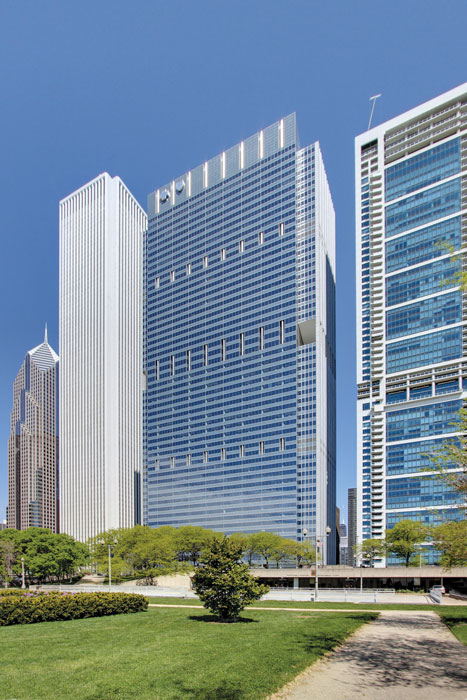
Photo courtesy of MKA
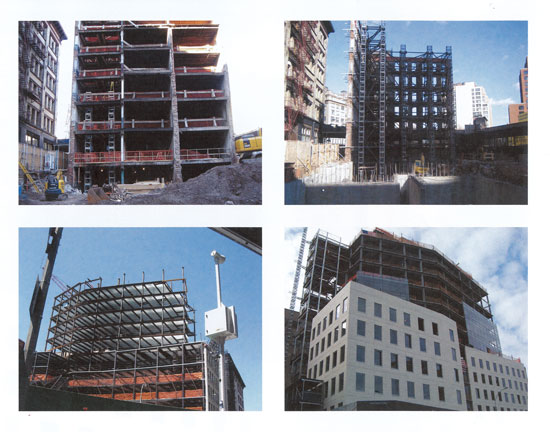
For Chicago’s tallest vertical expansion, adding on a 25-story, 850,000-square-foot addition to the existing 33-story tower at Blue Cross Blue Shield, structural steel leveraged a high strength-to-weight ratio and speed of construction to meet the project’s aggressive construction schedule.
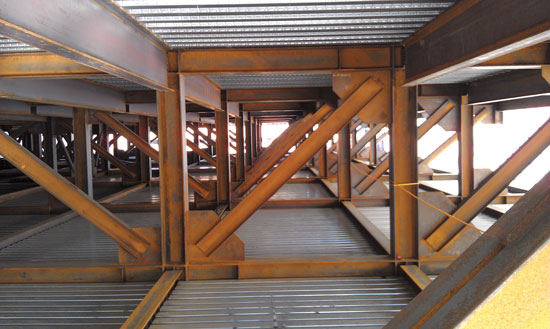
Photo courtesy of MKA
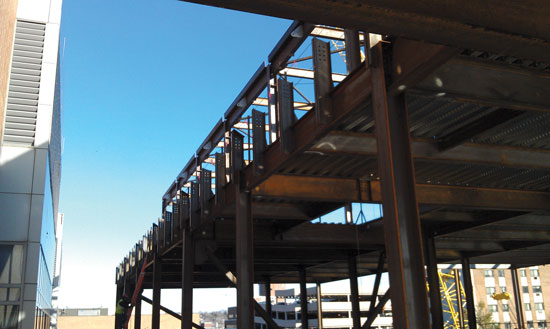
At the State University of New York Institute of Human Performance Upstate Medical University, structural steel was selected for this laboratory expansion project. Pictured above, upper floor and mechanical penthouse levels of the steel frame with horizontal bracing members at the roof and attachments will support a tied-back infill skylight. In the photo to the right, the full-story transfer girders serving as an interstitial-level MEP services distribution zone can be seen.
Comparing Concrete
Consider concrete, for example. In addition to the fact that concrete’s additional weight will increase foundation costs, in many cases this will also require the implementation of piles, caissons, mat-slab, or other deep foundations, which can easily create an unfavorable embodied-energy equation, explains Michael Liu, AIA, principal and vice president of The Architectural Team in Boston.
Or more simply stated, “An average concrete floor weight is 100 psf, as compared to steel, with a lightweight deck of 40 psf,” says Janis B. Vacca, P.E., vice president and principal of The Harman Group in Philadelphia. “That means you can get two floors of steel for every one floor of concrete.”
Another big difference with reinforced concrete, or masonry for that matter, is that it’s usually more difficult to apply it to a dissimilar existing building material, such as structural steel, requiring welding or bolting via studs or dowels to attach and interface the two materials, according to Jimmy Su, P.E., LEED AP, an associate structural engineer for Arup Boston. “There is usually more benefit to simply attaching new steel to existing steel with the same effort, and offering the advantage of smaller sizes for similar strength and more flexibility in connection configurations. In the case of existing wood, it is nearly impossible,” he says.
Raising another point about wood, Su adds that it is generally weaker when force is applied perpendicular to its grain, and this can create complications when one is attempting to reinforce or connect to wood. In addition, connection sizes into wood members can often be quite large because of the area required to disperse the force down to a level that won’t damage the material. The unfortunate upshot is many rows of nails or bolts spread out over a larger area.
Steel-to-steel connections also have very high capacities for relatively small connection areas. For example, bolt holes on the order of a ¾-inch to 1½-inch diameter or single-digit inches of weld, according to Su. In fact, one can derive thousands of pounds of capacity out of bolted or welded connections that take up just a few inches.
In terms of opening up a space, which could involve the removal of a column, adding steel framing to reinforce existing structural framing is considered a fairly straightforward endeavor, void of messy, disruptive construction, adds Reynolds.
Add the efficiencies inherent in prefabrication, and this enables structural steel elements to be installed while portions of an existing building remain occupied.
Yet another advantage is the fact that structural steel framing works well in resisting lateral loads. “The lower weight can keep lateral seismic forces lower, which can minimize or avoid the need to reinforce existing lateral load resisting systems,” says Gottlieb.
Bringing in another point, Reynolds explains that for exterior support facades, steel framing is a great solution, particularly in cases where the exterior walls are being upgraded to include tensioned glazing systems or blast loads. This is because it leverages one of steel’s greatest strengths—the ability to resist tension loads with compact sections.
Specifically regarding adaptive reuse, William D. Bast, P.E., S.E., principal at Thornton Tomasetti’s Chicago office, highlights the following:
The prefabricated nature of steel can be an advantage in avoiding formwork and/or the need to vacate space within the building during construction.
Steel members can be shallower or narrower than corresponding concrete members and therefore provide an advantage in ceiling or headroom program requirements.
Steel can be used for temporary means and methods, such as shoring or bracing, and then become part of the permanent structural system.
Structural steel is easily beneficial in filling-in floor openings due to its lightweight nature and ability to avoid the need for shoring.
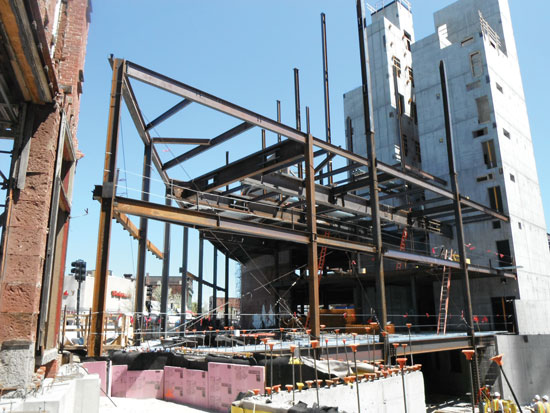
Photo courtesy of Arup
Incorporating Boston’s historic Curtis and Waterman buildings, and uniting their facades with five additional stories of structural steel, Arup worked with Sasaki Associates to design this new 215,000-square-foot headquarters for the Boston Public School system.
Evaluating Conditions and Testing
When embarking upon any type of adaptive structural steel project, the first step is evaluating the existing structural framing. Obtaining the original design drawings is ideal, in addition to procuring any subsequent changes. Reynolds advises then visiting the site to confirm that the existing drawings are consistent with what appears in actuality. Unfortunately, it’s not unusual to discover that existing drawings and documentation either don’t exist or are incomplete.
“Surveying the site, locating framing, taking measurements of the framing, acquiring material samples, and performing testing can all be done to verify the existing framing in place,” she explains. “Generally, steel structures can be easier to verify, assuming the structural framing is accessible. In recent years, the progression of 3-D/digital scanning of spaces is facilitating the process of surveying and measuring existing framing.”
On the other hand, concrete structures can be more difficult to ascertain, unless scanning is utilized to determine the size, spacing, and location of is the reinforcements hidden within concrete framing.
In terms of material testing, these samples are evaluated for performance strength and material compositions in a laboratory. However, it can be tricky to determine where to extract the specimens so as to not compromise the integrity of the existing building.
As such, Su recommends cutting out these redundant segments of materials from safe places such as the ends of beams. “In my experience, I’ve found that structural steel, even from the early 1900s, can be weld-able,” he observes.
“Once the existing framing is known, the real fun can begin—analyzing the strength of the existing framing, determining what the new demand may be on the existing structure or how it needs to be modified to meet the new program, and then determining how to accommodate the project requirements, whether it’s adding new framing, removing existing framing, or reinforcing the existing framing to provide additional strength or stiffness,” relates Reynolds.
For existing projects where space constraints and access might be an issue—for instance, when member sizes are limited to something that can fit within an elevator—steel can be broken into smaller pieces and re-attached during installation.
In terms of evaluating cost and feasibility for adaptive reuse, one of the main cost thresholds is the trigger for lateral upgrades, i.e., modern seismic and wind loads. This evaluation involves the original use versus intended use, the percentage of reinforced structure compared to the whole, and changes in area and weight loads, says Su. Considerable effort goes into gathering information, narrowing down options, and analyzing for levels of force changes in the adapted building.
“For expansion, the capability of the existing structure to be reinforced for both increased lateral and gravity loads is usually the key consideration,” says Su. “Usually, there are limits on how much space can be taken up by reinforcing measures, and the smaller the better.”
Overall, access and accommodating the installation of new framing must also be weighed, and as previously noted, existing documentation is important. If little to no information is available, this requires additional time and money for extensive surveying, testing, and documentation of the existing structure. Ultimately, inadequate information can result in more conservative solutions due to the unknown.
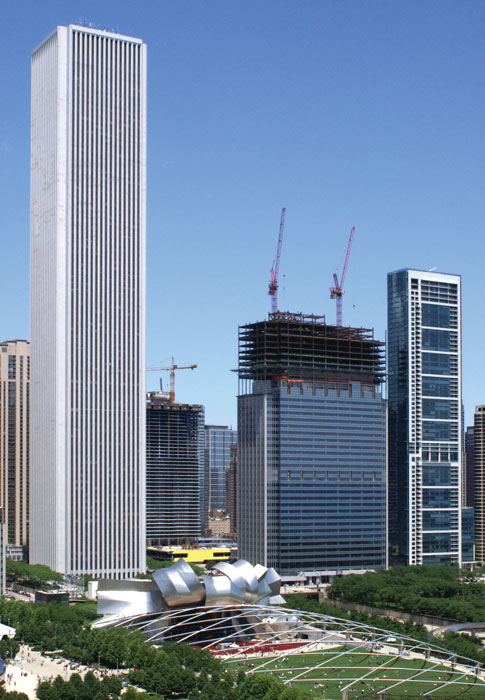
Photo courtesy of MKA
For Blue Cross Blue Shield, MKA’s optimized design of the lateral system, which incorporated a multistory intermediary truss, resulted in a 300-ton, 20 percent reduction.
Structural Expansion in Action
Looking at a number of projects that demonstrate the versatility and flexibility of structural steel, Magnusson Klemencic Associates (MKA) set out to provide the largest area of vertical expansion without over-stressing the existing foundations for Blue Cross Blue Shield in Chicago. To begin, extensive surveying was performed to confirm the tolerances and alignment of the structure. Fortunately, this alignment was such that the vertical expansion could be completed with only modest modifications to the original structure.
“Structural steel was the clear choice, given its strength-to-weight ratio and its speed of construction for the aggressive construction schedule,” relates Dave Eckman, S.E., P.E., AIA, senior principal of MKA. “The first floor of steel floor framing could be erected and decked, without the nuisance of shoring a floor slab over a roof deck that likely could not support the weight of a concrete slab.”
One unique aspect of this project involved the fact that the existing building was a steel-frame structure with two concrete cores that enclosed the vertical transportation. This meant getting workers to the job site, 500 feet above street level, was no small undertaking.
“Typically, a man-hoist is used to get people and light materials to the necessary levels under construction,” explains Eckman, “and that hoist is usually tied off to the structure every few floors to stabilize the hoist. Given that materials were loaded at street level, and the existing building was an occupied and an enclosed structure with 4,400 people working in it every day, penetrating the skin and attaching a hoist to the structure every few floors was not an option.”
Since the existing structure was steel, it was determined that the workers and materials could be lifted in one of the existing building’s service elevators to get close to the existing structure. From that point, a hoist could be built within the 30-story-tall atrium of the existing building. A hoist pit was constructed 30 stories in the air and hung over the atrium.
“The logistics and connections of an active construction hoist could not have been cost effectively achieved without steel, which was brought into the atrium in individual pieces on weekends, lifted up into the atrium, and then constructed hundreds of feet in the air, without any shoring from below the hoist pit framing,” explains Eckman.
The choice of steel leveraged a number of other advantages as well. For example, since the lateral system was comprised of steel-braced frames, as opposed to concrete core walls, the geometry could be organized to optimize efficiency. To achieve this, several bracing configurations were evaluated to determine that a 2-story X-brace would be the most efficient. This approach saved almost 300 tons of steel, compared to other bracing configurations, while still achieving similar strengths and stiffness, according to Eckman. This lightweight lateral system was less expensive than other options and allowed vertical expansion of the building by more floors without over-stressing the existing foundations.
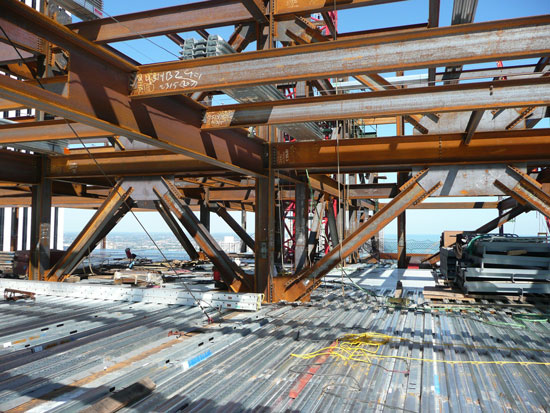
Photo courtesy of MKA
MKA also provided the desired functionality by redesigning the original framing scheme so it accommodated the deck rotation, eliminated hundreds of reinforced beam web penetrations, reduced fabrication time and cost, and cut 0.5 pounds per square foot, resulting in 225 tons off the original design.
The lightweight steel also helped achieve the desired maximum height. In essence, the deep foundations below the two existing concrete cores did not have sufficient capacity to support 25 more floors of a concrete core, but switching materials to a structural steel cross-braced core for the vertical expansion provided sufficient strength and stiffness, without having to add additional burdening weight foundations of concrete core, he explains. If concrete cores had been required, then the vertical expansion would have been several floors shorter, resulting in much less usable space for the owner in this populated urban setting.
For this project, the use of glass also allowed core-to-glass open workspace with relatively short floor-to-floor heights. “The column-free space increased the efficiency of the floor plates, and the open floor plan allowed deeper penetration of natural light into the building. The use of steel also allowed taller ceiling heights, as the MEP systems and structural framing could occupy the same interstitial space, since the steel girders were designed with beam web penetrations to accommodate the mechanical loop as well as other MEP systems,” explains Eckman.
Although not as complex, the project requirement for SmithGroupJJR’s Bowling Green State University called for creating a more lively and engaging common area for students. However, the presence of the load-bearing masonry walls made it difficult to achieve that openness. So, steel was brought in to supplement the masonry walls. With the beams and columns, this allowed for a floor-by-floor installation carefully timed with removing the amount of supplemental, temporary shoring needed.
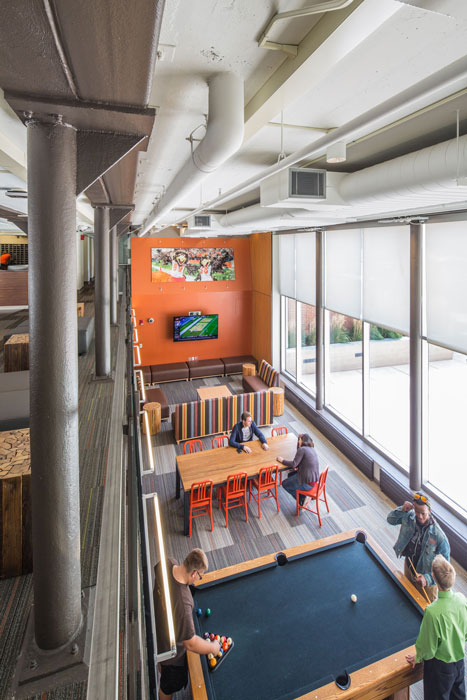
Photo courtesy of SmithGroupJJR/Jason Robinson Photography
For the renovation of McDonald Hall at Bowling Green State University, structural steel was used to support the existing building where interior masonry-bearing walls and a partial floor area were demolished to create a lively and open interior space. Steel columns were installed floor-by-floor to ease in phased construction and break the members into more manageable pieces.
To prevent any damage or cracks in the existing structure, the structural framing had to be stiff and strong. Furthermore, Bowling Green wanted to minimize the framing to achieve an open environment. Steel made that possible.
Historic Restoration
When it comes to historic restoration projects, structural steel can greatly benefit these unique and challenging endeavors.
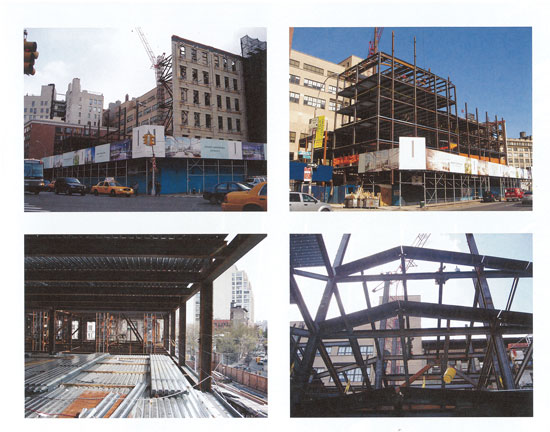
Case in point, thanks to a lightweight steel frame, nine floors were added to the existing eight stories of a 1920s steel and masonry warehouse in Manhattan’s Hudson Street without having to reinforce the building foundations. By opening the column grid to as much as 40 feet, as compared to the existing 13-foot-by-26-foot grid, using W36 rolled steel transfer girders the new layout could be conducive to a modern office, while the lower floors maintained a historic loft feel.
“The modern building has been upgraded to meet modern wind and seismic loads by the addition of a new braced steel core around the central elevators and stairs,” relates Gottlieb, who headed up the project for Thornton Tomasetti. “The steel bracing allowed the framing to offset at different floors to address entrances and layout changes required in the building while fitting the core with the existing floor plates. Four columns were inserted into existing masonry flues so as to be invisible within the floor plates while providing support for the new braced frames.”
For another historic reuse project on the Lower East side, Thornton Tomasetti brought in a new floor and roof to a group of five historic brick and timber buildings. The additional stories, “needed to be completed while the ground floor was being occupied,” explains Gottlieb. “A system of lightweight steel columns and girders was added on the existing masonry-bearing walls while the floors were constructed of 8-inch hollow core planks spanning each of three 25-foot spans for the 100-foot length of the building. This kept the weight low while maximizing ceiling heights on the new floor.”
The second phase was the removal and replacement of the ground and second floors with noncombustible floors, the removal of all of the bearing walls, and the installation of the new wind and seismic resisting system. This was achieved by installing new steel columns into chases in the existing bearing walls and then selectively removing the walls and flooring, followed by installing new steel-framed floors with concrete slabs on metal deck.
“The use of steel framing allowed for the very sequenced installation of member transfer of loads from the existing load-bearing members to the new columns and framing while keeping the upper floors fully occupied,” sums up Gottlieb. “This ability to prefabricate and install the framing sequentially was key to making the project possible. This would not have been possible without the use of steel framing.”
For another historic structural steel project, The Architectural Team refurbished a Boston Bay masonry building from the 1900s. As was typical of many early steel buildings of this era, its columns were vertical box trusses made of channels and plates bolted together with first-generation rolled C channels bolted back to back.
This horizontal expansion with structural steel provided the solution to resolve the lateral force deficiency of the existing structure. In this case, the new steel addition was designed entirely with moment connections of sufficient capacity to not only address the lateral stability of the addition, but also for the original building.
Dealing with a more complex undertaking, the Architectural Team had its hands full with the 1923 historic Boston Police Headquarters involving an additional three stories to its existing seven levels.

Photo courtesy of The Architectural Team
Adding three new stories to the former seven-story historic Boston Police Headquarters, structural steel was a great choice for The Architectural Team, leveraging speed of erection and dealing with an acute lack of lay-down space.
“While the original construction drawings suggested a concrete strength capacity of 3,500 psi at the columns, Swiss Hammer testing suggested compressive strengths as low as 1,800 psi,” explains Liu. “To make matters worse, the designers discovered that a 3-inch topping slab had been poured over the existing floors, presumably to correct and level poor structural concrete work, adding additional weight to the already overloaded columns. Finally, the original concrete bell caisson foundations were under-designed.”
Given the inadequacy of the existing structure and foundations, concrete was not an option. Rather, structural steel was the logical solution for both of the additional floors, as well as the horizontal addition. Steel also offered the advantage of speed in erection, and its use simplified a critical component of the construction schedule, which involved an acute lack of laydown space in this zero lot line urban project where street closures had to be kept to a minimum.
Yet another Architectural Team Boston North End project, this one at historic waterfront warehouse structure, involved the removal of two floors and the addition of three new floors with structural steel. “The implementation of new structural steel permitted the designers to eliminate alternating rows of columns, doubling the span of the structural bays and, in combination with a dramatically increased ceiling height, create dramatic, open, light-filled interiors in these new upper floors,” reports Liu.
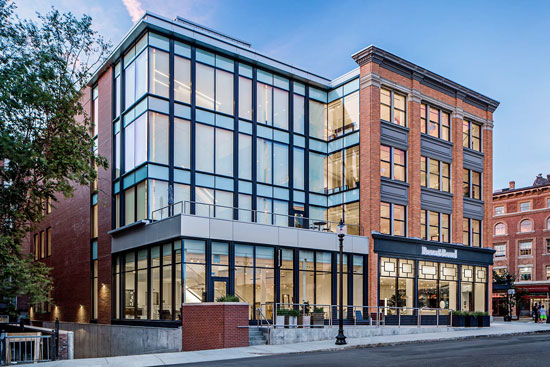
Photo courtesy of The Architectural Team
Horizontally expanding this historic Boston Bay project at 375 Newbury, structural steel enabled The Architectural Team to resolve the lateral force deficiency of the existing structure.
Lateral forces were addressed at lower floors with reinforced shotcrete stiffening of existing exterior walls, while moment connections were used at the new three upper floors to maintain the open spaces free of cross-bracing.
“Like many steel buildings of its era, the archaic steel superstructure of the original 1903 building was fireproofed by encasing the built-plate members in concrete. Selective demolition of the concrete encasement of a representative sampling provided sufficient information to determine performance characteristics for reinforcement, which was accomplished by removal of the existing non-structural concrete jackets and their replacement with formed and reinforced concrete surrounds.”
the Better
For
Moving to the Midwest, SmithGroupJJR’s work on the historic landmark Detroit Athletic Club created a rooftop addition that afforded a great view of downtown Detroit and Comerica Park, home of the Detroit Tigers. Materials were carefully selected to minimize the structural weight and steel was the top choice for the structural skeleton, according to Reynolds—both in weight and the ability to provide a low-profile and somewhat transparent structural system with slender structural members and cantilevered framing to minimize the appearance of the structural columns and maximize views to the exterior.
In addition to a desirable level of transparency, the steel also provided the opportunity for an interesting aesthetic with an overhang created by the cantilevered framing in a very cost-effective manner. Custom, yet simple, detailing was used on exposed ends of the framing. Furthermore, a new entrance vestibule was created at the club’s main entrance, which also accomplished the purpose of an elegant glass element that beautifully complements the historical facade.
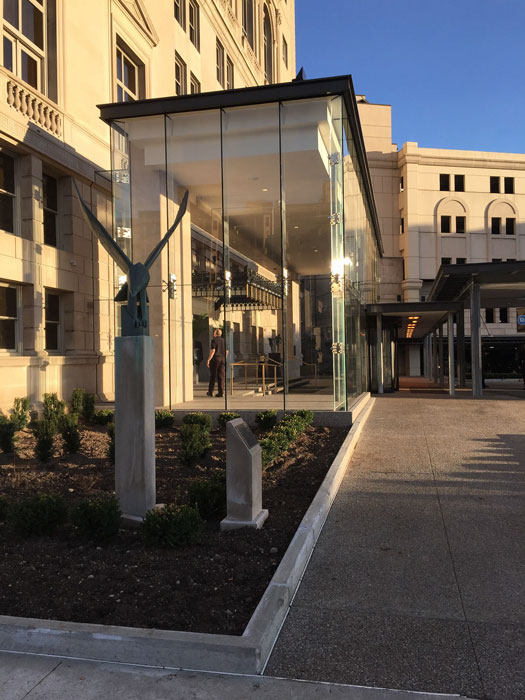
Photo courtesy of SmithGroupJJR
At the 100-year-old Detroit Athletic Club, steel framing creates an elegant and transparent glass entrance vestibule.
Another tricky issue involved new framing that needed to be carefully coordinated to align with the columns below. Furthermore, this column placement was irregular in many cases, plus the sloped nature of the existing roof limited the system’s strength. To address this, the design team devised a unique solution. “A lower level of framing was provided to support the new floor level with short columns that aligned with the existing framing below,” according to Reynolds. “The lower-level framing served as transfer beams to accommodate the placement of columns above that worked with the layout of the interior spaces.”
SmithGroupJJR also had to contend with expanding the elevators to the additional floor, while still continuing operations. “Naturally, the process of demolishing existing roof framing, adding new roof and machine support framing while keeping the elevators accessible was a considerable challenge.”
Once the structure was in place and enclosed, complete renovation of the elevator cabs and machinery replacement could be performed one elevator at a time. Although the existing elevator shaft space was tight, modification of the steel framing was necessary along the way, and in many cases, adequate clearance was difficult. But, the team made it work.
Overall, the analysis and understanding of the existing structure and the structure’s weight was key for this project. “The club was to remain fully functional during construction; reinforcing existing framing and foundations below would have been a deal breaker,” relates Reynolds.
Adventures in Steel
Transforming an old mechanical courtyard into an exciting double-loaded steel-framed gymnasium, John Ciardullo Associates took a historic structure—made primarily from steel over the course of 1885, 1899, and 1921—and changed it into a happening academic complex for secondary students at 26 Broadway in Lower Manhattan.
For this particular project, the team was very pleased with steel’s flexibility, which enabled the center core of the building to create a skylight and a large space for a gym.
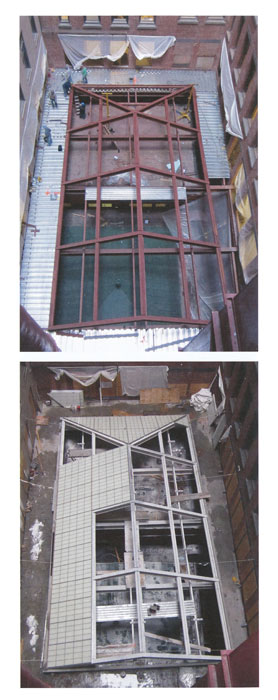
Photo courtesy of John Ciardullo Associates
Structural steel was the material of choice for John Ciardullo Associates’ adaptive use project for Lower Manhattan’s 26 Broadway, where an old mechanical courtyard was transformed into a double-loaded steel-framed gymnasium for a secondary school.
“You can literally put the beams anywhere within the steel structure,” John Ciardullo, RA, NCARB, president, says in a Metals in Construction article (the magazine is published by the Steel Institute of New York).
A concrete construct can be very difficult to analyze structurally because it’s impossible to know exactly what reinforcing steel is in the concrete frame without having to drill into the concrete.
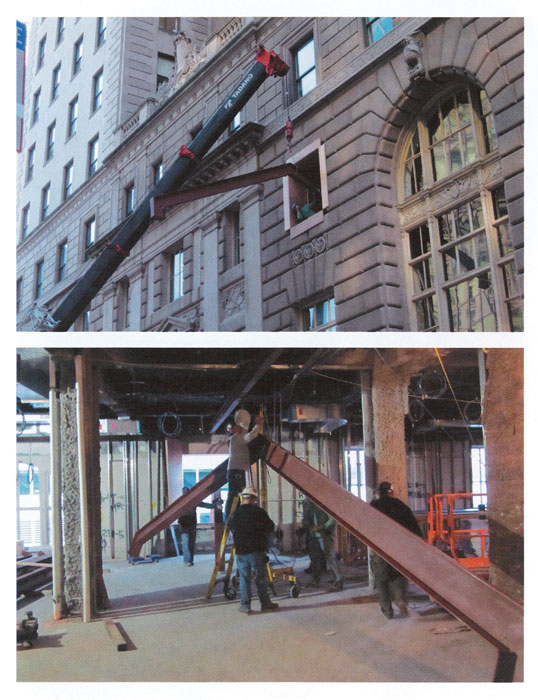
In order to execute this, W18x86 wide-flange beams were brought two stories above street level right into the building’s window openings. Next, the beams were welded at one end of the existing 1921 steel columns while 1-by-1-foot, 10-inch-deep pockets were cut in the 1890s masonry bearing wall resting atop a bearing plate attached, according to Ciardullo. In addition, the roof structure was cross-braced by W12x22 and W14x22 members, which are bolted to the W18s.
The skylight structure itself is created with W14x43 members, set up into five roof sections, which were lifted through the historic building’s windows and into the courtyard.
“The contractor, along with the steel fabricator and erector, came up with the solution of how to bring the steel into the building and put it in place,” says Ciardullo. As each piece was moved into position, the erection crew hung cables from the steel beams above in order not to damage the existing floor below. Whereas a design that utilized heavier material would have been impossible, steel’s light weight avoided the need for the formwork and the wheel mixer required for concrete.
Yet another program requirement was designing a convenience stair in order to connect the school’s four floor levels to limit elevator use.
It was achieved by removing a structural steel column to make room for the opening, something rarely undertaken in concrete construction. The remaining column adjacent to the stair opening was supported laterally by steel beams at each level, so the team had to calculate how many beams could be removed to create the opening.
“I knew the size of the steel column and I had the weight of the steel structure, so we did an analysis to determine the acceptable unsupported height of the column,” he says. “Since I had the size of the columns to calculate the buckling effect and column width by taking out the lateral support at one floor, we were able to then determine that the existing column could take the elimination of the lateral support beam and handle the buckling effect, and the non-lateral support, at each floor.”
Ciardullo also came up with an innovative way to eliminate some bulk from the area where the top of the stair was attached to a lateral steel beam. In most cases, plates are fastened to the top of a wide-flange beam to support the stair risers and treads, but this would have created a very bulky structure. As an alternative, the team cut away the top flange of the lateral beam, welding the top-most stair riser and tread to the beam and thus allowing it to function as the beam’s top chord. The stairs were fabricated in flights from Grade A36 plate and hoisted into the building through a window.
Highlighting another noteworthy Metals in Construction project, TEN Arquitectos tapped into a number of benefits for the Tribeca condo project One York in New York.
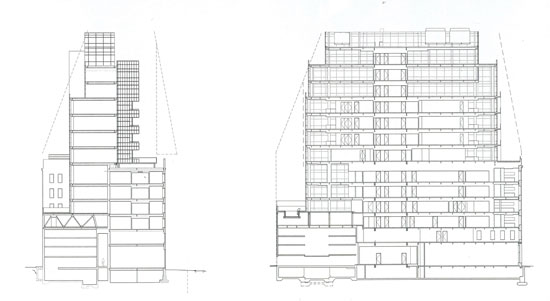
Photo courtesy of TEN Arquitectos
Thanks to its weight, flexibility, speed of erection, ease of reinforcement, and economics, structural steel was selected for New York’s Tribeca condo project, One York, enabling an additional seven new stories worth of high-end amenities and wraparound views, whereas concrete would not have afforded this option.
For starters, weight, flexibility, speed of erection, ease of reinforcement, and economics fared very well for structural steel. Perhaps equally as compelling, steel allowed several choices that a heavier concrete frame could not, including seven new stories’ worth of high-end amenities and wraparound views.
Bringing out an interesting point, DeSimone Consulting Senior Project Engineer Peyrouz Modarres relates that projects such as this, where planning and approvals create a long lead time and fabrication time isn’t as important as rapid construction, there is an opportunity to create a strong case for overcoming what Modarres calls “this false attitude that for residential construction, steel is not suitable.”
For the project, a number of large, relatively light members were used; namely, 12-inch-wide flange beams of ASTM A992 Grade 50, ranging from W12x14 through W12x30, amounting to a total of 876 tons of steel.
In order to contrast the difference between the glass and masonry volumes in the condos, TEN project architect Florian Oberhuber explains that in the apartments, the team wanted the curtain wall to have many horizontals and a wide span between the vertical members and lose the sense of slabs. Since the concrete flooring is a slim, 4¾-inches thick, the curtain wall is connected directly to cantilevered steel plates with welded inserts. Columns were set back from the perimeter about 4 feet along the west wall and 1½ feet along the east, and column sizes include W12x58, W12x72, W12x96, and W12x120, plus W14x257 columns in the elevator core.
Top Notch
As fully vetted in this comprehensive article, the many benefits of structural steel make it a highly attractive material.
“Steel is a highly recoverable and recyclable material,” says Su. “It can either be cut apart and reused with proper refitting or melted down and reshaped in multiple cycles of reuse. Most other nonmetallic building materials do not have this level of flexibility in manner of reuse.”
Together with its high strength-to-weight ratio, fast-tracked construction, flexibility, and the ability be to easily manipulated in the field, it behooves architects and engineers to consider structural steel for their next building project.

|
The Steel Institute of New York
The Steel Institute of New York is a not-for-profit association created to advance the interests of the steel construction industry. The Institute sponsors programs to help architects, engineers, developers, and construction managers in the New York building community develop engineering solutions using structural steel construction.
www.siny.org
|