This CE Center article is no longer eligible for receiving credits.
Benefits of Carpets
Carpet is a foundation for the look and feel of a room. It can provide
a casual simplicity to reinforce a soft, livable ambiance or it can lend vibrancy to a room through strong colors and heavier textures.
One of the easiest methods of personalizing an environment, carpet
also offers a host of health and safety benefits.
Improved Safety. Because it affords more traction, carpet helps
prevent falls. According to the above-mentioned Schapiro study, 77
percent of teachers agree that carpet helps prevent falls and injuries
and makes a classroom safer. Not only do fewer slips and falls occur
with carpeting, but when they do happen the chances of injury are
greatly diminished on a soft floorcovering. Further, carpet provides
a non-glare surface that reduces reflection and eyestrain.
Reduced Noise. With carpet, less acoustic protection is needed on
the ceiling and elsewhere. This provides a better learning atmosphere
with fewer distractions. According to the Technical Committee
on Architectural Acoustics of the Acoustical Society of America,
the speech intelligibility rating is 75 percent or even less in many
classrooms, meaning that those with normal hearing can understand
only 75 percent of the words read from a list. Research shows that
background noise from inside and outside the classroom negatively
affects learning. Excessive noise and reverberation interfere with
speech audibility, leading to diminished understanding, learning
and ability to focus on the lessons at hand.
Flooring is a major component of comprehensive noise
management. Based on a study by the American Society of
Interior Designers, carpet is deemed to be 10 times more efficient
in reducing noise compared to other flooring options. When a
cushioned backing made with polyurethane technology is added,
noise levels can be further reduced.
Increased Comfort. For teachers and other staff, a cushioned
walking and standing surface reduces leg fatigue. Several studies
have investigated the influence of floor surfaces on the body during
long-term standing, and results show that softer floor materials
usually result in less postural discomfort than standing on hard
floor surfaces (Redfern & Cham, 2000). According to Rys and
Konz (1988), heart rate was higher after two hours of standing on
a concrete floor compared to carpet, and perceived comfort was
higher when standing on carpet. Similarly, In 1997, Madeleine et al.
found that after two hours of standing, the comfort level was greater
for a soft surface. Standing on a hard surface increased parameters,
such as shank swelling and muscle fatigue. It also detrimentally
changed subjects' standing posture.
Better Insulation. Carpet is warmer to sit on or work on,
extending the learning areas to space on the floor. Thermal comfort
is improved because carpet retains inside ambient temperatures for
longer periods. Because of its fibrous construction, carpet traps a
layer of air close to the floor. Air is an excellent thermal insulator
and consequently carpet acts to increase the thermal insulation of a
surface. Additionally, a pad beneath carpet can further increase this
thermal insulation effect.
Research conducted at the Georgia Institute of Technology
School of Textile Engineering tested the thermal insulation values
(R-Values) of carpet and cushion and found that the total R-value
was more dependent on the total thickness of the carpet than the
type of fiber content. The research indicated that a carpet system
comprising carpet and pad can increase the R-value of the floor by
2 to 4 points.
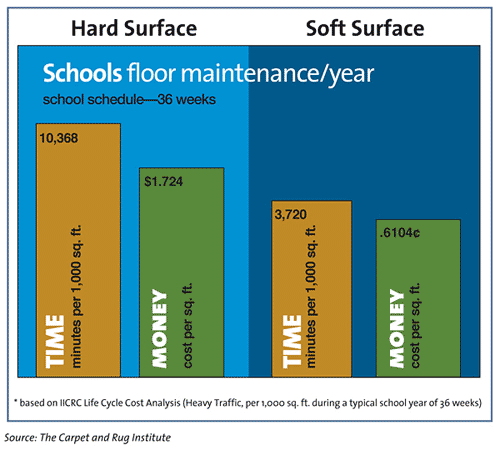
Lower Life-cycle Costs. Carpet that is properly selected,
installed and maintained lasts up to 10 years or longer. When
product, installation and maintenance supplies and labor costs are
considered over a 15- to 20-year period, carpet showed lower life
cycle costs than other flooring options. A 2002 report, "Life-cycle
Cost Analysis for Floor Covering in School Facilities," prepared by
the Institute of Inspection, Cleaning and Restoration Certification
(IICRC), found that carpet could be 65 percent less expensive
to maintain than hard surface flooring. In the study, buying and
installing the hard surface flooring was less expensive than carpet.
But when labor, supplies and equipment costs were calculated over
a 22-year life cycle, carpet proved to be more cost effective. The
life expectancy of the hard surface flooring was 22 years. The cost
of replacing carpet after 11 years was factored into the analysis.
The study also found that hard surface floors require two and onehalf
times more cleaning than carpet and that hard surface cleaning
supplies are about seven times more expensive than supplies for
carpeted floors.
The carpet industry is working to make carpet even longer lasting
in schools by creating more durable fibers and fabrication methods,
improving primary and secondary backings and increasing the
number of different design and performance options. Modular
carpets, the fastest growing segment of the industry, provide the
option of replacing parts of a carpeted surface, instead of the entire
carpet.
Improved Indoor Air Quality. The relationship between
carpet, asthma and allergies has been the subject of numerous
scientific and medical investigations. In a 2008 literature review
for the International E-Journal of Flooring Sciences, Mitchell W.
Sauerhoff, Ph.D., DABT, concluded that "carpet does not cause
asthma or allergies and does not increase the incidence or severity
of asthma or allergies symptoms. In fact with respect to asthma and
allergies, multiple studies have reported fewer allergy and asthma
symptoms associated with carpet." Allen Hedge, Ph.D., an indoor
environmental expert, in a paper at the 2001 annual meeting of the
Council of Education Facility Planners, Ref. 34, reached the same
conclusion: "concerns that carpeting in schools is contributing to
an increase in respiratory problems, allergies and asthma in schools
are unfounded."
From kindergartners to postgraduate students, a pleasing school
environment is a plus that can add up to superior performance.
Over the past several decades, school design has been widely
recognized as a factor in creating a good learning environment
that strongly affects student achievement, social development
and attendance, as well as teacher retention and satisfaction. In a
2001 study by the Atlanta-based research firm, Beth Schapiro &
Associates, more than 92 percent of teachers surveyed believe
general classroom design has a strong impact on students' learning
and achievement. In the same study, teachers identified the top
five design elements that promote the best learning environment:
comfort, safety, lighting, temperature control and good acoustics.
Carpet helps achieve several of these design goals, and is a
factor in the creation of welcoming, friendly and less institutional
classrooms that can contribute to a better educational environment
for students, teachers and school personnel. In fact, more than 70
percent of teachers surveyed in the Schapiro study prefer carpet on
their classroom floor.
This article will cover the sustainability, safety and health issues
related to carpeting in schools, as well as guidelines to selecting
the right carpet and keeping it a sustainable choice for the life of
the product. The proper way to clean and maintain carpets will be
explored, as well.
Â
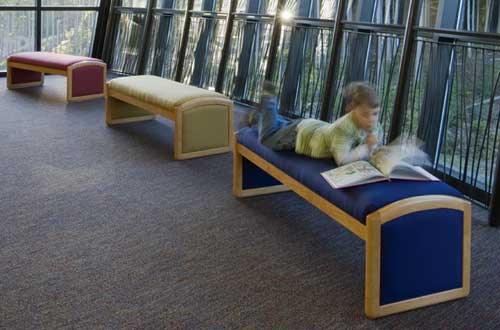 |
Photo courtesy of the Carpet and Rug Institute |
Benefits of Carpets
Carpet is a foundation for the look and feel of a room. It can provide
a casual simplicity to reinforce a soft, livable ambiance or it can lend vibrancy to a room through strong colors and heavier textures.
One of the easiest methods of personalizing an environment, carpet
also offers a host of health and safety benefits.
Improved Safety. Because it affords more traction, carpet helps
prevent falls. According to the above-mentioned Schapiro study, 77
percent of teachers agree that carpet helps prevent falls and injuries
and makes a classroom safer. Not only do fewer slips and falls occur
with carpeting, but when they do happen the chances of injury are
greatly diminished on a soft floorcovering. Further, carpet provides
a non-glare surface that reduces reflection and eyestrain.
Reduced Noise. With carpet, less acoustic protection is needed on
the ceiling and elsewhere. This provides a better learning atmosphere
with fewer distractions. According to the Technical Committee
on Architectural Acoustics of the Acoustical Society of America,
the speech intelligibility rating is 75 percent or even less in many
classrooms, meaning that those with normal hearing can understand
only 75 percent of the words read from a list. Research shows that
background noise from inside and outside the classroom negatively
affects learning. Excessive noise and reverberation interfere with
speech audibility, leading to diminished understanding, learning
and ability to focus on the lessons at hand.
Flooring is a major component of comprehensive noise
management. Based on a study by the American Society of
Interior Designers, carpet is deemed to be 10 times more efficient
in reducing noise compared to other flooring options. When a
cushioned backing made with polyurethane technology is added,
noise levels can be further reduced.
Increased Comfort. For teachers and other staff, a cushioned
walking and standing surface reduces leg fatigue. Several studies
have investigated the influence of floor surfaces on the body during
long-term standing, and results show that softer floor materials
usually result in less postural discomfort than standing on hard
floor surfaces (Redfern & Cham, 2000). According to Rys and
Konz (1988), heart rate was higher after two hours of standing on
a concrete floor compared to carpet, and perceived comfort was
higher when standing on carpet. Similarly, In 1997, Madeleine et al.
found that after two hours of standing, the comfort level was greater
for a soft surface. Standing on a hard surface increased parameters,
such as shank swelling and muscle fatigue. It also detrimentally
changed subjects' standing posture.
Better Insulation. Carpet is warmer to sit on or work on,
extending the learning areas to space on the floor. Thermal comfort
is improved because carpet retains inside ambient temperatures for
longer periods. Because of its fibrous construction, carpet traps a
layer of air close to the floor. Air is an excellent thermal insulator
and consequently carpet acts to increase the thermal insulation of a
surface. Additionally, a pad beneath carpet can further increase this
thermal insulation effect.
Research conducted at the Georgia Institute of Technology
School of Textile Engineering tested the thermal insulation values
(R-Values) of carpet and cushion and found that the total R-value
was more dependent on the total thickness of the carpet than the
type of fiber content. The research indicated that a carpet system
comprising carpet and pad can increase the R-value of the floor by
2 to 4 points.
Lower Life-cycle Costs. Carpet that is properly selected,
installed and maintained lasts up to 10 years or longer. When
product, installation and maintenance supplies and labor costs are
considered over a 15- to 20-year period, carpet showed lower life
cycle costs than other flooring options. A 2002 report, "Life-cycle
Cost Analysis for Floor Covering in School Facilities," prepared by
the Institute of Inspection, Cleaning and Restoration Certification
(IICRC), found that carpet could be 65 percent less expensive
to maintain than hard surface flooring. In the study, buying and
installing the hard surface flooring was less expensive than carpet.
But when labor, supplies and equipment costs were calculated over
a 22-year life cycle, carpet proved to be more cost effective. The
life expectancy of the hard surface flooring was 22 years. The cost
of replacing carpet after 11 years was factored into the analysis.
The study also found that hard surface floors require two and onehalf
times more cleaning than carpet and that hard surface cleaning
supplies are about seven times more expensive than supplies for
carpeted floors.
The carpet industry is working to make carpet even longer lasting
in schools by creating more durable fibers and fabrication methods,
improving primary and secondary backings and increasing the
number of different design and performance options. Modular
carpets, the fastest growing segment of the industry, provide the
option of replacing parts of a carpeted surface, instead of the entire
carpet.
Improved Indoor Air Quality. The relationship between
carpet, asthma and allergies has been the subject of numerous
scientific and medical investigations. In a 2008 literature review
for the International E-Journal of Flooring Sciences, Mitchell W.
Sauerhoff, Ph.D., DABT, concluded that "carpet does not cause
asthma or allergies and does not increase the incidence or severity
of asthma or allergies symptoms. In fact with respect to asthma and
allergies, multiple studies have reported fewer allergy and asthma
symptoms associated with carpet." Allen Hedge, Ph.D., an indoor
environmental expert, in a paper at the 2001 annual meeting of the
Council of Education Facility Planners, Ref. 34, reached the same
conclusion: "concerns that carpeting in schools is contributing to
an increase in respiratory problems, allergies and asthma in schools
are unfounded."
The reason is that allergies are usually affected by airborne
particles. Carpet traps allergens in its fiber and does not allow them
to circulate in the air, even with the activity of children. The allergens
trapped in the carpet then can be easily removed by adhering to a
regular cleaning and maintenance schedule that includes vacuuming
and periodic extraction cleaning using Seal of Approval-certified
products. Studies have compared the distribution of airborne dust
associated with normal activities on hard and soft flooring surfaces.
In 2002, research by G. Asbury titled, "Cleaning and Foot Traffic
Emissions Analysis," for the Professional Testing Laboratory, Inc.,
in Dalton, Georgia, showed that walking on hard surfaces disturbed
more particles. These particles became airborne and entered the
breathing zone. In contrast, carpeted surfaces trapped more particles
so that walking disturbed fewer particles. The result was less dust in
the breathing zone over carpeted floors.
In another study by Research Triangle Institute (RTI) and
University of North Carolina (UNC) researchers investigated
two schools in North Carolina from the same school district and
situated in rural locations with very similar outdoor environmental
conditions (Proceedings: Indoor Air 2002, Monterey California �
A Comparison of Biocontaminant Levels Associated with Hard
vs. Carpet Floors in Non-Problem Schools; Results of a Yearlong
Study.) Both schools followed almost identical cleaning programs.
One school was mostly resilient vinyl tile floors while the other
school had 70 percent to 75 percent carpet floors. The study
found that, although the carpet flooring had higher concentrations
of biocontaminants than an equal area of tiled floor, airborne
contaminants were higher over tiled floors than over carpet.
Yet another investigation of thirteen Florida classrooms
encompassing six schools presented at the 1996 International Indoor
Air Quality Conference, concluded that carpet does not contribute
to air quality problems:Â "Carpet can serve as a reservoir for nonviable
spores that enter from the outside, yet there is no evidence to
indicate mold spores or mite allergen leave the carpet."
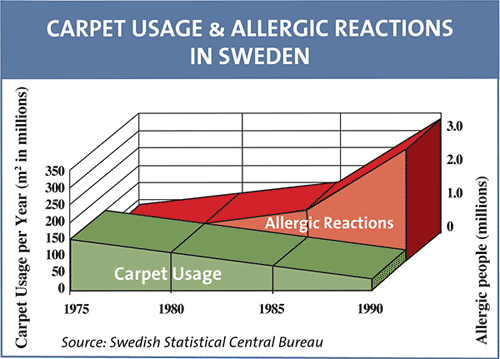
In a government study in Sweden, when carpet was banned from
public buildings and replaced with smooth surfaces, carpet's share
of the total floorcovering market dropped from 40 percent in the
mid-70s to only 2 percent in 1992. During this same time period,
the incidence of allergies among Swedes increased approximately
four-fold. The study authors believed that allergic reactions in
sensitive individuals were not directly associated with carpet, but
rather indoor air quality.
Dr. Hedge reports that carpet can improve indoor air quality
because carpet captures and holds dirt, contaminants and allergens
that would otherwise become airborne - "as long as schools keep
floors clean and use high-efficiency microfiltration vacuum bags,
carpets can be a healthy, safe and economical floor covering in
schools and day care centers. Microfiltration bags will trap very
small particles, such as dust mites and feces, so that these will not
become airborne."
Another indoor air quality issue is that of carpet and mold.
Clean carpet does not support mold growth even at prolonged and
elevated temperatures. However, left unresolved, leaks and spills,
heavy condensation and localized flooding, especially when
followed by prolonged high humidity, can lead to mold growth in
many areas of a school. For mold to grow, it needs water, oxygen,
a warm temperature and something that contains nutrients to feed
on, such as dirt, wood or paper. Moisture trapped below a carpet
can result in mold growth and the release of mold spores and
mold metabolic products (microbial volatile organic compounds
(VOCs or MVOCs) into indoor air. Effective moisture control is
critical to protect all building systems from the potential for mold
growth. That said, studies have shown that the biggest source of
mold spores is actually an improperly operated and maintained
HVAC system. Shutting the HVAC system off at night or during
downtime creates the perfect incubator for mold spores, which are
then flushed into the breathing zone.
Indoor air quality also involves the emissions of volatile
organic compound (VOC) levels from building materials. Carpet
may be the lowest VOC emitter of common flooring choices and
one of the lowest emitting products used in new construction
and renovation, much lower than products such as paint. The
already low VOC emission of new carpet drops significantly
after 24 hours, even sooner with fresh air ventilation. According
to Werner Braun of the Carpet and Rug Institute, the industry
has developed a program known as the Indoor Air Quality
Green Label Program to determine the level of VOC emissions
from carpet, floor adhesives, and cushion products. Attached
to a carpet, floor adhesive or cushion, the label signifies that
a representative sample of the product type has been tested by
an independent laboratory. The recent Green Label Plus is
an enhancement that incorporates additional requirements to
meet California's Collaborative for High Performance Schools
(CHPS) low-emitting materials criteria. Products listed as
CHPS-compliant materials have been chamber tested to meet the
indoor air quality guidelines outlined in California's specification
section 01350.
SUSTAINABILITY
With the plethora of carpet types available in the marketplace,
selecting the most sustainable carpet can be a challenge. NSF
140-2007, certified by the American National Standards Institute
(ANSI), is the prevailing sustainable carpet assessment standard.
The standard is voluntary, based on life-cycle assessment principles,
and provides a single rating system that recognizes levels of
achievement - mandatory minimum standards of sustainable
performance as well as silver, gold and platinum levels that define
a more sustainable carpet. It establishes performance requirements
and quantifiable metrics throughout the supply chain for public
health and environment; energy and energy efficiency; bio-based,
recycled content materials; manufacturing; and reclamation and end
of life management. While the standard can be used to evaluate any
carpet product, it is primarily intended for commercial carpets as its
evaluation methodology is complementary to emerging commercial
green building standards.
Selecting the Right Carpet. In many instances, new schools
have incorporated a mix of floor coverings, with carpet in entrances
and corridors to minimize dirt brought in and spread throughout
the facility. Carpeting in these areas also provides extra traction
for school children entering the building, particularly when it's wet
or snowy outside. In elementary school classrooms carpeting is
increasingly being used around teachers' and students' desks, with
smooth surfaces reserved for around sinks and water fountains and
in bathrooms and cafeterias.
Since choosing the right carpet is critical, the industry has
developed guidelines to assist design professionals in selecting
commercial carpet with acceptable texture retention performance
in specific end-use applications (www.carpet-rug.org/pdf_word_docs/fact_sheets/CRI_Factsheet_TARR.pdf).
The Texture Appearance Retention Rating (TARR) system
identifies the level of appearance change of a carpet surface
resulting from foot traffic. Developed through a consensus process
involving technical experts in the carpet industry and commercial
and government specifiers, TARR ratings identify changes in
appearance on a 1 to 5 numbered scale: 5 represents no change in
appearance and 1 represents a very severe change from the original
texture of the pile yarn expected in a given traffic area during
the first year after installation. Carpet with a higher rating, such
as 4.5 or 4.0, will retain its original new appearance longer under
various traffic conditions than carpet with a lower rating. The rating
does not reflect the potential influence of variable factors such as
soiling, staining, maintenance and improper installation. To obtain
the projected appearance retention performance, the carpet must
be correctly installed following the manufacturer's instructions
and in accordance with industry installation guidelines. Design
professionals note TARR numbers on commercial projects.
The guidelines classify moderate, heavy, severe, or special enduse
for each application based on the level of expected foot traffic.
For example, school offices are classified as moderate use (> 2.5
TARR); school classrooms, conference rooms, lounges and libraries
and classified as heavy use (> 3.0 TARR); and school corridors,
entrances and lobbies are classified as severe use (> 3.5 TARR).
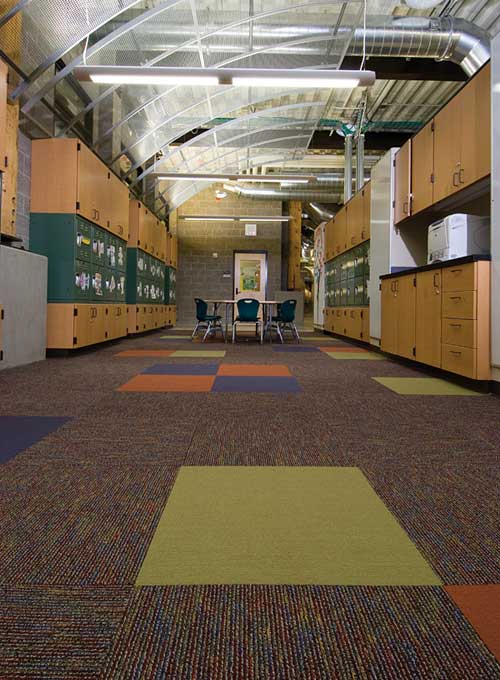 |
Variation in color and pattern can mask the effects of
traffic in school settings.
Photo courtesy of the Carpet and Rug Institute |
Experience has taught that a low profile, densely tufted, tight
loop construction is very functional in a school. Color selection
is a prime factor in long-term appearance retention and facility
managers and maintenance supervisors who understand this can
increase the longevity of the carpet and save on future replacement
costs. While a light color cut pile can make rooms and hallways
look brighter, they are a poor choice in heavy traffic areas and can
make successful maintenance more difficult. A darker color loop
pile will retain its appearance longer and is a better choice in heavy
traffic areas. Tweeds or patterns in the carpet are also a good choice
as they add interest to the floor and hide soil.
"Carpet is a cost-effective way to bring color and texture into a
project and has the flexibility to transition between areas within a
school," says Lisa Pinyan, ASID, IIDA, LEED® AP, Director of
Interior Design for Greenline Architecture in Savannah, Georgia.
Pinyan favors some variation in color and pattern to mask
the effects of traffic and notes that the construction method -
preferably loop - and dye methods are two key factors in her
specifying decisions. "When budgets allow, we go with solutiondyed
carpets." Pinyan also points out that carpet tiles, the fastest
growing component of the carpet industry, have their place. She
specified them for Georgia Southern University's new College
of Information Technology, where computer access flooring was
used throughout much of the building. "They're more expensive
initially, but they are easier to replace as individual carpet tiles
become damaged. If the school has the budget for them, carpet tiles
can have a longer life cycle," she says. Carpet tiles ranged from a
modern pattern in common areas to those with color and warmth in
the professional development area to classrooms where less pattern
and stain hiding ability were considerations.
STANDARDS FOR INSTALLATION
Proper installation is critical to carpet performance. Specific
installation instructions from manufacturers should be followed.
A professional installer will understand these guidelines and know
that carpet must be installed correctly to perform satisfactorily over
time. Most school carpet is installed using the direct glue method of
installation, whereby the carpet is adhered directly to the subfloor
with an adhesive.
Carpet installed in accordance with the manufacturer's
recommendation and with the industry standard will escape many
common installation problems, such as the development of wrinkles
and buckles, zippering, and seam failures. Adequate adhesive should
be applied and seams secured with seam sealers to prevent the most
common causes of installation complaints with school carpet.
CLEANING AND MAINTENANCE
Architects who can advise clients on product care and maintenance
will help to increase the life cycle of the product. Pinyan says she
has steered clients to professional carpet care. "School maintenance
people tend to use topical treatments, which can be magnets for
dirt," says Pinyan. "We favor hot water extraction cleaning, which
can actually make a carpet look better over time."
When it comes to carpet, appearance depends not only on its color,
pattern, density, fiber, but its maintenance program. Like many of
today's consumer products, carpet can have a long life if properly
cared for and maintained. Generally speaking, carpet can last from
seven to 12 years. But when carpet wears out or "uglies out" well
before its time, it not only results in a financial loss for the owner,
but it doubles or triples the product's environmental footprint. For
example, an educational facility that purchased 4,800 square yards
of carpet at a cost of $67,200 found that the product uglied out in
only two years due to poor cleaning and maintenance procedures
and had to be replaced. Assuming that carpet has a life of twelve
years if properly maintained, the loss in value to the facility was
$56,000.
Carpets are more stain resistant than ever, making them easier
to clean and maintain. However, maintaining the life and beauty
of carpet depends on several factors: the quality of products and
equipment used to clean carpets; the frequency and methods by
which carpets are cleaned; and the skill and knowledge of the
people doing the cleaning. It's important to note that there is a
big difference between cleaning carpet and maintaining carpet.
Cleaning is the removal of apparent soil. For many commercial
carpet owners, cleaning takes place irregularly, on an "as needed"
basis. Soiling, however, is a cumulative process, which if allowed
to go too far, cannot easily be reversed. Maintenance, in contrast
to cleaning, is a scheduled on-going process of soil removal
designed to maintain carpet's daily appearance at a consistent level
of cleanliness. In caring for carpet, schools are advised to follow
a regular maintenance program using cleaning products that meet
rigorous standards.
While carpet cleaning products, methods and equipment are
improving all the time, not all cleaning products clean equally
well. Industry experts have tested an assortment of carpet cleaning
solutions and equipment and found a wide variance in how well
these products work, with some products even damaging carpet.
The Seal of Approval (SOA) identifies effective carpet cleaning
solutions and equipment in several categories, including spot
removers, vacuums and extractors. An independent laboratory has
tested off-the-shelf spot removers and pre-spray solutions. Of the
25 products tested, only four cleaned a soiled carpet sample better
than water. Some caused the cleaned carpet area to resoil faster
and some products damaged the carpet's color and texture. Spot
removers are tested for their efficacy, as well as to show that they
do not encourage resoiling or cause damage to the carpet. Further,
vacuums must not affect the texture of the commercial cut pile
carpet more than a one-step change based on one year of normal
vacuum use. Extractors are tested to make sure they clean properly
and they remove water from the carpet.
A customized comprehensive carpet care program consists of
five elements:
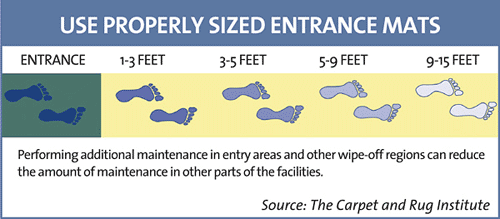
1. Soil Containment. Soil containment is the isolation of soil
entering the building using mats at entrances. Outside mats scrape
debris off of shoes that have the capability to track in that material.
Soil-removal mats that have a coarse texture are able to brush soil
from shoes, and hold large amounts of soil in their pile. Inside mats
remove smaller particles of dirt as well as oils and other liquids
that can be tracked in from outside. Water-absorbent mats prevent
tracked-in moisture from getting to the carpet. Mats that extend for
6 to 15 feet inside the entrance will trap eighty percent of soil and
moisture from the first five or six steps. Another way to prevent
soiling using mats is by placing protective mats around food
stations, water coolers, elevators, and stair thresholds to prevent
moisture and dirt from becoming ground into carpet.
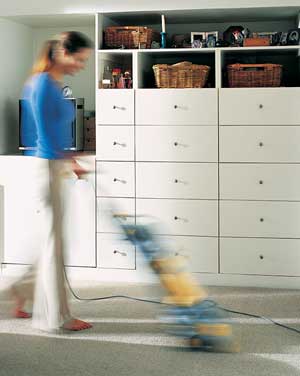 |
Vacuuming is an effective, economical way to keep carpets clean.
Photo courtesy of the Carpet and Rug Institute |
2. Vacuuming. Vacuuming is the single most effective and
economical means of keeping carpet in schools clean. The majority
of dry soil can be removed from carpet by following scheduled,
routine vacuuming procedures. Through independent testing, the
industry can certify high-performance vacuums that are effective
in removing soil and keeping dust and other particles within the
canister so they do not circulate back into the air. Daily vacuuming
is advised for carpeted areas with heavy foot traffic. Other areas
should be vacuumed two or three times a week.
3. Spot and Spill Removal System. In busy schools, floor
coverings are subjected to spills on a daily basis. Prompt removal
is recommended as the more time the spill remains on the carpet,
the more difficult it will be to remove. Spills on carpets should be
quickly addressed and always within 24 hours. A portable extractor
will remove spots quickly and effectively.
4. Interim Cleaning. Twice a year carpet should undergo
extraction cleaning by trained custodians or professional cleaning
services. Suggested times are just prior to the school year and during
winter holiday break.
5. Restorative Cleaning. Schools should schedule deep cleaning
to remove residues and trapped soils.
There are some conditions where appearance change must be
expected. In areas where the oily material from asphalt sealers is
tracked into the building, carpet and other flooring may become
yellowed over time. Carpeting that has experienced a slight dulling
of color indicates a build up of soil. It is virtually impossible to
remove all of this material once it has penetrated the fiber of any
carpet. Entrance mats and scheduled cleaning can reduce this
phenomenon. Areas where large amounts of sandy soil enter the
building may become dull in appearance over time. This is due
to abrasion of the fiber surface, affecting the reflection of light.
Frequent vacuuming helps to minimize this problem.
TROUBLESHOOTING COMMON CARPET ISSUES
Texture Surface Retention. Carpet in heavily traveled areas
receives the most wear. For better appearance and longer carpet
life, try to reduce the amount of traffic on these areas or use mats
in entrance ways, thresholds and in front of drinking fountains.
Remove and clean these mats while vacuuming the primary carpet.
Although some change will eventually occur in the texture of your
carpet, reducing the wear on heavily trafficked paths will slow this
change. Frequent changing of carpet squares in high traffic areas
also improves appearance.
 Crushing. Crushing is the loss of pile thickness because of foot
traffic. Crushing is not considered a manufacturing defect unless
it is specifically cited in the manufacturer's warranty. Regular
vacuuming may help reduce crushing that results from traffic.
Manufacturers' definitions of crushing may vary.
Crushing. Crushing is the loss of pile thickness because of foot
traffic. Crushing is not considered a manufacturing defect unless
it is specifically cited in the manufacturer's warranty. Regular
vacuuming may help reduce crushing that results from traffic.
Manufacturers' definitions of crushing may vary.
Depressions or Indentations. The weight of heavy fixtures and
equipment can cause indentations in carpet. Some depressions may
be permanent. Use furniture glides or cups under the bases of heavy
pieces, or move them a few inches backward or sideways so that
the weight is not concentrated in one place. To remedy depressions,
work the carpet pile back into place with your fingertips or the edge
of a spoon, then, dampen the area and heat it with a hair dryer,
working the fibers with your fingers or a spoon.
Fading or Color Loss. Carpet should be given normal protection
from direct sunlight. Emissions from heating systems or chemicals
or cleaning agents can also result in color loss.
Filtration Soil. Filtration soil may appear as dark or grayish lines
on carpet along walls, stairways and under doors. It is caused by
airflow over and through carpet, allowing fine soils to settle on the
surface. It is often caused by an improperly balanced ventilation
system, when the volume of air entering a room exceeds the
system's capacity to remove air from the room. Excess air then
seeks exit sources in gaps along walls and stairways. Prevent the
airflow through carpet and carpet edges by sealing openings through
the carpet and under doors and baseboards. Keeping the air in the
area clean and using good filtration in heating and cooling systems
and vacuum cleaners can help. Filtration soils may require special
cleaning treatment for effective removal.
Fluffing and Shedding. The balls of fluff, or loose fibers found
on carpet are the normal result of fiber left in the carpet from the
manufacturing process. Removing these loose fibers does not affect
carpet life or appearance. Because of their large size, these fibers
are too big to become airborne or to be breathed in. With proper
vacuuming using a quality vacuum cleaner, most shedding gradually
disappears within the first year after installation.
Matting. Manufacturers' definitions of matting may vary.
Matting is usually the result of the untwisting of the yarn and the
intermingling of the yarn tips through foot traffic. Matting may
be caused by various factors, including an improperly specified
cushion, cushion failure, or improper maintenance. Matting is not
considered a manufacturing defect unless it is specifically cited in
the manufacturer's warranty.
Moth, Beetle and Flea Control. Most wool and wool-blend
carpet made in the United States is permanently treated to prevent
moth damage. Carpet and rugs of manufactured (synthetic) fibers
are naturally resistant to insects, because such fibers are not a food
source and are resistant to beetles, commonly called carpet beetles.
Soiling. Dirty, airborne particles may be deposited on carpet,
causing dulling. Dulling is caused by the deposits of all types of soil.
A delicate rose color, for example, may dull down to a neutral taupe
because of soil, while light blue may take on a dull, gray-green hue.
Red clay soil also can cause a pronounced change in some colors. In spite of such phenomena, the original color of a carpet is not lost;
it is still present under the soil. Oily soil may be very difficult to
remove after it has been on the carpet for a long time, and it may be
actually absorbed into the fiber, causing the carpet to have a yellow
cast. Frequent cleanings are important to avoid this problem. Entry
mats at doorways trap soil, and combined with routine cleaning and
vacuuming, provide extra protection for all floor coverings.
Sprouting. Occasionally, a yarn tuft will rise above the pile surface
of a carpet. Rather than pulling them out, these can be snipped off to
the level of other tufts. If the problem persists in a localized area, the
flooring contractor or manufacturer should be notified.
Topical Treatments. Topical treatments include soil retardants,
stain repellents, antistatic treatments and deodorizers. The use of
after-market, topical treatments without the express approval of
the carpet manufacturer prior to application may void applicable
warranties.
Wear. Most carpet manufacturers offer "wear" warranties of
various time lengths. According to these warranties, "wear" is
defined as the loss of pile weight or pile fiber (usually 10 percent)
due to abrasive loss of fiber by weight. What appears to be wear, or
pile fiber loss, may actually be matting, crushing or permanent fiber
damage caused by soiling rather than loss of fiber. There is seldom
actual loss of pile fiber.
Wrinkles, Ripples and Buckles. Wrinkles, ripples and buckles
in carpet are most often caused by a failure to stretch the carpet
correctly using a power stretcher, the use of an incorrect or failed
cushion, or excessive temperature and/or humidity. Ripples can be
caused by a combination of any of the above. If ripples or buckles
develop, consult the carpet provider. Generally, the problem can
be corrected by a qualified carpet installer who reinstalls the carpet
with a power stretcher.
CONCLUSION
In conclusion, carpet has a lot to offer in a school environment.
Besides being a cost-effective way to add color and pattern, carpet
offers advantages across a spectrum of sustainability, safety and
health concerns. And when properly cleaned and maintained, carpet
is part of a winning aesthetic welcomed by students and teachers
alike.
Â
 |
The Carpet and Rug Institute (CRI) is the source for science-based information and insight into how carpet and rugs can create
a better environment � for living, working, learning and healing. CRI's membership consists of manufacturers representing over
90% of all carpet produced in the United States, and suppliers of raw materials and services to the industry. For more information
on CRI's Indoor Air Quality Green Label Program, Green Label Plus Program or the Seal of Approval (SOA), please contact the
Carpet and Rug Institute.
www.carpet-rug.org |
|