This CE Center article is no longer eligible for receiving credits.
The process of designing, documenting, constructing, and
maintaining a building is changing. Instead of treating these
as separate steps, a truly more integrated way of thinking is
emerging and, in many cases, being demanded by building owners.
Building Information Modeling or BIM is one big part of that
change and has been regarded as a central tool that has been bringing
together architects, engineers, contractors, building owners,
specialty consultants, product manufacturers, fabricators and others
to look and think differently about the information that they use and
the role that they each play in the design, construction and operation
of buildings.
BIM DEFINITION AND CHARACTERISTICS
In order to better understand the nature of this important tool, let's
take a closer look at how BIM is defined. According to the National
Institute of Building Sciences (NIBS);
"A Building Information Model (Model) is a digital
representation of physical and functional characteristics of a facility.
As such, it serves as a shared knowledge resource for information
about a facility forming a reliable basis for decisions during its life
cycle from inception onward."
The key here is that the BIM model becomes a long term
shared resource for a building or facility from the earliest design
conception, through construction, during the years it is operated and
maintained, through any alterations, additions or adaptive re-use, all
the way through to the end of its useful operating life and eventual
demolition or deconstruction. Further, NIBS goes on to point out
the following:

|
BIM and Complementary Building Products are used in virtually all buildings.
Photo courtesy of Nystrom, Inc. |
Â
"Some have identified BIM as dealing with only 3D modeling
and visualization. While important and true, this description is
limiting. A more useful concept is that a Model should access all
pertinent graphic and non-graphic information about a facility as an
integrated resource. A primary goal is to eliminate re-gathering or
reformatting of facility information; which is wasteful."
|
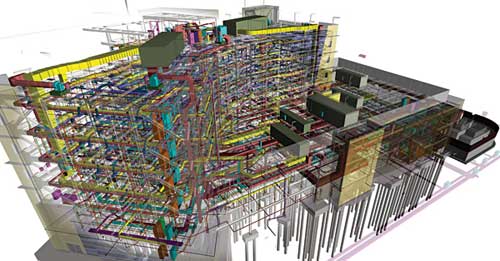
BIM Models are more than 3D computer models; they are an integrated
information resource. (Source: McGraw-Hill Construction 2009 Smart Market
Report - The Business Value of BIM)
Photo courtesy of GHAFARI Associates |
The integration of both graphic and non-graphic information
in one place gives the Model much more value as a resource that
can be accessed by many people instead of wasting time and
money to duplicate. The current wastefulness and redundancy in
building design and construction work, while difficult to accurately
quantify, is estimated by NIBS at a figure approaching $400 billion
dollars annually, without taking operating processes into account.
Eliminating this waste has been a key motivator on the part of owners
and others who seek a superior building outcome by incorporating
a more coordinated non-redundant methodology.
NIBS has also launched a specific initiative known as the
buildingSMARTallianceâ„¢, which has compared the rise in the
use of electronic modeling for buildings to similar changes that
have preceded it in the aircraft, microprocessor and automotive
industries. Based on those other industry successes, BIM is usually
characterized as having several key features:
• Digital or electronic format. The Model is created entirely on
computers.
• Parametric object-based. The information in the Model is not
a series of lines and shapes as in many Computer Aided Design
(CAD) applications, rather it is a collection of three-dimensional
"objects" that are inserted or virtually "built" into the Model. The
objects are often selected or created generically in BIM software
programs or custom created by design professionals. Parametric
objects are those that automatically adjust to other objects in a
model, such that if a change is made to the model that affects
the size or location or spacing of the object, it moves and adjusts
accordingly.
• Embedded information linkage. Beyond the physical representation
of an object, the functional data (e.g. specifications, warranty,
manufacturing information, etc.) associated with that object is
embedded or linked to the BIM object and readily accessible and
readable.
• Interoperable. With information coming from multiple sources,
the ability to openly and easily share that information in generic
formats without the restrictions of proprietary software becomes
critical. This point is common among a number of computer-based
activities and has strong precedent elsewhere. In fact, the Institute
of Electrical and Electronics Engineers (I-triple E) has spent a
considerable amount of effort looking at this topic and offers this
definition of interoperability: "The ability of two or more systems
or components to exchange information and to use the information
that has been exchanged."
A Model that incorporates all of these features lives up to the
true definition of BIM and its ability to deliver desired results.
THE GROWING USE OF BIM

|
|
Source: McGraw Hill Construction 2009 Smart
Market Report - The Business Value of BIM |
Of course, any tool is only of value if it is actually used and put
into practice. In order to understand the current and projected
usage trends and perceived value of BIM in practice, McGraw-
Hill Construction has undertaken a series of objective studies in
partnership with NIBS, the American Institute of Architects (AIA),
and others and published the findings as a "Smart Market Report
- The Business Value of BIM" (see  www.aia.org/ipd). The
2009 printing of this report updates the findings of the prior 2007
edition and reveals some insights into who is using BIM and why.
This study is based on input from information gathering surveys
from literally thousands of participants that came from all parts of
the Architecture, Engineering and Construction (AEC) spectrum
across North America. Some of the highlights of this study are
summarized below:
• Almost half (49%) of the total AEC industry is now using
BIM. This usage level is up considerably since 2007 when the
same study revealed that only
28% of the total industry was
using BIM or BIM related tools
at that time. This represents some
dramatic recent growth - a 75%
increase in two years. Further,
proficiency is up dramatically
too with three times as many
users characterizing themselves
as advanced or experts - 42%
in 2009 compared to only 14% in 2007.

|
Source: McGraw Hill Construction 2009 Smart Market Report - The Business Value of BIM |
In light of these findings, Steve Jones, one of the co-authors of
this report from McGraw-Hill Construction has said, "With about
half the North American AEC industry already up off their beach
chairs and at least wading ankle-deep in the BIM surf, we can stop
hyperventilating about "BIM" and just do BIM as a regular course
of business."
• All BIM users plan significant increases in utilizing BIM. Fully
one third of all current BIM users surveyed report employing BIM
on 60% or more of their projects today, but twice as many users
expect to be at that level in the next two years. Of those not yet
using BIM, half have yet to try it, although they are open to it,
and at least 42% of non-users believe that BIM will be either
highly or very highly important in the next five years. The trend of
increased usage observed during the past two years appears that it
will continue based on these survey results.
• Different groups of users have differing usage levels, but the
majority of users overall are seeing real business benefits
directly attributable to BIM. The report breaks down some
interesting observations about the different groups using BIM:

|
Source: McGraw Hill Construction 2009 Smart Market Report - The Business Value of BIM |
Â
- Architects:BIM used in the AEC industry is credited to
have gotten its start within the architectural community
and this early adoption has architects still reigning as the
highest users of BIM. As many as 60% of architects report
creating some form of BIM Model in their practice and two
thirds of those report that they find high value in the core
design development and construction document phases of
a project. This value is based on higher productivity and a
reduction in the need to re-work designs.
- Engineers: Overall, this group of design professionals
lags behind architects with only 42% of engineers reporting
using BIM, which is actually lower than the usage
percentage of contractors. Among the common resistance
expressed by engineers is the availability of sufficient
engineering content that is BIM compatible or a perception
that this approach doesn't apply to their particular
practice of engineering. On the positive side, engineers see
the reduction of conflicts and changes during construction
as the top ways that BIM adds value to a project.
- Contractors:This group is growing faster in usage than
any other with 50% currently reporting using BIM or
related tools compared to only 13% in 2007 - a fourfold
increase in only two years. This growth is likely fueled by
the finding that nearly 70% of contractors that are using
BIM are finding high value with greater chances of avoiding
errors and omission problems during construction,
enhancing productivity, avoiding conflicts, and improving
performance on both budget and time schedule.
- Owners: As a group, approximately 37% of building
and facility owners report using BIM, even though many
have yet to realize the long term operations and maintenance
benefits. Nonetheless, 70% of those utilizing BIM
for design and construction projects see positive value
through such benefits as lower overall project costs, clash
detection, avoiding rework, and a generally overall better
construction outcome.
- Material Fabricators:Accurate information and dimensioning
are the keys to successful material fabrication in any
construction project. By bringing fabricators into the design
and construction process earlier rather than later, they can
collaborate with the rest of the team to provide input and extract
data from the BIM Model rather than recreate it separately.
In this way the project can benefit from improved overall
quality, easier constructability, the reduction of waste,
better timeliness in fabrication schedules and a resulting
improvement in affordability.
- Building Product Manufacturers: This group is just
beginning to realize the potential benefits of incorporating
BIM into the way that they communicate and interact with
all of the other players above. Some are developing their
own libraries of their products as complete BIM objects.
Commercial services are also working with a steadily
growing number of manufacturers to make BIM objects
of their products available to those creating and using
BIM models.
Overall, then, the report points out that "the ability of teams
to create richer models and share more data with BIM has helped
foster more collaborative decision making on projects. BIM
has proven an effective tool for this [integrated project] delivery
method, breaking from the tradition of handing off completed work
from one team member to the next with little or no input from
others." It also summarizes the resulting overall benefits related to
saving time and money through 1) conflict avoidance/resolution, 2)
increased productivity/ efficiency and 3) the avoidance of rework/
changes. Beyond saving time and money, however, there are other
overall benefits for all parties including 1) a better understanding of
the project throughout the phases or stages, 2) better collaboration,
and 3) better visualization. Some future trends also noted include
the potential to reduce the need for submittals and shop drawings
while allowing more time for design and less time for documenting/
processing.

|
Source: McGraw Hill Construction 2009 Smart Market Report - The Business Value of BIM |
THE ROLE OF MANUFACTURED, COMPLEMENTARY
BUILDING PRODUCTS IN BIM MODELING
As previously noted, building product manufacturers are beginning
to become increasingly involved in providing their product information
as fully developed BIM objects. This is coming about for a
variety of reasons including:
• Recognizing change.Manufacturers are beginning to see that
BIM is quickly replacing CAD as the preferred design tool by the
architectural, engineering, and construction community.
• Filling a need. The creation of libraries of specific objects is
time consuming and often not cost effective for design firms,
particularly for objects of multiple manufacturers. Having
readymade objects that are accurate, up to date, and customizable
to suit a particular project helps architects realize the full
potential of BIM through greater efficiencies of time and
integration of data.
• Staying current. Products change and so does BIM software.
Manufacturers who are in for the long term recognize the
reality of needing to keep their information and data updated with
new product offerings and changes as well as maintaining
full compatibility with changing software programs. Adopting
and maintaining a BIM approach to conveying their product
information provides manufacturers with the best way to integrate
with the AEC community.
Understandably, some project owners do not allow the
pre-selection of a single manufacturer, favoring instead the open
bidding approach of providing the design criteria in drawings and
specifications for multiple manufacturers to demonstrate compliance
with. In other cases, owners have prior experience or even standing
accounts for particular products and manufacturers and want to ensure
that those products get used again. In either case, a discussion with
the owner at the outset of a project is important to ascertain what the
basis of design will be in the project regarding manufactured building
products. With more product information becoming readily available
in BIM format and more collaboration of designers, constructors,
suppliers, and manufacturers earlier in the design and construction
process, the trend is clearly heading toward making specific product
selections sooner rather than later. Hence, selecting and using specific
products in the overall building model would appear to be consistent
with that trend.
Certain building products fit into the category of "complementary
building products." The term comes from the definition of "acting as
or providing a complement (something that completes the whole)."
They are products or parts of buildings that are typically installed late
in the stage of construction that complement or complete a portion of
a building to get it to its finished functional state.

|
Complementary building products include integrated parts of buildings
such as entrance flooring and expansion joint covers.
Photos courtesy of Nystrom, Inc. |
Â
These products may also be referred to as specialty or
miscellaneous products, but it is likely that they are part of virtually
every building being undertaken today. They include code and
safety related things like roof hatches, smoke vents, access panels,
and fire extinguishing equipment plus products needed to meet
engineering requirements, such as air louvers and expansion joints.
It can also include interior items such as floor entrance mat systems,
stair nosings, and wall protection products. In the grand scheme of a
building, they can often go relatively un-noticed, which may actually
be the overall design intent. However, they can become a strong
focus of concern when it is time to demonstrate code compliance
or achieve final project close-out at the end of construction. More
significantly, they are often items that building operating and
maintenance personnel will use and need to find information about
on a regular basis.
Architects typically incorporate and specify most of these
complementary building products, so there is a need for awareness
about the nature of these products and the ways that they can fit into
and contribute to a BIM Model as well as the finished building:
• Design Integration. Complementary building products
are typically integrated as part of an overall building system;
therefore architects need to think about how the product they
are selecting will relate to its context. It usually becomes quite
apparent in a finished building when these products were properly
selected and integrated into an overall design and when they were
only an unfortunate afterthought. For example, expansion joints
typically require multiple choices to be made to integrate them
into the interior floor, wall, and ceiling or exterior wall and roof.
Using the BIM Model to take into account how the expansion joint
meets with and integrates into the floor, roof, and wall systems
will reveal whether or not the selected products truly work with
each other and the surrounding building materials. This level of
visualization and conflict avoidance will help architects to better
understand the products and their purpose while contributing to
the preferred appearance, functionality, maintenance, and overall
operation of the building.
• User needs. Some products have uses that need to be considered
other than just meeting a code or engineering requirement. For
example, smoke vents are required to vent out smoke in case of
a building fire and may need to be sized and located to meet a
particular code, but the desired use and operating requirements
may well go beyond that. By working with the owner, user, or
maintenance personnel the architect can discover how and when
the smoke vent may need to open not just for an unintended fire,
but also for some other intentional activity such as a theatrical
performance that needs to vent out fumes from a pyrotechnics
show. Incorporating a smoke vent as a fully configured BIM object
into a model can reveal for designers and operators the options of
how the doors close again once they are opened, how to integrate
them with building security needs, and how the smoke vent ties
into the roof structure and roofing membrane.
• Timing of selection. Selecting specific BIM object information
during design, rather than construction, will engage the architect
deeper in the final selection process rather than leaving the
choice solely up to the contractors. It may also eliminate the
need for submittals and shop drawings if that information is
essentially embedded in the Model and is in fact built accordingly. By
selecting an exact product earlier, and giving contractors and
subcontractors more focused rather than generic specification,
this selection will allow for time savings and potentially better
pricing when bids are being assembled. Assuming that competitive
bidding is still employed, this approach allows for the Owner
to get the best price for their project by allowing contractors to bid
"apples-to-apples" and reduce the amount of duplication and/or
unknown requirements that can cause inflated pricing.
• Customization. Complementary building products typically are
able to be configured and customized rather than be restrained
to "off the shelf" solutions. Some manufacturers will emphasize
their abilities in this regard by pointing out that their manufacturing
processes allow for flexibility in product design and other
characteristics such as finish and color, usually without impacting
scheduled lead times or affordability. Using BIM, manufacturers
can present customizable objects that are easy to select and configure
so that the right product can be chosen to provide the desired
aesthetics, correctly work with the adjacent construction, and truly
meet the Owners expectations of functionality. Architects, then,
no longer have to be restrained to design around a limited venue
of complementary building products rather they can select,
configure, and customize these products to best fit the overall
building design.
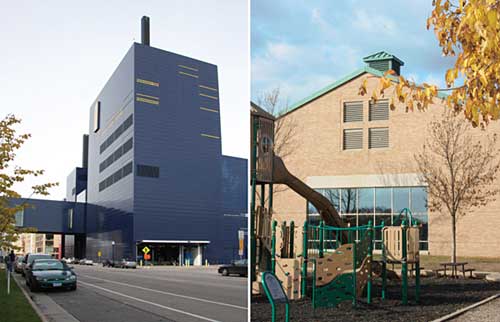
|
The ability of complementary building products, such as wall louvers, to
be customized into a building allow them to enhance any design style.
Photos courtesy of Nystrom, Inc. |
Â
• Complete information.Architects shouldn't be expected to know
everything off the top of their head about all the products they
incorporate into their designs, rather, they need to know where
to get the right information when it is needed. The use of fully
embedded BIM objects greatly reduces the amount of time needed
to find and use that information. Having complete specification
information including code compliance and testing information
readily available allows the designer to select products that meet
all of the building design requirements while avoiding the potential
for construction change orders or time delays if a product use
is questioned.
Overall, then, using BIM objects from complementary
building product manufacturers has the potential to contribute to
more complete and accurate building designs that put the right
product in the right place at the right time. At least one manufacturer
takes pride in being able to schedule the product to be delivered
right to the site when it is needed for installation.
PRACTICAL CONSIDERATIONS OF BIM
Risk management
BIM has been addressed by risk management and insurance firms
in a variety of ways. One of these firms, Victor O. Schinnerer
& Company, Inc., has observed, "BIM is not just the electronic
transfer of paper documents. It greatly increases the ability to
control and manipulate data and information in an unprecedented
way and in an interoperable format. The move from paper-centric
information to parametric, model-based information means that
the digital design can be used for cost estimations, simulations,
scheduling, energy analysis, structural design, GIS integration,
fabrication, erection, and facilities management." In essence,
they concur that this is a broader way of thinking and a much
more collaborative way of creating a central base of information
about a building. Nonetheless, there is a need for leadership and
control of that information in order to manage and control risks
associated with responsible control of the data and its use.
Schinnerer has addressed this point by stating, "Professional
service firms should be in control of the information source.
As integration of design and construction develops, protecting
public health, safety, and welfare becomes more critical. The
rationale for having a licensed professional in charge makes
increasing sense." Hence the role of the licensed architect or,
in some cases, a licensed engineer as a leader and the entity in
charge of the BIM Model is a significant part of the properly
managed collaboration. It also means that all those who want to
contribute to a BIM model should seek out the architect first for
the appropriate review and eventual inclusion of their information
into the Model.
Characteristics to look for in BIM objects
provided by Building Product Manufacturers
Building product manufacturers, especially those who produce
complementary building products, have been aware of the
importance of the role of the design leader and usually seek
to provide usable information accordingly. When architects
and engineers are selecting BIM objects prepared by building
product manufacturers to incorporate into an overall Model,
they should look for the following characteristics in those
objects:
• Up to date information readily available. Access to
information when it is needed is critical to keeping a project on
schedule. But that information has to be current and up to date,
otherwise a lot of time is wasted detailing the wrong things. Historically,
the architect has relied on manufacturer's representatives to
update the office library with catalogs, CDs and other information
for handy reference. The shortfall in this process is the possibility
that the catalogs become out of date without a designer realizing
it. Recognizing this, many product manufacturers offer their entire
product and design information electronically on their company
website. Others are working through independent company sources
(such as Sweets, Reed, ARCAT, etc.) that provide manufacturer
information in catalog and electronic format and are becoming
sources of a growing library of BIM objects. Obviously, working
with a manufacturer that can provide up to date, readily available
BIM objects for inclusion in an overall BIM Model will be easier
than creating a generic object in the design studio.
• Accurate visual representation.The BIM model needs to predict
the built condition as closely and as accurately as possible. Hence
the same is true with building products that are inserted as objects
into that model. It is important that the visual characteristics of the
computerized object match the detail and properties of the actual
physical object. This is easily revealed by comparing the computerized
object to photos or samples of the physical object and looking
for similarities and discrepancies in details and features.
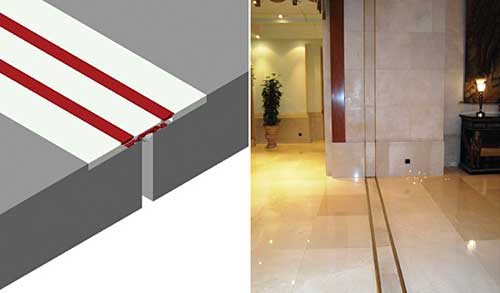
|
A BIM model showing an expansion joint with integrated cover and the
installed condition.
Photos courtesy of Nystrom, Inc. |
Â
• Complete embedded information. This is where the value of
BIM for products really shines. All of the relevant information
associated with a selected product should be readily accessed and
readable from the BIM object. That means that manufacturers
make and model numbers, full product specifications, cost/pricing
information, production and delivery requirements should all be
readily available. For the long term benefit of the owner, it should
also include a link to the warranty, maintenance, and replacement
information related to the product.
• Parametric modeling capability. Most BIM software programs
allow for automated interaction between different objects. This
interaction is governed by a set of computer programming rules
that an object must follow anytime a modification or insertion
of an object is made. This process is referred to as parametric
modeling and is one of the key advantages of using BIM. It means
that an object not only provides data about itself, it also has the
ability to interact with the rest of the model, such that a change
in the object triggers a corresponding change to other parts of
the model. For example, inserting a louver into a wall means that
the wall has to change to accommodate it. If the louver is one of
several and a schedule or chart is part of the Model summarizing
the details of all of the louvers, then the schedule has to be
updated. And if a particular louver has several options built into it,
the selection of those options should automatically be reflected in
all aspects of the Model. In simple terms, parametric modeling is
the means to make this all happen.
• Complete and open interoperability. Anyone who has ever tried
to open a computer file that produced either an error message
related to non-compatibility or a display of unintelligible characters
will readily understand the need for seamless integration
of information from multiple sources. That is what is meant by
interoperability - the ability to access complete and accurate
information regardless of the source of the different parts of the
information. The data from building manufacturers, then, needs to
be provided in a format that is accessible by all software identified
as important on the project.
Resources available supporting the growth and adoption of BIM
A number of organizations and coalitions are working to support
the already growing adoption and use of BIM. These efforts serve
as significant resources and opportunities for anyone that is developing
BIM Models or objects in their own work.
• The American Institute of Architects (AIA). The AIA has
an ongoing strategic initiative related to Integrated Practice/
Integrated Project Delivery (IP/IPD). This approach "leverages
early contributions of knowledge and expertise through the
utilization of new technologies, allowing all team members
to better realize their highest potentials while expanding the
value they provide throughout the project life cycle. Through an
integrated project delivery method, owners, designers, and builders
can move toward unified models and improved design, construction,
and operations processes". Â www.aia.org/ipd In addition, the AIA
Technology in Architectural Practice (TAP) Knowledge Community
serves as "a resource for AIA members, the profession, and the public
in the deployment of computer technology in the practice of architecture.
TAP members monitor the development of computer technology
and its impact on architecture practice and the entire building
life cycle, including design, construction, facility management, and
retirement or reuse." The AIA also sponsors multiple events
during the year such as conferences or seminars that focus on
BIM and related topics. Further, annual design awards are given
specifically for BIM generated projects. Â www.aia.org/tap
• National BIM Standards. Recognizing that the overall industry is
still rather fragmented and current efforts are often built within the
purview of individual initiatives, NIBS has created the buildingSMARTalliance
â„¢, which is developing a National BIM Standard
(NBIMS), similar to National CAD Standards that have been in
use for some time. Through this effort, the goal is to establish
needed uniform standards that can be used by all parties to "foster
innovation in processes and infrastructure" and "weave information
needed to create and operate wonderful buildings." The buildingSMARTalliance
â„¢ is not only the home for this common standardization
activity it is also tasked with industry-wide coordination,
outreach, education and adoption activities. As Deke Smith, FAIA,
Executive Director of the buildingSMARTallianceâ„¢ puts it, "We
are working on creating the basic infrastructure so that open access
to all is achieved." Hence, the development of NBIMS will help
to elevate everyone to a more common working place based on
interoperable, open standards and processes. Â http://www.buildingsmartalliance.
org/index.php/nbims/
• The Construction Operations Building Information Exchange
(COBIE). The Whole Building Design Guide (http://www.wbdg.
org/resources/cobie.php) is another initiative of NIBS. It recognizes
that operations, management and maintenance of buildings require
the transfer of information at the end of construction or renovation
projects. Most contracts require the handover of paper documents
containing such information in the form of equipment lists, product
data sheets, warranties, spare part lists, preventive maintenance
schedules, etc. COBIE has been developed as a standardized process
to address and update this need. By incorporating this process,
designers provide space layout, submittal register, and equipment
list in one file that others can use. Since it is based on being an
exchange format, it does not require specific software. Hence, it
can be provided manually or through the use of CAD or BIM files.
Since one of the benefits of BIM is to house all of this information
in one usable, interactive place, the connection between COBIE
and the growth of BIM becomes readily apparent.
• General Services Administration. "In 2003 the General Services
Administration (GSA), through its Public Buildings Service
(PBS) Office of Chief Architect (OCA), established the National
3D-4D-BIM Program. OCA has led over 30 projects in its capital
program, and is assessing and supporting three dimensional (3D),
four-dimensional (4D), and Building Information Modeling (BIM)
applications in over 35 ongoing projects across the nation. The
power of visualization, coordination, simulation, and optimization
from 3D, 4D, and BIM computer technologies allow GSA to
more effectively meet customer, design, construction, and program
requirements. GSA is committed to a strategic and incremental
adoption of 3D, 4D, and BIM technologies." (Source:Â http://
www.gsa.gov/Portal/gsa/ep/contentView.do?contentType=GSA_OVERVIEW&contentId=20917)
CASE STUDY EXAMPLE
The Building Information Model Awards, given by AIA Technology
in Architectural Practice (TAP) Knowledge Community, honor
projects that highlight proven strategies and the latest trends in
design and technology in the building industry. The 2009 "Juror's
Choice" Award is presented here as a case study of an exemplary
building that used BIM to achieve the project goals and illustrate the
connection between the BIM model and the building as constructed.
The jury comments included, "An amazing tour de force...it will
change New York architecture. It will wake people up," and "...a
complete demonstration of BIM's integration ...broad, rich engagement
of team members ...a clear winner." Excerpts from the submission
are presented below with the full presentation available at  http://
www.aia.org/aiaucmp/groups/aia/documents/pdf/aiab081564.pdf

|
BIM Model and the Cooper Union building under construction.
(Source: AIA 2009 BIM Awards and Morphosis Architects) |
Â
"The Cooper Union New Academic Building is conceived as a
stacked vertical piazza, contained within a semitransparent envelope
that articulates the classroom and laboratory spaces. The vertical
campus is organized around a central atrium that rises to the full
height of the building. The interior space configuration encourages
interconnection among the engineering, art, and architecture
departments. The skip-stop elevator system makes trips exclusively
to the fourth- and seventh-story sky lobbies that surround the atrium,
drawing occupants to congregate on the grand stair. These key social
spaces become the places where education informally takes place.
The building's physical and visual permeability helps integrate the
college into its neighborhood. A steel-and-glass skin improves the
building's performance through control of daylight, energy use, and
selective natural ventilation. The facility is exemplary as sustainable,
energy-efficient architecture, slated to receive a Platinum LEED
Rating - superior to any other lab building in New York."
"Using BIM helped the design team to be the know-how in the
building process, re-establishing the original meaning of the word
architect - that of master-builder on a highly collaborative project
delivered with traditional contracting relationships. The model was
used not just to facilitate prefabrication, but to economize even the
most hand-made elements of the project.
During the design phases, using techniques evolved over many
years, the model served many purposes: massing to illustrate the
zoning envelope and building program; solar studies; visualization;
production of construction drawings; 3DPrinting and laser cutting
scale models for communication with clients, engineers, and
contractors; and production of wind tunnel models.
The key to the models' success in all of these purposes was
the ability to both provide a holistic view and also break down the
project into subsystems that are by-themselves complete and easy
to understand, greatly improving comprehension of the design, and
greatly reducing the uncertainty that leads to higher costs. Each
subsystem represents a complete description of work by itself,
but anticipates connections to adjoining subsystems. Through the
process of digitally-integrated design build, at project completion,
these subsystems synthesize a broader whole to become the
architectural work."

|
BIM Model object detail and the Cooper Union detail construction.
(Source: AIA 2009 BIM Awards and Morphosis Architects) |
Â
"A key component of the project's high energy performance
goals was the use of Radiant cooling and heating ceiling panels.
A building assembly's layers are often separated between trades,
with trade unions formalizing the boundaries. In order to construct a
ceiling system which integrated several trades and performed many
functions, the design team devised a system which formed a tightly
integrated whole while dividing the installation into several trades
including lighting, HVAC, and radiating ceiling tiles, hanging
from a secondary structure suspended from the concrete structure.
Through digital integration, the AECO team could select the most
appropriate methods for a given layer of an assembly and rely
upon assistance from the model to ensure that the parts would fit
together. In this case, the design process resulted in architectural
construction documents which included an exploded axonometric
drawing showing the assembly broken out by trade: structure,
secondary suspended structure, electrical/lighting, ceiling support
channels, HVAC diffusers, ceiling tiles. This, in conjunction with
coordination models of the ductwork and piping and a 3D model
of the structure, made it possible to anticipate any issues that might
arise in fabricating and installing the ceilings and HVAC."
"It is important to note at this point that the project's budget
is roughly 70% the cost of comparable projects in New York City.
By combining BIM expertise and integrated practice, it is possible
to make the most effective use of the construction trades available,
greatly expanding the realm of what's feasible for a given budget.
The owner, contractor and AE team are all enjoying a positive
experience on the project."
Peter J. Arsenault, AIA, NCARB, LEED-AP is an architect
and green building consultant focused on sustainable design solutions
based in Upstate New York.


 |
Nystrom has been a leading source for complementary building products for more than a half century. Nystrom specializes
in providing complementary building products and services, those miscellaneous and specialty items that are not normally
of highest priority but are essential components in any commercial building project. Nystrom has them all under one roof.
Complementary building products are: Roof hatches, access panels, louvers, expansion joint covers, roof bellows, stair
nosings, wall protection, entrance flooring, floor doors, smoke vents, fire cabinets, fire extinguishers, and safety railings.
For more information about Nystrom and our products please visit us at; www.nystrom.com. |
|