This CE Center article is no longer eligible for receiving credits.
It is commonly noted that people currently spend 80 to 90 percent of their time indoors. That means we are breathing indoor air and, as a result, indoor air quality (IAQ) has been the focus of numerous studies, standards, and programs that seek to create healthy indoor environments. Common approaches to achieving better IAQ results, particularly in green building design, include careful selection of materials used and increasing ventilation rates. Over the last decade or two, there is also another option that is emerging, namely the use of a plant-based indoor air biofilter. This completely biological (i.e. natural) method of maintaining the quality of indoor air has become recognized as an exceptionally functional and very aesthetic system that can truly enhance indoor environments in many ways.
PRINCIPLES BEHIND INDOOR
AIR BIOFILTRATION
The science behind indoor air biofilters had its start back in 1994 at the Controlled Environment Systems research facility at the University of Guelph in Ontario, Canada. Early research was funded by the Ontario Center of Excellence (OCE) and by the European and Canadian Space agencies. The group gained worldwide recognition for their use of biological systems to improve indoor air quality. Some of the principles that were identified and developed since then are discussed below.
The Nature of Contaminants
Indoor air can be contaminated by any number of things thus reducing its quality and beneficial aspects. For purposes of our discussion, a contaminant is simply defined as anything in the air that we breathe that is detrimental to our health or well-being. It could be determined to be downright harmful due to its inherent make-up as a hazardous substance. Or it could be an otherwise common substance that is a concern due to its level of concentration in the air which exceeds the ability of a human body to deal with it. Hence a contaminant can take several forms.
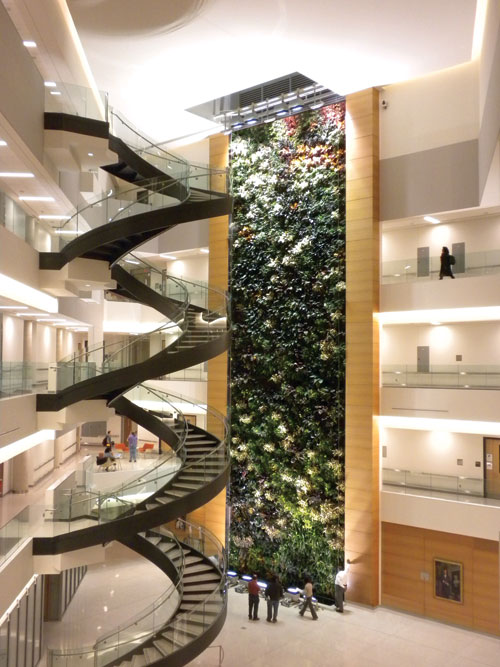 |
A five-story indoor air biofilter at Drexel University assisted in this academic building’s LEED Gold certification.
Photo courtesy of Nedlaw Living Walls Inc. |
One of the most common contaminants to be addressed is volatile organic compounds (VOCs). In simplest terms, these are defined as carbon-, oxygen-, and hydrogen-containing compounds that are present as gases under normal atmospheric conditions—in other words are released as a gas from a liquid or solid. The U.S. Environmental Protection Agency (EPA) differentiates between those that are a concern and those which aren't. Naturally occurring compounds found in the environment such as metallic carbides or carbonates, and ammonium carbonate don't typically react, so they aren't included in the EPA's definition. A large number of others have been deemed to have negligible effects and as such aren't regulated. Many regulated VOCs are included on EPA's list because of the potential harm they can do to people at certain concentration levels. They are of particular relevance since they are used in literally thousands of manufactured products that go into the construction or operation of buildings. When these products emit VOCs into the air once installed inside a building, they can cause concentrations that are 5 to 10 times higher than would be found outside of the building. The common VOC-containing building products include things like paints, paint strippers, adhesives, wood preservatives, composite board stock, furniture, flooring, etc. It is common to restrict the use of materials containing VOCs by specifying “low VOC” and occasionally “no VOC” products may be available, but it is more likely that some VOC-containing products will make their way into virtually any building. Once a building is occupied then it becomes the operations that use aerosol sprays, cleansers, disinfectants, moth repellents, air fresheners, stored fuels, automotive products, or dry-cleaned clothing that can become contributing sources of VOCs. Other contributors can also include printers, photocopiers, paper products, computers, and the people themselves (perfumes, deodorants, and our natural scent). The impact of activities on IAQ is so great that buildings constructed with low-VOC material will eventually have the same IAQ as a typical construction.
One VOC that is a particular concern is formaldehyde which is a naturally occurring combination of hydrogen, oxygen, and carbon, but found to be irritating or even toxic to people. It is well known as a preservative in medical laboratories, as an embalming fluid, and as a sterilizer. Its primary use is in the production of resins and as a chemical intermediate for other products. Urea-formaldehyde (UF) and phenol formaldehyde (PF) resins are used in buildings as part of foam insulations and adhesives used for wall and floor finishes. In short, its use is very widespread in the construction industry and is also used in some paper products (www.cpsc.gov/cpscpub/pubs/725.pdf). As a result, green building standards and organizations focused on healthy indoor environments all tend to specifically address limiting the use of formaldehyde in addition to VOCs in general.
 |
|
Image courtesy of Nedlaw Living Walls Inc. |
Moving beyond VOCs, other contaminants include concentrations of particulate matter (i.e. dust) or detrimental gases such as carbon monoxide in the air. High concentrations of particulates cause irritation in human airways and can cause a wide range of respiratory ailments as a result. The presence of high concentrations of non-VOC gases can be toxic or even fatal in severe cases since the air could become starved of oxygen.
The traditional approach to remediating both the presence and the concentration of contaminants inside buildings is to exhaust out the contaminated air and replace it with outside air that is presumably fresher and cleaner. Historically, this was done by natural ventilation (operable windows, doors, or louvers) and many green building designs are looking to this option again. More common, however, is the use of HVAC equipment to move and treat the air in a building. Fans exhaust the indoor air out on one end, while drawing in and conditioning outdoor air on the other to distribute it throughout the building. Inserting air particle filters of one type or another into this process has been common for a long time, but the types and sophistication of those filters have increased in recent years to address indoor air quality concerns from contaminants. Of course, the cost of those filters has often increased as well. The purpose of the filters is to remove primarily particulate contaminants that are brought in from the outside, but also to help clean any air of particles that is re-circulated indoors. Building codes and standards promulgated by ASHRAE and others call for copious amounts of ventilation air to keep the occupants of a building healthy, even while sometimes jeopardizing the ability to optimize energy performance.
The U.S. Green Building Council's LEED® rating system even includes a provision for a construction indoor air quality management plan before occupancy that includes the option of “flushing out” the building with thousands of square feet of air for every square foot of space—a process that can take days or even weeks and temporarily drive up an energy bill notably. The LEED® rating system and other green building standards also call for a reduction in the presence of VOCs in building materials to begin with which is appropriate for construction and renovation projects where this can be specified and controlled. Nonetheless, since VOCs can come from so many other sources and can concentrate in indoor spaces at high levels, ventilation and filtration will likely always remain appropriate for contaminant removal.
 |
Tiny microbes on the roots of plants use VOCs and other contaminants as a food source and break them down into harmless compounds.
Image courtesy of Nedlaw Living Walls Inc. |
Removing Contaminants with Natural Processes
Just as ventilation can be realized through either mechanical or natural means, it is now possible to realize highly effective air filtration through natural processes that can be coupled with mechanical systems. The scientists at the University of Guelph and others since then have advanced the indoor air biofilter as a way to filter and clean indoor air naturally by installing a properly designed system based on plant-scapes inside the building. These systems employ a vertical hydroponic green wall (i.e. soil free and water based) containing a range of plants chosen specifically for use in the system. As a living air filter, it removes common indoor contaminants and improves the quality of the air. Indoor air is actively drawn through the green wall of plants, activating highly specialized, natural, biological processes to break down pollutants into their benign components of water and carbon dioxide. Clean, cool air is then distributed throughout the space by the mechanical ventilation system.
The indoor air biofilter system works by employing technology that is an adaptation of two separate industrial processes:
Biofiltration. In this process, a contaminated air or water stream is passed through a biologically active substrate where beneficial microbes use the pollutants—such as VOCs—as their food source. Nothing accumulates within the biofiltration system, however, since microbes degrade the contaminants into their benign constituents of carbon dioxide (CO2) and water.
Phytoremediation. This process has traditionally used green plants to facilitate the recovery of contaminated soils, a process typically used to clean-up contaminated brownfield sites. Using this same fundamental technology, plants can be indirectly involved in cleaning up contaminated indoor air by assisting in the growth and effectiveness of the beneficial microbes and creating the environment where they can thrive.
Using these processes, the indoor air biofilter can be thought of as a system of exposed plants that are integrated within a building and appear as a vertical hydroponic wall. Behind the scenes, a pump constantly circulates water from a reservoir at the base to the top of the wall. The water then flows down the wall through a porous synthetic root medium in which the plants are rooted. Air from the occupied space is actively drawn through the plant wall by either the HVAC system or onboard fans and then returned to the occupied space. As the dirty air from the space comes in contact with the growing (rooting) media, contaminants move into the water phase where they are broken down by the beneficial microbes growing on the roots and other surfaces in the growing media.
It is important to make a distinction here. The indoor air biofilter works because of the combination of all parts of the system described. Potted plants in a space are not capable of achieving the same or even similar results. The reason is because the removal of air contaminants is accomplished not by the leafy parts of the plants but by microbes that exist on the roots. In potted plants, the roots are obviously contained in soil which has little or no exposure to the air. Further, the pot itself is impermeable meaning that air will not flow through the sides of the pot. Even if it did, it would not likely be able to flow through the soil so it would never reach the roots or the microbes that could do the job of cleaning the air. Therefore, while potted plants may absorb some small amount of carbon dioxide and replace it with oxygen through photosynthesis, they will have little other impact on indoor air quality. And they will certainly not filter out contaminants.
| UNIVERSITY OF GUELPH HUMBER |
Built: May 2004
Architects: Diamond and Schmitt Architects
Address: 207 Humber College Boulevard, Toronto, Ontario
The biofilter measures 10 m wide and 16 m high for a total area of approximately 160 m². The largest single indoor air biofilter constructed at the time, it is fully integrated into the building air handling system and capable of delivering 40,000 CFM. It is supplied with natural light and supplemented with architectural lighting, and contributed towards the building receiving a 2005 award of excellence from the Royal Architecture Institute of Canada. |
Green Benefits of Indoor Air Biofilters
Indoor air biofilters provide a full range of contributions toward greening a building. In addition to improving the aesthetics and the physical environments of the facilities in which they are installed, they also help building owners improve the quality of the air for the occupants.
The first contribution is the ability of an indoor air filter to break down VOCs through the biofiltration process. In controlled laboratory studies, these systems have been shown to remove up to 90 percent of VOCs in a single pass. Real world testing in actual buildings shows some expected variation from ideal laboratory conditions, but they have still been measured at impressively high VOC removal rates. The process for determining this actual performance involves using sensors to measure the presence of VOCs in the ambient air that is entering a biofilter and similarly measuring the air that is exhausted from the biofilter. Testing using this process was undertaken at a dozen different locations representing different building types in both summer and winter conditions. The results of ongoing sampling showed that the levels of VOCs measured in the indoor ambient air could vary widely throughout the day and between buildings. As that air passed through the 12 indoor air biofilters tested, they were all found to remove VOCs but the rate of removal ranged from a full 100 percent removal down to less than 50 percent in some cases. The average removal rate across all 12 systems was about 85 percent overall with a typical 20 percent variation. Equally important, the testing found that air leaving the biofilter was not significantly different from outside “fresh” air when comparing the ambient parts per billion (ppb) of VOCs in each. In essence, the indoor air biofilter was found to be transforming the indoor air to the quality of fresh outdoor air in terms of VOC content.
 |
The schematic make up of an indoor air biofilter
Image courtesy of Nedlaw Living Walls Inc. |
Indoor air biofilters also contribute to removal of particulate matter in the air. Commonly this is the role of filtration in HVAC systems which may use High-Efficiency Particulate Air (HEPA) filters rated to capture different sizes of airborne particles. They do nothing however, to control the gaseous chemicals in the air such as VOCs since they are specifically designed to trap particles. As these particles are collected, the filters get dirty and clog and need to be cleaned or replaced periodically, creating an ongoing maintenance and disposal requirement. By contrast, an indoor air biofilter uses the extensive surface of the plant material to significantly reduce airborne dust particles in addition to reducing chemical contaminants. This means that the system works very effectively as a total air “pre-filter” before the processed air enters or returns to the HVAC system. Dust particles collected in the biofilter are then washed away by the flowing water cascading down as part of the hydroponic process. This natural method of getting rid of contaminants means that the disposal issues are virtually eliminated.
 |
Indoor air biofilters can be readily integrated into a variety of vertical wall locations within a building.
Photos courtesy of Nedlaw Living Walls Inc. |
The presence of an indoor air biofilter also creates an improved work environment that incorporates green plantings and the associated lighting that goes along with those plantings. Essentially, this brings the psychological benefits of nature to the indoor environment. Numerous studies have shown that people may first respond emotionally to this benefit, but scientific evidence supports real physical and psychological benefits from buildings that incorporate natural features and plant life. Buildings with biophilic-inspired elements have been demonstrated to provide psychological benefits to their occupants in a variety of ways. Studies show that workers in offices with views to nature tend to feel less frustrated, more patient, report higher levels of overall satisfaction and well-being, and are therefore more productive employees. These benefits coupled with the indoor air quality improvements lead to decreases in common office ailments (e.g., less fatigue and fewer headaches, sore throats, coughs, and dry skin issues), decreases in employee absenteeism, and typically increased employee productivity. One of the more difficult human resource challenges is actually not “absenteeism” but termed “presenteeism,” which is lost productivity as people mentally “check out.” An improved workplace with a varied environment and sensory stimulus allows for people to be happier, more relaxed, and stay “tuned in” longer. Since the cost of employees is a major line item in most companies' budgets, recognizing the correlation between indoor environmental quality, absenteeism, illness, and worker productivity is important. Some estimates put worker salaries at 35 to 40 percent of the typical company's budget such that even small investments in employee health, productivity, or employee retention can have enormous impacts on the overall profitability of the company.
 |
Indoor air biofilters can provide clean indoor air directly to an adjacent space or distribute it throughout the building’s HVAC system.
Image courtesy of Nedlaw Living Walls Inc. |
Of course every green building is also concerned with the energy used to run the various building systems and here an indoor air biofilter can contribute significantly as well. Recent studies indicate biofilters are typically constructed to deliver 50 liters of “virtual outside air” per square meter of biofilter per second. This cleaned air can be integrated into the building in one of two ways. The first mode of operation is to keep ventilation rates the same and use the biofiltered air to augment what is being brought in from outside. Under this scenario, the occupants will enjoy a substantially higher IAQ since 30 percent reductions in airborne pollutants are expected, increasing the wellbeing of the occupants. There will be a small nominal increase in energy since the HVAC system will run normally while lights and water pumps associated with the biofilter will also need to run. The preferred, energy-efficient alternative mode of operation is to use the biofiltered air to actually replace the need for bringing in the full amount of outside air. Here, the building operator reduces the amount of outside air while the occupants do not experience any change in IAQ. This reduction in the amount of outside air brought into the space could reduce the capital costs (smaller HVAC units required) and/or operating costs (conditioning of smaller volumes of outside air) of the building. Both scenarios have pros and cons of course that need to be looked at for each specific building, but it is also possible that they need not be mutually exclusive—controls could allow for either scenario to operate based on need and occupancy of the building.
Although conceptually a simple system, the successful implementation of an indoor air biofilter requires integration of a range of design issues. Nonetheless, the flexibility of the various components enables a range of aesthetic outcomes.
INTEGRATING AN INDOOR AIR BIOFILTER INTO A BUILDING
As described thus far, the use of an indoor air biofilter involves the creation of a wall of hydroponic plants with circulating water and air that is integrated into the various other systems of a building such as the structure, HVAC and electrical systems. The place to start is by first assessing where and how large an area to make available for the indoor air biofilter. Typically, this means that a vertical wall area in an open area of the building needs to be available such as in an atrium or open stairway area. It could also be the wall of a gathering place, lobby, a central area, or a passageway. This vertical wall approach provides the maximum possible green space with minimum use of floor space. The vertical wall itself serves as the basic structural support for the components of the system and will need to be confirmed that it can accommodate the additional load. Typically, an indoor air biofilter will add approximately 11 to 16 pounds of dead load per square foot of green surface area. Allowing for this additional load should be readily accommodated in most building designs.
Once the location and loading are accounted for, the next area to integrate with is the HVAC system. Two different approaches are possible here. First, the indoor air biofilter can be constructed with internal or onboard air handling fans that can be used to draw air through the biofilter then release that cleaned air directly back into space that it is serving. This makes it a fairly closed system that serves the immediate surrounding space but not the rest of the building, although it is certainly possible to duplicate this approach multiple times throughout a building. Air flow generated by the building HVAC system would not likely be impacted by this first approach, although supply and return grilles would need to be located to complement, not compete with the biofilter fans. The second approach is to connect the biofilter directly to the HVAC system. In this case the HVAC fans draw the indoor air through the biofilter and distribute the cleaned air throughout the building.
 |
A biofilter mounted directly on the wall can be constructed in a variety of sizes and in a variety of locations.
Image courtesy of Nedlaw Living Walls Inc. |
| WESST CORP. |
Built: January 2009
Architects: Diamond and Schmitt Architects
Address: Albuquerque, New Mexico
This LEED Silver building was among the first indoor air biofilters constructed in the United States. A great project that incorporates great natural light emitted through the glass fronting exterior wall. |
When looking at the HVAC integration, it is important to consider both the quality of clean air generated and the quantity of air treated. Quality speaks to the efficiency and effectiveness of the indoor air biofilter removing contaminants as discussed previously. The quantity of air comes into play when determining what rate clean air can be delivered either to a contained area or to a full HVAC system. This is captured as a clean air delivery rate (CADR) which is calculated as the removal efficiency (expressed as a percentage) multiplied by the velocity of the air flowing through the system usually measured in cubic feet per minute (cfm). Hence, if a biofilter is working at 85 percent efficiency, then it will produce 85 cfm of clean air for every 100 cfm of air brought into the system. Note that this means the output of clean air is not limited by the biology of the system rather it is limited only by the amount of air flow into biofilters. Within typical operating conditions, the more air that goes in, the greater the quantity of clean air that goes out.
Since this is a hydroponic (water-based) system, a good quality water supply is needed. The typical approach is for a catch basin or reservoir to be included at the base of the biofilter to hold a small reserve of water. This water is then pumped from this basin up to the top of the system and flows down through the biofilter to nourish the plants that are hosting the beneficial microbes. Note that if this basin is kept filled with water and in some cases stone, then it could reach over 130 pounds per square foot of floor area which will need to be accommodated. The basin will need occasional maintenance, so a drain must be provided for that purpose or simply for the purpose of regulating the water level in the basin. Note that depending on the quality of the water provided, there may be some occasional salt build up in the basin or the rest of the system that will require periodic draining and cleaning.
Plants of course need light to grow and an indoor air biofilter needs light too. Natural daylight is certainly preferred and part of green building designs in general since people also thrive when they have views and access to daylight. In cases where natural daylight is a possibility, it should definitely be worked into the space where the biofilter is located so that the daylight will shine on the plants. In cases where this is not practical or possible, then supplemental electrical lighting can be used. Those lights will only need to be lit for a portion of the day, not 24 hours, and can be selected to be very energy efficient. In this way the added energy use of the biofilter remains small.
Finally, similar to any botanical system, indoor air biofilters generate humidity and some dripping or splashing may occur. This should be taken into account when determining the placement of the system and choosing the finishes around it. Only the materials forming the reservoir or basin need to actually contain water and be waterproof. The rest simply need to be tolerant of occasional spray or a little localized increased humidity. For the most part, a full range of commercial building finish products can be used that can be selected to blend with the interior design of the rest of the building.
Biofilter Design Options Section
With the above basics established, it is now possible to look at the various choices available for the design of the indoor air biofilter itself. The first fundamental choice has to do with wall mounting options. The biofilter will require a basic infrastructure and framework to support the plants, draw air through it, and provide the hydroponic watering. In the simplest manner, this framework can be mounted directly to a portion of an interior wall. Since there is some depth to the framework, there will be an exposed edge on each end that will need to be covered with finish or trim material. The plants will protrude out from the frame and the water basin at the base will likely extend a bit further, but can be finished appropriately.
Variations have emerged to the simple direct wall mount system which includes a constructed frame that extends on the sides of the biofilter and eliminates the need for the finish trim on either end. This gives the biofilter more of a built-in look and defines the area for it to be located very clearly. Moving one step further, a recessed alcove can be provided in the design such that the sides and top of the biofilter are surrounded providing a fully built-in and permanent appearance.
In certain cases, it may be possible or desirable to incorporate a biofilter that is double sided and gives the appearance of being free-standing in a space. In this scenario, the plants are installed on both sides of the infrastructure or framework. This double sided approach not only provides the opportunity for more green plants in roughly the same footprint, it also can be designed to accommodate more air quantity and overall velocity as well.
Once the wall mounting is decided upon, the focus can turn to options for the water basin design at the bottom of the biofilter which acts as the catchment or reservoir for the water circulating in the system. As with the wall mounting, there are some choices here as well. The simplest approach is to build up the basin on top of the floor in the manner of a shower stall or other basin. The height of the basin can certainly vary a bit needing only to accommodate the amount of water needed for the system which may be inches deep and not necessarily feet. For design reasons, it may be desirable to extend the wall of the basin up anyway to prevent people from walking into it or tripping over it. Either way, the basin will need to be waterproofed to hold water just as a fountain or shower base would be. If the option exists to pour the sides of the basin using concrete at the same time that a concrete floor slab is poured, then that will help with the waterproofing and overall design as well.
 |
|
An indoor air biofilter built into a recessed alcove appears more completely as a part of the building with a more permanent and finished look.
Image courtesy of Nedlaw Living Walls Inc. |
A variation on the simple basin design is to pursue greater integration into the design of the space. That could be done by raising the front edge up high enough to make it into a feature such as a sitting bench in front of the biofilter. Alternatively, the basin could be recessed or sunken into the floor so the bottom of the biofilter appears to be flush with the level of the floor.
 |
The basin and water are necessary elements of an indoor air biofilter but can be visually incorporated by sinking the basin below the floor line.
Image courtesy of Nedlaw Living Walls Inc. |
In this case, it would be prudent to provide a safety surface under and in front of the plants that can still feed water into the basin. This surface might include filling it with small, smooth, round stone or covering it with an entrance style grating. In a different setting, full integration of a biofilter might include raising it up higher than the floor to allow it to pass over fixtures or openings for passageways. In this case, the catchment basin will need to be raised above these items, allow for drainage down to a larger water storage area and pumping. In this way, the raised catchment basin remains lighter in weight without the need for special structural supports. It is also possible that the drainage and pumps could be located on a different floor to allow for better integration and work around other building features.
Constructing the Indoor Air Biofilter
Construction of the biofilter will typically begin by making sure that the basin is complete and waterproofed. It also requires ductwork or other aspects of the HVAC system to be in place if the biofilter is intended to connect into it. The infrastructure framework is then installed which primarily consists of multiple columns of perforated ductwork that draws the air into the system and channels it upward for distribution. A multi-story system will likely have intermediate manifolds and the whole system needs to be secured to the wall to support itself and the remaining elements.
Installation process of an indoor air biofilter: the basic infrastructure is set in place; the growth/rooting media is secured; plants are placed into the growth media; the final details of the wall are completed.
Next sheets of air permeable growth media are installed over the ductwork infrastructure in two layers and fastened in place. At this point the system is ready to receive plants which first must be removed from any soil so their roots are fully exposed. When ready, the plants are slipped into the growth medium and secured so the roots can both receive circulated water and filter the air.
The plants actually selected for use in the biofilter need to be carefully chosen for their appropriateness and effectiveness. This can include a mix of flowering and foliage varieties but will likely require the input of a specialist to discern the best mix to use for any given location. Some common choices include large leaf plants like philodendron selluom, or ficus elastica which can also add some variegated or deep coloring to the vertical wall of plants. Other small leaf varieties such as ficus benjamina or dazzle and cappella arboricola add full green coloring and a variation in texture. All plants must be able to thrive in controlled indoor environments and allow the beneficial microbes to grow on their exposed roots to perform the biofilter function. It is interesting to note that since these systems are built using natural plants and microbes, it takes advantage of nature's inherent ability to repair itself when it is stressed or damaged. It is this self-rejuvenation that is responsible for keeping outside air “fresh” and the same is true with living plants inside.
CONCLUSION
An indoor air biofilter is an aesthetic plant-scape that cleans air using natural processes to clean and improve the overall indoor environmental air quality in buildings. The soil-free system enables the creation of beautiful, and functional, living works of art that transform otherwise unused vertical surfaces into spaces where people can collect, congregate, relax, and refresh. They contribute to green building and sustainable design by improving the indoor environment, the health and well-being of building occupants, and optimize the use of energy for ventilation. Architects who choose to properly design and specify indoor air biofilters into buildings can provide their clients with all of these benefits while creating dramatic and appealing indoor spaces.
Peter J. Arsenault, FAIA, NCARB, LEED-AP practices, consults, and writes about sustainable design and practice solutions nationwide. www.linkedin.com/in/pjaarch
Alan Darlington, PhD, is a researcher in addition to being the founder and president of Nedlaw Living Walls. In 2001, after his first award of the Martin Walmsley Fellowship, Dr. Darlington commercialized the product of this research through the company, Air Quality Solution which merged in 2008 with the Nedlaw Group to form Nedlaw Living Walls.
 |
The science behind Nedlaw Living Walls’ indoor air biofilter had its start back in 1994 at the Controlled Environment
Systems research facility at the University of Guelph in Ontario, Canada. Early research was funded by the Ontario Center
of Excellence (OCE) and by the European and Canadian Space agencies. The group gained worldwide recognition for
their use of biological systems to improve indoor air quality. www.naturaire.com |