This CE Center article is no longer eligible for receiving credits.
Architectural hardware is a significant part of any commercial building, but particularly so in hospitality settings. Hotels, resorts, restaurants, and related building types all rely on properly controlling the flow of people and goods to maintain privacy, security, and operational success. Typically, this control requires well-designed and durable hardware systems that include door and window operating and locking components. From a design standpoint, the selected hardware needs to be consistent with these operational demands, but also with the overall design vocabulary of the building. Further, since all manufactured metals have an environmental impact, the selection of hardware that is made from predominantly recycled material by manufacturers using green and sustainable practices is paramount to green building design. Architects and other design professionals are increasingly finding that bronze architectural hardware meets all of these demands. As a long-standing traditional metal, it has proven its characteristics of durability and sustainability. Modern manufacturing methods combined with this historical strength, allow hospitality facility designers and owners to reap the benefits of the old and new characteristics of bronze architectural hardware.
Bronze as a Material
Bronze is one of the most innovative alloys ever discovered and has been used by humans since prehistoric times. Its significance in antiquity gave rise to the name “The Bronze Age” when it emerged as one of the dominant materials in early civilizations. Initially bronze was used to fashion utilitarian items such as tools, weapons, armor, and various building materials. More recently, bronze continues be one of the materials of choice for monumental statuary, other types of artwork, and building materials such as hardware, plumbing fixtures, and lighting fixtures.
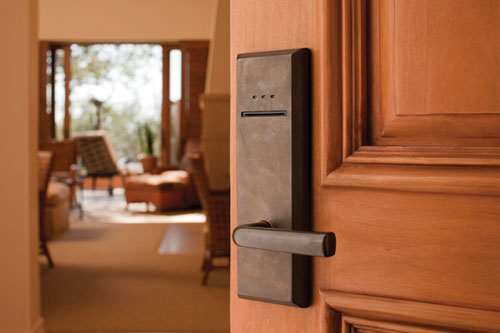 |
Bronze is actually an alloy or a mix of several different metals that are heated together to create a superior material. The individual metal components and their ratio vary based on the desired quality and color. Commonly, bronze is a mix of copper and tin, but fine art-grade bronze is predominantly a mix of copper and zinc with other elements added in smaller quantities. For architectural hardware, two art-grade alloy compositions are common that are suitable for high-quality installations that are both decorative and functional. The first and probably the most common composition is referred to as “silicon bronze” even though it contains only 4 percent silicon compared to 6 percent zinc content and the remaining 90 percent, or the overwhelming majority, coming from copper. This produces the commonly pictured coppery gold color that ages to a deeper, rich color that most people associate with bronze. A second popular choice for hardware where lighter natural colors are desired is referred to as “white bronze” or Tombasil. This alloy composition contains much less copper at 56 percent content, but much more zinc at 24 percent content. In addition, manganese (13 percent), nickel (5 percent), aluminum (1 percent), and lead (1 percent) are added to create the desired silvery color and other properties.
While different in color and other finish features, both types of bronze alloy described above have enjoyed popularity due to many favorable attributes, including:
Durability
Bronze is a non-ferrous material, meaning that it doesn't rust the way iron and steel can. In this way it can be superior to iron in many applications. Since it is also considerably less brittle, it will not bleed the way iron will. Further, it also conducts heat and electricity better than most steels. All of this allows bronze to achieve its well-known long-lasting durability. Bronze artwork and architectural elements in particular have been commonly known to last for centuries, making it a very sustainable metal with a very long service life.
Corrosion resistance
In addition to being extremely durable, bronze offers excellent resistance to corrosion. This trait is further helped by its ability to develop a naturally occurring coating, or natural patina that forms on the metal due to the oxidation of the alloy. This thin oxide layer protects the underlying metal from further corrosion. By forming this protective surface film, bronze, like most copper alloys, resists many corrosive environments.
 |
All bronze castings start with the creation of pattern by carving it out of wood or plastic.
Photo by Rocky Mountain Hardware |
Fatigue resistance
Since bronze oxidizes only superficially, it resists metal fatigue and corrosion (especially seawater corrosion) better than steel. As a particularly dense alloy, it offers high-strength capacity in stressful environments.
Lower melting point
Copper-based alloys such as bronze have lower melting points than steel or iron, and are more readily produced from their constituent metals. This lower working temperature and workability of bronze permit detailed and intricate working of the material to create final products. It also means that less heat is required to create the bronze which translates directly into less energy being required compared to the manufacture of other metals.
Easy care and maintenance
Ideally, bronze surfaces should not be treated with a harsh cleaner. However, to help it age gracefully, bronze can be cleaned with mild soap, water, and a non-abrasive cloth. A high-quality clear paste wax may be applied to protect the oxidized patina finish. It should be noted that the easy care of bronze contributes to its many sustainable features since the use of harsh cleaners is not required, saving time, money, and most importantly, the environment.
As a material, then, bronze has remained a reliable, durable, and sustainable material for a dramatically long time and continues to be so today using both time-tested and innovative manufacturing techniques.
Manufacturing with Bronze
The art of crafting bronze products to fit the image in an artisan's mind begins with the casting process. In general, art-grade bronze ingots are fired at temperatures of up to 2,200°F and are hand poured from a crucible into a mold, creating the raw bronze shapes referred to simply as castings. Once cooled, these castings are then given to the experienced hands of skilled craftsmen for detailed finishing of every surface.
There are two fundamental methods of creating bronze castings for architectural hardware—sand casting and investment casting, both of which are described further below. The principles involved in each are not new, but rather, have been gleaned from processes used since antiquity.
Sand casting process
Sand casting is one of the oldest and most efficient forms of casting dating as far back as 4000 B.C. It is very diverse, and responsible for nearly 90 percent of the world's castings, ranging in size from less than an ounce to hundreds of tons. Its popularity is likely based on the fact that the sand casting method can be used to duplicate a bronze work repeatedly and usually in significant numbers. Though the basic process remains the same, many technological advances have been made to produce the high-quality casting commonly seen today.
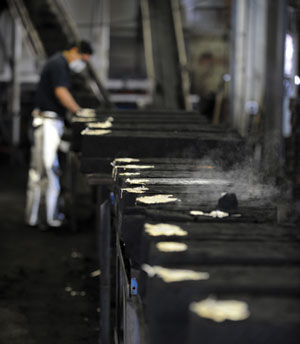 |
Sand molds are formed using pattern boards and then filled with molten bronze to create products using the common sand casting process.
Photo by Rocky Mountain Hardware |
Each piece of a bronze product, such as hardware, begins life in a pattern shop where craftsmen first hand-carve wood or plastic versions of the product. The resulting item is then used to create a permanent three-dimensional “pattern board” of numerous parts that can be re-used hundreds or even thousands of times. These pattern boards are used to create the sand molds to cast bronze pieces.
First, the pattern board is locked in the middle of a two-sided metal mold or “flask.” Next the flask is filled with sand which is prepared by mixing it in a muller where clay and water are added to achieve the desired strength and moisture level that will make it rigid enough to hold its shape during the casting. The prepared sand from the muller is added to the bottom of the flask and is compacted tightly to the pattern board. Then the flask is flipped over and the process is repeated on the other side. The idea is that sand mold halves are created on either side of the pattern board forms. This usually means that the two sand form halves are brought together along a seam or parting line and held together for casting.
Finally, when the sand mold is ready, it is removed from the flask and stands alone with the shapes of the desired product formed as cavities inside the mold. Bronze ingots and scrap bronze are then melted down to the proper molten pouring temperature, (approximately 2,000°F), and poured into the molds until they fill the internal cavities. After the molds have cooled and the bronze has solidified, the sand is simply pulled away while the remaining bronze casting is removed by hand and set aside to cool. The sand itself is reclaimed at this point going on to be re-conditioned and re-used repeatedly in the manufacturing process, thus avoiding any waste or by-products. The bronze castings then leave the foundry to be worked on by hand where every part is ground down to remove any unwanted parting line ridges caused by the mold pieces. In the process, nothing is wasted—scrap metal and filings are melted down and used once again.
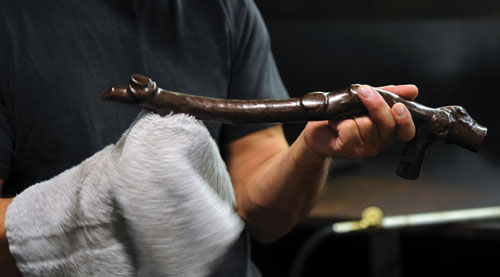 |
Cast pieces are finished and polished by hand.
Photo by Rocky Mountain Hardware |
Investment casting process
Investment casting, also known as lost wax casting, is another form of traditional metal casting and is considered to be one of the oldest manufacturing processes used. The Egyptians are known to have made jewelry for their pharaohs through this process some 5,000 years ago. Originally beeswax was used but contemporary methods use a high-technology wax. Unlike sand casting, investment casting yields only a single piece because the mold needs to be destroyed at the end of the process to remove the cast. However, this process is inherently more controllable and allows for more refined pieces to be cast with greater and finer detail than with sand casting.
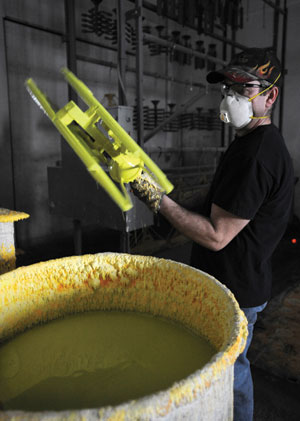 |
During the investment casting process, wax pieces are combined onto a "tree" of parts and dipped repeatedly into a ceramic slurry to create a ceramic mold.
Photo by Rocky Mountain Hardware |
Investment casting also starts with patterns to create two-part metal molds made up of a top and bottom. Warmed liquid wax is injected into the mold and after it cools, the resulting solid wax parts are removed from the mold; these mimic the final bronze product exactly. From there, each wax part is carefully attached to a tube or runner with a funnel-like pour cap at the top to create a “tree” of multiple wax parts. This wax tree is the basis for creating a final ceramic mold for casting. To do this, a cold slurry of ceramic material is prepared for the tree to be dipped into numerous times. After each dipping, the excess slurry is drained off, leaving the tree coated with a fine ceramic layer which is left to dry overnight or longer. Each dipping adds to the thickness of the mold until the desired shell thickness is achieved, at which point the wax is then removed (or “lost”) by flash steaming the trees in an autoclave. The melted wax drains out the bottom and is saved to be reused. The remaining ceramic mold now has cavities in the exact shape and pattern of the bronze pieces to be cast connected to the tube and pouring opening. While this method can produce many parts in each batch, it obviously takes much longer than sand casting to make each mold due to the multiple dippings and time between them for drying.
The next step is to place the ceramic tree into a kiln or furnace to harden it, much like firing pottery. This also preheats the ceramic molds to prepare them for the casting process. Hot molten bronze is then poured into the top of the ceramic mold and flows into the cavities previously formed by the lost wax shapes, producing the same forms out of metal. These molds are allowed to cool but now the metal is trapped inside the ceramic instead of the wax. Hence, the ceramic needs to be destroyed and removed by breaking it away either with simple hand tools or by pressure washing. The result is that each metal piece is extracted and is then ready to move onto final finishing processes.
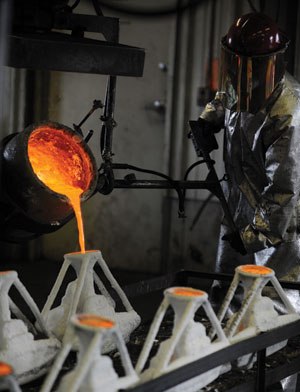 |
The completed ceramic molds receive the molten bronze and are broken away after the bronze cools to reveal the finished cast product.
Photo by Rocky Mountain Hardware |
Patina process
Patina is a natural process common with many non-ferrous metals that occurs when the metal interacts with the atmosphere and oxidizes, forming a thin protective layer on the metal. Bronze is one such metal that will naturally oxidize over time, thus changing the color, sheen, and texture of the surface. Factors that affect this ongoing aging process include time, touch, climate, and exposure to elements. The patina will continue to evolve at a natural rate based on these factors and actually helps to protect the surface of the metal, thus adding to its longevity and durability.
Recognizing the appeal of different patina colors and textures, manufacturers have developed ways to create these variations during manufacturing and get a substantial head start on nature. It is common for them to offer products with hand-applied patinas that bring a desired aged appearance to bronze hardware that enhance the hues and deep beauty of the bronze. Note that both silicon bronze and white bronze can be finished in either a brushed, light, medium, or dark patina. Rust-colored patina can be applied to silicon bronze only.
Manufacturers offer numerous finish and design options to complement a range of architectural styles, from rustic organic, to Tuscan, to more contemporary lines. As a result, architectural bronze hardware provides almost limitless design potential for today's designers and architects.
Green Characteristics of Bronze Products
Using bronze hardware gives the architect/designer/specifier a viable option to use sustainable materials while maintaining the desired aesthetic in both residential and commercial projects. Among the things to consider are the following:
Life cycle analysis
Life cycle analysis (LCA) is a standardized tool used to assess the environmental characteristics of building products. An LCA starts with an inventory of natural resource consumption (mining and energy resources), substance emissions (into the air, water, soil) and waste produced at each stage of the product's life cycle. The long life expectancy and durability of bronze contributes to its ability to perform well in an LCA. Further, specifying recycled bronze products allows even better LCA results.
Reducing embodied energy in materials
Bronze production is friendlier to the environment than ferrous metals due to its comparatively lower level of embodied energy. Embodied energy includes the total amount of non-renewable energy needed to create one unit of a finished product, including raw material extraction, transport, manufacturing, assembly, and installation. Using recycled copper and other materials eliminates the need for energy related to the raw material extraction. Manufacturing at a lower temperature than ferrous metals or aluminum means that less energy is required during this process as well.
Recyclability
Bronze is 100 percent recyclable both from a pre-consumer and post-consumer standpoint. Hence it eliminates further the need for future additional mining and extraction while maintaining its desirable qualities and attributes. Further, it is entirely realistic to specify a high recycled content up to 90 percent (based on fully recycled copper) or even 100 percent of recycled art-quality bronze. This is typically post-consumer material that has been reclaimed from existing buildings or other uses of copper. Scraps generated during manufacturing that are picked up off of the factory floor and are reused in the process are also common pre-consumer recycled content.
Selecting low-emitting or no-emitting materials
Part of the beauty of bronze comes from its natural coloration which means that no additional paints, sprays, or other treatments are needed. As a result, manufacturers, fabricators, installers, and users will never need to apply any other coatings on the metal. Consequently, no volatile organic compounds (VOCs) ever need to be introduced that might generate emissions which are contrary to healthy indoor environmental quality.
Green manufacturing
It is increasingly important to specify products that are produced by companies that are committed to an environmentally sound green philosophy, both as a matter of corporate policy and corporate culture. When specifying, consider manufacturers that have adopted sustainable manufacturing practices, such as recycling bronze scraps from casting and machining processes, purchasing recycled wax for their investment casting process, and reconditioning the sand in their foundry from the sand casting process.
Regional manufacturing
Bronze architectural hardware products are made in U.S. locations meaning that they may well be within a region local to many projects. In that instance, they can contribute to regional materials in a building, particularly if calculating by cost or weight.
Healthy environments
An emerging consideration for high-use hardware is the health concerns of many hands touching handles, knobs, etc. and transferring bacteria or other germs from one person to another. Bronze hardware can help in this regard since it contains inherent antimicrobial properties. The high copper content of bronze has been shown in numerous studies to actually kill bacteria, thus reducing the risk of transfer. Recognizing this emerging concern, some decorative hardware companies are now certified to cast hardware and accessories using a particular EPA-approved bronze alloy which has been specifically shown to kill bacteria.
Hospitality Applications of Bronze Door Hardware
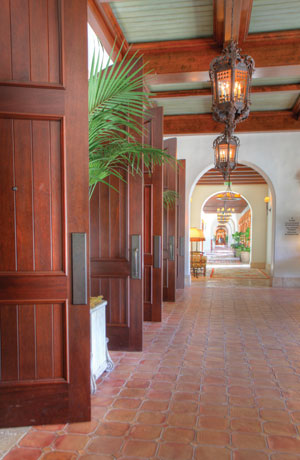 |
The antimicrobial properties of bronze make it ideal for use in areas where many people touch the same hardware and potentially transfer bacteria.
Photo by Rocky Mountain Hardware |
With a basic understanding of bronze as a material and its green characteristics, let's look specifically at the application of bronze architectural hardware in hospitality settings. Since this is a building type that typically receives around-the-clock heavy-duty use, materials such as bronze that are durable, long lasting, and require little or no maintenance are quite appropriate choices. Further, since most manufacturers offer very flexible design options, it is particularly appropriate for multiple properties where readily identifiable looks and branding of the buildings are important. Likewise, since custom fabrication is the norm, unique designs for stand-alone or boutique installations are also readily achievable.
The most common bronze application is in door hardware. Since this is a broad term that covers a lot of different types of products and parts, each are discussed separately below while describing their purpose and function in standardized language in the hardware industry.
Lockset is the overall term to describe locking hardware on a door and is typically made up of multiple pieces, both visible to the user and concealed inside.
Lock trim refers specifically to the visible portions of the lockset that is usually attached to the surface of the door and can vary interchangeably with other parts of the lockset, including:
- Escutcheon—the back plate that attaches to the door.
- Swing cover—the flap that covers the cylinder or the emergency release access.
- Thumb piece—the part that retracts the latch bolt on a thumb latch entry lockset.
- Handle—part of the hardware set that is pulled or rotated to open/close the door. Handle options include grips, levers, knobs, or ring pulls.
- Turn piece—operates the dead bolt or mortise bolt on the interior side of a locking set.
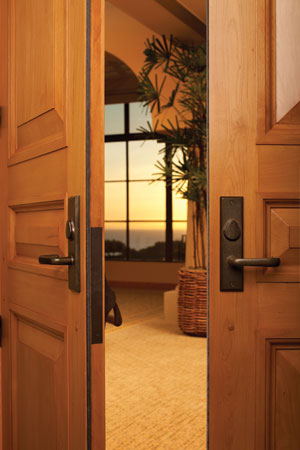 |
Bronze architectural locksets are made up of multiple parts and pieces that are combined to create a final installed product with different functions, trim, and applications.
Photo by Rocky Mountain Hardware |
Lock functions. The function of a lockset is the manner in which it operates and can be any of the following:
- Entry function—typically used on primary exterior doors. This type of locking set has operable handles with a keyed cylinder on the exterior side of the door and normally a turn piece on the interior side. Double cylinder sets are available that have a keyed cylinder on both sides of the door.
- Dummy function—A single dummy set has inoperable handles on one side of the door, while a full dummy set has fixed handles on both sides of the door. Dummy sets are typically used in conjunction with roller catches, flush bolts, or surface bolts.
- Push/pull function—A push/pull set has inoperable grip handles and/or escutcheons and can have locking mechanisms in single cylinder, double cylinder, or patio applications. They are typically used for commercial applications.
- Privacy function (spring latch)—This set is locked by a push button on the escutcheon from the interior side of the door and can be unlocked from the exterior side by an emergency release key.
- Privacy function (mortise bolt or mortise lock)—Generally used on bedroom and bathroom doors, privacy sets are available with mortise bolt or mortise lock mechanisms. They are characterized with operable handles that are locked by a turn piece from the interior side and may be unlocked by an emergency release key from the exterior.
- Emergency release—refers to the capability of a lock to be unlocked from the exterior side in case of an urgent situation and is a common feature of most interior privacy locksets.
Lock mechanisms are defined as the portion of the lockset operated by the handles, cylinders, thumb latches, and turn pieces. Types of lock mechanisms include:
- Dead bolts—A dead bolt locking mechanism is separate from the latching mechanism in a door set and can be locked by a key or a turn piece. Some manufacturers can provide separate dead bolt trim that is used above a handle set or can incorporate the dead bolt and handle trim onto the same escutcheon.
- Mortise bolts—Also separate from the latching mechanism, a mortise bolt mechanism is operated by a turn piece. It is commonly used for interior applications to provide privacy on bedroom and bathroom doors.
- Mortise lock—This mechanism incorporates the locking and latching mechanisms into a single cartridge style lock. The mortise lock is available in a range of lock functions, such as entry, patio, privacy, and passage.
- Spring latch bolt—A spring latch bolt mechanism is operated by the door handles.
- Multi-point lock—Some applications require mechanisms that latch the door at several points along the length of the door, rather than at a single point near the door handle. Multi-point locks are available in a variety of styles and are generally provided with French doors made by most of the major window manufacturers.
Cylinders. The cylinder is the portion of a lock where the key is inserted to lock or unlock the set. Types include:
- Mortise cylinders—A mortise cylinder is utilized with a mortise lock, and they are available in various lengths for different door thicknesses. They are threaded into the lock and secured by a set screw through the edge of the lock.
- Rim cylinders—Used in dead bolts, a rim cylinder is mounted with screws from the opposite side of the door. Rim cylinders do not vary in length, but the mounting screw and tailpiece lengths vary according to door thickness.
- American or U.S. cylinders—This refers to the type of cylinder used with several types of multi-point locksets. These cylinders are attached to the escutcheon and do not vary in length, but the tailpiece length varies according to door thickness.
- European profile cylinder—The other type of cylinder used with multi-point locksets is the European Profile cylinder. Unlike the American or U.S. cylinder, this mechanism does vary in length to accommodate different door thicknesses. To install, they slip through the exterior escutcheon, the door, and the interior escutcheon and are held in place by a set screw through the edge of the lock.
Electronic key locks are fairly standard in the hospitality industry and are available in bronze from some manufacturers. Solutions are available that are designed to meet the needs and stringent standards of the luxury hospitality market. The broad product selection includes entry grips and pulls and electronic card lock trim in a variety of escutcheon styles and levers. Electronic card lock trim integrates the traditional durability and beauty of bronze with the advanced security features of an electronic locking system.
Specialty locks. Other specialty lock products are available and include hardware for screen doors, gates, or other special use openings. The durability and customizability of bronze makes it ideal for such special applications like this.
Door accessories. Many different bronze door accessories are readily available and complement the lockset with matching appearance and continuity of design themes including:
- Bolts—Door locking mechanisms include surface, cane, and flush bolts, available in 12-in. to 30-in. lengths. Surface bolts are offered with a choice of universal, mortise, or angle strike.
- Butt hinges—This refers to hinges that attach one leaf to the jamb and one leaf to the edge of the door.
- Clavos—Available in a variety of sizes, clavos are decorative nails that are typically applied to the surface of the door.
- Strap hinges—Providing unique aesthetics, strap hinges are available in various sizes. They are installed similarly to butt hinges: One leaf is attached to the surface of the jamb, and one leaf is affixed to the surface of the door.
- Ornamental hinge straps—Designed to mimic the look of a functional strap hinge, and available in a range of lengths, an ornamental hinge strap is a decorative piece of metal that is installed on the surface of the door.
-
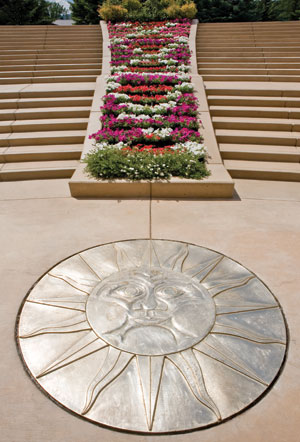 |
Custom cast bronze pieces can be created to form decorative pieces, logos, or other artistic pieces.
Photo by Rocky Mountain Hardware |
Flush pulls—These are recessed pulls used on sliding doors, such as bypass or pocket doors. Edge pulls are utilized to retrieve a pocket door from the pocket. Note that pocket doors are well suited for dining rooms, master bathrooms, kitchens, or anywhere floor space is at a premium, because they will free up valuable wall and floor space.
- Miscellaneous—Other bronze door accessories include door knockers, floor door stops, baseboard door stops, kick plates, corner brackets, and hook & eye hardware.
In addition to the architectural hardware applications described above, there are other hospitality applications for bronze that can be far reaching and can contribute to the overall look and design intent throughout a facility. These items allow a design theme to be further incorporated into a project, while carrying the same sustainable benefits as the hardware.
In bathrooms, this would include bronze sinks with bronze faucets. As long-lasting, non-rusting components of an overall design, they can be specified in a wide range of shapes and styles that complement the needs for performance and durability. Bronze light fixtures are also a possibility that can be custom fabricated in a wide variety of patina colors and finishes. The reflectivity of the finished metal can be selected to create the appropriate lighting quality of the fixture.
Bronze is also used to create handcast solid or decorative wall tiles. These tiles can protect wall surfaces and provide a low-maintenance alternative in high-use areas. Similarly, manufacturers can also produce unique customized bronze pieces that meet a facility owner's specific design requirements for custom or ornamental decoration, signage, logos, or other artistic pieces.
| Pelican Hill® Resort |
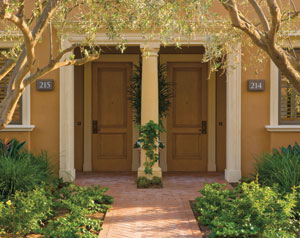 |
The Pelican Hill® Resort focused on a consistent design throughout the facility that included all bronze hardware on crafted wood doors.
Photo by Rocky Mountain Hardware |
Pelican Hill®, developed by the Irvine Company, is an extraordinary AAA Five-Diamond Destination Resort, located on the coast of California in Newport Beach. First opened in 2008, it offers guests 204 bungalows, 128 two-, three- and four-bedroom villas, a golf clubhouse, three restaurants, two café’s, a renowned spa, 20,000 square feet of meeting and event space plus a 136-foot-diameter “Coliseum” pool. The resort also features 36 holes of Tom Fazio-designed golf.
Pelican Hill® was not only inspired by the work of renowned Italian Renaissance architect Andrea Palladio, but also built upon his philosophical pedestal: The creation of an architectural masterpiece is in the countless details, and in striving for perfection. From conception through grand opening, Pelican Hill has mandated an emphasis on detail believed to be unprecedented in the resort world.
The design team was made up of a variety of firms that included Altevers Associates of San Diego, Calif., for the hotel, clubhouse, and public facilities plus Robert Hidey Architects of Irvine, Calif., for the bungalows and villas. Andrew Skurman Architects of San Francisco served as the interior architect with Darrell Schmitt Design of Los Angeles engaged as the interior designer. CalPac Construction executed the work. The overall design goal was two-fold: to achieve an authentic adaptation of Palladian architecture that is aesthetically pleasing, timeless, and perfectly suited to the coastal California setting; and to ensure the perfect guest experience, where every aspect, step, and moment of a guest’s stay is comfortable, satisfying, and uplifting.
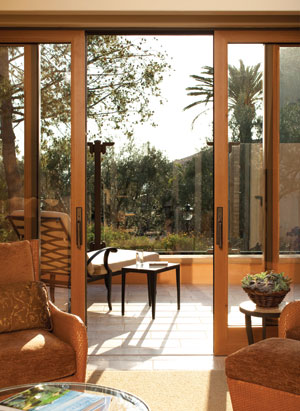 |
Interior view of a room at Pelican Hill with bronze patio door hardware
Photo by Rocky Mountain Hardware |
Numerous design, construction, and process details went into achieving this successful result including the use of hand-cut and carved limestone from Italy for all fireplaces in public areas, bungalows, and villas. It also included the use of specialized artisans who were brought in to create classical doors and windows, crafted of wood with all bronze hardware. In fact, this was a perfect project for bronze hardware from a single supplier because the goal was to maintain a consistent design quality throughout the entire project—from entry hardware in main common areas to electronic card lock trim on the guest doors all the way down to the patio door hardware. Further, the selection of recycled bronze hardware added to the positive life cycle and other sustainability benefits that will be realized by the owners for many years to come. By working closely with the hardware manufacturer, the design team was able to carry out the selected designs using both mainline and custom products. The regional representative was instrumental in making this project as seamless as possible, from concept through completion.
During construction, continuous experimentation and testing of materials, textures, colors, and applications, under the direction of consultants with specific Italian expertise went on for many months as part of a master plan to create the authentic look and feel of classical Italy for all interior and exterior surfaces and settings. Accordingly a dedicated mock-up yard was used where the different colors, surfaces, and materials were developed, tested, and finalized before being applied to the actual construction. This included the selection of color and antiquing of roof tiles to replicate those on older Italian buildings. Lime-based Italian plaster was used on interior and exterior walls, requiring adjustments throughout construction because the color evolves as it dries and ages. And all door hardware was selected based on using silicon bronze with a medium patina to blend with and complement this rigorous attention to materials, color, and the overall experience of being a guest at this world-class hospitality facility. |
Conclusion
Sustainable, recycled bronze is an excellent fit with the operational demands and aesthetic quality associated with hospitality settings. Manufacturers' standard products are readily available and span a full range of architectural hardware, plumbing fixtures, and lighting. Further, custom and specialty pieces are very possible to reflect unique identity and brand of hospitality facilities. Overall, it is a material choice that can contribute positively to the overall design intent of a given facility and its long-term successful operations.
 |
| Rocky Mountain Hardware manufactures handcrafted bronze architectural hardware for both residential and commercial applications. Each piece is cast from art-grade bronze with a minimum of 90% post-consumer recycled content and is available in 10 patina finishes. Its entire collection, from entry hardware to sinks, is proudly made in the USA. www.rockymountainhardware.com |