This CE Center article is no longer eligible for receiving credits.
BUILDING APPLICATIONS
We have noted that the array of beneficial characteristics of sintered compact surfaces make them well-suited for a variety of building applications, both interior and exterior. Interior designers and architects are finding them ideal in many cases for new or existing interior wall and floors coverings, where durability, appearance, and cleanliness are important. In addition, those designing kitchens, bathrooms, and work counters like the product for its nonporous and hygienic qualities. There are even specialty fabricators, such as cabinetry, furniture, or modular construction companies, that are all starting to incorporate sintered compact surfaces into their line of offerings.
While interior applications are growing, it is the exterior applications on building facades that are garnering more and more attention. Using a thin panel type of material for a facade has been the basis for numerous wall assemblies, particularly those that rely on wood or steel framing for the structural support and need an exterior weathering surface. Sintered compact surfaces are ideal for this type of lightweight but durable system, coming in below 5.5 pounds per square foot for ½-inch-thick panels and easily compatible with insulated, framed wall assemblies. Further, with the growth in the need for continuous insulation in exterior wall assemblies to comply with energy codes and ASHRAE 90.1, even concrete and CMU block construction can benefit from using sintered compact surfaces. The sintered products can readily cover the face of the insulation, creating a full cladding surface, and be applicable to almost any of these types of wall construction.
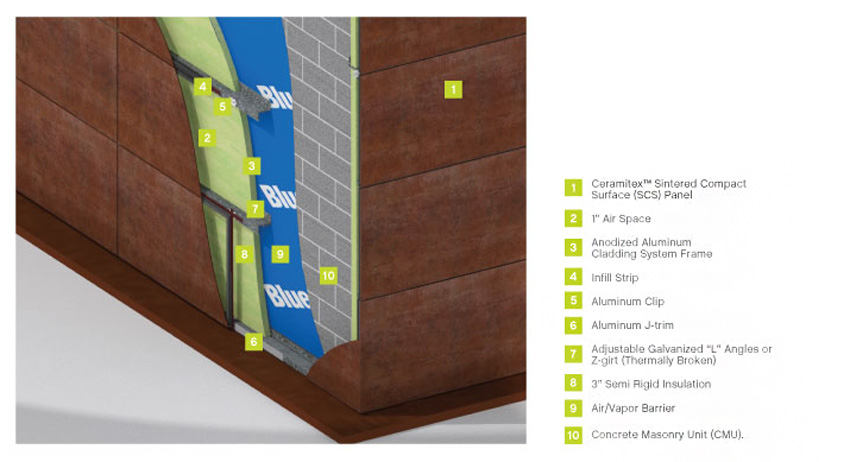
Cladding materials and panels are commonly secured to a building using vertical aluminum L or T channels secured with adjustable aluminum angle clips.
The key to successfully using a panel for the outermost surface for any exterior wall assembly option is the method of attaching or securing the panels in place. Within the general building industry, the common approach is to use an aluminum support system of vertical and/or horizontal channels or tees that are secured to the building structure with adjustable aluminum clip angles. In this way, the support system carries the weight and wind load of the cladding panels and transfers it directly to the building structure, which can readily be designed to accept it. The depth and spacing of the clips and channels can be designed to allow for continuous insulation to be installed between them and satisfy thermal envelope requirements. The channels provide vertical support using T- or L-shaped profiles depending on whether they coincide with the joints between panels or reinforce the center of the panels.
When it comes to attaching the panels to the support system, there are four common methods of attachment, and they are all appropriately being used with sintered compact surfaces. Since they each have different common applications in terms of building type and they also vary in their impact on the detailed design of the wall system, each of the four systems are discussed further as follows.
Chemically Bonded System
In the simplest form, panels can be attached using adhesives to create a chemical bond between the panel and the support system. This is most appropriately done on low-rise residential buildings where, in some cases, it may be possible to adhere the panels directly to an underlying, smooth substrate. More commonly, the panels can be adhered to the aluminum support system using an elastic chemical adhesive in the form of a tape system or applied adhesive. Such systems are commonly based on tested and certified materials and assemblies.
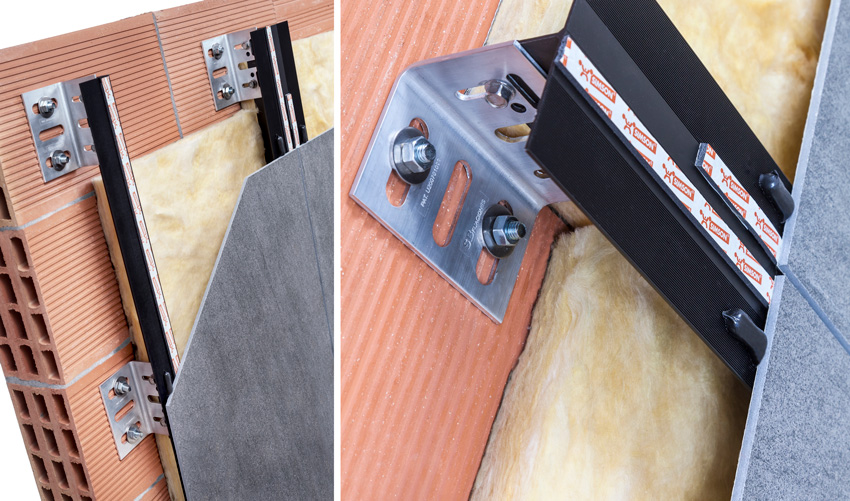
A chemically bonded system uses chemical-elastic anchoring with tapes or adhesives between the sintered compact surfaces and the support system.
There are a number of benefits of chemical-elastic anchoring, not the least of which is the completely hidden method of assembly. The anchoring is done completely on the back side of the panel, which means the panel joints are all that is seen on the face. From a performance standpoint, this type of mounting uses the continuous nature of the chemical-elastic anchoring to distribute stress evenly, preventing any concentration of stress in the adhesion surface and minimizing critical points where ruptures could begin. The flexibility of the system reduces or eliminates the transfer of vibrations between materials in contact and helps prevent failure in the connection due to fatigue. The non-conductive properties of such anchoring enables the connection of different types of materials and prevents galvanic corrosion.
Visible Mechanical Support System
In some cases, it is desirable to have a full mechanical support system that wraps over the edges of the panels with exposed clips or clamps. Such systems have been developed for sintered compact surface facades based on using visible support squares or safety clamps to which the panel edges are secured. With these support square clamps, it is possible to adjust the location of the panel and achieve proper levelling. The support square clamps are secured to the vertical sections of the support system, commonly with stainless steel screws, allowing the panels to be quickly and easily replaced if needed. To ensure the stability of the system, a line of elastic adhesive can be placed all along a vertical T-profile support. This elastic adhesive also improves the system’s reaction to wind pressure or suction and loads since the possible vibrations caused by these forces are absorbed by this adhesive.
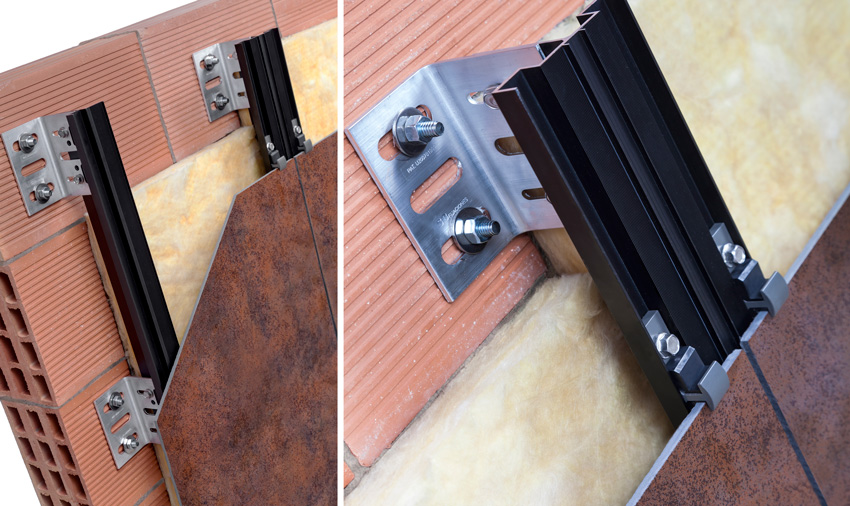
A mechanical support system with visible connectors or safety clamps can secure the edges of the panels in place and use chemical-elastic adhesive for additional security.
Non-visible Mixed Systems
There are many cases where using concealed fastening is preferred so that no clips or anchors are visible on the facade. There are several choices in this regard. The first is to use a support system designed to connect to the unexposed, rear side of a sintered compact panel. This approach is available from manufacturers based on creating angled grooves in the back side of the panel and securing horizontal aluminum channels into the grooves. In at least one case, this is achieved with a double groove at opposing 45-degree angles (like a dovetail in carpentry terms), where two aluminum profiles are inserted and fixed with structural adhesive to secure the channels to the panels. The connected channels are then secured to the aluminum support system holding up the whole facade. The panels can then hang and be levelled either to align with adjacent panels or be staggered without needing to increase the number of vertical supports. In all cases, this method of attachment allows the support system to become invisible due to the concealed fastening and aluminum members. This approach also eliminates the risk of panels separating from the structure in the event of breakage, which is why this system is considered to be among the most secure available on the market. This system also allows for easy removal and replacement of panels when necessary.
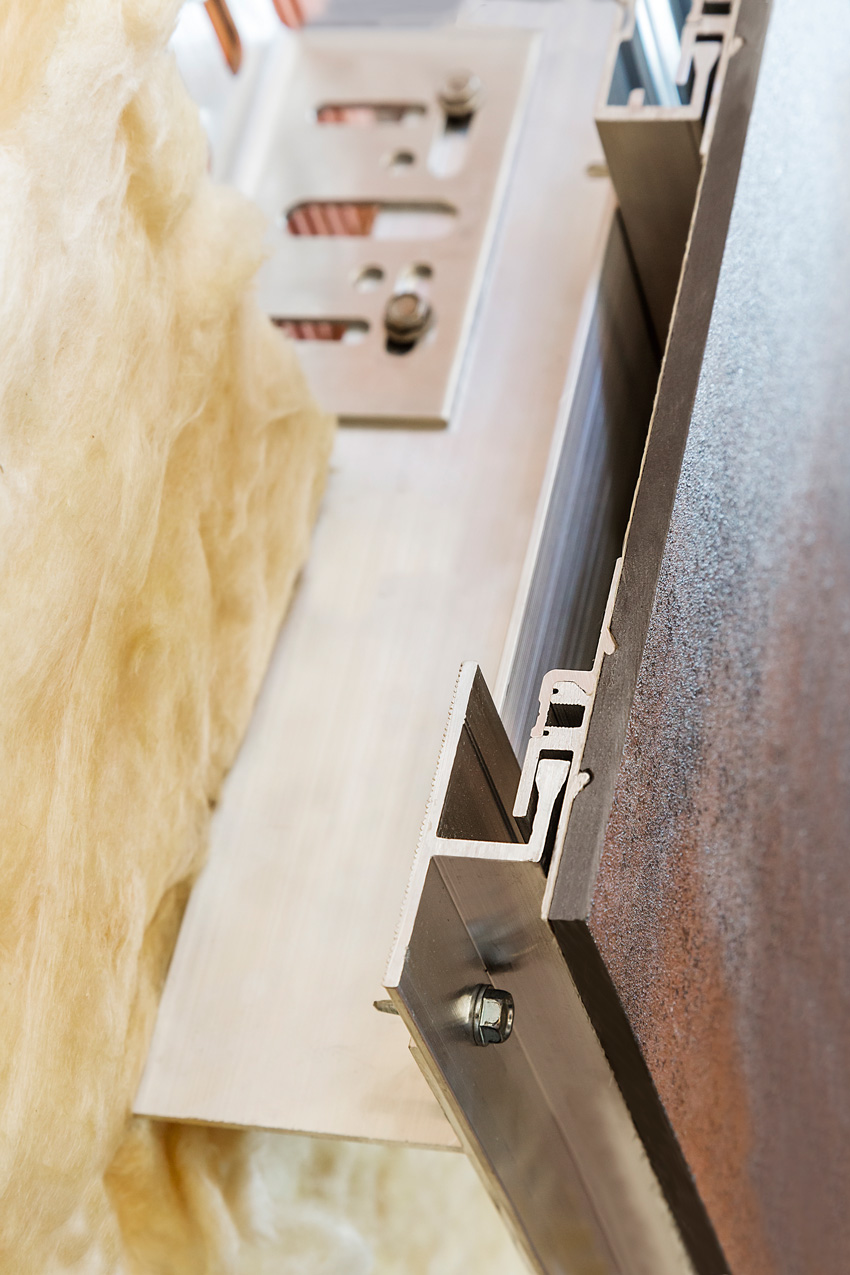
A concealed mechanical support system currently available relies on grooves being placed in the back side of sintered compact panels and aluminum support channels inserted and secured.
Another way to incorporate sintered panels into a facade with concealed mechanical attachment is to use them as spandrel panels in a curtain wall system. In this scenario, it is the curtain wall that is secured to the structure with metal clips and anchors and creates the frame for the facade materials to be inserted. In many cases, that is glass of one type or another. However, curtain walls increasingly contain insulated sections with opaque surfaces for energy code compliance, aesthetics, or both. The thin and lightweight nature of sintered compact panels allows them to be readily substituted for glass in a curtain wall system, often with the same detailing. The sintered compact panels simply fit into the curtain wall where the glass would have otherwise gone. Further, they can fully conceal and protect the area behind the panels, allowing those portions of the wall to be fully and continuously insulated.
Ventilated Rainscreen Systems
A popular building facade design approach is to use a rainscreen system, which works on the principle of separating the exterior cladding from the full wall assembly. The space between the two is intentionally designed to allow for air to enter and ventilate the wall as well as allow any water that enters to drain out of the bottom and away. The assumption is that rather than try to completely isolate water from penetrating the walls, some water or moisture will indeed get in at some point, so go ahead and plan for its escape. The idea is that the cladding is simply the first line of defense against the weather and the full air- and water-sealed wall surface behind it is the second. Any of the three sintered compact surface systems described so far can be used to create such a ventilated rainscreen on a building with very favorable results.
For tall buildings subjected to higher wind loading, ventilated rainscreens need to be looked at a bit closer. Higher wind loads mean more pressure is applied to the exterior cladding, and that can cause problems either to the cladding or the systems behind it. The solution is a pressure-equalized rainscreen, which relies on creating smaller compartments across a facade rather than one continuous ventilation cavity. These ventilation compartments respond independently to constantly changing wind pressure. When wind-driven air enters openings in the bottom of the sintered compact panels and finds no way to exit, the air pressure inside the cavity matches the wind’s pressure and “pushes back” against it, preventing wind-driven rain from entering. If a small amount of rain is driven into the cavity, the same openings allow the water to drain. Since these systems perform well under severe conditions, they can be shown to meet the approval of specific regional regulations, such as Miami/Dade County for hurricane resistance and California for seismic concerns.
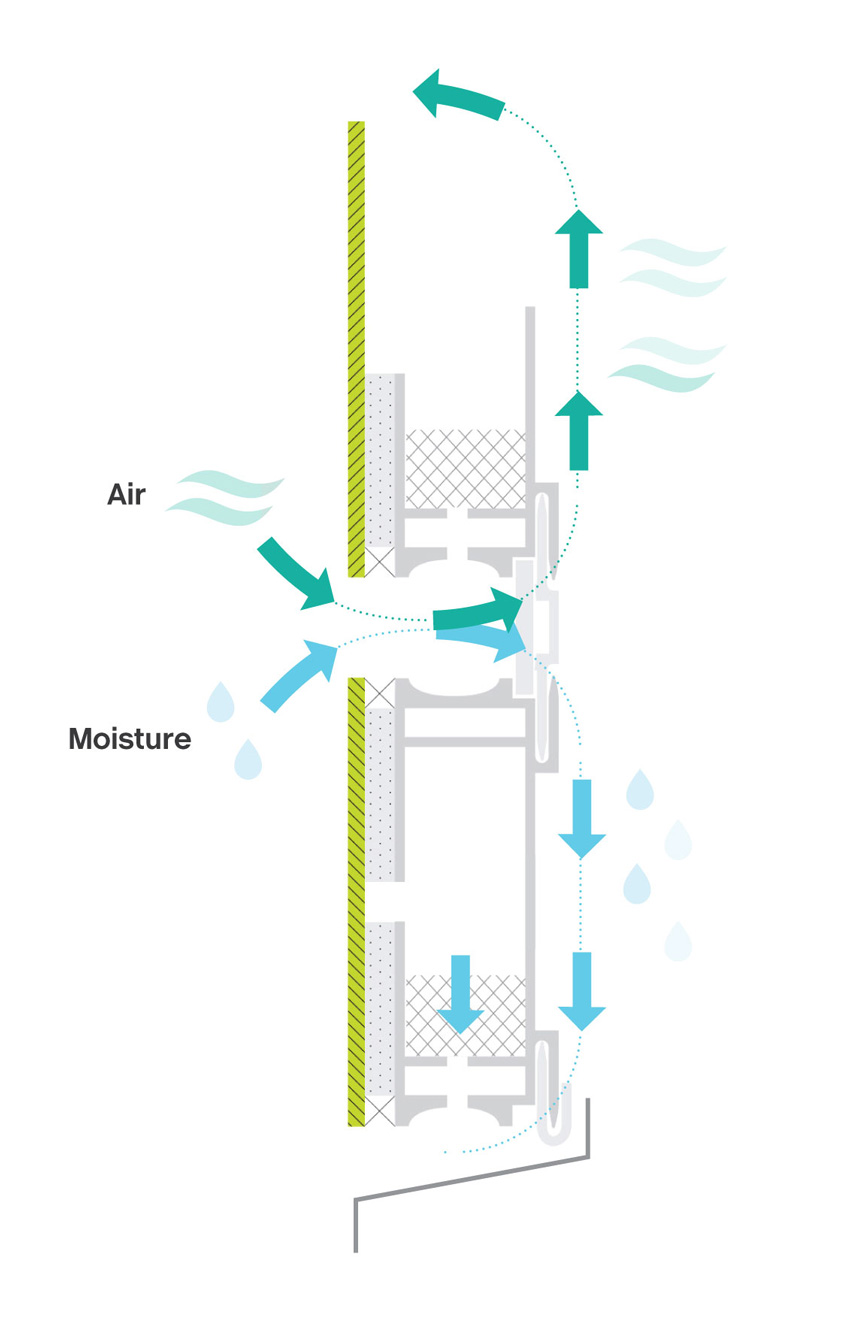
Pressure equalization in a rainscreen reduces the pressure difference across the cladding through the use of compartmentalization and back venting. Ingress of incidental water is reduced, and residual moisture is returned to the exterior at the drainage plane.
Installation
Regardless of the type of attachment system, it is important to install the support frame and the panels in accordance with manufacturers’ recommendations and instructions for specific application. In all cases, the large sizes available help reduce installation time, thus saving labor costs. Since it is a thin but durable product, it can be installed over existing surfaces, thus avoiding or reducing demolition and waste disposal activity and costs. This is readily done using one of the systems described above. Direct application onto an existing wall surface, however, will require an assessment for suitability and compatibility since some surfaces may not be appropriate. Nonetheless, as noted earlier, the very light size/weight ratio means that it can be installed on light-gauge metal framing wall systems
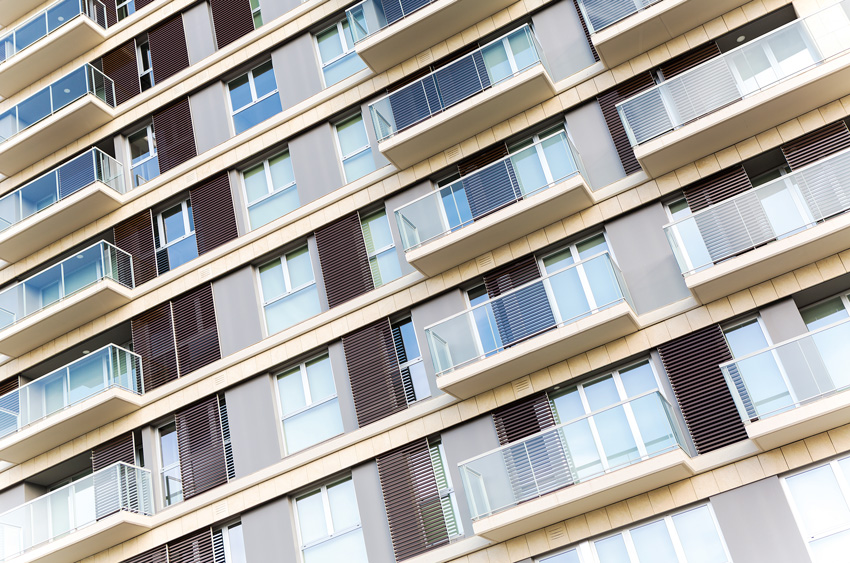
Materials used on building facades need to withstand many things, including water, wind, sunlight, and sometimes severe weather conditions. They also need to hold up to the effects of people who may inadvertently or even intentionally cause damage. Choosing a material to use for a facade is certainly influenced by the ability to hold up over time under all of these conditions. It is also influenced by the available size and weight, not to mention the appearance, of the material. Being able to install it in a manner that is efficient and cost effective usually rounds out the criteria for selecting a building material for building facades. Not surprisingly, there are number of different materials that have been available to select from, some of which have been around a long time, and others that are relatively new. There is one new product category that will be the focus of this course, namely sintered compact surfaces, which have been born in the last decade. As it is becoming better known, it is becoming more popular in the United States and Canada thanks to its ability to provide superior long-term performance for basically the same cost as other common facade cladding products. Sintered compact surfaces today are finding their way into curtain walls, rainscreens, siding applications, and other common wall systems for both residential and commercial buildings.
All images courtesy of Neolith by TheSize Surfaces SL
Building facades need to provide aesthetic benefits as well as stand up to a host of environmental and human factors over time. Sintered compact surface facades can meet all of those demands economically.
SINTERED COMPACT SURFACES OVERVIEW
While sintered building facade products may be new, the process of sintering is not. Sintering is a method for creating objects from powders, including mineral, metal, and ceramic powders. As such, sintering has been traditionally used for manufacturing ceramic objects, but there are common applications found across many industrial fields. The study of sintering and of powder-related processes is known as powder metallurgy and is fairly well-known. It is basically the process of using natural materials in powder form and processing them, usually under heat, pressure, or both, to create a desired product.
Looking more closely, sintering is based on atomic diffusion of particles, which occurs most quickly at higher temperatures. The atoms in powder particles diffuse across the boundaries of the particles, fusing them together and creating one solid piece. A simple observable example of sintering can be seen when ice cubes in a glass of water adhere to each other. The edges of the ice cubes, although not powder, can become irregular in the relatively warmer water surrounding it. The water atoms in each of the adjacent ice cubes react and bond together, even though they were originally separate.
Applying this sintering process to manufactured compact surfaces produces a thin, lightweight, and very strong material with properties similar to porcelain ceramic tile. The difference is that sintered products are made from selected natural minerals, with minimal amounts of water. This combination of powdered minerals, referred to as the compact, densifies first under pressure and then becomes nonporous during firing at temperatures below the melting point of the minerals. The powder particles thus bond together due to the applied pressure and heat, which force all surfaces of the particles to be directly connected to all of the surfaces of the adjacent particles, creating a very dense and strong end result.
As a building material, sintered compact surfaces provide a high-performance product with superior physical properties that can realistically be described as ageless in exposed outdoor applications, such as building facades. The material has a naturally high heat and fire resistance due to its all mineral composition. As a dense material, it is scratch and abrasion resistant and quite capable of withstanding even extreme abuse. The density means it is also very resistant to normal freeze-thaw temperature cycles. The material is even resistant to the ultraviolet (UV) rays of the sun, meaning the color and integrity of the surface will not degrade by being exposed to intense sunlight. And with a common porosity of less than 0.08 percent, it is virtually waterproof, meaning no extra sealers are required on the outside surface.
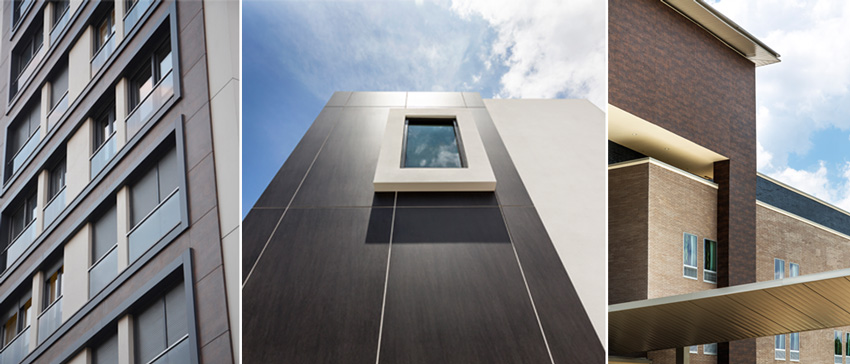
Sintered compact surfaces used on facades are available in a variety of colors, patterns, textures, and appearances.
From a building design standpoint, the surface of the material can provide the look of stone, tile, wood, smooth, or textured surfaces in a variety of colors and hues. However, it is lighter than many of the materials it can look like, weighing in at only 1.1 pounds per square foot for a 1/8-inch-thick panel. For those who maintain the building, they find the dense, nonporous surface easy to clean, including the removal of graffiti so the appearance and color are maintained over time. Even harsh chemicals aren’t a problem to use since it is chemical resistant. All of these design attributes have helped to promote its use not only on exterior walls, but also in interiors for floor and wall surfaces. The material has even been shown to be hygienic and suitable for food contact, which has also led to its use for countertops and food-handling surfaces.
With all of these high-performance and desirable characteristics, it is easy to have the misconception that using sintered compact surfaces for a building exterior is expensive. In fact, it is not. It has been proven repeatedly as being very cost neutral when looking at first costs and comparing it to many commodity facade products, such as aluminum composite paneling. When considering it over the life of the building and factoring in its anti-graffiti, impact resistant, and weather resistant agelessness, it readily lends itself to being an everyday common-sense solution for many architects and designers. Building owners are even quick to see its long-term cost-saving benefits when they realize that it is completely vandalism proof (scratch, paint/ink, impact) and virtually maintenance free for the life of the building.
MANUFACTURING PROCESS
Whether used for interior or exterior final applications, the manufacturing process to create sintered compact surfaces is the same.
Raw materials
Sintered compact surface materials typically require a combination of different materials mined from different locations. The specific materials are selected based on their ability to provide certain desired characteristics. Sand materials, such as silica, quartz, and feldspars, are used to provide hardness, strength, and chemical stability. In addition, some clay is used to provide elastic properties useful during manufacturing and finishing. To create different colors or chromatic properties in the final product, natural mineral pigments of different types can be used. Once all of these ingredients are located and mined, they are transported to the manufacturing facility, where they are stored until ready for processing. Since these are all natural materials, they can contribute to a green and sustainable design in the context of environmentally responsible mining practices.
Manufacturing Process
With the raw materials ready at the manufacturing plant, the first step is to prepare them into a spray dried mixture of sands, clays, and pigment. The mixture is then pressed to form an unfired slab ready to be decorated or colored to suit specific design requirements. The unfired slab needs to have a specific but limited amount of water in order to be pressed. The pressing process can require up to 15,000 psi to properly densify the slab.
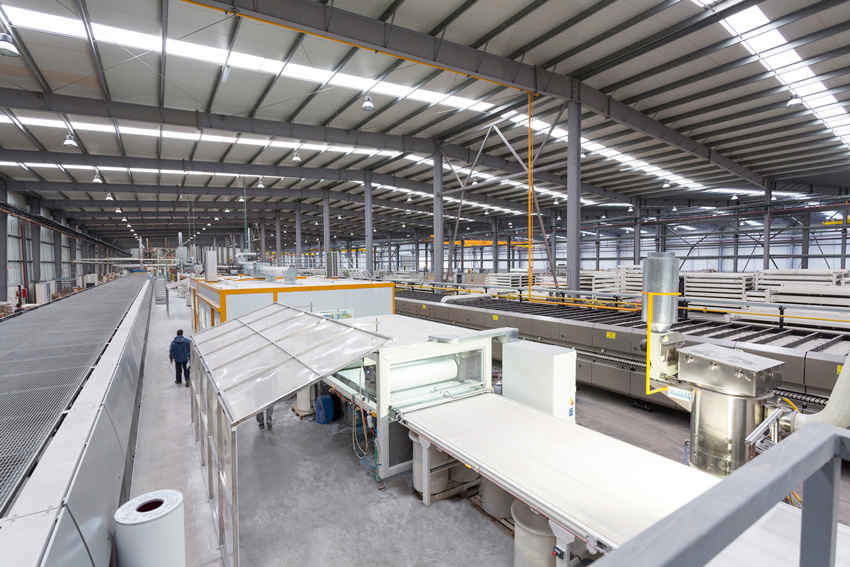
Sintered compact surfaces are manufactured from natural minerals and processed in plants using pressure and heat to create the atomic bond between particles.
Once a compact is ready, it can be fired in a large kiln at temperatures below the melting point of the minerals at normal atmospheric pressure. Due to vitrification, some limited shrinkage may occur in the slab during the firing process. This is the point where the sintering takes place, allowing the material to densify and become nonporous. Note that there is no extrusion involved as is common in other materials. Instead, the pressing plus the heat in a kiln produce strong, thin sheets in thickness on the order of 1⁄8 inch, ¼ inch, or ½ inch when finished. The thickness plus the overall face size of the sheets, or panels, can vary by manufacturer, particularly since many provide metric sizes due to their location in countries that rely on metric measurements. At least one manufacturer, however, offers non-metric sizes in 4-foot-by-12-foot and 5-foot-by-10-foot panels to match American construction sizes.
Fabrication
With the panels fully formed and ready for use, they can be fabricated either at the plant or in the field in a number of ways for specific uses. The so-called “raw slab” comes out of the kiln with rough edges so the slab needs to be squared and rectified before it can be used as a building material. Once that is done, the panels can be cut to specific sizes using wet diamond saws or high-pressure water jet machinery, all suitable for dense stone materials and providing a high degree of precision. In cases where the material is being applied to a corner, a mitered edge can be fabricated by cutting the slab at 45 degrees and 135 degrees using a bridge saw or waterjet. Then, the two pieces can be adhered together, creating a full mitered edge.

Corner conditions can be fabricated using sintered compact surface panels either by the manufacturer or in the field.
It should be noted that handling the thin panels is not much different than handling glass panels, although the sintered products are stronger. Nonetheless, even with the high flexural strength found in sintered compact surfaces, handling should always be done using appropriate handling equipment. That includes frames with mechanical suction cups to support and move the panels safely, just like moving glass or stone panels.
BUILDING APPLICATIONS
We have noted that the array of beneficial characteristics of sintered compact surfaces make them well-suited for a variety of building applications, both interior and exterior. Interior designers and architects are finding them ideal in many cases for new or existing interior wall and floors coverings, where durability, appearance, and cleanliness are important. In addition, those designing kitchens, bathrooms, and work counters like the product for its nonporous and hygienic qualities. There are even specialty fabricators, such as cabinetry, furniture, or modular construction companies, that are all starting to incorporate sintered compact surfaces into their line of offerings.
While interior applications are growing, it is the exterior applications on building facades that are garnering more and more attention. Using a thin panel type of material for a facade has been the basis for numerous wall assemblies, particularly those that rely on wood or steel framing for the structural support and need an exterior weathering surface. Sintered compact surfaces are ideal for this type of lightweight but durable system, coming in below 5.5 pounds per square foot for ½-inch-thick panels and easily compatible with insulated, framed wall assemblies. Further, with the growth in the need for continuous insulation in exterior wall assemblies to comply with energy codes and ASHRAE 90.1, even concrete and CMU block construction can benefit from using sintered compact surfaces. The sintered products can readily cover the face of the insulation, creating a full cladding surface, and be applicable to almost any of these types of wall construction.
Cladding materials and panels are commonly secured to a building using vertical aluminum L or T channels secured with adjustable aluminum angle clips.
The key to successfully using a panel for the outermost surface for any exterior wall assembly option is the method of attaching or securing the panels in place. Within the general building industry, the common approach is to use an aluminum support system of vertical and/or horizontal channels or tees that are secured to the building structure with adjustable aluminum clip angles. In this way, the support system carries the weight and wind load of the cladding panels and transfers it directly to the building structure, which can readily be designed to accept it. The depth and spacing of the clips and channels can be designed to allow for continuous insulation to be installed between them and satisfy thermal envelope requirements. The channels provide vertical support using T- or L-shaped profiles depending on whether they coincide with the joints between panels or reinforce the center of the panels.
When it comes to attaching the panels to the support system, there are four common methods of attachment, and they are all appropriately being used with sintered compact surfaces. Since they each have different common applications in terms of building type and they also vary in their impact on the detailed design of the wall system, each of the four systems are discussed further as follows.
Chemically Bonded System
In the simplest form, panels can be attached using adhesives to create a chemical bond between the panel and the support system. This is most appropriately done on low-rise residential buildings where, in some cases, it may be possible to adhere the panels directly to an underlying, smooth substrate. More commonly, the panels can be adhered to the aluminum support system using an elastic chemical adhesive in the form of a tape system or applied adhesive. Such systems are commonly based on tested and certified materials and assemblies.
A chemically bonded system uses chemical-elastic anchoring with tapes or adhesives between the sintered compact surfaces and the support system.
There are a number of benefits of chemical-elastic anchoring, not the least of which is the completely hidden method of assembly. The anchoring is done completely on the back side of the panel, which means the panel joints are all that is seen on the face. From a performance standpoint, this type of mounting uses the continuous nature of the chemical-elastic anchoring to distribute stress evenly, preventing any concentration of stress in the adhesion surface and minimizing critical points where ruptures could begin. The flexibility of the system reduces or eliminates the transfer of vibrations between materials in contact and helps prevent failure in the connection due to fatigue. The non-conductive properties of such anchoring enables the connection of different types of materials and prevents galvanic corrosion.
Visible Mechanical Support System
In some cases, it is desirable to have a full mechanical support system that wraps over the edges of the panels with exposed clips or clamps. Such systems have been developed for sintered compact surface facades based on using visible support squares or safety clamps to which the panel edges are secured. With these support square clamps, it is possible to adjust the location of the panel and achieve proper levelling. The support square clamps are secured to the vertical sections of the support system, commonly with stainless steel screws, allowing the panels to be quickly and easily replaced if needed. To ensure the stability of the system, a line of elastic adhesive can be placed all along a vertical T-profile support. This elastic adhesive also improves the system’s reaction to wind pressure or suction and loads since the possible vibrations caused by these forces are absorbed by this adhesive.
A mechanical support system with visible connectors or safety clamps can secure the edges of the panels in place and use chemical-elastic adhesive for additional security.
Non-visible Mixed Systems
There are many cases where using concealed fastening is preferred so that no clips or anchors are visible on the facade. There are several choices in this regard. The first is to use a support system designed to connect to the unexposed, rear side of a sintered compact panel. This approach is available from manufacturers based on creating angled grooves in the back side of the panel and securing horizontal aluminum channels into the grooves. In at least one case, this is achieved with a double groove at opposing 45-degree angles (like a dovetail in carpentry terms), where two aluminum profiles are inserted and fixed with structural adhesive to secure the channels to the panels. The connected channels are then secured to the aluminum support system holding up the whole facade. The panels can then hang and be levelled either to align with adjacent panels or be staggered without needing to increase the number of vertical supports. In all cases, this method of attachment allows the support system to become invisible due to the concealed fastening and aluminum members. This approach also eliminates the risk of panels separating from the structure in the event of breakage, which is why this system is considered to be among the most secure available on the market. This system also allows for easy removal and replacement of panels when necessary.
A concealed mechanical support system currently available relies on grooves being placed in the back side of sintered compact panels and aluminum support channels inserted and secured.
Another way to incorporate sintered panels into a facade with concealed mechanical attachment is to use them as spandrel panels in a curtain wall system. In this scenario, it is the curtain wall that is secured to the structure with metal clips and anchors and creates the frame for the facade materials to be inserted. In many cases, that is glass of one type or another. However, curtain walls increasingly contain insulated sections with opaque surfaces for energy code compliance, aesthetics, or both. The thin and lightweight nature of sintered compact panels allows them to be readily substituted for glass in a curtain wall system, often with the same detailing. The sintered compact panels simply fit into the curtain wall where the glass would have otherwise gone. Further, they can fully conceal and protect the area behind the panels, allowing those portions of the wall to be fully and continuously insulated.
Ventilated Rainscreen Systems
A popular building facade design approach is to use a rainscreen system, which works on the principle of separating the exterior cladding from the full wall assembly. The space between the two is intentionally designed to allow for air to enter and ventilate the wall as well as allow any water that enters to drain out of the bottom and away. The assumption is that rather than try to completely isolate water from penetrating the walls, some water or moisture will indeed get in at some point, so go ahead and plan for its escape. The idea is that the cladding is simply the first line of defense against the weather and the full air- and water-sealed wall surface behind it is the second. Any of the three sintered compact surface systems described so far can be used to create such a ventilated rainscreen on a building with very favorable results.
For tall buildings subjected to higher wind loading, ventilated rainscreens need to be looked at a bit closer. Higher wind loads mean more pressure is applied to the exterior cladding, and that can cause problems either to the cladding or the systems behind it. The solution is a pressure-equalized rainscreen, which relies on creating smaller compartments across a facade rather than one continuous ventilation cavity. These ventilation compartments respond independently to constantly changing wind pressure. When wind-driven air enters openings in the bottom of the sintered compact panels and finds no way to exit, the air pressure inside the cavity matches the wind’s pressure and “pushes back” against it, preventing wind-driven rain from entering. If a small amount of rain is driven into the cavity, the same openings allow the water to drain. Since these systems perform well under severe conditions, they can be shown to meet the approval of specific regional regulations, such as Miami/Dade County for hurricane resistance and California for seismic concerns.
Pressure equalization in a rainscreen reduces the pressure difference across the cladding through the use of compartmentalization and back venting. Ingress of incidental water is reduced, and residual moisture is returned to the exterior at the drainage plane.
Installation
Regardless of the type of attachment system, it is important to install the support frame and the panels in accordance with manufacturers’ recommendations and instructions for specific application. In all cases, the large sizes available help reduce installation time, thus saving labor costs. Since it is a thin but durable product, it can be installed over existing surfaces, thus avoiding or reducing demolition and waste disposal activity and costs. This is readily done using one of the systems described above. Direct application onto an existing wall surface, however, will require an assessment for suitability and compatibility since some surfaces may not be appropriate. Nonetheless, as noted earlier, the very light size/weight ratio means that it can be installed on light-gauge metal framing wall systems
GREEN BUILDING CONTRIBUTIONS OF SINTERED COMPACT SURFACES
Any product used in building construction is usually scrutinized for its ability to contribute to green building design. Sintered compact surfaces have been looked at in this regard with favorable reviews.
In terms of materials and resources considerations, you will recall that sintered compact surfaces are 100 percent natural. Made of minerals, clays, feldspar, silica, and natural mineral pigments, sinter compact surfaces will not emit toxic fumes into the environment when exposed to fire or extremely high temperatures. It is also 100 percent recyclable since its natural composition allows the panels to be reduced to its aggregates and fully recycled. In fact, it is common to find that up to 52 percent of sintered compact surfaces are made up of recycled natural content.

Compact sintered panels can contribute to green and sustainable building design in terms of natural materials that don’t compromise indoor environmental quality.
Indoor environmental quality is enhanced when using sintered compact surfaces as a finish material. With a porosity of less than 0.08 percent, sinter compact surfaces are impervious to absorption and therefore do not contribute to problems associated with water penetration, such as mold, mildew, or other issues. This low porosity also makes it a hygienic material that is resistant to bacteria growth that can cause disease and trigger allergies. From a finishing standpoint, the lack of any paintings or coatings being needed means that none of the potentially harmful effects of volatile organic compounds (VOCs) often found in those paintings or coatings are eliminated. Overall, it is both environmentally neutral in terms of the effects on people and preventive in terms of what it helps avoid.
SPECIFYING SINTERED COMPACT SURFACE FACADES
When specifying sintered compact surfaces, there are of course numerous choices and specification details to pay attention to. Coordination with manufacturers during the design phases of a project will help gain insight into details, cost drivers, installation requirements, and finish options. Some of the relevant items to address in a standard three-part specification format are highlighted as follows.
Part 1: General
The scope of specification work can include all preparation work, substrate review, product choices, and final installation. In determining quality control for the products, and depending on the type of system being used, the following standards can be referenced:
- ASTM E283: Rate of Air Leakage through Exterior Windows, Curtain Walls, and Doors under Specified Pressure Difference across the Specimen
- ASTM E330: Structural Performance of Exterior Windows, Curtain Walls, and Doors by Uniform Static Air Pressure Difference
- ASTM E331: Water Penetration of Exterior Windows, Curtain Walls, and Doors by Uniform Static Air Pressure Difference
- ASTM C373: Water Absorption, Bulk Density, Apparent Porosity, and Apparent Specific Gravity of Fired Whiteware Products
- ASTM E119: Fire Tests of Building Construction and Materials
- ASTM C510: Staining and Color Change of Joint Sealant
- ASTM C794: Adhesion-in-Peel of Elastomeric Joint Sealants
- ASTM D412: Vulcanized Rubber and Thermoplastic Elastomers-Tension
- AAMA 508: Voluntary Pressure Equalized Rain Screen System Test
- NFPA 285: National Fire Protection Association
- CAN/ULC S134: Multi-Storey Fire Test
Submittals for sintered compact surface products should include the usual manufacturer’s data and information, plus any recommended maintenance and cleaning information to be passed on to the building owner/operators.
Quality assurance is clearly an important part of any field installed system, and the same is true here. Protecting products and materials at the site is always important, particularly if panels are improperly supported or stored.
Part 2: Products
All of the relevant products used in the building should be called out and specified, whether for interior or exterior applications. Each sintered compact surface product and the mounting systems should be identified by type in the specifications and shown on the drawings. The details of the specified products can include:
- Specific color and texture or pattern. Manufacturer’s literature should be consulted for this as with any finish product. Custom finishes are possible with some manufacturers depending on the quantity needed.
- Shade variation tolerance on color.
- Breaking strength as measured using standard tests.
In addition, the particular finishing details of the product should be specified for each type of product used. Hence, if any fabrication details are needed at the production plant, they should be clearly identified and specified for the particular product.

Specifying sintered compact surfaces includes selecting the type of finish on the surface, such as glossy (shown on left) or satin (shown on right).
Part 3: Execution
As with any finish product, the installation requires multiple steps, which need to be clearly articulated in the specification in order to receive the best results.
- Examination and Preparation: The importance of this work should be stressed. In addition to the architect, the installer should review and examine the substrate for conditions affecting the performance of the sintered compact surfaces. Any issues will need to be corrected if they are found to be out of compliance with the requirements of the specifications. Ultimately, the goal is to provide a substrate surface that has been prepared to an acceptable level and able to minimize any out-of-plumb or out-of-level conditions.
- Attachment: The system for attaching and securing the sintered compact surfaces should be specified accordingly. Installation of that system may need to be based on manufacturer’s recommendations and instructions.
- Placement: The panels should be placed in the prepared areas according to the patterns and layouts shown on the drawings and in accordance with manufacturers’ instructions or recommendations.
- Protection: Once applied, the sintered compact surfaces should not need any additional protection except as appropriate to keep unwanted construction activity away from it.
- Cleaning: As the panels are installed, they should be cleaned with a damp cloth to remove any dust or debris.
When specified and installed correctly, sintered compact surfaces can work quite well with other construction systems and help create the overall result intended.
CONCLUSION
Sintered compact surfaces are becoming an exterior cladding product of choice for many building types. Their proven properties of being a natural, lightweight cladding available in many different colors and surface appearances are getting the attention of architects and designers. Their long-term durability and ageless properties make an excellent choice for those concerned not only with controlling first costs but also life-cycle costs. The various methods of attachment make them familiar and easy to install, maintain, and replace if needed. In short, they are likely to continue to grow in use and popularity because of their variety of
Peter J. Arsenault, FAIA, NCARB, LEED AP has authored more than 120 continuing education and technical publications as part of his national architecture and green building practice. www.linkedin.com/in/pjaarch

|
Founded in 2009, TheSize is a natural stone company headquartered in Castellón, Spain. In 2010, TheSize launched an all-natural sintered compact surface called Neolith. This product is a durable material created through a high-temperature, high-pressure process known as sinterization. www.thesize.es/neolith |