This CE Center article is no longer eligible for receiving credits.
Architect James S. Yu, AIA, principal at SY Design in Port Huron, Michigan, has an LED lighting model for an outdoor installation resting in the middle of his studio workspace.
Yu is reluctant to allow the developer to install the new LED lighting designed to accompany a gateway to Port Huron, because it looks so great in his office. Once installed, this energy-efficient LED light sculpture will provide an exciting entry to the new riverfront boardwalk along the St. Clair River that divides Canada from the U.S. By working with manufacturers, he was able to adjust the amount of lighting required for this heavily trafficked area so that the unique, colorful display will not disappear in the ambient lighting. Says Yu, “we were able to work with a lighting color consultant to identify the appropriate light intensity to maximize visibility. This project highlights a new community gathering space for Port Huron.”
He is one of many architects who understand that their mission is not just to design buildings, but to claim a “third place”—that social gathering space for people to live, work, and play both outdoors and indoors. These design professionals are becoming placemakers. They are creating new urban environments using innovative new materials, lighting, and planting techniques. They are motivated by research and development statistics that show outdoor amenities add value both for healthy communities as well as for the bottom line.
Placemaking
“At recent conferences and in professional journals, the advantages of claiming outdoor spaces by using color, materials, lighting, and vegetation to create new, imaginative outdoor spaces is becoming a smart development tool. Young millennials are choosing to live in dense urban environments and are seeking new lifestyle amenities. Developers are finding that they can add market value even as they shrink housing units to maintain affordability, by adding exterior amenities. Rooftop gardens, outdoor kitchens, entertainment areas, putting greens and urban retreats increase the value of these downtown properties. Young professionals are asking for these amenities in the housing that they are selecting. The added advantage is that outdoor amenities also build community,” says Lisa von Gunten, president of Bison Innovative Products.

Image courtesy of Bison Innovative Products
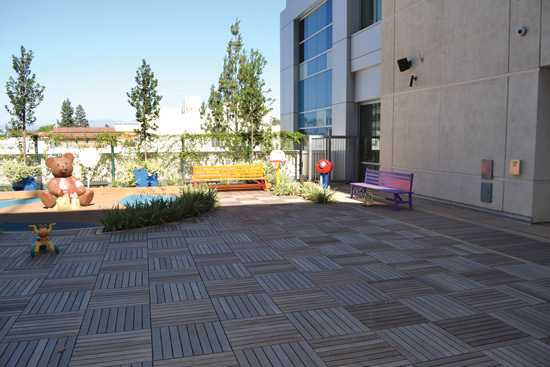
This large “neighborhood park” is five stories above the ground in this apartment complex at 4545 Center Boulevard, Long Island City, New York. A modular, pedestal deck system allowed for the installation of an entertainment center, outdoor barbecue, putting green, playground, and gardens.
Building community or placemaking has become an important design element that bridges the gap between the design of a single building and the environment and landscape around the building. “Placemaking is a quiet movement that reimagines public spaces as the heart of every community, in every city. It's a transformative approach that inspires people to create and improve their public places. Placemaking strengthens the connection between people and the places they share,”1 according to the Project for Public Places, a leader in research and documentation of what makes great public spaces. Authors Jane Jacobs and William H. Whyte began to research and write about making great places in the 1960s. This movement has grown to be inclusive of both public and private spaces. The principles of placemaking are focused on inclusion and process. Key attributes include design that is attractive, safe, accessible, interactive, inclusive of the environment, and multi-generational.
Architects are consulting with communities to find ways to light urban spaces efficiently, preserve trees, and create “break-out” spaces for community events that give compelling reasons to be downtown. In California, New York, Illinois, Iowa, and Colorado, to name just a few, pop-up restaurants are reclaiming parking spaces for downtowns. This trend is made possible by new pedestal outdoor floor decking systems. The commercial sector is also finding value in the creation of outdoor gardens, street-side seating, rooftop bars, and dance floors. Health centers are using their rooftops for tennis, play areas, and running tracks, and the demand is growing for similar amenities on top of mixed-use housing projects.

Photo courtesy of IRONSMITH
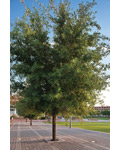
This plaza at the Haas School of Business at the University of California Berkeley used an innovative paver suspension system to allow room for shade trees to grow while preserving the open space.
Some of the tools that have been refined in recent years to add to the architect's toolkit include versatile roof deck pedestal systems, efficient LED lighting, and paver suspension systems that allow for the preservation of mature trees and compliance with the Americans with Disabilities Act. “The challenge to designers, owners, and communities is to preserve the character of public space while managing organic materials. Capturing public spaces through energy-efficient lighting, planting trees downtown, or creating garden paving systems require the integration of natural materials with mechanical systems. Successful outdoor places bring people together and help preserve culture and community,” says Paul Bambauer, president of IRONSMITH.
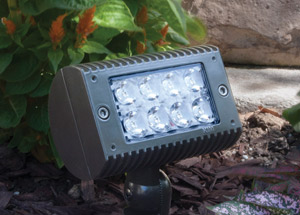
Photo courtesy of Kim Lighting
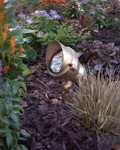
Innovative LED lighting can be placed in landscape areas to highlight and enhance plants and trees.
Integrating high-tech lighting, utility installation, and stormwater control requires the knowledge of both the micro—and the macro—climate of the specific location. “Because of the complexity of interactions in public spaces, daylighting, type of vegetation, outdoor signage, the impact of weather, daylight, and climate, designers must analyze many factors when considering lighting the outdoors. Sophisticated LED lighting systems can be calibrated to specific locations and are more sensitive to color renditions that highlight organic features. Energy-efficient LED systems will become standard in illuminating activities downtown while complying to Dark Sky ordinances and security concerns,” predicts Steve Wojno of Kim Lighting.
Each of these innovative products addresses the complexity and contradictions the designer faces while integrating organic materials into their placemaking. A review of some of these issues will aid the designer in avoiding some common mistakes.
Design For Micro-Climate

Photo courtesy of IRONSMITH
Custom trim rings for the Haas School of Business can be adjusted for tree growth.
Most designers are knowledgeable about the elements of climate. Temperature ranges, wind speed, solar aspect, and rainwater/snow volumes are all elements that are part of every initial site analysis. As the design professional digs deeper into a project, they analyze the human factors that impact design, traffic, public/private use of the building or public space, the adjacent buildings, and natural features that are in the immediate vicinity of the proposed project. Local, state, and/or national zoning codes may require stormwater treatment, tree or canopy shade calculations, lighting controls for “dark sky” preservation. In addition to these, an integrated approach includes the calculation for growth of organic materials, the color and intensity of lighting systems, and the sloped surfaces of uneven or deliberately canted roof and paving surfaces. The following is a review of some details to consider when drilling into the complexity of integrative design that is made less difficult by innovative paver suspension systems, LED lighting, and new decking systems.
Paver Suspension Systems That Preserve Mature Canopy Design
The microclimate of a public space is created by a variety of impacts caused by weather and orientation. These might include salt spray and snow collection in the winter, adjacent buildings or features that can create wind tunnels or too much or too little sun, water fountains, vehicle and pedestrian traffic. Creating the atmosphere of sun and light spatter or nighttime elegance and safety and defining a place for pedestrians to walk or dine can be a challenge.
In the past, the approach to outdoor design has been to strip a site of all vegetation and then replant. The disadvantage of this approach is that it may take many years to re-establish the ambience that mature trees bring to a site. In many cases, these new landscapes fail to capture the sense of place that can be developed using more mature trees.

Chart courtesy of Kim Lighting
Comparison of energy-efficient LED lighting to other light sources.
Efficient, Color-Correct Lighting with BUG Ratings
High-quality, architecturally relevant landscape lighting offers a broad array of tools for the architect's lighting palette. LEDs are being installed from large commercial applications, hotels, schools and government buildings to residential homes. LEDs are becoming popular because they not only save energy dollars, they also create a friendly atmosphere. The latest LED technology is a sophisticated system of lighting diodes that provides opportunities to maximize both color and light levels in outdoor environments. They are being used in homes, courtyards, public parks, commercial rooftop gardens as accent lighting or to light a building facade or sculptural detail. An LED light comes in many forms and one of the main advantages is that these lights are energy sippers. A low-voltage LED can save 70 percent more energy when compared to other sources of lighting on the market.

Photo courtesy of Bison Innovative Products
Downtown New York City rooftop putting green gives employees a new way to take their “coffee break.”
When selecting an LED lighting product it is important to understand the location where it will be installed. The advantage of this energy-efficient lighting is that it can also be adjusted for color correction and intensity. It can also be rated for compliance to Dark Sky ordinances.

Image courtesy of Kim Lighting
Lighting label for LED lights.
Cool, hip, and attractive nighttime lighting is appearing in many downtowns, on urban rooftops, and in parks and event spaces. Product labels for LED lighting include information on lighting efficacy in lumens/watt, color temperature, and its Color Rendering Index (CRI). The CRI is particularly important when specifying a light system for a specific feature. With the wrong choice for color temperature, a cozy warm park bench becomes a forbidding alcove, trees appear to have orange leaves, and the red brick wall appears to be brown and colorless. Sensitivity to color in the environment is a skill and some manufacturers will provide color consultation when the designer is trying to specify the correct Correlated Color Temperature (CCT) and/or CRI. LED diodes do not have special lenses as the diodes are calibrated to provide accurate colors to illuminate the project as designed.

Photo courtesy of Kim Lighting
Different white light can be selected as a light source to effectively highlight flowers and shrubs.
In a recent blog post, Chris Bailey, director of Lighting Solutions Center at Hubbel Lighting, explains the difference between CRI and CCT and provides definitions and explanations as to why the color composition at the source of lighting is important. Because accurate color renditions can greatly affect the appearance of an object, it is key to understand the importance of selecting a complete lighting system rather than just replacement lamps. The advantage of specifying a whole LED lighting system rather than specifying replacement lamps is that the color temperature and lighting efficacy will be maintained over the life of the project.
“Similar to CRI, CCT is only part of the color story. It is simply a designation given to a light source to describe the color appearance of the light emitted by a lamp, but does not provide information regarding the range and level of colors of the source. It is for this reason, possibility among others, that two lamp sources can have the same appearance, but produce very different effects on the illuminated environment. This phenomenon can often be observed when a facility is re-lamped. While a facilities worker may take note of the marked color temperature as he or she begins to replace the original lamps in the luminaire, the replacement lamps are often selected based on their pricing and availability. As a result, the differences between the original and new lamps can often be seen in the colors reflected off nearby illuminated objects such as painted walls, partitions, work surfaces, or artwork. The differences between the original and new lamp, despite having the same CCT, can be found in their respective color composition, or spectral power distribution (SPD).”3
Solid-state lighting (SSL) technology has the potential to reduce U.S. lighting energy usage by nearly one half and contribute significantly to our nation's climate change solutions. The U.S. Department of Energy acts as a catalyst to drive R&D breakthroughs in efficiency and performance, and to equip buyers to successfully apply SSL lighting.4
Five years ago, LED lighting was new to the market and there were many failures. Today, there are replacement LED light bulbs available today for almost any fixture. However, in order to guarantee control of lighting colors and intensity throughout the life of the project, most manufacturers recommend specifying the sealed LED units. The improved circuitry that is provided in these solid state systems include the ability to color sequence a lighting palette depending on the time of day, place, or atmosphere the designer wishes to create.
Outdoor or indoor LED lighting that is both water and dustproof should be specified to meet stringent third-party testing and certifications. The National Electrical Manufacturers Association, or NEMA, provides a certification for LED lighting. When properly installed LED lighting with the NEMA 3r IP67 certification will protect the public from exposure to electrical wiring or hazardous components. Lighting with this certification is also suitable to use outdoors in wet or dusty locations.
In addition, the designer should look for ENERGY STAR lighting. According to ENERGY STAR, not all LED lights are highly efficient or long lasting. The EPA reports “that after less than a year of use, a poorly designed LED product can flicker, shift in color, look dim, offer uneven light, or continue to use power when turned off, among other problems.
• Brightness is equal to or greater than existing lighting technologies (incandescent or fluorescent) and light is well distributed over the area lighted by the fixture.
• Light output remains constant over time, only decreasing towards the end of the rated lifetime (at least 35,000 hours or 12 years based on use of 8 hours per day).
• Excellent color quality. The shade of white light appears clear and consistent over time.
• Efficiency is as good as or better than fluorescent lighting.
• Light comes on instantly when turned on.
• No flicker when dimmed.
• No off-state power draw. The fixture does not use power when it is turned off, with the exception of external controls, whose power should not exceed 0.5 watts in the off state.
Bad design can lead to a wide range of problems, some immediately observable and some not. Poorly designed products often come with exaggerated claims while failing to deliver on the quality specifications above.”5 Selecting an ENERGY STAR lighting system, will both save money and provide quality to the project.
LED lighting is also a good choice when meeting Dark Sky requirements. Dark Sky requirements are rapidly becoming common in many localities. This movement aims to protect the ability to see the night sky even in urban environments. LED lighting provides an intense directional lighting system that lights the intended object, rather than the sky. The BUG rating for an LED lighting does not refer to insects but stands for backlight, uplight, and glare describing the types of lighting escaping from an outdoor luminaire. The International Dark-Sky Association created this classification for lighting zones that can be used by architects to meet model ordinances.6
Modular Deck Tiles that Conquer the Slopes
As with many new products now on the market, weatherproof deck pedestals and deck tiles are manufactured with recycled content, FSC-certified wood and designed for longevity, ease of maintenance, and criteria that adds to USGBC LEED® certification credits.
A traditional deck system is comprised of deck planks, stringers, and shims that tie into the wall and structure. In larger projects, sand or concrete balls have been set into the roof creating a heavier dead load and adding labor and expense to the project. These systems had a high potential for leaks and because of this, the addition of roof decks has not been a common practice in the commercial market. In comparison, a gravity-based, screw jack deck pedestal rests on the uneven surface without causing damage to the surface. New systems include an elevated tile grid supported on the pedestals while being contained at the edges of the building system. This innovative system allows designers to place numerous styles, colors, and materials of decking into the grid. It also allows for the installation of plant cubes, lighting fixtures, benches, play equipment, and even in one case, a putting green on a rooftop.
The benefits of pedestal and tile systems include the following:
• Meet numerous sustainable LEED® criteria that include a percentage of recycled content, FSC-certified wood materials, and low-VOC finishes.
• Easy to maintain as only portions need to be removed for roof maintenance.
• Provide a cavity. The decking is locked to the pedestals to prevent against wind uplift but can be unlocked for repairs and roof access as well as to conceal under deck wiring, irrigation systems, plumbing and mechanical systems.
• Apply easily to renovation projects.
• Durable and ideal for streetscapes with heavy pedestrian traffic as well as small residential projects.
• Affordable and installed with less labor than other systems.
In addition, the opportunity to design with numerous materials as outdoor flooring is fun and encourages design creativity. Designers are finding numerous ways to use these systems in innovative ways. Rooftop dog parks, play parks, exercise areas as well as play areas for hospitals are easy to add to the mix of project amenities with these systems. They are creating outdoor rooms using this modular tile system, changing materials to define special areas for entertainment, exercise or rest. Design professionals who provide outdoor space whether on the rooftop or the street are responding to research that has concluded that people need exposure to nature.
Amenities Benefit the Market
Claiming a third place for people to live, work, and play brings many advantages.
Benefits of the third place. When calculating rental returns and the construction of new facilities, one market study calculated that the top rental amenities first includes a central downtown business location and second, a building that meets LEED® criteria.9 Living in places that are vibrant, walkable, and sustainable seems to be the draw for renters and young professionals. The New York Times reports that the object for more city dwellers is to know their neighbors and they are recreating what might be considered the adult, college dormitory. New rentals on the High Line, the Manhattan above-ground linear park, include numerous break out spaces computer lounges, fitness centers, party rooms, and even dog daycare centers. At the Abington Apartments, there are 30,000 square feet of amenities that include three terraces overlooking the highline. Access to these spaces includes a fee and because of the ambience, the rental prices are steep.10
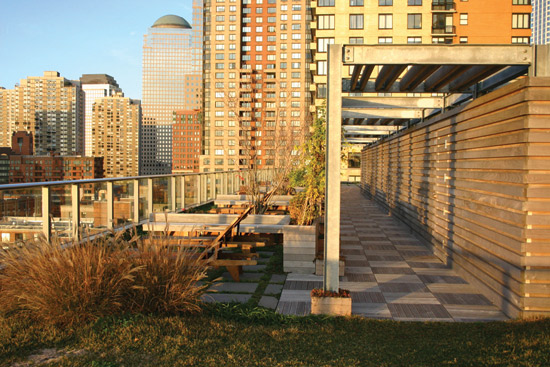
Photo courtesy of Bison Innovative Products
Design professionals are creating new third places in New York’s first LEED Platinum-certified condominium, the Visionaire. These urban retreats combine lighting, planting, and innovative gravity system modular deck grids supported on pedestal bases.
Outdoor spaces add value to real estate. “Homeowners continue to embrace the trend of maximizing outdoor living space, whether it's an outdoor kitchen or patio living room with a fire pit,” says Lonny Sekeres, a landscape designer with Villa Landscapes in Oakdale, Minnesota. “Real estate experts say that for every dollar you invest in landscaping projects, you could see up to a $2 return when you sell your home.”11 By adding lighting, installing new decks and planting trees, whether for a home or a commercial project designers can build in design value.

Photo courtesy of Bison Innovative Products
Design professionals are adding square footage to residential and commercial properties by claiming rooftops as desirable places. They are using innovative suspended decks, gardens, planting systems, and energy-efficient lighting, as seen 10 stories high in this urban retreat located in New York City’s Chelsea section.
Providing affordable, easy to maintain and install modular decking provides numerous creative opportunities to add value and the “third place” to numerous projects both residential and commercial.
Benefits of the urban forest. The quality of third places is important. Economics are not the only reason to develop a toolkit that includes these new design materials. Protecting the environment and promoting healthier lifestyles by exposure to the outdoors is an intrinsic value as well as having an economic benefit. For example, tree protection is important because healthy trees contribute to our environment and communities. Trees reduce carbon dioxide in our atmosphere. By protecting tree canopies in cities, the surrounding temperature is reduced, thus reducing the heat island effect of urban places.
The effect of “eyes on the street” is well known as a crime deterrent, however a recent study of the relationship between trees and crime aggregates in residential neighborhoods found that there was a reduction in crime when larger trees were planted and maintained in the public right of way.12 Other environmental studies such as the one published by Palo Alto, California titled “Sustaining The Legacy, Palo Alto Urban Forest” used data from a Bay Area tree eco-analysis model to determine their master planning for this tree-lined city. Using the I-Tree model analysis, the values that they found for preservation and maintenance of an urban forest included:
• The annual benefit from energy reduction has a value of $589,805 or $20.23/tree.
• The net annual benefit from CO2 reduction has a value of $51,563 or $1.77/tree.
• The annual benefit associated with property-value increases is nearly $5,900,000 or $201.49/tree.
The I-Tree streets analysis indicates that the Benefit Versus Investment ratio or BIR is 3.22:1. That is for every $1 that the City spends on street trees the City reaps $3.22 in benefits.13 These results demonstrate that the economic and environmental benefits of healthy urban forests are not separate entities and part of a whole strategy for the community.
A study in Providence, Rhode Island, by the Brown University Center for Environmental Studies lists the following benefits of the urban trees. These include summer cooling and winter warmth, stormwater and flood reduction, air and water pollution prevention, the capture of higher property values, greater biodiversity, and an improved quality.14 Using advanced paver suspension systems allows the designer more flexibility and design opportunities to place trees in harsh streetscapes and busy pedestrian areas. These systems promote healthy tree growth and allow for easier maintenance and care for new urban forests.
Bright lights and nighttime magic. Designing for nighttime adds excitement to any outdoor project. Previous lighting systems that were energy efficient were harsh, unfriendly, and cast light into the sky rather than highlighting the buildings and surroundings. LED lighting systems can be calibrated for any outdoor use. Some of them have Bluetooth® controlled systems that enable field aiming and dimming as well as sequencing to create colorful outdoor places. Designers can now select systems with color sensitivities and multiple color choices, even multiple choices among white light which is necessary to properly light certain landscapes and objects. Landscape lighting can be divided into two basic types, lighting walkways and pathways or accent lighting. By using lighting with the versatility and energy efficiency provided by LED lighting, the designer has more choices for creating signature spaces, whether these be designed for the home, restaurant, or downtown.
All of these innovations provide an opportunity for creative fun. Product manufacturers are helping design professionals find new, green, and sustainable materials that extend their design palettes to celebrate the environment.
Celeste Allen Novak, FAIA, LEED AP, (www.celesteallennovakarchitect.com) specializes in sustainable design and planning in Ann Arbor, Michigan. She is the author of “Designing Rainwater Harvesting Systems: Integrating
Rainwater Into Building Systems.”