This CE Center article is no longer eligible for receiving credits.
Automation may be considered one of the hallmarks of the 21st century. Voice recognition software, ATMs, e-commerce, and airport kiosks are just a few examples of the automated solutions that have already become commonplace. People are increasingly interfacing with machines in the pursuit of improved productivity and efficiency in their daily and professional lives, happily relegating some routine action items to new automated resources. Buildings are becoming increasingly more automated too.
The 21st century demands that the built environment become more economical, more environmentally friendly, and more comfortable for the occupants and employees within. It has been proven that incorporating daylight into the interior, a practice referred to as daylighting, can advance all three legs of that agenda. When daylight is present, electric lights can be dimmed or turned off, dramatically reducing the lighting costs. Consuming less energy reduces the overall carbon footprint of the building, and studies have shown that people have a positive response to daylight and views of the outside, improving their productivity, workplace satisfaction, and morale.
The only drawback to daylight is that the sun is a dynamic light source that requires constant attention and most people do not have the time and resources to actively manage it. Walking around a building, it is not unusual to see manual shades that have been pulled down weeks before to block intense early morning light, but are now keeping soft, ambient afternoon light out as well. The management of daylight seems like the perfect candidate for automation.
Automated shading and lighting control systems offer specifiers a dynamic daylighting solution that readily adjusts to custom fit the microclimate of any building, without active oversight by personnel. These systems are cutting-edge in their ability to optimize a building's use of and response to the sun. They can predict and respond to cloudy or clear sky conditions, maximizing the diffuse daylight allowed into the space and actively defending the interior from distracting direct sunlight. A combination of daylight control (shading) and electric lighting control systems equips specifiers with a tool to maximize the collaboration between these two types of light, improving efficiency and the ability to control the complete visual environment. Automated shades are affordable and have cost-effective return on investment (ROI) considering all their benefits.
 |
Automated shading and light systems
continuously manage the presence of daylight in the workspace to improve
occupant comfort and create energy savings, as in The New York Times
Building, New York City.
Photo courtesy of Bernstein Associates |
NOTE: The results of a post-occupancy study are available at: windows.lbl.gov/comm_perf/nyt_post-occupancy.html
Daylighting Goal #1: Maximize Daylight, Control Glare
In 2013, designing for daylighting has become increasingly standard. More and more green building initiatives are incorporating language that defines the minimum amount of daylight that should be incorporated into a space and stipulates that some level of glare control is necessary. The preeminent green building rating system in the United States, the Leadership in Energy and Environmental Design (LEED) 2009 New Construction contains credit 8.1 Daylight and Views—Daylight which requires that specific daylighting levels be satisfied in 75 percent of regularly occupied spaces and mandates the inclusion of glare control devices.
Similar recommendations are finding their way into local guidelines and international rating systems like the Buildings Research Establishment Environmental Assessment Method (BREEAM™). Even the federal government is getting on-board with daylight in the workspace. The guidelines for High-Performance Sustainable Buildings (HPSB) as defined by the federal government require that federal buildings achieve a minimum daylight factor in 75 percent of all spaces occupied for critical visual tasks and provide glare control.
The Daylight Advantage
One impetus for the growing popularity of daylighting in design is the scientific validation that daylighting is both good for business and good for people. A significant body of work has been amassed over the last 40 years extolling the virtues of daylight in the workspace. Providing building occupants with a visual connection to the outdoors has been proven time and time again to improve morale, motivation, mental functioning, and maintain circadian rhythm. Documented increases in productivity and reductions in absenteeism are just two of the reasons why a daylit workplace works harder.
 |
Daylighting in the workplace can
measurably improve productivity, employee outlook and feelings, resulting in reduced absenteeism.
Photo courtesy of PDK Commercial Photographers, Ltd. DBA Bernstein Associates |
The Direct Sunlight Threat
However, not all daylight is created equal. The soft, diffuse daylight that fills the sky on a cloudy day has very different properties than the intense direct sunlight that seems to stream straight from the sun into a building. The intensity of direct sunlight can create glare and solar heat gain, ultimately causing discomfort and distraction for the people inside. So while bringing diffuse daylight into a workspace improves productivity, direct sunlight may destroy it and should be excluded to the greatest degree possible.
Causing glare in the office. As more and more daylight is being incorporated into the workspace, the threat of glare becomes more pressing and the use of glare control mandatory. People perceive the brightness of an object in terms of its contrast with surrounding objects. Car headlights on a sunny day are barely noticeable. The same car headlights on a dark stretch of highway can appear so radiant they are uncomfortable to look at for any period of time. Glare occurs when a light source or the reflection of a light source is significantly brighter (generally more than three times brighter) than the ambient light surrounding it, causing visual discomfort.
The visual discomfort is a result of the human eye being ill-equipped to deal with glare. The eye is capable of increasing or decreasing its overall sensitivity to light to function in both bright and dark settings. Unfortunately, the adjustment in sensitivity is uniform across the eye, making it impossible for the eye to compensate for hot spots that may exist in the visual field. If the eye's sensitivity is decreased to focus on the brightest object, the surrounding objects are too lowly lit to be seen clearly. If the eye's sensitivity is increased to read a dimly lit object, brighter objects in the visual field become glaring.
Because their eyes cannot effectively adjust to glare, building occupants will use their bodies to accommodate it. Squinting, furrowing a brow, lowering a head, contorting the neck, these are all examples of how a person will attempt to physiologically accommodate a hot spot in their visual field. This is often an unconscious, automatic response, like blinking when eyes are dry. Repetitive use of these accommodation tactics can lead to stress injuries and muscle fatigue that manifest in the form of eye strain, headaches, and computer vision syndrome. These problems are uncomfortable, fatiguing, and contribute to decreased productivity in the workplace.
An office space with views to the outside and no active daylight control sets the stage for potentially glaring conditions, because direct sunlight is often significantly more intense than the general lighting of the average office space. Daylight can range in intensity from a few foot-candles, on an overcast day, to over 1,000 foot-candles on a clear, sunny day. The average electric light level in an office space is between 35 -50 foot-candles. This extreme contrast in intensity paired with the highly visual tasks occurring in an office, explain why direct sunlight is prone to create glare in the office environment and why it is so detrimental to the functionality of the space. When direct sunlight streams through a window in an office, it can create distracting hot spots as it reflects off darker computer screens or desktops. The window itself can become a hot spot in the visual environment. If the difference between the intensity of the light streaming through the window and the ambient office light surrounding it is too great for the human eye to accommodate on its own, it will become uncomfortable to look at.
 |
The static nature of many traditional daylight control tools leaves them ill-equipped to manage the everchanging position of the sun as it transitions through the seasons.
Image courtesy of MechoSystems |
The Limitations of Traditional Daylighting Tools
In the early 1900s, with the incandescent light source still in its infancy, the sun was the greatest, most reliable source of light. Architects paid particular attention to the siting and orientation of a building, because they relied on available daylight to illuminate the interior.
Today, building orientation and shallow floor plates are still used to maximize the daylighting levels in a building, while providing some protection against glare-causing direct sunlight. Good building orientation helps minimize the building's exposure to direct sunlight throughout the day, especially during sunrise and sunset, and shallow floor plates help to maximize the daylighting levels that are possible throughout the interior.
New innovations in permanent exterior and interior shading devices, like fixed overhangs and high-performance glazing, provide constant glare control, but are limited in their ability to offer any variety in the amount of daylight protection they provide. As a result of their static and unmoving nature, these systems may be vulnerable to direct sunlight penetration at certain times of the day or year, or, if designed for aggressive daylight management, they may minimize the amount of daylight allowed on the work floor altogether.
Internal shading or blinds systems that rely on daily manual manipulation are often pulled down on a bright day to block the harsh direct light streaming through the windows and then left down every day after that, negating the original design intent to provide a view to the outdoors and illuminate the interior with daylight.
Unfortunately, these traditional approaches to daylighting do not offer any dynamic, automated control of the daylit environment. The building envelope, complete with glazing and fixed overhangs, treats daylight on a cloudy day and daylight on a sunny day as if they had equal opportunity to create glare. It is the same structure every day, all year round, through summer sun, winter sun, and shadow. Manually controlled devices put the onus on individual occupants to manage the building's interaction with the sun, which almost always results in the daylight not being managed at all.
New Daylighting Tool—Automated Shading Systems
There is a new daylighting solution that equips buildings to actively monitor and respond to ever-changing daylight conditions. An automated shading system predicts, monitors, and responds to the unique microclimate of the building. For example, the system can determine if the day is sunny or cloudy, or if a zone of windows is in shadow and adjust the shade positions accordingly to maximize the amount of ambient daylight in the space.
Comprised of motorized solar shades, roof-mounted solar radiometers that monitor sky conditions in real time, exterior-mounted photometers that monitor sky brightness, interior-mounted photosensors that monitor each building façade for the presence of direct sunlight (local brightness), and advanced daylighting software, this system raises and lowers solar shades automatically in response to the position of the sun and the sky conditions detected by the sensors. In addition, the woven solar fabrics used as the physical shades enable building occupants to view the outdoors, even when the shade is deployed in the down position.
 |
Automated shading systems provide
dynamic daylight control, automatically adjusting the position of the shades to best accommodate the position of the sun, regardless of the time of year.
Image courtesy of MechoSystems |
Architects used to refer to historical weather data and sunpath diagrams to predict where the building was at risk for direct sunlight penetration, addressing the potential threat with a permanent shading solution. Now, automatic shading systems monitor and respond to the actual, daily microclimate of the building, offering a customized shading solution that changes whenever weather conditions, direct sunlight, or new season warrant. They also have the ability to recognize when skies are cloudy and compensate for undesirable sky brightness and shadow. This informed flexibility enables an automated shading system to maximize the amount of daylight that can penetrate the space and still protect the interior from direct sunlight, when present.
Actively manage direct sunlight. The automated shading system continuously monitors for the presence of direct sunlight and actively manages the access that direct sunlight has to the interior. The system constantly calculates the sun's angle on each window in the building. It takes into account window elevation, solar geometry, orientation, and profile angle. Structural elements such as balconies, overhangs, and fins that may block the sun are included in these calculations. The system then adjusts the shade position to manage the distance that any direct sunlight can enter a space.
Differentiate between clear and cloudy days. Specialized scientific solar radiometers are mounted on the roof and monitor real-time sky conditions, enabling the system to determine if it is clear or cloudy. When cloudy, the shades are raised, welcoming the pleasant and diffused daylight into the building. When clear, the shade position is adjusted according to the solar angle and any user-defined zone parameters to prevent glare-causing direct light from wreaking havoc in the visual environment.
Recognizes overcast, but bright. Sometimes Mother Nature makes it overcast, but bright. In these conditions, the automated default response to cloud cover, which is to raise the shades, would be inappropriate, because the general brightness of the sky could create glare in the workspace. Luckily, these shading systems are equipped with a brightness-override module. A photosensor placed near working level by a window detects the amount of daylight that is streaming through the window and onto the work plane. When illuminance levels exceed a specified threshold, the system automatically adjusts the shade to a predefined position to reduce the risk of excessive brightness in the space.
Compensates for shadow. If a window is in shadow, there is no immediate threat of glare-causing sunlight streaming in through it, even if the day is one of the brightest and sunniest of the season. A shadow-override module considers adjacent structures, such as buildings or trees, and identifies when the façade will be in shadow for some pre-determined minimum amount of time. When the shadow conditions exist, the system raises the shade, so that occupants can enjoy glare-free views.
 |
At the West Midtown
Intermodal Ferry Terminal, New York City, automated shading and lighting systems coordinate the presence of daylight and electric light in a space, saving energy.
Architect: William Nicholas Bodouva & Associates; photo courtesy of Jim Roof Creative, Inc. |
Daylighting Goal #2: Coordinate Electric Light and Daylight
Daylight control can offer more to an office space than improving productivity and controlling glare, especially when combined with an automated lighting control system. The visual environment of an office space that has windows or some connection to the outdoors is comprised of two types of light: electric light and daylight. While many offices contain these two types of light, few are equipped to coordinate them. This lack of light coordination creates two significant issues in the workspace. First, most buildings today are over-lit because lights are on at full intensity while there is ample daylight streaming in through windows and skylights. Second, a large amount of electric lighting energy is being wasted. Luckily, automated shading and lighting systems can now be specified to coordinate the presence of daylight and electric light, maintaining an optimal visual environment and saving energy.
A comprehensive automated shading and lighting control system leaves little in the visual environment to chance, because everything is controlled. Here's a quick explanation of how the two systems work together. Essentially, target levels of illumination are determined throughout the building. The shading system operates as it would, regardless of whether or not a lighting control system is present, maximizing the amount of daylight in the space, while blocking or diffusing glare-causing direct sunlight. As the solar shades raise and lower automatically, strategically placed photosensors throughout the interior continuously monitor the levels of available daylight and send those readings to the lighting control system. The lighting control system dims, switches off, or brightens the electric lights in the space to maintain the target levels of illumination throughout the building.
Maintain Optimal Visual Environment
Coordinating daylight and electric light with an automated shading and lighting control system provides the optimal amount of light at the workplane automatically, every day. The Illuminating Engineering Society of North America (IESNA) has developed recommendations that define optimal light levels for various visual tasks. The IESNA recommends that office buildings maintain 40 foot-candles at working level in a single office, 40 foot-candles at the working level in open plan offices, and 30 foot-candles at working level in a conference room. As previously mentioned, daylight can range in intensity from a few foot-candles, on an overcast day, to over 1,000 foot-candles, so it is easy to imagine just how common it is for office spaces that receive any daylight, let alone a lot of sunny daylight, to be over-illuminated.
Save Energy
In commercial buildings, lighting typically accounts for more than 30 percent of the building's total electricity consumption. Much of this expense could be avoided by specifying an automated shading and lighting control system that would coordinate daylight and electric light. Daylight harvesting is the lighting control strategy where electric light is essentially used to supplement available daylight when necessary to provide the optimal level of illumination on the workplane. When sufficient daylight is present, electric lights are dimmed or switched off, saving energy and preventing the space from being over-lit.
Now required by building codes. Coordinating the presence of daylight and electric light is newly becoming required by national and state building codes. The standard adopted by the Department of Energy as the national energy standard for all commercial buildings in the United States is written by the American Society of Heating, Refrigeration, and Air-Conditioning Engineers (ASHRAE) and is commonly referred to as ASHRAE 90.1. The latest version, ASHRAE 90.1-2010, requires specific daylighting controls for the first time since its initial publication in 1975. The 2012 International Energy Conservation Code or the 2012 IECC mandates that day lit zones shall be controlled independently from other general lighting and may be either manually or automatically operated. Title 24 is the building code for both residential and non-residential buildings in California. Title 24 2013, which is scheduled to take effect in January 2014, requires photocontrols in all interior day lit spaces with at least 120W of installed lighting power.
Spend a Day at The New York Times Building
When a design team decides to coordinate daylight and electric light with an automated shading and lighting control system, the results can be extraordinary. For an example of extraordinary, consider the results realized by The New York Times Building, completed in 2006 and located on 8th Avenue between 40th and 41st streets. It was designed by Renzo Piano Building Workshop, Paris, in association with Fox and Fowle Architects, New York City; interiors by Gensler and interior lighting design by SBLD Studio. Following construction, the building realized a 24 percent total energy savings.
 |
The New York Times Building pushed the boundaries of what was considered possible in daylighting and daylight harvesting and today realizes a 24 percent total energy savings, according to recent Lawrence Berkeley National Laboratory studies.
Image courtesy of: The New York Times Company, Forest City Ratner Companies, Renzo Piano Building
Workshop, FXFowle Architects; photo by Artefactory |
The 51-story building clad in a curtain wall of clear, low-iron glass and white ceramic tubes has become one of the most celebrated experiments of daylighting and daylight harvesting in a commercial environment. At the time of the building's design and mock-up, this project pushed the boundaries of what was considered possible in terms of shading and electric lighting systems integration. Today, it is the proof that these automated daylighting strategies can deliver significant energy savings and maintain an optimal visual environment, supporting productivity and employee morale.
In fact, the results of the post-occupancy study, conducted in a collaboration of the Lawrence Berkeley National Laboratory (LBNL) and The New York Times Building, have recently been published at http://windows.lbl.gov/comm_perf/nyt_post-occupancy.html. The evaluation of the dimmable lighting and automated shading systems found dramatic energy savings and overall occupant satisfaction, resulting in an impressive payback period.
The Automated Shading and Lighting Control System
At the core of the automated shading and lighting control system used in the New York Times Building are motorized roller shades, solar radiometers, photometers, photosensors, dimmable fluorescent ballasts, and daylighting software. The automated shading system was designed to be both proactive and responsive. The system preemptively programmed the positions of its roller shades based on the known solar path of the sun and then modifies the shade position to accommodate changes in sky condition or reflecting surfaces. Solar radiometers were mounted on the roof to continuously monitor sky conditions and enable the shading system to adjust to cloudy or clear days accordingly. Photometers were placed externally on the building to monitor sky brightness and photosensors were placed on the interior to monitor the amount of daylight present in the space. The dimmable fluorescent ballasts dim, switch off or brighten the fluorescent lighting depending upon the levels of daylight detected in the space. The selected ballasts communicated via the Digital Addressable Lighting Interface (DALI) protocol. Each DALI ballast receives an independent address and can be independently controlled or controlled as part of a larger group of ballasts. This independent control was especially critical for the lighting fixtures around the perimeter of the building and gave each ballast the ability to respond to the specific illumination needs of their immediate environment. The daylighting system also features brightness-override to protect occupant comfort in all daylight conditions and shadow-override to raise the shades to maximize daylight and view whenever a window zone has been in shadow for 20 minutes or more.
Daylighting and Daylight Harvesting System Goals
At the time that the specification was written, The New York Times intended to establish target illumination levels on a departmental basis. This allows each department to customize its own visual environment to best support the specific visual tasks performed in the space and accommodate preferences of the personnel. Although target illumination levels may vary from department to department, the automated systems will coordinate the presence of daylight and electric light in the space to maintain that target illumination level on the work plane.
The goals for the shading system are based upon the understanding that in The New York Times Building, daylight is preferred over electric light, so daylight is treated as the primary light source and electric light will be used as a supplement when necessary. To that end, the shading system goals include: maximizing the daylight in the space, avoiding direct solar radiation on the occupants, and maintaining a glare free environment.
An important aspect of the visual environment in an office space is known as the contrast ratio. The contrast ratio describes the relative brightness of the computer screen and the brightness of the backdrop of windows, or, in the case of The New York Times Building, the brightness of the glass curtain wall. When a person is sitting at a desk that is facing out toward the glass curtain wall, that person would see both the computer screen and the curtain wall in the visual field. The ratio must be managed, so that uncomfortable conditions do not arise. The IESNA recommends a ratio of 1:7, where the window should not be more than seven times brighter than the computer screen. The New York Times Building initially relaxed this ratio to 1:10, allowing the exterior curtain wall to be up to 10 times brighter than the computer screen. After occupying the space for awhile, building occupants have requested that the shades be allowed to be open even more, and The New York Times is now considering further relaxing the ratio to allow even more daylight into the space.
System Performance
An automated shading and lighting control system constantly monitors the building's microclimate outdoors and responds in real time, while continuously regulating interior illumination levels. In order to truly appreciate the adaptability of this dynamic daylighting solution, let's discuss the changes the system undergoes in one day of operation.
The amount and type of daylight around a building at any given time is dependent upon three factors: the latitude of the building, the orientation of the building, and the weather conditions of the day. Although the latitude and orientation of a building do not change, as the sun moves throughout the day, the characteristics of the daylight available to that stationary building change. For example, as the sun rises in the morning, east-facing windows receive considerable amounts of direct sunlight. South-facing windows, in general, receive nice amounts of ambient light, but can experience limited exposure to direct sunlight during the afternoon hours. As the sun is setting in the west, west-facing windows receive substantial exposure to direct sunlight.
Here is a play-by-play explanation of how the automated shading and lighting control system manage the sun's movement around The New York Times building, while satisfying illumination targets in the space, every afternoon.
At 2:40 p.m., the shades on the south elevation are deployed to the third position, three-fourths of the way down, and the shades on the western side are adjusted to the first position, one-fourth of the way down. Enough ambient daylight is present in the space to satisfy illumination targets, so the electric lights are completely off.
At 3:20 p.m., shades on the south elevation remain in the third position and the shades on the west elevation have lowered to the third position, as well. Interior lighting is now on to 10 percent.
At 5:45 p.m., the sun is below the horizon. Both sets of shades have risen to the full-up position, providing building occupants with impressive cityscape views and the interior electric lights are on.
Two Important Considerations When Specifying An Automated Shading and Lighting control System
As the movement for daylighting and daylight harvesting continues to gain momentum in the energy codes and green building programs, the number of projects that will require some type of automated shading and lighting control system will continue to grow. While not every project will have the scale or scope of The New York Times Building, there were some lessons learned about how certain products impacted the overall system that may be wise to share. There are two important features to consider when selecting a system. One will maximize a building's exposure to ambient, glare-free daylight. The other ensures that the lighting system is compatible with a larger product pool, providing designers more choice in fixture types, lighting controls, etc.
Select Systems with Solar Radiometers
The amount and type of daylight around a building at any given time is dependent upon three factors: the latitude of the building, the orientation of the building, and local weather conditions. However, not all automated shading systems are capable of taking advantage of the diffused daylight that is available when it's cloudy outside.
Many automated shading systems use an astronomic timeclock (ATC) to schedule the various positions of the shades throughout a day. An ATC schedules events in relationship to the position of the sun. For example, the shades on an east-facing window can be scheduled to deploy to the floor 15 minutes before sunrise, so they are in place to diffuse the direct early morning light. While an ATC is perfectly equipped to schedule shade positions to coordinate with the known solar path of the sun, it is unable to interpret local sky conditions and so it must control the shades as if every day is bright and sunny and potentially glare-creating.
Automatic shading systems that include solar radiometers, can determine if the day is sunny or cloud covered and modify shade position accordingly. On cloudy days, shades can be raised to let in the available daylight, when they may otherwise be found in the full-down position on a clear day. These radiometers enable a building to truly maximize daylight exposure by recognizing that there is no reason to further diffuse light that has already been diffused.
Specify DALI Ballasts for More Product Options
Ballasts that are individually addressable employ a communication protocol to receive signals from the central control panel. Many of the automated lighting control systems available today have closed and proprietary systems, meaning that the central control panel distributes signals that can only be interpreted by the same brand of ballast and those ballasts can only interpret the signals sent from their specific lighting control panel. These systems can trap specifiers into buying the entire lighting and lighting control system from one manufacturer and this can severely limit the number of compatible products available, which can impact design freedom. Other lighting control panels are termed independent or ballast neutral, meaning that the central unit does not employ a proprietary communication protocol and can communicate with any number of dimmable ballasts on the market. DALI is one such type of universal communication protocol.
Today, automated shading and lighting control systems offer the dynamic control necessary to best manage the ever-changing presence of daylight in a building, in the automated solution that minimizes the amount of time building occupants must spend controlling their lights. It lowers shades to keep direct sunlight out. It raises shades to maximize the available views and ambient daylight allowed in. It dims the electric lights, when daylight is present. It raises electric light levels, when daylight is not present and it does it all automatically. In fact, it's doing it right now.
Conversion of Factory Building to Office Space Yields LEED GOLD and Exceeds
Sustainability Goals
|
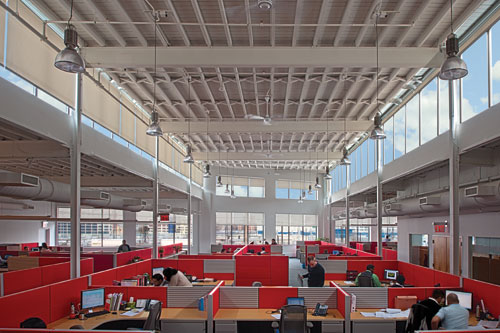 |
Automated shading and light systems enable this recently renovated company headquarters to maximize the daylight available to the interior, without risking exposure to direct sunlight and glare.
Photo of MechoSystems headquarters courtesy of Anthony Cavaciuti |
Over the last four years, in Long Island City, New York, contractors have been transforming a 46,000-square-foot, 100 year-old factory into a certified LEED Gold company headquarters, enhancing the original design with the latest automated building systems. Water conserving fixtures, photovoltaics, HVAC systems, eco-friendly office interiors, and replacement façade windows with 1-inch insulate glass and low-e coating have all been incorporated, but it has been the automated shading and lighting control system that has had the greatest impact improving occupant experience, saving energy, and realizing the full potential of the original design's intent to maximize the daylight in the workspace.
The factory is a perfect example of an early 1900s building where the architect gave great consideration to siting and orientation in order to optimize the interaction between daylight and the interior. The north wall is predominately dressed in glass and clerestory windows run east and west above the factory floor. Converting this factory into a single-tenant office space for 200, management wanted to take full advantage of all of the windows designed by the first architects and even restored windows that had been eliminated during previous renovations.
With an automated shading system, windows can be added to an envelope, without exposing the interior to direct solar radiation or glare. Scheduled to accommodate the known solar path of the sun, the shades will lower automatically when the sun is positioned in such a way that direct sunlight would penetrate the space. The woven fabric of the solar shades diffuses the direct light eliminating potential glare. When the sun’s position changes, the shades raise automatically, filling the space with ambient daylight and unobstructed views of the outdoors.
This renovation required more than better management of daylight to achieve LEED Gold status. The energy efficiency of the factory had to be improved. The automated shading and lighting control systems have generated considerable savings for both lighting and HVAC systems. When daylight is detected in the interior, the electric lights dim or switch off. Many days, the electric lights around the perimeter of the building and under the clerestory windows are not on until the sun goes down.
Today, this sturdy, industrial building in an urban setting is occupied and operational. The project has achieved a LEED Gold certification and consumes about 25 percent less energy than its baseline design. The automated shading and lighting control systems continue to actively manage the light levels in the building. |
 |
MechoSystems is the world's leading designer and manufacturer of manual, motorized, and automated solar-shading systems for the architectural and design communities. The company provides contemporary WindowManagement® solutions for today's design challenges. Products are designed to meet the challenges of sustainability, WindowManagement®, and effective daylighting. To contact representatives and distributors worldwide, visit: MechoSystems.com/automation |