This CE Center article is no longer eligible for receiving credits.
Stone has been a popular design material for centuries. In fact, many consider stone to be the first building material ever used by man. While loved for its beauty, timelessness and durability, designing with real stone has become less frequent due to the undesirable influence that this material often has on project schedules and costs. This is especially true today, where projects face increasingly tighter timelines and smaller budgets. In the past few decades, the design community has balanced its love of the stone aesthetic and the budgetary constraints of a project by settling for an artificial alternative. Now there is a new way to design with this classic material that enables architects to incorporate real stone onto projects, without extending timelines or exceeding budgets. Natural modular stone systems are an important advancement in the first building material of mankind.
The Strengths of Full-bed Stone
In construction today, when a stone aesthetic is designed into a building, stone is not used to create the physical structure of a building. Load bearing walls are not drystacked or mortared together. Instead, the stone is used as a decorative veneer on walls and floors and columns to disguise the concrete, wood or steel structure of the building underneath.
Traditionally, these stone veneers were created from natural stone that was delivered directly to the job site from the quarry. This quarry to project stone is called full-bed natural stone. These individual, full-bed stones were then stacked and arranged and mortared into the desired veneer by a stonemason on the job site.
 |
Designers can use natural stone on their projects, without extending timelines or exceeding budgets, with natural modular stone systems. These modular systems, pictured here in an Ashlar pattern of tumbled sandstone, are an important advancement in the first building material of mankind.
Photo courtesy Real Stone Source, LLC. |
Â
Timeless Beauty
There are many reasons that stone has enjoyed such popularity throughout the years. The combination of color, texture, and unique aesthetic stamp of the uncalculated and uncontrolled variation that can only occur in a material that is manufactured by nature describes why the beauty of stone has inspired architects and artists alike for hundreds of years. Stone naturally occurs in many colors, shapes, sizes and types of grain. This aesthetic diversity enables natural stone to appeal to a wide variety of palates and perfectly fit an assortment of purposes.
Beyond intrinsic beauty, the accessibility and constant presence of stone throughout time have enabled people to use this material to create fences, houses, and works of art. Farmers in Ireland drystacked modest and meandering stone walls in order to illustrate the boundary of their land. Palaces all over the world have been built of polished marble creating symbols of wealth, permanence and power. The cream-colored Italian travertine quarried in Tivoli was the favorite building stone of Ancient Rome and was used to construct both the Coliseum and Bernini's Colonnades to St. Peter's Cathedral. Â
Because of the ways in which stone has been used in the past, it carries with it a cultural and historical significance. This significance gives stone a modern-day relevance that safeguards the material from ever going out of style. This quality of timeless beauty exists in few other building materials.
Lasting Quality and Durability
Impressive durability is another reason that stone has been such a popular building material. Stone is designed to withstand the elements with minimal wear. The color will not fade in the sun or discolor in the rain. If the stone is chipped, it just reveals its deeper layers. As the stone weathers over time, the beauty and character of the stone is only further enhanced.
There is no better illustration of this fact than the many stone structures that are still standing, in good condition, after hundreds, even thousands, of years. One great example of the durability of stone is the Great Pyramid, in Egypt. Construction of the Pyramid is estimated to have been completed in 2560 B.C. This structure has survived 4,569 years of searing desert conditions and sandstorms. Â
Ease of Maintenance Â
Maintaining stone is easy. Its durability minimizes any necessary maintenance requirements. By natural design, it is equipped to be exposed to rain and wind and time and will weather slowly. This material can be power washed, washed in a mild acid, or lightly brushed without damaging it. Â With natural stone there is no paint coating that may chip or pre-treated surface that would be compromised by a chemical cleaning solvent.
Sustainability Â
Another characteristic of stone that has made it an attractive building material in today's construction industry is its sustainability. Stone is one of the most accessible natural resources available and the life-cycle analysis (LCA) of using stone in construction is very promising. The manufacturing process required to get natural stone job site ready is fairly straightforward. It is harvested from quarries and then cut down to the right size and shape. Once it is installed on a project site, stone exists in buildings as it would exist on the side of the mountain, weathering the elements. When it is disposed of, natural stone simply returns back to the ground. It can also be crushed and re-used in construction and landscape materials.
The Shortcomings of Full-bed Stone
Despite the inherent beauty of stone, its durability, its ease of maintenance, and its sustainable qualities, the use of traditional full-bed natural stone in construction has been declining since the 18th century. This decline is due in part to inadequacies in the age-old process of quarrying rock and delivering it directly to the job site. The use of stone was also challenged by the emergence of new, more consistent, construction-friendly materials, including brick and concrete masonry units (CMU). These more controllable and predictable materials increased in popularity as builders and architects began to demand structural performance and increased production rates on the job site.
Long Production Rates and Complex Installation Â
The rate of production refers to how quickly an installer can complete the installation of a system or product on a job site.
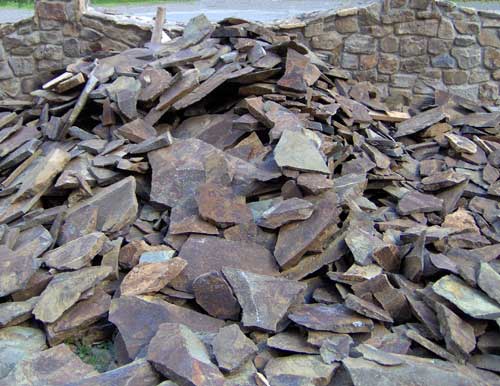 |
Traditionally, natural stone was delivered to the job site from the quarry. Stonemasons would unpack tons of loose rock and begin sifting through the stones, performing quality control and fitting tasks.
Photo courtesy Real Stone Source, LLC. |
Â
The conventional process of using full-bed natural stone on a project includes time-intensive tasks that stretch production rates considerably. Traditionally, full-bed stone is quarried from a mountain. Then the stone is packaged into large pallets at the quarry and shipped directly to the job site, without undergoing any quality control to ensure that the stones are consistent in color or cut into the right dimensions. When the stone arrives, stonemasons unpack the tons of loose rock and begin quality control and fitting. During quality control, stonemasons hand-select the individual stones that are the right color and dimension for the project. Fitting describes the task of puzzling hundreds of rocks together to form the desired structure. This hand-selection and fitting process is very time intensive and incurs high labor expenses. Additionally, if the stonemason falls behind schedule, it can dramatically affect the timeline of the entire project.
These quality control and fitting tasks continue throughout the build process. Usually, stonemasons will unload one or two pallets of stone, select and fit the stones together for the section of the project upon which they are immediately focused, install those veneers, and continue to another section, where they begin quality control and fitting again. Over the course of the project, different masons and different pallets of stone can create noticeable variations from one installed area to the next.
Once the full-bed stone has been selected and puzzled together for a specific area, the installation begins. First a concrete mixture of rock, sand, and cement is poured, creating a footing for the stone. Then each individual stone is positioned in the footing and set with mortar. As the individual stones are set in place, stonemasons continue to cut and chip away to create stones that are the right size and shape for the project. If the space has corners that need to be covered in stone, the stonemason makes the cornerstone pieces by hand. After all of the stones were in place, the mortar between the stones, also called grout joints, was groomed and the excess mortar was cleaned from the stones.
Beyond the labor-intensive installation, the use of full-bed stone creates extra tasks and areas of concern on the job site. Repeated on-site cutting creates extra dust and materials for disposal and the palettes of rock are difficult to move.
Poor Color Consistency/Uniformity
The traditional process also made it difficult to provide rock to a job site that was consistent in color or uniform in shape. Natural stone is formed in mountains or large pools of bedrock, not produced to specification on a manufacturing floor. The geology can change from one area of a quarry to the next, producing stones of different color characteristics and textures. Stone collected from one area may be patchy or discolored, darker or lighter than stone collected for the same project, but from a different part of the quarry. While these natural variations may be unnoticed when peppered throughout the entire delivery, these rocks were often packaged as they were mined, so all of the discolored rocks may be on one pallet, or perhaps the darker rocks were delivered first and lighter rocks last. If the rocks were not mixed by hand by the stonemasons, walls built from rocks that arrived on the first pallet may not match subsequent walls built from rocks quarried from a different area.
Design Challenges
Design teams value the aesthetic richness that natural stone brings to a project. However, they also value product consistency. There were so many variables in creating full-bed stone veneers that architects rarely knew what the final product would look like until it was finished. Specifiers were not confident that the stone selected for a project would be the stone delivered to the project. It could be lighter, darker or patchier than the original sample that was specified. Additionally, the look of the final stone surface relied heavily on the skill and personal style of the stonemason, which would vary from project to project.  Â
If the design called for stone to be used on any combination of exterior, interior, or floor spaces, simply finding the necessary materials was often challenging. The type of veneer would change based on its location. For instance, an exterior veneer may incorporate larger or more clefted stones, while interior veneers may require stones that are longer, thinner and flatter. Even though the style and dimension of the stone on a project varied, the color was supposed to remain the same.  If one vendor was unable to provide the same stone quarried in these different styles or dimensions, then design teams were often left to the complicated task of trying to match stones from different sources. Â
Difficult Job Costing
Working with an inconsistent material that is difficult to install makes it hard for contractors to create an accurate estimate of how much the job will cost. There are simply too many variables when working with full-bed stone. Poor job costing often created many friction points throughout the construction process as real costs escalated and construction timelines slowed.
The Artificial Answer: Artificial Stone
The aesthetic appeal of stone as a building material coupled with the significant shortcomings of specifying actual bedrock spurred an investment in creating an alternative to natural stone. In the early 1960's, artificial stone was introduced into the construction industry. Â
 Most artificial stone is created by placing white and grey cement, sand, gravel and color pigments into a mold designed to look like real stone. Some manufacturers also paint the inside of the mold to add desired tones to the surface of the faux-rock product. These artificial rocks are then packaged and shipped to a job site as either individual stones or in pre-fabricated modular panels. With this controlled production process, artificial stone successfully addresses many of the design and installation issues inherent in the traditional creation of full-bed natural stone veneers. Â
Improved Rate of Production and Simplified Installation
When artificial stone is manufactured and shipped to a work site, it is the right color and the right size for the project and it is ready to be installed. Stonemasons are no longer responsible for the on-site quality control of each individual piece of stone. Artificial stones cannot be chipped and shaped on-site, because it will destroy the stone exterior. They are delivered in the size and shape in which they should be installed. This allows lesser skilled or experienced masons to work on projects, which further decreases labor costs.
When working with loose artificial stone, stonemasons begin by piecing together individual stones to create the desired wall, fireplace or floor, etc. When the artificial stones are delivered in modular panels, product installation is further simplified. Instead of piecing together the individual stones, stonemasons fit the pre-made panels together and join them as seamlessly as possible.
Artificial stone is made with a light-weight aggregate to minimize the weight of the product. These lighter materials do not require a foundation, or footing, and are mortared directly onto the side of the structure that they are disguising. Cement mortar, known as a "scratch" or "brown" coat, is applied onto the surface of the structure and buttered onto the back of the artificial stone. The concrete product is then pressed to the structure to adhere.
Consistent Color
The consistency of color that was impossible to dictate on a mountain-side is much more easily managed in a manufacturing facility. Artificial stone is developed to a specification, like many other manufactured products, and is not affected by the natural variations in geological processes. Additionally, if a certain artificial stone was selected to be applied throughout an entire development, the product that arrived to outfit the final house on the project would be a uniform match to the first artificial stones installed.
Accurate Job Costing
The factory-manufactured product paired with a significantly simplified installation process removed many of the variables that made it difficult to create an accurate job estimate. Using artificial stone was slightly more predictable than loose natural stone and, therefore, design teams and construction estimators were better equipped to deduce the total costs of the project.
Design Consistency
Another benefit of using artificial stone products was that the design of a wall, column, or cobbled floor was no longer determined by the expertise of the installation team. Specifiers could specify an artificial stone wall for a project and know almost exactly how the end result would look. This predictability gave design teams a confidence in the ability of this final product to meet their initial design standards.
Synthetic Limitations
Artificial stone successfully addressed many of the shortcomings that existed in the way that bedrock was traditionally incorporated into a construction project. However, these man-made products were unable to surpass, or even duplicate, nature in a number of important areas.Â
Artificial Appearance
While this color-specified, man-made material may eliminate inconsistency on a project, it also removes the variations and imperfections that are expected and adored in natural objects. Artificial stone systems will deliver identical stones that create a uniform aesthetic throughout a project. However, to truly look like a natural stone surface, there is a certain level of variability in both texture and color must exist in the material.
Vulnerable Stone Surface
 |
When artificial stone is chipped, the cement interior is exposed and the stone aesthetic is destroyed. Artificial stones are also susceptible to effloresce, which causes a white powdery coating on the surface of the manufactured rock. Both chips and the effects of efflorescence are visible here.
Photo courtesy Real Stone Source, LLC. |
Â
One significant weakness in artificial stone is the vulnerability of its stone surface. While this building material is molded to look like stone, the interior of the product is still a mixture of cement, aggregate and color pigments. This dual nature is easily exposed when the decorative surface chips, cracks, or breaks. The manufactured interior becomes visible and the stone aesthetic is destroyed.
These man-made, color-treated stone exteriors are more susceptible to outdoor wear and tear and chemical exposure than the natural stone after which they are modeled. The color of the stone may noticeably fade as it weathers or be discolored if it is treated with a chemical solvent. Artificial stone products are not recommended in areas with cascading waters, such as fountains and pools, and exposure to deicing salts can also cause damage to manufactured cement products.
This product is also predisposed to be affected by efflorescence, which causes a significant shift in the exterior color of the manufactured stone. Efflorescence is a naturally occurring process that affects all concrete when it is exposed to low temperatures, moist conditions, condensation, rain and dew. As soluble salts and other water dispersible materials leak from the concrete, it creates a powdery whiteness on the surface of the stone that can make the color appear faded. Â
Hard to Maintain
Unfortunately, the vulnerability of the artificial stone surface also makes it very difficult to maintain. In most cases, artificial stone may only be cleaned with a soft bristled brush and detergent. Anything more powerful: wire brushes, acid washes, power cleaners, bleach and other chemical solvents, including paint remover and concrete cleaner, can potentially discolor or disintegrate the product. This sensitivity to chemicals makes it difficult to remove paint or mortar that may have accidentally been applied to the surface during construction, or the powdery whiteness caused by efflorescence.Â
The weathering and wear that occurs on the surface of these products, also makes it difficult to repair individual stones, without damaging the overall uniformity of the system. When stones are cracked or chipped, and need to be replaced, the replacement stones will stand out in the system because of the differences in wear.
Artificial stone improved the production rate, color inconsistency, design challenges, and job costing ambiguities that plagued the traditional use of full-bed natural stone. Even with all of those improvements, artificial stone was still incapable of duplicating the natural aesthetic, durability, and ease of maintenance inherent in natural stone. Â Was it possible to have the best of both worlds?Â
Â
The New Stone Solution: Natural Modular Stone Systems
Â
 |
The Arroyo Market Square in Las Vegas (shown above) utilizes over 150,000 square feet of natural modular stone. This system pairs the beauty and durability of natural stone with the design consistency and production value of artificial stone.Â
Photo courtesy Real Stone Source, LLC. |
Â
Natural modular stone systems are the solution that combines the beauty and durability of natural stone with the design consistency and production value of an artificial stone system. These systems take the original, natural stone and modify the traditional process of sending quarried stone directly to the job site. Instead, quarried stone is sent to an assembly house where the rock is organized into veneer panels or mats or other veneer accessories, like corner pieces. Those modular components are then sent to the project site for installation.
A Better Process: Quality-controlled Assembly
A natural modular stone system improves upon the traditional process of delivering loose bedrock to the job site directly from the quarry. This new alternative process begins by shipping freshly-quarried natural stone to an assembly factory. At this factory, the loose rock is hand-selected for color consistency and cut into forms that fit within specified dimensions. The rock is then assembled into a variety of structures, like panels for wall veneers, floor mats, and accessories, and delivered to the job site as modular components that are easily fitted together and installed, thus saving costs in both time and labor.
Adding the intermediary assembly process, between the quarry site and the job site, has addressed and eliminated many of the deficiencies that existed in the straight delivery method.Â
Real Stone Panels, Mats, Columns and Accessories
These natural modular stone systems are preassembled and standardized wall panels, wallmats, floor mats, columns and accessories made of real stone. The individual stones are hand-selected and trimmed and then affixed together to form a quality-controlled modular unit. These panels are then fastened together to create a complete veneer surface on a project exterior, interior, wall or floor.
Modular panels are available in many different types of stone, colors, and configurations. For example, panels have been created in a drystacked veneer, a design in which no mortar is present. Wallmats are available in the popular Ashlar pattern of tumbled sandstone. Large modular floor mats are available in materials such as cobblestone and flagstone and commonly referred to as cobblemats and flagmats, respectively.
Additionally, these systems include natural stone accessories in complementing color selections, such as wall caps, column caps, wainscot sills, pool coping, and natural stone tiles to put the finishing touches on a project.
Improved Color Consistency
The color consistency of natural modular stone systems has been dramatically improved over the days of matching loose bedrock on the job site. This improvement in color consistency is achieved by constantly mixing different batches of quarried rock together at the assembly factory. Â This continual shuffling creates a total blended collection of stone that best captures the natural variation of the material.
Every modular unit is created with stones from this thoroughly shuffled inventory of rock. Creating the modular units this way ensures a uniform and consistent look from one unit to the next, while still incorporating a range of natural variation within each product that is unique to natural stone.Â
Improved Production Value and Streamlined Installation
Natural modular stone systems arrive to the job site pre-assembled into panels, floor mats, wallmats, and accessories. The installation process has been extraordinarily streamlined by removing the need for stonemasons to hand-pick individual rocks and then cut them on-site, so that they puzzle together to form the desired structure. Â Now masons simply install quality-controlled modules such as panels and mats that have been designed to fit together.Â
Those natural modular stone systems are installed by first creating a scratch coat substrate that is comprised of a vapor barrier, metal lathe, and a smooth coating of mortar. Then the installer parges the wall by placing a wet layer of mortar on the scratch coat in the area that will be immediately installed and back butters the panel with mortar as well. The panel is then seated flush on the wall, aligned with previously installed panels.Â
The use of natural stone modules, instead of individual natural stones, greatly reduces the total installation time of the project. Also, less cutting reduces the on-site dust, noise pollution, and other associated wastes that require disposal.  Controlling installation costs and production wastes are two ways that natural modular stone systems improve the overall production value of natural stone.
Stockton Golf and Country Club |
 |
The design team for the Stockton Golf and Country Club clubhouse faced a dilemma. "Natural stone was preferred over artificial stone for both aesthetic superiority and total overall quality, but installing full-bed stone required more time than the project would allow," explained project designer Michael Donaldson AIA, LEED® AP. A natural modular stone system was their solution.
Photo courtesy Belcher Photography |
|
The new clubhouse at the Stockton Golf and Country Club needed to be completed in a very short period of time. The existing buildings on the project had been patterned after prairie style architecture and it was widely accepted that a stone exterior and interior stone fireplaces would be the perfect complement to both the new building and its surroundings. "Natural stone was preferred over artificial stone for both aesthetic superiority and total overall quality, but installing full-bed stone required more time than the project would allow," explained project designer Michael Donaldson AIA, LEED® AP from LDA Partners in Stockton, California.
The solution was natural modular stone systems. "These systems enabled us to use natural stone and install it in an incredibly streamlined manner," said Donaldson. The individual panels and accessories are assembled in a factory before being delivered to the job site. When the components arrive, they are ready to be installed. "In projects where full-bed stone is used, stonemasons have to custom cut accessories on-site. The ability to have both 45 degree and 90 degree corner pieces pre-assembled and delivered to the job site, ready to be installed, saves a significant amount of labor and time for the stonemason."
 |
Using natural modular stone systems, John Wait and his team were able to complete the stone installation four weeks ahead of schedule. Â
Photo courtesy Real Stone Source, LLC. |
|
"Natural modular stone systems are so user friendly," said project stonemason John Wait, owner of Wait Masonry in Lodi, California. "Available accessories, such as interlocking corners and finished ends dramatically simplify the installation and they look great."
In total, the clubhouse was two stories and 44,000 square feet. Using natural modular stone systems, Wait and his team were able to complete the natural stone installation four weeks early. |
Â
Innate Durability
Natural stone panels are able to offer building owners and homeowners alike the durability that is impossible to match in artificial stone products. The rock used in natural modular stone systems are culled from the sides of mountains and designed by nature to withstand the rain, wind, and sun with minimal weathering. As with the full-bed stone, weathering actually increases the beauty and character of the veneer over time.
Easy to Maintain
Beyond being more durable than artificial stone, these natural stone systems are easier to maintain. If a rock is chipped, the chip simply reveals deeper layers of rock. Natural stone does not need to be touched up or repainted when chips occur.  Natural stone can be power washed, washed in a mild acid or lightly brushed without damage, unlike faux products. If paint is accidentally applied to a natural stone, a solution designed to remove paint can be applied to the surface of the rock without damaging the natural finish or luster of the stone.
Designability
 |
 |
Front and back view of standard panel
Photos courtesy Real Stone Source, LLC. |
Â
Every stone in every modular unit has been hand-selected in a quality-controlled, factory environment. This consistency in material, size, shape, and color is important to design teams that need to know that the final stone structure will match their specified design, every time. Beyond consistency throughout one project, design teams need to know that projects in different parts of the world, built at different times, will be built with the same consistency and uniform look with which they were designed.
Design Efficiency
Natural modular stone is now able to offer design teams a design efficiency not provided by the traditional use of bedrock stone. These modular systems are available in many different families of stone-slate, quartzite, granite, basalt, limestone, sandstone, etc. Within each of these families, different colors and styles are available with the same production values and consistency that keeps installation times short and costs low. Beyond different colors, each system includes complementing components that will provide the finishing touches on columns, pool sides, or walls. The design efficiency is provided in the fact that once a designer becomes familiar with the different types of stone and colors, a design team can easily specify very different looks for different projects, without learning an entirely new system of product.
This efficiency is paired with a unique and high quality look and added value through streamlined design, installation and estimation. These benefits can be enjoyed by not only architects and designers, but installers, building owners and homeowners alike.
Lincoln Public Library at Twelve Bridges |
 |
Natural modular stone systems offer significant savings in time and labor and the benefits of real stone, adding value to any project, from high profile public or commercial projects through residential applications.
Photo courtesy Real Stone Source, LLC. |
|
The city of Lincoln, California was building a new main library as part of a joint venture between the City of Lincoln, the Sierra Community College District, and the Western Placer Unified School District. "A library is a testament to stability and progress in a town," said the   Architect of Record Jordan Knighton, AIA, NCARB, and Partner of NTD Architecture. "Initially, we wanted to use localized rock throughout this project to reflect the cultural history of the area in this contemporary building designed to foster learning and advancement."Â
The project was a public contract and expensive labor laws in California made the traditional, labor-intensive avenue of using full-bed natural stone cost prohibitive. The design team still wanted to use a durable material, that would, like the library, stand the test of time. Â Natural modular stone systems were able to couple the natural stone aesthetic and durability with a significant labor savings, so that the total cost of the stone system fell within the pricing parameters of the public contract.
 |
Natural modular stone systems are available in a wide selection of colors and styles along with a full line of natural stone components, offering the designability needed to create a beautiful and unique project. Â
Photo courtesy Gregory Blore |
|
"Even though we were not able to incorporate local material, we were able to create the natural stone aesthetic, on budget," said Knighton. "And the rock palette available in the natural modular stone system offered a variety of colors and textures, enabling the design team to use different colors and styles within one family of stone to create a very textured and interesting complex." |
Â
Differences in Natural Modular Stone Systems
Natural modular stone systems optimize the use of real stone for construction projects making installation easier and providing a new level of product consistency that previously did not exist with real stone. Although all of these systems, from all different companies, use real stone, not all natural modular stone systems are created equal. Here are a few differentiating factors to be aware of when determining which natural stone product to place in a design.
All Stone is Not Cut Equally
Look at the thickness of the individual stones in the module. Typically, thicker stone has more integrity than thinner stone and is better equipped to withstand its own gravity or an impact. Thicker stone is often slightly more costly due to necessary anchoring materials and more expensive to ship, because the thicker product is heavier. With certain styles, thickness dramatically affects the look and feel of the completed job and changes the emotional reaction to the project.
Differences in Glue
Some adhesives are more brittle than others and/or more susceptible to breaking down or cracking in heat or sun. If the glue is exposed to the elements for any period of time at any stage of manufacture, shipping, storage, delivery, or on-site, the glue could break down and the assembled stone panel could fall apart. Glues should be flexible and UV resistant to better manage this problem.Â
The Importance of Packaging
The packaging of these different modular units should be protective, easily transported and easily identifiable. Some companies ship their panels loosely in unprotected bundles in a crate or on a pallet. The individual panels are not protected during shipping or the construction process, which significantly increases the likelihood of scuffing, chipping and breakage. Â
Look for materials that are boxed within a crate, making it both easy to move via mechanical means (forklift) and by hand, box-by-box. This convenient packaging means better job stocking ability and movement around the job for more efficient installation, as well as easier removal and transport of leftover material. For the best end results, every panel should be conveniently packaged and protected.
The packaging should also clearly identify the product contained within. Clear labeling minimizes the opportunity for ordering, delivery and installation errors.Â
Mesh or No Mesh
The use of mesh on the back of a natural stone panel communicates a lot about the quality of the product. Companies sometimes put mesh on the back of the assembled rocks to help hold them in place in case the internal structure of the panel cracks. Panels can crack as a result of using poor quality glue during assembly or inadequate protection during shipping. With the mesh in place, the cracked panel will not appear broken.
Placing mesh on the back of the natural stone panels may compromise the installation. When panels are installed, the natural stone panel is set into a mortar coating that covers the originally constructed surface. It is important that the rock firmly bond itself to the mortar. The presence of the mesh can compromise the bond between the rock and the mortar and create an installation with questionable integrity.
Panels built without mesh have often been constructed with better glues, stone with more integrity, or a cleaner assembly process and are usually thought to be a higher quality product.
Stepped Panels vs. Standard Rectangular Panels
Panels are available in either a standard rectangular panel or a stepped panel. Stepped panels were designed to break up the vertical seam that can occur when rectangular panels are aligned, by offsetting the panel in the middle. While the aesthetic motivation behind the selection of these products is clear, the shortcomings of the stepped panel may only be revealed during installation and may end up damaging the overall aesthetic more than it improves it. The danger lies in the fact that stepped panels have more surfaces, both vertical and horizontal, than the standard rectangular panel. This equates to more surfaces that must be cleaned and tightly fitted during installation and an overall more challenging puzzle of panel pieces.
Consider the installation of a dry stacked modular system. A dry stacked modular system is designed to replicate the practice of dry stacking stones, which means, literally, without using mortar. In order for dry stacked modular systems to retain their full aesthetic value, they must be precisely fit together, so that no mortar is visible between the units. As the number of surfaces that need to fit together grows, the installation process slows and the opportunity for poor installation increases.
While most of the panels in the stepped system will be stepped panels, rectangular panes will still need to be used to fit the stepped panels into the corners. This change from stepped to standard that occurs in every corner of the project may cause more visual noise than a consistent seam from aligning rectangular panels throughout the project.
It requires more stepped panels than rectangular panels to cover an area. This is because the shape of the stepped panel with a step on each side makes it less efficient at covering an area than the rectangular shape. The standard rule of thumb is that stepped panels yield 12.5 percent less on a job than a rectangular panel. That represents a significant difference in both the materials and labor necessary to complete the installation.
Â
After centuries of using traditional full-bed stone and decades of settling for molded concrete that looks like stone, there is a new stone solution: natural modular stone systems. Made from real stone, these products offer the timeless beauty, durability, ease of maintenance, and sustainability that has made full-bed stone so popular. In addition, by adding an assembly process between the quarry and the job site, these products also offer the color consistency, production rate, designability and ability to accurately job cost that has differentiated artificial stone from full-bed stone for so long.  Natural modular stone systems make designing with stone easy and cost-effective. It is real stone made simple.
Â
|
| As the source for a range of high quality natural stone products & accessories, innovative modular systems and time saving installation techniques, Real Stone Source, LLC. is bringing revolutionary product benefits to the building industry, and reviving natural stone as the preeminently desired surfacing material of choice. www.roxproducts.com |
|