All photos courtesy of Inpro
Senior living spaces balance comfort, connection, and independence while supporting care needs without feeling institutional.
Several years ago, Nancy and Ted, both in their late 60s, lived a seemingly idyllic retired life in her quaint childhood home in Westport, Connecticut, on a large property with flowering trees.
But when Ted was diagnosed with oncoming dementia, Nancy could see the proverbial writing on the wall. She would not be able to maintain the property or take care of Ted’s growing needs. He could not be left alone, and she feared increasing isolation from her active lifestyle. With their daughter and grandchildren living several hours away in New Jersey, getting family help was not easy. Finally, the couple made the difficult decision to sell their home and move into a senior living community near their daughter.
For Nancy, the move she dreaded worked out better than expected. With their own cozy apartment, they could maintain their independence and privacy and prepare their own meals. Or, when they wanted to connect with others, they could enjoy meals in the community’s dining room. Ted thrived with the companionship of other residents, and Nancy knew there was help nearby if needed.
For many older Americans, a similar dilemma lies ahead: Do we stay in our home, isolated with the difficulties that may arise? Or do we move into a senior community where help and companionship are nearby?
Changing Demographics Create Design Challenges
Nancy and Ted are part of the Baby Boomer generation, born between 1946 and 1964. which has reshaped American life at every stage. Now, as they enter retirement and later years, they are once again driving a significant transformation, this time in their need for senior housing and care environments. The power in their sheer number is often described as the “Silver Tsunami.”
Each day, about 11,000 Americans turn 65. The population age 65 and older already exceeds 60 million and is projected to surpass 70 million by 2030. The most rapid growth, however, is occurring among those 80 and older, a group expected to increase by more than 55 percent to nearly 23 million by 2035. At the same time, more than 560,000 new senior housing units will be needed by 2030 to meet demand, while current development is projected to fall far short of that need. This is according to Argentum, a national organization representing companies that develop, own, and operate senior housing.
As the Boomer population grows, designers are tasked with creating housing that strikes the right balance between the kinds of places in which active, socially connected seniors want to live and thrive, and at the same time receive care as needed. Much of that hinges on how senior housing looks, feels, and functions.
The Evolution of Senior Living Options
For decades, the dominant idea as people got older was “aging in place,” which encouraged remaining in the family home indefinitely. The idea perhaps harkened back to earlier times, when households tended to be multigenerational with support built in, or when families often lived near each other, making care for aging relatives possible and convenient.
But times have changed. Families are more dispersed, and many seniors end up living alone, perhaps far from loved ones. For many active Boomers, the aging-in-place model is being reevaluated. Living out one’s senior years in large, maintenance-heavy homes with stairs, narrow hallways, and physical barriers may no longer be an appealing option.
Many people in the Boomer generation are choosing to “right-size,” moving into communities designed for this stage of life. But they are not looking for basic accommodation. They want to stay connected and active, with access to care as their needs change. Just as important, they want a place that feels like a home, not a healthcare setting.
That expectation changes how these communities are designed. Spaces need to work for a range of needs without feeling clinical. Layout, materials, and everyday details all play a role in making that possible, allowing the building to perform well while still feeling familiar and comfortable.
While the majority of seniors still say they want to age in place, their expectations for how they want to live are evolving in ways that many existing homes cannot support.
What Does the Silver Tsunami Want?
Perhaps the main factor describing today’s seniors is their high expectations for their living environments. While past generations may have acquiesced or quietly settled for less-than-optimal conditions, the Baby Boomers largely understand what they require for a high quality of life in their elder years and are not hesitant to make those needs and desires known.
“Older adults considering senior living have never been more sophisticated and demanding,” said James Balda, president and CEO of Argentum.
As Balda notes in an article titled “What Today’s Senior Living Consumers Really Want: Expectations, Trends, and Industry Shifts,” today’s older adults are “used to being catered to as consumers,” and are less willing to accept generic or institutional environments, instead seeking greater choice and personalization.
That sentiment is echoed by Sarah Martell, Senior Interior Designer at Inpro, a manufacturer of interior building systems.
“Senior living design is shifting from care-based environments to experience-driven, wellness-centered communities that prioritize comfort, connection, and independence over an institutional feel,” Martell said. “Today’s spaces draw on residential and hospitality-inspired design—warm, nature-based palettes, intuitive layouts, and meaningful social areas—to support wellbeing while enhancing safety and dignity. At the same time, there’s a growing focus on neuro-inclusive design, creating environments that reduce overstimulation and offer varied sensory experiences so residents can navigate spaces in ways that feel comfortable and empowering.”
Common Fears About Moving into Senior Housing
Research and industry data consistently show that resistance to moving into senior living is driven by a core set of concerns. Chief among them is the fear of losing independence, followed closely by anxiety about social isolation. Additional concerns often include the quality of care and fear of an institutional environment.
Seniors who resist moving to senior communities where help is nearby might sum up their concerns with five statements:
- “I want to stay independent.”
- “I don’t want to be isolated.”
- “I want to feel good where I live.”
- “I want to feel secure without being managed.”
- “I want it to feel like my home, not a facility.”
The Designers’ Solutions
While senior respondents to surveys identify how they want to feel and behave in an ideal senior living situation, it is the designers’ vision and specifications that largely make that vision a reality. Independence arises from universal design, for instance. Safety is promoted by handrails and non-slip flooring, among many other factors. Wellness increases with daylighting. Connection arises from common areas and technology. And a high-quality environment arises with materials that are both durable and homelike.
In this way, an educated design professional addresses fears about senior living through design solutions. Therefore, it will be helpful to fully address each concern about senior living and illustrate the design solutions to solve these anticipated problems.
We’ll start with independence.
Independence in Senior Living Environments
Spaces are designed for ease of movement and intuitive use, allowing residents to handle daily routines independently as needs change over time.
The first challenge is more about mindset than anything else. Many people moving into senior living don’t really see themselves as “seniors” in the traditional way. They’re still active, picky about what they like, and they push back against anything that feels like it signals decline or dependency. Architects are challenged to create spaces that feel like a natural continuation of the life they’ve chosen, rather than a step down into managed care.
Residents arrive with varying levels of mobility and ability, and those needs change over time. The question is not how to design for limitation, but how to support independence for as long as possible without constant adaptation.
This means anticipating change without making it visible. Spaces should feel intuitive and effortless to navigate, with support built in rather than added later.
Using the Space Without Help
Autonomy comes down to one simple thing: can residents do their everyday tasks without needing help? That’s why designers pay close attention to how easy it is to reach things and use them. They place storage shelves at comfortable heights instead of high overhead cabinets. Appliances are chosen and positioned so people don’t have to bend down or lift heavy items. Cabinet pulls and door handles should be easy to grip, even for people with limited strength or fine motor control. In kitchens and bathrooms, there should be enough clear floor space for residents to move around freely while cooking or washing up. These factors make the difference between someone handling daily tasks on their own and having to ask for assistance every time.
Control Over Light, Comfort, and Surroundings
Independence is enhanced when residents can adjust their surroundings without asking for help or figuring out a complicated system. Controls should be easy to find and straightforward to use, not grouped into panels that take effort to understand. Light switches are placed where people expect them, so there is no searching. Window shades can be adjusted from a seated position without strain. Thermostats are clear and easy to read, with settings that make sense right away. When these basics are handled well, people can manage their space without thinking about it.
Acoustic comfort is part of this as well. Materials that soften sound and doors that close tightly can give residents a sense of control over noise in their space. When these elements are handled well, people can respond to their environment in real time. They can make a room brighter, quieter, warmer, or cooler as needed.
Choosing When to Be Private and When to Engage
Independence is closely tied to a resident’s ability to control their level of privacy throughout the day. Designers create this flexibility by layering spaces that range from fully private to more social, with clear transitions between them. An apartment entry might open into a small threshold or alcove rather than directly into a corridor. This small buffer gives residents a moment of separation. Doors, sidelights, and partial walls let residents see out when they want to, while still keeping a comfortable sense of privacy. Even inside the apartment, placing the bedroom away from the main living area provides a natural place to retreat. These simple choices help residents decide when they want to join others and when they want some quiet time, all without leaving their home or asking for help.
Moving Through the Building Without Effort
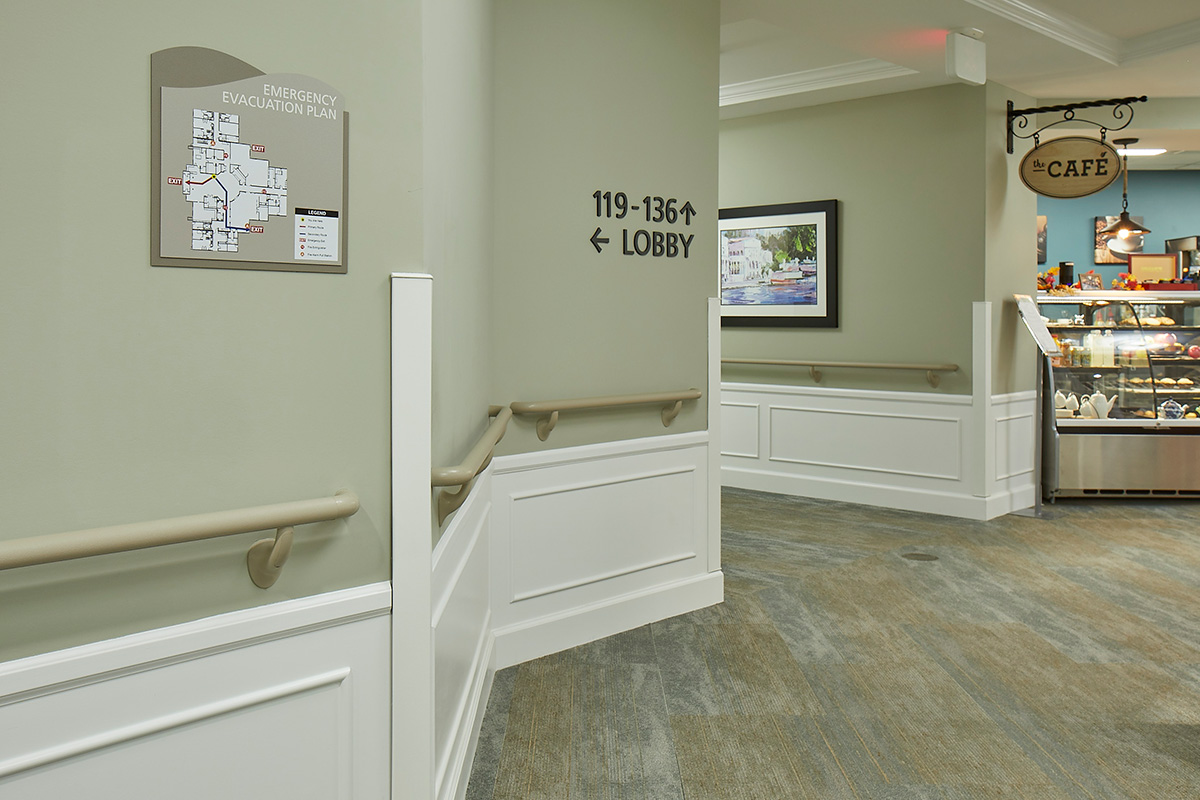
Independence often comes down to how far residents have to travel to destinations and how easy it is to get there. Designers make this easier by keeping distances short and routes straightforward. They place everyday destinations—like the dining room, mailboxes, and outdoor areas—along the natural paths people already walk, instead of forcing them to take detours. Corridors have fewer unnecessary turns, and steps or level changes are kept to a minimum or removed completely. Consistent signage that meets ADA standards helps residents find their way independently. The lettering is easy to read, with strong contrast and tactile cues, yet it still fits the space’s overall aesthetic. When handrails are needed, they run continuously and blend comfortably into the walls rather than looking like an afterthought. Wide door clearances, smooth thresholds, and even flooring add to the feeling of ease. When moving around feels natural, residents can handle their daily activities without needing help.
Spaces That Continue to Work Over Time
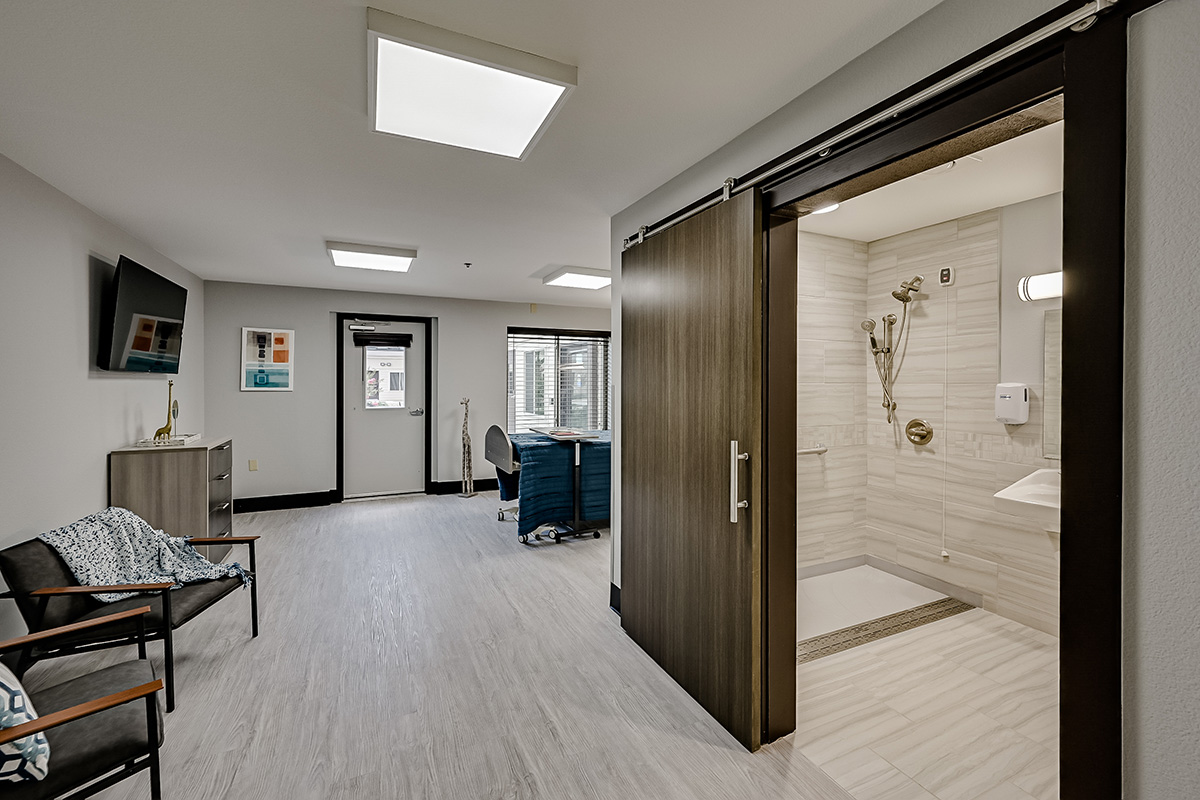
Curbless showers and reinforced walls allow bathrooms to adapt over time, supporting independence as residents’ needs change without requiring major renovations.
Independence is not only about how well a space works right now. It is also about whether it will still work well a few years down the road. Designers plan for this by building flexibility into the layout from the very beginning. Bathrooms are large enough to fit future mobility aids without major changes later on. Walls are reinforced in the right spots, so more grab bars can be installed easily without tearing anything open.
Doorways and clearances are kept wide enough for whatever comes later. Showers are built without curbs, even if no one needs that right now. These choices don’t call attention to themselves, but help residents stay independent longer and keep control of their daily lives as their abilities change.
All photos courtesy of Inpro
Senior living spaces balance comfort, connection, and independence while supporting care needs without feeling institutional.
Several years ago, Nancy and Ted, both in their late 60s, lived a seemingly idyllic retired life in her quaint childhood home in Westport, Connecticut, on a large property with flowering trees.
But when Ted was diagnosed with oncoming dementia, Nancy could see the proverbial writing on the wall. She would not be able to maintain the property or take care of Ted’s growing needs. He could not be left alone, and she feared increasing isolation from her active lifestyle. With their daughter and grandchildren living several hours away in New Jersey, getting family help was not easy. Finally, the couple made the difficult decision to sell their home and move into a senior living community near their daughter.
For Nancy, the move she dreaded worked out better than expected. With their own cozy apartment, they could maintain their independence and privacy and prepare their own meals. Or, when they wanted to connect with others, they could enjoy meals in the community’s dining room. Ted thrived with the companionship of other residents, and Nancy knew there was help nearby if needed.
For many older Americans, a similar dilemma lies ahead: Do we stay in our home, isolated with the difficulties that may arise? Or do we move into a senior community where help and companionship are nearby?
Changing Demographics Create Design Challenges
Nancy and Ted are part of the Baby Boomer generation, born between 1946 and 1964. which has reshaped American life at every stage. Now, as they enter retirement and later years, they are once again driving a significant transformation, this time in their need for senior housing and care environments. The power in their sheer number is often described as the “Silver Tsunami.”
Each day, about 11,000 Americans turn 65. The population age 65 and older already exceeds 60 million and is projected to surpass 70 million by 2030. The most rapid growth, however, is occurring among those 80 and older, a group expected to increase by more than 55 percent to nearly 23 million by 2035. At the same time, more than 560,000 new senior housing units will be needed by 2030 to meet demand, while current development is projected to fall far short of that need. This is according to Argentum, a national organization representing companies that develop, own, and operate senior housing.
As the Boomer population grows, designers are tasked with creating housing that strikes the right balance between the kinds of places in which active, socially connected seniors want to live and thrive, and at the same time receive care as needed. Much of that hinges on how senior housing looks, feels, and functions.
The Evolution of Senior Living Options
For decades, the dominant idea as people got older was “aging in place,” which encouraged remaining in the family home indefinitely. The idea perhaps harkened back to earlier times, when households tended to be multigenerational with support built in, or when families often lived near each other, making care for aging relatives possible and convenient.
But times have changed. Families are more dispersed, and many seniors end up living alone, perhaps far from loved ones. For many active Boomers, the aging-in-place model is being reevaluated. Living out one’s senior years in large, maintenance-heavy homes with stairs, narrow hallways, and physical barriers may no longer be an appealing option.
Many people in the Boomer generation are choosing to “right-size,” moving into communities designed for this stage of life. But they are not looking for basic accommodation. They want to stay connected and active, with access to care as their needs change. Just as important, they want a place that feels like a home, not a healthcare setting.
That expectation changes how these communities are designed. Spaces need to work for a range of needs without feeling clinical. Layout, materials, and everyday details all play a role in making that possible, allowing the building to perform well while still feeling familiar and comfortable.
While the majority of seniors still say they want to age in place, their expectations for how they want to live are evolving in ways that many existing homes cannot support.
What Does the Silver Tsunami Want?
Perhaps the main factor describing today’s seniors is their high expectations for their living environments. While past generations may have acquiesced or quietly settled for less-than-optimal conditions, the Baby Boomers largely understand what they require for a high quality of life in their elder years and are not hesitant to make those needs and desires known.
“Older adults considering senior living have never been more sophisticated and demanding,” said James Balda, president and CEO of Argentum.
As Balda notes in an article titled “What Today’s Senior Living Consumers Really Want: Expectations, Trends, and Industry Shifts,” today’s older adults are “used to being catered to as consumers,” and are less willing to accept generic or institutional environments, instead seeking greater choice and personalization.
That sentiment is echoed by Sarah Martell, Senior Interior Designer at Inpro, a manufacturer of interior building systems.
“Senior living design is shifting from care-based environments to experience-driven, wellness-centered communities that prioritize comfort, connection, and independence over an institutional feel,” Martell said. “Today’s spaces draw on residential and hospitality-inspired design—warm, nature-based palettes, intuitive layouts, and meaningful social areas—to support wellbeing while enhancing safety and dignity. At the same time, there’s a growing focus on neuro-inclusive design, creating environments that reduce overstimulation and offer varied sensory experiences so residents can navigate spaces in ways that feel comfortable and empowering.”
Common Fears About Moving into Senior Housing
Research and industry data consistently show that resistance to moving into senior living is driven by a core set of concerns. Chief among them is the fear of losing independence, followed closely by anxiety about social isolation. Additional concerns often include the quality of care and fear of an institutional environment.
Seniors who resist moving to senior communities where help is nearby might sum up their concerns with five statements:
- “I want to stay independent.”
- “I don’t want to be isolated.”
- “I want to feel good where I live.”
- “I want to feel secure without being managed.”
- “I want it to feel like my home, not a facility.”
The Designers’ Solutions
While senior respondents to surveys identify how they want to feel and behave in an ideal senior living situation, it is the designers’ vision and specifications that largely make that vision a reality. Independence arises from universal design, for instance. Safety is promoted by handrails and non-slip flooring, among many other factors. Wellness increases with daylighting. Connection arises from common areas and technology. And a high-quality environment arises with materials that are both durable and homelike.
In this way, an educated design professional addresses fears about senior living through design solutions. Therefore, it will be helpful to fully address each concern about senior living and illustrate the design solutions to solve these anticipated problems.
We’ll start with independence.
Independence in Senior Living Environments
Spaces are designed for ease of movement and intuitive use, allowing residents to handle daily routines independently as needs change over time.
The first challenge is more about mindset than anything else. Many people moving into senior living don’t really see themselves as “seniors” in the traditional way. They’re still active, picky about what they like, and they push back against anything that feels like it signals decline or dependency. Architects are challenged to create spaces that feel like a natural continuation of the life they’ve chosen, rather than a step down into managed care.
Residents arrive with varying levels of mobility and ability, and those needs change over time. The question is not how to design for limitation, but how to support independence for as long as possible without constant adaptation.
This means anticipating change without making it visible. Spaces should feel intuitive and effortless to navigate, with support built in rather than added later.
Using the Space Without Help
Autonomy comes down to one simple thing: can residents do their everyday tasks without needing help? That’s why designers pay close attention to how easy it is to reach things and use them. They place storage shelves at comfortable heights instead of high overhead cabinets. Appliances are chosen and positioned so people don’t have to bend down or lift heavy items. Cabinet pulls and door handles should be easy to grip, even for people with limited strength or fine motor control. In kitchens and bathrooms, there should be enough clear floor space for residents to move around freely while cooking or washing up. These factors make the difference between someone handling daily tasks on their own and having to ask for assistance every time.
Control Over Light, Comfort, and Surroundings
Independence is enhanced when residents can adjust their surroundings without asking for help or figuring out a complicated system. Controls should be easy to find and straightforward to use, not grouped into panels that take effort to understand. Light switches are placed where people expect them, so there is no searching. Window shades can be adjusted from a seated position without strain. Thermostats are clear and easy to read, with settings that make sense right away. When these basics are handled well, people can manage their space without thinking about it.
Acoustic comfort is part of this as well. Materials that soften sound and doors that close tightly can give residents a sense of control over noise in their space. When these elements are handled well, people can respond to their environment in real time. They can make a room brighter, quieter, warmer, or cooler as needed.
Choosing When to Be Private and When to Engage
Independence is closely tied to a resident’s ability to control their level of privacy throughout the day. Designers create this flexibility by layering spaces that range from fully private to more social, with clear transitions between them. An apartment entry might open into a small threshold or alcove rather than directly into a corridor. This small buffer gives residents a moment of separation. Doors, sidelights, and partial walls let residents see out when they want to, while still keeping a comfortable sense of privacy. Even inside the apartment, placing the bedroom away from the main living area provides a natural place to retreat. These simple choices help residents decide when they want to join others and when they want some quiet time, all without leaving their home or asking for help.
Moving Through the Building Without Effort
Independence often comes down to how far residents have to travel to destinations and how easy it is to get there. Designers make this easier by keeping distances short and routes straightforward. They place everyday destinations—like the dining room, mailboxes, and outdoor areas—along the natural paths people already walk, instead of forcing them to take detours. Corridors have fewer unnecessary turns, and steps or level changes are kept to a minimum or removed completely. Consistent signage that meets ADA standards helps residents find their way independently. The lettering is easy to read, with strong contrast and tactile cues, yet it still fits the space’s overall aesthetic. When handrails are needed, they run continuously and blend comfortably into the walls rather than looking like an afterthought. Wide door clearances, smooth thresholds, and even flooring add to the feeling of ease. When moving around feels natural, residents can handle their daily activities without needing help.
Spaces That Continue to Work Over Time
Curbless showers and reinforced walls allow bathrooms to adapt over time, supporting independence as residents’ needs change without requiring major renovations.
Independence is not only about how well a space works right now. It is also about whether it will still work well a few years down the road. Designers plan for this by building flexibility into the layout from the very beginning. Bathrooms are large enough to fit future mobility aids without major changes later on. Walls are reinforced in the right spots, so more grab bars can be installed easily without tearing anything open.
Doorways and clearances are kept wide enough for whatever comes later. Showers are built without curbs, even if no one needs that right now. These choices don’t call attention to themselves, but help residents stay independent longer and keep control of their daily lives as their abilities change.
Making Connections in Senior Living Communities
Along with worry about losing independence, many people’s next big fear is feeling cut off from others, as if they’re out of sight and slowly forgotten. That fear makes sense, especially considering how some older senior facilities were designed. But Nancy and Ted discovered the opposite. With shared spaces, neighbors close by, and plenty of places to spend time together, their world actually became more connected, not less. Good design plays a quiet but powerful role in making that happen. It shapes how often residents naturally run into each other and how easy it is to stay engaged with the people around them.
Spaces Where Interaction Happens Naturally
Whether people connect or keep to themselves often comes down to how easy it feels to step into a space. Large, open rooms can look good on a plan, but they are not always the places residents choose to spend time.
Many people are more comfortable in smaller settings where they can sit without feeling on display. That is why a mix of spaces tends to work better. A small lounge just off a corridor, a pair of chairs set near a window, or a quiet corner within a larger room can all support different kinds of interaction. The way these spaces are arranged matters. Furniture that faces inward encourages conversation. Lower ceilings or softer lighting can make a space feel more settled and easier to stay in.
Many interactions do not happen in dedicated rooms, but in places people pass through every day. Corridors, elevator lobbies, and entries can either keep people moving or give them a reason to slow down. When a hallway opens up just a bit and includes a place to sit, people are more likely to stop. Seating near the elevator provides a place to pause and perhaps interact with others coming and going. Someone may stop without thinking about it, and a short conversation can happen.
Dining as a Daily Social Anchor
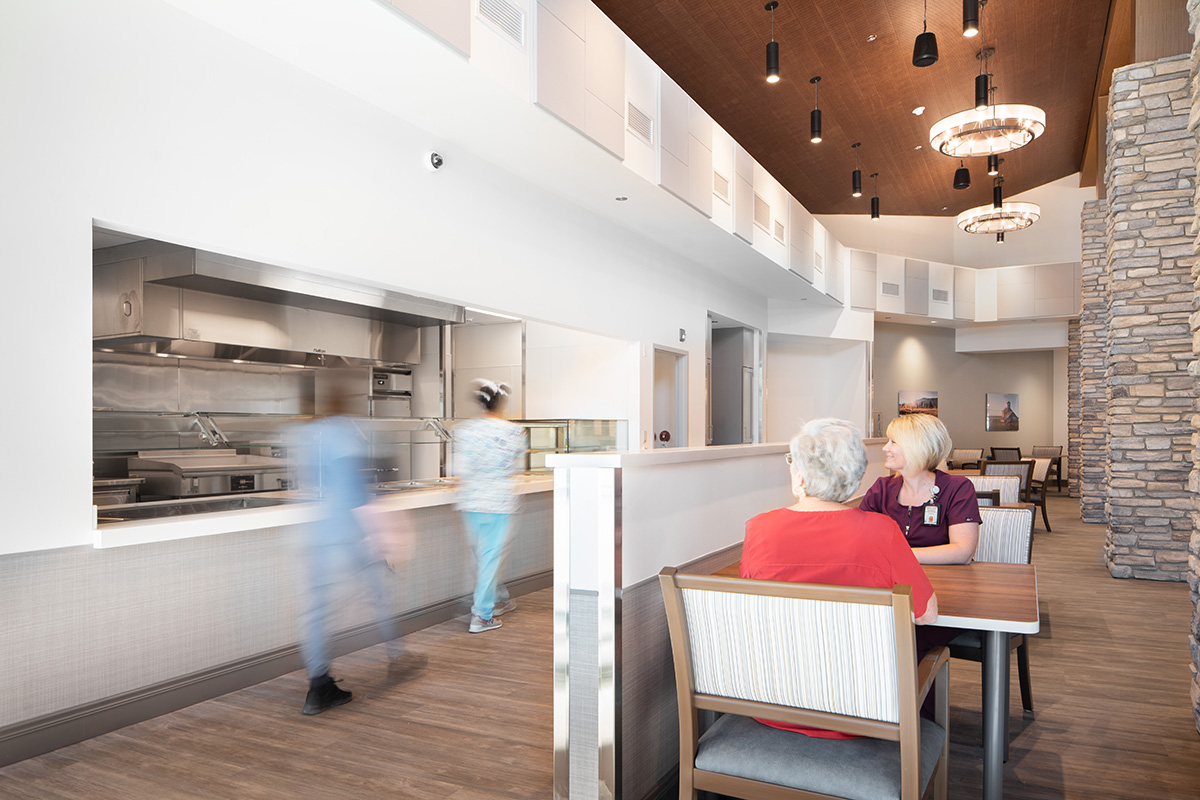
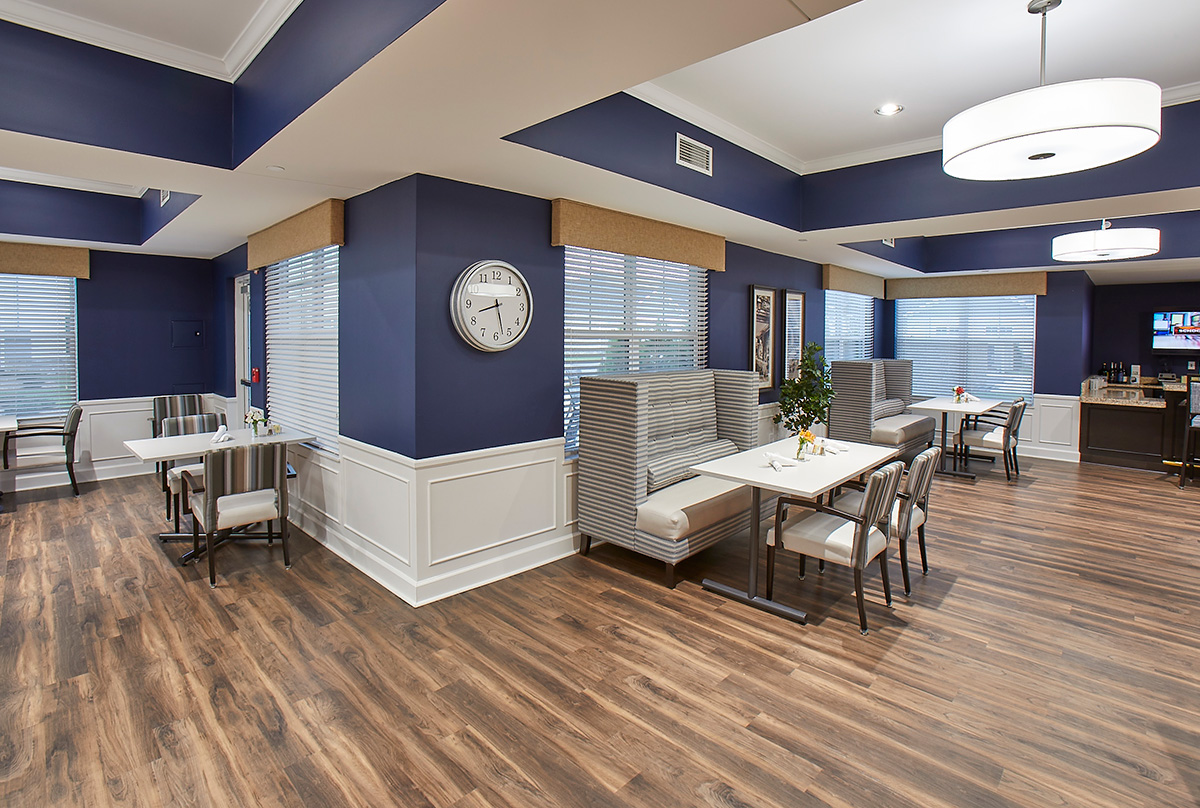
Dining spaces with varied seating and easy movement encourage residents to stay longer, connect with others, and make shared meals part of the day.
Meals tend to anchor the day in senior living communities. They occur at predictable times and give residents an easy reason to leave their apartments and be around others without having to plan anything extra. How that experience feels — rushed or relaxed — depends a lot on how the dining space is designed. When the room feels stiff or institutional, many people eat quickly and head back to their unit. But when the setting is warm and comfortable, with a mix of seating options and easy movement, residents are far more likely to linger, chat with neighbors, and enjoy the meal as a social moment.
Smaller tables make it easy for residents to sit with one or two people, while larger tables work well for those who want more company. Some residents prefer a quieter area, while others enjoy a livelier room. Outdoor seating can offer a refreshing alternative.
Lighting affects how the room works at a basic level. When it is even and not overly bright, residents can more easily see their food and read a menu, and recognize the person across the table without effort. Harsh overhead light or strong contrast can wear on the eyes over time and make the space feel uncomfortable.
Too much noise affects how people enjoy their meals. As the noise gets louder, residents may find it harder to keep up with a conversation. They may repeat themselves or fall quiet. Finishes that cut down on echo can help keep voices clear and keep background noise in check. The room should allow people to talk and be heard without effort. The goal is to create an environment where people want to linger.
Spaces Built for Reading, Hobbies, and Common Interests
Connection often starts with an activity rather than any pressure to socialize. It might be a puzzle someone left out on a table or a quiet corner for reading. A room where residents can sit and work on art gives them a reason to be there without expecting anything more. A conversation might happen, or it might not — and that’s perfectly fine. The space still serves its purpose.
Lighting affects how long residents stay in a space. As people get older, their eyes need more light to see details clearly, so brighter, even lighting makes it comfortable to read or work on a puzzle. Harsh glare or dark shadows can make the room feel unpleasant. Sound also matters. If sound bounces around and gets loud, it gets tiring. Over time, when a space feels good, residents keep coming back to the same spots. They start recognizing each other, and little connections happen naturally.
Technology and Staying Connected to the World Beyond
For many residents, staying connected is not only about the people nearby. It also depends on how easily they can reach the outside world. Technology plays a role in that, and should be critical infrastructure from the start. Internet service needs to be reliable and strong in both private units and shared areas, without dead spots or complicated setups.
Spaces designed for technology make a difference as well. A room set aside for computer use or small technology classes gives residents a place to check in with family or stay up to date on what is happening beyond the building. Areas set up for shared viewing can bring people together around a film or a live-streamed event. When these spaces are easy to use and feel familiar, they help residents stay engaged with the world beyond the building while still being part of a community.
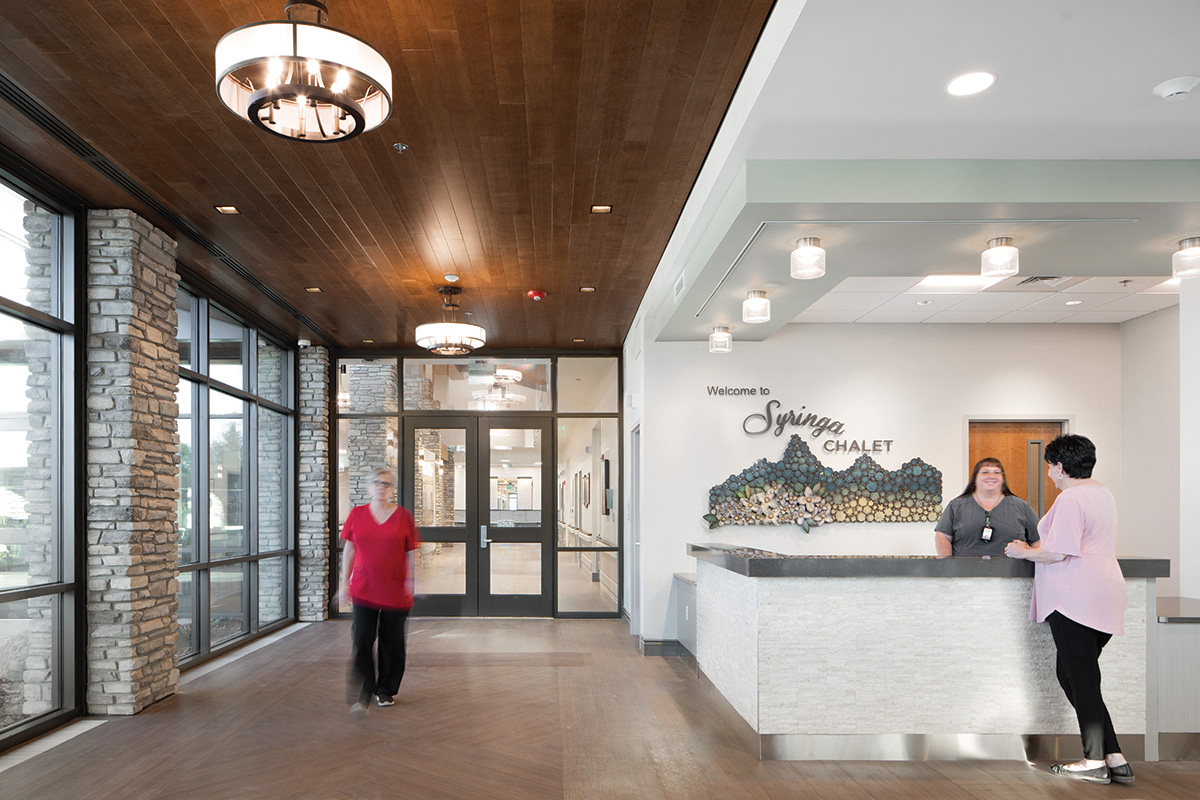
The following example shows how these ideas come together in a single community.
Personal Safety and Building Resilience
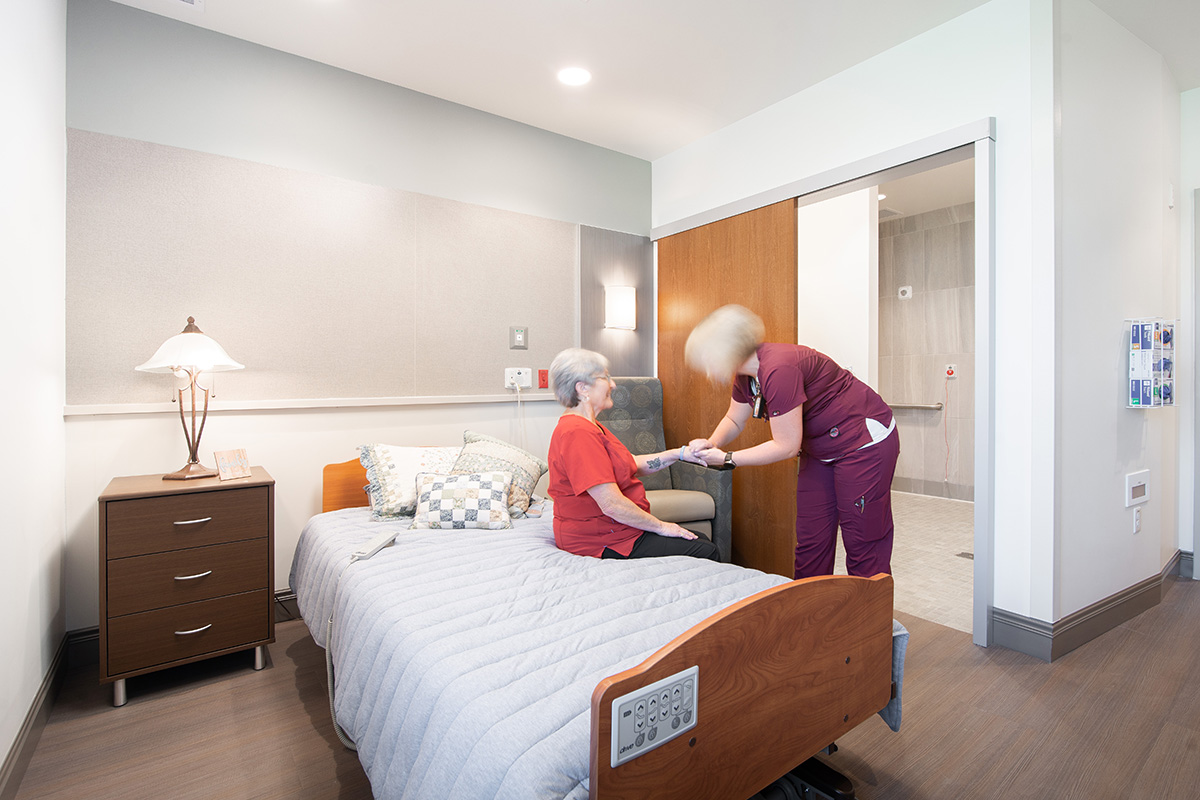
Care is close at hand in a resident room, providing support when needed while maintaining a calm, comfortable, and familiar setting.
Safety in senior living is not only about preventing harm, but about environments that feel steady and predictable. Design can reduce risk without signaling it, embedding protection into everyday experience while also ensuring the building itself remains functional under stress, especially from weather extremes.
Safety That Feels Residential
When safety features are too blatant, the space starts to feel like an institution — with handrails that don’t fit with the aesthetic and flat lighting that makes everything look harsh. Residents pick up on those signals quickly, and the whole place begins to feel more about limitations than comfort.
Safety matters, but it shouldn’t be the main thing noticed when one walks in. Handrails, lighting, floor transitions, and materials all help people move safely and easily, but they should blend in and look like they belong there naturally. Handrails, for instance, can be shaped to match the woodwork or finished in warm wood tones that go with the doors and trim. Floors should be smooth and level, without bumps or thresholds that trip people up, especially those with mobility equipment.
Reducing Disorientation Through Design
Moments of confusion often happen when everything looks the same, and there is nothing to help residents figure out where they are. In many senior living buildings, the hallways all look alike, the doors are lined up in identical rows, and intersections offer little guidance. Residents sometimes pause and hesitate, trying to get their bearings. If that happens too often, it can become discouraging. Over time, some residents start staying closer to home just to avoid that uncomfortable feeling of not knowing where they are.
It helps when the building gives residents something to look at as they move about. A view to the outside or a glimpse of the dining room ahead can quietly signal which way to go. Shared spaces are easier to find when they sit right along the main paths instead of being tucked around corners. When residents can see where they are going and recognize where they are, they don’t have to stop and figure it out. They keep moving with more ease and confidence. This makes daily activity and connection feel much more natural.
Being Close to Help Without Feeling Watched
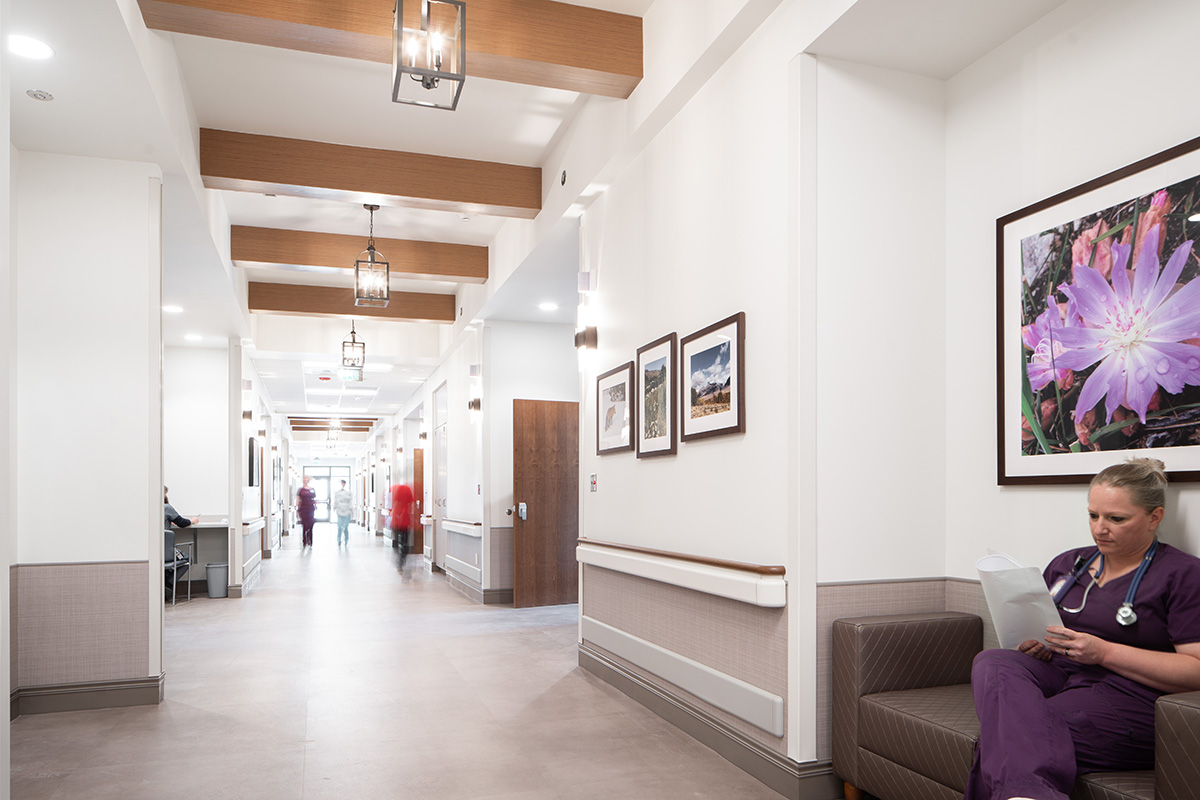
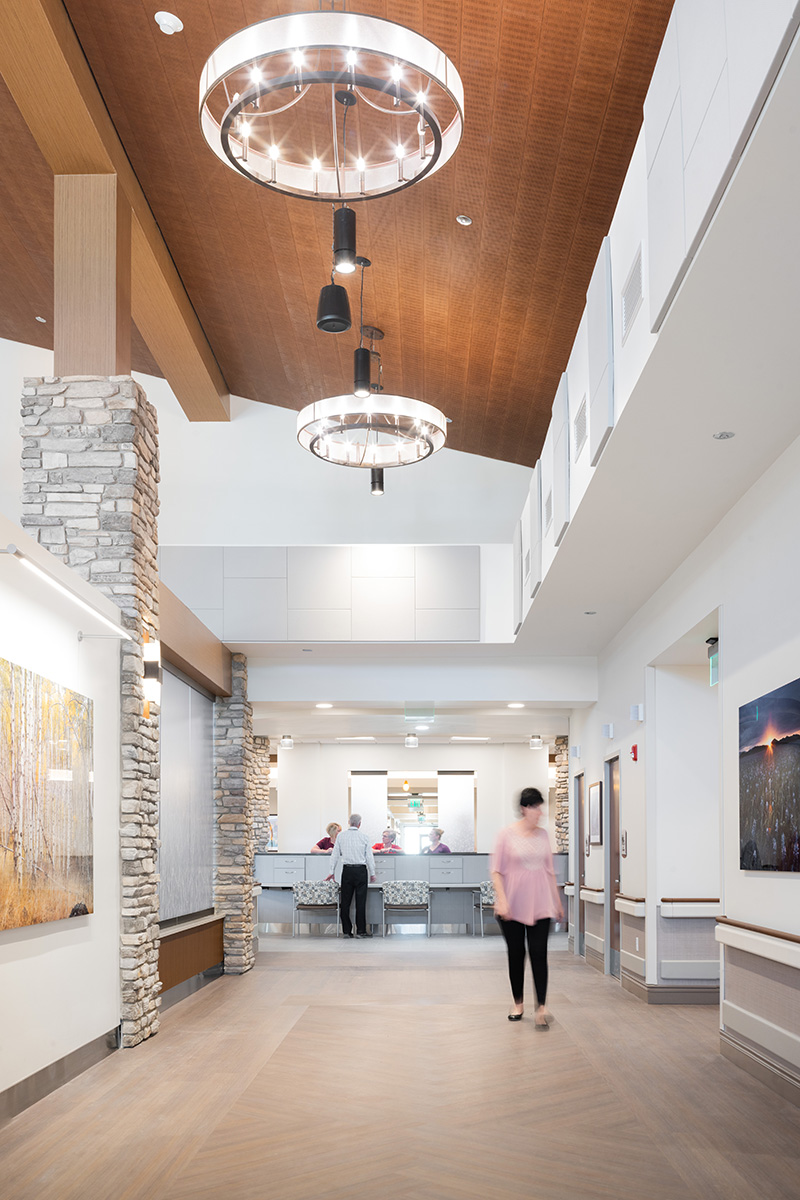
A nurse writing reports in a small seating nook stays nearby for quick help without feeling intrusive.
Safety often comes down to how quickly someone can get help, but that does not mean staff need to be in full view all the time. In some communities, staff areas are located close to resident rooms and shared spaces, so help is nearby without taking over the space. Smaller work areas are built into the plan rather than set apart, often near elevators or where hallways meet. From these locations, staff can move quickly in more than one direction and stay aware of what is happening around them. Residents pass by these areas as part of their normal routine, so staff are present when needed, but the setting still feels calm and residential rather than watched.
Partial walls, glazing, or millwork screens can provide visibility outward without making the station feel exposed. Clear lines of movement between resident areas and care spaces reduce response time, while avoiding back-of-house corridors that separate staff from daily activity.
Buildings That Maintain Safe Conditions in Extreme Events
Safety becomes most visible when something goes wrong. Power outages, heat waves, wildfire smoke, flooding, or seismic and storm events affect everyone, but the consequences are greater for residents who rely on building systems to remain comfortable and supported. Design plays a direct role in how well a community continues to function when these conditions occur.
Walls and roofs that limit heat gain and loss help keep indoor conditions from shifting too quickly when power is down. When backup power is in place, it preserves lighting and elevators, as well as medical equipment. During wildfire season or poor air quality events, filtration systems become critical, keeping indoor air safer so residents are not exposed to conditions outside.
Structural systems and detailing allow the building to absorb movement from wind, temperature swings, or seismic activity without failure. Spaces designed for sheltering in place reduce the need for evacuation when it may not be practical.
In many buildings, the biggest failures during a storm or flood come from where equipment was placed. When electrical gear is located below grade, even a small amount of water can take it out. Projects that have learned from that tend to move this equipment higher in the building or into protected rooms. The ground floor is often treated differently as a result. Instead of housing critical systems, it is finished with materials that can get wet and be cleaned or replaced without major disruption. When this is done well, the building can stay operational after a minor flood, and residents are not forced to leave while repairs are made.
During long power outages or extreme heat, simple passive features make a real difference. Good insulation helps keep indoor temperatures more comfortable, even when the systems are struggling. Operable windows also help. Safe refuge areas inside the building with power and natural light allow residents to stay in place instead of having to leave.
FEMA and the U.S. Department of Housing and Urban Development both stress that multifamily and senior housing should be designed to stay functional during and after disasters. The main goal is to protect residents and allow them to stay in place whenever possible. It’s not just about preventing damage — it’s about keeping daily life and care going as normally as possible.
Designing for Wellness
Wellness in senior living is not a new priority. Many residents have spent years organizing their homes and lives around daylight, access to nature, and daily movement. Those expectations do not disappear with a move. Senior living communities should offer the same qualities, making it easy to live well without changing habits.
Natural Light and Daily Rhythm
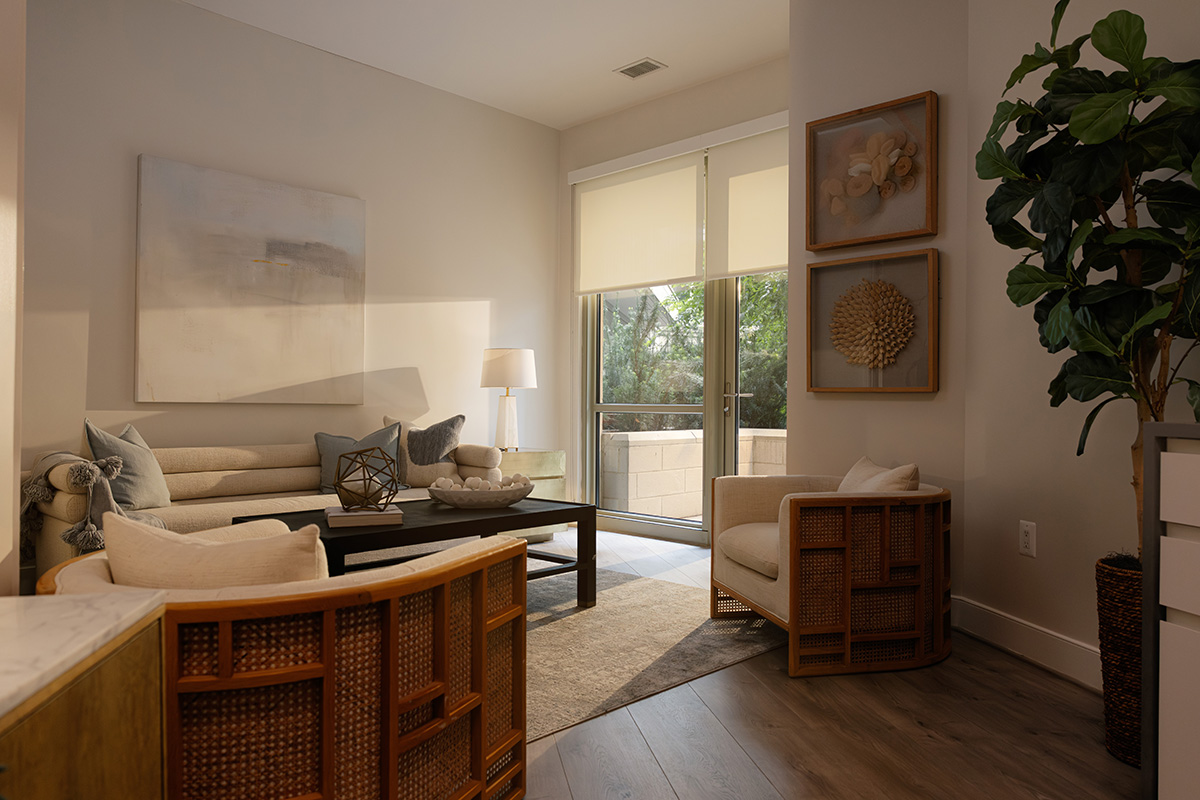
Window coverings filter daylight to reduce glare while maintaining a clear connection to natural light and daily rhythms.
Research has linked the timing of light exposure to better sleep and cognitive health in older adults. Daylight does more than illuminate a room. It also gives people a sense of time passing, which matters when routines begin to slip.
Living areas that get morning light help signal the start of the day and encourage regular wake patterns. Later in the day, the goal shifts to keeping spaces comfortable without the harshness of low sun angles. Living areas that get morning light help signal the start of the day and encourage regular wake patterns. Later in the day, the goal shifts to keeping spaces comfortable without the harshness of low sun angles. Glare becomes more of an issue as people age. Bright, low-angle sunlight can make it hard to see or stay comfortable near windows. Window coverings that soften the light without blocking it completely allow residents to stay connected to daylight without being uncomfortable.
Biophilic Strategies
Views to trees, gardens, or the sky give residents a constant, calming connection to the outside world. Natural materials, textures, and patterns bring that feeling indoors in a subtle way. Site planning and building layout should make outdoor spaces easy to reach.
As biologist E.O. Wilson famously said: “If there is an evolutionary basis for biophilia… contact with nature is a basic human need.” Placing windows at the end of a corridor or locating a seating area near plantings helps satisfy that need. These strategies reduce stress and promote focus, bringing about a sense of calm and well-being.
Movement Built into the Day
Many residents arrive with established routines that include walking and staying active. Design can either make those habits easy to continue or work against them.
Looping walking paths through the site and continuous interior routes encourage movement without requiring any special planning. Stairs that are visible and inviting also help. Fitness rooms offer more structured exercise, but they may get more use when they feel like a natural part of the building, perhaps off a main corridor, rather than a separate destination.
Feels Like Home, Built to Last
When Nancy and Ted thought about their move, they weren’t just thinking about care or convenience. They were leaving behind a home full of familiar details—divided-light windows and hardwood floors that gave every room real character. They wondered what it would feel like to walk into their new place each day. Would it feel like something they had chosen, or something they simply had to settle for?
Bringing Down the Scale
Corridors in senior living have to be wide enough for mobility, but they don’t have to feel oversized. When they go on without any change, they can start to feel long and impersonal. A few small adjustments can shift that. Lowering the ceiling in certain spots can make the space feel less stretched. Softer lighting can make it more comfortable to walk through. Artwork or wall panels can break up the length, and a place to sit gives someone a reason to pause.
Doorways and baseboards should look finished, not overlooked. When those details are done well, the corridor starts to feel like part of the home instead of something to move through quickly.
Materials That Hold Up Without Looking Institutional
Materials in senior living have to do two things at once. They need to handle constant use, and they need to feel like part of a home. That applies across the board—flooring, wall finishes, millwork, and trim. These surfaces are touched, cleaned, and exposed to daily wear, and they show it quickly if they are not chosen carefully. At the same time, materials that are too hard or too uniform can make a space feel more like a facility than a place to live.
The goal is to strike a balance. Materials need to hold up to impact and cleaning, but still feel warm and not draw attention to every mark. Finishes with some texture or variation tend to wear better over time and help a space feel more comfortable from the start.
Wall surfaces are a good example of how that balance can be handled. Wall panels that combine high-impact durability with digitally printed imagery can make a space feel more approachable and calming. The imagery can range from photos and patterns to custom graphics, allowing designers to bring in local landscapes, familiar visuals, wayfinding cues, or calming nature scenes. These elements help soften large wall areas and give residents something to focus on as they move through the building.
The imagery is not applied like wallpaper. It is integrated into the panel itself, so it does not scratch or wear off easily. At the same time, the panels are built to handle daily contact from walkers, wheelchairs, and carts. The result is a surface that looks like art or wallcovering, but performs like wall protection.
In high-use areas, handrails, wall panels, and door protection are all in view at the same time. Using one source helps keep the finishes and details consistent, so the space doesn’t look pieced together. Repairs also blend in more easily over time.
Furniture That Feels Like Home
Furniture largely determines how spaces are experienced day to day. While residents may not select the pieces in common areas, they still compare them to what they would choose for themselves. Seating should provide firm support and an appropriate seat height to make sitting and standing easier, with arms positioned for leverage but not oversized or clinical in appearance. Seat depth and cushion firmness matter, particularly for residents with limited mobility. Tables should allow for wheelchair clearance and flexible seating arrangements. Upholstery should be durable and easy to clean, but selected in textures and patterns that feel residential rather than uniform or synthetic.
Arrangement is just as important as selection. Seating grouped in small clusters encourages conversation while maintaining clear paths for movement. Pieces should be easy to reposition without feeling lightweight or temporary. Variation in furniture styles, finishes, and fabrics helps avoid a matched, catalog-driven look. When furnishings are chosen and arranged with care, shared spaces feel intentional, comfortable, and worth spending time in.
Conclusion
The desires and needs of the Baby Boomer generation are elevating expectations for senior living in ways that extend well beyond basic care. As this course has explored, design now responds to a broader set of priorities: independence and control, opportunities for connection, environments that feel safe without appearing restrictive, support for physical and emotional well-being, and a level of quality that reflects how residents have chosen to live throughout their lives. These are not aspirational features. They are baseline expectations.
For Further Research
Argentum. "What Today’s Senior Living Consumers Really Want: Expectations, Trends, and Industry Shifts.” Argentum.
Frey, William H. “Baby Boomers Are Turning 80.” Brookings Institution, 7 Jan. 2026.
National Investment Center for Seniors Housing & Care (NIC MAP). NIC MAP Market Fundamentals Data Report, Q4 2025. NIC, 2026.
Walbaum, Markus, et al. “Preferences of People 50 Years and Older when Thinking of Their Future Care Needs.” Journal of Long-Term Care, 2024, pp. 42–53.
Wiles, Janine L., et al. “The Meaning of ‘Ageing in Place’ to Older People.” The Gerontologist, vol. 52, no. 3, 2012, pp. 357–366.
Figueiro, Mariana G., et al. “Lighting for Improving Balance in Older Adults with and without Visual Impairment.” Journal of the Illuminating Engineering Society, vol. 41, no. 2, 2012, pp. 7–20. PMC.
Centers for Disease Control and Prevention. “Older Adult Falls Data.” CDC.gov, 26 Feb. 2026.
Lok, R., et al. “Timing of Outdoor Light Exposure Is Associated with Sleep and Cognitive Health in Older Adults.” Frontiers in Sleep, 2023.
Kathy Price-Robinson writes about construction and architecture with a focus on durability and climate resiliency. www.kathyprice.com.