This CE Center article is no longer eligible for receiving credits.
The dramatic rise in births immediately after World War II led to a boom in more than babies. Demand exploded for every type of consumer product from toothpaste and cereal to televisions and cars, houses in the suburbs, schools and hospitals to serve them, and roads to drive there. Now as the first boomers move into their 60s, once again the sheer number of that generation is driving a wave of growth and innovation. At the other end of the age curve, concepts in educational facilities are also morphing, as current infrastructure deteriorates and the requirement for high performance increases. In both healthcare and education, demographic trends are shaping new models far beyond traditional schools and hospitals, many of which were first built to accommodate the boomers during the 1950s and 60s.
The new spaces will have to meet the specific needs of a changing population while making the least possible demand on limited financial and natural resources. They will serve people young and old, often those in most need of protection and support. Innovation in design, materials, and products will be the only way forward. This course will focus on selecting floors that are sustainable throughout their life cycle, as they provide a basis for the healthy, positive, mission-enhancing spaces we need now.
In 1945, U.S. births averaged around 2.8 million a year, as they had during the 1930s. In 1946 that number grew to 3.47 million, and this dramatic increase continued through 1964. Today's population explosion in this country is of senior citizens. About half of the total population growth in the U.S. over the next 20 years is expected to be people over age 65. The baby boomers are aging—but it's a different kind of “age” than ever before. For one thing, it's much longer. A hundred years ago, people who reached age 65 could expect to live about 12 more years. Today, according to the Centers for Disease Control, this figure is closer to 19 years. So the approximately 71 million people turning 65 in the coming years can expect to live another couple of decades.
The need for healthcare is growing, but at the same time, people over 60 are often healthier, living longer, and demanding changes in the way older people function in society. This affects the old concepts of “hospital” and “nursing home” and even “healthcare establishment,” as more people choose to “age in place” and want to build healthcare into their home. The demand is growing for active retirement communities, assisted living facilities at every level of support from lawn services to 24-hour medical care, long-term care facilities for higher acuity patients, and outpatient and other special-care facilities for services like joint replacement and elective surgery.
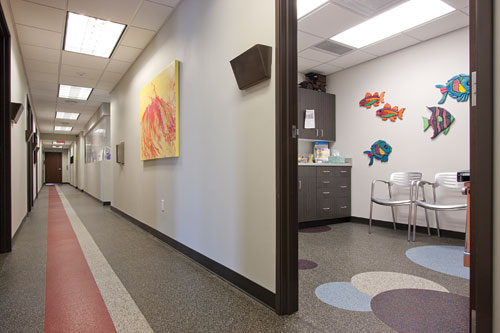 |
Healthy Outlook Family Medicine in Phoenix installed a 5,000-square-foot recycled rubber floor reflecting its commitment to an old-fashioned personalized approach combined with cutting-edge technology.
Photo courtesy of Ed Taube |
Renovation is also a strong trend. Often these are modifications to homes of baby boomers who want to age in the same place they raised their children, or move to smaller homes in urban areas where density means less driving and more cultural opportunities. But “traditional” hospitals are undergoing renovation as well. According to a survey conducted by Health Facilities Management magazine and the American Society for Healthcare Engineering (ASHE), 73 percent of construction is currently for facility renovation and modernization to be greener and more patient friendly, and to update information technology infrastructure and facilitate greater clinical integration within the facility and among healthcare providers (Health Facilities Management, February 2011). The 2012 introduction of Medicare's 30-day return stay rule, part of the Affordable Care Act, is driving health systems to manage patient care better and improve readmission rates.
 |
Resilience is essential in flooring for educational facilities, making a daily difference in the safety and comfort of teachers and kids alike. Designers of City Hall Academy at the Tweed Courthouse, New York, New York (Architect: Loffredo Brooks Architects) were also committed to making the city facility an excellent example of environmental responsibility, so sustainability in all materials was a priority. But the ability of recycled rubber flooring to incorporate almost any combination of color, pattern, or artwork also brought an opportunity to make the entire floor a teaching moment: a waterjet-cut Technicolor map of the city.
Photo courtesy of ECORE |
School Change
Although they are probably getting the most press (as they have since 1946), the baby boomers are not the only part of the population driving innovation in facilities. Changing patterns of fertility, immigration, and education, together with a school infrastructure that is crumbling in many places, will require both investment and rethinking. The picture for educational facilities is complex, and varies significantly by region and even by district. New schools are still being built, especially in western and southern states where demand is high. But renovation is a strong trend in education just as in healthcare. Many existing schools were first built when baby boomers were babies, and some schools are even older. In districts where budgets are tight and approval for new construction takes years and can change with the political climate, funding for small improvement projects is often less difficult.
School districts in the U.S. spent just over $12.24 billion on construction projects completed during 2011, including 56.4 percent on new schools ($6.9 billion). The rest of the construction was split between additions to existing buildings ($2.69 billion) and retrofit and modernization ($2.65 billion).
The outlook for educational construction has a lot of “ifs.” This includes the size of budget cuts and the fate of the proposed American Jobs Act, which would make a $25-billion investment in school infrastructure to modernize at least 35,000 public schools, and a $5-billion investment in modernizing community colleges.
These new schools and renovations are likely to be highly innovative and sustainable, as the design of high-performance schools has advanced dramatically in recent decades. This is in response to new technologies in the classroom, empowered parents, and growing evidence that informed design of classroom spaces has a positive impact on the health and performance of both teachers and students. Renovations are often undertaken specifically to improve energy efficiency and cut costs. As with healthcare, new concepts of educational facilities are emerging, including schools as community centers, as places for retraining and lifetime learning, and as physical buildings to support distance learning and other technology-based education.
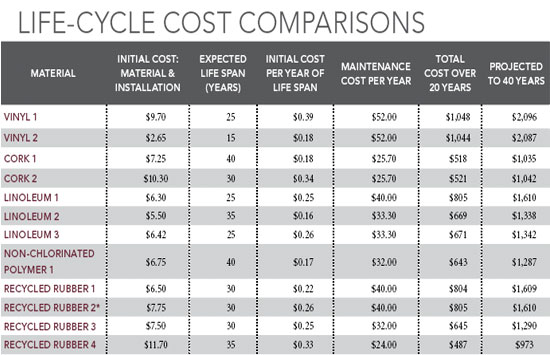 |
This life-cycle analysis study by the independent organization Center for Health, Environment and Justice compared major flooring types for their total cost over 20 and 40 years, including material, installation, and maintenance.
|
The Growth Will Be Green
In both educational and healthcare facilities, tough financial times have not seen any trade-off in demand for sustainability. In fact, in both new construction and renovation projects, reduced energy use and overall sustainability are becoming even more of a priority, and the “green share” of nonresidential construction is growing rapidly. In 2005, it was about 2 percent of the market. By the end of 2012, it is expected to reach 44 percent, and 48-55 percent by 2016.
Education Construction
In education construction, the “green” growth is even more remarkable, accounting for about 45 percent of activity, but many experts predict that by 2025, all new school construction will be green. From 2008 to 2011 many states set standards requiring new schools to be green, and school districts have found that this pays off in terms of energy expenditure and the performance and well-being of students and teachers. Numerous organizations have programs dedicated to green and high-performance schools, and many effective and popular programs have been established, including the Collaborative for High Performance Schools, the 21st Century School Fund, and the U.S. Department of Energy's Green Ribbon Schools, just to name a few.
The highest use of Leadership in Energy and Environmental Design® (LEED) (as well as Energy Star) is in dorms, education, and public buildings. In higher education, many major universities have announced they will require LEED certification in new construction. Education in general is an area where sustainability is a particularly high priority. Sustainability and “saving the planet” are now part of the curriculum and consciousness of kids and parents starting in grade school, so they expect their schools to be green.
Healthcare Construction
Healthcare construction has also shown strong “green” growth. In 2012 despite a drop in overall construction activity, the green share of healthcare construction increased 25 percent. The government has been one major driver, requiring sustainability as new veterans' and military hospitals are built. In healthcare facilities, always highly energy-intensive, major cost savings are achievable through reducing energy use, eliminating waste, and reducing infections. But sustainability is also an integral part of a move towards healthier, more holistic, healing-centered environments. The emphasis on sustainability is reflected in rating efforts such as LEED for Health and the Green Guide for Health Care, and industry initiatives such as the Sustainability Roadmap, Practice Greenhealth, and many others.
Focus on the Floor
However diverse all these new and renovated spaces will be, they are all going to need floors. The choice of flooring in both healthcare and educational facilities can have a surprisingly far-reaching impact on the success of the work going on inside the buildings, and on the larger environment as well. Noisy, hard, cheap surfaces that are difficult to keep clean and require frequent replacement are a fact of life in many older facilities. Spaces designed today can benefit from a substantial and growing body of evidence demonstrating the strong, direct connection between the quality of the surroundings and the success of the outcomes.
For example, a 2004 study, sponsored by the Center for Health Design and the Robert Wood Johnson Foundation, reviewed more than 600 studies documenting the effects of the environment on overall healthcare quality, including key factors such as staff stress and fatigue, effective care delivery, patient safety, patient stress, and other outcomes. These and other recent studies show that environmental factors like noise, glare, and poor air quality can create stress that can be measured in real terms like increased heart rate and blood pressure and reduced oxygen levels in the blood. When good design and effective products reduce these stressors, hospitalization is less stressful and more restful, and healing is encouraged.
Recycled rubber flooring offers high performance in areas where this kind of evidence is strong, and where the specific requirements of healthcare and educational facilities overlap: sustainability, ergonomics, acoustics, indoor air quality, and the use of color and aesthetics to support human performance.
Sustainability
In both healthcare and education, decision makers are increasingly insisting on sustainable designs, products, and materials.
“Sustainable” has come to mean an entire life cycle of low environmental impact. More sophisticated tools are now available to measure every phase of a product's performance, from the raw material through manufacturing, transportation, installation, maintenance, occupant health, and comfort during a long service life, and finally how the material will ultimately be disposed of or, in the best case, recycled or reclaimed.
The life-cycle cost of recycled rubber flooring is lower than most other flooring materials (see “Life-Cycle Cost Comparisons). This is partially due to its inherent material properties, and also to innovative manufacturing processes that result in products with very low embodied energy.
Recycled rubber manufacturers who stress sustainability can participate in the ASTM E2129 Sustainability Assessment program, which requires verified responsible practices at every stage of the product's life cycle. (See “Checklist: The Most Sustainable” on page 8.)
Renewable Source
Although some natural rubber is used in products today, most rubber is a highly engineered, sophisticated material requiring large amounts of energy for its initial manufacturing. Synthetic rubber is formulated to resist wear and degradation, remain permanently resilient and unaffected by moisture, absorb sound and impact, and maintain a high coefficient of friction whether it is wet or dry.
So when millions of rubber tires are thrown into landfills, a tremendous amount of embodied energy is literally going to waste. It has been estimated that seven gallons of crude oil are needed to produce just one car tire, and there are literally millions of waste tires in landfills today. The resistance of rubber to decomposition presents an additional problem, making waste tires into a virtually permanent hazard.
Although recycled rubber flooring is primarily comprised of discarded tire materials, it can also be made of other recycled materials, such as plastic bottles, and used rubber flooring reclaimed from a previous application. In a recent example, some advanced athletic surfaces are actually being manufactured from discarded athletic shoes.
In the most sustainable flooring products, a low-energy manufacturing process is used, requiring minimal water and low heat, and reusing in-line scrap to decrease waste. Scrap tire is ground, screened, and stray particles like stone, wood or fiber are removed to create a clean, consistent high-quality rubber crumb. Rubber crumb has been studied extensively and found to meet very high safety standards that are even suitable for applications like children's playgrounds (see the C.S. Mott Children's Hospital case study).
Service Life
Recycled rubber flooring begins its service life with installation using no-to-low VOC urethane adhesives, without the need for heat welding. These floors are also easier to maintain than other common flooring products, requiring only minimal routine care. They do not require the extensive and repeated high-VOC sealing necessary for some flooring products. Instead, new “green” sealing done as part of the manufacturing process is available with some products, making them even more impervious to dirt and stains even with heavy use and dramatically reducing maintenance needs over the life of the floor.
Maintenance is an important and often overlooked aspect of a material's overall cost both in dollars and environmental impact. Obviously in healthcare settings, where healthcare associated infections are a critical problem, surfaces have to be as clean as possible. Maintenance for most common flooring surfaces often requires harsh chemical cleaners, frequent re-sealing, daily or weekly buffing to remove scuff marks and stains, and frequent replacement of floors. In an example from schools, a recent study by the Florida Dept. of Education on flooring operations and maintenance costs found that with some materials, operation and maintenance costs were almost the same as replacing the entire floor each year and some schools were doing just that. Replacement was easier to budget for than extensive maintenance. This alone would probably negate any sustainable benefits from other aspects of the buildings.
For recycled rubber flooring, specially formulated Green Seal™ certified cleaning products are available to reduce environmental impact from VOC-intensive chemicals and fumes over the floor's service life, typically 15 years or longer. Extended durability also contributes to sustainability by avoiding the need for tearing out, disposing, transporting, and re-installing new material.
Waste Management and Reclamation
Recycled rubber products result in very little waste. Throughout its life cycle from manufacturing to the construction site, overages and scraps can be reground and reprocessed for new flooring. Innovative new “take back” programs are being established by responsible manufacturers who are reclaiming used floors to be made into new floors.
Low to No VOC Throughout
Another important aspect of a material's environmental impact is its volatile organic compound (VOC) profile. VOCs emitted from building products and materials not only pollute the air and degrade the atmosphere, they also have adverse effects on the health and comfort of people inside those spaces throughout the product's service life. As mentioned above, the manufacturing process for the most sustainable recycled rubber products use low heat processes that release minimal VOCs, and can be installed using zero-VOC, low odor one-component adhesives. Cleaners and sealers are also low or zero-VOC and meet stringent South Coast Quality Air Management District (SCAQUMD) and GreenSeal criteria.
The flooring products themselves do not contain formaldehyde, which can release high levels of VOCs in conventional flooring products. Recycled rubber flooring's positive contribution to healthy indoor air quality meets the highest criteria, including those established by:
- The State of Washington (the most stringent in the U.S.)
- Collaborative for High Performance Schools (CHPS) criteria (section 01350)
- FloorScore third-party certification program.
FloorScore standards require independent laboratory testing, a certified site audit, and documented control system requirements to establish compliance with California's Section 01350 emissions limit. The FloorScore label indicates that both the flooring products and the production facilities comply with rigorous indoor air quality emission requirements.
Because of their excellent performance at every stage of the life cycle, high-quality recycled rubber flooring products can also contribute to LEED points (see the LEED chart for details).
Ergonomics Underfoot
In spaces with specific missions, like healthcare and education, even the most sustainable floor must still meet the priorities of healing and learning, and must support the professionals who are making that happen. The good —or bad—ergonomic performance of a floor directly affects the experience of every patient, visitor, doctor, nurse, student, and teacher every day of the floor's service life. In addition to comfort, essential health and safety are improved with properly designed and selected flooring. This can be an important consideration not only in patient and student outcomes and staff performance, but also in risk management and insurance planning.
Strictly speaking, “ergonomics” applies to all aspects of an environment, from a building's layout and lighting to the user friendliness of the electronic devices, and some of the other factors discussed in this course such as sound control, aesthetics, cleanliness, and clean air. But recycled rubber as a material has ergonomic benefits by specific metrics that are particularly important in spaces designed for healthcare and education.
Of course, all the performance criteria discussed below reinforce each other. For instance, a healthcare facility or a school might require both a resilient layer for injury prevention and fall protection, and a cleanable, low-VOC wear surface that provides good mobility and traction.
Comfort
Even the most cushioned shoes cannot remedy back and joint pain caused by standing on hard floors all day. Uncomfortable professionals are less able to provide the positive support needed by patients or pupils. Comfortable, low-impact, anti-fatigue flooring increases productivity for staff, reduces stress, and contributes to healing for patients.
In general, comfort in flooring is related to the material's thickness for cushioning, its tensile strength, and its flexibility. Recycled rubber flooring, including underlayments and advanced products combining surface and underlayment in one product, perform well in these areas due to the inherent resilience of the material.
Major relevant ASTM standards and sample ranges for a high-performing recycled rubber roll or tile product include:
Tensile Strength: (ASTM D412) 150-200 pounds per square inch (minimum)
Flexibility: (ASTM F147) Pass ¼-inch mandrel
Slip Resistance and Mobility
Slip resistance is a crucial attribute in flooring. It protects against falls, a desirable attribute almost anywhere, from traditional retirement homes where mobility has declined significantly to the newly renovated, upscale homes of active retired people aging in place. The danger of falls is certainly not limited to the elderly or disabled. The National Floor Safety Institute (NFSI) keeps a database of slip and fall accidents collected from government, industry, and insurance-related sources. According to their research, more than 50 percent of slip and fall accidents are caused by the condition of the flooring. The U.S. Bureau of Labor Statistics found that the incidence rate of lost-workday injuries from slips, trips, and falls in hospitals was 38.2 per 10,000 employees, which was 90 percent greater than the average rate for all other private industries combined (20.1 per 10,000 employees).
But high-performance flooring in healthcare or education applications has to combine slip resistance with mobility. People must be able to walk and turn easily, move equipment efficiently, and maneuver walkers and wheelchairs.
One particularly important measure for slip resistance is Coefficient of friction: (ASTM D2047). This number indicates traction—the higher the number, the less slippery the surfacing. The ADA standard for coefficient of friction is .5. High-quality recycled rubber flooring products typically have coefficients of friction in the range of .85 to .9 (as measured for flooring on concrete base), and some are available with ratings of .90-1.10. Measurements should be high in tests for both leather and rubber soles and for surfaces with various coatings, as the coating can play an essential role in slip resistance.
Fall Protection
Even with high slip resistance, falls inevitably occur. In these cases, the quality and composition of the flooring can prevent serious injury or worse. In some applications, such as athletic surfaces or schools full of running kids, falls are just a part of doing business. Recycled rubber flooring can prevent injury and stress on joints of any age.
The key measurements for flooring that provide fall protection are also closely related to comfort. They include:
Compression: (F36) The flexibility of surfacing to cave under the repeated impact of weight (such as walking). A mid-range percentage is desirable for cushioned support.
 |
The performance of the floor in healthcare facilities can contribute significantly to healing by providing comfort, safety, healthy indoor air quality, and a quiet and restful atmosphere. This floor in the Peyton Manning Children's Hospital at St. Vincent in Indianapolis adds the colorful, artistic appeal that has been shown to lower stress and increase well-being in patients, their families and visitors, and hard-working staff.
|
Resistance to Head Injury: (ASTM 1292) This testing measures the ability of the flooring surface to cushion and absorb the impact of an object being dropped on the floor, or a person falling and hitting their head on the floor. This is typically denoted as “pass/fail,” based on certain criteria that are calculated from the test, such as Maximum Deceleration (i.e. “g-max”) and HIC or Head Injury Criterion.
Sound Performance
The importance of quiet in healthcare facilities is a subject of intense research but it is also clear to anyone who has spent a night in a typical hospital. A 2005 study at Johns Hopkins Hospital found that hospital noise has been rising since the 1960s to levels well beyond those recommended by the World Health Organization. The Center for Health Design study mentioned above cited many other examples clearly showing the negative effect of noise on patients and caregivers, in terms of elevated stress, difficulty in staff and patient communications, poor sleep, and medical error due to noise distractions.
In education, the simple inability to hear properly has been linked to a host of problems including poor grades, behavior issues, and teacher stress. For example, a multi-year study undertaken by the Orange County Public School District (OCPS) in Orlando, Florida, compared teacher retention and student test scores in classrooms which had acoustical improvements and those without. Students in sound-enhanced classrooms scored 10 percent higher on average on Florida achievement tests, and teacher absenteeism in the classrooms with better acoustics was 25 percent less. OCPS now requires sound enhancement systems in every new and renovated school.
Acoustic performance is not a luxury, but an important determinant of outcomes, and flooring plays a key role.
For sound transmission between spaces, two basic ways of measuring acoustical performance are Sound Transmission Class (STC, ASTM E90, E336) ratings and Impact Insulation Class (IIC, ASTM E492, E1007, E2179) ratings. STC measures a partition or floor-ceiling assembly's ability to block sound borne through the air, such as voices or music. IIC measures an assembly's ability to isolate impact noise, like a footstep or furniture moving overhead in a multistory building. In general, a higher rating indicates better performance. STC and IIC ratings typically range from 25, which is considered poor, to 50, acceptable, to 60 and above, for good performance.
Tests measure a floor-ceiling assembly, and to interpret the ratings correctly it is very important to know test factors. This includes finishes on the floor, the thickness of the floor, the construction and material of the subfloor and ceiling, and many other details which may affect the ratings. A Delta IIC test (ASTM E2179), usually written as ΔIIC, is used as an indication of how a floor covering performs over a standard 6-inch concrete slab, although this, too, will depend on the composition of the flooring assembly.
Recycled rubber flooring offers extremely high sound reduction along with its other attributes of sustainability and durability. Underlayments are also easy to install with virtually all other floor finishes, in single or multistory buildings. Recycled rubber is available in various thicknesses, but in general it can meet strict building code requirements while adding minimal floor height. (See “Bard's Crossing” case study.)
As Pretty Does
A recent survey of healthcare executives asking about trends affecting the industry in the coming year found that providers are strongly focused on fostering a culture that increases employee engagement and patient satisfaction. As hospitals and other establishments compete with each other for patients, patient satisfaction will be measured and promoted more intensively. Healthy, comfortable, colorful environments become an essential part of the business plan. For example, a recent study at a pediatric hospital indicated higher parent satisfaction with the aesthetics of a facility was directly associated with their satisfaction concerning the healthcare services.
Just as in other aspects of evidence-based design, such as the importance of good acoustics, comfort, and air quality, research is recognizing the powerful positive effects of color and beauty on human performance. Although the specific needs of healthcare and educational settings might differ—for example, calm and quiet in one, visual stimulation and creativity in the other—the overall positive effects of color and beauty can be effective in both. The organic colors and precision waterjet cutting technology used in recycled rubber flooring make it adaptable to creative designs, with few limits on color, pattern, or use of custom artwork. Since the color is inherent in the material, it can't fade, smear or chip over long periods of heavy use.
Bard’s Crossing
Rosemont, Minnesota | Architect: JSSH | Acoustical Consultant: Veneklasen Associates
|
|
When Wensmann Homes, the builders of Bard’s Crossing, planned an 83,000-squarefoot retirement community condominium in a suburb of St. Paul, Minnesota, they designed the floor/ceiling assembly to provide a quiet environment for potential residents.
The floor/ceiling design utilized two layers of gypsum board, a resilient channel, 1-inch of gypsum concrete, and a sandwich configuration of recycled rubber resilient soundproofing mat. Mike Vallez, project manager of design and construction for the project builder Wensmann Homes, noted that the recycled rubber product sound insulation “produced the highest IIC ratings of anything we’ve used. We were extremely satisfied with the results.” The open web assembly (see drawing) produced IIC field ratings of 64 with wood, 55 with ceramic tile, and 56 with vinyl. Vallez had worked on four previous projects with Wensmann Homes, and says the sound control results produced at Bard’s Crossing with the recycled rubber product were by far the best.
John LoVerde of Veneklasen Associates, who performed the sound testing on the Bard’s Crossing project, noted that he encounters recycled rubber flooring products on nearly a fifth of the jobs he tests, often selected because they have the flexibility to perform at a high level with a variety of assemblies and under a full range of floor toppings.
|
For example, designers of the City Hall Academy at the Tweed Courthouse in New York City used the floor itself to provide an interdisciplinary learning experience centered around the culture and history of the city for the 200 children who attend the school daily (see Figure 3). Recycled rubber was selected for its resilience and sustainability, and overall comfort for students and teachers alike (compared to most other materials, especially those sturdy enough to stand up to use in classrooms, recycled rubber is softer and even warmer to the touch). But an added benefit was the adaptability of recycled rubber to creative use of color and design, all made out of EPDM material with high recycled content. The entire floor is a waterjet-cut Technicolor map of New York City.
The Peyton Manning Children's Hospital at St. Vincent is another example of using recycled rubber flooring to meet practical needs in a creative, artistic way to make a stressful environment welcoming, even fun. (See page 6.)
Technical requirements such as resilience, slip resistance and mobility, acoustics, indoor air quality, hygiene, and sustainability are essential in flooring. But it doesn't hurt—and research shows it very often helps—to make people happy, too.
 |
The recycled rubber flooring designed for the Redding School of the Arts, a charter school in northern California, reflects the school's philosophy that art enriches, expands, and prepares students for life.
Photo by Whittaker Photography |
| Checklist: The Most Sustainable |
What are the characteristics of the most sustainable, state-of-the-art recycled rubber flooring products available?
■ High content (up to 70 percent) of cleaned and recycled post-consumer SBR from black scrap tire, blended with pigmented EPDM rubber (up to 20 percent recycled), granulated for additional color
■ Company produces its own line of EPDM for use in the form of color chips, using specially cleaned and post-consumer material from virgin EPDM manufacturing
■ High recycled content throughout the flooring product, not just in the base or wear material. Highest: solid recycled rubber flooring, or new products that fuse the wear layer with the underlayment to form a single-component product.
■ Manufactured with a low-heat processes that cause little or no off-gassing.
■ Extremely low levels of VOCs (at or approaching zero) throughout flooring’s life span, meeting FloorScore, Washington State, CHPS, and other stringent criteria
■ No chemical laminate or high heat vulcanization to define the wear surface
■ Ergonomic performance by established independent standards
■ Construction waste management programs
■ End-of-life “take back” programs
■ Manufacturer participates in ASTM e2129-05 Sustainability
■ Product meets criteria allowing contribution to USGBC LEED points
|
Recycled Rubber Flooring and LEED
Recycled rubber flooring's high recycled content and low VOC emissions can help contribute points toward LEED certification, including LEED for Health. Your manufacturer should be able to give you detailed guidance. The following is a summary of some potential areas:
Materials and Resources
MR 2.1 & MR 2.2 Construction Waste Management:
Possible when recycled rubber flooring selvages and overages; can be shipped back to manufacturer for re-grinding into new products.
MR 4.1 & MR 4.2 Recycled Content:
Possible when recycled rubber flooring product has high post-consumer and pre-consumer recycled content.
MR 5.1 & MR 5.2 Regional Suppliers: Up to 2 points.
Possible when project is located within a 500 mile radius of manufacturer or supplier. Some manufacturers use scrap tires within 500 miles of their facility, so the materials meet the radius requirement.
Environmental Quality
EQ 4.1, 4.2 Low Emitting Materials:
Possible when adhesives and sealants used with a recycled rubber flooring product are low emitters of VOCs (some new products emit zero VOCs).
EQ 4.3 Compliance with FloorScore:
Possible when product has been certified by the FloorScore program. VOC content of adhesives and sealants must be lower than current limits of South Coast Air Quality Management District (SCAQMD) Rule #1168. Some recycled rubber underlayment products use low-VOC adhesives that are 50 percent lower than the FloorScore standard.
C.S. Mott Children’s Hospital
|
 |
Von Voigtlander Women’s Hospital Indoor Playground. Architect: HKS of Northville, Michigan,
in conjunction with the in-house healthcare design professionals at the University of Michigan
Photo by Bob Foran |
According to U.S. News & World Report, C.S. Mott Children's Hospital, located in Ann Arbor, Michigan, is one of the top pediatric children's hospitals in the United States, consistently ranking among the nation’s best in all ten pediatric specialties evaluated.
The hospital's newest state-of-the-art facility, the Von Voigtlander Women's Hospital, enables it to continue its commitment to providing newborns, children, and pregnant women with the best health care possible. One of the many unique things about the Von Voigtlander Women's Hospital is that it features something for patients' families—an indoor children's playground.
“I'm not sure they have another kids' play area in any of the other University of Michigan hospitals,” said Jere L'Heureux, the agent involved with the flooring installation for the playground. “They were going to go with a poured in place system, because they thought it would save them money; but that surfacing didn't pass the hospital's indoor air quality standards. They decided to use recycled rubber commercial flooring, and it worked out quite well.”
The flooring for the indoor playground used custom cut tiles. A local waterjet cutter worked on the innovative flooring designs.
C.S. Mott Children's Hospital has been very happy with the results of the playground installation and its flooring. “They like the bounce of it; the recycled rubber provides excellent cushioning should a child fall,” said L'Heureux. “Underneath the flooring, you will find a one and a quarter-inch-thick cushion of underlayment. This also makes the floor very quiet. So, if the children are running around upstairs, no one can hear them downstairs.”
“I think it's great that children have a safe, colorful, and fun place to play and burn off steam while they are in the facility,” said L'Heureux, “and the hospital seems to like it, too.”
|
 |
ECORE Commercial Flooring is comprised of world-class, market-leading, sustainable, and innovative commercial brands. ECOsurfaces, QT Sound Insulation, Everlast sports surfacing with Nike Grind, and ECO98 are manufactured by ECORE in the USA and lead their respective markets as the highest-quality and most sustainable, recycled rubber products in the industry. www.ecoreintl.com |