This CE Center article is no longer eligible for receiving credits.
The term “masonry” refers to construction with stone, and it has been around for centuries, from the pyramids to the Coliseum to the magnificent cathedrals of Europe. Masonry by its very nature conveys permanence and quality, and its attributes are well recognized. Masonry is structurally sound, withstanding wind loads and gravity loads. It is fire resistant. Acoustically, it confers peace and quiet, and it provides good moisture control and thermal performance. In short, masonry endures.
Over the years, masonry has evolved as a result of better quality control, improved construction methods, enhanced design, and a deeper understanding of the material's fundamental properties, and in modern times, continues to be identified with longevity and low life-cycle cost. To today's buildings, masonry brings durability, value, and aesthetics. Many structures incorporate a wide spectrum of compatible masonry components from split face concrete masonry units (CMU) and cast-in-place concrete to pre-cast elements and concrete pavers.
To big box stores, masonry offers durability and value. In renovations, it provides an attractive and practical re-cladding material. And the designer's palette is not limited to exterior applications—many interiors incorporate the aesthetic and practical appeal of the material.
Now masonry is poised for another major evolutionary step—to meet changing energy codes. As society moves towards sustainable building, energy codes are becoming ever more demanding. Rising to the challenge of stricter regulations, manufacturers are working to develop new, more insulated masonry systems with better thermal performance. This article will discuss the changing green building picture, focusing on new requirements in the International Energy Conservation Code (IECC). Compliance options for masonry will be identified, with particular emphasis on foam wall panel systems.
 |
Among the requirements of today’s energy codes are higher R–values and continuous insulation.
Photo courtesy of Oldcastle® Architectural |
Calling for More Energy-Efficient Buildings
The statistics indicating that buildings have a significant impact on energy use and the environment have been widely publicized. According to the World Business Council for Sustainable Development (WBCSD), buildings account for 40 percent of the world's energy use. Besides using more energy than any other sector of the U.S. economy, buildings account for approximately 70 percent of electricity consumption, 40 percent of CO2 emissions, and 14 percent of water consumption in the U.S.
Recognizing the implications of these numbers, the building industry has responded on several levels with calls to adopt sustainable, resource-efficient building practices that can play a major role in reducing the impacts of the built environment on the natural environment.
Professional organizations and governments are calling for greener targets; codes and regulations are evolving in support of that objective. Several of the building industry's sustainability initiatives are highlighted below.
The AIA Commitment
A growing national initiative, the AIA 2030 Commitment provides a consistent, national framework with simple metrics and a standardized reporting format to help firms evaluate the impact that design decisions have on an individual project's energy performance. The idea is that to truly rise to meet the energy reduction goals of 2030, architects have to apply the principles of sustainable design to every project from its inception and early design through project completion and ongoing building operations–not just those projects where clients wish to pursue third-party green building certification. The profession can't meet radical building energy use reduction targets one project at a time and architects are embracing the challenge at hand by thinking differently about sustainable design.
Vision 2030
Composed of several industry groups including the AIA, Vision 2030 asks the global architecture and building community to achieve a dramatic reduction in the climate-change-causing greenhouse gas (GHG) emissions of the building sector by changing the way buildings and developments are planned, designed, and constructed. Vision 2030 is specifically focused on lowering building energy consumption and greenhouse gas emissions. Although Vision 2030 is at the core of the AIA 2030 Commitment, it encompasses other issues as well, such as incorporating water and indoor air quality requirements in every design and outlining internal policies within the firm with regards to recycling, green product purchasing, and energy conservation, among others. While the AIA's commitment also asks for action plans and implementation steps to be documented and submitted, Vision 2030 is a stand-alone commitment, and encourages firms to design buildings that meet prescribed targets.
Green House Gas Sources
 |
Total Carbon Dioxide Emissions from Energy Consumption by Sector (2008)
|
Vision 2030 seeks to have all new buildings, developments, and major renovations designed to meet a fossil fuel, GHG-emitting, energy consumption performance standard of 60 percent below the regional (or country) average/median for that building type—and at a minimum, to have an equal amount of existing building area renovated annually to meet those goals. With the overall objective of carbon-neutral buildings by 2030, the following interim goals are targeted: The fossil fuel reduction standard for all new buildings and major renovations increased to 70 percent in 2015, 80 percent in 2020, and 90 percent in 2025.
While these goals go well past those of the current energy codes, Vision 2030 suggests that targets may be accomplished by implementing innovative sustainable design strategies, generating on-site renewable power, and/or purchasing (20 percent maximum) renewable energy. Of these three approaches, sustainable design strategies are by far the most important. While manufacturers can help with new and better products, the bigger burden falls on architects, who can employ such design strategies as building size—volume and floor space—orientation, air tightness, higher R-values, thermal mass, and continuous insulation to reduce energy costs.
ASHRAE 90.1
This standard provides minimum requirements for energy-efficient designs for buildings except low-rise residential buildings. Originally published in 1975, ASHRAE 90 has undergone multiple editions due to the rapid change in technology and energy prices.
Now the standard is ASHRAE 90.1, which has been updated several times since it was published in 2001, on the basis of making technologies more efficient and developing new technologies. Many states apply the standard or equivalent standards for all commercial buildings while others do so for all government buildings.
International Energy Conservation Code (IECC)
The IECC is published by the International Code Council, a member-focused association dedicated to helping the building safety community and construction industry provide safe, sustainable, and affordable construction through the development of codes and standards used in the design, build, and compliance process. Most U.S. communities and many global markets choose the International Codes, or I-Codes. Providing minimum safeguards for people at home, at school and in the workplace, the I-Codes are a complete set of comprehensive, coordinated building safety and fire prevention codes.
The IECC, which references ASHRAE standards, is an I-code, a model code adopted by many state and municipal governments in the U.S. for the establishment of minimum design and construction requirements for energy efficiency. Introduced in 1998, the IECC addresses energy efficiency on several fronts including cost savings, reduced energy usage, conservation of natural resources and the impact of energy usage on the environment. IECC's precursor was called the Model Energy Code. IECC 2009 was recently updated by the IECC 2012.
It is generally considered that the adoption and enforcement of energy codes is one of the quickest, cheapest, and cleanest ways to reduce energy use in the built environment and help ensure a sustainable and prosperous future. Not only do energy codes reduce needless energy consumption and help protect the environment, they provide common benchmarks that drive new designs and technologies.
 |
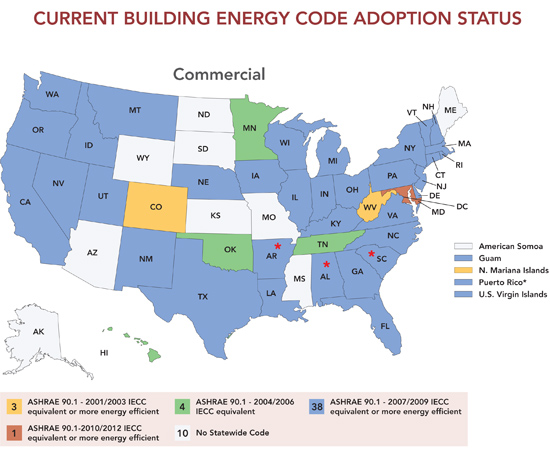
States marked with an asterisk have locally adopted residential energy codes that are above the state-mandated minimum.
Chart courtesy of Oldcastle® Architectural |
The desirability of energy codes is a given, but the question becomes which code to follow. The answer lies in where the project is located. Rather than mandating across-the-board changes, IECC code changes are only enforceable when they are adopted at the state or local level. Many jurisdictions do not adopt new versions of the code immediately after publication. When states or municipalities do adopt updated codes, they generally incorporate changes to reflect regional building practices, or state-specific energy-efficiency goals, sometimes deleting, supplementing, or otherwise changing various sections of the code. As of August 2012, the commercial code status is as follows:
- Most states and U.S. territories—38 out of 56—require ASHRAE 90.1-2007 / IECC 2009 equivalent or less.
- One state has stricter requirements.
- The rest have less stringent requirements.
- Ten states have no statewide code at all.
The maps on the previous page illustrate the commercial and residential energy code situation by state.
The U.S. Department of Energy
To see that the U.S. government is motivated and involved in improving energy standards in the built environment, one has only to look at the U.S. Department of Energy (DOE), whose energy goals are either driven by policy or law. As spelled out in the DOE's Annual Report for 2011, the agency's goals include cost effectively increasing energy efficiency in all buildings by 50 percent through more efficient building codes by 2015. DOE, through its Building Energy Codes Program (BECP), is working to enable 70 percent of states to adopt either the 2009 IECC, or ASHRAE Standard 90.1-2007, or better by 2015, and 90 percent of states to adopt these codes or better by 2017.
A Closer Look at the IECC 2012
Each revision of the IECC ratchets up energy performance requirements, and the 2012 revision is no exception. The major changes in the latest version of the code center on creating buildings that use 30 percent less energy than that required by the 2006 IECC edition—and targets for the 2015 code are 20 percent above the 2012 edition. Essentially, the code is heading toward a pronounced emphasis on building insulation and building envelope construction, with changes that affect building insulation values, fenestration, and air leakage.
Of prime importance to designers of masonry systems are the air barrier requirements. Air barriers systems are comprised of a number of materials which are assembled together to provide a complete barrier to air leakage through the building enclosure. They control the unintended movement of air into and out of a building enclosure—an important consideration in reducing energy costs as air leakage from a building can result in an increased use in energy costs of up to 30-40 percent in heating climates and 10-15 percent in cooling costs. Still, according to the Air Barrier Association of America, only Florida, Georgia, Maryland, Massachusetts, Minnesota, New York, and Rhode Island have air barriers in their codes.
The IECC 2012 version requires air barriers in both commercial and residential energy codes. Air barriers are now required in zones 4 – 8, with a continuous air barrier for the opaque building envelope required to comply with Sections 402.4.1.2.1, C402.4.1.2.2, or C402.4.1.2.3. The commercial code definition for an air barrier is the same as the residential code, with the following additional requirements:
- Materials – Air Permeance < 0.004 CFM/SF
- Assemblies – Air Permeance < 0.04 CFM/SF
- Building – Air Permeance < 0.4 CFM/SF
- Mandatory Testing
| Relevant Web Sites |
For further information on energy codes, architects will find the following links helpful.
|
Getting Started in Compliance
R-value requirements for building envelope components are determined by climate zone and are also impacted by building occupancy types, wall types, and the compliance path chosen.
Climate zone. It is first necessary to determine in what climate zone the project is located. Today there are eight climate zones for the entire U.S., a vast improvement over 1989 when there were 38. Tables in the code identify the correct climate zone for every U.S. county and territory.
Building type. Section 502 of the code defines residential and commercial building types. Residential buildings include detached one- and two-family dwellings and multiple single-family dwellings (townhouses) as well as Group R-2, R-3, and R-4 buildings three stories or less in height above grade plane. The last phrase is sometimes called “light commercial.” In the energy code world, it is considered residential, primarily because the equipment and appliances used and exterior walls more closely match those used or found in a single-family house than in an office building. Commercial buildings refer to all buildings not included in the definition of “residential buildings.”
Wall type. While the IECC has reduced the number of climate zones, R-value tables have become more complex. The commercial table lists multiple variations within each envelope component, except for walls below grade, where only one type is listed. Three types of roofs, for example, four types of above-grade walls, and two types of floors make for many permutations.
 |
Continuous insulation helped a Wisconsin apartment rehab project win a government grant.
Photo courtesy of Oldcastle® Architectural |
Compliance path. There are three paths to compliance: prescriptive, performance, and whole building analysis. In the prescriptive path, building design and components need to meet R-values listed in the tables. The prescriptive path is stringent and offers little flexibility, and does not take into account much individualized proposed building information, other than categories given in the tables. The performance path uses established software to measure compliance, providing less stringent requirements and more flexibility to trade off requirements. In the performance path, the designer is allowed to “build” a description of the structure, including specific information on project location, wall and window areas, orientation, the location of thermal mass relative to the exterior insulation layer, etc. If the envisioned envelope fails to meet the code requirements, it becomes a matter of adjusting the various components. To be sure, the performance path is more complex than the prescriptive path, which architects have traditionally followed. But with software becoming easier to use and the design flexibility it offers in meeting more stringent code requirements, the performance path may be more readily embraced in coming years. While not explicitly referenced in the IECC, the ASHRAE standard on which the IECC is based, specifically names two computer programs that are designed for use by the average architect.
Another path to compliance uses the whole building analysis. While this method requires even more complex software, tradeoffs are allowed among envelope components, HVAC systems, and lighting. For example, the whole building path may allow lower R-value wall material in exchange for pre-heating incoming “fresh” air. While not widely used today, the whole building path may be the main method in future years as it analyzes a building's total energy use, rather than compliance of individual components.
IECC and Continuous Insulation
National model energy codes are advancing the way designers approach commercial and residential exterior walls, some by focusing on continuous insulation (CI) systems, which provide an uninterrupted insulation layer over an entire wall, not just in the wall cavities. The 2012 code has created more opportunities for the use of CI on both new residential and commercial walls. Any time the insulating layer is interrupted, the effective R-value of the insulation is reduced. Increases in thermal performance have resulted in CI figuring more and more in meeting both prescriptive requirements and overall building R-value targets.
Continuous insulation is not currently defined specifically in the ICC family of International Building Codes, but it is defined in ASHRAE 90.1 as:
Continuous insulation (c.i.): Insulation that is continuous across all structural members without thermal bridges other than fasteners and service openings. It is installed on the interior or exterior or is integral to any opaque surface of the building envelope.
Because CI combines rigid insulating foam and structural sheathing into an easily fabricated product that provides uninterrupted exterior insulation, air sealing, and a solid nailing surface for exterior finishes, many find it helps meet new code requirements in less time and with less incremental cost.
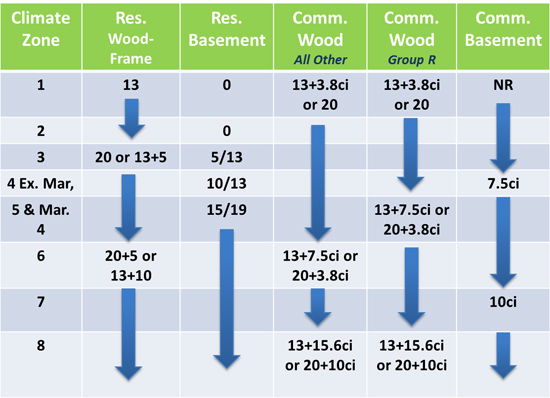
CI is found in various places in the 2012 IECC. Table C 402.2, for example, is a prescriptive table that lists all opaque (non-window) wall R-value requirements. Where CI is listed in this table, it is mandatory.
Footnotes are worth noting. In the commercial table, the footnotes specify: for SI: 1 inch = 25.4 mm. ci = Continuous insulation. NR = No requirement. In the residential table, the following footnotes are important to consider:
Footnote C. “15/19” means R-15 continuous insulation on the interior or exterior of the home or R-19 cavity insulation at the interior of the basement wall. “15/19” shall be permitted to be met with R-13 cavity insulation on the interior of the basement wall plus R-5 continuous insulation on the interior or exterior of the home. “10/13” means R-10 continuous insulation on the interior or exterior of the home or R-13 cavity insulation at the interior of the basement wall.
Footnote H. First value is cavity insulation, second is continuous insulation or insulated siding, so “13+5” means R-13 cavity insulation plus R-5 continuous insulation or insulated siding. If structural sheathing covers 40 percent or less of the exterior, continuous insulation R-value shall be permitted to be reduced by no more than R-3 in the locations where structural sheathing is used– to maintain a consistent total sheathing thickness.
The table pictured below is an R-value summary for the 2012 code. CI requirements are scattered throughout the table. Note that EPS (expanded polystyrene) R value = 3.8 /inch, while XPS (extruded polystyrene) R value = 5 /inch.
2012 IECC R-Value Summary
 |
Energy performance criteria |
R-values are on the increase. For example, in terms of increased R-values, Zone 4 steps up basements for residential and commercial properties. Zone 5 steps up residential basements and commercial wood, and Zone 6 steps up R-values in residential wood frame and commercial wood, and all other occupancy types.
It is important to note the definition of mass walls. According to Section C402.2.3 of the code, mass walls weigh at least 35 lb/ft2 of wall surface area, or 25 lbs./ft2 of wall surface area if material weight is ≤ 120 lb./ft3. Masonry veneers are not mass walls. The Residential Code in Section R402.2.5 says that mass walls are above-grade walls of concrete block, concrete, insulated concrete form (ICF), masonry cavity, brick (other than brick veneer), earth (adobe, compressed earth block, rammed earth) and solid timber/logs. Masonry veneers are not mass walls. They are usually isolated from the interior conditioned air. Architects should not use “Effective” or “Thermal Mass adjusted” R-values for walls and/or products when checking compliance in prescriptive tables. For example, consider the R-value minimum for mass wall vs. wood frame in a non-residential occupancy such as a strip shopping center or fast food restaurant. In every climate zone the mass wall R-value is less than for the frame wall in the same climate zone. Therefore, it is safe to conclude that thermal mass benefits are already included in the tables.
Masonry Compliance with IECC
The following comparative analysis shows how traditional and new masonry systems comply with the IECC 2012, culminating in a chart that assesses each system according to the following parameters: labor rates, R-values / AIA 2030, renovation potential, CI and thermal bridging, water management, acoustical, fire, air barrier, cost, and aesthetics.
Single Wythe Walls
A single wythe wall is a stone, brick, or concrete wall that is one masonry unit thick. It is the most economical wall type as the single layer provides the structure, exterior surface finish and, in some designs, interior surface finish. It is considered durable and inherently fire-proof with fire ratings up to 4 hours. Although the thermal mass and inherent R-values may be sufficient to meet code requirements, particularly in warmer climates, additional insulation may still be required. Rigid insulation inserts, foamed in place or loose fill insulation can be applied to the interior or exterior of the unit. Furring strips can be added to the interior to increase insulation. Alternatively, exterior insulation and finish systems (EIFS) can be added to the exterior. R-values will depend on the density of the concrete, the number and height of the of webs, the depth of CMU as well as the type of insulation calculation method used. With the variety of concrete masonry units and insulation types and thicknesses, R-values from 5 to over 25 are possible. These R-values are relatively low. There is no continuous insulation but if the U-value table is used, continuous insulation is not necessary. Water penetration is sometimes a concern with single wythe walls.
Cavity Walls
Cavity walls consist of two 'skins' separated by a hollow space or cavity, which can be filled with insulation by various methods. A continuous layer of rigid insulation is easily fitted between the cavity and the inner skin of the wall. The cavity itself also helps in insulating the building by acting as a thermal break between the two skins of the wall. The insulated cavity wall adds R-value from the rigid board in the cavity. Board insulation that is 4-5 per inch of thickness times 1-2 inches thick gives an extra R-value of 4 to 10 compared to the single wythe wall. With cavity walls, water management is also superior to that of a single wythe wall, and continuous insulation is achieved. Cavity walls, however, are more costly than single wythe walls; many municipalities, school districts, and other entities consider cavity walls the “Cadillac” of walls.
 |
Energy performance criteria
Source: International Masonry Institute |
Traditional Masonry Veneers
Traditionally, masonry veneers are either anchored brick, concrete, or natural stone units, or adhered manufactured stone, or thin-cut natural stone. One concern is how continuous insulation is incorporated into an adhered veneer. The addition of insulation between furring strips may appear to be a solution, but furring strips often replace a drainage mat to avoid water management problems. The bottom line is that the designer has to rely on the back-up wall for R-value in adhered veneer.
Newer Wall Systems
Newer wall systems, which include thin veneer systems, various rainscreen walls, and foam panel systems usually have thinner and/or lighter units and employ different anchoring techniques. Insulation and CI is sometimes included.
Thin brick systems are composed of metal panels with or without ridges that act like furring strips to hold the metal panel off the wall. Half circles are punched out to support brick. Each brick is glued into place before mortaring. Thin brick systems are available in both insulated and un-insulated versions with and without drainage channels in the metal panel. Systems with ridges allow for air pressure to equalize on both sides of brick cladding. Insulation is also provided from the back up wall. One drawback to thin brick systems, however, is that installation can be somewhat complicated and time consuming as each brick must be glued into place.
Masonry rain screen walls allow bigger masonry units, but metal channels interrupt the insulation, hence there can be no CI. Far preferable in a number of respects are foam panel wall systems. Relatively new to the market, they consist of polystyrene foam panels, stainless steel screws or anchors, masonry units and mortar. Type S mortar can be used, which has the advantage of additives to achieve easier pumping, better bonding, flexibility, and dimensional stability. A variety of masonry units are available including durable stone, clay, and concrete brick with others under development. Masonry units are friction fit in the foam, with different types of units having different foam panels.
Foam Panel Wall System
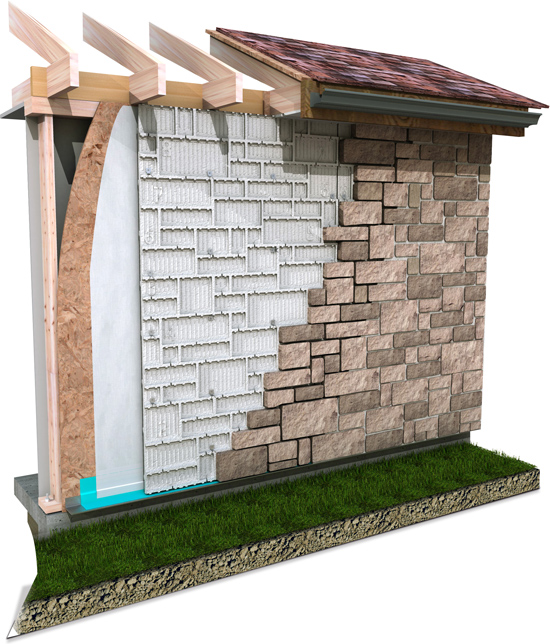 |
3D rendering showing the existing wall or substrate, foam insulation panel, anchor/screws, stone, and specially engineered mortar.
|
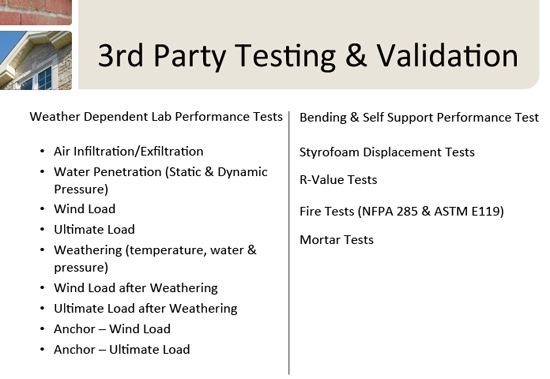
The foam is the key to the efficacy of the unit, adding good water management with drainage on both sides to take away any water that may infiltrate the wall and protect the structure from damage over its service life of high moisture exposure. R-values are high as well—9.1 Steady State and 13.6 including Thermal Mass. An STC of 51 and an NCMA TEK 13-1B sound transmission rating for concrete masonry walls means loud sounds are only faintly heard and occupants can enjoy their space in peace and quiet. Some foam systems have been proven to resist wind speeds of more than 110 mph according to ASTM E330 with no lasting deformation, which essentially eliminates the structural risk of damage experienced with lighter-weight veneers. Fire resistance criteria notably NFPA 285 and ASTM E119 assures that tested foam walls have successfully withstood one hour of exposure to temperatures of more than 1,700 degrees F. Foam panels systems should meet the above mentioned criteria as well as those in the accompanying table.
 |
|
To install the panels, foam is applied over sheathing, flashing, and one to two layers of a weather-resistant barrier. Stainless steel anchors are used for wood, steel, or concrete structures. Screws are used for wood studs, self-tapping screws for metal studs, and tapcons for concrete or CMUs. Protrusions along the top of the panel help stones to fit snugly into the foam. Concrete brick generally comes in 4-inch by 5-inch lengths, with +/- 3.25 bricks per square foot. Some manufacturers enable installation via an easy “paint by numbers” template. Mortar is then applied via an injection gun.
Architects should be aware that manufacturers are constantly coming out with new masonry units and improved features for the foam wall panels. New options include larger stone units; stacked stone; thin brick applications in 4 x 8 x 16; larger units up to 12 by 24 inches; larger foam panels up to 4 by 4; and redesigned anchors.
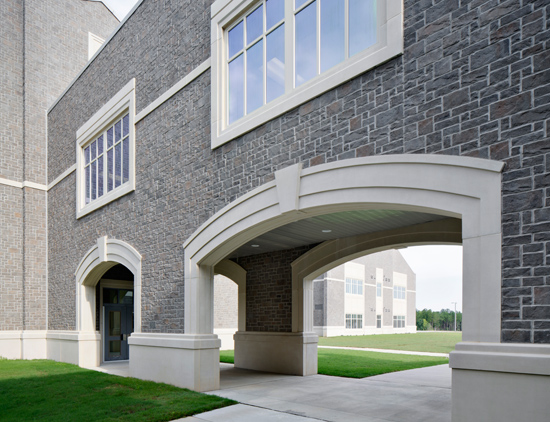 |
A foam panel system satisfied multiple design goals with a single product for a South Carolina high school.
Photo courtesy of Oldcastle® Architectural |
In practice, foam panel systems are achieving impressive results. The design team of the Westwood High School, Blythewood, South Carolina, chose the foam system for its ability to satisfy multiple design goals with a single product. Able to clad interior columns in addition to the exterior walls, the stone selected was a custom color blend offered the look and durability of natural stone for a fraction of the cost plus a number of sustainable design benefits. With an R-13.61 insulation factor, drainage channels that prevent moisture accumulation, and the ability to manufacture the product regionally with a percentage of recycled concrete, the system opened the door to a number of LEED® credit opportunities. “The placement grid provided by the insulation panels increased overall construction speed and virtually eliminated the 'oops' factor. The installation is even faster and cleaner than expected,” says Christopher M. Caudle, lead project architect, AAG Associates, LLC, in Beaufort, South Carolina.
In Beaver Dam, Wisconsin, a foam system was used for an apartment complex rehabilitation that required both aesthetic improvements and enhanced energy efficiency. The level of energy efficiency achieved qualified the project for funding from the U.S. Housing and Urban Development (HUD) Green Retrofit Program. The manufacturer trained the contractor and masonry crews on product installation and built on-site life-sized color samples for product selection. “The mason contractor loved the product because of the simplicity,” says project owner Col. Peter Knaup. After installation, engineers working for Wisconsin's Focus on Energy program discovered that a 20 percent reduction in air infiltration had occurred compared to previous measurements. “The engineers who did the testing could not believe the test numbers,” says Knaup. “They had never seen anything like it.”
The foam panel system also worked for the ReVISION House Orlando 2011. Before renovations, the ReVISION House was a typical Florida concrete block-style home. While originally built with a highly durable wall system able to withstand termites and hurricanes, it lacked quality insulation. Prior to renovation, the R2.5 walls were a major contributor to both heating and cooling loads. The “before” walls led to loads of 6.8 MBTU to heating and 14 MBTU to cooling on an annual basis. After renovating, annual loads dropped to 1.9 MBTUH for heating, and 2.5 MBTUH for cooling: a reduction of nearly 80 percent. These dramatic reductions not only save energy directly, but also improve occupant comfort and allow for a much smaller HVAC system, providing additional savings.
Foam Panel Systems Are a Sustainable Solution
Experts agree that R-value and continuous insulation requirements are here to stay—and they are only going to get stricter with each version of the IECC. Manufacturers have and will continue to respond to this reality. While various types of insulated masonry units abound, foam panel systems deliver an all-in-one energy-efficient, aesthetic, water management solution. This is an effective tool to have in meeting the present and future versions of the IECC, in meeting green goals, and in creating a sustainable built environment.

|
No matter where you are, chances are Oldcastle® Masonry is there. You’ve probably seen Oldcastle® Masonry before in the
places you most enjoy. Oldcastle® Architectural manufactures the products used in the interiors and exteriors of buildings
across the nation. Join the satisfied customers who have chosen North America’s largest manufacturer of building products,
Oldcastle® Architectural—the face of masonry. For more information, visit www.oldcastleapg.com |