This CE Center article is no longer eligible for receiving credits.
Complexity and nuance, say leading architects, are the hallmarks of today's best building envelope designs. From meeting key performance measures to projecting unforgettable aesthetics, their pioneering building projects benefit from the latest innovations in façade systems and exterior cladding products. In fact, the most recent crop of solutions have been designed to exceed baseline needs, protecting the enclosed spaces, improving performance, and lending unique identity to the various building types. To employ them for best effect, façade architecture must be subtle, detail oriented, and installation focused.
“Successful enclosure projects also consider occupant comfort, which has real return on investment” or ROI, says Terry Zeimetz, AIA, CSI, commercial marketing manager for Pella, listing four options for façade window renovations as an example. “To reduce air infiltration, you can leave the envelope as is but seal the existing windows. Or you can seal the façade and retrofit a basic window or a high-performance window product. Last, you can specify windows with sunshades and light shelves, between-the-glass blinds, and/or dynamic glazing to even better regulate heating and cooling requirements.” All of the renovation approaches help reduce drafts and temperature fluctuations at the building perimeter.
“Air sealing is critical to maximizing the performance of the building envelope and getting the most out of the thermal insulation in the available cavity along with keeping costs within budget,” says Bill Lippy, CEO of reflective insulation manufacturer Fi-Foil® Company, Inc., who has authored technical articles on radiant barriers. “That's why many architects are combining technologies that accomplish these aims—maximizing the envelope while reducing waste and enhancing durability.” As an example, he points to “hybrid insulation” assemblies using enclosed air spaces and low-emittance or low-emissivity (low-E) reflective insulation, such as layers of metallic foils, along with typical insulation materials. As explained in ASHRAE Fundamentals, a 3/4-inch air gap in a wall assembly has an insulating value of about R-1; adding a low-emissivity barrier film can improve the performance to R-3. Multiple low emittance layers can boost performance even higher.
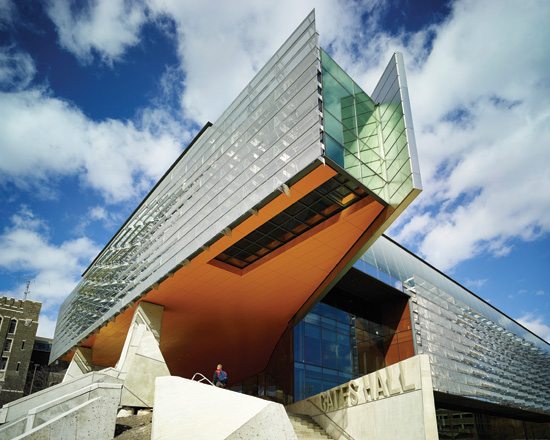
Photo courtesy of W&W Glass, LLC
Gates Hall at Cornell University, designed by Morphosis, uses a custom unitized curtain wall with a custom-perforated metal panel system.
Such methods also cut energy use, which—along with occupant comfort—is a top project objective. Overall thermal performance of a façade is reported as U-value, which is the heat transfer coefficient of the full enclosure; the lower the U-value, the better the insulating capacity and thermal performance. “Part of controlling heat transfer is insulation and the trend is toward higher-performance products being used in façades. Historically, this was achieved by reducing the window-to-wall ratio,” or WWR, says Jody Cash, vice president of operations with manufacturer Quest Window Systems Inc. “But lower WWR means reducing daylighting, which is generally not preferred. So architects are seeking unitized window systems that are better insulated, especially in the non-vision areas.”
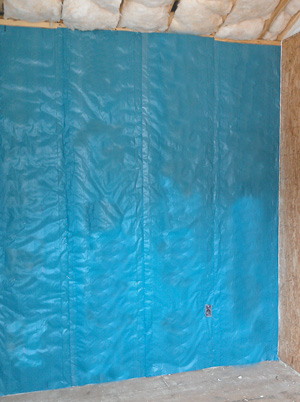
Photo courtesy of Fi-Foil® Company, Inc.
For air sealing of the envelope and to control façade system emittance and radiant heat to improve thermal performance, some projects use hybrid insulation assemblies with enclosed air spaces and low-E reflective insulation.
The increased use of unitized systems helps to control façade construction variables, and accommodates the use of thermal performing advances such as triple glazing, says Donnie Hunter, a Kawneer Company architectural promotion marketing director whose background is in architectural engineering. “The leading systems also have better thermal break pockets, such as the frames with two thermal breaks: dual-polyurethane pour and debridged or polyamide inserts, with frame depths of up to 6 inches, and up to 7.5 inches for curtain wall,” he explains.
These incremental improvements benefit one of the major façade design trends of today, in fact: the desire to use ever-larger spans of glass. Yet design teams must also specify well-engineered products designed for structural performance, say experts. “Insulated glazing units, or IGUs, are engineered for energy efficiency, so the manufacturer or fabricator must have a track record of making IGUs and IGU spacers that can withstand significant amounts of deflection,” says Jeff Haber, a managing partner with W&W Glass, which specializes in point-supported glazing systems.
Other material innovations are complicating these structural calculations—while also creating the means for new design expression. For example, the use of durable, shatterproof polycarbonate instead of glass—which for decades has been much more prevalent in Europe—has helped improve fenestration insulating values and reduce solar heat gain, making façades more efficient. “Compared to glass, polycarbonate panels provide about double the R-value,” says David Strait, director of sales and business development at EXTECH/Exterior Technologies Inc., which fabricates polycarbonate glazing systems. “And the translucent materials admit diffused daylight, which eliminates glare and hot spots on the interior.”
Another design approach gaining from the success of European exemplars has been the use of rainscreens, says Paul Schwarz, CEO of Architects' Surfaces, also known as FunderMax USA. FunderMax manufactures compact high-pressure laminate (HPL) cladding materials for the North American construction market. “The most important element of an open-joint rainscreen, which is drained and back-ventilated, is to provide a reliable and effective weather-resistant barrier on the substrate behind the rainscreen system,” he explains. “The highly durable compact HPL rainscreen cladding reduces energy costs by minimizing hot and cold air and thermal movement through the wall.”
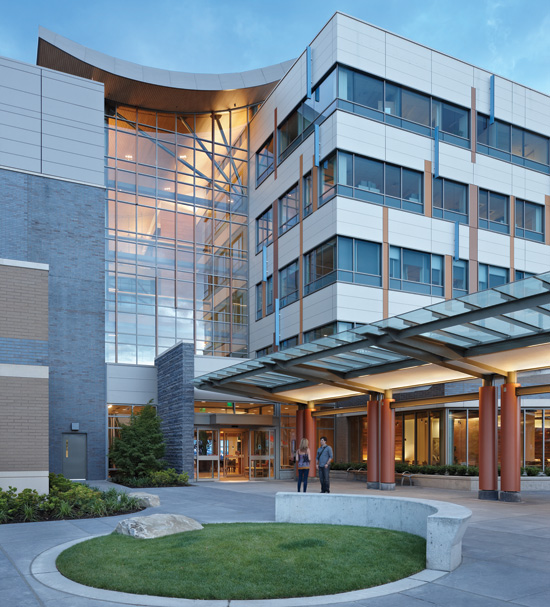
Photo by Ben Benschneider, courtesy of Guardian Industries
Using targeted glass formulations on different elevations helps optimize light transmission and thermal performance, as at the Swedish Medical Center in Issaquah, Washington, designed by CollinsWoerman Architects.
While innovation with rainscreens and polycarbonate, among other materials, is a major driver for today's façade designs, in some cases architects are also relying on timeless, classic approaches that have benefited from incremental improvements over the decades. As an example, tried-and-true anodized aluminum finishes are seen as resilient, sustainable and healthy, says Phil Pearce, LEED AP, vice president of sales and marketing for Lorin Industries, which anodizes aluminum coil for architectural uses. “It may cost more than paint, but it never chips, peels, or flakes, and it passes a pencil hardness test for graffiti resistance, ASTM D3363,” says Pearce.

Photo courtesy of EXTECH/Exterior Technologies Inc.
The Volo Aviation hangar at Sikorsky Memorial Airport in Stratford, Conn., designed by Beinfield Architecture, uses a full-height translucent polycarbonate facade to provide insulation as well as daylighting within the large technical facility.
While industrial anodizing dates to the mid-1920s, the results still can outshine other metal finishes, especially with the color and finish consistency that continuous coil anodizing can deliver, as opposed to batch or piece-part anodizing. Yet many of those metal cladding assemblies benefit from design processes and material innovations that are only recently becoming mainstream.
Inflection Points in Façade Design
For a closer look at how façade and cladding product approaches are shifting architectural currents, the following five topics demonstrate where manufacturers and fabricators have provided products or systems that lend subtle inflection points. These begin with the emergence of new design tools that are successfully expanding the horizons of building envelope performance.
Underlying the new tools—which include standalone online calculators, specification analytics, and output ready for use with building information modeling (BIM) platforms—are widespread concerns about incomplete or inappropriate specification practices. “Experienced architects know you can't just always go with what you've used before,” says Andy Nixon, a builder sales manager and architectural specialist for Simonton Windows & Doors. “Yet the specs we see are often very broad, or they list performance and thermal characteristics that are out of synch with the project or application.”
Nixon and other window makers recommend that architects spell out the required standards, including American Architectural Manufacturers Association (AAMA) certifications, the North American Fenestration Standard (NAFS), and National Fenestration Rating Council (NFRC) listings. Specifications should also provide all relevant performance components, such as U-values, visible light transmission (VLT), and solar heat-gain coefficient (SHGC), among others.
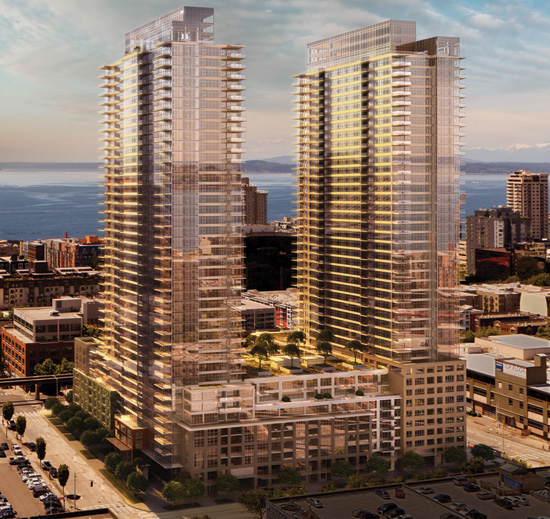
Photo courtesy of Bosa Development
Some façade systems, like the one used for Insignia Tower in Seattle, designed by Perkins & Company Architects, are designed so that each infill of glass, panel, operable window, or door is individually drained, as well as the surround of the window.
In total, the designer should be able to answer seven or eight basic questions beyond aesthetics, including the frame material choice, the required AAMA performance grade (PG), and the design pressure (DP), which identifies the wind and snow loads the product can withstand. Newer spec criteria include air leakage, which Nixon says will be required for the federal Energy Star program in 2015, as well as any specialized criteria for acoustics, impact resistance, security, child safety, and protections for wildlife, such as birds and sea turtles.
BIM Integration and Specification Tools
With more accurate specifications and project takeoffs in mind, several manufacturers have created design tools to get answers to these many façade questions. “With so many products out there, architects are asking, how do I choose the best one for the project?” says Chris Dolan, director of marketing for Guardian Industries, a glass manufacturer. “We've created a Glass Analytics program to give the design team a head start and a tool to use for architectural glass solutions.” The online selector allows the project team to down-select or tailor the glass specification and test its suitability in four discrete steps: first, by estimating glass performance variables such as VLT, U-factor, and SHGC. Second, the tool estimates energy use for the proposed building based on its size, orientation, and location. With these results, a third step is to use a built-in generator to create a BIM object for the glass product under consideration. Fourth, a visualization module lets the project team review the glass option in terms of simulated color, light qualities, reflectance, and reflectivity, from both an outside and inside view.
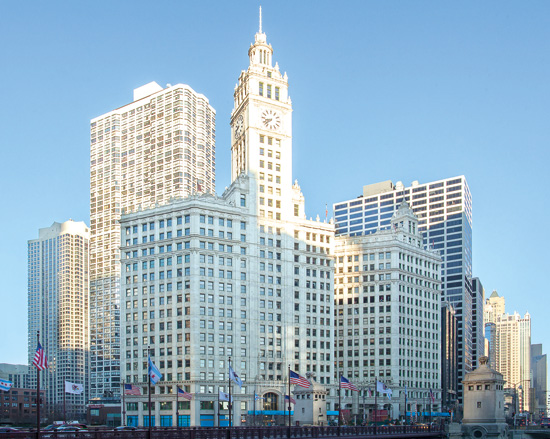
Photo courtesy of Pella EFCO Commercial Solutions
Using an envelope analysis tool for the iconic Wrigley Building in Chicago, the project team showed that 41% of total energy use was due to the underperforming envelope. The solution was to retrofit 2,000 single-pane windows and air-seal the openings.
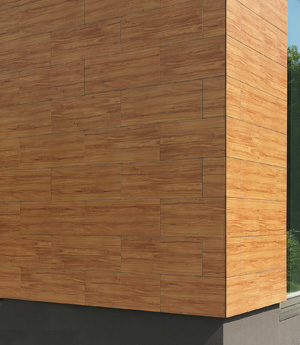
Photo courtesy of FunderMax USA
Rainscreens and other façades using panels of duromer HPL are effective for weather protection, while offering unique expression such as colors, patterns, and even the look of wood grain.
Beyond the physical glass samples that are commonly compared to determine the impact of glass choice on a project's aesthetics and interior spatial qualities, the visualization allows for a relative understanding of these effects, which helps inform glass selection early in the design process.
In addition to isolating the proper glazing considerations, other new analytical tools have been developed to evaluate the interdependencies between various building systems, says Jack Williams, a former engineer and now director of product marketing for EFCO. Developed with the energy consultant The Weidt Group, the envelope analysis service helps account for ways energy is lost through the envelope in addition to variables such as U-factor and SHGC. “But what about sources of air leakage, and the comfort of people inside the building?” asks Williams. “This analysis service allows you to compare a simple renovation solution against a very high-performance solution, such as dynamic windows, curtain wall or storefront.”
As an example, Williams points to a recent and extensive retrofit of the iconic Wrigley Building in Chicago, designed by Daniel Burnham acolyte Charles Beersman of Graham, Anderson, Probst & White. The goal was to recapture Beersman's original design intent while improving interior performance and usability to attract new tenants. The analysis by Pella EFCO Commercial Solutions found that 41 percent of total energy use was attributable to the underperforming envelope, and upgrading its 2,000 single-pane windows and air-sealing the openings would save the 1920s Wrigley Building about $276,000 annually in energy costs—a 27 percent savings—and reduce carbon emissions by 1,730 tons per year, or about 22 percent. The payback of about 15 years was sweetened by the fact that windows with a higher thermal resistance would allow occupants to relax the thermostat set points by up to 5°F, for significant energy savings. The windows and air-sealing would also reduce drafts by 51 percent.
Thermal Performance and Moisture Control
In addition to sealing against air leakage, a variety of advances in façade system engineering relate to preventing unintended penetration of moisture and water through the façade. For window wall and curtain wall, there are three types of assemblies to consider: face-sealed, water-managed, and pressure-equalized rainscreen systems. Whichever is selected, the façade system must mitigate water infiltration caused by gravity, wind, air pressure differentials, and capillary motion.
“Prevention of water penetration is a function of how the fenestration systems are detailed and installed, including frame construction, drainage details, gaskets, flashings, and sealants,” says Quest Window's Cash, who currently has projects in such cities as San Francisco, Seattle, Toronto, and Denver, among others, using the company's unitized window systems. “Watertight frames and drainage of the glazing pocket are essential in keeping water out.” The system is designed so that each infill of glass, panel, operable window, or door is individually drained. The same philosophy is then expanded to the surround of the window, backsealing, membraning, and flashing the cavity around the window to be pressure equalized and drained. Cash explains that in Quest's façade system, each floor is isolated from the next using this approach. Project examples include Insignia Tower in Seattle, designed by Perkins & Company Architects.
One successful approach Cash details is a window wall system that bypasses the slab, with about half of the window unit's depth cantilevered off the slab edge—or, more accurately, “extended downward to bypass the slab,” he says. “This method meets America's toughest seismic standards and also provides a very long path for water to climb at the slab-edge detail.” This means that even as slab height varies, there is a long and impenetrable path for water to move and migrate up and into the building. More important, the detail can give a building the look of an all-glass tower, without the use of curtain wall. In some cases, opaque panels in the unitized windows are used instead of aluminum composite material (ACM), precast, or other solid materials supported by a structural stud wall, reducing the number of trades needed for façade construction and limiting responsibility of the waterproofing to fewer elements or trades.
Moisture management is important for any cladding systems, including rainscreens, says Paul McCafferty, U.S. technical director for Architects' Surfaces. The multi-component approach of rainscreens includes a cavity, thermal layer, air barrier, moisture barrier, and supporting wall in addition to the cladding system. Yet the cladding must meet basic weathering criteria to remain durable and attractive over many years. “Compact HPL panels meeting the EN 438-6 standard and ICC AC92 testing criteria with enhanced fire resistance, type EDF, are very effective for weather protection, resisting delamination and water intrusion, and exhibiting very minimal color change over decades of weather and sun exposure,” he adds.
Next-Generation Glazings
In addition to these panels, windows, glazing units, and stick-built curtain walls are also incorporating advanced glass formulations that allow more light transmission or VLT while reducing solar heating, measured as SHGC. In more cases, the options being considered include low-E coated glass, active glazings such as switchable, electrochromic glass with its user-controlled tinting, as well as insulating polycarbonate panels, which are used extensively in countries where energy costs are a primary consideration.
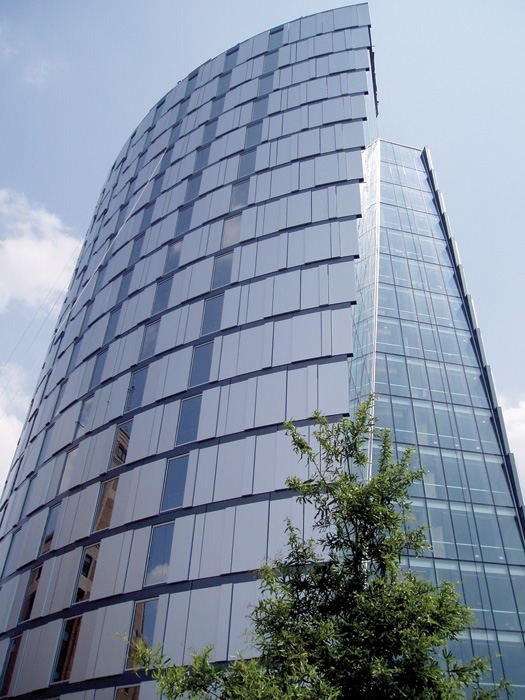
Photo courtesy of Kawneer Company, Inc.
At Drexel University, the new Millennium Residence Hall features a unitized curtain wall that was specified to have coordinated glass panels and aluminum composite panels, all provided by the same manufacturer.
Material choice and specification begins with top-level issues, such as desired color or appearance, and related aesthetics, such as the need for matching vision and spandrel glass, says Guardian's Dolan. “Glass can be specified as clear, but newer low-iron glass formulations are even more clear than those standard glazings marketed as clear, offering a more neutral and less greenish look,” he explains. Glass colors such as light gray, gray, green, and others are also available, all with low-E coatings. “Because of advances in low-E technology in recent years, as many as five to 18 layers of metal or metallic oxides can be deposited onto the glass surface, boosting its performance.” These include new “triple-silver coatings” that yield an attractive neutral/blue reflected color yet boast a low SHGC of 0.23—meaning that 77 percent of the solar energy is blocked—while allowing 51 percent light transmission.
In spite of these very high performance levels, architects are also considering alternatives. “While the glass industry has been adding exotic treatments to their formulations to improve performance, polycarbonate is naturally good at insulating and rejecting solar heat gain,” says EXTECH's Strait. “For applications such as clerestory openings in gymnasiums, industrial facilities, or any place that does not require visual access, translucent polycarbonate glazing admits high levels of natural light while eliminating glare.” In addition, polycarbonate—made from thermoplastic polymers—is shatterproof, easily molded to various shapes, and can be color-matched to a particular design scheme. Properly integrated into an engineered framing system, polycarbonate glazing is effective in reducing air infiltration, controlling moisture entry, and meeting any required codes.
Other glazing innovations like these are boosting the WWR for new buildings while keeping energy performance within tight ranges. Dolan notes that pre-painted glass in very large sizes is now available for spandrel applications. These manufacturer-painted panels are then cut and heat-treated by fabricators—some of which don't paint glass or previously required longer lead times to do so—making it easier to improve glass matching on the façades.
Whether spandrel or clear or coated glass, the ever-larger panels are helping accommodate the trend toward larger IGUs and lite sizes. Bigger units mean reductions in the number of frame components and amounts of field labor as compared to traditional systems. For example, while a 30-foot opening might typically require six modules, now they are commonly achieved with two or four units that have steel reinforced members, depending on seismic and wind load requirements. With larger openings come greater demands on manufacturer and contractor quality, cautions Haber of W&W Glass—and this in a market that still exhibits a post-recessionary “hangover” accustomed to commodity pricing and generic performance levels.
“Large-span façades are all about glass engineering,” says Haber. “Yet the design team is facing quality issues in glass fabrication such as roller-wave distortion due to softening from the heat-treating process and nickel sulfide spontaneous breakage, a catastrophic failure seen in heat-tempered glass with nickel sulfide contamination.” While a heat-soak process is used by most U.S. and European manufacturers to reduce or eliminate potential breakage, Haber says that some Chinese glass suppliers are distributing low-cost glass with dramatic increases in nickel sulfide content, resulting in significant instances of onsite breakage.
In addition, cost and warranty issues loom larger as glass panels get bigger, Haber notes. “Oversized glass manufacturing, packaging, shipping, and installation are inherently riskier and more expensive, and also limit the number of vendors who can make the product,” says Haber. “To limit liability, architects and their project teams should start out with a solid, performance-based specification with prequalified vendors and then pick the right product, always insisting on a manufacturer's warranty for the system, not a warranty from the subcontractor, who is really just a system amalgamator.”
Unitized, Pre-Engineered Systems
With these quality and liability issues in mind, an increasing number of architects are specifying unitized products where site-assembled once predominated. “More and more mid-size façades are using unitized solutions on smaller projects, such as four- to eight-story buildings, which traditionally would be stick-built and are now more often unitized,” says Kawneer's Hunter. “The reasons are that today, the glazing skills are harder to find depending on the area of country, and the glazier's trade is handed down from generation to generation rather than taught in schools.”
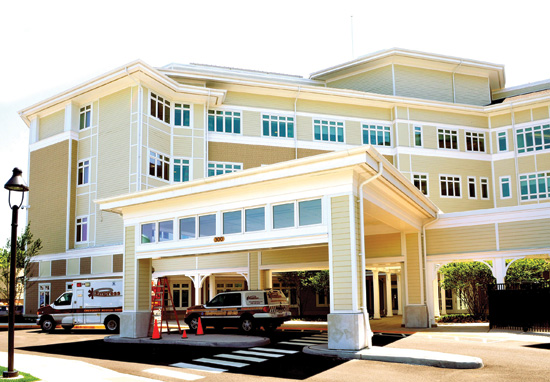
Photo courtesy of Simonton Windows & Doors
For the LEED-certified Elizabeth Seton Pediatric Center, a long-term-care facility for 130 children in Yonkers, New York, the firm Perkins Eastman specified crisp, white vinyl frames for new picture windows and casements using low-E glass with argon gas fill.
So more contractors want to unitize their low- and mid-rise projects, which brings the added benefits of improved quality control and by having the ability to closely monitor labor in a shop environment vs. in the field. It can also accelerate the scheduling, helping the contractors enclose the buildings faster and expediting occupancy. “But it takes more pre-planning and you have to get all shop drawings completed and approved so that manufacturing can start earlier in the project sequence,” Hunter adds.
Quest Window's Cash agrees, adding that about 30 percent of the company's unitized façade systems are specified as opaque openings, similar to Kawneer's approach offering aluminum composite material (ACM). The same is true with polycarbonate glazing systems, adds EXTECH's Strait, which are sometimes combined with glass panels for variety, view, and increased visible light. “We pre-fabricate the entire glazing system in our shop, so that it arrives at the jobsite ready to install. We eliminate the uncertainties associated with field fabrication,” says Strait. “Deep glazing rabbets and low-friction gaskets help the façades maintain an effective seal against air and water infiltration, while allowing for thermal movement of glazing.”
Manufacturers of unitized systems also offer a variety of specification and installation services to help smooth the project work. This typically starts with engineering support in the design phase followed by an optional mock-up phase, which many façade consultants recommend, noting that it is a required element of building enclosure commissioning (BECx). Later, the product manufacturers offer installation guides and field support to contractors and the trades. Some even offer training and certifications in their particular specialties.
In addition to product laboratory testing and project field checks, the mock-up helps “verify that the individual systems are assembled and installed appropriately, [and] that all systems will function interactively to meet the project goals,” according to Rick Ziegler, P.E., a BECx expert with engineering firm Smith Seckman Reid. “The testing conducted is typically not as comprehensive as laboratory testing, but can include structural, seismic, thermal, durability, air infiltration, and water penetration.” Mock-ups can be valuable for both stick-built and unitized systems, though the unitized systems tend to benefit from more lab review, reducing issues found in the mockup tests.
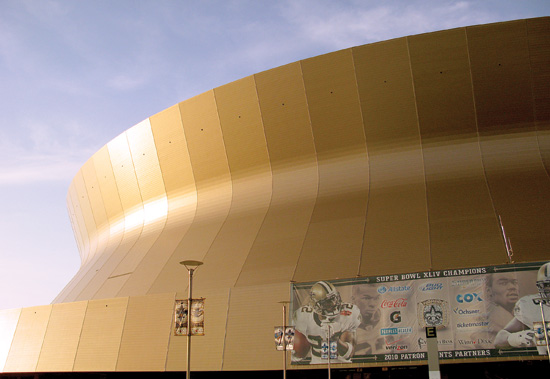
Photo courtesy of Lorin Industries Inc.
To restore and resurface the Mercedes-Benz Superdome after Hurricane Katrina, the architect Brad McWhirter, AIA, of Trahan Architects, specified 365,000 square feet of anodized aluminum panels colored to match the 1975 original façade.
Touting this benefit, a number of door and window makers offer industry-standard certifications for product performance and integrity, says Simonton's Steven Saffell, a technical expert. “AAMA's Gold Label certification states who manufactures the product and to what levels it has been tested, and the information is publicly available on their website,” he explains. “This gives the end-user confidence that can't be matched by self-certification or other audits that don't have an independent third party involved.” According to AAMA, its certification program and familiar Gold Label are required by many federal, state, and municipal building codes and administrators.
AAMA's certification programs, which began more than 50 years ago, are ANSI-accredited and require testing to the NAFS standard known as 101/I.S.2/ A440-11. The required battery of tests shows that the products meet minimum criteria for assembly air leakage, zero water penetration at certain wind speeds, structural resistance, and life-cycle durability. Optional certification for thermal performance and condensation resistance may be included using the AAMA 1503 method or an NFRC equivalent, and some products only tested for thermal values are given AAMA's Silver Label certification. For the Gold Label, however, manufacturers must even submit to unannounced plant inspections.
Resiliency, Durability, and Life-Cycle Benefit
The product control side of building quality is only half the battle of façade design, however. Savvy architects note that good long-term design decisions are too often undermined by underlying challenges in the commercial building market, ranging from mortgage financing and short-term ownership to value engineering by contractors and even low costs for dirty energy sources. These forces can cheapen projects and make them less adaptable to future conditions, often with insidious or even catastrophic consequences.
Fortunately a number of countertrends are encouraging investors and project teams to boost building value and think long-term. In addition to the green building movement—with its emphasis on life-cycle assessment (LCA), resource conservation, and low maintenance needs—the new interest in resiliency is raising quality expectations for architecture. As defined by the Resilient Design Institute (RDI), resiliency is “the capacity to adapt to changing conditions and to maintain or regain functionality and vitality in the face of stress or disturbance.” To survive earthquakes, hurricanes, droughts, or the next energy crisis, says RDI, today's buildings should be (a) simple, passive, and flexible; (b) durable in terms of methods, materials, and design; and (c) reliant on locally available, renewable, and reclaimed resources, “such as solar energy, annually replenished groundwater, and local food, [which] provide greater resilience.”
This thinking is also dramatically influencing product manufacturers focused on façades that can enhance long-term value and building life expectancy. “We're investing in a proven and efficient technology, coil aluminum anodizing, which is a very benign process in environmental terms yet is also among the most durable, resilient finishes for architectural metals,” says Lorin's Pearce, explaining that the process recovers materials, reuses water, and neutralizes industrial chemicals so no harmful materials negatively impact the environment. “Plus aluminum is 100 percent recyclable because it does not have the unrecyclable alloying elements found in many other metals,” he adds. The resulting finishes have no VOCs, unlike many paint or coatings, and aluminum—with its very high strength-to-weight ratio—provides a resilient, durable structure.
From another point of view, EFCO's Williams illustrates how manufactured façade products are boosting strength-to-weight ratios, thermal performance, and durability by using alternate materials and inventive detailing. “New curtain wall systems are employing fiberglass for pressure plates and the thermal spacer that acts as a setting chair for the glass,” he explains “This not only reduces weight but also greatly improves thermal characteristics when compared to traditional curtain wall systems.”
For wood windows, architects see vinyl alternatives and vinyl-clad wood products as a durable, resilient spec for both retrofit and new building projects, says Megan Mazur, a marketing director at Simonton Windows & Doors. “The perception of vinyl has been changing in the last five to six years, with improved quality of extrusions, better vinyl performance, and such incentives as the Federal Energy Tax Credit in 2009 to 2010 that encouraged the use of high-quality vinyl,” says Mazur, adding that vinyl doesn't rot, requires less painting, and offers aesthetics that many architects and end-users prefer. “You can get a look and feel indistinguishable from wood, including durable exterior coatings or interior woodgrain laminates, and all the hardware options expected for wood windows.”
While anti-vinyl sentiment has arisen in the past due to vinyl manufacturing processes and presence of dioxin in the materials, the U.S. Green Building Council issued two papers on PVC building materials in 2004 and in 2007 that outlined a technical basis for LEED credits involving PVC-related materials. The reports said that using LCA methods, vinyl materials were not seen to be any less desirable based on environmental or health concerns. This helps explain how vinyl building products outperform competing products, with durable, resilient, and low-maintenance qualities. “Vinyl is a good retrofit and new building material,” Mazur concludes. “It can be painted during manufacturing, and we see it used in historic districts, with the thin, architecturally correct profiles and simulated divided lites needed for landmark buildings.”
In this way, whether for the hidden recesses of façade systems and even the most persnickety visible details, the use of high-performance materials is not only accepted but in many cases preferred. Another valuable example is the increasing sophistication of insulation and barrier systems, says Fi-Foil's Lippy, which have benefits in installation time, waste reduction, less call-backs, and operational performance.

Photo courtesy of Pella EFCO Commercial Solutions
SmithGroupJJR specified a sophisticated glass wall system for the LEED Gold-certified BAE Systems Land & Armaments complex in Sterling Heights, Michigan, which has a pattern of digital camouflage fritted to the glass to block the view into the building from the nearby road.
“There is growing use of hybrid insulation systems that outperform single types of insulation alone, such as combinations of low-emittance multi-layer reflective insulation, insulating air gaps, and an insulation product such as spray polyurethane foam, expanded polystyrene boards, or fiberglass or cotton batts,” says Lippy. While SPF is beneficial for air sealing, the applicator teams commonly overfill stud wall cavities, needlessly increasing material costs and requiring them to shave off the excess to be carted away and discarded. Instead, says Lippy, “You can combine closed-cell or open-cell foam with reflective insulation. One example is spraying 4 inches in the 5.5-inch (2 x 6 nominal) stud wall, leaving a 1.5-inch nominal air gap, and then installing a multi-layer reflective insulation to the face fo the studs. Another example is 2-inch of closed-cell SPF with reflective insulation in a 2-inch x 4-inch cavity.” With closed-cell SPF running about $1.00 per square foot per inch of depth installed, this saves at least $1.50 per square foot of façade area while providing a high R-value. You cannot completely fill a wall cavity with spray foam without over-spray, which results in unnecessary waste and cost. The hybrid system is a better option.
As the material examples mentioned show—whether it's fiberglass and reflective insulation along with an air barrier or spray foam and reflective insulation—façade product innovation goes to the heart of resiliency and robustness while potentially reducing material needs, waste, and environmental impact. As building enclosure guru Joe Lstiburek, Ph.D., president of Building Science Corporation, based in Westford, Massachusetts, has said, “Durability and energy efficiency are the cornerstones of sustainability.”
Safety for Occupants—and Wildlife
In addition to the building's sustainability based on durability, energy use and occupant health and enjoyment, there is also significant impact of façade design on the external world, including people, wildlife, and flora.
In terms of fire safety, façades should be designed to comply with the National Fire Protection Association (NFPA) Standard 285, a fire test procedure for evaluating the suitability of exterior, non-load bearing wall assemblies and panels including curtain wall and rainscreens using combustible materials. Generally, building exterior walls are required to be noncombustible, which protects occupants from flame and fire propagation and also protects people outside or near the building, including firefighters.
Because exterior foam insulations, air barriers, sealants, coatings, and some cladding products are inherently combustible, the NFPA 285 standard has been adopted to test full assemblies, many with high-performing features such as continuous insulation, or CI. To comply with the codes, “designers must either conform to the details and products of tested assemblies, use non-combustible alternatives, or request a variance” from the authorities having jurisdiction, according to Brian Kuhn Jr., PE, a life-safety specialist, and Andrew E. Jeffrey, an engineer, both with façade consulting firm Simpson, Gumpertz & Heger. One of the biggest challenges, they say, is reconciling thermal insulation and weatherproofing goals with the fire testing rules.
Hurricane requirements also protect building occupants as well as passersby, say life safety experts. With the trend toward larger sizes for glazed openings, architects must use glass materials tested for panels of up to 50 square feet or more.
Stringent building codes for hurricane resistance may present a challenge for four-sided structural glazed assemblies and point-supported curtain wall, but many fenestration systems have been tested to show that they comply and will protect people near the building envelope—indoors and out.
In addition, new façade innovations help address concerns about impact on wildlife, say experts. One unexpected change in recent years has been the enactment of “sea turtle lighting” ordinances in a number of cities and counties on Florida's coastline, including the Sea Turtle Protection Code. The reason is that, during the nesting season, sea turtles can be affected by how much light emanates from building interiors through windows, storefronts, and curtain wall. When baby turtles hatch in beach sands, they immediately follow moonlight to reach the water; if nearby artificial lighting is strong enough, the hatchlings may be confused and move toward coastal buildings instead.
For this reason, glass sections of buildings in the affected zones must use glazing products with a VLT of .45 (or 45 percent) or less. Depending on the glass color, tinting, films, low-E coating and whether it is insulating, laminated or laminated insulating type, there are a range of acceptable VLT thresholds that are accepted in the jurisdictions aiming to protect sea turtle populations.
The sea turtle protections call to mind the many ordinances for bird-friendly glass recently enacted in cities from Toronto and Portland to Chicago and New York. In these places, rules state that exterior glass must be the kinds that are more visible to birds, especially on façade areas closer to grade, where they tend to fly. Below about 60 feet, the glass façades reflect trees and other vegetation, which increases their potential confusion. Some of the bird-protective glass types include silkscreen patterns; a number of product types are evaluated and recommended by the American Bird Conservancy, which scores some products on a range of effectiveness.
According to the conservancy, songbirds are most at risk from collisions with glass, but nearly 300 species have been reported as collision victims, including hummingbirds, woodpeckers, kingfishers, and birds of prey. In any place where buildings are near special habitat zones and resting spots for migrant birds, the protective glazings are recommended. In addition to using the protective glass types, there are tapes and decals that can serve as retrofit solutions. Also, building managers can turn off exterior vanity lighting and flood lighting turned at night, especially during migration seasons, to help reduce the number of collisions.
Fortunately, whether the intent is to protect birds, turtles, or humans, there is a large range of product solutions to serve even the most complex needs. The fact is, today's development of envelope and cladding systems is among the most active area in the architectural universe.
Chris Sullivan is an author and principal of C.C. Sullivan (www.ccsullivan.com), a marketing agency focused on architecture, construction, and building products.