This CE Center article is no longer eligible for receiving credits.
Making buildings safer for occupants in the event of fire is the responsibility of everyone involved through the design and construction phases of a building. This is especially true for architects and designers, as this responsibility begins with material considerations. Fire codes are in place to ensure buildings are as safe as possible. The materials and assemblies that architects and designers specify must meet the requirements of these codes; however, the path to code compliance is not always straightforward. Perhaps because fire-related deaths are so tragic, some manufacturers advertise their products’ fire-prevention benefits based on attributes that may not be necessary or practical in real-world scenarios. Consequently, there are several myths around how building products, such as insulation, can contribute to an effective fire-prevention strategy. Specifying the most appropriate product starts with a good understanding of fire codes, fire ratings, and the range of insulation products available to help you both meet fire-related code requirements and satisfy the other goals of your project.

The Evolution of Fire Codes
According to the National Fire Protection Association (NFPA), structural fires occur every 61 seconds throughout the year in the United States. Smoke from building fires accounts for 73 percent of fire-related deaths. Building codes have evolved over the decades, with the goal of improving fire safety and reducing fire-related deaths. For example, codes now require that many building products and assemblies resist flame spread and smoke development for extended periods of time. Yet many of the design features we take for granted in commercial buildings, including how buildings are physically located in relation to the street and to each other, have come at great cost.
For centuries, fire codes, fire marshals, and fire departments did not exist. Cities burned and were rebuilt, only to burn again. In 1666, the Great Fire of London burned 80 percent of the city’s buildings. The close spacing of buildings and combustible construction materials made them vulnerable, yet the city was rebuilt without significant changes in either, though the fire did catalyze the development of hand-pumped fire suppression tools.
The history of the United States is a history of tragic, sometimes catastrophic fires. One of the first American fire ordinances, enacted in 1631 by Boston Governor John Winthrop, outlawed wooden chimneys and thatch roofs. While the fire hazards of such constructions may seem obvious to us today, they were common in colonial settlements. In 1648, New York City employed its first fire wardens, who were responsible for inspecting chimneys for proper construction and cleanliness.
Following a large fire in 1679, the City of Boston hired the first firefighters, and in 1736, under the direction of Benjamin Franklin, the first volunteer fire department formed in Pennsylvania. These early firefighters mostly used the “bucket brigade”—a line of people who passed buckets full of water from person to person—to fight fires.
In 1871, a fire engulfed the rapidly growing city of Chicago. Three fire departments responded, but their efforts were thwarted once the fire overwhelmed the waterworks facility. The Great Chicago Fire sparked code changes, including new requirements for the spacing of buildings and allowable construction materials. A year later, the Great Boston Fire consumed 60 acres of buildings. This fire also instigated changes, including widened streets, uniform building codes, and more frequent building inspections.
Many state and local jurisdictions can and do adopt their own sets of codes. This can create a complex patchwork of contradictory practices, with at times disastrous consequences. In the Baltimore Fire of 1904, much of the city burned, despite the response of fire personnel from several jurisdictions. The efforts were handcuffed by the incompatibilities between fire hose couplings and city hydrants. Following this fire, which left a “Burnt District” of 80 city blocks downtown, Baltimore adopted a new fire code, and the NFPA adopted a national standard for fire hydrant and hose connections.
Many of the tragic fires, such as the Iroquois Theater Fire in Chicago in 1903—which, with 602 reported deaths, has the unfortunate distinction as the deadliest single-building fire in American history—illuminated the need for better access to exits, a greater number of exits, improved exit signage, maximum occupancy limitations, and strategies that allow for quick exiting of a building, such as panic bars. This fire resulted in changes to both federal and state codes.
Ironically, many of the worst fires occurred in buildings that had recently passed fire inspections. For example, the Winecoff Hotel, which caught fire in Atlanta in 1946, had recently passed a fire inspection, yet it did not include a fire alarm system, fire suppression system, or fire escapes. Following this tragic fire, which killed 120 people, codes were changed to require fire alarm and fire suppression systems and designated locations for fire exits.
Fires in hospitals, factories, hotels, prisons, and night clubs often resulted in the adoption of code changes for that category of buildings. For example, in 1980, the MGM Grand Hotel fire in Las Vegas killed 84 people and injured hundreds. The hotel did not have a sprinkler system, and smoke and fire spread rapidly throughout the building due to lack of separation in the stairwells, elevators, and seismic joints. Following this fire, Las Vegas required a complete retrofit of sprinklers within casinos throughout the city. This fire also brought to light the fact that smoke kills more people than the actual fire.
As recent incidents such as the Oakland Warehouse Fire of 2016 demonstrate, deadly fires still occur in commercial buildings. Fortunately, most buildings are safer than ever, thanks to stricter codes and enforcement and better construction materials and technologies.
Making buildings safer for occupants in the event of fire is the responsibility of everyone involved through the design and construction phases of a building. This is especially true for architects and designers, as this responsibility begins with material considerations. Fire codes are in place to ensure buildings are as safe as possible. The materials and assemblies that architects and designers specify must meet the requirements of these codes; however, the path to code compliance is not always straightforward. Perhaps because fire-related deaths are so tragic, some manufacturers advertise their products’ fire-prevention benefits based on attributes that may not be necessary or practical in real-world scenarios. Consequently, there are several myths around how building products, such as insulation, can contribute to an effective fire-prevention strategy. Specifying the most appropriate product starts with a good understanding of fire codes, fire ratings, and the range of insulation products available to help you both meet fire-related code requirements and satisfy the other goals of your project.
The Evolution of Fire Codes
According to the National Fire Protection Association (NFPA), structural fires occur every 61 seconds throughout the year in the United States. Smoke from building fires accounts for 73 percent of fire-related deaths. Building codes have evolved over the decades, with the goal of improving fire safety and reducing fire-related deaths. For example, codes now require that many building products and assemblies resist flame spread and smoke development for extended periods of time. Yet many of the design features we take for granted in commercial buildings, including how buildings are physically located in relation to the street and to each other, have come at great cost.
For centuries, fire codes, fire marshals, and fire departments did not exist. Cities burned and were rebuilt, only to burn again. In 1666, the Great Fire of London burned 80 percent of the city’s buildings. The close spacing of buildings and combustible construction materials made them vulnerable, yet the city was rebuilt without significant changes in either, though the fire did catalyze the development of hand-pumped fire suppression tools.
The history of the United States is a history of tragic, sometimes catastrophic fires. One of the first American fire ordinances, enacted in 1631 by Boston Governor John Winthrop, outlawed wooden chimneys and thatch roofs. While the fire hazards of such constructions may seem obvious to us today, they were common in colonial settlements. In 1648, New York City employed its first fire wardens, who were responsible for inspecting chimneys for proper construction and cleanliness.
Following a large fire in 1679, the City of Boston hired the first firefighters, and in 1736, under the direction of Benjamin Franklin, the first volunteer fire department formed in Pennsylvania. These early firefighters mostly used the “bucket brigade”—a line of people who passed buckets full of water from person to person—to fight fires.
In 1871, a fire engulfed the rapidly growing city of Chicago. Three fire departments responded, but their efforts were thwarted once the fire overwhelmed the waterworks facility. The Great Chicago Fire sparked code changes, including new requirements for the spacing of buildings and allowable construction materials. A year later, the Great Boston Fire consumed 60 acres of buildings. This fire also instigated changes, including widened streets, uniform building codes, and more frequent building inspections.
Many state and local jurisdictions can and do adopt their own sets of codes. This can create a complex patchwork of contradictory practices, with at times disastrous consequences. In the Baltimore Fire of 1904, much of the city burned, despite the response of fire personnel from several jurisdictions. The efforts were handcuffed by the incompatibilities between fire hose couplings and city hydrants. Following this fire, which left a “Burnt District” of 80 city blocks downtown, Baltimore adopted a new fire code, and the NFPA adopted a national standard for fire hydrant and hose connections.
Many of the tragic fires, such as the Iroquois Theater Fire in Chicago in 1903—which, with 602 reported deaths, has the unfortunate distinction as the deadliest single-building fire in American history—illuminated the need for better access to exits, a greater number of exits, improved exit signage, maximum occupancy limitations, and strategies that allow for quick exiting of a building, such as panic bars. This fire resulted in changes to both federal and state codes.
Ironically, many of the worst fires occurred in buildings that had recently passed fire inspections. For example, the Winecoff Hotel, which caught fire in Atlanta in 1946, had recently passed a fire inspection, yet it did not include a fire alarm system, fire suppression system, or fire escapes. Following this tragic fire, which killed 120 people, codes were changed to require fire alarm and fire suppression systems and designated locations for fire exits.
Fires in hospitals, factories, hotels, prisons, and night clubs often resulted in the adoption of code changes for that category of buildings. For example, in 1980, the MGM Grand Hotel fire in Las Vegas killed 84 people and injured hundreds. The hotel did not have a sprinkler system, and smoke and fire spread rapidly throughout the building due to lack of separation in the stairwells, elevators, and seismic joints. Following this fire, Las Vegas required a complete retrofit of sprinklers within casinos throughout the city. This fire also brought to light the fact that smoke kills more people than the actual fire.
As recent incidents such as the Oakland Warehouse Fire of 2016 demonstrate, deadly fires still occur in commercial buildings. Fortunately, most buildings are safer than ever, thanks to stricter codes and enforcement and better construction materials and technologies.
Understanding Fire-Prevention Rating Systems
It’s important to remember that the top priority of fire requirements is the safety of occupants—to ensure that a fire, should one break out, is contained long enough to allow occupants to escape the building and to prevent structural collapse.
When evaluating building materials, such as insulation, and how they can contribute to the safety of an assembly in terms of fire, you will encounter specialized terminology and references to several standards and tests. Having a working knowledge of these will help you specify the best materials and systems for your project.
Combustible and noncombustible materials: The International Building Code (IBC) and other building codes distinguish between combustible and noncombustible building materials. By definition, a noncombustible material is one of which no part will burn or ignite when subjected to fire or heat. Materials that pass ASTM E 136 are considered noncombustible. In addition, materials consisting of a structural base of noncombustible material with a surfacing material no more than 1/8-inch (3.2-millimeter) thick, which have a flame-spread index (FSI) of 50 or less, are also considered noncombustible. An example of the latter is fiberglass batts with Class A rated facings, such as foil-scrim-kraft (FSK) and poly-scrim-kraft (PSK).
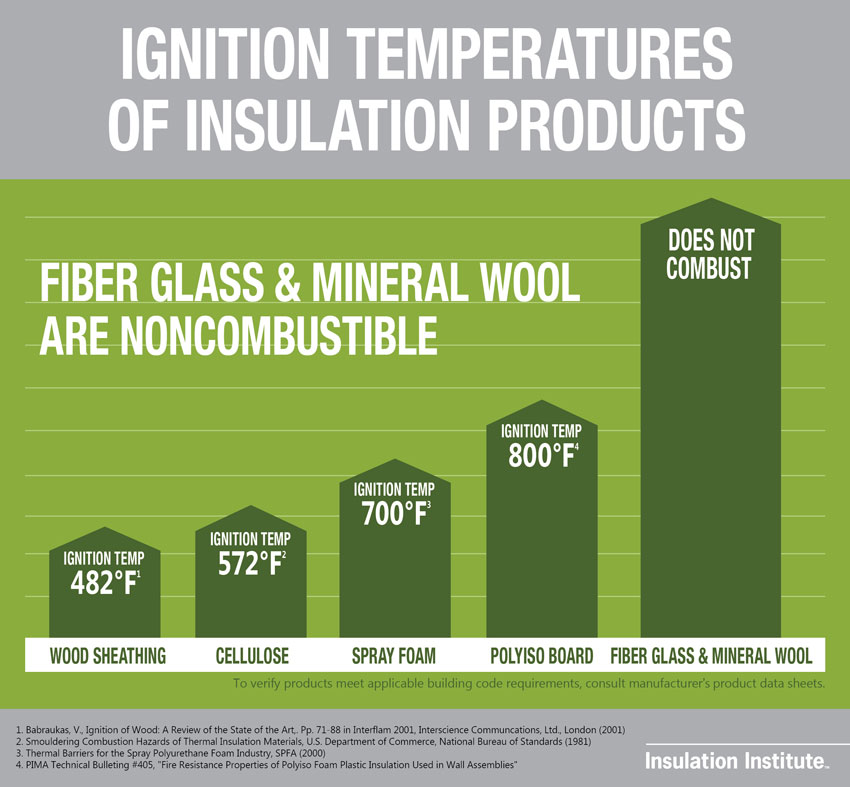
Image courtesy of CertainTeed Insulation
This graphic shows the ignition temperature of insulation materials.
Section 602 of the IBC defines five construction types, each with different levels of fire-protection requirements and allowable use of combustible materials. Building Types I and II require noncombustible materials, such as steel, concrete, and masonry. Building Types III and IV require noncombustible construction for exterior walls; code-compliant wood construction can be used for interior walls. Type V buildings allow any code-compliant construction materials.
Not all insulation materials are noncombustible; in fact, only unfaced fiberglass and mineral wool products are naturally noncombustible. Some insulation products, including cellulose and spray foam, are treated with flame retardants to improve their performance in the face of fire; however, these materials will eventually ignite.
Fire resistance: This is another important concept that can be applied to either individual materials or assemblies, both of which can be tested and rated. A fire-resistance rating refers to the period of time a building element, component, or assembly maintains the ability to confine a fire, continues to perform a given structural function, or both.
Building codes specify minimum fire-resistance ratings for various building components, such as interior and exterior walls, roofs, doors, and structural framing. To be recognized by code as providing a fire-resistance rating, a material or assembly of materials must be tested. The intent of the test is to determine the number of minutes or hours in which the material or assembly can contain or limit the spread of fire and/or restrict the thermal transfer of heat from a fire source to the protected component. The loss of this thermal protection can result in the spread of the fire and associated heat, smoke, and toxic gases throughout the building, and it can ultimately result in failure of the building itself.
Because fire resistance is often considered for assemblies rather than individual components, the rating considers the performance of the several materials that are incorporated into a wall, floor, or roof. Fire-resistance directories, such as the one provided by UL, include listings for products used to provide various hourly fire-resistance ratings for all types of building elements. The UL directory (http://database.ul.com/cgi-bin/XYV/template/LISEXT/1FRAME/fireressrch.html) divides protection systems into different categories, including floor-ceilings, roof-ceilings, beams, columns, walls, and partitions. Fiberglass, mineral wool, cellulose, and spray foam insulation materials can all contribute to fire-rated assemblies when installed as specified in the designs.
Flame spread: While fire-resistance ratings can be used to judge the ability to resist flame penetration into the building, they do not necessarily provide information regarding flame spread or the tendency of a material to burn rapidly and/or spread flames. Both ASTM E 84 and UL 723 measure this quality to characterize materials into one of three classes. You have no doubt encountered products with “Class A” or “Class 1” fire rating. This means that laboratory testing has a flame-developed index (FDI) of 25 or less. The building code uses this measure to address interior finishes, including walls, paneling, acoustical materials, and insulation. Requirements for this characteristic vary depending on building type and application. For example, Types I and II buildings require all insulation products and facings to have flame-spread and smoke-developed indices that do not exceed 25 and 450, respectively. It’s important to note that exposed insulation is considered an interior finish and has a different requirement than insulation that is enclosed in a cavity.
Testing to the Standards
Now let’s take a closer look at the most common tests used to evaluate insulation materials and building assemblies.
ASTM E 136: Standard Test Method for Behavior of Materials in a Vertical Tube Furnace at 750 Degrees Celsius (Determines Noncombustibility)
Building codes specify ASTM E 136 as the test required to establish a material as a noncombustible material. This test does not apply to laminated or coated materials, such as faced insulation batts. For this test, a tube furnace is preheated to a temperature of 750 degrees Celsius. A preweighed material specimen is lowered into the furnace with one thermocouple attached to its surface and another located at its center. Testing continues until both thermocouples have stabilized at a maximum reading or until one of the acceptance criteria is violated. A material is rated as either pass or fail; no numeric value is given.
ASTM E 119: Standard Test Method for Fire Tests of Building Construction and Materials (Measures Fire Resistance)
ASTM E 119 evaluates how long building elements can contain a fire and/or retain their structural integrity. For the test, an assembly or structural member is placed in a flat furnace in either the horizontal or vertical position. If the specimen is a load-bearing element, a specific load is imposed on it. The specimen is then subjected to a controlled flame introduced from one side of the assembly, simulating exposure conditions in the field. The temperature of the controlled flame is increased to a maximum along a specific time-temperature relationship that simulates a flashover condition. The test continues until one of the following takes place: structural collapse occurs, the temperature of the unexposed surface of the assembly exceeds 250 degrees Fahrenheit, or cotton waste placed on the unexposed side of the assembly ignites. The assembly is classified based on time expired before failure. For example, a 1-hour fire-resistant assembly will withstand fire exposure for 1 hour before the structural integrity of the wall fails.
ASTM E 84: Standard Method for Surface Burning Characteristics of Building Materials
Building codes specify ASTM E 84, sometimes referred to as the “flame-spread test,” to assess the contribution of surface finishes on walls and ceilings to fire loading. It utilizes the Steiner Tunnel Test to measure the propagation of flame from an ignition source along a specified length of the material, comparing the distance of propagation to reference materials. The result is expressed as a FSI number between zero and 100, with zero representing asbestos cement board and 100 representing red oak. Materials are divided into classes based on the FSI as follows:
Class 1 or Class A: 0 – 25
Class 2 or Class B: 26 – 75
Class 3 or Class C: 76 – 100
The lower the number, the less the flame spread. A product that has a flame spread of 25 has a surface-burning spread that is 25 percent of red oak. A test report for a product may also include the smoke-developed index (SDI), which measures the concentration of smoke produced by a material as it burns. The SDI is required to be less than 450 for all classes of materials. ASTM E 84 is also known as UL 723. NFPA 255: Standard Method of Test of Surface Burning Characteristics of Building Materials utilizes ASTM E 84.
The NFPA Life Safety Code and Section 803.1 of the IBC limit finishes for interior walls and ceilings to materials in these three classes and give greater restrictions for certain rooms.
NFPA 286: Standard Methods of Fire Tests for Evaluating Contribution of Wall and Ceiling Interior Finish to Room Fire Growth
The flame spread test is not reflective of real-world conditions, so NFPA developed a second test to better simulate conditions in an actual fire. NFPA 286 measures flame spread in a room configuration, including fire spread along walls, ceilings, and combinations of both. Though this method is preferred over NFPA 255, it is more expensive. Test results for heat, smoke, and combustion product release from NFPA 286 can be used in fire models for performance-based design, whereas results from NFPA 255 cannot.
Insultation and Fire
Insulation serves many purposes in modern construction, from increasing energy efficacy to sound attenuation. But insulation is also critical to help ensure the safety of occupants in the event of fire. When specifying insulation from the point of view of fire safety, the goal should be to choose insulation products that will increase the potential for a best-case outcome in a fire—that is, one that allows all occupants to exit the building unharmed.
Fire Behavior
To understand the role of insulation in an assembly, one should first have a basic understanding of fire behavior. When a fire ignites, oxygen combines with fuel and heat in a sustained chemical reaction. If a fire is not put out at this point, it will continue to grow if more fuel is available. Through convection and radiation, more fuel sources ignite and the fire moves upward toward the ceiling. There, hot gases collect, and soon, flashover occurs. Flashover refers to the near-simultaneous ignition of most of the directly exposed combustible material in an enclosed area. When a fire is fully developed, it has reached all available fuel sources and temperatures reach a peak. Once a fire has consumed all available fuel, it begins to decay. This cooling phase of a fire typically lasts the longest.
As mentioned earlier, the point of a fire-resistant assembly is to contain a fire so that it does not spread to other rooms or other buildings, and to buy time so that occupants can safely exit. Drywall or gypsum board plays a huge role in the fire resistance of a wall assembly.
Gypsum rock contains about 21 percent (by weight) water, which is chemically combined with calcium sulfate. When exposed to fire, heat starts converting some of this water to steam, which effectively resists fire. The opposite side of the gypsum board wall remains cool until all water in the gypsum core has been converted to steam or until the gypsum board itself is breached by the flames. The characteristics of the board (e.g., its density or thickness) can affect its fire resistance. Type X drywall, which is required for fire-rated assemblies, contains a glass fiber reinforced gypsum core. The fibers reduce the extent and severity of cracks in the board when exposed to flame and heat, thus increasing the time it performs without failure.
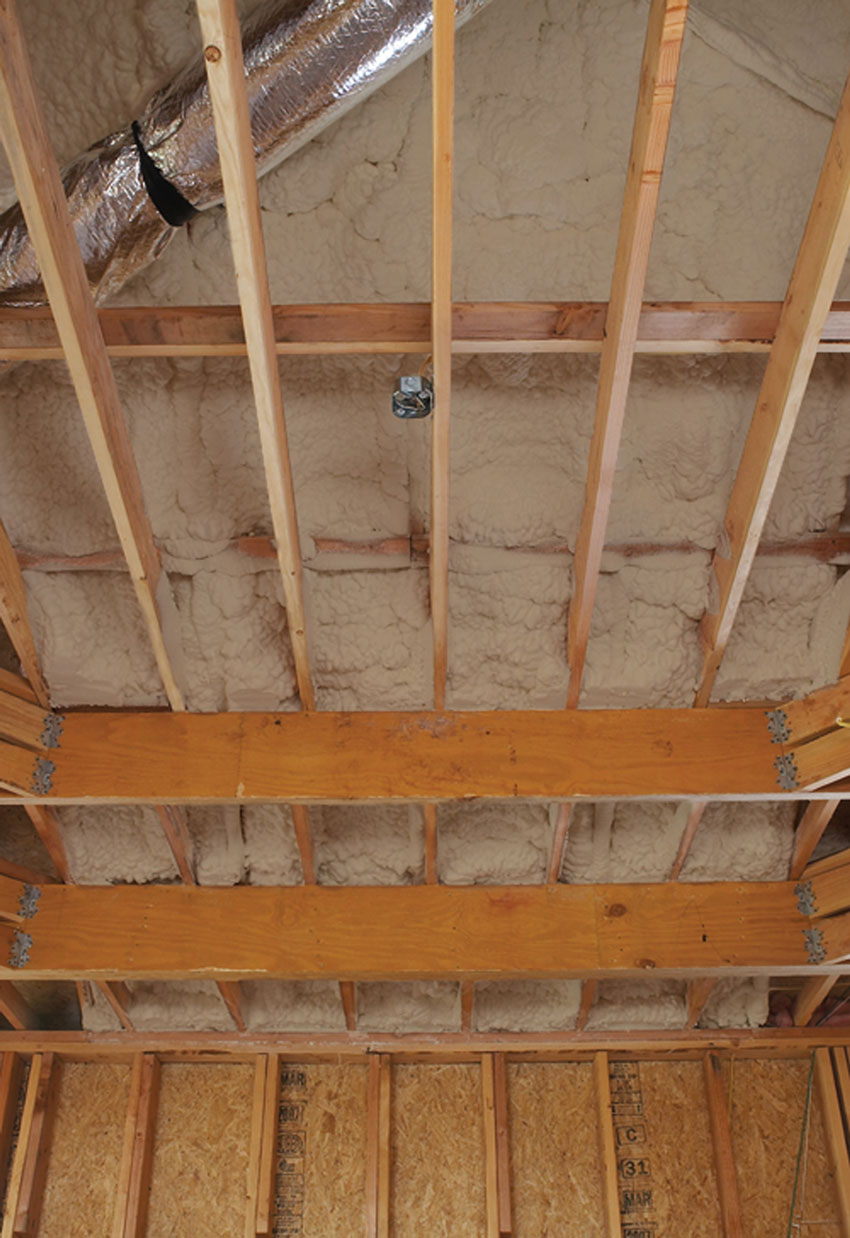
Photo courtesy of CertainTeed Insulation
Although a popular choice for air sealing and increased R-value, spray foam insulation may not be an ideal choice when it comes to aggressive fire codes, unless it’s an Appendix X-rated foam.
Insulation Types for Fire-Resistant Assemblies
Common insulation types include fiberglass, mineral wool, cellulose, and spray foam. While all of these can be used to create fire-rated assemblies, only unfaced fiberglass and mineral wool are noncombustible materials. They will not ignite or burn; consequently, they will not react to fire prior to the flashover point. In fact, unfaced fiberglass and mineral wool are accepted as a fire block in wood frames. Combustible insulation products, even if treated with flame retardants, can potentially ignite, thus accelerating the growth stage of a fire and reducing the amount of time for occupants to safely evacuate. Choosing materials that reduce the ability for fire to react is key to ensuring fire safety.
To understand the differences between fiberglass and rock wool, let’s take a look at the manufacturing processes and performance characteristics of each. First, let’s clarify some terms. “Mineral fiber” insulation is a broad term that is used to categorize insulation composed principally of fibers manufactured from rock, slag, or glass, with or without binders. “Mineral wool” is one type of mineral fiber, and it refers to synthetic vitreous fiber insulation made by melting predominately igneous rock or furnace slag and other inorganic materials and then physically forming the melt into fibers. Mineral wool products are often called rock wool, slag wool, or stone wool.

Photo courtesy of CertainTeed Insulation
Fiberglass insulation comes in faced and unfaced batts and encapsulated batts; it can be also be blown into a wall cavity or loosely blown into a space like an attic.
Fiberglass
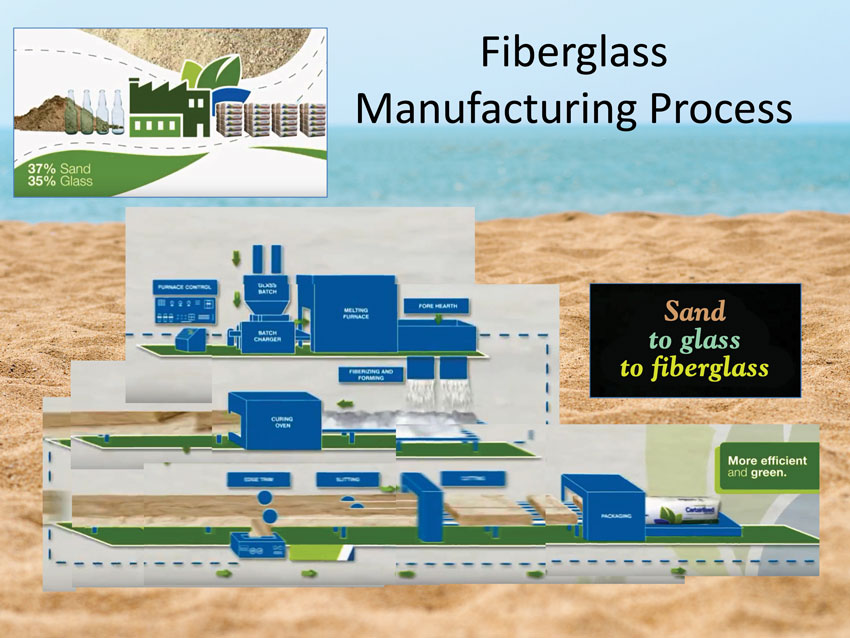
Fiberglass insulation is made from molten glass that is spun into fine microfibers. The raw materials, which include sand and glass, are heated in a glass-melting furnace to temperatures ranging from 1,500 to 1,700 degrees Celsius (2,700 to 3,100 degrees Fahrenheit).
During a process called forming, glass fibers are made from molten glass, and if producing batts, a binder is simultaneously sprayed on the fibers. The binder is essentially a glue that holds the fibers together—most fiberglass batts today also incorporate a “green,” plant-based binder that contributes to a healthier environment. Once the fibers are formed into a wool fiberglass mat, they can then be cured, cooled, backed (if they will include a facing), labeled, cut, and packaged. The trimmed edge waste from the mat and the fibrous dust generated during cutting and packaging are either recycled back into the manufacturing process or repurposed as other insulation products. The finished product is lightweight and low density, and it is easily compressed for packaging and transport.
Fiberglass is made from silica sand, one of the most abundant and renewable minerals on Earth. On average, it consists of 50 percent recycled post-consumer glass content, which can include recycled glass bottles, windshields, etc. Some insulation products are then faced with a vapor barrier.
Mineral Wool
Also called stone wool, mineral wool is made from tightly spun mineral fibers of natural stone and recycled steel. Like fiberglass, it can be produced as blankets or in loose-fill form. The raw material is loaded into a cupola in alternating layers with coke. As the coke ignites and burns, the mineral charge is heated to the molten state at a temperature of 1,300 to 1,650 degrees Celsius (2,400 to 3,000 degrees Fahrenheit). The molten mineral charge exits the bottom of the cupola in a water-cooled trough and falls onto a fiberization device.
At this point, various chemical agents may be applied to the newly formed fiber. An oil is applied to suppress dust and in part to anneal the fiber; sometimes a binding agent is added as well. Mineral wool is compressed to the desired density and cured in an oven before being cut into batts. The short fibers give mineral wool products a highly dense, rigid structure.
Most mineral wool produced in the United States today is produced from slag or a mixture of slag and rock. Most of the slag is generated by integrated iron and steel plants as a blast furnace byproduct; other sources of slag include the copper, lead, and phosphate industries. Rock wool contains an average of 10 to 15 percent recycled blast furnace slag, while slag wool contains an average of 70 percent recycled content.
Specifying the Most Appropriate Insulation
Fire safety begins with good design. As we touched on earlier, smoke inhalation accounts for the majority of fire-related deaths, so building codes require that many building products and assemblies resist both flame spread and smoke development for extended periods of time.
Let’s look at an assembly from the perspective of a building in which a fire has started. There are two different sets of consideration before and after flashover has occurred. Before flashover, you want products that will not contribute fuel to the fire, that will not contribute smoke, and that will not help spread flames. Once flashover occurs, the goals change. At this point, there is likely no escape from the room in which the fire began; instead, the priorities shift to preventing the fire from spreading and trying to save the building.
Fiberglass and mineral wool have similar attributes and benefits when it comes to fire-related requirements. Neither is combustible, so neither will contribute fuel energy or smoke to a fire (although the facing of some faced batts is combustible).
Fiberglass insulation comes in faced and unfaced batts and encapsulated batts; it can be also be blown into a wall cavity or loosely blown into a space like an attic. When used in a flooring assembly between floors, it can in many cases also serve as an alternative to sprinkler systems. Mineral wool insulation is mostly available in unfaced batts and rigid boards. When specifying insulation products, the decision comes down to balancing fire-safety attributes with cost (both material and installation), energy performance, moisture management, and other factors. While each product has its pros and cons, fiberglass tends to have more flexibility in application.
Pros and Cons
Cost: Fiberglass products generally cost less per square foot than comparable mineral wool products. No investment in expensive machinery or specialized personal protective equipment is required to install fiberglass and mineral wool batts.

Photo courtesy of CertainTeed Insulation
Both fiberglass and mineral wool have excellent sound-absorbing characteristics, and both absorb up to 25 percent more sound than other insulation types. Fiberglass batts are easy to work with and install quickly.
Density: Mineral or stone wool is naturally dense, which gives products made from the material good dimensional stability and rigidity. Batts are easy to cut, and they fit snugly into cavities. Mineral wool products are also heavy, placing a greater literal burden on the installer.
Fiberglass is low density and lightweight—characteristics that make it easy to handle and transport. The material can be compressed without compromising its performance later, which makes for efficient transportation. In fact, a delivery truck can contain three times as much fiberglass material as mineral wool.
Sound attenuation: Both fiberglass and mineral wool have excellent sound-absorbing characteristics, and both absorb up to 25 percent more sound than other insulation types. Both provide a high level of sound control between interior rooms and between inside and outside.
It’s worth noting that the insulation thickness within the wall cavity is the most important property when it comes to sound attenuation, and that complete filling of the cavity provides the best performance between walls, for example. Air sealing is also critical, as a proper seal can block pathways through which sound can travel. (Note: You may come across the term sound transmission class (STC), which measures the ability of a wall, window, or other assembly to attenuate sounds. Insulation products do not achieve STC ratings on their own; this rating applies to whole assemblies.)
R-value: Both fiberglass and mineral wool products can be used to meet or exceed code requirements, and both can be part of high-performance envelopes. Mineral wool has a slightly higher R-value per inch, as it is a denser product, and blown-in products (both fiberglass and mineral wool) achieve higher R-values per inch than batts. In addition, these products do not lose R-value over time, and they do not settle once installed. To achieve their full insulating value, insulation materials should not be compressed when installed.
Sustainability: Both fiberglass and mineral wool products contain recycled materials, though percentages vary from manufacturer to manufacturer. A typical pound of fiberglass, rock, or slag wool insulation saves 12 times as much energy in its first year in place as the energy used to produce it, and it continues saving for the life of the building. Fiberglass and mineral wool batts can be removed from an existing building and reinstalled, making them among the few reusable forms of insulation. In addition, these products do not include chemical flame retardants. Many are GREENGUARD certified and can contribute to healthy indoor air quality, as they will not emit (or offgas) potentially harmful susbtances, such as volatile organic compounds (VOCs).
Moisture management: Being made of inorganic materials, neither fiberglass nor mineral wool support mold growth. Neither requires drying or curing time during installation. Consequently, they do not introduce moisture into the cavity, unlike cellulose and spray foam, which are typically applied wet.
Many fiberglass batts include specialty facings and/or advanced smart vapor retarders that help moisture escape the cavity. Finally, fiberglass insulation absorbs less than 1 percent of its weight in moisture, whereas cellulose absorbs 5 to 20 percent of its weight.
Insulation products that include a vapor retarder must be installed correctly in order to achieve optimal performance. Separate vapor retarders may be installed with unfaced batts, but this adds a step in installation. As we shall see, some manufacturers now offer “all-in-one” products that provide both superior moisture management and Class A fire resistance.
Innovative Fiberglass Insulation Solutions
Manufacturers of fiberglass insulation are offering products that address current trends in buildings—in particular, more stringent energy codes. These products are worth noting, as they may represent potentially less-expensive alternatives that do not sacrifice performance or fire safety.
Moisture management: The trend toward more airtight and energy-efficient building envelopes has created a need for products with better moisture management. In response, some manufacturers now offer fiberglass batts with Class A fire-rated facings. These “smart” vapor retarders block moisture when humidity is low in the cavity but increase its permeability when humidity is high to let moisture escape. Such products allow designers and builders to meet fire and airtightness requirements without sacrificing moisture management. These products are appropriate for walls, ceilings, and floors where a low flame spread vapor retarder is required or where insulation will be exposed, and for concealed applications in noncombustible construction.

Photo courtesy of CertainTeed Insulation
A passive protection system, like fire-rated insulation, can provide a cost-effective solution to installed sprinkler systems in midfloor applications.
Midfloor applications: Sprinklers are an active suppression measure that can help prevent a fire from getting out of control; however, the installation of sprinklers throughout buildings is expensive. Chapter 8 of NFPA 13: Installation of Sprinkler Systems addresses sprinkler requirements for commercial buildings. It recognizes the use of passive protection systems and includes specific exceptions for concealed spaces for which installation of sprinklers can be omitted. Chapter 8.15.1.2.7 states that concealed spaces filled with noncombustible insulation shall not require sprinkler installation. In simple terms, this means that in some conclealed spaces, like between floors in a multistory building, appropriately fire-rated insulation can be used as fire suppression mechanism rather than installing sprinkler systems. NAIMA recommends that the space above ceilings (between floors) be filled with either unfaced fiberglass or mineral wool batts, or with loose fill.
Plenum applications: NFPA 90A Section 4.3.10.2 requires materials exposed to the airflow in ceiling cavity plenums used for supply, return, or exhaust air from the occupied area to be noncombustible, limited combustible, or have an FSI not exceeding 25 and an SDI not exceeding 50. Products for these applications are required to have a Class A fire rating. Some fiberglass insulation manufacturers offer encapsulated fiberglass batts, which are wrapped in vapor-permeable polyethylene sheeting that controls dust and allows for easy handling. Encapsulated batts are easier to install in plenum locations, which are often overhead, as the batts are easier to slide and pull and create less dust. Unfaced ecapsulated batts are appropriate for any application that calls for unfaced batts or batts with a Class A rated facing.
Wrapping It Up
We’ve come a long way since the days of thatched roofs, wood chimneys, and narrow streets. Today, fire codes are in place primarily to establish requirements that provide a reasonable degree of safety from fire in buildings and structures. Though these requirements vary depending on building type and occupancy, the codes are generally concerned with flammability ratings of interior finish materials, combustibility of constructions and components, and the ability of a construction to resist exposure to fire. As we have seen, both fiberglass and mineral wool insulation can contribute to the construction of safe, energy-efficient, and comfortable buildings. Architects and designers can rest assured that by specifying these products, the occupants of their buildings are better protected in the event of fire.
Andrew A. Hunt, vice president, Confluence Communications, has 16 years of experience in green building and has produced more than 100 educational and technical publications. http://confluencec.com/

|
With the most comprehensive product line in the industry, CertainTeed has everything you need to satisfy even the toughest building codes and customer demands. It’s our mission to prepare you for fire safety on every job. For more information on CertainTeed’s innovative fire performance solutions, visit www.certainteed.com/fireperformance.
|