View course on Architecturalrecord.com
520 Fifth Avenue
For May, RECORD’s focus on tall buildings returns for a seven-project survey showcasing the best in vertical architecture.
Select an article to read more.
Wasl Tower
UNS | Dubai
By Nathan Eddy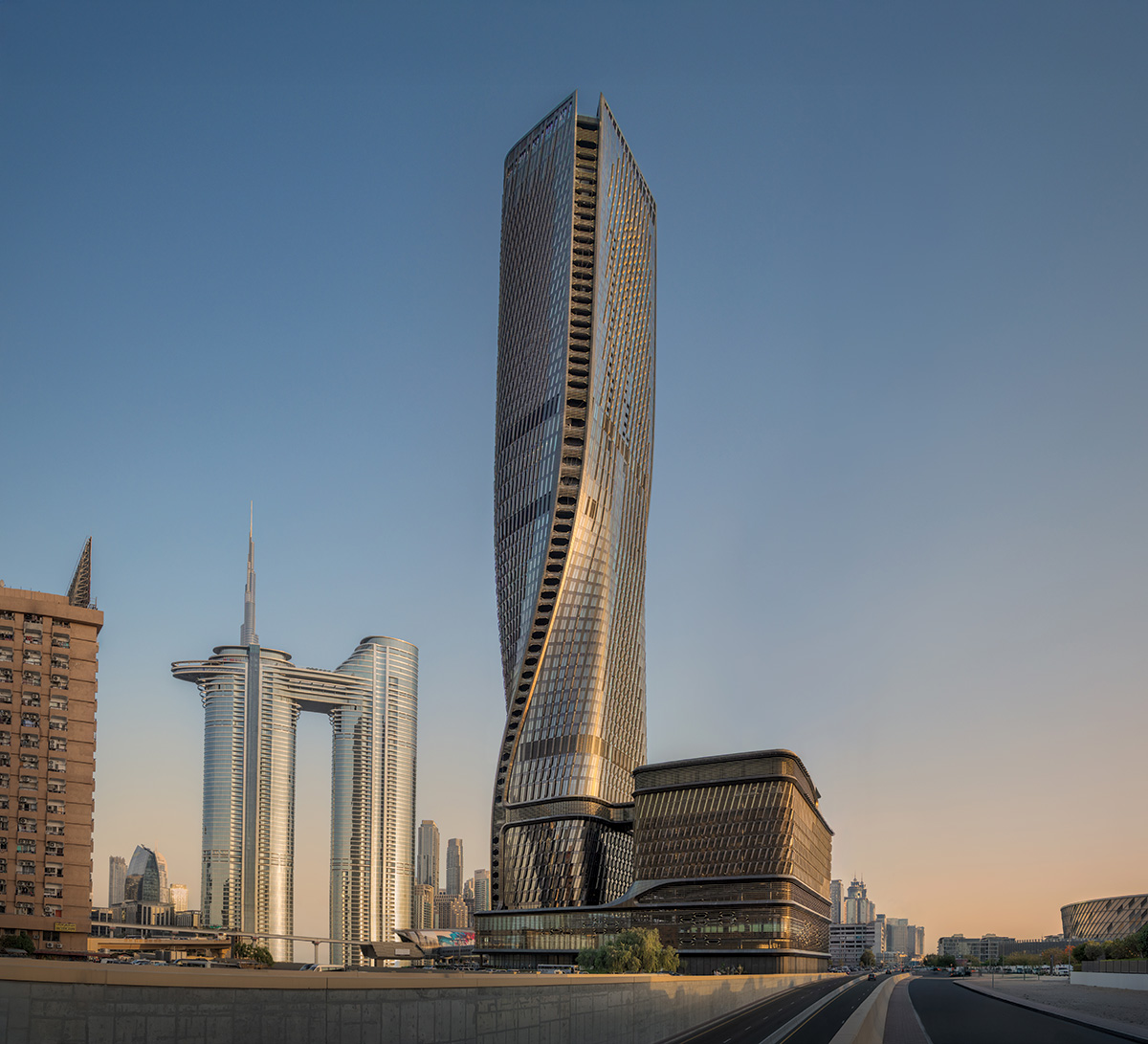
Photo © Ahmad Alnaji
Wasl Tower.
Dubai doesn’t need another showstopping skyscraper. Between overinflated Big Ben knockoffs, kitschy retro-futuristic supertalls, and the Burj Khalifa—the world’s tallest tower (for now)—the skyline isn’t short on spectacle. What it lacks is discipline: tall buildings that do more than compete for attention. The 995-foot-tall Wasl Tower approaches that challenge with restraint, pairing a streamlined silhouette with higher building performance, material efficiency, and a calibrated approach to vertical living.
The high-rise’s form turns, its surface shifts, and its logic reveals itself gradually—less a one-liner than an edifice with what Ben van Berkel of UNS (formerly UNStudio) calls “1,001 facades.”
At first glance, the building reads as a torsional volume—“a building with a twist,” in van Berkel’s words—its geometry driven by computational modeling developed in collaboration with German engineer Werner Sobek, who joined the project in 2013 before a final architectural concept had been established. Tasked with defining the technical framework and assembling the design team, Sobek brought van Berkel into the project.
Refined through solar and wind studies, the form reduces wind loads by approximately 20 percent, allowing a leaner structural frame and lower material use. The tower replaces conventional shear walls with a central core, 10 perimeter columns, and four outrigger trusses, with several columns inclined to follow the facade geometry. The result is a non-repetitive floor plate.
The building’s mixed-use program spans roughly 1.16 million square feet, combining 216 residential units, 259 hotel rooms, office space, and retail within a single vertical stack. Van Berkel organizes this density into distinct program bands: wellness facilities at lower levels, a sky bar for hotel guests, and a restaurant with panoramic views. “We are creating communities in the sky,” he says.
Inset balconies wrapped in a weblike lattice of steel trace the tower’s curved spine, while thousands of vertically oriented ceramic fins—ranging from approximately 13 to over 20 feet in length—articulate the facade. Parametrically tuned, the fins vary in orientation to limit solar exposure, reducing heat gain by roughly 40 percent while maintaining daylight penetration. “We wanted to have light transmission but avoid solar energy transmittance,” Sobek says.
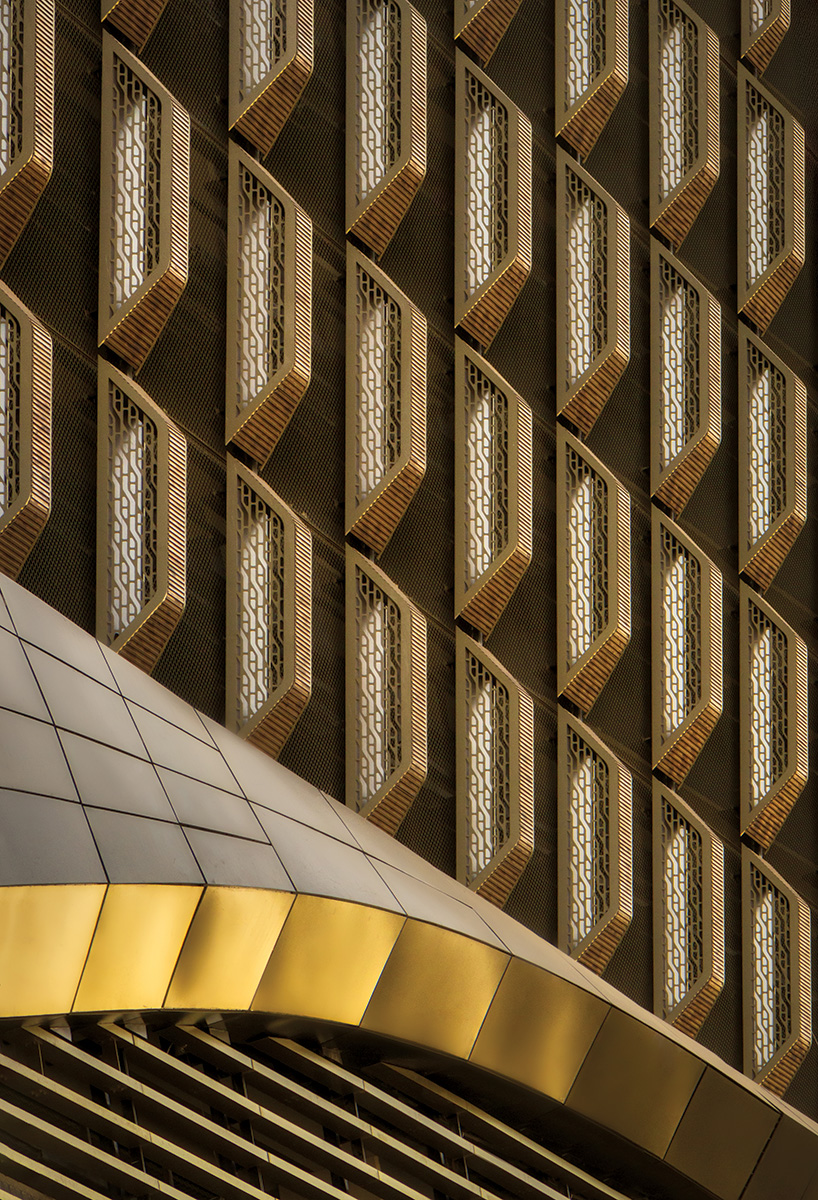
Thousands of fins (above) dot Wasl Tower’s facade, which twists from its base (below) toward the sky (top of page).
Photos © Ahmad Alnaji
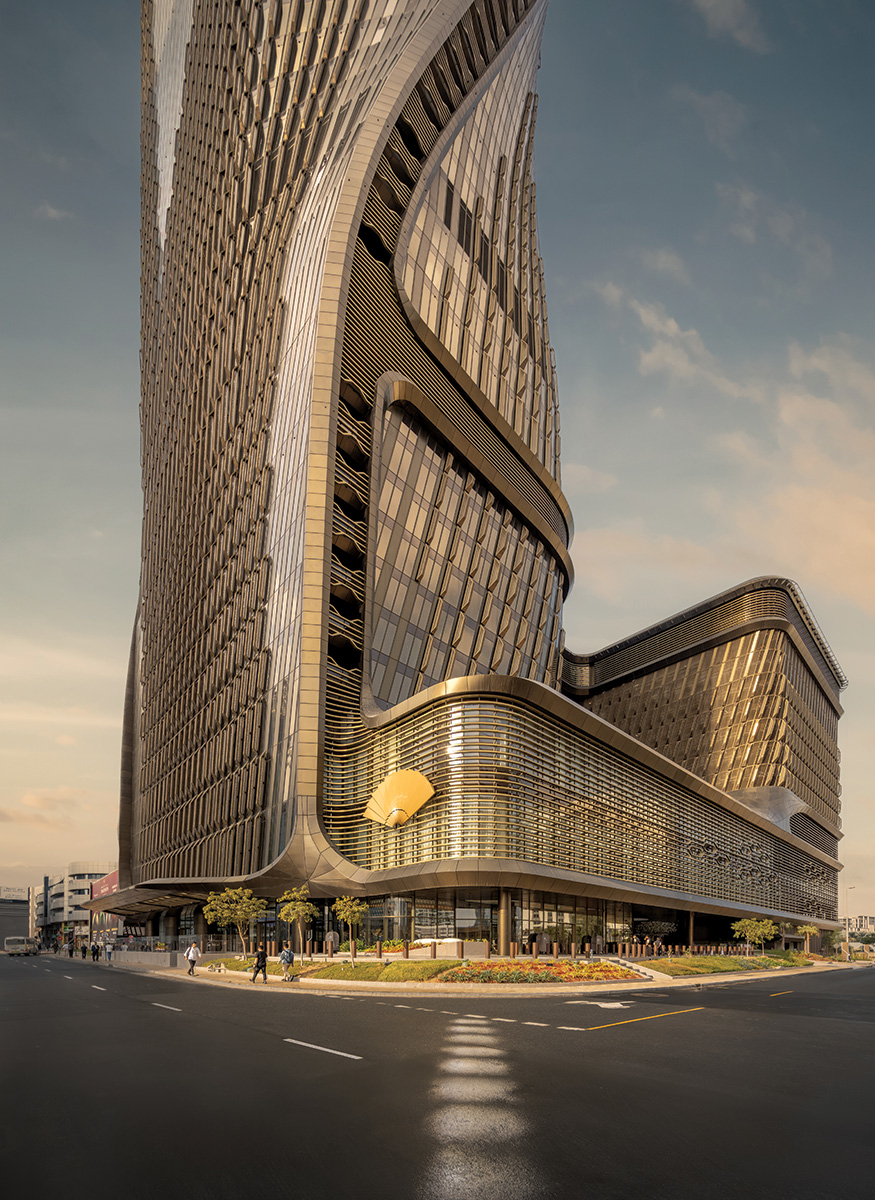
Grille-like slots in the fins allow air to move through the outer layer, supporting passive cooling. Combined with reflective bronze glazing calibrated to avoid color distortion, the facade reduces cooling loads in a climate dominated by air-conditioning demand.
At grade, service functions are relocated underground, freeing the perimeter and the space between the tower and its adjacent parking structure for a landscaped garden. The parking structure operates as an extension of the program, housing a 16,000 square-foot ballroom, meeting and prefunction spaces, and back-of-house areas on its lower levels. A pool deck atop the garage is bridged to the tower’s spa levels on floors 11 and 12. Stacked elevator systems—17 in total—compress the core footprint and increase usable floor area.
Sany Irootech Headquarters
SOM | Guangzhou, China
By Clifford A. Pearson
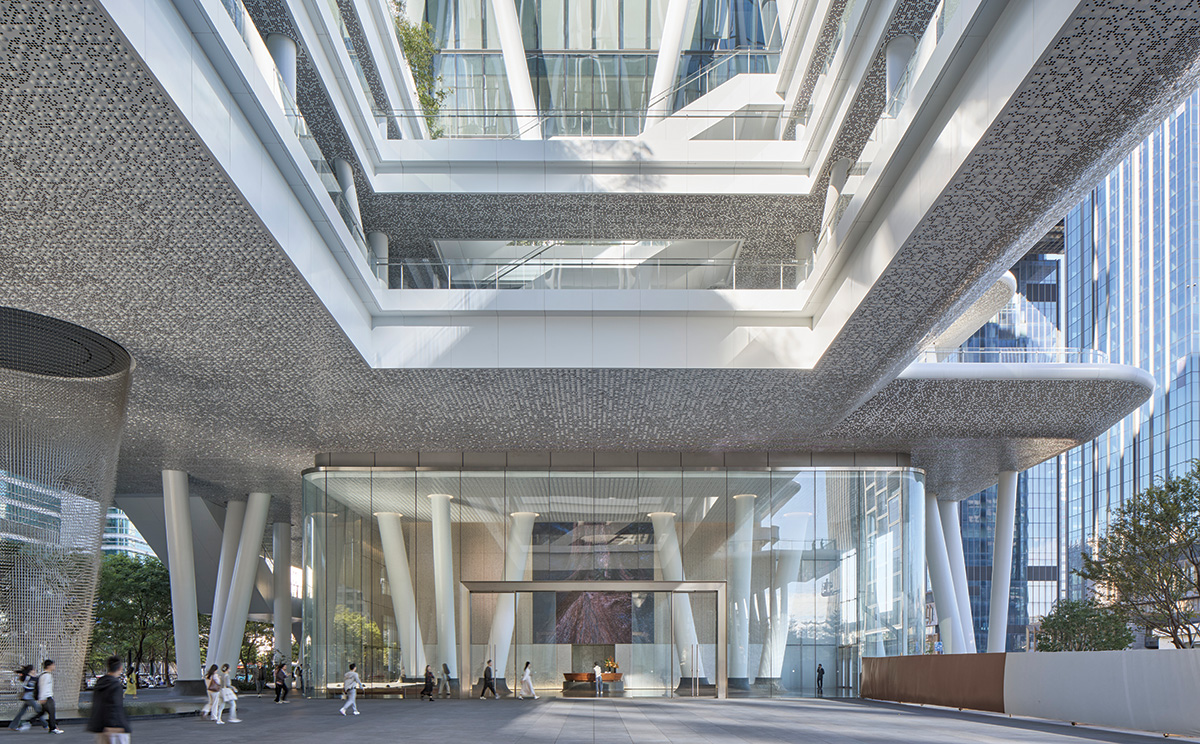
Photo © Dave Burk / SOM
Sany Irootech Headquarters.
Battered by typhoons and shaken by earthquakes, the city of Guangzhou in southern China challenges architects working there to create buildings that are both strong and flexible. For the headquarters of a new cloud technology company established by Sany, a construction equipment manufacturer, SOM designed a two-tower complex that exploits the efficiencies of a steel diagrid structure and engages its urban context with an open podium hovering above a shaded public plaza. Integrating architecture, engineering, and landscape was a key goal for the firm and its client.
Located in the rapidly developing Pazhou business district across the Pearl River from the historic part of Guangzhou, the 1.89 million-square-foot project sets itself apart from its mostly glass-skin neighbors with its distinctive steel exoskeletons. “The area is being built at enormous speed and there’s a sameness to all the buildings,” says Brian Lee, SOM design partner. “We wanted to take a different approach here.” The clearly expressed structure appealed to the client, says Lee, because it manifests the parent company’s roots in construction. It also offered the flexibility of column-free interiors, an asset that proved especially important when the client changed the program for some floors midstream. Around 12 floors in the 38-story tower are now slated to be a hotel, while residential units are planned for approximately five floors of that tower and 10 floors in the 36-story one. About 2,000 employees of Sany Irootech work in the two buildings.
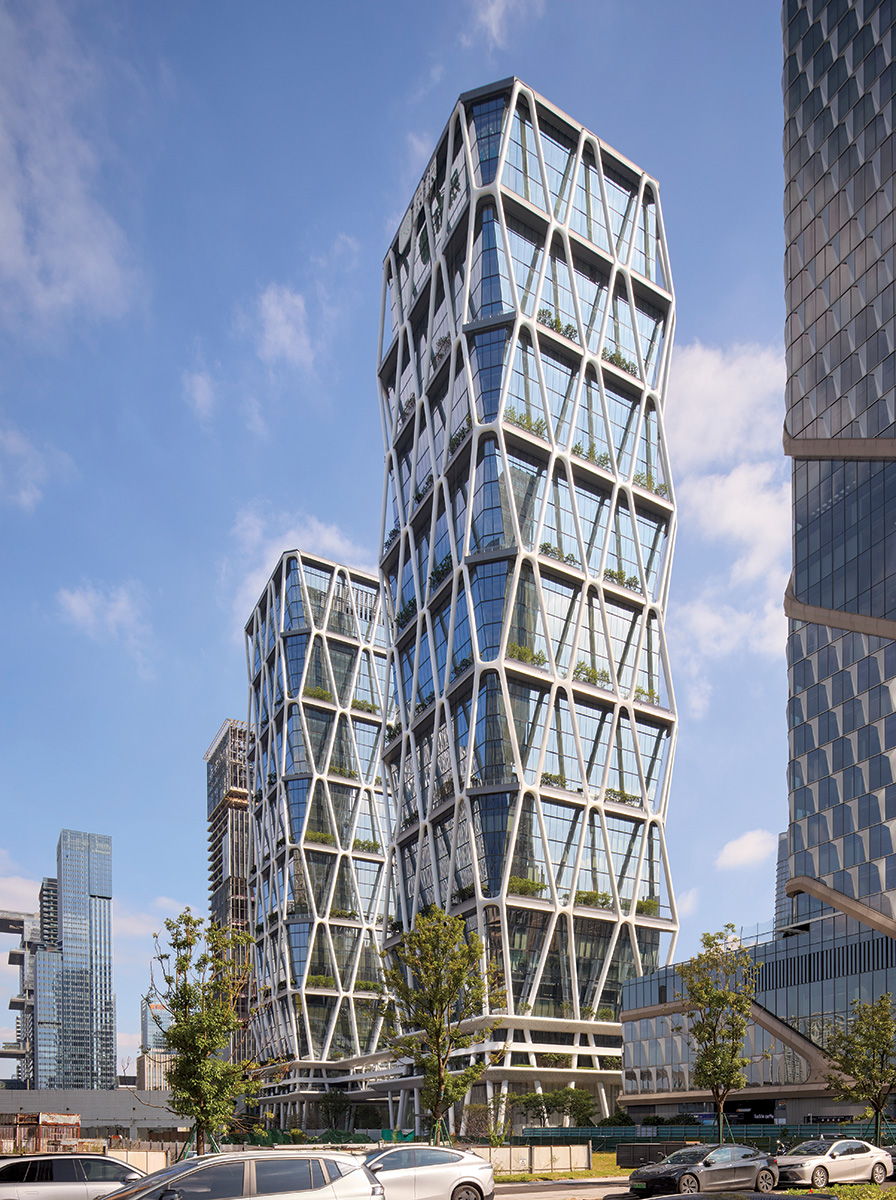
Photo © Dave Burk / SOM
The pair of towers, with their distinctive exoskeletons (above), are linked by a bridge-like connector that shades a ground-level plaza (top).
The fraternal twin towers rise from an elevated podium that connects them above the street with a covered arcade offering retail, food, and recreational spaces and a landscaped terrace above that—all open to the public. At ground level, the bridge-like connector shades a public plaza extending from a large avenue on one side of the site to a future park on the side closest to the river. “We wanted landscape flowing throughout the project,” says Lee, “linking different levels and eventually reaching out to the park when it is completed.”
The architects minimized the size of the lobbies and wrapped them with highly transparent, low-iron glass to make them feel like pavilions set within the plaza. Taking advantage of the diagrid structure, SOM configured the towers themselves as stacked five-story blocks suspended from a perimeter ring beam at every fifth floor. Leaning the curtain wall inward reduced direct sun loads on interiors and created an outdoor terrace on the lowest floor of each five-level module.
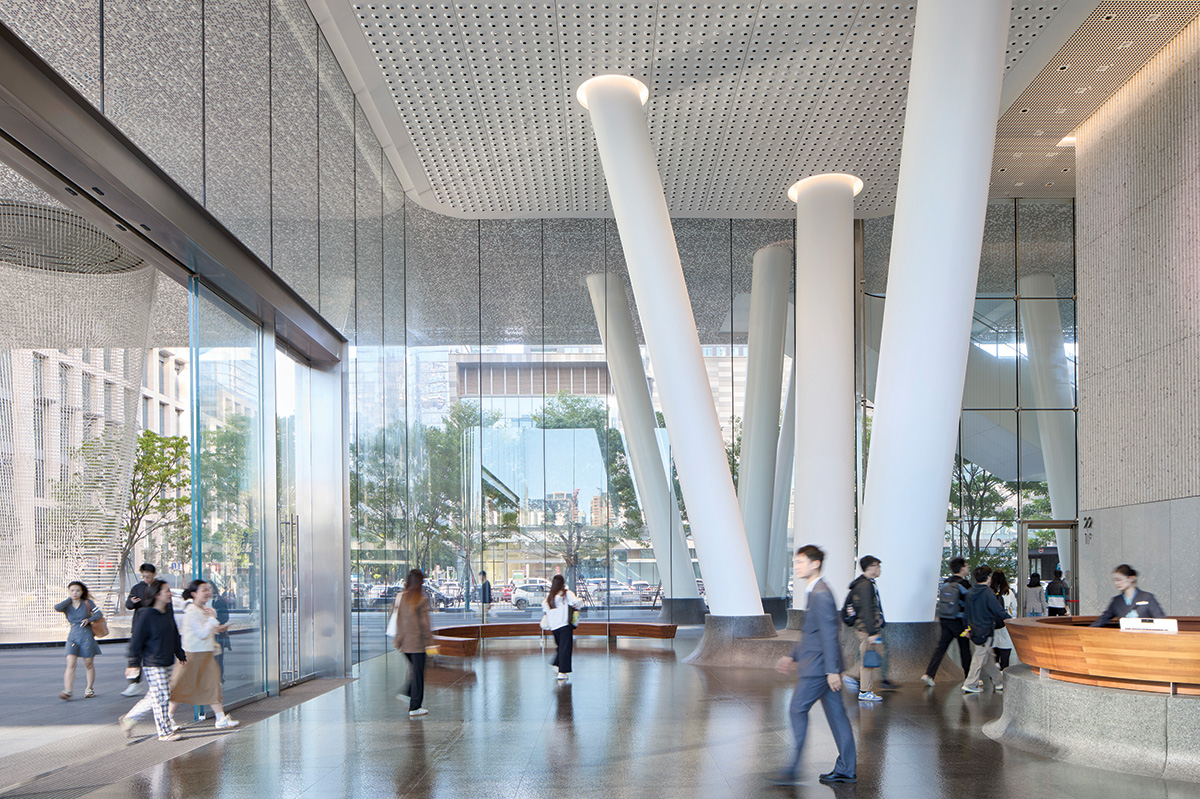
Photo © Dave Burk / SOM
The towers’ lobbies are wrapped in low-iron glass.
The external structure was erected with five-story-tall steel columns connecting to prefabricated steel nodes that employ an innovative assembly of steel plates, vertical slots, and bolts using friction to control slippage during seismic events. Mark Sarkisian, SOM structural engineering partner, says he got the idea for the pin-and-friction joints after visiting the attic of a Jesuit church in South America. It had survived a major quake in 1960 thanks to its wood-dowel connections. While Sany Irootech’s diagrids provide a high degree of stiffness, the nodes introduce ductility and dissipate energy when the earth shakes. The goal, says Sarkisian, is to create resilient structures that not only survive extreme events, but can be occupied shortly afterward. The steel columns—3.9 feet in diameter on the lower 10 floors and 3.6 feet in diameter above—were filled with concrete after assembly on-site, while the nodes remain hollow. The design minimizes moment connections and the size of bracing elements, making the project more efficient and faster to build, according to SOM.
520 Fifth Avenue
KPF | New York City
By Leopoldo Villard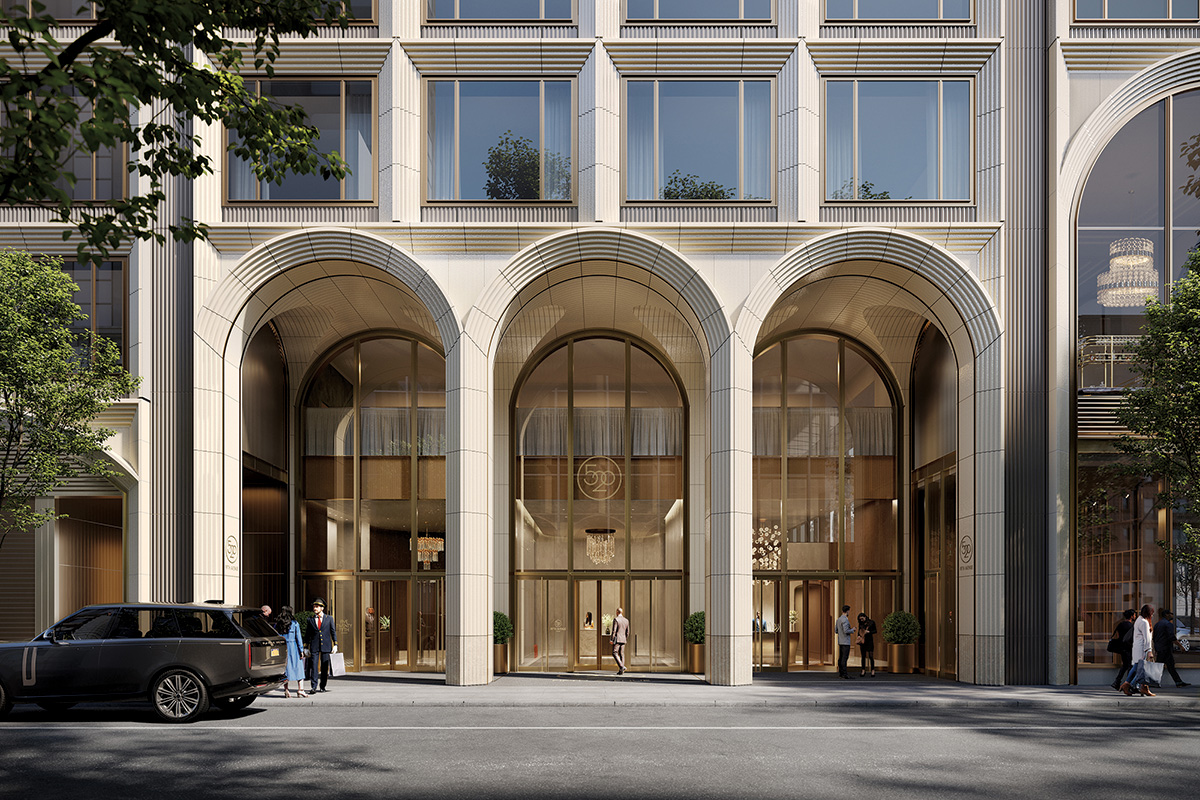
Image © Binyan
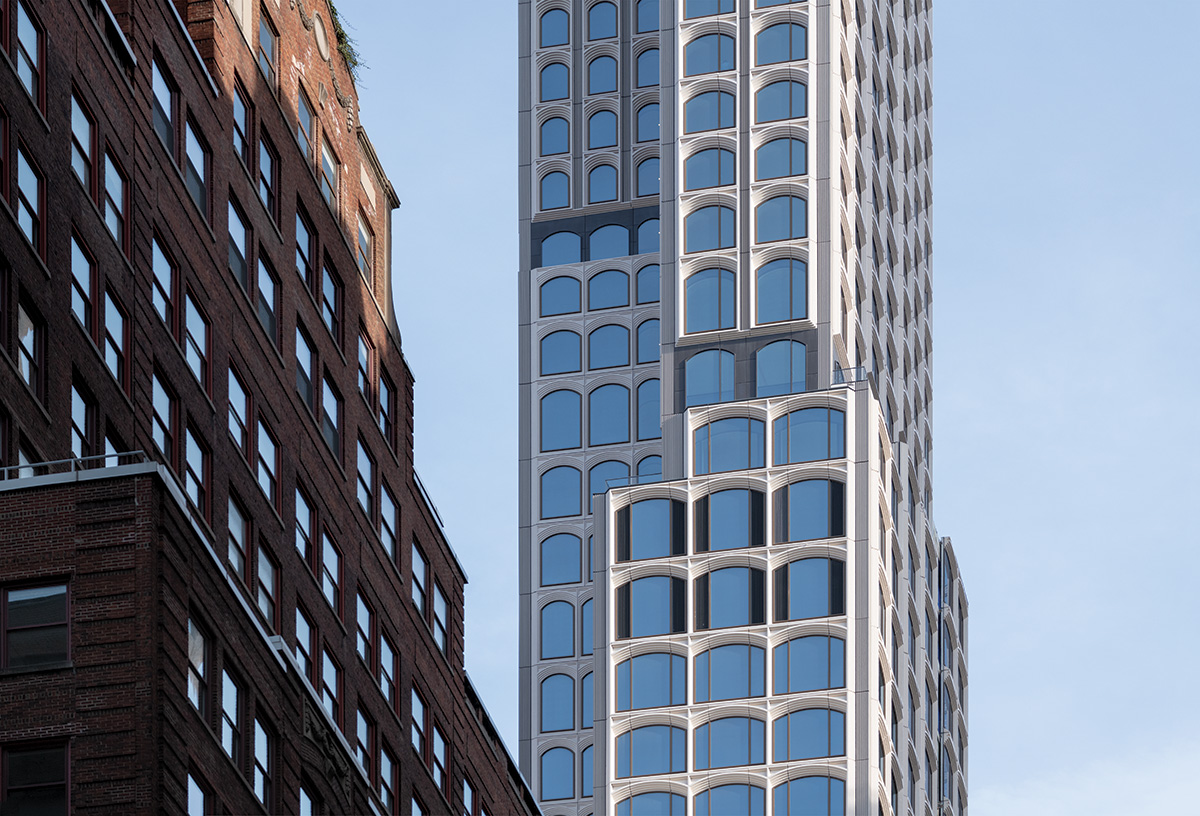
At 520 Fifth Avenue, three grand arches form three separate lobbies.
Old-fashioned cold calls seem a rarity nowadays, but that’s exactly how Jamie von Klemperer, president of Kohn Pedersen Fox (KPF), landed the commission for the firm’s latest supertall in New York City.
“I found out through some gossip who had bought the site,” von Klemperer recalls. “So I reached out to say, ‘I understand that you’re thinking about a mixed-use tower. Give us a call.’ ” He admits it was an unusual tactic, but von Klemperer knew the parcel in question all too well. The vacant lot at 520 Fifth Avenue, just around the corner from KPF’s Manhattan office, had been the focus of a feasibility study for a hotel, later abandoned, with a previous client. To von Klemperer’s delight, the new owner—developer Mickey Rabina—returned his call with something different in mind.
Architects and developers are often guilty of overusing the term mixed-use. Planting a penthouse atop an office building or positioning retail on the ground floor of an apartment complex hardly warrants the description, but the program of 520 Fifth Avenue indeed justifies it. KPF, responsible for the project’s core and shell, managed to tightly pack a slender, arch-laden tower with a four-story social club, residential amenities, and retail alongside 25 levels of leasable office space and 37 floors of apartments—all on a site that, at 10,625 square feet, isn’t much larger than three side-by-side tennis courts.
Von Klemperer likens the 1,000-foot-tall 520 Fifth Avenue, which broke ground in 2022, to a Swiss watch—precise, efficiently planned, and requiring a high degree of technical coordination. A previous transfer of air rights to the site from the neighboring Century Association, the now-defunct Princeton Club, and General Society of Mechanics and Tradesmen also gave designers about 200,000 more square footage to shape. (The structure is now the tallest on Fifth Avenue after the Empire State Building.)
“The massing is very much part of the performance of the zoning,” von Klemperer says, citing the 1916 municipal code that went on to define the classic silhouettes of many Manhattan towers, “and the stepping also suits this mixed-use type, where the lower office floors want to be a bigger dimension than the upper residential apartments can tolerate.” These setbacks double as terraces and balconies that offer fresh air—design elements, von Klemperer says, whose importance was “amplified by the pandemic.” They also appealed to brokers who have long insisted on such outdoor spaces. However, unlike the many high-rises of yesteryear, 520 Fifth Avenue’s setbacks form something of a spiral as the tower thins out at its crown.
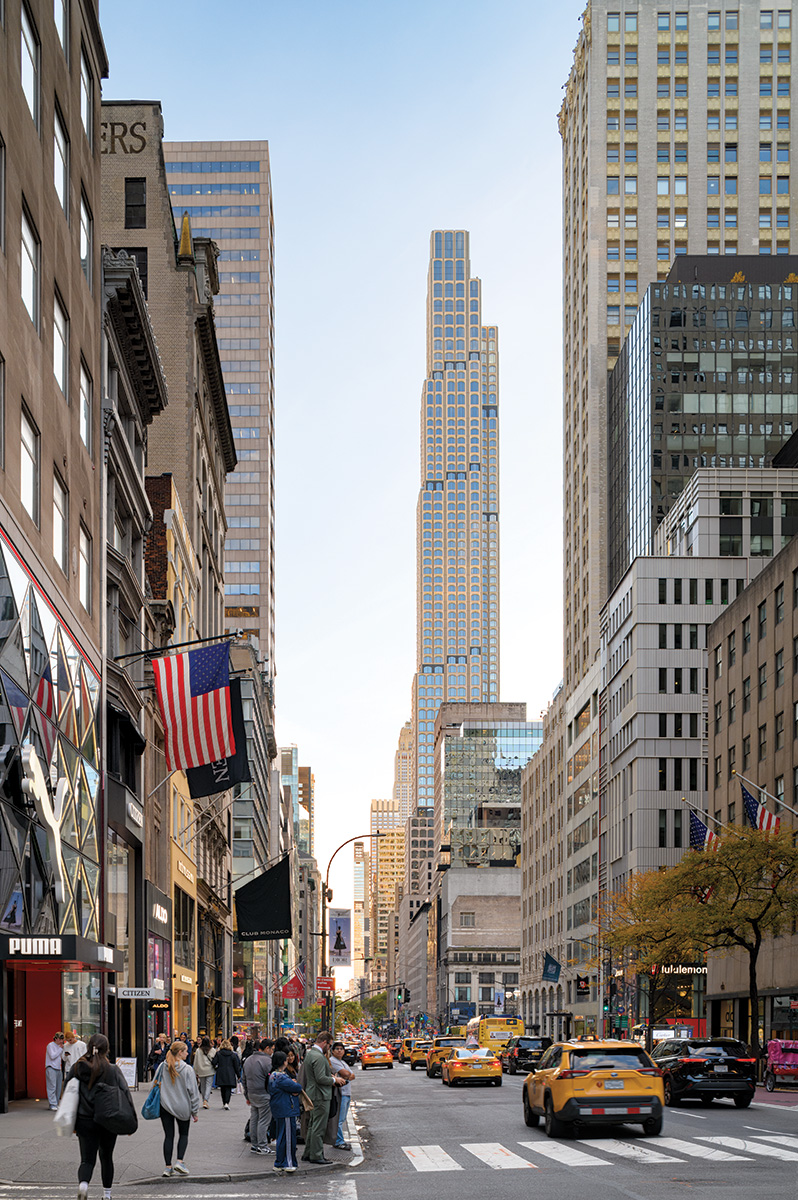
Photo © Raimund Koch
The tower’s setbacks corkscrew upward.
On the ground, large arches define the street-facing elevations, and a 32-foot-tall entry portico filters residents, tenants, and club guests into three separate lobbies. The western and central lobbies lead to apartments and offices, respectively, by way of a core that has been pragmatically pushed to the northern edge of the site. The residential units—100 in total, 98 of which have already sold—are laid out in a mix of bedroom configurations, but the highest occupiable space, on floor 88, has been set aside for shared amenities. Among them is a solarium, measuring 16 feet by 25 feet and glazed on three sides, offering spectacular simultaneous views of uptown, the Hudson River, and downtown. Above this sky-high lounge are various mechanical areas, including one that houses a tuned mass damper, which reduces the building’s sway and, in turn, minimizes structural bulk (critical for space-saving planning on such a small footprint).
Fundación Universitaria Compensar
Bermúdez Arquitectos | Bogotá, Colombia
By Patrick Templeton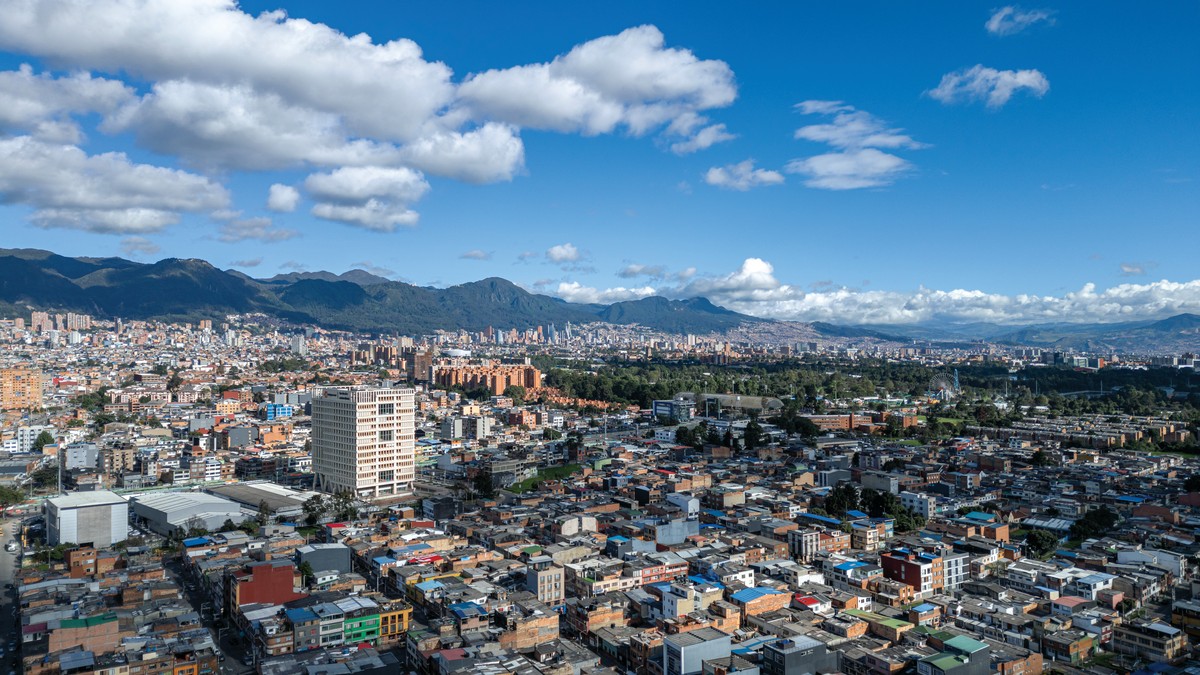
Photo © Be Estudio
Fundación Universitaria Compensar.
“It looks like an alien walking around the city,” says Ramón Bermúdez, partner at Bermúdez Arquitectos in Bogotá, Colombia. But, rather than wreaking havoc, as in a giant-monster movie, the 16-story educational building that seems to have landed in the center of the sprawling South American metropolis is a result of its rapid growth and may offer a glimpse of more urban development to come.
The Colombian capital has rocketed from approximately 6 million residents at the turn of the millennium to just under 12 million today. Projections suggest further but tapering growth over the next few decades driven largely by internal migration from the countryside. This rise in population, coupled with Bogotá’s uniquely constrained geography—nearly 9,000 feet above sea level on a plateau in the Andes Mountains—has led to its being one of the densest cities in the Americas. Apart from a cluster of towers downtown, this urban density has taken the form of mostly low-lying development.
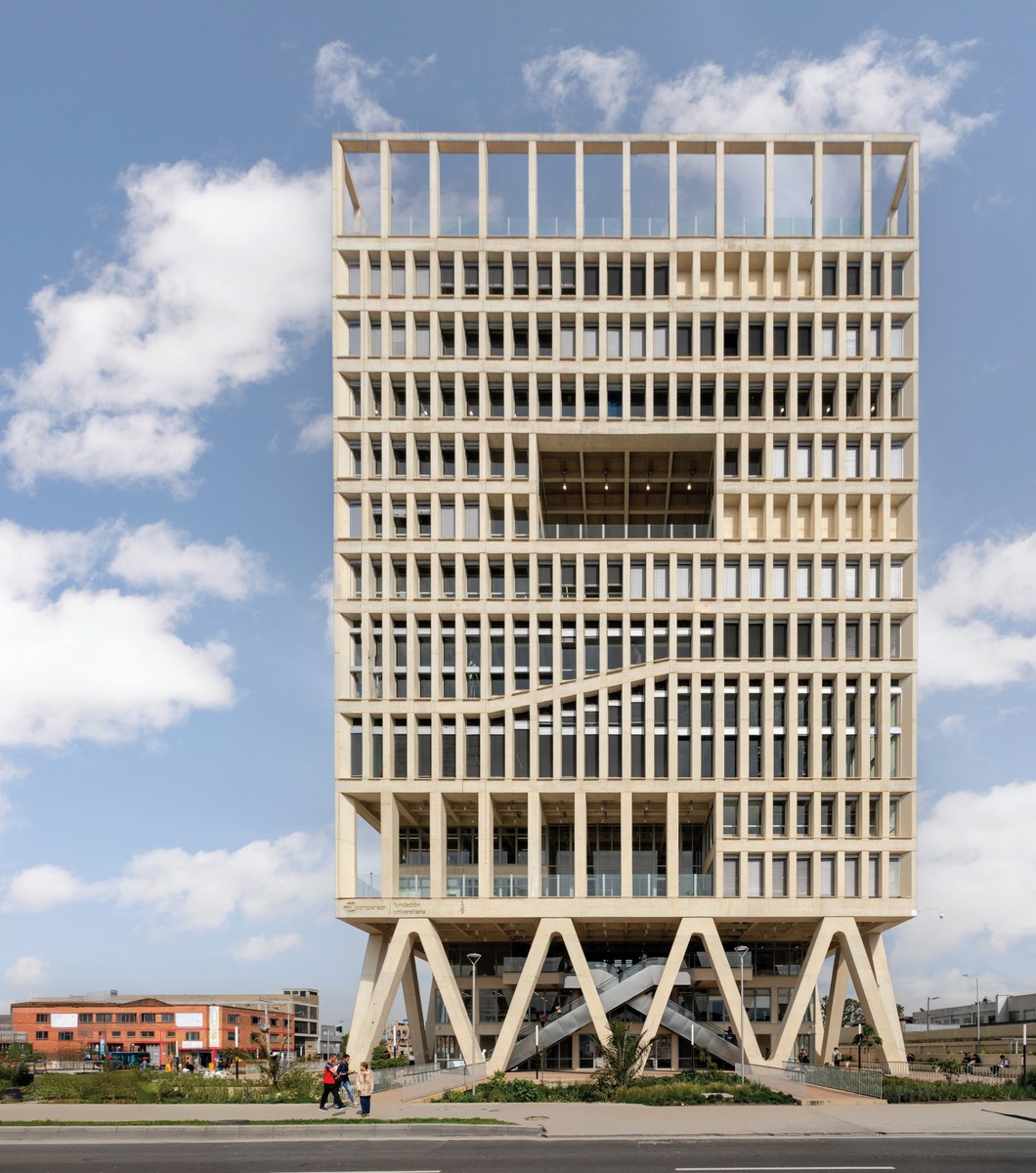
Photo © Jairo Llano
The 16-story vertical campus stands out among Bogotá’s low-lying buildings (above).
In 2013, Bermúdez Arquitectos—a family business founded by Daniel Bermúdez, the father of Ramón and his younger architect and landscape architect brothers—won a private competition to design the new vertical campus for Fundación Universitaria Compensar. This is the third location for the post-secondary school, which is a public-private institution that prioritizes technical training and certifications. Located on a major thoroughfare near Simón Bolívar Park, Bogotá’s “Central Park,” the tower was only possible because of changes in zoning ordinances implemented by the mayor, anticipating the need to densify the urban fabric. However, the project was delayed for six years while these laws were contested and adjudicated in court. The resolution of the case ultimately led to the tower’s needing to be redesigned in 2019 to fit within revised setbacks before construction could begin in 2022.
Both the original proposal and what would eventually be built seem to hark back to midcentury-modern sensibilities. The design prioritized the composition of an ordered facade rhythm, where programmatic elements inside are evident on the exterior, as well as concerns for how the heft of the structure meets the ground and engages the sky. “It’s quite a rational building,” Ramón explains, “with just a few architectural gestures that work within the program.” V-shaped columns around the base—like the many legs of an alien creature—leave the corners cantilevered, either making the mass feel weightless or as if it might rampage through the city. Although constructed almost entirely out of rough cast-in-place concrete, the béton brut isn’t reviving brutalism for the sake of style but responding to local constraints. “When constructing in Colombia,” explains Ramón, “you have to be very specific about what the conditions you have to build with are, the materials available to you, and the knowledge of how to build with them.”
Vertical campuses aren’t common in Colombia, so Bermúdez Arquitectos looked to KPF’s 14-story William and Anita Newman building at Baruch College in New York City.
CIBC Square
WilkinsonEyre | Toronto
By Matthew Allen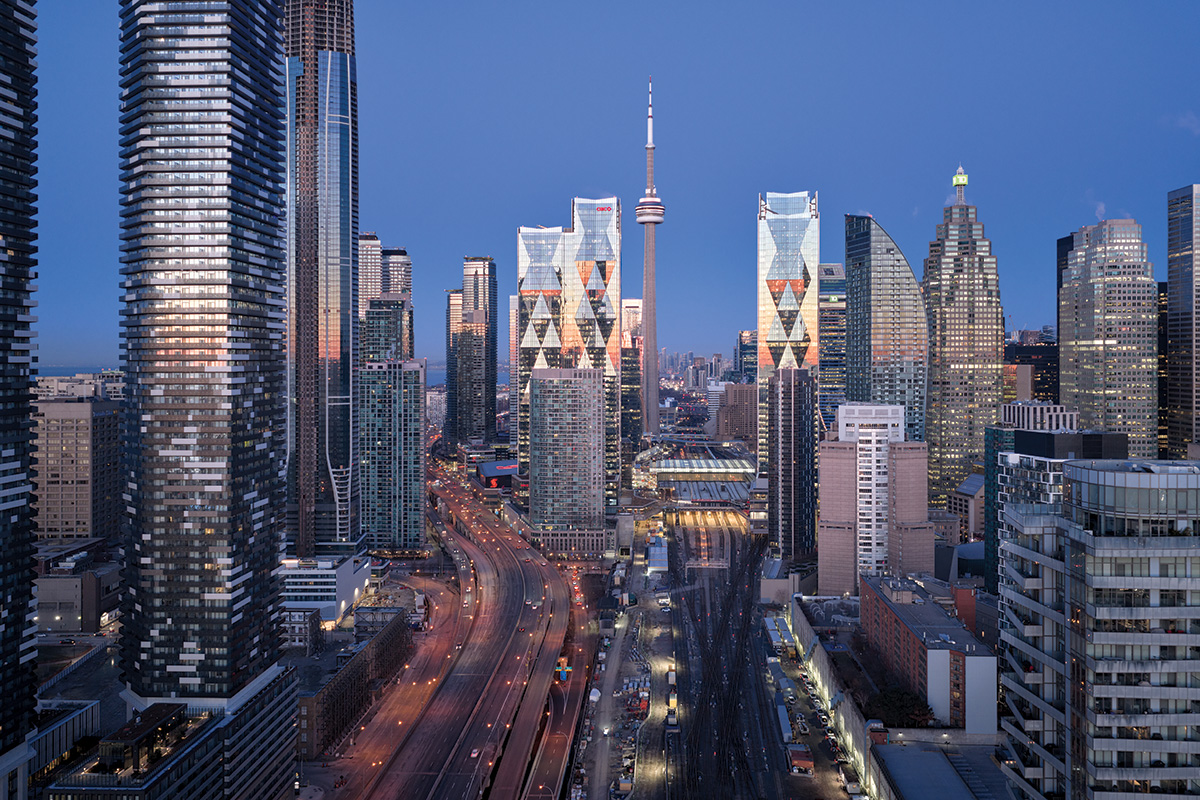
Photo © Doublespace Photography
CIBC Square.
A central node of Toronto’s financial district is migrating south and up 80 feet into the air. In response to a design competition by developers Ivanhoé Cambridge and Hines to link two sites split by a rail corridor across the street from Canada’s busiest station, London-based architect WilkinsonEyre has designed two towers connected by a 1-acre park. By so doing, it has created a campus four stories above the pavement for one of the nation’s Big Five banks. The Canadian Imperial Bank of Commerce (CIBC) was announced as the anchor tenant in 2017 and now leases over half of the towers’ 3 million square feet. Dominic Bettison, a WilkinsonEyre board director who led the winning competition submission in 2014, speaks with a note of relief when describing floor plates as “sensible” and “predictable” in a project that is otherwise over the top. It is now a short distance for bankers to travel from trading floors onto a landscaped swath inspired by regional landforms and programmed with a skating rink, to gaze serenely beyond the congestion below.
WilkinsonEyre’s strategy for ensuring CIBC Square would “resonate with the bankers” began by replicating a local legend. “The floors are almost identical to the Toronto-Dominion Centre,” Bettison says, referring to the 1960s tower ensemble designed by Ludwig Mies van der Rohe a couple of blocks north. Each of CIBC Square’s rectangular volumes is split in half by a vertical notch, making the two 820-foot-tall towers look a bit like four. Several details—like chamfered corners and glazing that continues beyond the top story into the sky—make the curtain wall seem almost to float at a distance from the floor plates. As a result, the towers feel lighter and more open than most others in the district. Facades patterned with colossal diamonds also diverge from the dogged rhythm of horizontal spandrels that saturates the financial district. By projecting a mere 30 inches, the diamonds’ facets reflect a surprising variety of colors throughout the day. This effect is accentuated at dusk by lighting at nodal points, directed along fins at the diamonds’ edges—what Bettison calls his “lightsaber” detail. Nearer the ground, steel-and-glass canopies mitigate downdraft and complement lightweight stairs that signal access to the park. (Escalators directly inside are a more popular option for ascent.)
The towers’ nearly identical appearance masks a major structural difference: one side of the north tower sits over the rail tracks. There are no columns below the sixth floor.
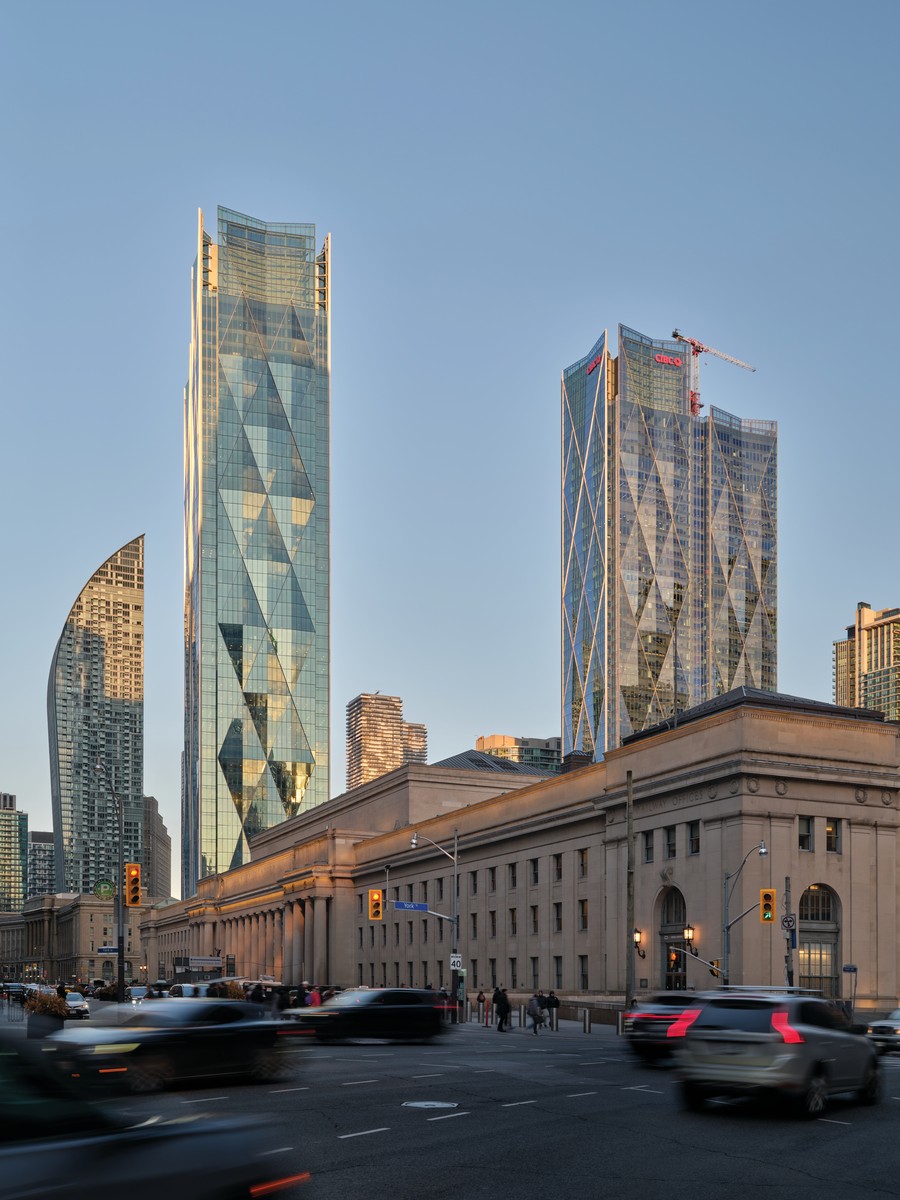
Photo © Doublespace Photography
The towers’ faceted facades reflect changing colors throughout the day.
As when standing on one leg, it is lateral loading—sway from the wind—that is most difficult to deal with in this situation. Though outriggers near the building’s top limit this movement, a cable system with incorporated springs helps maintain the right amount of tension in the glazing at the base as the tower sways. This leaves the north tower’s lobbies extra open. Travertine facing on the elevator banks seems to glow in the daylight, and floor-to-ceiling backlit artworks by the painter Steve Driscoll literally do. In the south tower, his depiction of a pine forest rendered in red resonates with the CIBC logo.
The larger urban agenda of CIBC Square is to help reconnect downtown Toronto to its waterfront. The towers’ sites seemed cursed with infrastructural blight; they were occupied by a parking lot and an aging bus terminal. The train tracks, an elevated expressway, a sudden grade change, and the congested tangle of Union Station itself all stood between office workers and a harbor-front stroll. (Half of the south tower’s podium houses the relocated bus terminal, which Bettison says is “designed along the lines of a small regional airport.”) A leap of imagination will be needed for Torontonians to see that they can, in fact, walk straight down to Lake Ontario. WilkinsonEyre’s canopies and stairs combine with a spindly Santiago Calatrava–designed galleria, completed in the early 1990s, jutting over the sidewalk to constitute a series of lightweight features punctuating the view down Bay Street, over the tracks, and toward the lake. We will have to wait until summer to see if people pick up on the signals and throng this way to the boardwalk.
CIBC Square is Toronto’s first test of the strategy of suturing its infrastructural wounds with rail-deck parks, and it signals the difficulty of pulling off the procedure. Due to the height required to surmount the train tracks, the park may function more as a destination than as a connection. It is simply too many steps up and down, when going under or around are also options. Bettison notes that other pedestrian bridges WilkinsonEyre has designed have been about 50 feet from the ground, but this one is 30 feet higher: “It would have been a lot easier without such a big level change.” Bettison observes that the investment required to plant a park on a bridge was only worthwhile because the client owned land on both sides of the tracks; the payoff will continue for generations. CIBC Square’s park—a privately owned public space—faces open skies to both the east and the west, and it is unlikely that a building will go up to block the light. If plans to green the roof of the adjacent train shed come to fruition, one side of the park will overlook a small sea of green. Even now, other banks’ headquarters surround the site at a comfortable distance. Once they start hopping the tracks, Bay Street’s southern migration will be accomplished.
ByteDance Houhai Center
Ennead Architects | Shenzhen, China
By Russell Fortmeyer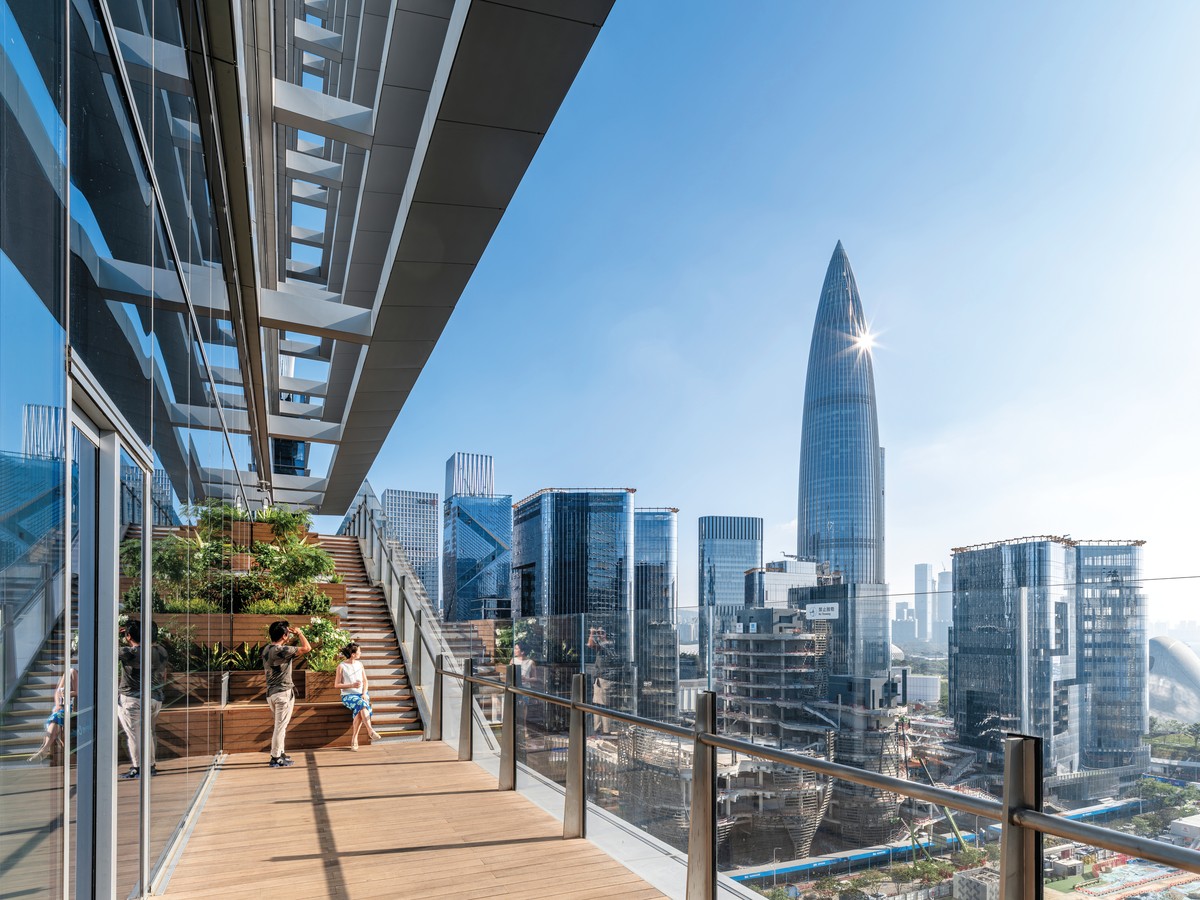
Photo © Yihuai Photography Studio
At ByteDance Houhai Center, decks include ferns and other plants appropriate to the climate.
In January, the Chinese social media company ByteDance sold a majority stake of its United States subsidiary, which operates the popular TikTok app, to a group of American investors to avoid an outright ban in this country. That may seem like a setback, but, at its new offices in central Shenzhen, designed by Ennead Architects, the company’s spectacular growth is on full display.
Strikingly for such a dense location—as well as for technology clients, who generally prize privacy—the tower’s first 13 floors include a series of outdoor terraces that wrap around the glazed curtain wall. A prominent horizontal brise-soleil, cantilevered from the building’s primary structure with individually expressed outriggers, provides shading and, at night, with integrated LEDs, lights up the building. On some floors, such as the ninth, the terraces extend diagonally up the north and south side of the building to link to multiple levels above. The 12th floor includes a double-height interior space that features oversized stepped seating up to the 13th floor, mirroring a similar condition on its exterior diagonal terrace.
Peter Schubert, Ennead’s design partner for the project, says the client particularly appreciated the scheme’s approach to outdoor access without relying on an elevator to exit the building. This allows staff to stay more connected throughout the day. “Connectivity for collaboration is what drives innovation,” says Schubert. The architects ensured that these outdoor spaces would be enlivened, by compressing a series of multipurpose spaces into the first nine stories of the 32-story, 674,000-square-foot building. This move directly engages staff with the life of the street, framing the program within a dynamic envelope that becomes more conventional as the building rises to the office floor plates above.
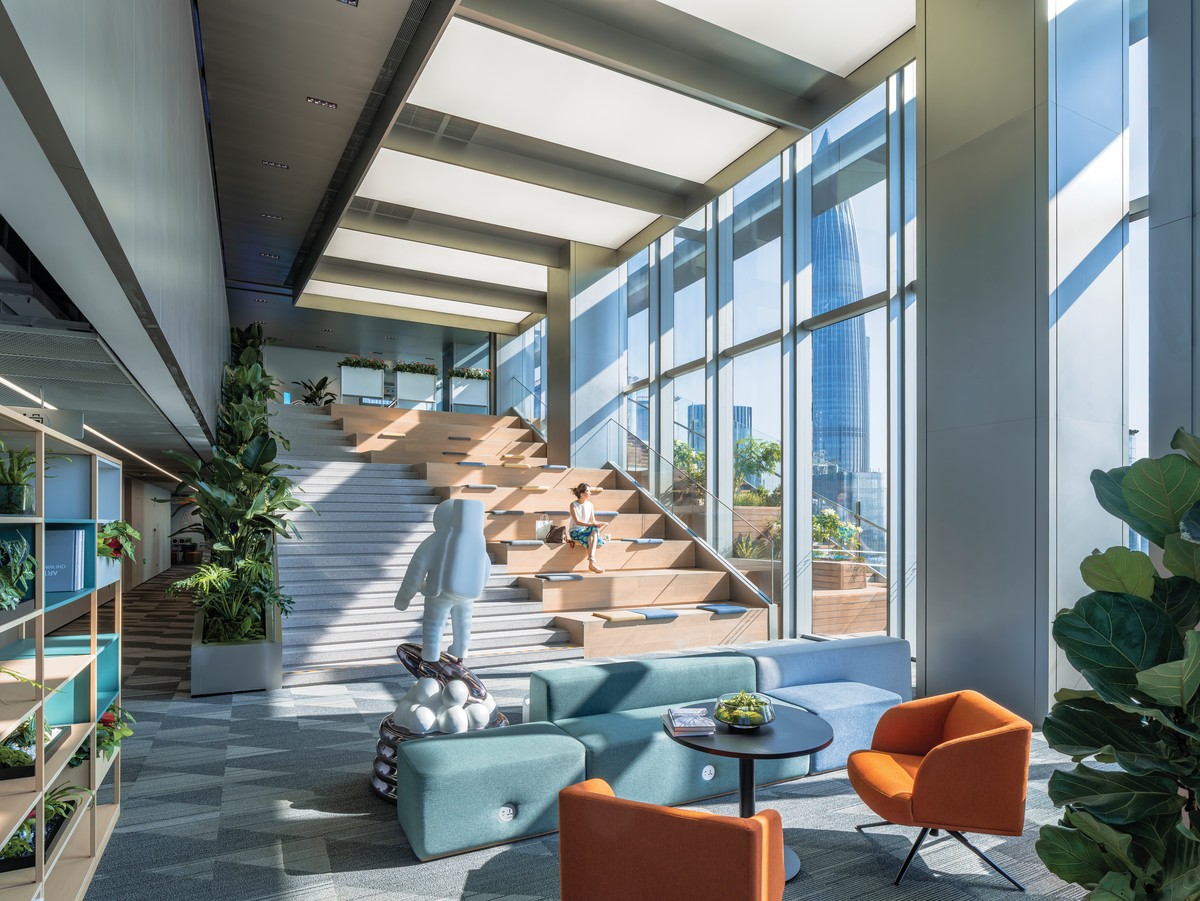
Photos © Yihuai Photography Studio
Interior stadium seating (above) mirrors a similar condition on the exterior where terraces extend diagonally, linking multiple levels (below).
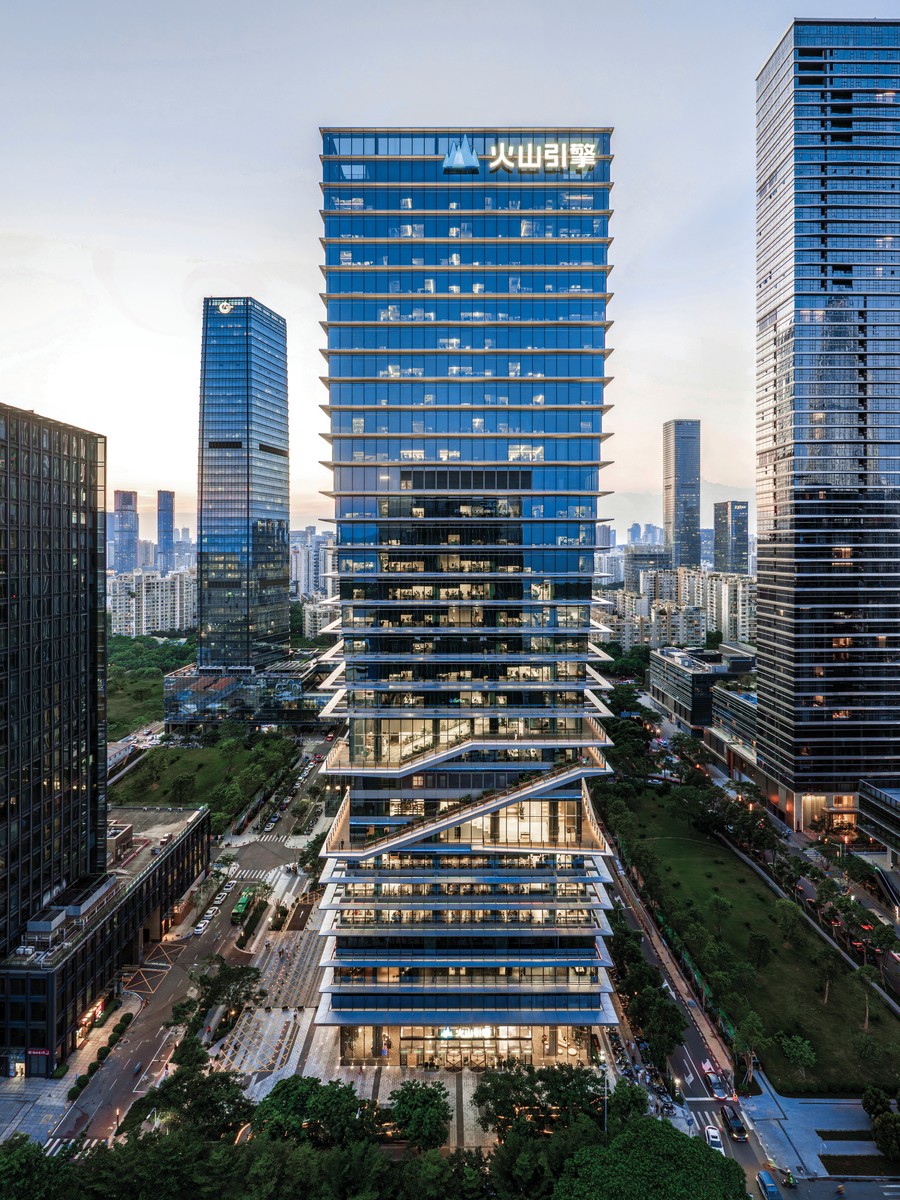
These lower floors include retail areas, conference and event spaces, dry-technology labs, a commercial kitchen, a gym, and three floors of communal staff dining, all of which visually activate the building’s presence within an otherwise restrained business district. “The massive canteens are used by everyone at lunch,” Schubert says, which is common for technology companies. The built project closely reflects Ennead’s competition-winning concept from 2020, he says.
Schubert led the project team from New York City in collaboration with project director Grace Chen, a partner who leads Ennead’s business in Asia from its Shanghai office. Chen says the outdoor terraces have proved popular. “The client told us staff enjoy the terraces even during heavy rain because the overhangs keep them from getting wet,” Chen says. Lab D+H landscape architects designed a series of planters, finished in timber like the terrace decks, which contain ferns and other greenery appropriate for Shenzhen’s subtropical climate and serve to soften the outdoor spaces.
10 World Trade
Sasaki | Boston
By Joann Gonchar, FAIA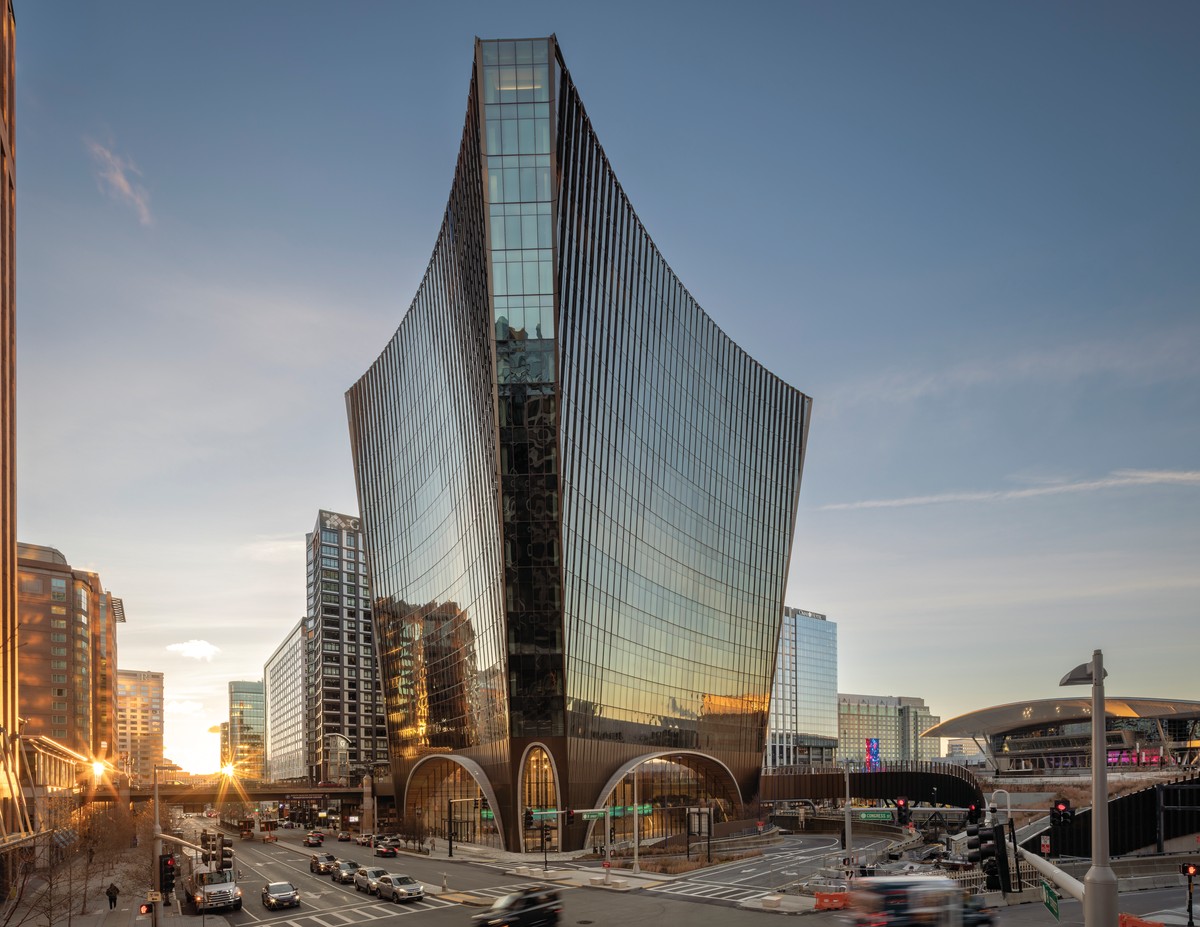
Photo © Michael Grimm
10 World Trade occupies a complex multilevel site circumscribed by an elevated viaduct, a busy street, and an interstate exit ramp.
Not so long ago, Boston’s Seaport District was an expanse of abandoned warehouses, surface parking lots, and crumbling piers. Now the once desolate landscape has been replaced by a neighborhood of shiny office buildings and glittering apartment towers. But there is a predictability to this development, at least according to some critics. Typical Seaport buildings, they say, have a sameness about them: they tend to have podiums that extend all the way out to the property line and then, to maximize leasable square footage, unimaginatively extrude straight up.
The developer Boston Global Investors (BGI) and Sasaki, its architect, sought to do something different with 10 World Trade, a recently completed 600,000-square-foot, 17-story commercial lab and office building. It sits on an oddly shaped 1.1-acre parcel circumscribed by an interstate exit ramp, Congress Street (a major traffic artery running from the Financial District to South Boston), and World Trade Center Avenue (a viaduct elevated 26 feet above grade). “There is a lot going on here,” says Victor Vizgaitis, Sasaki’s principal in charge. “But the complexities gave us reason to be creative.”
The footprint of the resulting 252-foot-tall building—the maximum height allowed due to the proximity of Logan International Airport—pulls away from the site’s edges at the ground. Within the structure’s convex and angled glass facades, each successive floor plate is slightly larger than the one below it, producing a flared, sculptural tower without an apparent back or front.
The goal, however, was not to create a building that would be merely different or eye-catching. The idea was to give some of the site to the public realm—a requirement of the 2018 RFP from the land’s owner, the Massachusetts Port Authority. The RFP also included a stipulation that the project provide a way for pedestrians to ascend from Congress Street to World Trade Center Avenue, and that this route be accessible 24/7. BGI wanted to consider these demands “holistically,” says John Hynes IV, the company’s vice president. “We didn’t think of them as just boxes to check.”
In response to the RFP and BGI’s desires, Sasaki designed a 42-foot-tall “great hall” at the tower’s base below a curved, wood-clad ceiling defined by a series of intersecting arches springing from the building’s corners. The dramatic three-story space was envisioned as more than a lobby or the usual office-building dining options (though it will probably include such amenities), but also as a venue for community events such as celebrations, performances, and exhibitions. In addition, it was planned as a way for pedestrians to traverse the site’s grade change, any time of day or night, and be protected from the elements, either via an elevator or by way of a grand stair wrapping the central core and bordered by a lushly planted seating area. The scheme also incorporates another lot—half an acre and triangular, on the opposite, west side of the highway ramp—connected to the tower by a pedestrian bridge. The small area, landscaped, includes terraced steps and a zigzagging sloped pathway, offering yet another way to travel between Congress Street and World Trade Center Avenue. Below this “triangle park” is a sheltered area that could serve for any number of functions, suggests Vizgaitis, such as food vending, or as a basketball court. In all, the project provides about 2 acres of public space, both indoors and out.
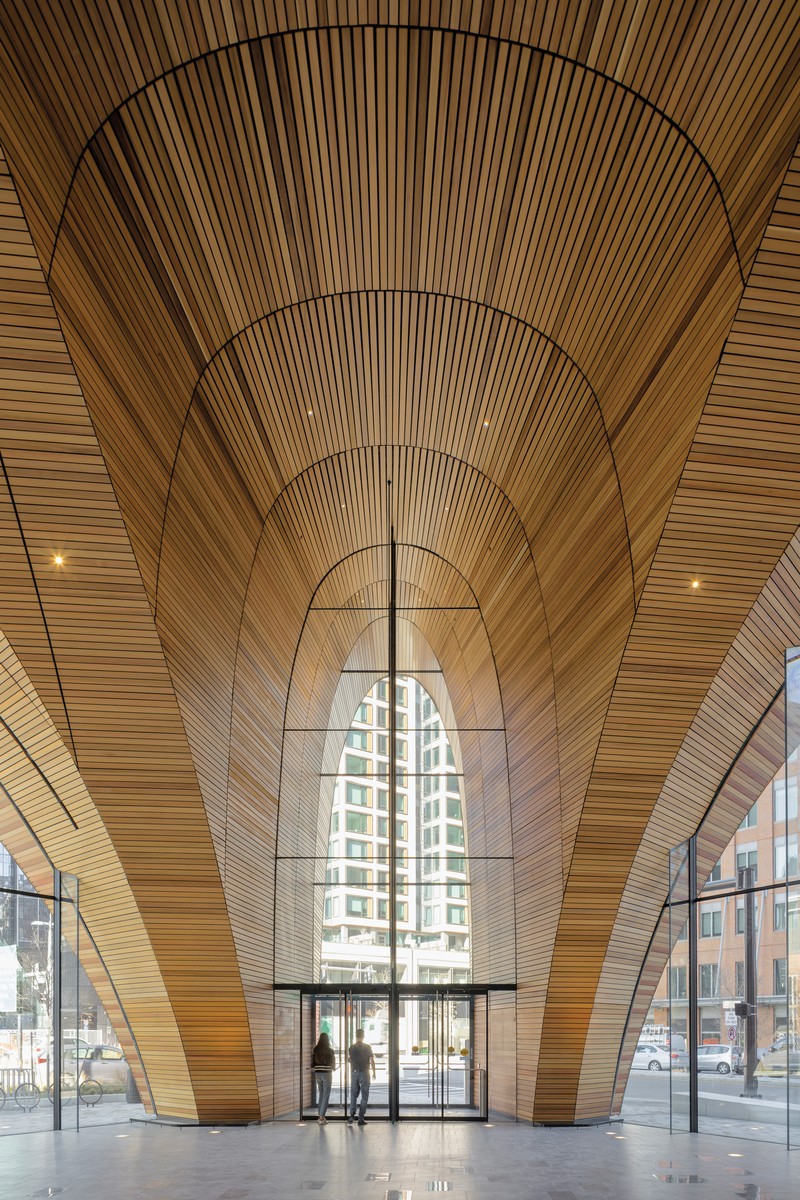
Photo © Michael Grimm
Steel-trussed arches are concealed behind the great hall’s curved western red cedar–clad acoustical ceiling.