SELECT AN ARTICLE TO READ MORE
What’s in a (Firm’s) Name?
Recent starchitect deaths—and fresh lawsuits—have stirred up discussion about legacy, succession, and smart business practices, writes Chris Foges.

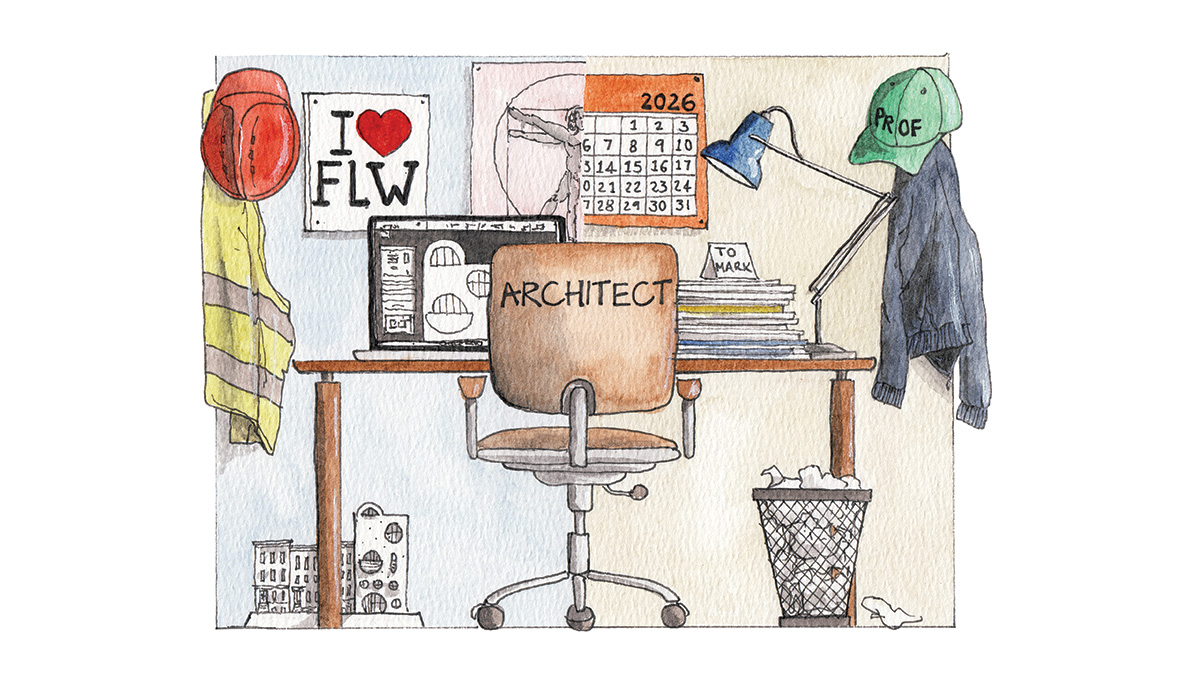
Illustration by Anna Gibb

One bright morning this past March, exactly 10 years after the unexpected death of Zaha Hadid, guests gathered for the unveiling of a stone-carved signpost at a Milan street renamed in her honor. Tributes were paid by trustees of the charitable Zaha Hadid Foundation (ZHF), which she established in 2013 to conserve her work. The anniversary was also marked by a grand fête for her friends at London’s Serpentine Gallery, where a heartfelt speech on how she continues to inspire was given by Patrik Schumacher, principal of Zaha Hadid Architects (ZHA). Though these commemorations illustrate their complementary spirit, there has been no friendly coordination between Hadid’s firm and her foundation, which have been in bitter and near-constant dispute for the past decade.
It’s a situation that carries lessons for practices planning leadership succession. Multiple court cases pitting ZHA against ZHF have aired sensitive issues many firms grapple with internally: what long-term obligations founders feel toward their staff; the nature of architectural authorship; and the ways reputations are safeguarded, or exploited.
When Hadid died, she left an estate worth around $127 million (when adjusted for inflation). She had instructed that the firm should go to its staff and, after much legal wrangling between executors (including Schumacher), it is now owned in trust for the benefit of employees. The foundation, which preserves her archive and continues her legacy through education and public programs, inherited the lion’s share of Hadid’s remaining assets, including Miami real estate and her distinctive wardrobe. But it also inherited something arguably far more valuable—the rights to her name, the issue at the crux of ZHA and ZHF’s latest legal battle.
The agreement in place at the time of Hadid’s death, at the age of 65, licensed the trademark to the firm in exchange for 6 per-
cent of its global net income. Between 2018 and 2024, that portion totaled around $27 million—a contribution the firm says is unsustainable, and was only meant to supply Hadid with a source of income during her lifetime. ZHF disputes this claim, arguing that the “indefinite” arrangement was indeed intended to be permanent. In 2025, ZHA went to court to challenge this contract, which gave it no option to quit, and lost. In February, however, it appealed and won.
“Can it sensibly be said,” asked the judge, “that the parties intended the company to be bound to associate itself with and to promote Dame Zaha’s architectural identity in 100 years’ time?”
In principle ZHA is now free to change its name, though it doesn’t really want to. For now, at least, Hadid’s image is integral to its brand and the firm insists that her work remains the wellspring for the parametric style it champions. Instead, ZHA will aim to renegotiate its license.
Although neither the firm nor foundation would formally comment on the matter, citing the ongoing legal deliberations, just before press time ZHF sought to take its case to the U.K.’s highest court of appeal. There could yet be another twist in the tale.
This conflict illustrates the general need to carefully align concerns regarding legacy with those pertaining to future business interests, when preparing for succession. It’s a vexed subject. Some founders are uncomfortable attaching their own names to work they won’t control. Their successors, meanwhile, are often keen to preserve brand equity built up, in part, by their own efforts.
The late Richard Rogers certainly had such questions in mind as far back as the 1980s, when beginning to think about his own succession. He established a charitable foundation to assume ownership of his practice, which in 2007 rebranded as Rogers Stirk Harbour to reflect the appointment of two young codirectors. In 2022, just one year after he died at 88, and two years after Rogers’s formal retirement, the firm was rechristened RSHP—removing the founder’s name within the timeframe stipulated by its governing constitution.
“There haven’t been many good second-generation practices,” says director Graham Stirk. “Richard always cited the example of Frank Lloyd Wright as a reason why he wanted his name removed.”
RSHP’s leaders did in fact decline an opportunity to retain Rogers’s name for a fee, Stirk elaborates, and instead looked for a new identity that subtly evokes the firm’s history. Rogers’s initial recognizes his role in establishing the parent charity, while the other names were also abbreviated to emphasize a collective ethos.
“The practice actually belongs to no one,” says Stirk, adding that the impersonal acronym prepares the way for the next generation of leaders. “It signals that there isn’t a complete blockage at the top. When I leave, I leave; I don’t need to mark my territory like a dog.”
Naming was also intensively debated in succession planning at Robert A.M. Stern Architects. Long before Stern’s death last year, at the age of 86, his partners argued that the firm should adopt the additional sobriquet RAMSA to reduce the focus on any one individual. “Bob struggled with it because he liked the personal aspect, and referred disparagingly to firms with names ‘like radio stations,’ ” says partner Graham Wyatt. “But he did come to understand the benefit.” ...continue article.
By the Numbers
Jacob Reidel asks if America has too many architects and explores who counts as one.

Illustration by Anna Gibb
According to the most widely cited sources, there are roughly 120,000 architects in the United States today—about the population of Hartford, Connecticut. All of America’s architects could fit into the single Brooklyn neighborhood of Bushwick (120,747). Compare this to the number of physicians and surgeons (839,000), lawyers (864,800), or software developers (1,895,500), as estimated by the U.S. Bureau of Labor Statistics (BLS), and one begins to realize that, in the grand scheme of things, there aren’t that many architects in America. Consider the European Union, which has a total population only 32 percent greater than the U.S., but—according to estimates published by the Architects’ Council of Europe—has 380 percent more architects than America (Italy alone, with a population one-fifth the size of the U.S., has 152,000 architects). So how many do we need?
The BLS projects 4 percent growth in the number of architecture jobs from 2024–34, meaning that it views architecture as a relatively stable occupation, growing at roughly the same rate as the overall U.S. labor market. Let’s consider how many architects we have. That 120,000 figure is based on three primary sources. The BLS reports that in 2024 there were 123,600 jobs classified as “architect.” The National Council of Architectural Registration Boards (NCARB) reports roughly 116,000 licensed architects. Meanwhile, economists at the American Institute of Architects (AIA) estimate between 120,000 and 130,000 architectural staff working in private practice.
These figures appear to converge, but they are derived by different methodologies and represent different things—jobs, licenses, and staff. The BLS counts employer-reported job titles and projects demand by extrapolating industry growth patterns. NCARB aggregates licenses. The AIA estimates firm-based employment through surveys. That these totals are similar raises a question: When we count architects, who are we actually counting?
As architect and scholar of architectural practice, Georgia Tech’s professor emeritus George Barnett Johnston observes, the distinction between architects and draftspersons “evaporated from the culture of U.S. architectural practice in the decades following World War II, both in discourse and in the denomination of work,” even as the underlying division of labor remained. Today, that structure persists, he says. Separately, the BLS counts more than 110,000 “architectural and civil drafters,” many of whom perform work that overlaps with that of architects. AIA surveys suggest that 35 to 40 percent of architectural staff are not licensed. And NCARB records nearly 40,000 individuals actively pursuing licensure—who aren’t captured in the organization’s total figure—many already working in firms. These categories overlap but do not align. What appears to be agreement between totals is, in reality, a reflection of how loosely the term “architect” is defined in labor estimates.
As the definition expands from licensed practitioner to the broader field of architectural labor, the apparent size—and purpose—of the profession changes dramatically. One way to cut through this ambiguity is to shift the question. Instead of asking how many licensed architects or job-titled architects there are, consider a broader category: individuals trained as spatial designers—graduates of architecture programs with the unique skills and outlook associated with the discipline. By this definition, the population is clearly larger than the roughly 120,000 counted in official statistics. The National Architectural Accrediting Board (NAAB) reports more than 33,000 students currently enrolled in accredited programs. (Note that these figures exclude the substantial number of students enrolled in nonaccredited four-year B.A. or B.S. architecture programs.) Roughly 6,000 to 7,000 students graduate from accredited programs each year, and the vast majority—between 84 and 90 percent—report being employed within a year in “a field for which the program prepared them.”
At first glance, this suggests strong and stable demand. But, as Marta Gutman, dean of the City College of New York’s Spitzer School of Architecture, notes, schools often lack precise data on where graduates go, relying instead on informal networks and anecdotal evidence. What is clear to dean Gutman is that City College’s architecture graduates disperse widely—not only into architecture firms but across graphic design and communications, urban design, government, construction, and other fields. Renée Cheng, who leads Arizona State University’s Herberger Institute for Design and the Arts—which contains one of the largest architecture programs in the country, totaling over 1,500 undergraduate B.S.-in-architecture students and 470 M.Arch. students—observes that “a large number” of graduates do not become practicing architects at all, and sees this not as a failure but as evidence that architectural education provides a generally applicable form of training. ...continue article.
Restricted Access
Diana Budds probes the heightened challenges facing foreign nationals hoping to work or study in the U.S.

Illustration by Anna Gibb
“People are scared to death,” says a human resources director at a large architecture firm based in New York State. What she’s referring to are the effects of the Trump Administration’s anti-immigrant policies. “We had somebody at an airport getting ready to leave the country to go visit family, and he wondered, ‘Should I get on this plane or not?’ And the answer is, ‘We don’t know,’ ” she continues. Another source, Zarith Pineda, the founder of the design collective Territorial Empathy, hasn’t been able to reach one of her most trusted subcontractors, who is an immigrant, for months. “It’s already difficult to be a practitioner,” Pineda says. “But when your coworkers and your collaborators disappear, it brings another level of complexity.”
Between travel bans, expanded ICE activity, and new and constantly evolving visa restrictions, U.S. immigration policy has become increasingly inscrutable since President Trump began his second term. And architecture is suffering consequences. It’s too early to ascertain the full effects of these policies, but the immediate impacts have included more precariousness for architects and architecture students who are foreign nationals, significantly higher immigration-related administrative expenses for firms, and a culture of fear that is changing the way offices, institutions, and jobsites operate.
According to another large U.S.-based practice, one of the most disruptive changes is longer, and unpredictable, visa-processing times. (The new headline-grabbing $100,000 H-1B visa fee announced in late 2025 applies to people residing outside the U.S. who are first-time petitioners; the firm mostly hires foreign nationals who are already in the country, either as students or who are employed at another firm.) It now takes between eight and nine months on average to obtain an H-1B visa, which is for workers with specialized knowledge—if the application is processed at all. Because of this, paying premium processing fees, which cost around $3,000 per application, has become compulsory. Significantly higher immigration-related expenses have followed. In 2025, the firm spent $432,000 on these costs, a 68 percent increase from 2024 and a nearly fourfold increase from 2020.
The firm employs 136 people on visas, some of whom are from countries on the Trump Administration’s travel-ban list. The Department of Homeland Security has halted visa processing for all applicants from these countries. An HR manager from the firm says they’re still submitting renewals but have no idea if they will be granted before the employees’ current visas expire and the grace period for legal employment (240 days from expiration) ends. “I’m hoping by then the halt will be lifted, but we just don’t have enough information right now,” she says. When it can, the firm has begun to relocate employees experiencing visa trouble so they can keep their jobs. Last year, the HR representative found positions in international offices for 10 students who didn’t make the H-1B lottery (last year, the firm sponsored 37 visas but only nine people were selected through the lottery) as well as an employee who lost their temporary protected status. “One of my concerns is, in the future I may not be able to find as many places for folks that run out of time in the U.S.,” she says.
American Institute of Architects president Illya Azaroff says the organization is “closely monitoring” new policies. “Architecture is a global profession,” he says. “Firms rely on the ability to recruit and retain talented individuals from all around the world, and schools depend on international students and faculty to sustain both enrollment and the exchange of vibrant, new ideas that drive innovation.”
Before the Trump Administration’s changes in policy, it was difficult for foreign nationals to find sponsors for their visas and make it through the lottery. Now, a new weighted system for awarding H-1B visas, which prioritizes higher-earning applicants, is making it even harder for architects, who earn significantly less than lawyers, doctors, and engineers. A Tier I worker (where early-career architects would fall) has a 15.9 percent chance of being selected, while someone in Tier IV has a 61 percent chance. In 2024, 10 percent of H-1B visas went to people working in architecture. One architect who came to the U.S. on a student visa and now works in business development and marketing at a large Chicago firm says she experienced more difficulty finding potential employers to sponsor her H-1B visa than her friends who work in tech. She knows five people in architecture—recent graduates and early-career professionals—who chose to return to their home countries last year instead of building their careers in the U.S. “They’re like, ‘It’s too much to deal with. It’s not worth it,’ ” she says. ...continue article.