All photos courtesy of W.R. Meadows
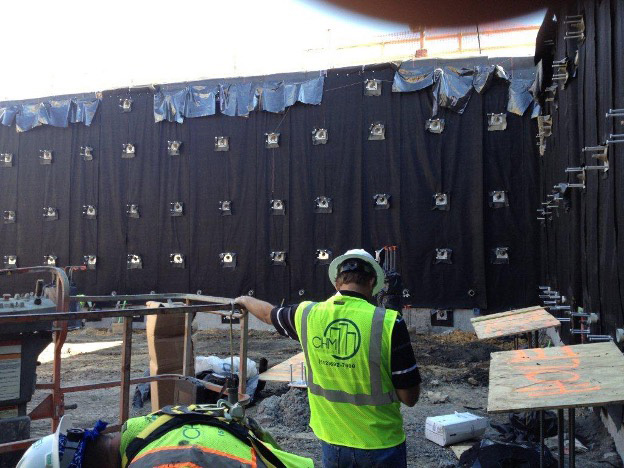
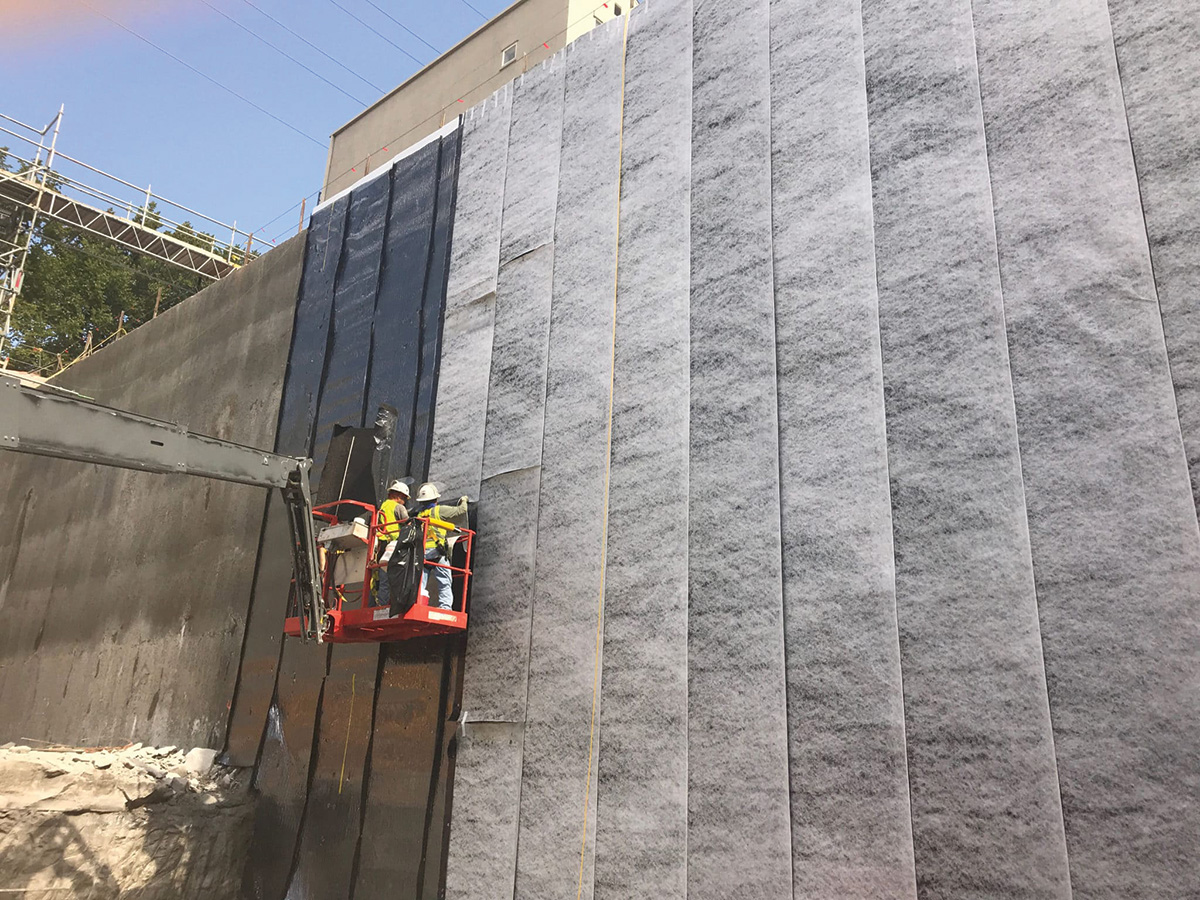
Quality assurance in waterproofing is critical to the success of the entire project. In this image, a pre-applied waterproofing membrane designed for blindside and underslab applications where access to the positive side is limited is applied. This particular specification prevents water migration, moisture intrusion, and the infiltration of gases such as methane and radon.
Moisture is found in some form or another on every building site. The difference between a satisfied owner and a “problem” project is how the design team, manufacturer, contractors, and installers deal with that moisture.
To do that, waterproofing is essential. But since there are so many application types available, choosing the right method is a complex decision. Factors such as geographical location, hydrostatic pressure, and temperature limitations play a significant role in determining the most appropriate waterproofing system. Additionally, and critical to waterproofing, are all the products used in combination to create an integrated system.
It is this system that ensures the project will have complete control of moisture migration.
FOUNDATIONAL DEFINITIONS
What Is Waterproofing?
Moisture is a primary cause of failure in assemblies. Bulk liquid water transports moisture at the greatest rates, as experienced in events like flooding due to exterior or interior sources. The absorption and transport of liquid water through the unobstructed spaces of a porous medium, such as wood or concrete, is known as liquid capillarity. This is more commonly referred to as “wicking” and is another significant moisture transport mechanism. Air-transported water vapor can also be an important conveyance mechanism; it can both act across layers of an assembly as a leak, for example, warm humid interior air leaking into a cavity and condensing on a cold surface in winter, or within a layer. Interlayer transport can look like convective looping of air from one side of an insulated cavity to another, transporting moisture. Vapor diffusion is the slowest-acting mechanism. However, vapor diffusion can still cause failures if excess wetting or inadequate drying occurs.1
Waterproofing is crucial for several reasons: to maintain structural integrity, to prevent water damage, and to prevent issues from mold and mildew. Water can seep through the soil and infiltrate walls, foundations, and other portions of a structure, causing damage over time. Waterproofing helps maintain the building element’s structural integrity and ensures that it remains stable and functional. Without proper waterproofing, water can seep through, causing erosion and potentially damaging the structure itself or nearby structures. Waterproofing prevents this water damage and protects your property. Water infiltration can also lead to the growth of mold and mildew, which can cause health issues and damage to structures.
Waterproofing and moisture control products, when used in proper combination as a system, ensure protection against moisture migration in all its forms. To begin decision making, it is helpful to clarify terminology. A starting point is differentiating between “above-grade” and “below-grade.” As the names suggest, “above-grade” refers to structures or portions of structures that are above the ground level, while “below-grade” pertains to those below the ground level. It is vital to distinguish between these two waterproofing approaches because they demand different protective measures.
Waterproofing systems are primarily applied below-grade. This is because structures below the ground are more susceptible to hydrostatic pressure and moisture ingress, since they are in direct contact with the soil and groundwater. Safeguarding these parts of the building against moisture is crucial to prevent potential damage and maintain the structural integrity of the building. In addition to directly applied waterproofing, it is vital that the design team strategizes all methods to keep liquid water away from the foundation, via measures such as directing runoff away with eavestroughs and downspouts, and proper grading. Adding a drainage system to the wall with a dimpled drainage mat significantly reduces bulk water exposure of the concrete. In addition, control of any rising groundwater with a footing drain system is vital.
However, below-grade portions of a structure are not the only parts of the building that face threats from moisture. Above-grade parts of buildings, which are exposed to air and external environmental factors, require air and moisture barriers. These barriers safeguard the structure from external moisture and temperature variations, and prevent the infiltration of unconditioned air into the building and the exfiltration of conditioned air from the building.
To simplify, while below-grade protections focus on keeping water out, above-grade protections prioritize maintaining the desired indoor environment and ensuring the external facade’s longevity. There are a few unique situations where a design team might need to waterproof above-grade. Examples of these scenarios include roofs or parking garages.
General Application Types
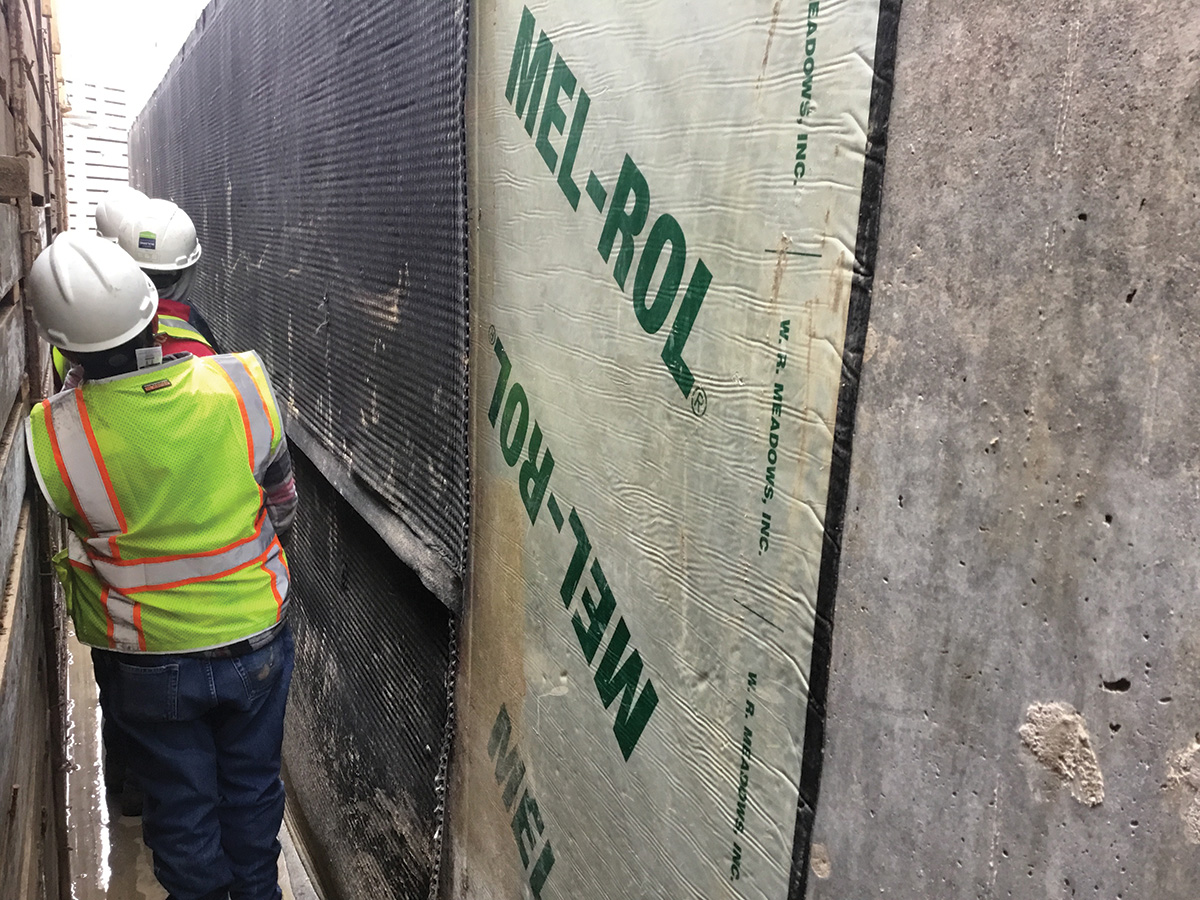
In this application, a roll-applied, self-adhering waterproofing membrane is installed to protect below-grade foundations, walls, and slabs from unwanted water intrusion. The design features a durable, 60-mil membrane that combines a polymeric waterproofing layer with a tough polyethylene carrier film.
Initiating the waterproofing process involves evaluating the structure’s age and accessibility. For new constructions, accessibility is typically not a concern, unless the structure is right on the property line. Therefore, in new construction, waterproofing can be planned and executed with greater ease, and the waterproofing method can be tailored to the specific type of application desired. However, for existing structures, the approach to waterproofing must be adapted based on the level of access available to the targeted areas requiring treatment.
The first application methodology is positive side waterproofing. In this method, the waterproofing membrane is applied to the exterior, or the ‘wet side’, of the concrete. This approach does require access to the outside face of the structure. Positive side waterproofing offers excellent defense against moisture and protects the entirety of internal structural components. All types of cementitious, sheet, and fluid-applied waterproofing systems can be applied with the positive-side.
By contrast, in negative side waterproofing, the waterproofing membrane is applied to the interior, or ‘dry side,’ of the concrete. This interior application method only defends the inner surfaces and is traditionally used only for repairs or when positive side application is no longer feasible due to unavailable or prohibitive exterior access. Cementitious systems are normally best for negative side waterproofing, since these products can withstand hydrostatic pressure and have breathability, which prevents water vapor and debonding from the substrate.
A final approach is blind side waterproofing. This method is particularly used in constrained environments, such as when a new construction is adjacent to an existing structure or property line, making traditional exterior waterproofing impossible. In blind side waterproofing systems, protective layers are applied before the concrete structure is poured. Typically, this involves the use of specialized materials, or lagging materials, that are affixed to the neighboring structure or soil retention system. When the concrete is poured, it adheres to this pre-installed membrane, creating a waterproof barrier that is “blind” or sandwiched between the new wall and the adjacent structure or element. This effectively mitigates moisture infiltration and is activated and sealed as it gets wet, ensuring a dry and protected interior.
Site Considerations
Various other design aspects that are unique to each project should also be considered when determining the best waterproofing system.
The first of these is site conditions. The physical layout of a building site often determines the type of waterproofing required. For instance, in confined spaces where structures are close to property lines, blind side waterproofing becomes a necessity since accessing the exterior for positive side waterproofing becomes impossible.
Furthermore, the site’s hydrostatic pressure is a key factor in choosing a waterproofing method. Systems like bentonite products and elastomeric sheets, which are chemically or heat-welded, are often chosen for their ability to withstand high hydrostatic pressures compared to other systems. Efficient drainage is essential for both vertical and horizontal waterproofing applications. Specific membranes, like hot rubberized asphalt, are suited for low- or no-slope surfaces but are unsuitable for lightweight concrete fill. The incorporation of efficient drainage systems atop the membrane is critical to manage water effectively.
The effectiveness of a waterproofing system can also be influenced by temperature. Some materials and installation techniques are affected by low temperatures, especially those involving solvents, adhesives, and sealants. It’s crucial to adhere to the manufacturer’s guidelines on temperature constraints to ensure the effectiveness of the waterproofing application.
The waterproofing system generally does not impact the structural integrity of a building. However, additional considerations, such as load-bearing capacity and adaptability to various weather conditions, are essential when dealing with green roofs and plaza decks.
Compliance with building codes is mandatory, and these codes often dictate the minimum required waterproofing systems, especially in areas prone to hydrostatic pressures. In most instances, enhancing a building’s thermal performance necessitates the incorporation of insulation into the waterproofing system. Insulation materials should be chosen based on their ability to resist water absorption, especially for below-grade applications.
Attention to detail is paramount in the waterproofing process, especially at penetrations, joints, and transitions.
In blind side systems, particular care is needed due to the complexity of installation and the potential for water intrusion at specific points. Most leaks occur at penetrations, cracks, and joints. Addressing these areas effectively is essential. Protecting the reinforcing steel in the concrete wall is also essential to prevent oxidation and further cracking.
Waterproofing Products 101
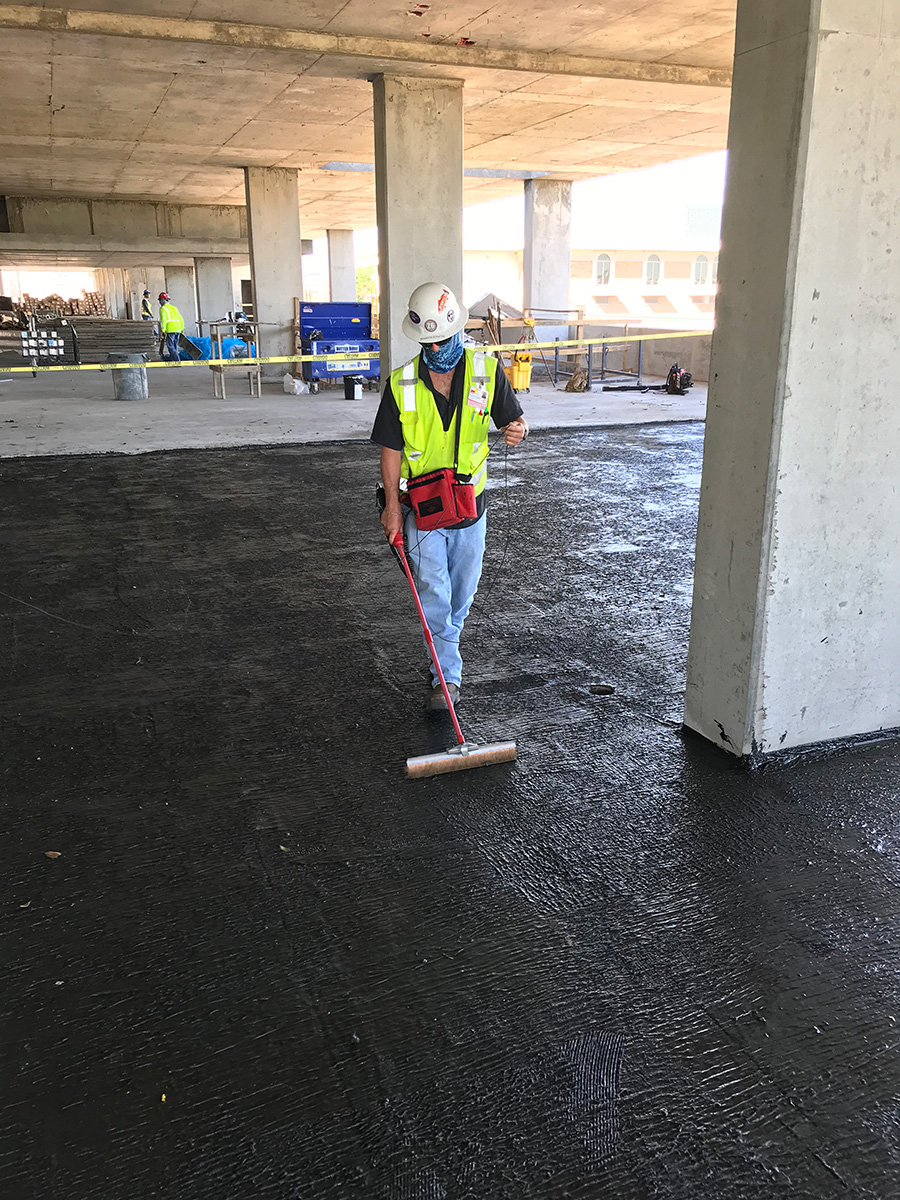
Checking for proper execution of the selected product once installed is crucial to the success of the project.
Waterproofing systems encompass a range of accessories, each playing a vital role in fortifying a structure against moisture intrusion. Essential components include primers, drainage sheets, protection layers, and membranes.
Waterproofing system primers prepare the concrete surface, ensuring optimal adhesion for subsequent waterproofing layers. These are specialized coatings that enhance adhesion and ensure a strong bond between the substrate and the waterproofing system.
Drainage boards, or sheets, are essential for efficient water management in both vertical and horizontal applications. These offer not only added protection but also facilitate the proper flow of water away from the structure, preventing potential damage. Installing proper drainage systems, such as weep holes, perforated pipes, or drainage mats, can help to manage water infiltration and reduce the hydrostatic pressure on the structure. These systems are to be used in conjunction with other waterproofing methods to provide an effective waterproofing system.
All photos courtesy of W.R. Meadows
Quality assurance in waterproofing is critical to the success of the entire project. In this image, a pre-applied waterproofing membrane designed for blindside and underslab applications where access to the positive side is limited is applied. This particular specification prevents water migration, moisture intrusion, and the infiltration of gases such as methane and radon.
Moisture is found in some form or another on every building site. The difference between a satisfied owner and a “problem” project is how the design team, manufacturer, contractors, and installers deal with that moisture.
To do that, waterproofing is essential. But since there are so many application types available, choosing the right method is a complex decision. Factors such as geographical location, hydrostatic pressure, and temperature limitations play a significant role in determining the most appropriate waterproofing system. Additionally, and critical to waterproofing, are all the products used in combination to create an integrated system.
It is this system that ensures the project will have complete control of moisture migration.
FOUNDATIONAL DEFINITIONS
What Is Waterproofing?
Moisture is a primary cause of failure in assemblies. Bulk liquid water transports moisture at the greatest rates, as experienced in events like flooding due to exterior or interior sources. The absorption and transport of liquid water through the unobstructed spaces of a porous medium, such as wood or concrete, is known as liquid capillarity. This is more commonly referred to as “wicking” and is another significant moisture transport mechanism. Air-transported water vapor can also be an important conveyance mechanism; it can both act across layers of an assembly as a leak, for example, warm humid interior air leaking into a cavity and condensing on a cold surface in winter, or within a layer. Interlayer transport can look like convective looping of air from one side of an insulated cavity to another, transporting moisture. Vapor diffusion is the slowest-acting mechanism. However, vapor diffusion can still cause failures if excess wetting or inadequate drying occurs.1
Waterproofing is crucial for several reasons: to maintain structural integrity, to prevent water damage, and to prevent issues from mold and mildew. Water can seep through the soil and infiltrate walls, foundations, and other portions of a structure, causing damage over time. Waterproofing helps maintain the building element’s structural integrity and ensures that it remains stable and functional. Without proper waterproofing, water can seep through, causing erosion and potentially damaging the structure itself or nearby structures. Waterproofing prevents this water damage and protects your property. Water infiltration can also lead to the growth of mold and mildew, which can cause health issues and damage to structures.
Waterproofing and moisture control products, when used in proper combination as a system, ensure protection against moisture migration in all its forms. To begin decision making, it is helpful to clarify terminology. A starting point is differentiating between “above-grade” and “below-grade.” As the names suggest, “above-grade” refers to structures or portions of structures that are above the ground level, while “below-grade” pertains to those below the ground level. It is vital to distinguish between these two waterproofing approaches because they demand different protective measures.
Waterproofing systems are primarily applied below-grade. This is because structures below the ground are more susceptible to hydrostatic pressure and moisture ingress, since they are in direct contact with the soil and groundwater. Safeguarding these parts of the building against moisture is crucial to prevent potential damage and maintain the structural integrity of the building. In addition to directly applied waterproofing, it is vital that the design team strategizes all methods to keep liquid water away from the foundation, via measures such as directing runoff away with eavestroughs and downspouts, and proper grading. Adding a drainage system to the wall with a dimpled drainage mat significantly reduces bulk water exposure of the concrete. In addition, control of any rising groundwater with a footing drain system is vital.
However, below-grade portions of a structure are not the only parts of the building that face threats from moisture. Above-grade parts of buildings, which are exposed to air and external environmental factors, require air and moisture barriers. These barriers safeguard the structure from external moisture and temperature variations, and prevent the infiltration of unconditioned air into the building and the exfiltration of conditioned air from the building.
To simplify, while below-grade protections focus on keeping water out, above-grade protections prioritize maintaining the desired indoor environment and ensuring the external facade’s longevity. There are a few unique situations where a design team might need to waterproof above-grade. Examples of these scenarios include roofs or parking garages.
General Application Types
In this application, a roll-applied, self-adhering waterproofing membrane is installed to protect below-grade foundations, walls, and slabs from unwanted water intrusion. The design features a durable, 60-mil membrane that combines a polymeric waterproofing layer with a tough polyethylene carrier film.
Initiating the waterproofing process involves evaluating the structure’s age and accessibility. For new constructions, accessibility is typically not a concern, unless the structure is right on the property line. Therefore, in new construction, waterproofing can be planned and executed with greater ease, and the waterproofing method can be tailored to the specific type of application desired. However, for existing structures, the approach to waterproofing must be adapted based on the level of access available to the targeted areas requiring treatment.
The first application methodology is positive side waterproofing. In this method, the waterproofing membrane is applied to the exterior, or the ‘wet side’, of the concrete. This approach does require access to the outside face of the structure. Positive side waterproofing offers excellent defense against moisture and protects the entirety of internal structural components. All types of cementitious, sheet, and fluid-applied waterproofing systems can be applied with the positive-side.
By contrast, in negative side waterproofing, the waterproofing membrane is applied to the interior, or ‘dry side,’ of the concrete. This interior application method only defends the inner surfaces and is traditionally used only for repairs or when positive side application is no longer feasible due to unavailable or prohibitive exterior access. Cementitious systems are normally best for negative side waterproofing, since these products can withstand hydrostatic pressure and have breathability, which prevents water vapor and debonding from the substrate.
A final approach is blind side waterproofing. This method is particularly used in constrained environments, such as when a new construction is adjacent to an existing structure or property line, making traditional exterior waterproofing impossible. In blind side waterproofing systems, protective layers are applied before the concrete structure is poured. Typically, this involves the use of specialized materials, or lagging materials, that are affixed to the neighboring structure or soil retention system. When the concrete is poured, it adheres to this pre-installed membrane, creating a waterproof barrier that is “blind” or sandwiched between the new wall and the adjacent structure or element. This effectively mitigates moisture infiltration and is activated and sealed as it gets wet, ensuring a dry and protected interior.
Site Considerations
Various other design aspects that are unique to each project should also be considered when determining the best waterproofing system.
The first of these is site conditions. The physical layout of a building site often determines the type of waterproofing required. For instance, in confined spaces where structures are close to property lines, blind side waterproofing becomes a necessity since accessing the exterior for positive side waterproofing becomes impossible.
Furthermore, the site’s hydrostatic pressure is a key factor in choosing a waterproofing method. Systems like bentonite products and elastomeric sheets, which are chemically or heat-welded, are often chosen for their ability to withstand high hydrostatic pressures compared to other systems. Efficient drainage is essential for both vertical and horizontal waterproofing applications. Specific membranes, like hot rubberized asphalt, are suited for low- or no-slope surfaces but are unsuitable for lightweight concrete fill. The incorporation of efficient drainage systems atop the membrane is critical to manage water effectively.
The effectiveness of a waterproofing system can also be influenced by temperature. Some materials and installation techniques are affected by low temperatures, especially those involving solvents, adhesives, and sealants. It’s crucial to adhere to the manufacturer’s guidelines on temperature constraints to ensure the effectiveness of the waterproofing application.
The waterproofing system generally does not impact the structural integrity of a building. However, additional considerations, such as load-bearing capacity and adaptability to various weather conditions, are essential when dealing with green roofs and plaza decks.
Compliance with building codes is mandatory, and these codes often dictate the minimum required waterproofing systems, especially in areas prone to hydrostatic pressures. In most instances, enhancing a building’s thermal performance necessitates the incorporation of insulation into the waterproofing system. Insulation materials should be chosen based on their ability to resist water absorption, especially for below-grade applications.
Attention to detail is paramount in the waterproofing process, especially at penetrations, joints, and transitions.
In blind side systems, particular care is needed due to the complexity of installation and the potential for water intrusion at specific points. Most leaks occur at penetrations, cracks, and joints. Addressing these areas effectively is essential. Protecting the reinforcing steel in the concrete wall is also essential to prevent oxidation and further cracking.
Waterproofing Products 101
Checking for proper execution of the selected product once installed is crucial to the success of the project.
Waterproofing systems encompass a range of accessories, each playing a vital role in fortifying a structure against moisture intrusion. Essential components include primers, drainage sheets, protection layers, and membranes.
Waterproofing system primers prepare the concrete surface, ensuring optimal adhesion for subsequent waterproofing layers. These are specialized coatings that enhance adhesion and ensure a strong bond between the substrate and the waterproofing system.
Drainage boards, or sheets, are essential for efficient water management in both vertical and horizontal applications. These offer not only added protection but also facilitate the proper flow of water away from the structure, preventing potential damage. Installing proper drainage systems, such as weep holes, perforated pipes, or drainage mats, can help to manage water infiltration and reduce the hydrostatic pressure on the structure. These systems are to be used in conjunction with other waterproofing methods to provide an effective waterproofing system.
Protection layers, often composed of materials like protection board or protection fabric, safeguard a waterproofing system from mechanical damage, UV exposure, and other external factors, enhancing its longevity and performance.
Membranes act as the primary barrier against moisture infiltration. General membrane categories include fluid-applied, sheet-applied, hot rubberized, and cementitious, among many other types of membranes, each with its own benefits for different project types. This variety of membrane types allows a design team to tailor waterproofing for specific conditions.
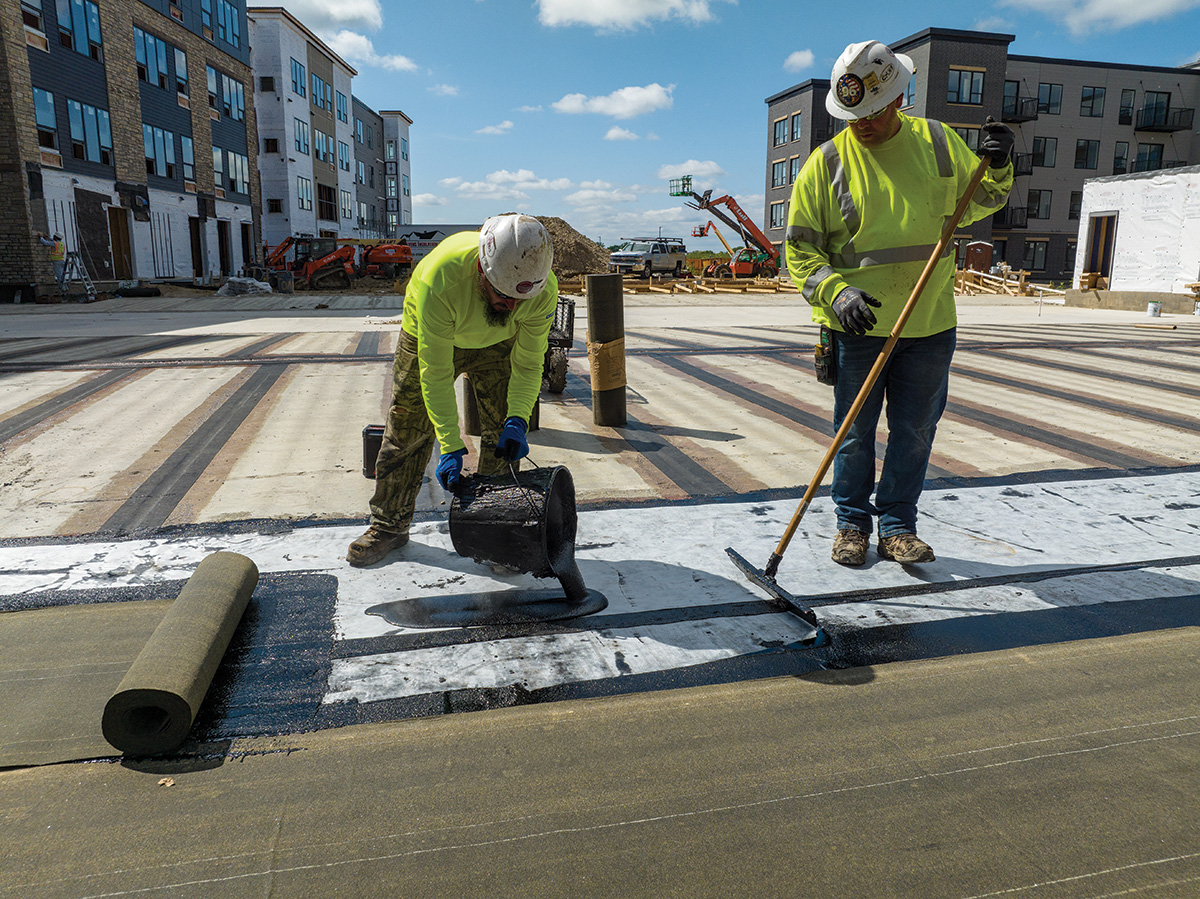
Sheet membrane waterproofing involves pre-formed waterproofing sheets that are adhered to the wall or surface. They provide a durable, water-tight barrier that is easy to install to provide continuity on the wall. This type of waterproofing is ideal for long-term protection of the occupied space and the substrate. Liquid membrane waterproofing involves applying a liquid coating to the surface, creating a seamless, watertight barrier. The waterproofing coatings are flexible and can be applied to a variety of surfaces. Liquid-applied waterproofing is highly dependent upon the expertise of the applicator, and as a result, selected installers should be fully trained in the installation of these types of materials.
Cementitious waterproofing involves the application of a cement-based mixture, as a slurry, to the surface or wall, forming a durable, water-resistant barrier. This method is relatively easy to apply and can be quite effective in certain applications, such as retaining walls. It is particularly well-suited for concrete retaining walls and can be used in conjunction with other waterproofing methods for added protection; however, it may not be as flexible as other methods, making it more susceptible to cracking over time.
Integral waterproofing involves adding a waterproofing agent to the concrete mix used to build the structure.
Bentonite clay is a natural material that swells when wet, creating a watertight barrier. This method is environmentally friendly and provides excellent waterproofing. However, it can be more difficult to apply and may not be suitable for all types of projects.
Critical Standards for Waterproofing
Selecting an effective waterproofing system ultimately must balance various factors, including application type, site conditions, and material properties. Understanding these elements is crucial for a successful waterproofing endeavor that stands the test of time, weather, and environmental conditions.
There are many standards that govern the performance of waterproofing materials, including tests for adhesion, elongation, and tensile strength. Compliance with codes and local requirements is also essential. Proper compliance requires ensuring materials can bridge nonstructural cracks and that the chosen system is tested for hydrostatic pressure. Common standards related to waterproofing include ASTM C836- Standard Specification for High Solids Content, Cold Liquid-Applied Elastomeric Waterproofing Membrane for Use with Separate Wearing Course, ASTM D 5385- Hydrostatic Head Resistance, ASTM E 96- Water Vapor Permeability, ASTM D 412 (Die C)- Tensile Strength, and ASTM D 412 and D 5329- Elongation.
Specifying Responsibility
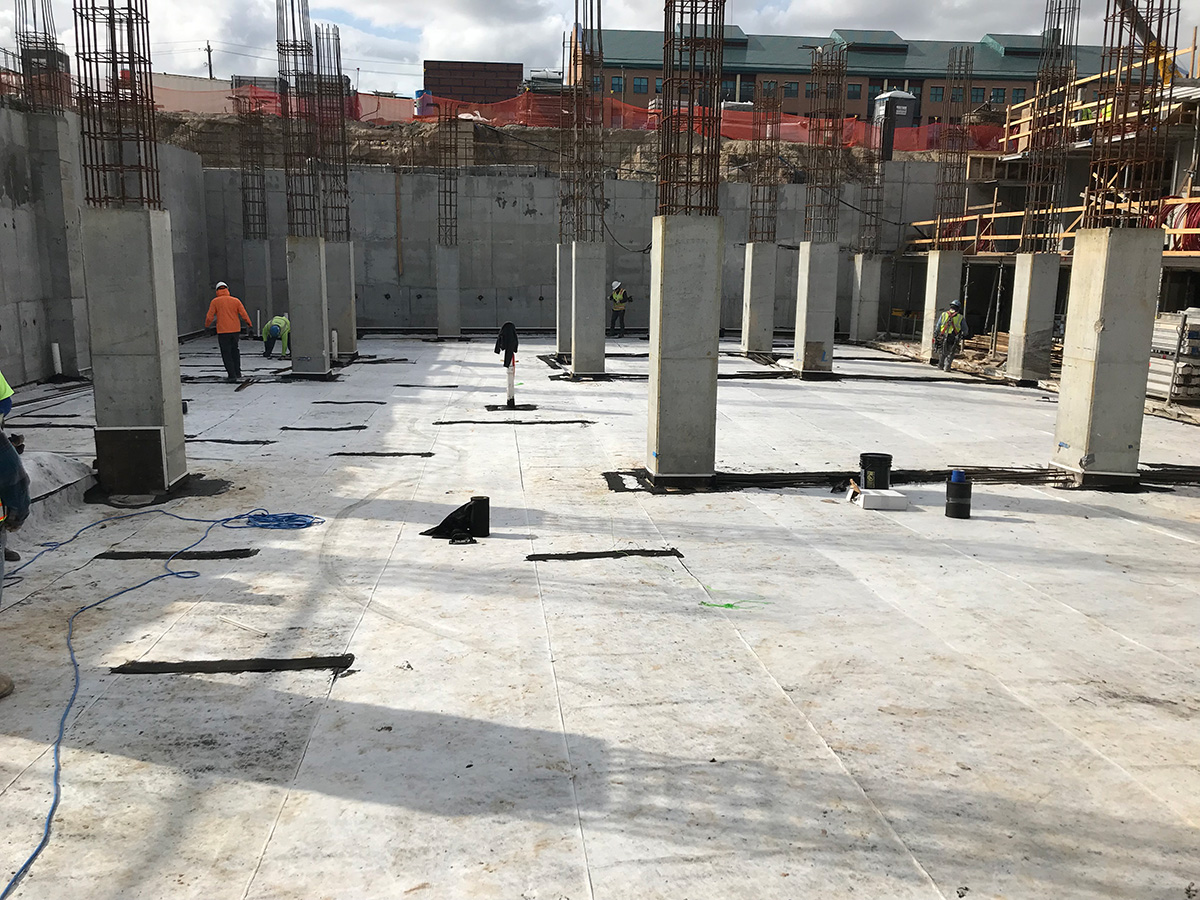
Coordination of details and tie-ins, as well as coordination of trades, is a make-or-break step for waterproofing specification.
The right system choice, complemented by proper design and field inspections, ensures the structural integrity and durability of a new or existing structure. When it comes to protecting concrete structures, not all moisture-related solutions are created equal. Depending on the site conditions, structural use, and exposure levels, it’s critical to select the right approach, whether that’s dampproofing, vaporproofing, or waterproofing. While these terms are often used interchangeably, they serve very different purposes. To ensure comprehensive solutions and expert guidance on a project, collaborating with a quality manufacturer’s representative, who can recommend products for a project’s specific needs, provides optimal protection and longevity to the structure. The manufacturer’s architectural and technical representative can help navigate the many material options and find the optimized solution. Good manufacturers’ representatives help construction professionals navigate these distinctions to guarantee that every structure gets the moisture protection it truly needs.
Setting Accurate Specifications
Construction document review allows the design team to confirm that critical performance criteria have been met and that these performance expectations are clearly written into the specification.
Besides verifying that the selected system is designed to meet expectations, performing a product review with a manufacturer’s representative addresses potential compatibility issues before they occur in the field. For example, many waterproofing membranes contain SBS rubberized asphalt. Rubberized asphalt is not compatible with polyurethane, silicone, and TPO – all ingredients common in many associated products.
Additional details to review within the specification include vertical and horizontal application ability, compatibility with adjacent system materials, and accessibility to terminations and transitions between differing products. Detailing terminations and transitions correctly is critical for the success of the design and the eventual building.
Plans should indicate correct continuity details, including termination. Terminate end laps and top of sheet membrane with approved termination sealant. Anchor the top of the sheet membrane with a termination bar. Where required, detail a drainage board or approved protection course to protect the membrane.
Complex transitions, such as an underslab-to-vertical membrane system, need to have adequate adhesion or anchoring. An example of this situation occurs when a blindside sheet for underslab and a self-adhered sheet for vertical meet. The blindside sheet can be installed on formwork or have an extended tail. It may be necessary to bond the tail to the concrete with appropriate mastic.
Vertical waterproofing to an underslab vapor barrier at the floor level presents a different, complex transition scenario. The tail of the blindside sheet or plastic vapor barrier should be installed to the top of the self-adhered sheet using the appropriate mastic and termination bar. Following backfill to the level of the self-adhered sheet, the installer should lay down the preinstalled tail of the plastic vapor barrier or blindside sheet on grade to tie into the rest of the underslab membrane. No backfill should occur until the tail of the underslab membrane is installed at the top of the self-adhered sheet.
Complex transition scenarios, such as this one, demonstrate the incredible value of partnering with a qualified and knowledgeable manufacturer’s representative to check the process.
Correct waterproofing accessory options should also be specifically called out as required. For example, reinforcement fabric is often required at expansion joints or cracks greater than 1/16 inch, even when using a non-reinforced system. However, adding fabric will reduce the elongation properties of the membrane. Given the change in properties this accessory brings, it serves as a reminder for the design team to consider how the material is expected to perform under specific conditions. Always follow manufacturer guidelines when detailing and specifying reinforcement.
Finally, specifications need to dictate the time and conditions of installation. These are directed by the manufacturer’s representative or product information. Included within the installation instructions should be a UV resistance timeframe for the materials, once installed. It is crucial that the schedule does not leave waterproofing membranes or materials exposed past their UV limitations. Additionally, document language should stress that no backfill occurs until the appropriate protection course is installed.
Preconstruction Steps to Quality Assurance
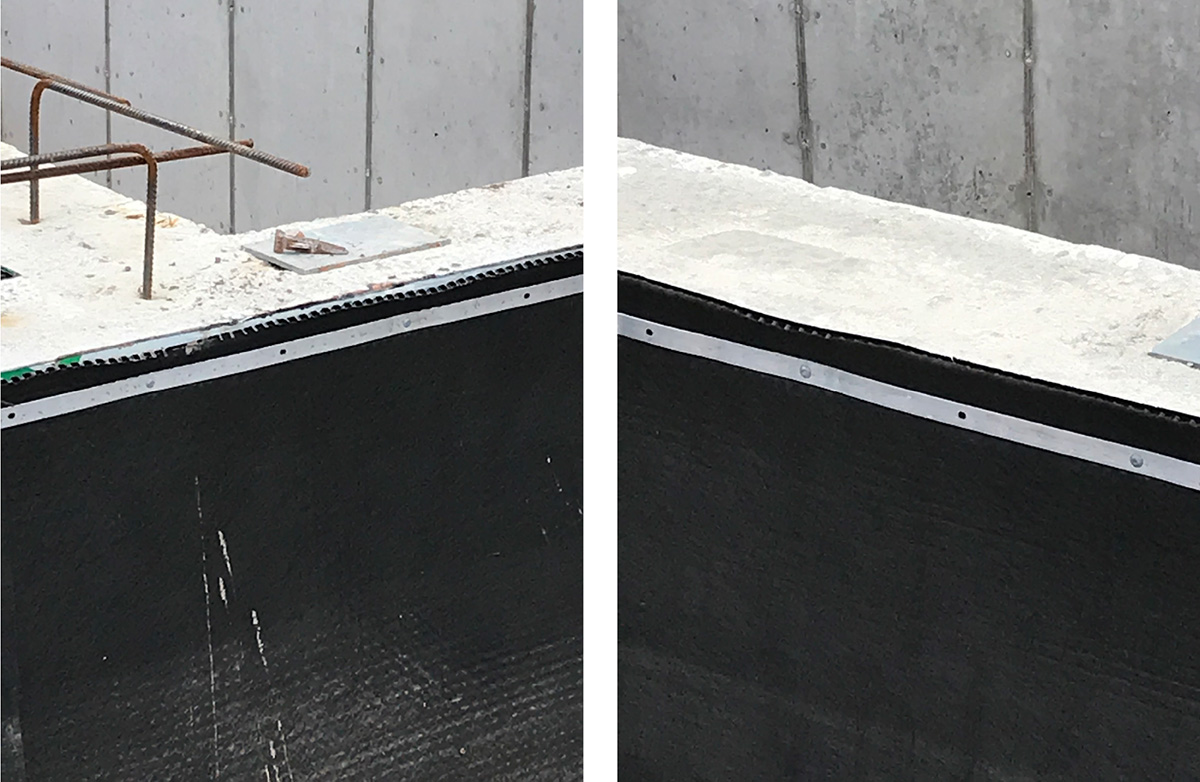
These photos show what anchoring looks like, as opposed to a proper termination. The top of membrane and drainage board must be properly sealed to prevent moisture intrusion and buildup from the top.
Today’s buildings represent a major investment, and that investment deserves the very best protection available. Holding a preconstruction meeting demonstrates commitment to collaboration and ensures that the entire team of architects, engineers, contractors, and distributors can confidently install the selected waterproofing solution as specified. Prevention of issues in the field with products and different trades is priceless.
In Michael Kubal’s reference, Construction Waterproofing Handbook, Kubal cites two key waterproofing principles. The first is the “90%/1% Principle,” which states that “90 percent of all water intrusion problems occur within 1 percent of the total building or structure exterior surface area.” Kubal’s second principle is the “99%/1% Principle,” pertaining primarily to workmanship. Kubal writes that “approximately 99 percent of waterproofing leaks are attributable to causes other than material or system failures.” Kubal explains that, “When considering the millions of square feet of waterproofing systems installed, it can be estimated that only 1% of envelope failures and resulting leakage is actually attributable to materials or systems actually failing. The reasons typically involved in failures include human installation errors, the wrong system being specified for in-place service requirements, the wrong or no primer being used, inadequate preparatory work, incompatible materials being transitioned together, and insufficient or, in certain cases, such as sealants, too much material being applied.”2
Design and installation details are key. The more complex the design, the more challenging the installation. Collaboration before the project begins is particularly critical when multiple trades are responsible for the building envelope. For example, at times the concrete contractor is responsible for the underslab vapor barrier, whereas the waterproofing contractor is responsible for installing the vertical waterproofing membrane. By having a preconstruction meeting, both trades are able to view the transitions before executing them in the field. Another common point for collaboration can occur when two separate moisture-control subcontractors are scheduled, one for waterproofing and one for the air barrier.
Who to Invite?
Preconstruction meetings should include the waterproofing installer, manufacturer’s representative, and any trades that contact waterproofing, concrete, shotcrete, backfill, rebar, and plumbing.
A basic preconstruction meeting for waterproofing should address scheduling, lay the groundwork for communications between trades, delineate responsibilities between multiple trades and in transition areas, and clarify surface preparation requirements. When planning for transition areas, such as the transition between an air barrier and waterproofing, it is important to clarify which trade executes each segment and, if it is possible, to simplify the transition without ambiguity.
Planning Field Observations
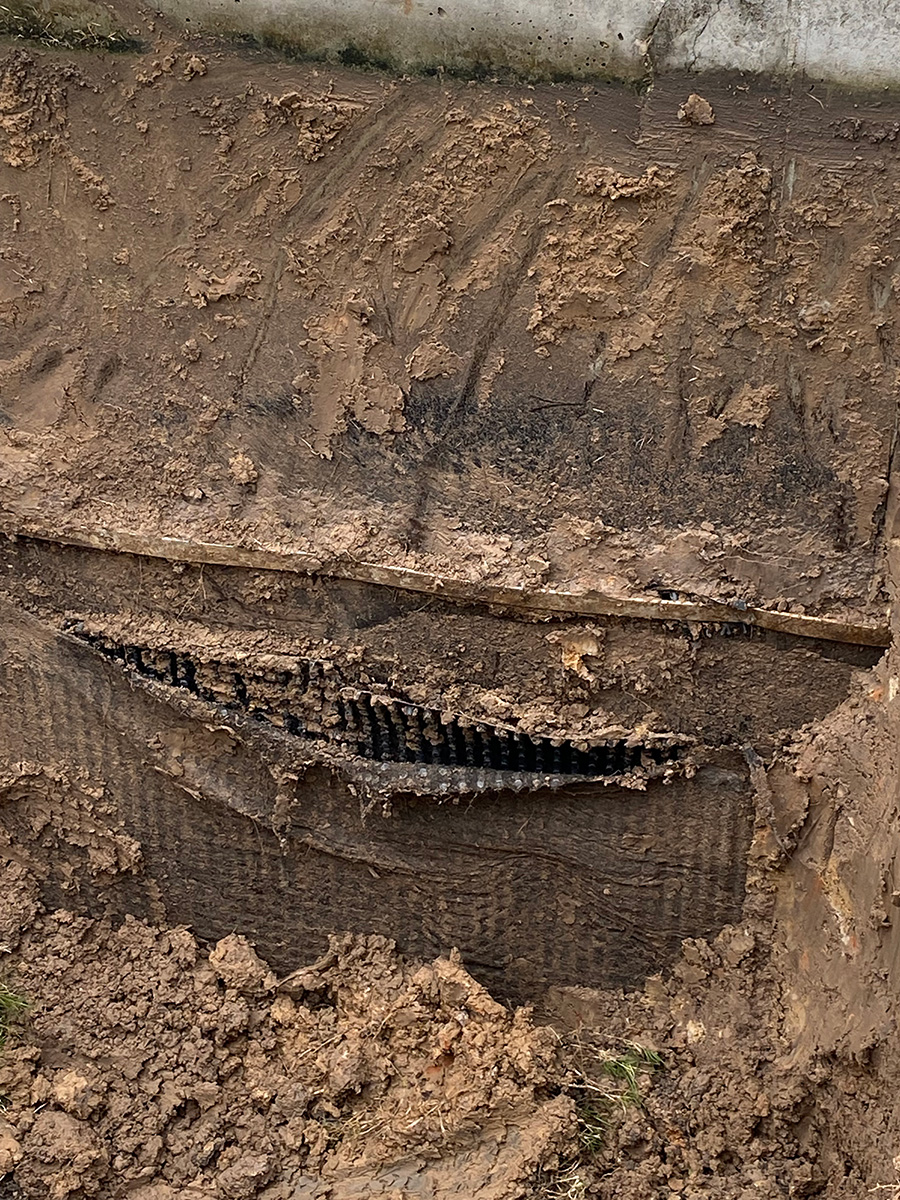
Slow backfill ensures damage prevention to the waterproofing system.
In construction, precision matters. Scheduling field observations helps applicators stay within specifications and gives QA/QC teams documentation that the job was performed correctly. Assigning appropriate timeframes ensures that these visits occur at the necessary junctures for the project. The number of visits from a manufacturer’s representative and third-party building envelope consultant should also be verified and aligned with these scheduled observations.
Especially when working with membranes designed to protect a structure from air and moisture intrusion, knowing what is occurring in the field is crucial. For example, every liquid-applied membrane is engineered to perform within a specific range of dry film thickness once cured. That thickness directly impacts how well the membrane adheres, cures, and ultimately protects the building envelope. When a coating is too thin, the membrane may fail to form a continuous film, creating weak spots or pinholes that compromise the barrier’s integrity. This can result in air or moisture infiltration and, ultimately, system failure. When applied too thickly, the product may cure unevenly, form soft spots, or take longer to dry. Over-application can also reduce yield and increase costs, especially on large-scale projects. The goal is consistency: a uniform, monolithic layer applied according to the manufacturer’s specifications, to ensure proper curing and optimal barrier performance.
On some projects, verifying wet mil thickness of liquid-applied membranes is part of warranty compliance, as manufacturers and inspectors often require proof of proper application. Keeping detailed records of thickness readings helps confirm that product performance expectations have been met. Other waterproofing systems also have documentation requirements to achieve warranty status.
For the manufacturer, accurate application ensures that the product is applied properly and will provide a durable, continuous layer. For the applicator, field observations and QA/QC visits are a small step that prevents rework, reduces waste, and provides peace of mind for the design team, knowing that the installation meets both performance and warranty standards.
Beyond documentation, scheduling field observations and compliance checks has additional benefits. Once applicators become familiar with what correct application and installation looks like, they can better maintain consistency across an entire project. This improves application efficiency and helps optimize material usage. For large-scale installations, that adds up to significant savings without compromising performance.
Consistency in application is the key to durability and protection. A few quick checks in the field can make the difference between a successful project and one that falls short. Precision, consistency, and attention to detail are small steps that separate executing a good job from a great one.
Executing for Success
Proper moisture management and effective sealing of a building can prove to be one of the most effective ways to prolong building life, improve indoor air quality, and dramatically increase the energy efficiency of a structure. When designed and installed correctly, these measures deliver a swift payback to the owner. In addition, many states and other jurisdictions are adopting building codes that address the problems associated with air movement and moisture infiltration.
Appropriate application of the selected waterproofing systems is paramount to the success of the building envelope system. The manufacturer should be consulted for any special installation recommendations to ensure that the product specified and the building to which it is applied will perform to their maximum potential.
When selecting, designing, and installing barrier systems, it is important to choose the best product that meets the needs of the project, the budget, and the anticipated design lifetime. Of equal importance is the quality of the installation.
Details in the Field
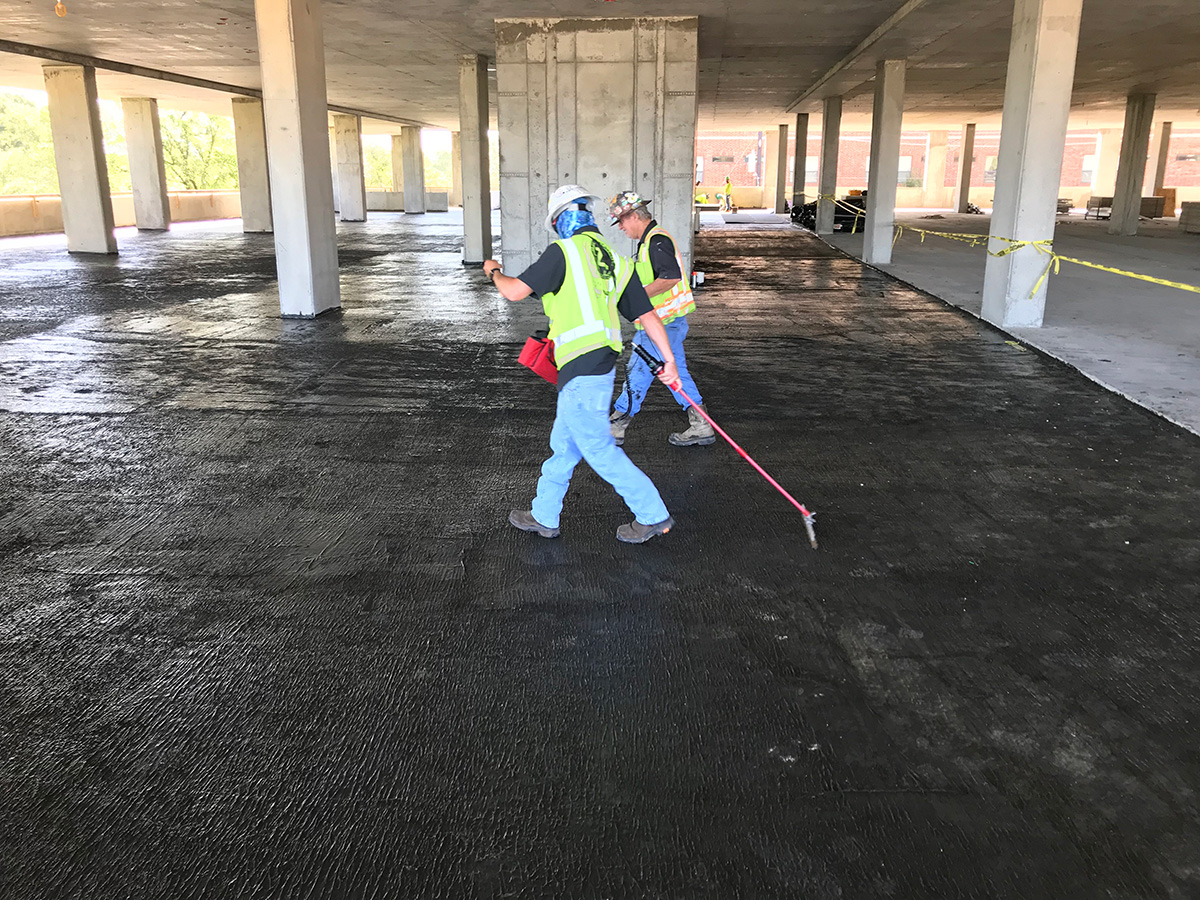
Both execution and continuity are being assessed in this application.
Common problems in the field can be grouped into two broad categories: improper execution issues and continuity issues.
Vital installation pinch points in the field include surface preparation, terminations, product exposure limitations, complex transitions, and the backfill plan.
Resolving surface preparation issues frequently comes down to assigning responsibilities. When waterproofing a concrete wall, the concrete contractors need to ensure that the concrete is consolidated well and confirm that it is placed correctly and precisely where it is supposed to be. The waterproofing contractor then needs to ensure the concrete is clean, void-free, and primed, if needed. If a void is greater than ¼ inch, it must be filled with repair mortar. Dirt and debris will act as a bond breaker, so it is important that the contractor remove any loose mortar before proceeding.
Successful transitions equal successful building envelopes. Unfortunately, most transitions in the field qualify as complex. That means all involved trades will need to review the transitions in a preconstruction meeting. Often, two separate moisture-control sub-contractors may be scheduled, one for waterproofing and one for the air barrier. When a transition between an air barrier and waterproofing is planned, it is critical to identify which trade is responsible for each segment and to simplify the transition, where possible, without ambiguity.
Terminations offer another detail which, if not executed correctly, is a weak point in the design. The design should specify termination of end laps and the top of the sheet membrane with an approved termination sealant. Installers should also anchor the top of a sheet membrane with a termination bar. Anchoring and termination should not be confused. Anchoring systems hold the material in place during construction, often using termination bars, and typically secures the top edge of a membrane. Termination officially ends the system at a safe point, sealing it against water infiltration. Termination specifications refer to the overall detail, including sealant, flashings, and anchoring, that prevent water from getting behind the membrane at its edge.
For example, with an underslab-to-vertical membrane system, a blindside sheet for underslab and a self-adhered sheet for vertical may be specified. The blindside sheet can be installed on formwork or have an extended tail. It may be necessary to bond the tail to the concrete with appropriate mastic. The self-adhered sheet shingles on top of the blindside sheet and is anchored with a termination bar forming the termination detail at the formwork. Vertical waterproofing should then join the underslab vapor barrier at floor level. The tail of the blindside sheet or plastic vapor barrier will be installed to the top of the self-adhered sheet, using an appropriate mastic and termination bar. Following backfill to the self-adhered sheet, the installers should then lay down the preinstalled tail of plastic vapor barrier or blindside sheet on grade to tie into the rest of the underslab membrane. It is critical that subcontractors do not backfill this area until the tail of the underslab membrane is installed at the top of the self-adhered sheet. A drainage board or approved protection course is installed to protect the membrane.
Once a waterproofing system is successfully installed, it is imperative that the schedule and other trades do not allow the membrane to be exposed past its UV limitations. Leaving a product exposed creates alligator cracking, shrinkage, and separation. It also exposes the system to other forms of damage, like cuts or penetrations. Once the protection course is installed, backfill can begin. Slow backfill from the bottom of the wall is the safest method to protect the system.
Obtaining a Warranty
The credentials of the subcontractor are crucial in securing a warranty. Only authorized and trained applicators with experience who have demonstrated their ability to successfully install such products and systems in accordance with published guidelines and specifications of the manufacturer’s waterproofing systems are eligible to apply for and receive a warranty.
The waterproofing system or product warranty term can range between 1 and 20 years, depending on the specification and manufacturer.
Third-party inspection and commissioning offer a valuable opportunity to confirm installation quality in the field and secure a warranty. Taking these steps adds only a nominal cost, particularly when compared to the cost of remediation and litigation in the case of failure.
For something as critical as moisture control and waterproofing, it is an almost priceless advantage for design teams to have trusted manufacturer representatives at their disposal. Throughout the process, from original design conception to commissioning, these representatives can provide options, demonstrate that the design can achieve end goal results, and understand and execute project goals. Manufacturers’ representatives offer a well of valuable information, and collaboration throughout the process equates to ultimate success.
ENDNOTES
Straube, John. “Field Monitoring and Hygrothermal Modeling of Interior Basement and Insulation Systems.” Research Report-0906. Building Science Corporation. September 15, 2009. Accessed April 28, 2026.
Kubal, Michael T. Construction Waterproofing Handbook. Second Edition. McGraw Hill. 2023. ISBN-10: 1265895813.
Amanda Voss, MPP, is an author, editor, and policy analyst. Writing for multiple publications, she has also served as the managing editor for Energy Design Update.