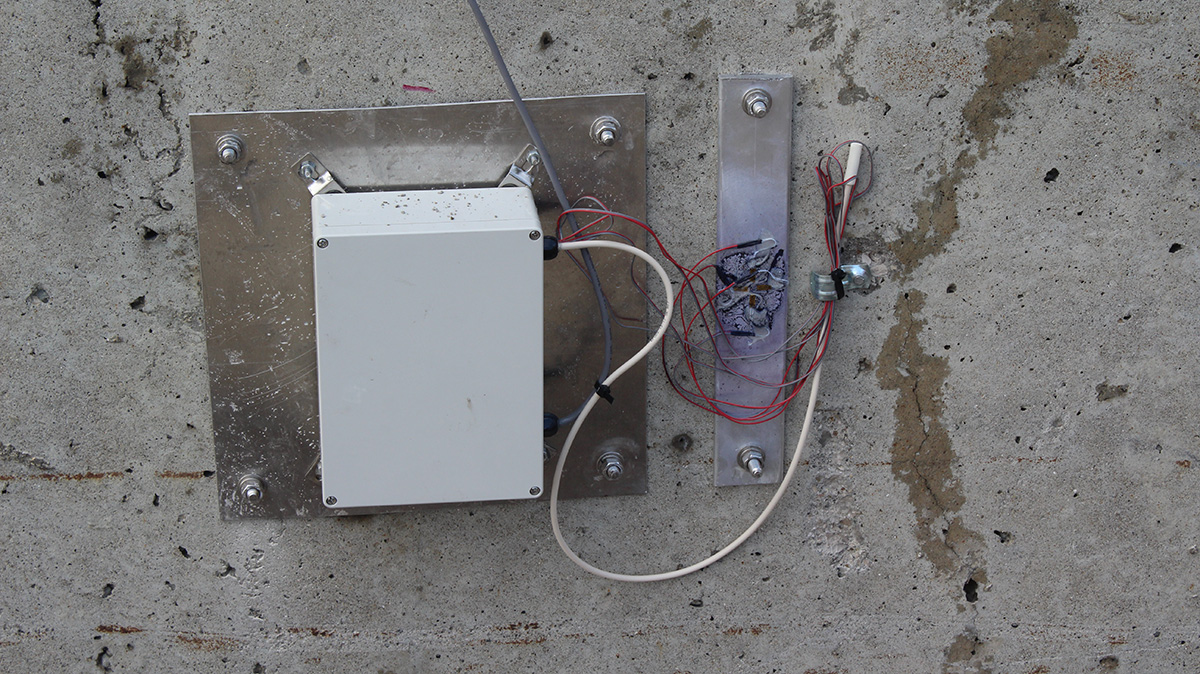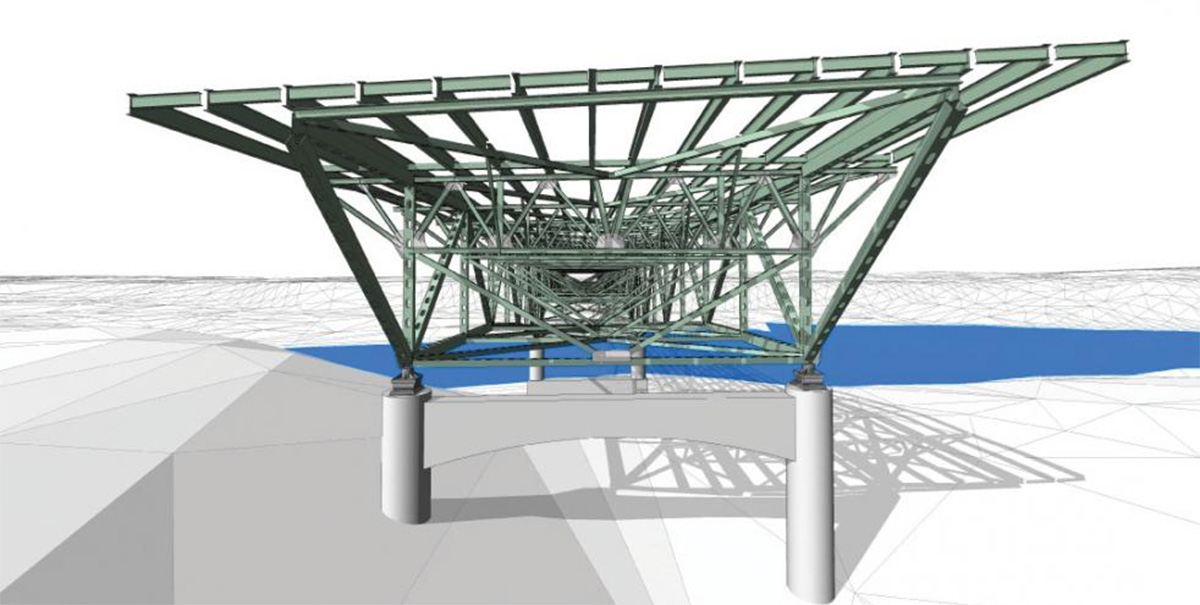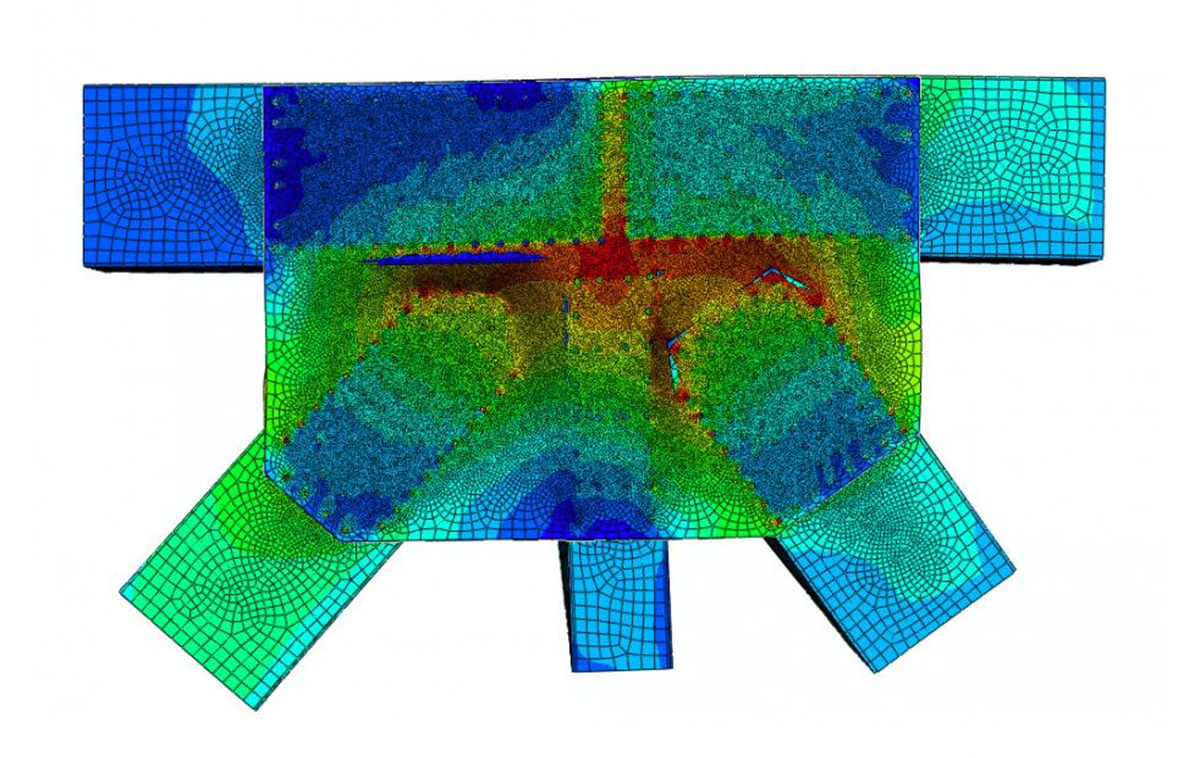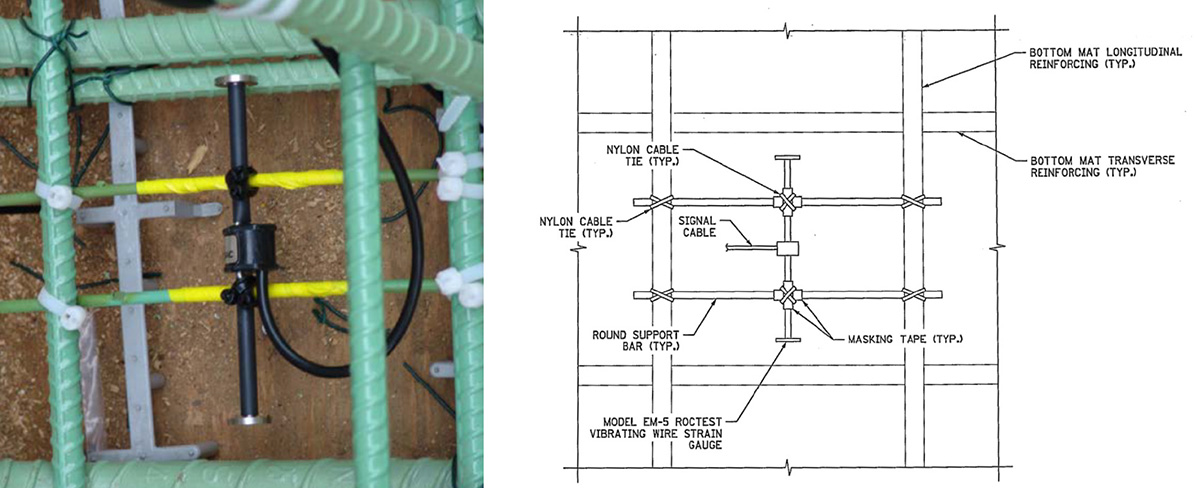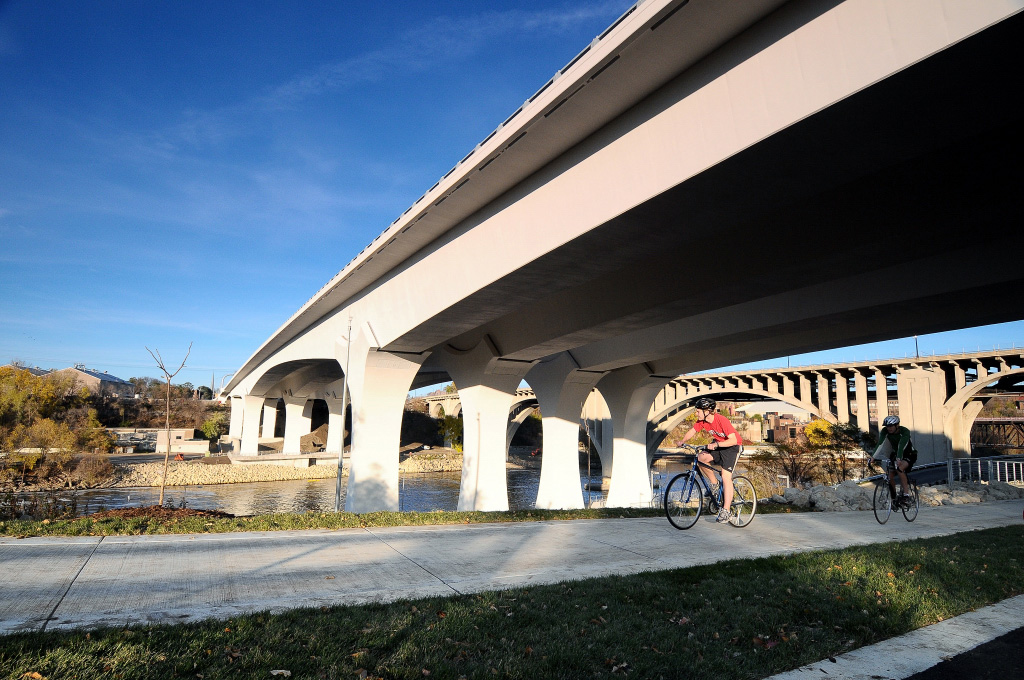
Photo courtesy of Minnesota Department of Transportation
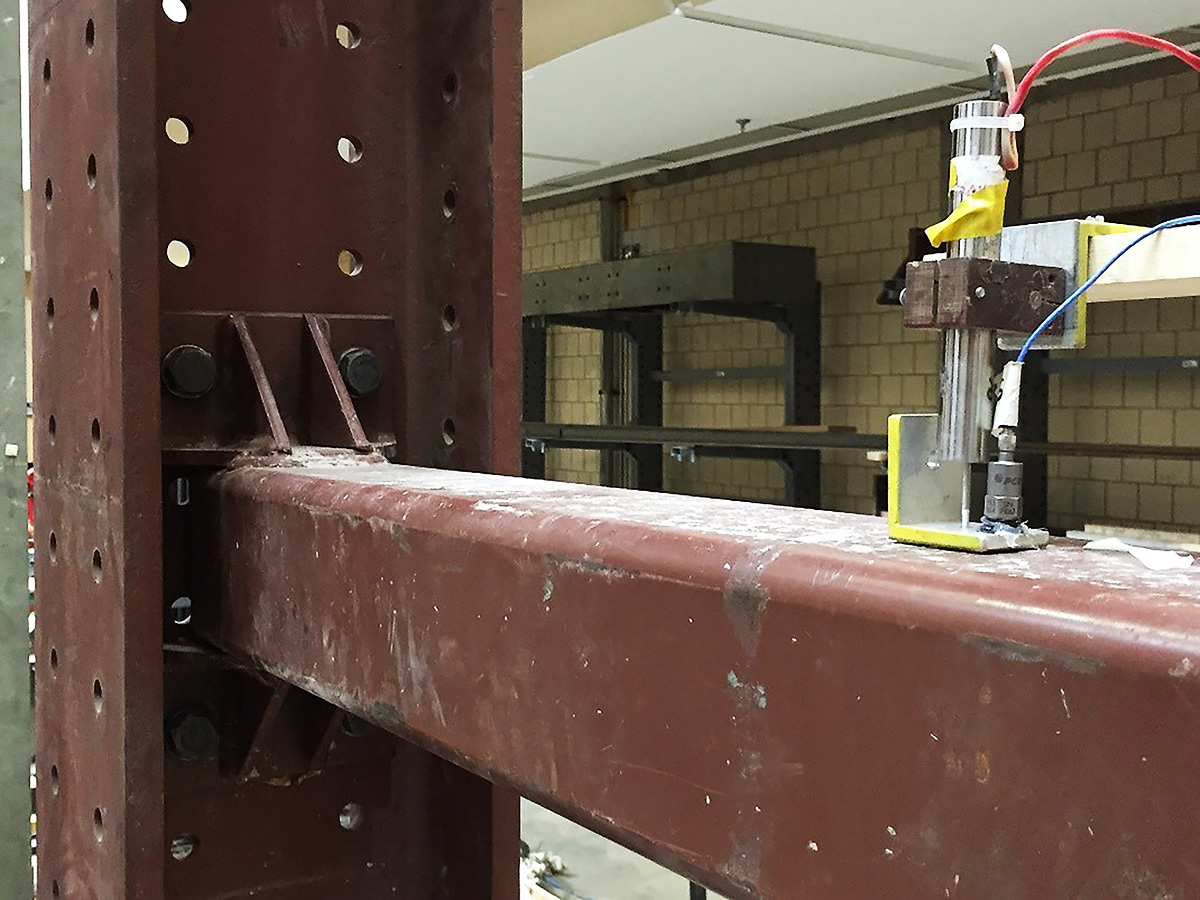
Accelerometer attached to a steel test beam for laboratory study of vibrations.
An architect in today’s world may live in a smart home, where the lights, locks, and HVAC system are networked just like the computers and phones. This residence may be located on a smart street, where sensors linked to the Internet of Things (IoT) harvest information on traffic patterns, energy consumption, air quality, and other variables. It may be part of a community planned for smart growth, a more environmentally resilient alternative to suburban sprawl. Perhaps the architect commutes to work in a smart car that enhances its energy use, navigation, and safety using networked information. In this environment full of objects getting smarter, the architect may wonder why the building’s steel beams aren’t credited with a comparable IQ.
The construction industry, rightly or wrongly, has a reputation for slow adoption of digital technology. A 2017 McKinsey Global Institute report (Barbosa et al.) castigated the construction sector for having “the lowest productivity gains of any industry” (Economist 2017), citing resistance to consolidation, technology, and mass production, and McKinsey consultants have continued to press the point (Blanco et al.). This situation is changing, at least on the technology front, and the neologism smart steel is coming into use.
On construction sites, steel members can be tracked with attached or embedded radio-frequency identification (RFID) tags, bringing more sophisticated methods of inventory control and material distribution to the erection process. Sensors are available to monitor the structural soundness of beams, bolts, and other steel components during and after construction. Drawing on advances in related fields such as infrastructure construction and maintenance, where structural health monitoring (SHM) is a well-developed discipline with a significant information-technology component, the construction industry stands on the threshold of an era when smart steel offers advantages in efficiency and safety, overcoming barriers of cost and recognition.
SHM specialist Andrew W. Smyth, PhD, professor of civil engineering and engineering mechanics at Columbia University’s Fu Foundation School of Engineering and Applied Science and chair of the Smart Cities Center at Columbia’s Data Science Institute, points to various technologies commonly used to monitor metallic structures, such as fiber-optic strain gauging for bridge components, though he is unaware of them being marketed as discrete products by steel mills. “The place where it’s most commonly embedded at the outset in construction is actually attached to rebar in concrete,” he says. “There are a huge number of sensor types that are used on infrastructure in general, be it steel [or] concrete; it’s sort of agnostic.” Sensing systems for monitoring fatigue cracks are well established, he continues, “they’re pretty old technologies. Fiber-optic strain gauging is advancing and has been in the last 20 years. Maybe not everyone knows about it, but they are pretty widely used.”
The term smart steel is new enough that its definition is fluid and often unfamiliar. To Robert K. Otani, PE, chief technology officer at New York-based engineering firm Thornton Tomasetti (TT) and a member of the American Institute of Steel Construction’s technology committee, “smart steel has intelligence built in” at all stages of use: manufacturing, fabrication, erection, operations, and the end of life, which for steel includes “the circularity aspect.” Steel’s inherent recyclability, the clarity about sourcing and embodied carbon that environmental product declarations provide, and the lighter carbon footprint of steel made in electric arc furnaces rather than basic oxygen furnaces, Otani continues, all impart forms of intelligence. Another usage appears in the marketing realm, as when the Swedish firm SSAB, formerly Svenskt Stål Aktiebolag, created a SmartSteel app that manages metadata about its products (SSAB 2018). A more specific sense of smartness in steel, however, is the incorporation of digital technology into the steel components and the processes involving them.
Tagging, Tracking, and Beyond
An early and simple smart-steel application, Otani recalls, was fabricators’ use of RFIDs to track the location, condition, and progress of steel members on major projects like MetLife Stadium in East Rutherford, NJ, which opened in 2010. He describes this approach as “low-hanging fruit” that deserves to be common practice. Although RFID tagging on metallic objects has encountered signal interference, manufacturers have developed metal-mount tags that overcome the problem (Gotfryd; Pereira et al.; Zhang et al.).
More complex applications, Otani says, such as embedded sensors for in-service stress measurement – “smart IoT-enabled steel, which is still not used as much as it should be or could be” – are of interest to TT’s engineers for research and development, particularly for risk mitigation in conditions of high seismic stress, wind loads, or flood risk, and in forensic studies, e.g., after the 1994 Northridge earthquake near Los Angeles or the I-35W bridge collapse in Minneapolis (see Case Study). “We can actually simulate the extent of damage to the building by using sensors, and correlate that with the structural performance and analysis of the building, without having to go to the site and do a full analysis before people can move back in,” Otani says. “A whole assessment has to be done by a structural engineer; physical inspection takes a long time. But if there were sensors on those buildings and we had the correlated structural analysis, we would know the extent of the damage almost [in] real time.”
Forensic applications, Otani continues, lead logically to predictive and preventive uses. “A lot of what we do in the AI world is anomaly detection, because it’s easy to do. So if there’s a pattern that happens for many months or many years, and all of a sudden the pattern changes, something’s wrong. So I see it as the technology for early alerts, as well as potentially even downstream of assessing the extent of damage in a building.” TT’s forensics team has been called in on “new projects that demonstrated signs of problems, and we have started setting up sensors to correlate anticipated design movements relative to what was happening in the field, and there’s a feedback loop of making modifications.”
Strain gauges and accelerometers to provide continuous data on structural conditions, Otani speculates, might have forestalled incidents like the 2018 Ponte Morandi viaduct collapse in Genoa, Italy. “If there were even minimal sensors on the bridge,” he says, “you would know right away that there was a problem.... There was a significant change in the behavior of this structure prior to that collapse. It wasn’t overnight. It was something that was happening over time. But without an IoT or any kind of other monitoring, you won’t notice that.”
These analyses are not performed as often as they could be, Otani notes, in part because of cost perceptions. Sensors require a small power supply and “have to be bulletproof,” he says. “It can’t be something that breaks down every few months, and then someone’s got to replace it.” Clients’ hesitation “has to do with two issues. One is going to be some return on investment with relatively low risk. You [don’t] want to be the first one to do something and have it go wrong. Real estate is too is too valuable.” The other reason is time, since a developer intending to operate a building for five years or so and then sell it is less likely to adopt new technologies than long-range property holders such as universities. “I’m an IoT fan,” he summarizes, “but only when it provides value.”
That said, Otani proposes that its benefit/cost ratio suits certain clients well. One new project, he says, “a type of project that had never been done before,” and is not describable in detail because of a nondisclosure agreement, used sensors during the construction phase. “If you’re doing something that’s a one-off, that might make sense to do some level of monitoring to measure performance during construction.
Anything that can go wrong in the field is big dollars to fix, so putting some devices on steel is low-risk. And if it gets stuck there forever, who cares?”
Otani’s colleague Elisabeth Malsch, PhD, Thornton Tomasetti’s managing principal and forensics practice co-leader, groups RFID tagging of steel with lower-tech measures, such as Universal Product Codes and grease-pencil markings, that enable more sophisticated advances as well as inventory control: three-dimensional building information modeling (BIM), replicating physical assets in computer-aided design systems and computer-controlled cutting or full-size 3D printing.
“More contractors have iPads or Windows tablets on site,” Malsch notes, “and they get an accounting of what steel is coming to site, and then they can check off that it’s been erected. So you can, in various programs, track that the steel construction is within expectations of the steel fabrication.” Cap-mounted cameras, she adds, can “tie the inspection information for not just the steel but the walls and the assemblies as they come together with the construction in real time.” She cites a firm founded in 2017, OpenSpace, as a leader in integrating data “from the 3D model to the steel pieces, which have their own now unique tags that are tagged on their way to construction [and] then documented when the building’s built.”
On-site visual technology, Malsch says, can become “the robot dog that gets in the way.” Learning curves are unavoidable, particularly in settings that bear out the claim that construction is “a Luddite profession” (Barbosa et al., Mischke et al.). Malsch views technology use and innovation as intertwined but distinct concepts.
“Whether you can track something on your iPad or not,” she comments, “isn’t a sufficient definition of innovation.” Advances in steel’s toughness, recyclability, and carbon footprint have made it more reliable, and “those aspects have had a lot of innovation, without being something you can see on your iPad.” A decade or two since the incorporation of steel into 3D modeling and Tekla printing, she says, the jury may still be out on how technological progress boosts cost efficiency. “An engineer will always tell you, ‛We design things to be efficient, so we would have already chosen the cheapest assembly available at the time.’ The technology doesn’t necessarily make it cheaper, but it does increase the amount of options one has for coordinating and construction.”
Concrete’s tendency to “creep and shrink,” Malsch says, means that instrumentation aids in calculations and adjustments “so that when the first new tenants are walking into the space, they see a flat-as-possible floor. On steel buildings, there’s less unpredictable behavior, so we know how much the steel will shorten as the weight is put on it. I’ll instrument steel if I’m doing something unusual, like putting shoring in a building or repairing something that didn’t behave as expected. If I’m lifting up any part of a building, I’ll put strain gauges on the columns to make sure I’m not putting forces into the building in an inappropriate way, and we’ll also use ongoing optical monitoring – ‛measure twice, cut once.’ It’s something that we all know how to do, but we only use it in those kinds of unusual circumstances.”
“The specific [forensic] issue in steel is that it rusts,” Malsch continues. As the byproduct of a chemical reaction, “the appearance of rust suggests a lot of problems”: surface rust, pitting rust causing pipe leakage, microbial involvement, or electrochemical corrosion, a common finding near light-rail systems. She has seen sidewalk vaults with “a section of steel that’s a ghost of itself, because the middle is missing, and other pieces are have turned; it looks like phyllo dough.”
One option that Malsch sees, “in places where steel can be splashed, or can be in the zone where it gets oxygen and then oxygen leaves, is called cathodic protection. It’s a current that goes to the steel and gives back what the oxygen takes away, so it reduces the chance of rusting, and it’s an instrumented system, so one can read from the change in voltage whether the steel is rusting, or at what rate.” In maritime applications of passive cathodic protection, “a material that’s sacrificial to the steel is put onto a hull, and it rusts or degrades in advance of the steel degrading.” Other settings call for active cathodic protection, applying an external direct current to the steel. This simple form of “smart steel” has been recognized since Sir Humphry Davy and Michael Faraday recommended it to the British Royal Navy in the 1820s (Ackland et al.).
Keeping an Eye on the Long-Span Members
Erleen K. Hatfield, PE, FAIA, FASCE, managing partner of Hatfield Group Engineering (the firm she launched in 2018 after 12 years at TT and 10 at Buro Happold), contrasts today’s anticipatory stress measurement with the more specific techniques of the past. “Twenty years ago, if we wanted to measure something in the field or after the fact, a technician or an engineer would apply a strain gauge or some sort of sensor onto a piece of steel after it was erected, or maybe during construction. It was applied very intentionally to measure something very specific. Now with smart sensors, these can be embedded in the steel [and] provide real-time data.” Applications already used for buildings’ MEP systems, she points out, can incorporate structural information as well. “It could be all integrated together into a system where the superintendent who’s keeping track of the air- conditioning and heating equipment is also now keeping track of the condition of the structural steel.”
Structural failures occur, Hatfield notes, because of either material failures or overstress. A future network of sensor-equipped steel members will monitor both situations, informing engineers that strains have exceeded the allowable capacity over time or that a component is metallurgically compromised, increasing engineers’ awareness of quietly progressing problems. The extension of sensing technology developed in other domains into steel fabrication, she suggests, could be a paradigm shift comparable to Frank Gehry’s incorporation of Catia (Computer-Aided Three-Dimensional Interactive Application) aerospace-design software into building design.
Hatfield’s experience in stadium and arena design, including Atlanta’s Mercedes-Benz Stadium (2016) at Happold, suggests that long-span construction offers appropriate opportunities for strain or deflection monitoring in steel trusses. In “anything that’s outdoors,” she says, particularly steel exposed to water and salts, “having smart steel would allow real-time monitoring of corrosion, stresses, [and] overstrains.... During construction, it can help the entire design team understand exactly how much something is deflecting, and how that affects pipes or ductwork that may not fit because you’ve got a tighter squeeze. Because you’re monitoring your steel, you know exactly where things are during construction; you can be tighter on the tolerances when you’re designing.” Sensors mounted on steel members to measure iron oxide can augment visual inspection, she adds, a potential boon to state departments of transportation. “Maybe the visual inspections are spaced out farther now, because you’ve got sensors inside the material that can do a better job than somebody going out and looking at something, because they can detect problems at a metallurgical scale... Maybe that even postpones the visual inspections of bridges,” particularly when combined with drone-based photography. “When we go look at things in stadiums, we’ll go up in the roof. We’ll walk around on the catwalks; I’ll take a pair of binoculars to see a connection that’s 80 feet away. Being able to use drones and have sensors in your steel makes understanding your structures and the life cycle of a structure potentially longer. There are green benefits: if you keep a structure in use longer, [making] repair decisions at the appropriate times, you can extend the lives of those structures.”
Hatfield’s responsibilities include vice-chairing New York City’s Structural Technical Code Update Committee. She points out that although codes have yet to address smart steel, sensor-based information can clarify the relation between code requirements and in-service load measurements. “If we have hundreds of buildings with smart sensors, and you can collect that real-time data on loads,” she speculates, “let’s say you do a classroom that’s good for 50 pounds a square foot, but the sensor is actually showing that it’s never over 50 percent of its stress level. Maybe in the next building-code cycle, you don’t need to design for such a high amount of load. Or maybe that classroom in the future can then be converted to some assembly space that has more load requirement.” She can envision the three-year code-revision cycle incorporating benefits from sensor data: if one code cycle allows or encourages sensor use, “the next code cycle might require it. The first code cycle might be something along the lines of ‛Buildings that monitor their allowable stress levels of their steel might be able to potentially use higher load capacities.’”
Technology Transfer: What Buildings Can Learn From Bridges
Jerome Lynch, PhD, dean of engineering at Duke University’s Pratt School of Engineering and the founder of two research-driven companies (Civionics and Sensametrics), points out that the infrastructure and construction fields have different technological priorities. SHM is a highly interdisciplinary realm, he observes, conducive to technology transfer; “civil, mechanical, aerospace, even electrical engineers are all part of the community that we call structural health monitoring. All of them have a role to play, and there’s a lot of cross-pollination of ideas.” Aircraft and spacecraft encounter extreme loads on lighter structures and thus have narrower safety margins than infrastructure or buildings, he notes; advances in bridge safety contribute more directly to knowledge transfer, benefiting the construction sector.
“Both fields have been highly innovative and big proponents of technology,” Lynch says, “playing active roles in shaping and developing those technologies.” In architectureal realm, he has seen more investment in digital-twin technologies. “In the infrastructure world, a lot of emphasis has been placed on sensing and SHM technology, just because those infrastructure systems see very different types of loads.” Wear and tear (e.g., bridges supporting vehicles and resisting wind stress) and “phenomenal loads” (dams holding water) require quantitative evidence of loading and structural aging to inform maintenance decisions. Transfer of sensing innovations to the building sector, he observes, has focused on structures exposed to seismic activity or tropical storms, addressing questions of building closure or safe reoccupation, often in retrofit settings. Sensor use during the construction phase addresses the safety and stability of scaffolding, standards for poured concrete, and stress-strain relationships in steel.
Photo courtesy of Minnesota Department of Transportation
Accelerometer attached to a steel test beam for laboratory study of vibrations.
An architect in today’s world may live in a smart home, where the lights, locks, and HVAC system are networked just like the computers and phones. This residence may be located on a smart street, where sensors linked to the Internet of Things (IoT) harvest information on traffic patterns, energy consumption, air quality, and other variables. It may be part of a community planned for smart growth, a more environmentally resilient alternative to suburban sprawl. Perhaps the architect commutes to work in a smart car that enhances its energy use, navigation, and safety using networked information. In this environment full of objects getting smarter, the architect may wonder why the building’s steel beams aren’t credited with a comparable IQ.
The construction industry, rightly or wrongly, has a reputation for slow adoption of digital technology. A 2017 McKinsey Global Institute report (Barbosa et al.) castigated the construction sector for having “the lowest productivity gains of any industry” (Economist 2017), citing resistance to consolidation, technology, and mass production, and McKinsey consultants have continued to press the point (Blanco et al.). This situation is changing, at least on the technology front, and the neologism smart steel is coming into use.
On construction sites, steel members can be tracked with attached or embedded radio-frequency identification (RFID) tags, bringing more sophisticated methods of inventory control and material distribution to the erection process. Sensors are available to monitor the structural soundness of beams, bolts, and other steel components during and after construction. Drawing on advances in related fields such as infrastructure construction and maintenance, where structural health monitoring (SHM) is a well-developed discipline with a significant information-technology component, the construction industry stands on the threshold of an era when smart steel offers advantages in efficiency and safety, overcoming barriers of cost and recognition.
SHM specialist Andrew W. Smyth, PhD, professor of civil engineering and engineering mechanics at Columbia University’s Fu Foundation School of Engineering and Applied Science and chair of the Smart Cities Center at Columbia’s Data Science Institute, points to various technologies commonly used to monitor metallic structures, such as fiber-optic strain gauging for bridge components, though he is unaware of them being marketed as discrete products by steel mills. “The place where it’s most commonly embedded at the outset in construction is actually attached to rebar in concrete,” he says. “There are a huge number of sensor types that are used on infrastructure in general, be it steel [or] concrete; it’s sort of agnostic.” Sensing systems for monitoring fatigue cracks are well established, he continues, “they’re pretty old technologies. Fiber-optic strain gauging is advancing and has been in the last 20 years. Maybe not everyone knows about it, but they are pretty widely used.”
The term smart steel is new enough that its definition is fluid and often unfamiliar. To Robert K. Otani, PE, chief technology officer at New York-based engineering firm Thornton Tomasetti (TT) and a member of the American Institute of Steel Construction’s technology committee, “smart steel has intelligence built in” at all stages of use: manufacturing, fabrication, erection, operations, and the end of life, which for steel includes “the circularity aspect.” Steel’s inherent recyclability, the clarity about sourcing and embodied carbon that environmental product declarations provide, and the lighter carbon footprint of steel made in electric arc furnaces rather than basic oxygen furnaces, Otani continues, all impart forms of intelligence. Another usage appears in the marketing realm, as when the Swedish firm SSAB, formerly Svenskt Stål Aktiebolag, created a SmartSteel app that manages metadata about its products (SSAB 2018). A more specific sense of smartness in steel, however, is the incorporation of digital technology into the steel components and the processes involving them.
Tagging, Tracking, and Beyond
An early and simple smart-steel application, Otani recalls, was fabricators’ use of RFIDs to track the location, condition, and progress of steel members on major projects like MetLife Stadium in East Rutherford, NJ, which opened in 2010. He describes this approach as “low-hanging fruit” that deserves to be common practice. Although RFID tagging on metallic objects has encountered signal interference, manufacturers have developed metal-mount tags that overcome the problem (Gotfryd; Pereira et al.; Zhang et al.).
More complex applications, Otani says, such as embedded sensors for in-service stress measurement – “smart IoT-enabled steel, which is still not used as much as it should be or could be” – are of interest to TT’s engineers for research and development, particularly for risk mitigation in conditions of high seismic stress, wind loads, or flood risk, and in forensic studies, e.g., after the 1994 Northridge earthquake near Los Angeles or the I-35W bridge collapse in Minneapolis (see Case Study). “We can actually simulate the extent of damage to the building by using sensors, and correlate that with the structural performance and analysis of the building, without having to go to the site and do a full analysis before people can move back in,” Otani says. “A whole assessment has to be done by a structural engineer; physical inspection takes a long time. But if there were sensors on those buildings and we had the correlated structural analysis, we would know the extent of the damage almost [in] real time.”
Forensic applications, Otani continues, lead logically to predictive and preventive uses. “A lot of what we do in the AI world is anomaly detection, because it’s easy to do. So if there’s a pattern that happens for many months or many years, and all of a sudden the pattern changes, something’s wrong. So I see it as the technology for early alerts, as well as potentially even downstream of assessing the extent of damage in a building.” TT’s forensics team has been called in on “new projects that demonstrated signs of problems, and we have started setting up sensors to correlate anticipated design movements relative to what was happening in the field, and there’s a feedback loop of making modifications.”
Strain gauges and accelerometers to provide continuous data on structural conditions, Otani speculates, might have forestalled incidents like the 2018 Ponte Morandi viaduct collapse in Genoa, Italy. “If there were even minimal sensors on the bridge,” he says, “you would know right away that there was a problem.... There was a significant change in the behavior of this structure prior to that collapse. It wasn’t overnight. It was something that was happening over time. But without an IoT or any kind of other monitoring, you won’t notice that.”
These analyses are not performed as often as they could be, Otani notes, in part because of cost perceptions. Sensors require a small power supply and “have to be bulletproof,” he says. “It can’t be something that breaks down every few months, and then someone’s got to replace it.” Clients’ hesitation “has to do with two issues. One is going to be some return on investment with relatively low risk. You [don’t] want to be the first one to do something and have it go wrong. Real estate is too is too valuable.” The other reason is time, since a developer intending to operate a building for five years or so and then sell it is less likely to adopt new technologies than long-range property holders such as universities. “I’m an IoT fan,” he summarizes, “but only when it provides value.”
That said, Otani proposes that its benefit/cost ratio suits certain clients well. One new project, he says, “a type of project that had never been done before,” and is not describable in detail because of a nondisclosure agreement, used sensors during the construction phase. “If you’re doing something that’s a one-off, that might make sense to do some level of monitoring to measure performance during construction.
Anything that can go wrong in the field is big dollars to fix, so putting some devices on steel is low-risk. And if it gets stuck there forever, who cares?”
Otani’s colleague Elisabeth Malsch, PhD, Thornton Tomasetti’s managing principal and forensics practice co-leader, groups RFID tagging of steel with lower-tech measures, such as Universal Product Codes and grease-pencil markings, that enable more sophisticated advances as well as inventory control: three-dimensional building information modeling (BIM), replicating physical assets in computer-aided design systems and computer-controlled cutting or full-size 3D printing.
“More contractors have iPads or Windows tablets on site,” Malsch notes, “and they get an accounting of what steel is coming to site, and then they can check off that it’s been erected. So you can, in various programs, track that the steel construction is within expectations of the steel fabrication.” Cap-mounted cameras, she adds, can “tie the inspection information for not just the steel but the walls and the assemblies as they come together with the construction in real time.” She cites a firm founded in 2017, OpenSpace, as a leader in integrating data “from the 3D model to the steel pieces, which have their own now unique tags that are tagged on their way to construction [and] then documented when the building’s built.”
On-site visual technology, Malsch says, can become “the robot dog that gets in the way.” Learning curves are unavoidable, particularly in settings that bear out the claim that construction is “a Luddite profession” (Barbosa et al., Mischke et al.). Malsch views technology use and innovation as intertwined but distinct concepts.
“Whether you can track something on your iPad or not,” she comments, “isn’t a sufficient definition of innovation.” Advances in steel’s toughness, recyclability, and carbon footprint have made it more reliable, and “those aspects have had a lot of innovation, without being something you can see on your iPad.” A decade or two since the incorporation of steel into 3D modeling and Tekla printing, she says, the jury may still be out on how technological progress boosts cost efficiency. “An engineer will always tell you, ‛We design things to be efficient, so we would have already chosen the cheapest assembly available at the time.’ The technology doesn’t necessarily make it cheaper, but it does increase the amount of options one has for coordinating and construction.”
Concrete’s tendency to “creep and shrink,” Malsch says, means that instrumentation aids in calculations and adjustments “so that when the first new tenants are walking into the space, they see a flat-as-possible floor. On steel buildings, there’s less unpredictable behavior, so we know how much the steel will shorten as the weight is put on it. I’ll instrument steel if I’m doing something unusual, like putting shoring in a building or repairing something that didn’t behave as expected. If I’m lifting up any part of a building, I’ll put strain gauges on the columns to make sure I’m not putting forces into the building in an inappropriate way, and we’ll also use ongoing optical monitoring – ‛measure twice, cut once.’ It’s something that we all know how to do, but we only use it in those kinds of unusual circumstances.”
“The specific [forensic] issue in steel is that it rusts,” Malsch continues. As the byproduct of a chemical reaction, “the appearance of rust suggests a lot of problems”: surface rust, pitting rust causing pipe leakage, microbial involvement, or electrochemical corrosion, a common finding near light-rail systems. She has seen sidewalk vaults with “a section of steel that’s a ghost of itself, because the middle is missing, and other pieces are have turned; it looks like phyllo dough.”
One option that Malsch sees, “in places where steel can be splashed, or can be in the zone where it gets oxygen and then oxygen leaves, is called cathodic protection. It’s a current that goes to the steel and gives back what the oxygen takes away, so it reduces the chance of rusting, and it’s an instrumented system, so one can read from the change in voltage whether the steel is rusting, or at what rate.” In maritime applications of passive cathodic protection, “a material that’s sacrificial to the steel is put onto a hull, and it rusts or degrades in advance of the steel degrading.” Other settings call for active cathodic protection, applying an external direct current to the steel. This simple form of “smart steel” has been recognized since Sir Humphry Davy and Michael Faraday recommended it to the British Royal Navy in the 1820s (Ackland et al.).
Keeping an Eye on the Long-Span Members
Erleen K. Hatfield, PE, FAIA, FASCE, managing partner of Hatfield Group Engineering (the firm she launched in 2018 after 12 years at TT and 10 at Buro Happold), contrasts today’s anticipatory stress measurement with the more specific techniques of the past. “Twenty years ago, if we wanted to measure something in the field or after the fact, a technician or an engineer would apply a strain gauge or some sort of sensor onto a piece of steel after it was erected, or maybe during construction. It was applied very intentionally to measure something very specific. Now with smart sensors, these can be embedded in the steel [and] provide real-time data.” Applications already used for buildings’ MEP systems, she points out, can incorporate structural information as well. “It could be all integrated together into a system where the superintendent who’s keeping track of the air- conditioning and heating equipment is also now keeping track of the condition of the structural steel.”
Structural failures occur, Hatfield notes, because of either material failures or overstress. A future network of sensor-equipped steel members will monitor both situations, informing engineers that strains have exceeded the allowable capacity over time or that a component is metallurgically compromised, increasing engineers’ awareness of quietly progressing problems. The extension of sensing technology developed in other domains into steel fabrication, she suggests, could be a paradigm shift comparable to Frank Gehry’s incorporation of Catia (Computer-Aided Three-Dimensional Interactive Application) aerospace-design software into building design.
Hatfield’s experience in stadium and arena design, including Atlanta’s Mercedes-Benz Stadium (2016) at Happold, suggests that long-span construction offers appropriate opportunities for strain or deflection monitoring in steel trusses. In “anything that’s outdoors,” she says, particularly steel exposed to water and salts, “having smart steel would allow real-time monitoring of corrosion, stresses, [and] overstrains.... During construction, it can help the entire design team understand exactly how much something is deflecting, and how that affects pipes or ductwork that may not fit because you’ve got a tighter squeeze. Because you’re monitoring your steel, you know exactly where things are during construction; you can be tighter on the tolerances when you’re designing.” Sensors mounted on steel members to measure iron oxide can augment visual inspection, she adds, a potential boon to state departments of transportation. “Maybe the visual inspections are spaced out farther now, because you’ve got sensors inside the material that can do a better job than somebody going out and looking at something, because they can detect problems at a metallurgical scale... Maybe that even postpones the visual inspections of bridges,” particularly when combined with drone-based photography. “When we go look at things in stadiums, we’ll go up in the roof. We’ll walk around on the catwalks; I’ll take a pair of binoculars to see a connection that’s 80 feet away. Being able to use drones and have sensors in your steel makes understanding your structures and the life cycle of a structure potentially longer. There are green benefits: if you keep a structure in use longer, [making] repair decisions at the appropriate times, you can extend the lives of those structures.”
Hatfield’s responsibilities include vice-chairing New York City’s Structural Technical Code Update Committee. She points out that although codes have yet to address smart steel, sensor-based information can clarify the relation between code requirements and in-service load measurements. “If we have hundreds of buildings with smart sensors, and you can collect that real-time data on loads,” she speculates, “let’s say you do a classroom that’s good for 50 pounds a square foot, but the sensor is actually showing that it’s never over 50 percent of its stress level. Maybe in the next building-code cycle, you don’t need to design for such a high amount of load. Or maybe that classroom in the future can then be converted to some assembly space that has more load requirement.” She can envision the three-year code-revision cycle incorporating benefits from sensor data: if one code cycle allows or encourages sensor use, “the next code cycle might require it. The first code cycle might be something along the lines of ‛Buildings that monitor their allowable stress levels of their steel might be able to potentially use higher load capacities.’”
Technology Transfer: What Buildings Can Learn From Bridges
Jerome Lynch, PhD, dean of engineering at Duke University’s Pratt School of Engineering and the founder of two research-driven companies (Civionics and Sensametrics), points out that the infrastructure and construction fields have different technological priorities. SHM is a highly interdisciplinary realm, he observes, conducive to technology transfer; “civil, mechanical, aerospace, even electrical engineers are all part of the community that we call structural health monitoring. All of them have a role to play, and there’s a lot of cross-pollination of ideas.” Aircraft and spacecraft encounter extreme loads on lighter structures and thus have narrower safety margins than infrastructure or buildings, he notes; advances in bridge safety contribute more directly to knowledge transfer, benefiting the construction sector.
“Both fields have been highly innovative and big proponents of technology,” Lynch says, “playing active roles in shaping and developing those technologies.” In architectureal realm, he has seen more investment in digital-twin technologies. “In the infrastructure world, a lot of emphasis has been placed on sensing and SHM technology, just because those infrastructure systems see very different types of loads.” Wear and tear (e.g., bridges supporting vehicles and resisting wind stress) and “phenomenal loads” (dams holding water) require quantitative evidence of loading and structural aging to inform maintenance decisions. Transfer of sensing innovations to the building sector, he observes, has focused on structures exposed to seismic activity or tropical storms, addressing questions of building closure or safe reoccupation, often in retrofit settings. Sensor use during the construction phase addresses the safety and stability of scaffolding, standards for poured concrete, and stress-strain relationships in steel.
Commentators with SHM experience describe an array of sensor types used to monitor steel (see Images 1-4) (Lynch and Loh; Mardanshahi et al.). Metal-foil sensors, Lynch says, are “thin-film transducers that change their resistance proportional to the amount of strain.” Fiber-optic strain gauges have become popular over the past 20 years: “They provide a more distributed way of getting many strain measurements; you can run a fiber for very long distances; you only need one laser and one optical detector to put the signal in the fiber and get it back, but you can get many measurements over the run of that fiber.” Smyth finds them “more impressive than many people realize [because] a single strand could have thousands of sensors along it,” measuring strains at different locations. The fiber itself is inexpensive; “it’s the thing that interrogates them that’s not cheap.”
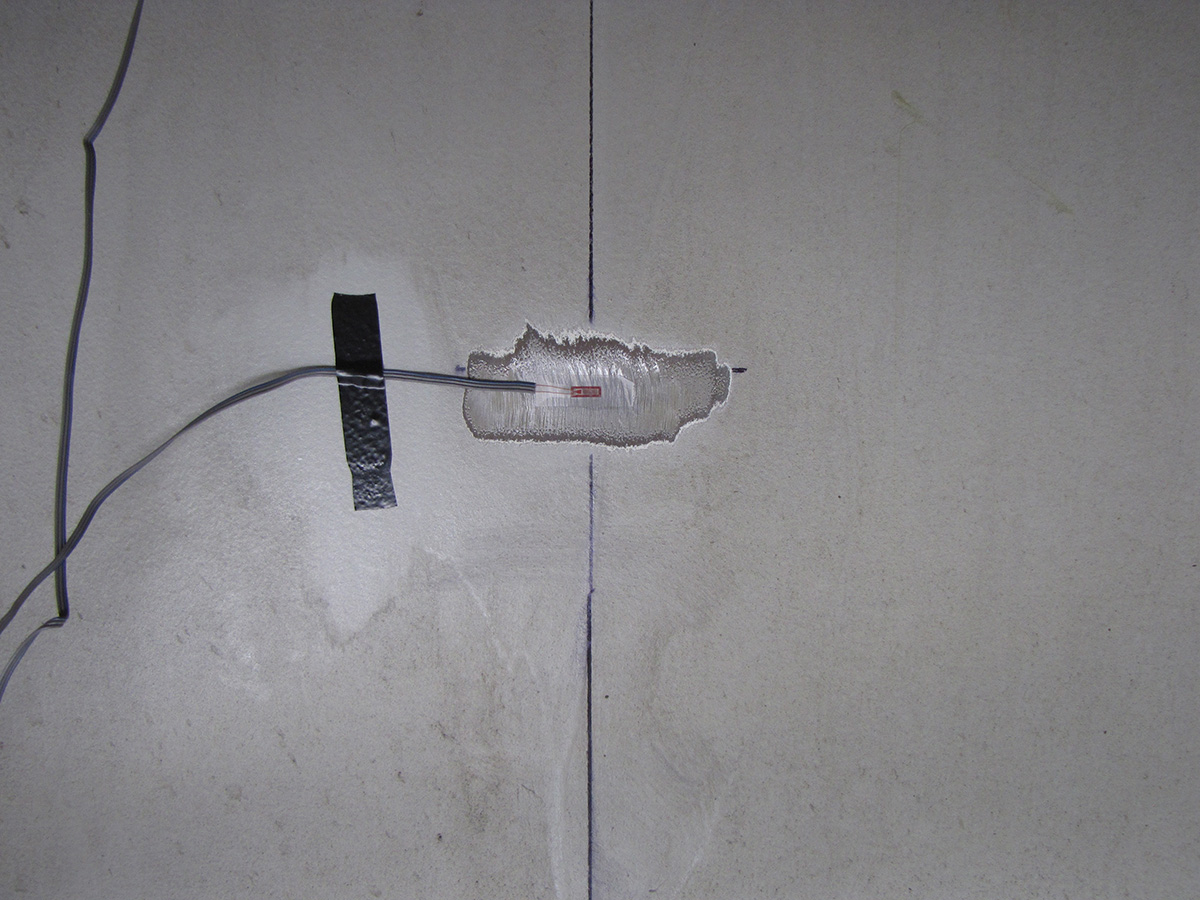
Photo courtesy of Jerome Lynch
Standard metal-foil strain gauge installed on a steel girder on the Telegraph Road Bridge (Michigan) to measure flexural strain under truck loadings. Strain gauges are ubiquitous sensors in structural health monitoring.
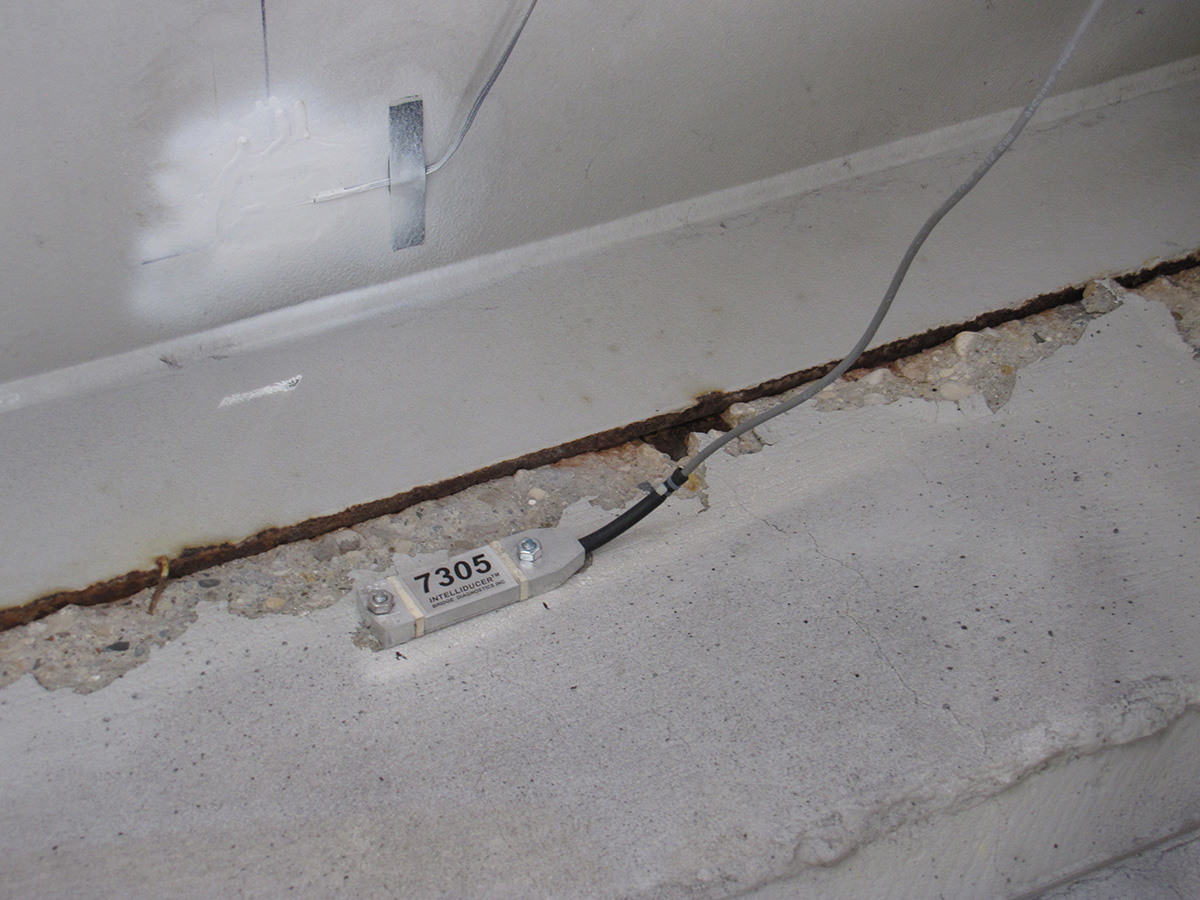
Photo courtesy of Jerome Lynch
“Bridge Diagnostics Intelliducer” to measure long-gauge strain in a concrete deck on the Telegraph Road Bridge (Michigan). Bridge Diagnostics is a company that sells these commonly used strain sensors for concrete structural elements.
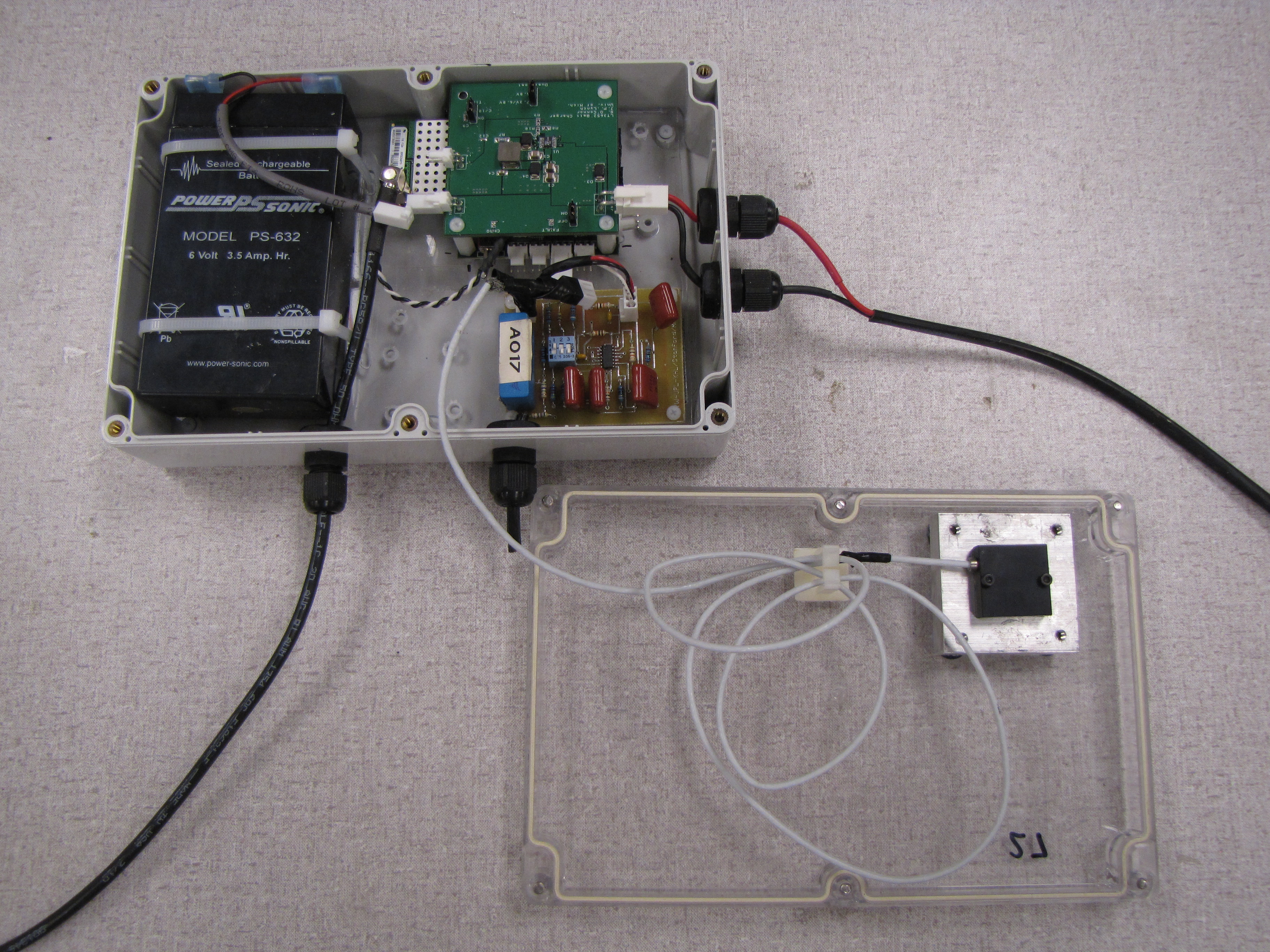
Photo courtesy of Jerome Lynch
“Narada” wireless sensor designed by Prof. Jerome Lynch (Duke University) for structural health monitoring. The version shown has a tri-axial accelerometer to measure structural accelerations of buildings, bridges, and other structures.
Photo courtesy of Jerome Lynch
Wireless sensor node (left) and long-gauge strain sensor with thermocouple to measure flexural strain on Interstate 696 retaining wall in southeast Michigan.
Accelerometers measure the steel’s response indirectly, Lynch says, by “looking at the global response of the structure.” Under a wind load, an accelerometer measures “the acceleration of that movement, which you could double-integrate to get a rough order of displacement on the structure.” Accelerometer technology has progressed dramatically in the past 25 years or so, Malsch comments, since her days at Columbia, studying under Rene Testa (now retired) as he was monitoring the George Washington Bridge. The accelerometers of the day were bulky, expensive, high-maintenance instruments using masses moving in oil. The arrival of micro-electromechanical systems (MEMS), which “you could fit in the palm of your hand, instead of needing a whole aircraft box,” she says, transformed the field. “It’s got both the electronics to take the signal and the device that reads the accelerations, and it’s far more detailed than what we had on the George Washington Bridge.”
Smyth adds that “the accelerometers that we have in our phones are MEMS accelerometers, and those have becomecheap and reliable because of all the consumer uses.” The accelerometers used on bridges can measure the low frequencies of infrastructural deflection; “some of those are not MEMS sensors, but in general, the MEMS-based sensors have a lot of capability.” Very small sensors are familiar to researchers; ”the intelligence that we now build into the sensors is maybe new, so we can have more processing and decision-making happening at the sensor.” Wireless sensors require energy for sensing, communication, and processing; the telemetered data may not be the entire signal of a vibration but only “sending whether there’s an exceedance and maybe some statistics on the information, so less power to send the data is needed.”
RFID sensors, Smyth continues, are “energized when you go and visit them,” a common approach for bridges and other outdoor settings, where a drone can “visit them and interrogate them to get historical data from them and charge them. There are companies looking at laser-based charging of remote sensing as well; they’re active in military contexts, but they’re looking at possibly doing this in civilian contexts as well. One sends a laser to a receiver at the sensor that then is charging a battery.”
Piezoelectric sensors, used less in the field than accelerometers, are “viable sensors that you can use to introduce elastic stress waves into a structural element, looking for things like fatigue cracks,” Lynch says. “With a piezoelectric transducer bonded to the surface of the steel, you use one to generate a wave and another to receive that wave, and changes in how that wave moves through the steel may tell you a fatigue crack is present between those two transducers.” Thermography introduces heat into a steel element showing fatigue crack through the propagation of heat.
Smyth has also worked on differential global positioning systems (GPS), assessing macro-scale deformations in a building or bridge. “If you have a good finite element model, if you’re measuring at a few points,” he says, “then you can figure out what the stresses and deformations were in all of the other members.” Malsch adds seismometers as simple, compact, and inexpensive systems for vibration monitoring during construction in dense urban environments, though they measure velocity, and “people don’t feel velocity; we feel acceleration,” so that “an accelerometer is the right device for measuring everything that’s related to how people feel,” including commissioning tuned mass dampers. The linear variable differential transformer (LVDT) is a contactless and robust device for precisely measuring rectilinear motion on scales from micrometers to several centimeters. “They’re all different versions of calipers,” Malsch comments; “they measure the distance between two points.”
Choices among sensor types, Lynch comments, come down to “ease of use and interpretation of the data. Those more novel sensing systems tend to require quite a bit more expertise to interpret the signals” than traditional strain sensors and accelerometers, which are more cost-effective. The “local approaches, what we’d call nondestructive-evaluation-type sensors, generally require more expertise,” are manually applied, and are more expensive.
Lynch views code-writing organizations as “great partners in the development of these technologies,” even though codes do not yet require sensors. “All of the US-based code bodies have committees that look at these technologies” and make recommendations. “Even if the technology is not stipulated directly in the code, oftentimes there are manuals of practice produced by many of these code bodies that will give best practices to stakeholders in the industry that want to use these technologies. So not everything we adopt is always based on code.”
California, Lynch notes, has a Strong Motion Instrumentation Program in place since 1972 (California Department of Conservation), assessing the state’s infrastructure. “Building owners are allowed to install sensors and use the data from sensors for reoccupancy decisions,” he says; “that drove a lot of adoption of sensors in that marketplace when that was put into the California codes, because a lot of building owners were willing to install sensors so that they could reoccupy their buildings more quickly after an earthquake event. Those would have all been done as retrofit sensors installed after the building’s been operational for some time. Buildings typically would be instrumented after the fact” rather than during new construction, though nothing prevents an owner from anticipating seismic risk, particularly for a novel design, and proactively attaching a monitoring system. Earthquake-prone Japan also has decades of experience in building instrumentation; Lynch cites the Kajima and Shimizu companies as global leaders.
The decision to equip a structure with monitors is a matter of both safety and long-range return on investment, Lynch says, considering the cost of installing a system and keeping it operational for decades. After any structural failure event that requires closure, “building reoccupancy may allow you to charge rent sooner [and] save significant lost revenue. That’s a great return on investment, and that has driven the adoption of sensors in certain applications. In others, the return on investment has been harder to prove, or to quantify in a precise way; we’ve seen less sensing adoption when that’s the case. So the market tends to rationalize the decision that building owners have to make.”
Communicating with Braces, Bolts, and Flooring
Seismic conditions and other structural challenges call for imaginative responses by engineers and by designers of both buildings and products. One new sensing instrument has drawn fabricators’ attention as a model for the integration of steel structural components with information technology. Brandt Saxey, SE, LEED AP, technical director at CoreBrace, a manufacturer of buckling-restrained braces (BRBs) based in West Jordan, Utah, describes a monitoring device that transforms a BRB, a steel-and-concrete device developed by Nippon Steel in the 1980s that protects a building’s frame from seismic forces, into a processor of information about the building’s resilience and integrity.
BRBs have allowed buildings, bridges, dams, and mining facilities to be constructed economically in areas of medium to high seismicity, Saxey says. A medium-sized building might have 100 BRBs; a large one, 1,000. Industry researchers have established the braces’ fatigue properties and can predict their behavior after seismic events. Each BRB’s displacement history – how much it has stretched, the number and scale of cycles – is essential for modeling a building’s performance. Replacing BRBs that may or may not be damaged is expensive and time-consuming; a brace rarely needs replacing after a single earthquake, yet uncertainty about its condition carries obvious risk.
“The question is, ‘Is that BRB still good to survive a future earthquake, or does it need to be taken out and replaced?’” says Saxey. “Even in design, an engineer might say, ‘This is the earthquake I’m designing for,’ and they can run the BRB through that earthquake record... and establish to satisfy the building official or a peer reviewer that ‘This earthquake that we’re designing around doesn’t even harm the BRB.’” Information about a BRB’s condition allows for an economical design phase as well as a quick decision on reoccupancy.
CoreBrace’s self-contained displacement transducer, the ReCOREder, is added onto a BRB at the factory and spends most of its existence in battery-powered sleep mode. When it detects movement along the length of the brace (calibrated to a threshold of seismic activity and not vibrations from weather or vehicles), it turns on, measures and stores the BRB’s deformation, and goes back to sleep, returning to recording mode for aftershocks. Information is hard-written to the ReCOREder itself – not, Saxey points out, to the cloud or IoT, to avoid dependence on networks that may be down during earthquakes – and can be transferred to a USB drive or card for portability.
Not every BRB needs its own transducer; for a 100-brace building, Saxey says, 10 or 20 ReCOREders should suffice. Early adopters include airports, refineries, large stadiums, and large commercial buildings, where quick assessments for safe reoccupation are a priority. Though numerous firms manufacture either BRBs or seismic monitoring equipment, competing transducers coupled to BRBs have yet to appear commercially as far as Saxey is aware.
Otani and colleagues have prototyped a small accelerometer glued onto a steel member and connected to the Internet, with monitoring through a web-based dashboard; they have used it on real projects but have not commercialized it to date. He also calls attention to SmartBolts, a fastener that visually indicates a load by changing color as the proper bolt tension (not rotational torque) is reached, measuring clamp force accurately and simplifying joint inspection. Bolt-load monitoring can be a point of uncertainty, Malsch points out: “The force in a bolt is calculated rather straightforwardly when a structure is built, but once it’s lived a little, it’s more difficult to infer [and] calculate how much load is really in the bolt.... The more efficiently one can install and inspect bolts, [the more] there’s a financial win to knowing what stress is in a bolt faster. That’s why it’s an item where innovation continues to occur.”
Another combination of structure and instrumentation that draws the TT engineers’ attention is Calmfloor, an active damping device attached to flooring to mitigate vibration, constantly calculating the effective damping behavior to control a range of frequencies (3-30 Hz) simultaneously. “Depending on the type of project, particularly lab or hospital projects that require significant damping, 30 percent of the steel could be just for mitigating vibration in the floors,” Otani estimates. “These new active dampers can minimize how much steel you throw at the building just to deal with that issue.” In repurposing office buildings vibration-sensitive programs, he speculates, active damping means “you can do it without welding plates and things all over the place.”
“The limiting design factor for very tall buildings is vibration,” Malsch says: “side-to-side vibration for the structure itself, and floor vibration for the design of the floors. So when the spans are aggressively long, or longer than usual, and the building is taller than usual, the reason we need more steel is to reduce vibrations.” Either a passive tuned mass damper to reduce lateral movement or an active damper, she says, allows for “a smaller ceiling assembly with a longer span.” The active approach helps conserve materials: “Passive dampers are about 5 percent of the weight of the floor, so they’re relatively large, and they’re good for bridges, purposeful long spans, and stadium seating.” Compared with passive dampers like the 660-metric-ton steel sphere in Taipei 101, she says, “active dampers can be smaller: less than 1 percent of the modal mass of the floor.”
Conclusion
The space between research and construction-industry practice with smart steel is narrowing. “The fashionable word now is digital twins,” Lynch says. “The whole point of the research area of SHM is to instrument a structural system, and then you’re building a mathematical computer simulation/representation of the same system and comparing the simulated performance with its actual performance.” Whether one is evaluating a retrofit, studying change over time, or performing finite-element modeling of a structural system, increasingly high fidelity makes it easier “to have instrumentation at a few points that then helps you infer deformations at all of the points..”
The problems that an instrumented structure can prevent are so catastrophic that an investment in sensor systems, either initially or as a retrofit, is often a bargain. Smyth emphasizes “the opportunity and the relatively low cost of being proactive, to install some sensors with an objective to monitoring your system over its lifetime, because every structural system is unique, and so even your supposition about the baseline or the virgin state might actually not be correct. You don’t know what the as-built truly is until you measure.”
Business consultant Peter Drucker’s adage that “you can’t manage what you don’t measure” has a corollary: The more precise the measurements from instrumented steel, the more manageable the complexities of construction become.
Works Cited
Ackland B, Dylejko K, Green W, et al. 200 years on: Sir Humphry Davy and cathodic protection. Corrosion 2025; 81 (5).
Barbosa F, Woetzel L, Mischke J, et al. Reinventing construction through a productivity revolution. McKinsey Global Institute, Feb. 27, 2017.
Blanco JL, Rockhill D, Sanghvi, A, Torres A. From start-up to scale-up: accelerating growth in construction technology. McKinsey Global Institute, May 3, 2023.
Brown RJ, McCoy R, Shield CK, et al. Ten-year review of monitoring system on I-35W Saint Anthony Falls Bridge. Report no. 2020-19, Minnesota Department of Transportation, June 2020.
California Department of Conservation. California Strong Motion Instrumentation Program.
Efficiency Eludes the Construction Industry. Economist, Aug. 19, 2017.
French CEW, Shield CK, Stolarski HK, et al. Instrumentation, Monitoring, and Modeling of the I-35W Bridge. Report no. MnDOT 2012-24, Minnesota Department of Transportation, August 2012, .
Gotfryd S. RFID on metal: RFID tags and metal surfaces. Atlas RFID Store, April 10, 2013.
Lynch JP, Loh KJ. A summary review of wireless sensors and sensor networks for structural health monitoring. Shock and Vibration Digest 2006; 38(2): 91-128, http://dx.doi.org/10.1177/0583102406061499.
Mardanshahi A, Sreekumar A, Yang X, et al. Sensing techniques for structural health monitoring: a state-of-the-art review on performance criteria and new-generation technologies. Sensors 2025; 25(5): 1424,
Mischke J, Stokvis K, Vermeltfoort K, Biemans B. Delivering on construction productivity is no longer optional. McKinsey Global Institute, Aug. 9, 2024.
National Transportation Safety Board. Collapse of I-35W Highway Bridge, Minneapolis, Minnesota, August 1, 2007. Washington, DC: Highway Accident Report NTSB/HAR-08/03, November 14, 2008.
Pereira E, Júnior S, Vieira Silva LF, et al. RFID tags for on-metal applications: a brief survey. Technologies 2024; 12(5): 58.
SSAB. SmartSteel 1.0 – The first step toward an internet of materials. Press release, May 23, 2018, https://www.ssab.com/en/news/2018/05/smartsteel-10—the-first-step-toward-an-internet-of-materials.
Zhang J, Tian GY, Marindra MJ, et al. A review of passive RFID tag antenna-based sensors and systems for structural health monitoring applications. Sensors 2017; 17(2): 265.
Bill Millard is a New York-based journalist who has contributed to Architectural Record, The Architect’s Newspaper, Oculus, Architect, Common Edge, OMA’s Content, and other publications.