Photo courtesy of Siplast
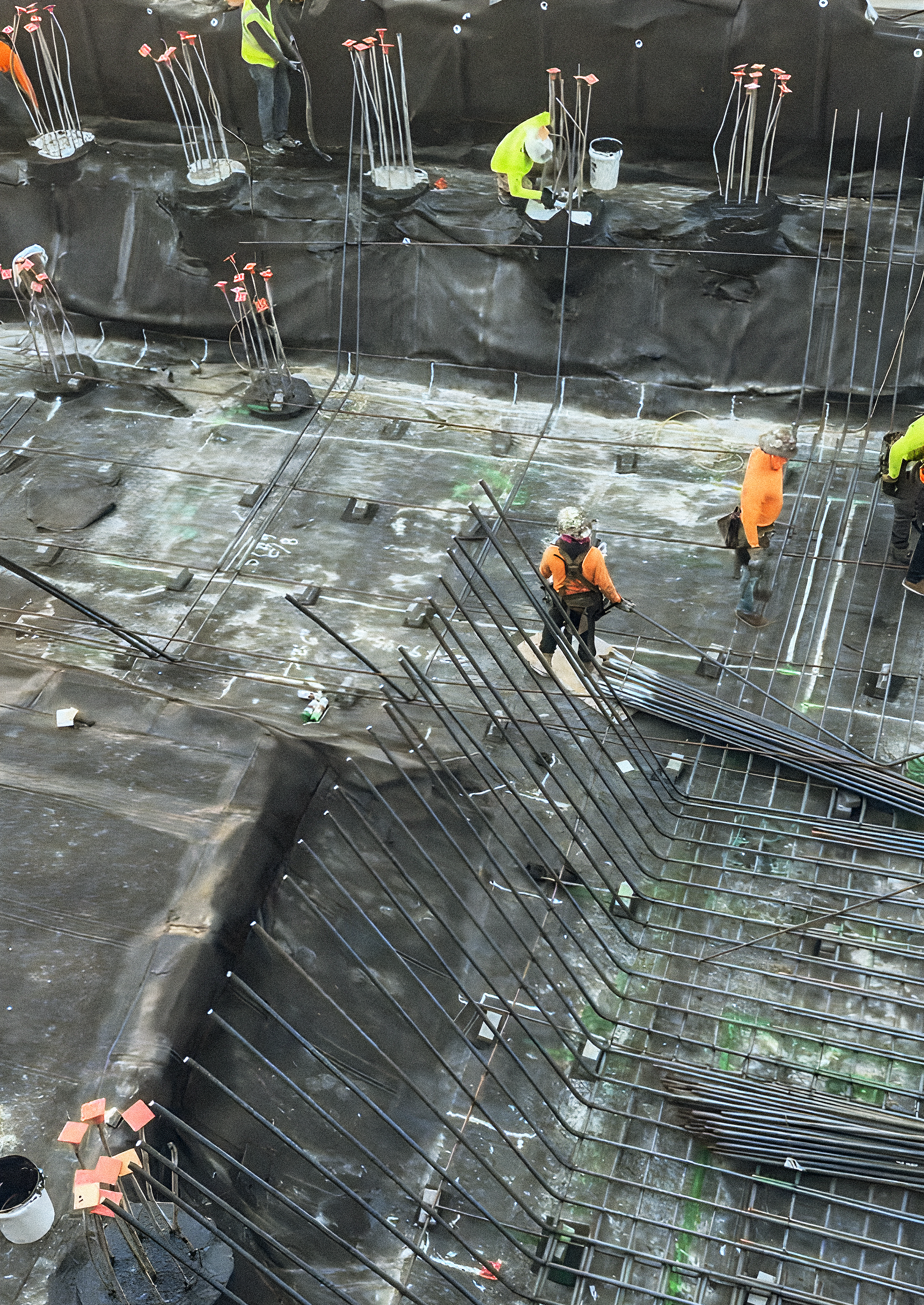
Preparation for concrete installation takes place on top of a below-grade pre-applied waterproofing installation.
The Whole-Building Approach
In the construction industry, the “building enclosure” is often discussed in terms of roofs and walls. However, the foundation is the very base of that enclosure, and its performance is paramount to the longevity of the structure. In building enclosures, the water control layer is a critical defense against environmental degradation. While an assembly may be continuous at the time of installation, the inevitable stresses of building aging, thermal cycling, and structural movement can introduce stresses into the system over time.
Because these waterproofing systems are physically inaccessible once the building is complete, designers require more thorough design and attention than just specifying a product; they require robust assurance that the selected waterproofing is engineered to withstand the unique, subterranean rigors of the site for the life of the structure. Approaching below-grade waterproofing as a critical component of the whole building approach means understanding how protection layers of the foundation interact not only with its substrates and buried environment, but also with the air, vapor, thermal, and water control layers of the above-grade enclosure systems.
Control Layers and Performance
In an ideal world, the building enclosure is a continuous “layer” of protection. The four primary control layers—water, air, thermal, and vapor—must remain continuous as they transition from the roof and walls down into the earth. Below-grade, the water control layer must evolve into a robust waterproofing system capable of resisting permanent hydrostatic pressure. Discontinuities at the “grade line” are common challenging points. If the air control layer or thermal insulation is interrupted at this interface, there is a risk of energy loss and condensation. Similarly, if the water control layer isn’t seamlessly tied from the facade to the below-grade membrane, moisture will exploit the gap.
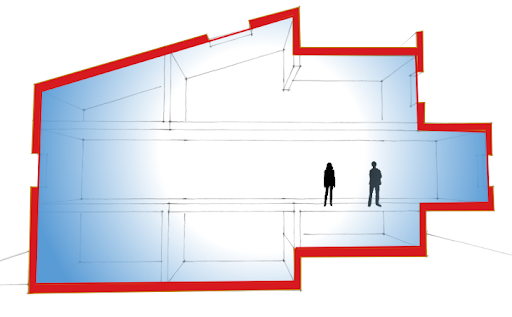
Illustration courtesy of Siplast
A complete building envelope on all sides of a building – a continuous “layer” of protection.
In addition to those physical realities, building and energy codes have shifted from general, disparate system-based suggestions to strict, mandatory performance thresholds for the entire enclosure. For a building to be compliant, it must function as a single, airtight, and watertight unit. Modern codes, such as IECC and ASHRAE Standard 90.1, now emphasize whole-building pressure testing to ensure airtightness. This “whole-building” requirement is exactly why the below-grade transition is so vital. You cannot have a high-performance air barrier enclosure if it stops at the dirt line. If there is a gap between your above-grade Air and Water Barrier (AWB) and your below-grade waterproofing membrane, the building can leak to a level that compromises the whole building airtightness test.
Below-Grade Physics and Material Technology
Unlike roofs, which deal primarily with gravity-driven water shedding, below-grade structures are often immersed in groundwater, and systems can be subjected to structural movement as well as chemical or biological contaminants found in the soil. And unlike roofing or above-grade wall systems, where failures typically manifest through visible leaks or localized moisture damage, the occupant feedback loop for buried systems is limited. Correct selection, specification, and installation of below-grade systems is paramount to the building’s longevity and habitability.
Installation Strategies: Post-Applied vs. Pre-Applied Section
In the world of below-grade construction, understanding the needed installation methodology is just as important as choosing the right material. The two primary approaches are post-applied or pre-applied waterproofing. Site constraints often dictate the waterproofing application method will be used before the product is selected, specifically, how much space around the structure there is to work with.
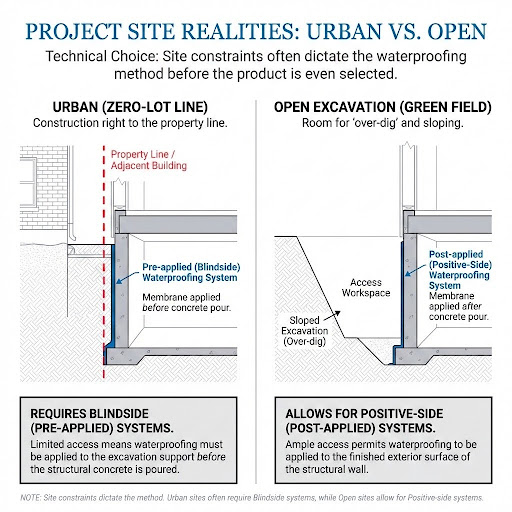
Illustration courtesy of Siplast
Two illustrations demonstrating the different site constraints used to determine the type of below-grade waterproofing system to be installed.
Post-applied waterproofing, also known as positive-side waterproofing, is the traditional method for application. It involves applying the membrane to the exterior face of a structure after it has been built. Post-applied systems are the traditional choice for projects with open excavations, where there is enough room for workers to apply membranes to the exterior of the foundation wall after the concrete has cured. These systems often utilize liquid-applied membranes or self-adhering sheets that provide a positive-side defense against groundwater.
However, in crowded urban environments where buildings are constructed right up to the property line, “blindside” or pre-applied waterproofing becomes necessary. In these zero-lot-line scenarios, the waterproofing must be installed against the excavation support system, such as soil nails or lagging, before the foundation concrete is even placed. This is a high-stakes installation because the membrane must be durable enough to withstand the pressure of the concrete pour and the heat of hydration while remaining sealed at the seams. For these applications, heat-weldable SBS-modified bitumen sheets are often preferred because they create a fused, permanent bond that does not rely on simple adhesives, which can fail under the constant pressure of groundwater.
Choosing the Right Technology
Selecting the right membrane technology is a critical design decision that depends on site conditions, the required level of protection, and the construction method. Below-grade waterproofing membranes are generally classified by their chemical composition and how they are installed to resist hydrostatic pressure and soil contaminants.

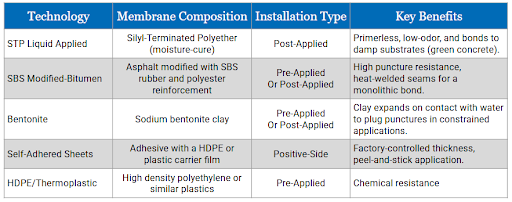
Table courtesy of Siplast
Table comparing the different common technologies used in the construction industry for below-grade waterproofing membranes.
Modern material science has given designers more tools than ever to address these challenges but choosing between sheet-applied and liquid-applied technologies requires a balanced understanding of their pros and cons. Sheet membranes, like those made from SBS-modified bitumen, offer the benefit of factory-controlled thickness. When you specify a sheet, you know exactly how thick your waterproofing layer is before it ever reaches the job site.
On the other hand, liquid-applied membranes, particularly those using advanced Silyl-Terminated Polyether (STP) technology, offer the advantage of being self-flashing. These liquids can easily conform to complex shapes, such as pipe penetrations or irregular footings, creating a monolithic, seamless barrier. STP technology is especially valuable because it can often be applied to green concrete that is only a few days old. This helps keep fast-moving construction schedules on track without sacrificing the bond quality. When evaluating these options, designers should look beyond material cost alone. It’s best to consider the forces and factors at play, such as chemical resistance, water holdout, and application environment.
And while the general strategy is about keeping the structure dry, the details are often where the battle is won or lost. Even the strongest membrane can fail if it isn’t properly connected at the corners, around pipes, or where the wall meets the floor. To ensure your system can handle the demands of below-grade application, we must look at how these individual parts work together to form a seamless barrier.
Post-Applied Waterproofing Systems
Post-applied waterproofing is the traditional method where the foundation is excavated, the concrete walls are poured and stripped of forms, and the waterproofing is then applied to the exterior (positive side) of the wall before backfilling. The advantage of post-applied systems is accessibility. The installer can see the substrate, ensure it is clean and smooth, and verify the integrity of the membrane before it is buried with backfill.
Photo courtesy of Siplast
Preparation for concrete installation takes place on top of a below-grade pre-applied waterproofing installation.
The Whole-Building Approach
In the construction industry, the “building enclosure” is often discussed in terms of roofs and walls. However, the foundation is the very base of that enclosure, and its performance is paramount to the longevity of the structure. In building enclosures, the water control layer is a critical defense against environmental degradation. While an assembly may be continuous at the time of installation, the inevitable stresses of building aging, thermal cycling, and structural movement can introduce stresses into the system over time.
Because these waterproofing systems are physically inaccessible once the building is complete, designers require more thorough design and attention than just specifying a product; they require robust assurance that the selected waterproofing is engineered to withstand the unique, subterranean rigors of the site for the life of the structure. Approaching below-grade waterproofing as a critical component of the whole building approach means understanding how protection layers of the foundation interact not only with its substrates and buried environment, but also with the air, vapor, thermal, and water control layers of the above-grade enclosure systems.
Control Layers and Performance
In an ideal world, the building enclosure is a continuous “layer” of protection. The four primary control layers—water, air, thermal, and vapor—must remain continuous as they transition from the roof and walls down into the earth. Below-grade, the water control layer must evolve into a robust waterproofing system capable of resisting permanent hydrostatic pressure. Discontinuities at the “grade line” are common challenging points. If the air control layer or thermal insulation is interrupted at this interface, there is a risk of energy loss and condensation. Similarly, if the water control layer isn’t seamlessly tied from the facade to the below-grade membrane, moisture will exploit the gap.
Illustration courtesy of Siplast
A complete building envelope on all sides of a building – a continuous “layer” of protection.
In addition to those physical realities, building and energy codes have shifted from general, disparate system-based suggestions to strict, mandatory performance thresholds for the entire enclosure. For a building to be compliant, it must function as a single, airtight, and watertight unit. Modern codes, such as IECC and ASHRAE Standard 90.1, now emphasize whole-building pressure testing to ensure airtightness. This “whole-building” requirement is exactly why the below-grade transition is so vital. You cannot have a high-performance air barrier enclosure if it stops at the dirt line. If there is a gap between your above-grade Air and Water Barrier (AWB) and your below-grade waterproofing membrane, the building can leak to a level that compromises the whole building airtightness test.
Below-Grade Physics and Material Technology
Unlike roofs, which deal primarily with gravity-driven water shedding, below-grade structures are often immersed in groundwater, and systems can be subjected to structural movement as well as chemical or biological contaminants found in the soil. And unlike roofing or above-grade wall systems, where failures typically manifest through visible leaks or localized moisture damage, the occupant feedback loop for buried systems is limited. Correct selection, specification, and installation of below-grade systems is paramount to the building’s longevity and habitability.
Installation Strategies: Post-Applied vs. Pre-Applied Section
In the world of below-grade construction, understanding the needed installation methodology is just as important as choosing the right material. The two primary approaches are post-applied or pre-applied waterproofing. Site constraints often dictate the waterproofing application method will be used before the product is selected, specifically, how much space around the structure there is to work with.
Illustration courtesy of Siplast
Two illustrations demonstrating the different site constraints used to determine the type of below-grade waterproofing system to be installed.
Post-applied waterproofing, also known as positive-side waterproofing, is the traditional method for application. It involves applying the membrane to the exterior face of a structure after it has been built. Post-applied systems are the traditional choice for projects with open excavations, where there is enough room for workers to apply membranes to the exterior of the foundation wall after the concrete has cured. These systems often utilize liquid-applied membranes or self-adhering sheets that provide a positive-side defense against groundwater.
However, in crowded urban environments where buildings are constructed right up to the property line, “blindside” or pre-applied waterproofing becomes necessary. In these zero-lot-line scenarios, the waterproofing must be installed against the excavation support system, such as soil nails or lagging, before the foundation concrete is even placed. This is a high-stakes installation because the membrane must be durable enough to withstand the pressure of the concrete pour and the heat of hydration while remaining sealed at the seams. For these applications, heat-weldable SBS-modified bitumen sheets are often preferred because they create a fused, permanent bond that does not rely on simple adhesives, which can fail under the constant pressure of groundwater.
Choosing the Right Technology
Selecting the right membrane technology is a critical design decision that depends on site conditions, the required level of protection, and the construction method. Below-grade waterproofing membranes are generally classified by their chemical composition and how they are installed to resist hydrostatic pressure and soil contaminants.
Table courtesy of Siplast
Table comparing the different common technologies used in the construction industry for below-grade waterproofing membranes.
Modern material science has given designers more tools than ever to address these challenges but choosing between sheet-applied and liquid-applied technologies requires a balanced understanding of their pros and cons. Sheet membranes, like those made from SBS-modified bitumen, offer the benefit of factory-controlled thickness. When you specify a sheet, you know exactly how thick your waterproofing layer is before it ever reaches the job site.
On the other hand, liquid-applied membranes, particularly those using advanced Silyl-Terminated Polyether (STP) technology, offer the advantage of being self-flashing. These liquids can easily conform to complex shapes, such as pipe penetrations or irregular footings, creating a monolithic, seamless barrier. STP technology is especially valuable because it can often be applied to green concrete that is only a few days old. This helps keep fast-moving construction schedules on track without sacrificing the bond quality. When evaluating these options, designers should look beyond material cost alone. It’s best to consider the forces and factors at play, such as chemical resistance, water holdout, and application environment.
And while the general strategy is about keeping the structure dry, the details are often where the battle is won or lost. Even the strongest membrane can fail if it isn’t properly connected at the corners, around pipes, or where the wall meets the floor. To ensure your system can handle the demands of below-grade application, we must look at how these individual parts work together to form a seamless barrier.
Post-Applied Waterproofing Systems
Post-applied waterproofing is the traditional method where the foundation is excavated, the concrete walls are poured and stripped of forms, and the waterproofing is then applied to the exterior (positive side) of the wall before backfilling. The advantage of post-applied systems is accessibility. The installer can see the substrate, ensure it is clean and smooth, and verify the integrity of the membrane before it is buried with backfill.
STP liquid membranes are popular because they are moisture-curing and can be applied to “green” concrete without blistering. Sheet systems, like self-adhered membranes, provide factory-controlled thickness. When these technologies are used together, such as using a liquid membrane to “flash” a complicated corner after installing a sheet system, the result is a seamless and multi-layered defense that guards against the complex conditions found below grade. Two common vulnerable areas in post-applied systems are at corners and penetrations. Because the membrane is on the outside, it must be detailed and reinforced to handle the stresses of building settlement and thermal expansion.
Inside and outside corners are among the higher-risk areas in below-grade waterproofing because they are subject to structural stress and potential movement. To detail these areas, the use of multi-layered reinforcement and sealant cants ensure the water control layer remains continuous and flexible at each transition and change of plane.
Pipe penetrations are high-stakes “point-source” leak risks because they represent a physical break in your continuous water control layer. To mitigate this risk, the detail requires a multi-stage approach:
- Cleaning the pipe: Ensuring the PVC, steel, or iron surface is free of dirt and rust for maximum adhesion.
- Sealing the base: Applying a high-performance sealant or a swelling waterstop around the base to fill voids and provide an initial line of defense.
- Flashing the membrane: Extending the membrane—often using a liquid-applied hybrid like STP or a catalyzed resin like PMMA—directly onto the pipe to create a permanent chemical and mechanical bond that moves with the structure.
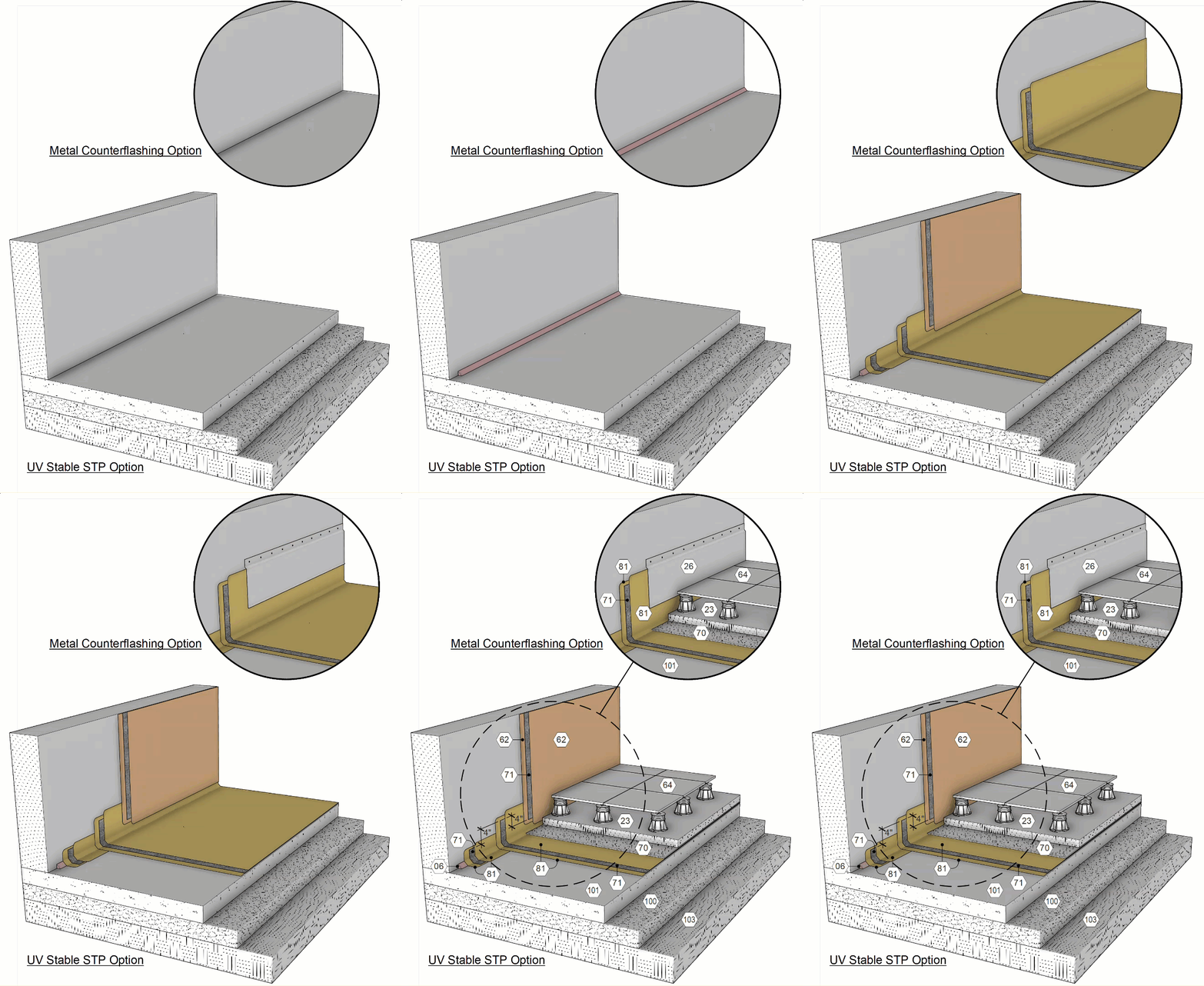
In plaza decks or tiered foundations, the transition from horizontal to vertical surfaces is a critical junction where mechanical stress and water accumulation are highest. To manage this in traditional below-grade waterproofing, the transition at the grade line (where the building meets the dirt) often relies on a mechanical termination called counterflashing. In this setup, the buried waterproofing membrane is tucked into a “reglet” (a groove cut into the wall) or fastened behind a metal strip, which is then covered by a secondary metal flashing. While this provides a physical shield against water dripping down the wall, it creates a “lap joint” that relies heavily on sealants.
As shown in the detail below, review, a more modern, high-performance approach involves a seamless transition using liquid-applied technologies. In this scenario, the buried (UV-protected) membrane is chemically bonded to a UV-stable liquid membrane that continues up the wall. Because the materials are chemically compatible the, “joint” is eliminated entirely. This ensures that the water control layer remains continuous and durable as it emerges from the soil, preventing moisture from “tipping” behind the membrane at the grade line.
Pre-Applied (Blindside) Waterproofing Systems
In dense urban environments, property lines often prevent the excavation required for post-applied systems. The membrane is fastened to the soil retention system (e.g., soldier piles and lagging, sheet piling, or shotcrete). The concrete foundation wall is then poured directly against the membrane.
The critical success factor for pre-applied systems is the mechanical and chemical bond between the membrane and the wet concrete. If the bond fails, water can migrate between the membrane and the wall, making it difficult to locate the source of a leak from the inside. Because the installer is working against a rough shoring wall, the way sheets are overlapped (shingled) is vital. In a pre-applied system, improper shingling creates a “reverse lap” that can direct groundwater behind the membrane. These counter-lapped transitions essentially act as a series of small funnels, allowing water to bypass the primary water control layer.
Corners in blindside conditions are challenging because the installer cannot easily “wrap” the corner. Fabricating corner reinforcements involves applying a secondary layer of waterproofing membrane that is welded in place to reinforce these areas before the rebar cage is installed. This ensures that when the concrete is pumped in, the pressure of the wet concrete doesn’t tear the membrane at these high-stress points.
These reinforcements at corners are critical because they prevent the weight of the wet concrete from prying the overlaps apart, ensuring the membrane remains a continuous waterproofing protection against the high hydrostatic pressure common in urban excavations.
In pre-applied scenarios, penetrations like tie-backs or utility pipes must be flashed against the shoring before the wall is poured. This often involves the use of specialized target patches and liquid flashing to ensure a watertight “sandwich” once the concrete cures.
In addition to liquid flashing and target patches, some pre-applied systems utilize specialized swelling waterstops or mechanical compression seals that are part of the overall protection strategy of the assembly. These waterstops provide a secondary physical barrier that expands when exposed to moisture, ensuring that even if the primary bond is slightly compromised the penetration or joint remains a dead-end for pressurized groundwater.
Mastering the Interface: Achieving Enclosure Continuity
A fundamental element of building enclosure design is the transition between different systems. As established in the control layers and performance section, codes are increasingly demanding that the building function as a single, airtight and watertight unit. For the foundation to truly serve as the “bottom” of this high-performance box, the below-grade waterproofing must be integrated with the above-grade layers. This interface is a vulnerable area, making the following “tie-in” details the most critical part of the entire enclosure.
Above-Grade Wall to Below-Grade Foundation
Image courtesy of Siplast.
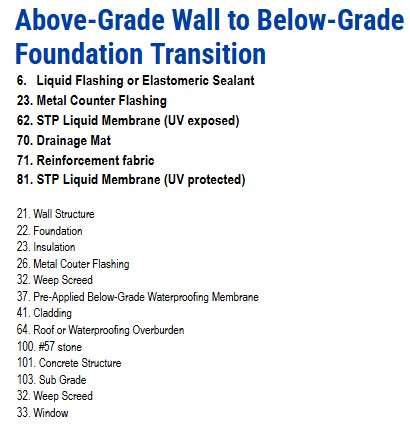
Sequencing examples detailing a transition that maintains waterproofing continuity from a post-applied below-grade system to an above-grade system.
To maintain the water control layer’s integrity from a post-applied system to the above-grade system, the below-grade membrane should extend above the finished grade (usually 8–12 inches) and will traditionally be counter-flashed by the above-grade air barrier or base-of-wall flashing. This shingle-effect ensures that any water running down the facade is directed over the foundation membrane rather than behind it, protecting the structure from incidental moisture and bulk water.
Image courtesy of Siplast
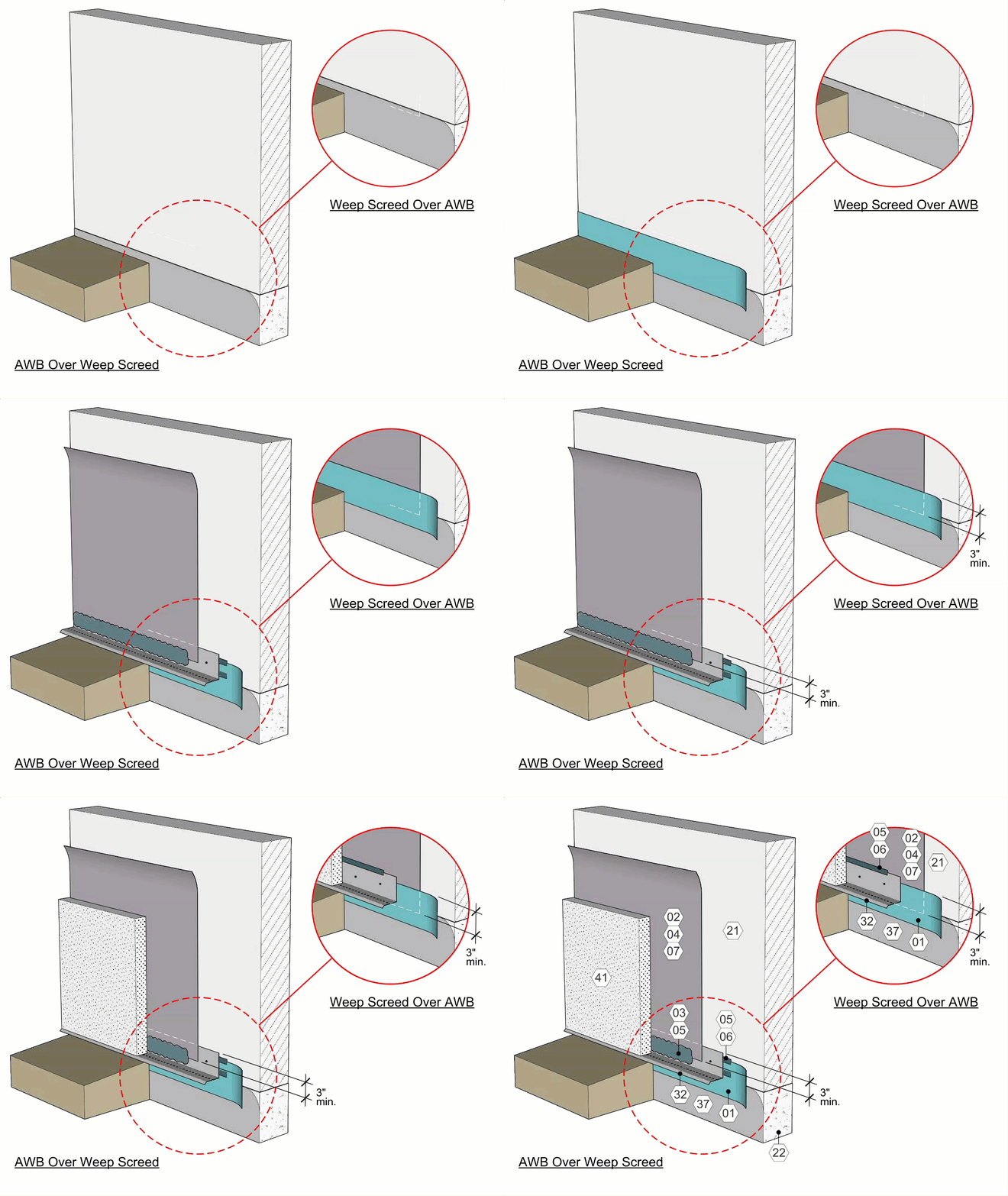
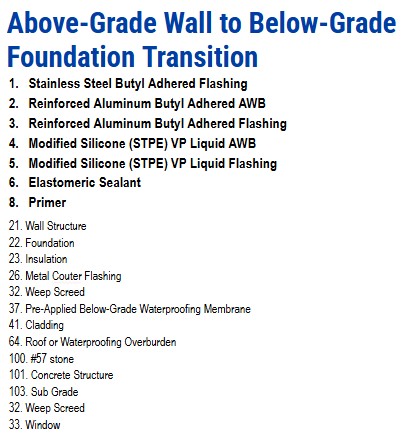
Sequencing examples detailing a transition that maintains waterproofing continuity from a pre-applied below-grade system to an above-grade system.
Transitions from pre-applied systems are often more complex because the membrane is buried against the shoring. The pre-applied membrane must be extended and turned out at the top of the shoring to enable subsequent tie-ins after the concrete is placed. These extended areas can then be tied into the horizontal waterproofing or the above-grade wall. To meet whole-building airtightness requirements, this often requires a transition strip of compatible material to bridge the gap between the SBS foundation membrane and the above-grade air barrier.
Above-Grade Horizontal Waterproofing to Below-Grade Section
When a parking garage or basement space extends beyond the footprint of the building above, the roof of the extended area also needs to be waterproofed. To ensure the continuous thermal and water control layers demanded by code, the waterproofing on this deck needs to tie into the vertical foundation walls in a waterproof manner.
Specifying for Success
Achieving a dry building requires more than just a good product; it requires coordination. To ensure a successful waterproofing system, designers should clearly define and detail air, water, and thermal continuity on the project drawings. Sequencing of installation for complex conditions should be spelled out clearly, and construction documents should identify system materials and components as well as transitions and interconnections.
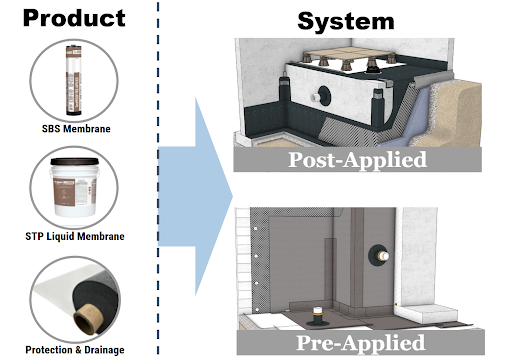
Image courtesy of Siplast
A number of waterproofing products are used to make up a waterproofing system.
Specifiers should ensure that performance criteria are included in project material specifications. The specification should also serve to define the complete scope of the system, and ensure material and system components are compatible, especially around system transitions. It should also clearly delineate submittal requirements, as well as any additional requirements such as sources limitations or warranties.
One of the most effective ways to ensure success is to utilize Division 01 of the specifications to coordinate the entire building enclosure. This involves setting clear Owner’s Project Requirements (OPR) and utilizing Building Enclosure Commissioning (BECx) to provide third-party oversight during both design and construction. By specifying a single-source manufacturer for as much of the enclosure as possible, architects can eliminate scope gaps and avoid finger-pointing. A single-source approach ensures that the materials are chemically compatible and that the warranty covers the entire assembly, providing the owner with peace of mind.
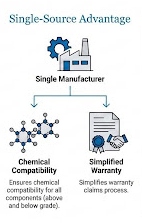
Illustration courtesy of Siplast
Advantages of specifying products and systems from a single manufacturer.
To ensure that the design intent matches the reality of the completed structure, manufacturers and contractors should be engaged early in project conversations. Manufacturers can add value in early conversations by providing expertise in materials and assemblies. Once selected, contractors should provide site-specific shop drawing, and guidance, and verify that the substrate and project conditions meet the requirements for the selected products. Early alignment with contractors can help to clarify scope, terminology, and expectations for the project, helping to avoid construction delays and miscommunications due to scope gaps.
Conclusion
As modern building codes shift toward mandatory performance thresholds, the continuity of the four primary control layers—water, air, thermal, and vapor—has become a non-negotiable requirement for compliance and durability. Whether utilizing post-applied systems for their visibility and accessibility or pre-applied systems for zero-lot-line urban constraints, the success of the installation hinges on the details.
When we bridge the gap between design and construction with clear specifications and coordinated systems, we ensure that our buildings remain dry, comfortable, and efficient for decades to come. From reinforcing high-stress corners to flashing complex pipe penetrations, mastering the interface between below-grade waterproofing and above-grade air barriers is essential to prevent moisture exploitation and ensure the building envelope is continuous.
Ultimately, achieving a dry, energy-efficient building requires a shift from the out-of-site, out-of-mind approach to a coordinated, site-specific strategy. Success is found in the early alignment of designers, manufacturers, and contractors to clearly define material compatibility and installation sequencing. By prioritizing seamless transitions and robust mechanical bonds, professionals can transform their design intent into a high-performing reality that withstands the persistent hydrostatic pressures of the buried environment.
References:
- Lstiburek, Joseph. “BSI-001: The Perfect Wall.” Building Science.com Corporation. July 15, 2010. Accessed April 5, 2025.
- Ibid.
- Meyer, Benjamin. “Parapets Part 2: Navigating Codes.” Building Science. GAF Roof Views Blog. January 24, 2020. Accessed April 8, 2025.
- Ibid.
- Kirby, Jim AIA. “Air and Water-Resistive Barriers.” Siplast. March 2024. Accessed April 8, 2025.
- Ibid.
- Meyer, Benjamin. “Designing for Moisture Durability & Energy Efficiency.” Building Science. GAF Roof Views Blog. May 6, 2020. Accessed April 8, 2020.
Benjamin Meyer, Siplast’s Building Enclosure Business Director, is an architect and consultant. He has chaired ASHRAE 90.1 and served on LEED and ABAA boards.
Chris Fetterman is the Building Enclosure Technical Manager for Siplast, where he supports the below-grade waterproofing portfolio and provides expertise on high-performance enclosure systems.