J
Image courtesy of PABCO Gypsum
Show Me the Money – The Economics of STC-Rated Walls will explore the economics, design methods of sound control, substitutions, environmental impact, and calculate the true value.
Quiet as a Design Advantage: What Architects Need to Know
Ask almost anyone who has lived in an apartment, stayed in a hotel, or worked in collaborative office spaces what they disliked about the building, and “noise” will usually make the top three. Yet acoustics often remains one of the quietest topics in design meetings.
For architects, that’s a missed opportunity. Acoustic performance is not just a technical specialty; it’s a core part of the Health, Safety, and Welfare (HSW) mandate. Sound affects sleep, concentration, privacy, and perceived quality. A poorly performing wall can undo thousands of dollars of investment in finishes and furnishings.
At the same time, every improvement in sound isolation carries a cost. Additional layers of gypsum board, more complex framing, specialty acoustic panels, decoupling systems, sealants, inspection time—these all show up in the bid. Owners understandably ask, “Why is this wall so expensive? And what do I get for that money?”
Architects are perfectly positioned to answer these questions. You already think in systems: structure, envelope, egress, daylighting. Acoustics is simply another system—one that needs to be understood not just in decibels, but in dollars.
This article explores the economics of STC-rated walls from the architect’s perspective. It uses the familiar language of wall types and details, but overlays that with cost, labor, and value so you can:
- Set realistic STC targets for different spaces
- Choose assemblies that hit those targets efficiently
- Understand how much each “acoustic upgrade” actually costs
- Defend those assemblies during value engineering by showing the true cost
We’ll explore the economics, design methods of sound control, substitutions, environmental impact, and calculate the true value—and go deeper into each.
The Economic Climate Around Wall Construction
For better or worse, we no longer operate in a world of stable material prices. Wall assemblies that were once considered “standard” can become temporarily unaffordable, only to return to affordability two years later. Understanding what’s driving this volatility helps you explain to owners why certain acoustic strategies make sense even when line-item prices appear higher.
Material Volatility
Steel studs are particularly sensitive to global and policy factors. Their price is influenced by:
- Raw Material (iron ore/scrap steel) 40–50%
- Energy prices for smelting and rolling 5–10%
- Labor (manufacturing & handling) 5–8%
- Transportation & Logistics 5–7%
- Trade Policies & Tariffs 0–50%
- Overhead & Plant Maintenance 5–7%
- Global and Regional Demand & Speculation 5–15%
In practice, this means stud costs can swing 20–30% in a relatively short time. A stud wall that would have cost $8/ft² two years ago might be close to $10/ft² today purely because steel went up—even if gypsum stayed flat.
Wood studs also has its set of cost drivers that influence the market price of wood framing:
- Raw Material (logs/timber) 35 – 45%
- Milling & Processing 15 – 20% • Energy (electricity, kiln fuel, sawmill) 3 – 5%
- Transportation & Logistics 8–12% • Labor (handling, distribution) 5 – 7%
- Regulatory & Environmental Compliance 2 – 5%
- Market Demand & Price Premiums 10 – 20%
The key economic differences between wood and steel are that the raw material’s share is slightly lower for wood than steel but milling & processing are a bigger portion. Conversely, transportation has a higher percentage impact on wood because studs are bulky and lower value per pound compared to steel.
Gypsum board is somewhat more stable, but still affected by fuel costs, supply chain disruptions, and the growing share of specialty products. Lightweight, mold-resistant, abuse-resistant, and Constained-Layer Damped (CLD) panels all occupy niches with price premiums. Commodity type X board may still be relatively inexpensive, but when projects require abuse resistance, mold control, or high STC, the panel cost picture changes.
The key economic point: when you’re choosing between “add one more layer of cheap board” and “use a more expensive but higher-performance panel”, you can’t just look at the material quote. You must look at installed cost for the required acoustic performance that the wall must achieve. The labor component is often larger than the material cost alone.
Labor as a Moving Target
Construction labor is subject to forces of its own: demographics, training pipelines, union agreements, regional booms, and immigration patterns. Wages for drywall installers and finishers have risen steadily in many markets and are not expected to drop.
A critical fact for wall design is this: for typical interior partitions, labor represents 48%-54% of total cost of the wall. This is based on RS Means Construction Data. This has a direct implication: if you specify an assembly that reduces the number of touches—fewer layers to hang, fewer framing members to cut and install—your design can save money even if the material unit cost is higher.
Let’s look at three different markets and see how these examples track through this discussion. The cost of 5/8” type X drywall without finishing applied to walls with Open Shop and Union labor for the application is:
- New York City – a high labor market
- Open Shop $0.98 / Union $1.25 per ft2
- Kansas City – on par with the National Average
- Open Shop $0.58 / Union $0.73 per ft2
- Dallas – a very low labor market
- Open Shop $0.37 / Union $0.47 per ft2

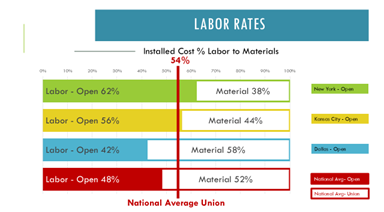
Chart courtesy of PABCO Gypsum, RE Means Construction Data, Open Shop and Union Labor
Installed cost of an interior partition: labor cost verses material cost comparison, Open shop for New York City, Kansas City, Dallas and US National Average.
Given these labor rates and the regional material costs, we can look at these markets as arrange of the percentage of labor verses material for installing that layer of gypsum drywall. Taking a conservative approach and only considering the lower Open Shop cost we see the labor percentage range expanse from 42% in Dallas to 62% in New York City.
Why Labor Dominates
Several realities explain why labor looms so large:
- Multiple trades and passes – Layout, framing, insulation, board hanging, taping, sanding, caulking, painting—each stage involves separate crew mobilizations and supervision.
- Skill requirements – Acoustic details from resilient channels to commodity gypsum panels, to sealant application, require experienced installers. Errors are costly to fix once walls are finished.
- Schedule pressure – Accelerated schedules lead to overtime, stacking trades in the same area, and higher crew costs.
- Regional wage differences – A drywall hanger in New York or San Francisco may cost double compared to one in a lower labor market like Dallas or Washington DC, dramatically changing the labor-to-material ratio.
How Design Influences Labor
Architects have more influence over labor cost than they might think. Design decisions that increase labor intensity include adding multiple layers of drywall to reach an STC target or with intricate decoupling schemes with fussy sound clip patterns or resilient channels that are prone to field error.
Design decisions that reduce labor intensity include choosing assemblies that achieve a given STC with fewer layers, fewer parts, or fewer passes. For example, installing one CLD panel instead of two standard layers of commodity type X. Moving stud spacing from 16” to 24” o.c. where allowed by code and structural conditions, reducing the number of studs, screws, and cuts.
Labor as a Hedge Against Inflation
Industry data in recent years suggest that labor rates for gypsum and framing trades are growing faster than material costs. Each percentage point of wage inflation pushes installed costs higher even if material pricing is flat.
An assembly that reduces labor sensitivity—by simplifying installation, limiting the number of operations, and reducing rework risk—therefore acts as a long-term hedge. Architects who design for labor simplicity are indirectly protecting their clients from future cost shocks.
We’ll revisit labor in more detail when we examine different wall configurations, but for now it’s enough to recognize that the “expensive” acoustic panel may be labor-cheap, while the “cheap” multi-layer solution may be labor-heavy. If you only look at material unit cost, you’re missing the full economic picture.
STC: What the Number Means in Real Life
Sound Transmission Class (STC) is the primary method of describing airborne sound isolation in North America. It compresses a lot of frequency-specific lab data into a single number that can fit on a wall tag, a spec line, or a code requirement. As an architect, you don’t need to calculate STC yourself, but you do need to know what different values imply:
- STC 35–40 – Conversations on the other side are clearly audible and intelligible. This is common for basic residential interior walls or office partitions with doors.
- STC 45–49 – Voices are still audible, but intelligible only at higher levels. This may be acceptable for many non-critical partitions, but people will still “hear” that someone is talking.
- STC 50–54 – Normal speech is muffled; words are largely unintelligible. This is the typical benchmark for dwelling unit separations and hotel guestroom walls.
- STC 55+ – Loud speech is only faintly heard; most content is not intelligible. This is the domain of high-end hospitality, patient rooms in hospitals, executive offices, and confidential spaces.
It is vital to remember that these values are based on laboratory testing under ASTM E90, with ideal construction tolerances, perfect sealant, no outlets, and no flanking paths. In the field, measurements under ASTM E336 (often expressed as Apparent Sount Transmission Class (ASTC) are typically 3–7 points lower than the lab rating, and sometimes more.
The building codes and reference standards provide minimum STC values for some occupancy types, but they rarely address the nuances of client expectations. A luxury multifamily project with code-minimum acoustics is unlikely to feel “luxury” once real people move in.
From the architect’s perspective, STC is a bridge between experience and specification:
- In healthcare, acoustic privacy is tied to patient dignity, HIPAA concerns, and staff stress.
- In education, poor acoustics undermine speech intelligibility, attention, and learning outcomes.
- In offices, acoustical comfort influences productivity, distraction, and the perceived quality of the workplace.
- In hospitality and multifamily, acoustic comfort drives online ratings and renewal decisions.
When you put an STC value next to a wall type in your drawings, you are making a promise about that experience. The real economic question becomes: how can we keep that promise in the field, and what is the smartest way to pay for it?
The Three Levers of Sound Control: Mass, Decoupling, and Damping
Effective wall assemblies rely on three physical principles: mass, decoupling, and damping. Each offers different tradeoffs of performance, cost, and wall thickness.
Mass: Simple but Not Always Efficient
Adding mass—usually additional layers of gypsum—has been the default acoustic strategy for decades. The physics is straightforward: heavier assemblies are harder to set into motion. Mass is especially effective at blocking lowerfrequency sound (HVAC rumble, city noise, amplified bass), which is difficult to attenuate otherwise.
However, the relationship between mass and STC is logarithmic, not linear. Doubling the mass of a wall does not double the STC rating; it generally increases it by only about 4 points. That means, economically:
- The first extra layer of drywall may be relatively cost-effective.
- The second and third layers yield diminishing returns.
- Each additional layer adds labor and thickness but fewer STC points.
When wall thickness is unconstrained and labor is cheap, mass may still be acceptable. But in most modern projects, neither of those conditions is true.
Another real concern is space. Even though we are talking about adding 5/8” to each side of the wall we are increasing the wall thickness and depleting the useable space of the room. This also means in some cases, thicker, more expensive door jams, window framings, etc.
Decoupling: Big Gains, Bigger Complexity
Decoupling strategies reduce or break the direct mechanical path between the two faces of a wall so that vibration on one side cannot easily drive vibration on the other. Methods include: • Resilient channels that support the drywall on a springy metal member rather than the stud • Staggered studs, where alternating studs carry each side of the wall and do not touch the opposite face • Double-stud walls, where two separate rows of studs support each face, separated by an air gap When done correctly, these configurations can deliver large improvements in STC—often in the range of 5–10 points compared to a single-stud wall. However, they come with trade-offs: • Added thickness – staggered and double-stud walls are significantly thicker, adding 4” to 6”, consuming usable floor area • Installation sensitivity – if resilient channels are installed backwards, or gypsum screws penetrate through to studs, the acoustic benefit is negated almost entirely • Inspection and coordination – these assemblies require more precise installation and careful supervision to be installed correctly. They are more vulnerable to complications in the field. That complexity is not just a technical risk; it’s an economic one. Complex assemblies tend to carry higher labor costs, greater risk premiums from contractors, and more variability in field performance.
Constrained-Layer Damping (CLD): Performance Without Thickness
CLD panels take a different approach. Instead of only adding mass or separating components, they introduce a viscoelastic damping polymer constrained between gypsum layers. When sound energy hits the wall, the layers shear against each other and the polymer dissipates the vibrational energy.
In practical terms, CLD assemblies:
- Provide 5–15 additional STC points over traditional walls
- Switching to CLD panels will not increase wall thickness
- Can be installed with the same methods used for regular gypsum (same crews, tools, and sequencing)
The economic significance is that CLD panels can replace multiple layers of board or some decoupling strategies with one product and one installation step, reducing labor hours, error risk, and overall wall thickness. CLD assemblies exploit this labor reality by delivering acoustic gains with minimal change in crew behavior. Contractors don’t need to learn a new process; they only handle a different panel type. Fewer layers mean fewer passes, fewer joints, and fewer places to go wrong.
The tradeoff is that the materials cost is higher when compared to commodity type X gypsum drywall.
From a value perspective, CLD often delivers a lower cost solution than alternatives, even though the material unit price is higher. This is the heart of the “show me the money” argument: owners don’t buy panels, they buy performance. Panels are just one component in an assembly to achieve the targeted performance.
Pulling Multiple Levers to Achieve Results
The beauty of these three physical principles is that they are not mutually exclusive. They can be combined to exploit the strengths of each to create walls with high results. For example, you may find the need for an STC 60 or 65 wall and find solutions that incorporate sound isolation clips, CLD panels and multiple layers of commodity type X gypsum panels. In this case all three principles, decoupling from the clips, mass from the multiple layers of type x, and damping from the CLD panel are required to work in unison to achieve the lofty STC target efficiently.
The economic takeaway for architects is that simplifying assembly steps is one of the most powerful ways to control wall cost, labor cost and build schedule.
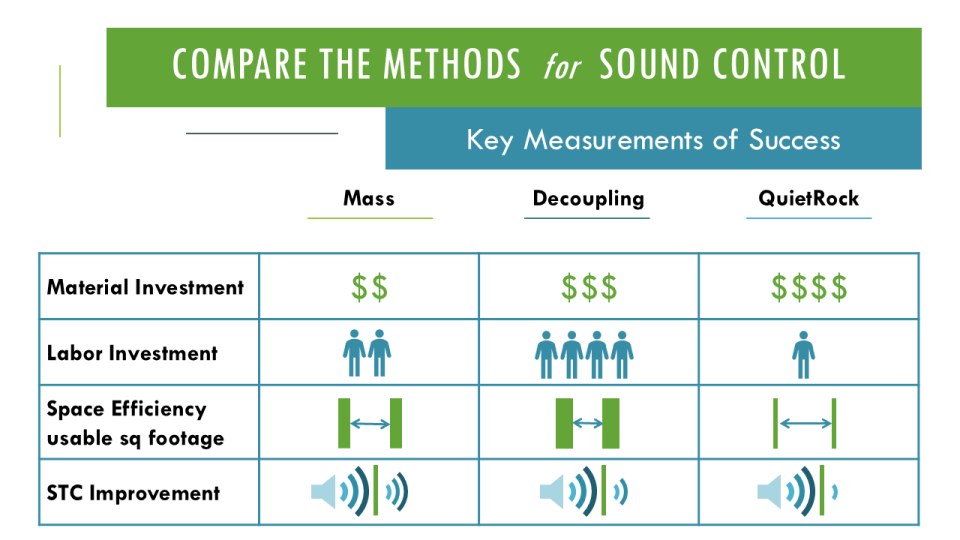
Image courtesy of PABCO Gypsum, The Sound Design Guide, RS Means Construction Data, Q3 2025, National Average, Union Labor
Comparison of mass-only, decoupled, and CLD assemblies, showing typical STC gains, added thickness, and relative labor impact.
J
Image courtesy of PABCO Gypsum
Show Me the Money – The Economics of STC-Rated Walls will explore the economics, design methods of sound control, substitutions, environmental impact, and calculate the true value.
Quiet as a Design Advantage: What Architects Need to Know
Ask almost anyone who has lived in an apartment, stayed in a hotel, or worked in collaborative office spaces what they disliked about the building, and “noise” will usually make the top three. Yet acoustics often remains one of the quietest topics in design meetings.
For architects, that’s a missed opportunity. Acoustic performance is not just a technical specialty; it’s a core part of the Health, Safety, and Welfare (HSW) mandate. Sound affects sleep, concentration, privacy, and perceived quality. A poorly performing wall can undo thousands of dollars of investment in finishes and furnishings.
At the same time, every improvement in sound isolation carries a cost. Additional layers of gypsum board, more complex framing, specialty acoustic panels, decoupling systems, sealants, inspection time—these all show up in the bid. Owners understandably ask, “Why is this wall so expensive? And what do I get for that money?”
Architects are perfectly positioned to answer these questions. You already think in systems: structure, envelope, egress, daylighting. Acoustics is simply another system—one that needs to be understood not just in decibels, but in dollars.
This article explores the economics of STC-rated walls from the architect’s perspective. It uses the familiar language of wall types and details, but overlays that with cost, labor, and value so you can:
- Set realistic STC targets for different spaces
- Choose assemblies that hit those targets efficiently
- Understand how much each “acoustic upgrade” actually costs
- Defend those assemblies during value engineering by showing the true cost
We’ll explore the economics, design methods of sound control, substitutions, environmental impact, and calculate the true value—and go deeper into each.
The Economic Climate Around Wall Construction
For better or worse, we no longer operate in a world of stable material prices. Wall assemblies that were once considered “standard” can become temporarily unaffordable, only to return to affordability two years later. Understanding what’s driving this volatility helps you explain to owners why certain acoustic strategies make sense even when line-item prices appear higher.
Material Volatility
Steel studs are particularly sensitive to global and policy factors. Their price is influenced by:
- Raw Material (iron ore/scrap steel) 40–50%
- Energy prices for smelting and rolling 5–10%
- Labor (manufacturing & handling) 5–8%
- Transportation & Logistics 5–7%
- Trade Policies & Tariffs 0–50%
- Overhead & Plant Maintenance 5–7%
- Global and Regional Demand & Speculation 5–15%
In practice, this means stud costs can swing 20–30% in a relatively short time. A stud wall that would have cost $8/ft² two years ago might be close to $10/ft² today purely because steel went up—even if gypsum stayed flat.
Wood studs also has its set of cost drivers that influence the market price of wood framing:
- Raw Material (logs/timber) 35 – 45%
- Milling & Processing 15 – 20% • Energy (electricity, kiln fuel, sawmill) 3 – 5%
- Transportation & Logistics 8–12% • Labor (handling, distribution) 5 – 7%
- Regulatory & Environmental Compliance 2 – 5%
- Market Demand & Price Premiums 10 – 20%
The key economic differences between wood and steel are that the raw material’s share is slightly lower for wood than steel but milling & processing are a bigger portion. Conversely, transportation has a higher percentage impact on wood because studs are bulky and lower value per pound compared to steel.
Gypsum board is somewhat more stable, but still affected by fuel costs, supply chain disruptions, and the growing share of specialty products. Lightweight, mold-resistant, abuse-resistant, and Constained-Layer Damped (CLD) panels all occupy niches with price premiums. Commodity type X board may still be relatively inexpensive, but when projects require abuse resistance, mold control, or high STC, the panel cost picture changes.
The key economic point: when you’re choosing between “add one more layer of cheap board” and “use a more expensive but higher-performance panel”, you can’t just look at the material quote. You must look at installed cost for the required acoustic performance that the wall must achieve. The labor component is often larger than the material cost alone.
Labor as a Moving Target
Construction labor is subject to forces of its own: demographics, training pipelines, union agreements, regional booms, and immigration patterns. Wages for drywall installers and finishers have risen steadily in many markets and are not expected to drop.
A critical fact for wall design is this: for typical interior partitions, labor represents 48%-54% of total cost of the wall. This is based on RS Means Construction Data. This has a direct implication: if you specify an assembly that reduces the number of touches—fewer layers to hang, fewer framing members to cut and install—your design can save money even if the material unit cost is higher.
Let’s look at three different markets and see how these examples track through this discussion. The cost of 5/8” type X drywall without finishing applied to walls with Open Shop and Union labor for the application is:
- New York City – a high labor market
- Open Shop $0.98 / Union $1.25 per ft2
- Kansas City – on par with the National Average
- Open Shop $0.58 / Union $0.73 per ft2
- Dallas – a very low labor market
- Open Shop $0.37 / Union $0.47 per ft2
Chart courtesy of PABCO Gypsum, RE Means Construction Data, Open Shop and Union Labor
Installed cost of an interior partition: labor cost verses material cost comparison, Open shop for New York City, Kansas City, Dallas and US National Average.
Given these labor rates and the regional material costs, we can look at these markets as arrange of the percentage of labor verses material for installing that layer of gypsum drywall. Taking a conservative approach and only considering the lower Open Shop cost we see the labor percentage range expanse from 42% in Dallas to 62% in New York City.
Why Labor Dominates
Several realities explain why labor looms so large:
- Multiple trades and passes – Layout, framing, insulation, board hanging, taping, sanding, caulking, painting—each stage involves separate crew mobilizations and supervision.
- Skill requirements – Acoustic details from resilient channels to commodity gypsum panels, to sealant application, require experienced installers. Errors are costly to fix once walls are finished.
- Schedule pressure – Accelerated schedules lead to overtime, stacking trades in the same area, and higher crew costs.
- Regional wage differences – A drywall hanger in New York or San Francisco may cost double compared to one in a lower labor market like Dallas or Washington DC, dramatically changing the labor-to-material ratio.
How Design Influences Labor
Architects have more influence over labor cost than they might think. Design decisions that increase labor intensity include adding multiple layers of drywall to reach an STC target or with intricate decoupling schemes with fussy sound clip patterns or resilient channels that are prone to field error.
Design decisions that reduce labor intensity include choosing assemblies that achieve a given STC with fewer layers, fewer parts, or fewer passes. For example, installing one CLD panel instead of two standard layers of commodity type X. Moving stud spacing from 16” to 24” o.c. where allowed by code and structural conditions, reducing the number of studs, screws, and cuts.
Labor as a Hedge Against Inflation
Industry data in recent years suggest that labor rates for gypsum and framing trades are growing faster than material costs. Each percentage point of wage inflation pushes installed costs higher even if material pricing is flat.
An assembly that reduces labor sensitivity—by simplifying installation, limiting the number of operations, and reducing rework risk—therefore acts as a long-term hedge. Architects who design for labor simplicity are indirectly protecting their clients from future cost shocks.
We’ll revisit labor in more detail when we examine different wall configurations, but for now it’s enough to recognize that the “expensive” acoustic panel may be labor-cheap, while the “cheap” multi-layer solution may be labor-heavy. If you only look at material unit cost, you’re missing the full economic picture.
STC: What the Number Means in Real Life
Sound Transmission Class (STC) is the primary method of describing airborne sound isolation in North America. It compresses a lot of frequency-specific lab data into a single number that can fit on a wall tag, a spec line, or a code requirement. As an architect, you don’t need to calculate STC yourself, but you do need to know what different values imply:
- STC 35–40 – Conversations on the other side are clearly audible and intelligible. This is common for basic residential interior walls or office partitions with doors.
- STC 45–49 – Voices are still audible, but intelligible only at higher levels. This may be acceptable for many non-critical partitions, but people will still “hear” that someone is talking.
- STC 50–54 – Normal speech is muffled; words are largely unintelligible. This is the typical benchmark for dwelling unit separations and hotel guestroom walls.
- STC 55+ – Loud speech is only faintly heard; most content is not intelligible. This is the domain of high-end hospitality, patient rooms in hospitals, executive offices, and confidential spaces.
It is vital to remember that these values are based on laboratory testing under ASTM E90, with ideal construction tolerances, perfect sealant, no outlets, and no flanking paths. In the field, measurements under ASTM E336 (often expressed as Apparent Sount Transmission Class (ASTC) are typically 3–7 points lower than the lab rating, and sometimes more.
The building codes and reference standards provide minimum STC values for some occupancy types, but they rarely address the nuances of client expectations. A luxury multifamily project with code-minimum acoustics is unlikely to feel “luxury” once real people move in.
From the architect’s perspective, STC is a bridge between experience and specification:
- In healthcare, acoustic privacy is tied to patient dignity, HIPAA concerns, and staff stress.
- In education, poor acoustics undermine speech intelligibility, attention, and learning outcomes.
- In offices, acoustical comfort influences productivity, distraction, and the perceived quality of the workplace.
- In hospitality and multifamily, acoustic comfort drives online ratings and renewal decisions.
When you put an STC value next to a wall type in your drawings, you are making a promise about that experience. The real economic question becomes: how can we keep that promise in the field, and what is the smartest way to pay for it?
The Three Levers of Sound Control: Mass, Decoupling, and Damping
Effective wall assemblies rely on three physical principles: mass, decoupling, and damping. Each offers different tradeoffs of performance, cost, and wall thickness.
Mass: Simple but Not Always Efficient
Adding mass—usually additional layers of gypsum—has been the default acoustic strategy for decades. The physics is straightforward: heavier assemblies are harder to set into motion. Mass is especially effective at blocking lowerfrequency sound (HVAC rumble, city noise, amplified bass), which is difficult to attenuate otherwise.
However, the relationship between mass and STC is logarithmic, not linear. Doubling the mass of a wall does not double the STC rating; it generally increases it by only about 4 points. That means, economically:
- The first extra layer of drywall may be relatively cost-effective.
- The second and third layers yield diminishing returns.
- Each additional layer adds labor and thickness but fewer STC points.
When wall thickness is unconstrained and labor is cheap, mass may still be acceptable. But in most modern projects, neither of those conditions is true.
Another real concern is space. Even though we are talking about adding 5/8” to each side of the wall we are increasing the wall thickness and depleting the useable space of the room. This also means in some cases, thicker, more expensive door jams, window framings, etc.
Decoupling: Big Gains, Bigger Complexity
Decoupling strategies reduce or break the direct mechanical path between the two faces of a wall so that vibration on one side cannot easily drive vibration on the other. Methods include: • Resilient channels that support the drywall on a springy metal member rather than the stud • Staggered studs, where alternating studs carry each side of the wall and do not touch the opposite face • Double-stud walls, where two separate rows of studs support each face, separated by an air gap When done correctly, these configurations can deliver large improvements in STC—often in the range of 5–10 points compared to a single-stud wall. However, they come with trade-offs: • Added thickness – staggered and double-stud walls are significantly thicker, adding 4” to 6”, consuming usable floor area • Installation sensitivity – if resilient channels are installed backwards, or gypsum screws penetrate through to studs, the acoustic benefit is negated almost entirely • Inspection and coordination – these assemblies require more precise installation and careful supervision to be installed correctly. They are more vulnerable to complications in the field. That complexity is not just a technical risk; it’s an economic one. Complex assemblies tend to carry higher labor costs, greater risk premiums from contractors, and more variability in field performance.
Constrained-Layer Damping (CLD): Performance Without Thickness
CLD panels take a different approach. Instead of only adding mass or separating components, they introduce a viscoelastic damping polymer constrained between gypsum layers. When sound energy hits the wall, the layers shear against each other and the polymer dissipates the vibrational energy.
In practical terms, CLD assemblies:
- Provide 5–15 additional STC points over traditional walls
- Switching to CLD panels will not increase wall thickness
- Can be installed with the same methods used for regular gypsum (same crews, tools, and sequencing)
The economic significance is that CLD panels can replace multiple layers of board or some decoupling strategies with one product and one installation step, reducing labor hours, error risk, and overall wall thickness. CLD assemblies exploit this labor reality by delivering acoustic gains with minimal change in crew behavior. Contractors don’t need to learn a new process; they only handle a different panel type. Fewer layers mean fewer passes, fewer joints, and fewer places to go wrong.
The tradeoff is that the materials cost is higher when compared to commodity type X gypsum drywall.
From a value perspective, CLD often delivers a lower cost solution than alternatives, even though the material unit price is higher. This is the heart of the “show me the money” argument: owners don’t buy panels, they buy performance. Panels are just one component in an assembly to achieve the targeted performance.
Pulling Multiple Levers to Achieve Results
The beauty of these three physical principles is that they are not mutually exclusive. They can be combined to exploit the strengths of each to create walls with high results. For example, you may find the need for an STC 60 or 65 wall and find solutions that incorporate sound isolation clips, CLD panels and multiple layers of commodity type X gypsum panels. In this case all three principles, decoupling from the clips, mass from the multiple layers of type x, and damping from the CLD panel are required to work in unison to achieve the lofty STC target efficiently.
The economic takeaway for architects is that simplifying assembly steps is one of the most powerful ways to control wall cost, labor cost and build schedule.
Image courtesy of PABCO Gypsum, The Sound Design Guide, RS Means Construction Data, Q3 2025, National Average, Union Labor
Comparison of mass-only, decoupled, and CLD assemblies, showing typical STC gains, added thickness, and relative labor impact.
Framing Materials and Configurations
Framing does much more than hold up gypsum board and paint. It defines the geometry, stiffness, and resonance of the wall—directly affecting STC and cost.
Steel vs. Wood
Steel studs dominate commercial interior work. They are straight, dimensionally stable, noncombustible, and easy to coordinate with fire ratings. Their cost is tied to global steel prices, energy, and tariffs. Wood studs remain common in low-rise residential and light commercial construction. They offer lower embodied energy and familiar construction practices but are sensitive to moisture and dimensional change. Shrinkage, warpage, or differential movement can create cracks and gaps that undermine acoustical seals. For acoustics, what matters is not just the stud material but its mass, spacing, and flexibility. The more resilient the framing is, the more acoustically advantageous the wall becomes. Thinner mil thickness framing will provide higher STC results than thicker mil studs or wood framing. Heavier studs can shift the wall’s resonance; closer spacing can increase stiffness and reduce damping. The result is that “stronger” or “tighter” framing does not necessarily mean better sound control.
Spacing and Configuration
Dramatic acoustic performance can be achieved by addressing the more subtle issue: spacing and configuration. This applies to both wood and steel assemblies.
First let’s explore spacing with this example of two very similar walls:
Both walls are designed with 3-5/8” 33mil, steel studs, R-13 insulation in the cavity, on one side there is a CLD panel on the opposite side there is a commodity type X panel. They both comply with UL U425 and have a 1-hour, load bearing fire-resistance rating.
- Single-stud, 16” o.c.: will have an STC 40 and will cost $10.28/ft2 to construct.
- Single-stud, 24” o.c.: by moving the studs further apart, the STC improves by 12 STC points to 52 because the wall is less stiff and transmits fewer vibrations and saves $1.20/ft2. Fewer studs reduce stiffness and bridging, often improving STC and saving material and labor.
Here, simply changing stud spacing yields higher STC at lower cost. That kind of result is only visible when you look beyond “standard details” and consider acoustics and economics together.
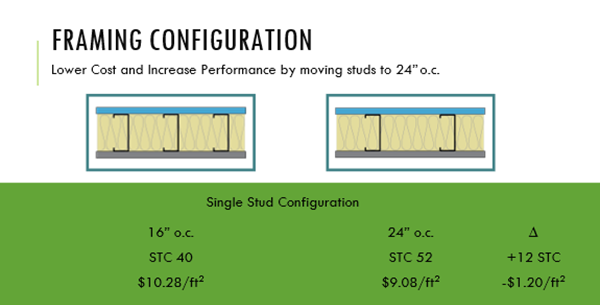
Image courtesy of PABCO Gypsum, The Sound Design Guide, North Orbit Acoustical Laboratory Test reports 22-0918 and 22-0907, RS Means Construction Data, Q3 2025, National Average, Union Labor
Comparison of STC performance increase and cost decrease by changing stud spacing from 16” o.c. to 24” o.c.
Configuration has a profound effect on both performance, wall thickness and installed cost:
- Single-stud: The most common baseline; structurally efficient but directly couples both faces of the wall.
- Staggered-stud: Dramatically reduces direct structural connection, providing strong acoustic gains at the cost of added thickness.
- Double-stud: Maximizes decoupling and STC at the cost of even greater thickness and material.
In this example we will look at wood studs, but the same principles hold true for their steel framed cousins. Our baseline assembly will be 2x4 wood framing 16” o.c. with insulation in the cavity and one layer of CLD panel on each side.
- Baseline – STC 45 - Installed Cost $10.18/ft2
- If we stagger those studs our STC improves to STC 53 and our cost increases by $2.14 to $12.32/ft2
Obviously, better performing solutions come at a higher cost. But we have more control on all these levers than you might think.Moving further we can construct a double stud wall with a 1” airgap. Again, we see STC performance improvement to STC 61 along with the relative installed cost increase to $13.46/ft2.
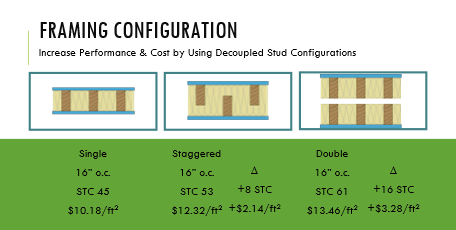
Image courtesy of PABCO Gypsum, The Sound Design Guide, North Orbit Acoustical Laboratory Test reports 20-0412, 17-0939, and 21-0741, RS Means Construction Data, Q3 2025, National Average, Union Labor
Comparison Single, Staggered, Double Woods Studs impact on STC performance and cost.
Insulation, Sealants, and Detailing – The Small Things That Matter
High-performance gypsum and stud configurations get most of the attention, but from an economic perspective, insulation and sealants punch far above their weight contributing STC points to achieve your goal.
Insulation in the Cavity
Adding mineral wool or fiberglass batts to a stud cavity typically yields 2–4 extra STC points at very low cost. The cost per STC point is often in the range of $0.20–0.30. The wall would rarely be considered acoustically complete without it. Insulation:
- Increases sound absorption within the cavity
- Smooths out the STC curve across certain frequencies
- Contributes to fire and thermal performance depending on product
The key is to treat insulation as necessary but not sufficient. On its own, it cannot deliver dramatic STC improvements. It must be combined with mass, decoupling, or damping. Nonetheless, it is almost always worth including in any sound-rated partition.
Sealants and Perimeter Joints
If insulation is the easiest way to add STC, gaps are the easiest way to lose them—flanking. Acoustic performance is only as good as the weakest path between rooms. A 1/4-inch gap under a base track, an unsealed head of wall, or a crack at the edge of a door frame can steal away 10 STC points or more. Penetrations and unsealed joints create flanking paths that bypass even the best of wall designs.
ASTM C919 requires:
- Continuous acoustical sealant at the perimeter of sound-rated partitions
- Sealant at any gypsum-to-non-gypsum junction (e.g., drywall to concrete or masonry)
- Other designated locations where continuous mass is interrupted
Architectural drawings must make these requirements explicit. If sealant is only mentioned in a general note, it may be missed during bidding or downgraded in the field. Calling it out in the details and the partition schedules reduces that risk.
From an economic standpoint, acoustical sealant is extraordinarily cheap relative to the STC points it protects. The real cost risk comes not from buying the tube, but from coordination failure: if the detail is omitted from the drawings or not enforced in the field, the acoustic performance you paid for in materials and labor can be lost to flanking.
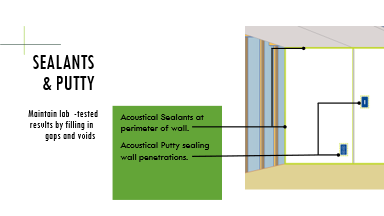
Image courtesy of PABCO Gypsum
Detail sketches demonstrating effective perimeter of wall acoustic sealant and wall penetration acoustic putty applications.
Penetrations and Devices
Outlets, switches, and other penetrations must be treated with the same seriousness as doors or windows when it comes to acoustics:
- Avoid back-to-back boxes • Stagger boxes in separate cavities on opposite sides of the wall, both horizontally and vertically
- Use acoustical putty pads in STC partitions
- Keep large duct penetrations and risers away from the most acoustically sensitive separations
It is easy for drawings to show a perfect assembly and for the field to build something different. The more explicit you are about the treatment of penetrations; the closer field results will match the lab test. These are not exotic measures. They are the “last 10%” of detailing that ensures your STC numbers are achievable, not hypothetical.
Substitutions and Value Engineering: Where Performance Goes to Die
On many projects “value engineering” becomes code for reduce first cost. In acoustics, however, unchecked substitutions almost always create negative value—higher lifecycle cost, missing acoustical targets and lower occupant satisfaction. Substitutions, however, are a reality of practice. Contractors have relationships with suppliers, preferences for certain brands, and legitimate concerns about lead times. But in acoustic design, small substitutions can have large consequences. What do you do when faced with a substitution request on an acoustically rated partition? I suggest we need to look at the new cost of the assembly. What is the new direct material cost, what is the new installation cost, and are there any costs associated with this change on the build schedule? If costs are in alignment, then the next step is crucial. You must evaluate the acoustic performance. Nearly always this means looking at a new STC test. Any deviation from an STC tested assembly will necessitate a new acoustic test to validate results. If the new costs are lower and the new STC result is equal to or better, then you have a viable substitution. Most often you don’t get to check both boxes. Here are a few of the most common substitution requests observed with acoustic assemblies.
Example 1 – Drywall Type Change
Your original design had a CLD panel on each side with studs spaced at 24” o.c. You achieved a 1-hour fire-resistance rating and STC 52 complying with Building Code and your cost was $9.08/ ft². Contractor gets sticker shock or does not think that the CLD panels are any different than commodity type X. The result—the wall was less expensive, saving $1.31; BUT you fell far short of the required STC by only achieving STC 45.
Example 2 – Double Gypsum Swap
You offered the same original design with a CLD panel on each side with studs spaced at 24” o.c. You achieved a 1-hour fire-resistance rating and STC 52 complying with Building Code and your cost was $9.08/ ft². This time the contractor knowing that CLD panels add performance, but got sticker shot, goes to his tried-and-true solution that he, his father, and his grandfather had been installing for decades: double commodity type X on each side. The result: he did achieve STC 50 so you are still in compliance with Building Code. But he looked only at the material cost and neglected the cost of installing those additional layers. The cost to install this system rose by $1.23/ ft² to $10.31/ ft², resulting in economic failure.
Example 3 – Stud Spacing Change
Compare to your same original design with a CLD panel on each side with studs spaced at 24” o.c. You achieved a 1-hour fire-resistance rating and STC 52 complying with Building Code and your cost was $9.08/ ft². This time this contractor says, “I don’t believe in 24” o.c. studs.” So, he only wanted to build the wall at 16” o.c. The result is a double failure. By tightening up the stud pattern he unknowingly killed the STC performance by 12 STC points. Your STC 52 became a 40, a catastrophic failure. To add insult to injury it cost $1.20/ ft² more at $9.62/ ft² to build that wall that doesn’t meet your requirements.
Architects can manage this risk by:
- Tying each partition type to a specific tested assembly, by number, from a recognized sound design guide
- Requiring that any substitution be backed by equivalent or better STC and fire-resistance test, not just a vendor letter
- Including language that “substitutions that affect acoustic performance require architect’s written approval”
- Require written approval for any substitutions by acoustic engineers named on the project
- If necessary, require mockup field-testing and/or post-construction acoustic testing for sensitive spaces as a contract requirement
The goal is not to forbid all flexibility, but to ensure that substitutions are evaluated on performance, not just price per sheet.
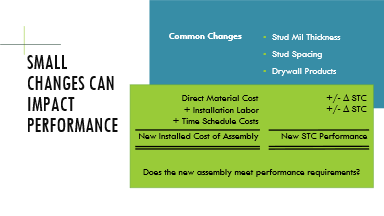
Image courtesy of PABCO Gypsum
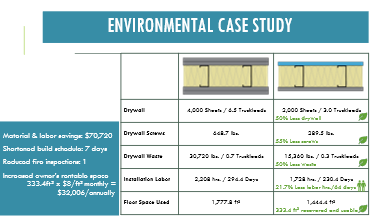
Even small changes require recalculation of total installed cost and reevaluation of STC performance.
Environmental and Spatial Economics
Acoustic decisions intersect with sustainability and space planning in ways that are easy to overlook both practically and economically. They can share a surprising amount of common ground. Both aim to create healthier environments using fewer resources.
Environmental Impact
Each additional material needed to achieve the acoustic results has an adverse environmental effect. Whether it be layers of drywall, additional studs or added components, each of those items carries its own carbon footprint.
Every additional layer of gypsum, for example, increases:
- Embodied carbon (from manufacturing and transport)
- Additional movement of materials and use of installation equipment on the jobsite
- Jobsite material handling and waste
Gypsum typically has a 10% waste factor on projects. So, for every 10 truckloads of drywall coming onto a project, 1 truck will also leave full of scrap to a landfill or best case, a recycling center.
It is important to remember that it is possible to achieve STC requirements using less material without sacrificing performance.
Spatial Efficiency and Rentable Area—The Math of Space Savings
Thickness matters. With over thousands of linear feet of wall, every extra inch consumes measurable floor area. We may only think it’s 1-1/4” (5/8” x2), but that can add up quickly and in renovation work, you simply many not have the space.
This is another, more theoretical example:
- Consider a 10-story apartment building with 100 units per floor and 10,000 linear feet of demising walls.
- Switching from an 8-1/2” thick staggered-stud assembly to a 4-7/8” thick CLD wall recovers 3-5/8” per wall.
- 10,000 feet × 10 floors × 3-5/8 inch ≈ 30,201 ft² of additional floor area.
Assuming this is a residential rental project, the annual revenue increase could be:
- National Average @ $2.34/ft2/month = $70,670/annually
- New York City @ $6.81/ft2/month = $205,669/annually
- Kansas City @ $1.64/ft2/month = $49,530/annually
- Dallas @ $1.95/ft2/month = $58,892/annually
In this framing, the acoustic decision is not a cost consideration; it is a tool for growing income. A single design revision transforms the acoustic upgrade into a financial windfall.
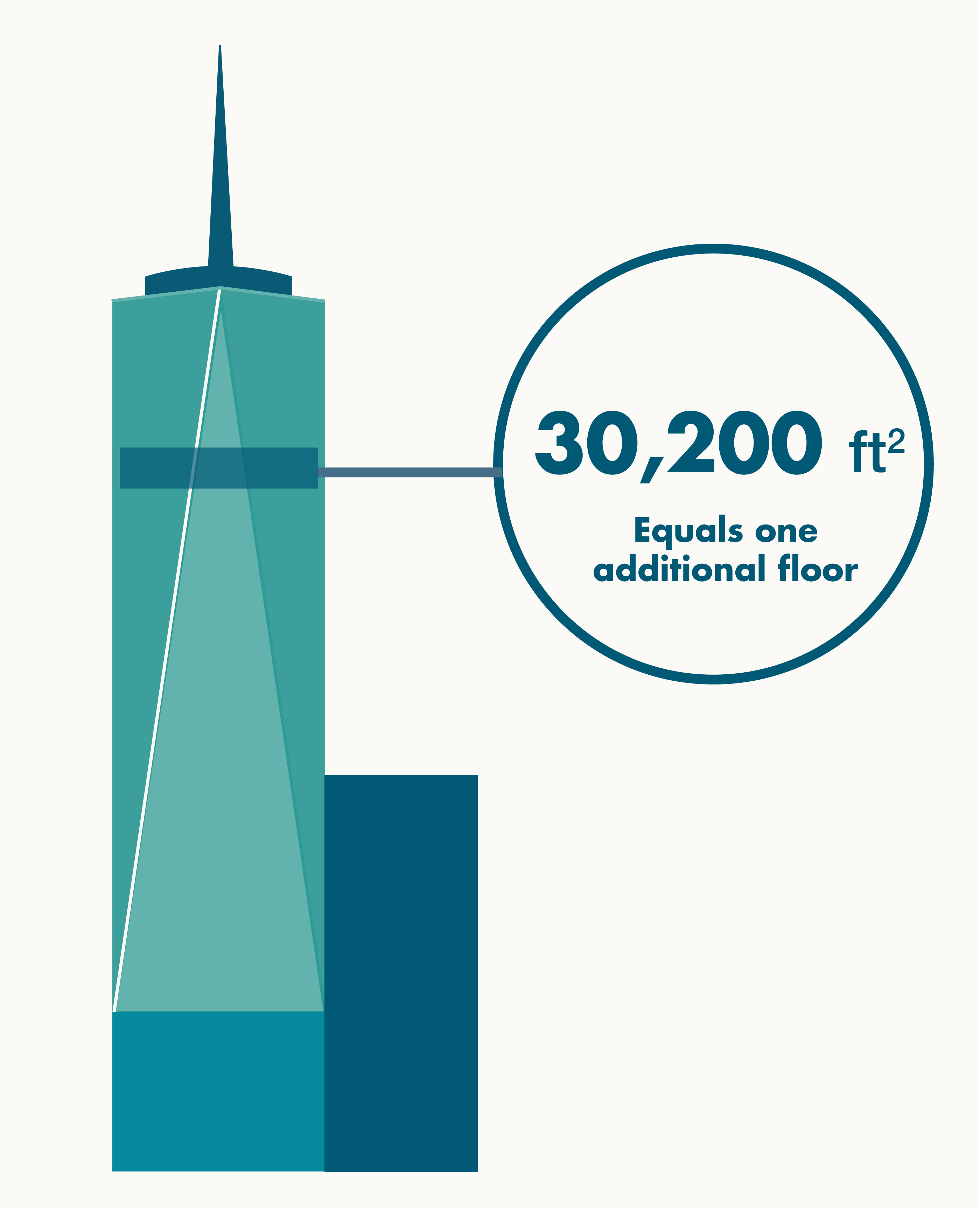
Image courtesy of PABCO Gypsum
Adding perspective – recover of 30,200 ft2 is equivalent to adding another floor to our tallest skyscrapers like One World Trade Center or the Empire State Building.
Lifecycle Impact
Eliminating redundant gypsum reduces embodied carbon and landfill waste. Fewer truckloads mean less fuel and site congestion. These outcomes directly support LEED v4 EQ (Acoustic Performance) and WELL Standard acoustic comfort credits.
The takeaway for architects is strategic: the quiet wall is also the green wall. A thinner, smarter partition uses fewer materials, installs faster, and lasts longer—all while enhancing occupant well-being.
Cost Comparisons of Mass, Decoupling and CLD
Let’s revisit our three levers and see how, on their own, they can be used to design a wall that meets STC 50 and 1-hour fire-resistance ratings. We are going to look at the material and labor costs associated with these designs in the three markets we discussed earlier as well as National Average costs.
The assemblies all share the same studs and configuration. They are all 3-5/8” 33-mil steel studs spaced 24” o.c., with 3-1/2” fiberglass insulation in the cavity.
Baseline - 1 layer of commodity type X gypsum drywall on each side STC 45 (NOAL 19-0714) / 1 hour Fire (UL U425) 4-7/8” thick and 5.1 lb/ft2
Mass - 2 layers of commodity type X gypsum drywall on each side STC 50 (NOAL 19-0715) / 1 hour Fire (UL U425) 6-1/8” thick and 9.3 lb/ft2 – Adding 1-1/4” thickness and 4.2 lb/ft2
Decoupling - resilient channels applied to stud at 24” o.c. and 1 layer of commodity type X gypsum drywall on each side STC 50 (NOAL 19-0713) / 1 hour Fire (UL U425) 5-3/8” thick and 5.3 lb/ft2 – Adding 1/2” thickness and 0.2 lb/ft2
Damping - 1 layer of commodity type X gypsum drywall on one side and a CLD panel on the other side. STC 52 (NOAL 22-0918) / 1 hour Fire (UL U425) 4-7/8” thick and 5.6 lb/ft2 – Adding no incremental thickness and 0.5 lb/ft2
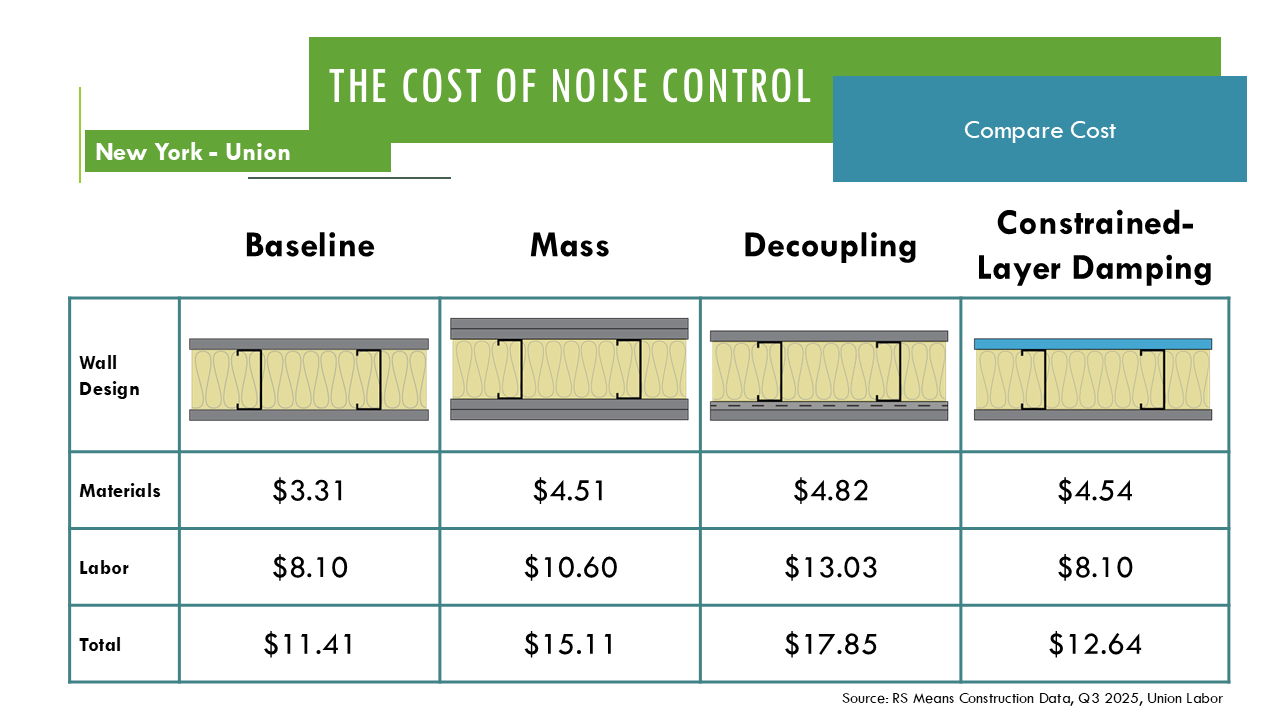
Image courtesy of PABCO Gypsum, RS Means Construction Data, Q3 2025, New York, City Union Labor
Cost comparison of acoustic walls using Mass, Decoupling or Constrained-Layer Damping as the sole acoustic solution to achieve STC ≈ 50 and minimum 1 hr. fire using union labor costs in New York City - High Labor Market.
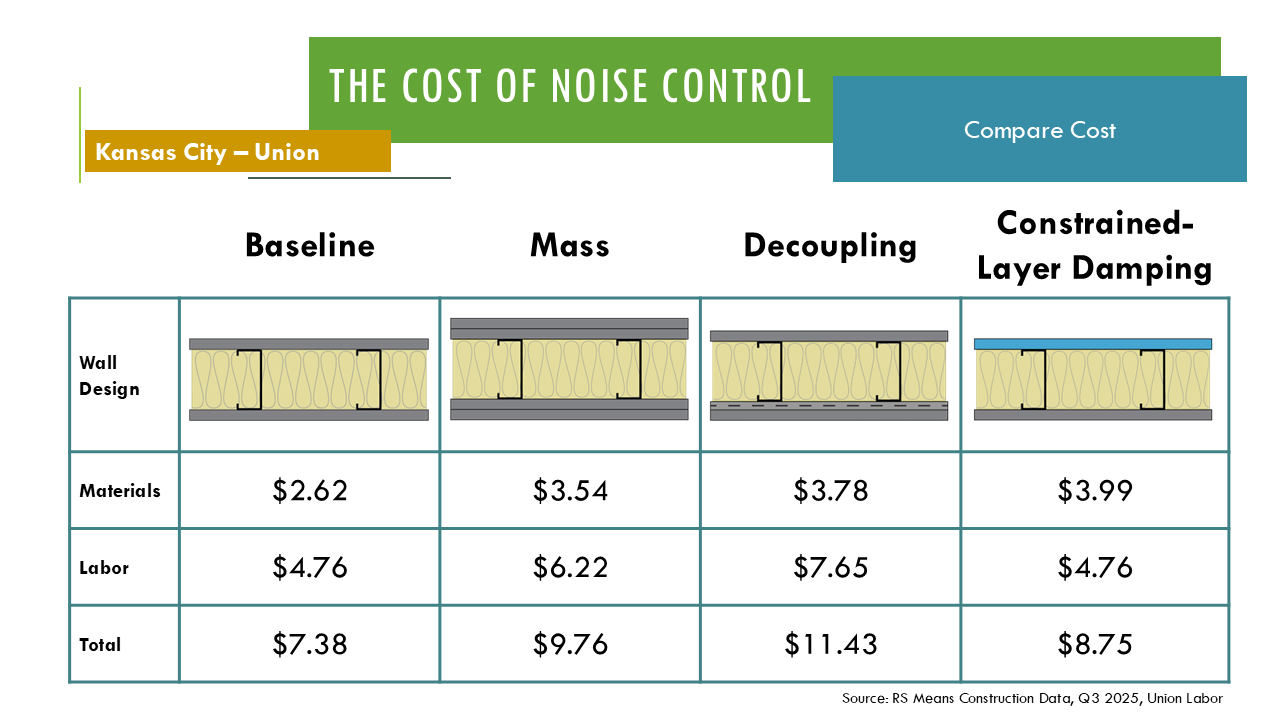
Image courtesy of PABCO Gypsum, RS Means Construction Data, Q3 2025, Kansas City, Union Labor
Cost comparison of acoustic walls using Mass, Decoupling or Constrained-Layer Damping as the sole acoustic solution to achieve STC ≈ 50 and minimum 1 hr. fire using union labor costs in Kansas City - Average Market.
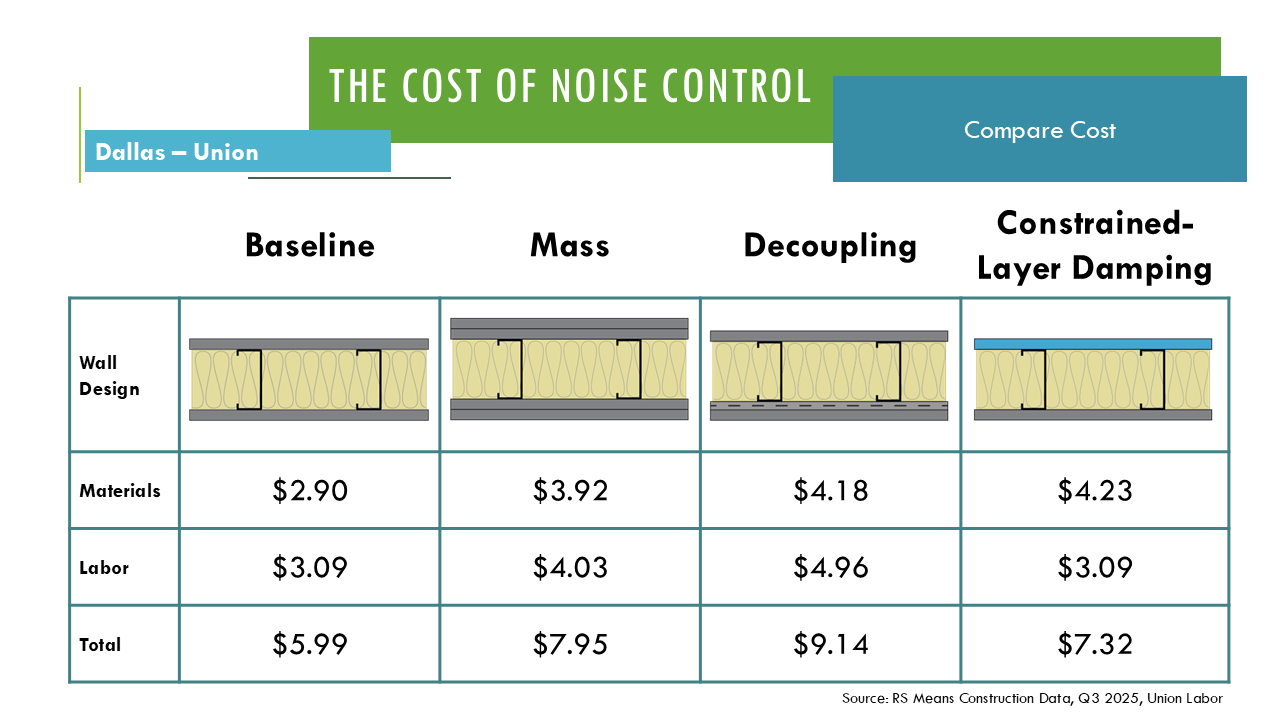
Image courtesy of PABCO Gypsum, RS Means Construction Data, Q3 2025, Dallas, Union Labor
Cost comparison of acoustic walls using Mass, Decoupling or Constrained-Layer Damping as the sole acoustic solution to achieve STC ≈ 50 and minimum 1 hr. fire using union labor costs in Dallas - Low Labor Market.
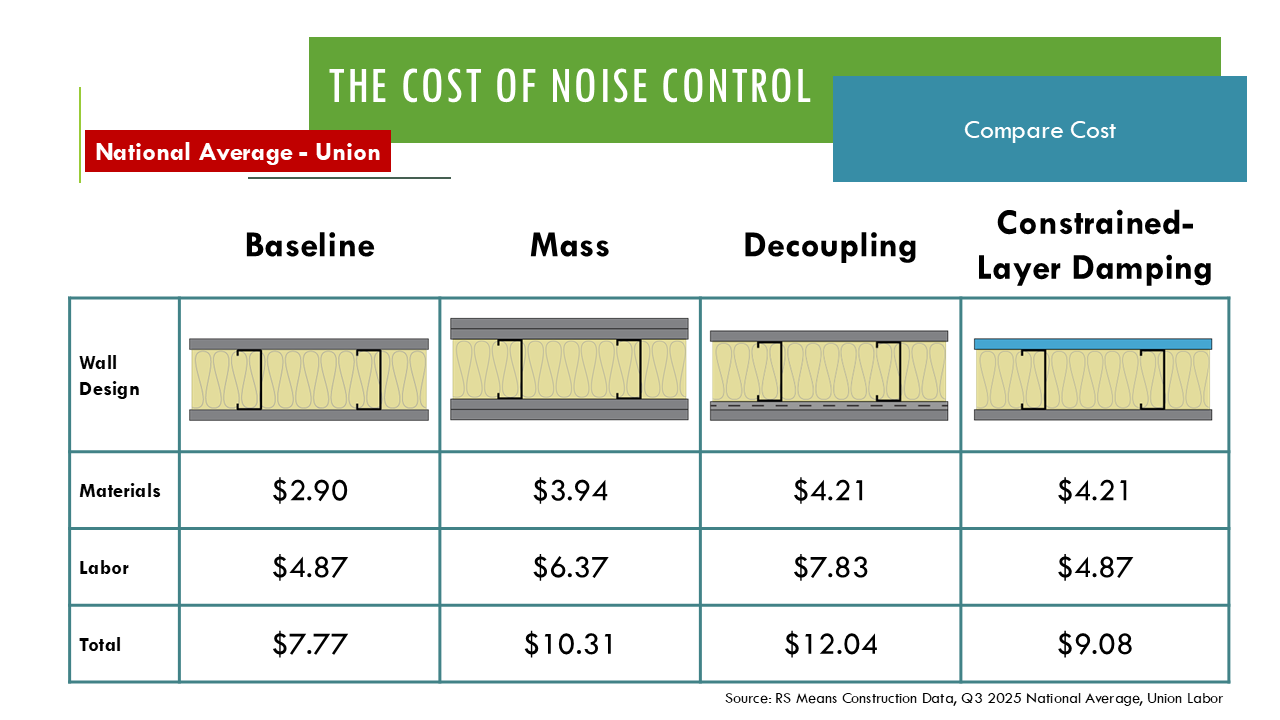
Image courtesy of PABCO Gypsum, RS Means Construction Data, Q3 2025, US National Average, Union Labor
Cost comparison of acoustic walls using Mass, Decoupling or Constrained-Layer Damping as the sole acoustic solution to achieve STC ≈ 50 and minimum 1 hr. fire using union labor costs in US National Average.
You can conclude from these examples, no matter the labor market, be it a high cost, low cost or somewhere in the middle the relationships of these sound control methodologies hold true. The least expensive STC 50 wall is the CLD panel methodology, followed by the Mass wall and the resilient channel wall follows as the most expensive alternative. This result is not the natural mindset, because we are often trapped into evaluating cost by simply looking only at material costs alone. But the reality is, materials don’t install themselves and we need to remember to look at that other large cost component of the wall—the labor cost.
Quantifying Acoustic Value – Cost per STC Point
When clients hear that “better acoustics cost more,” the conversation often stops. The most effective way to reopen it is with math. Architects can turn sound control into a quantitative, defensible investment using one simple ratio: cost per STC point.
Step 1 – Define the Baseline Section
Start with the common partition your client already accepts—for instance, our baseline above is a single-stud wall with one layer of 5/8” commodity type X drywall on each side, 3-5/8” steel studs at 24” o.c., and batt insulation. National average cost data (RS Means Q3 2025 Union Average) calculates the total installed cost of $7.77/ft² and delivers STC 45.
Step 2 – Identify Alternatives
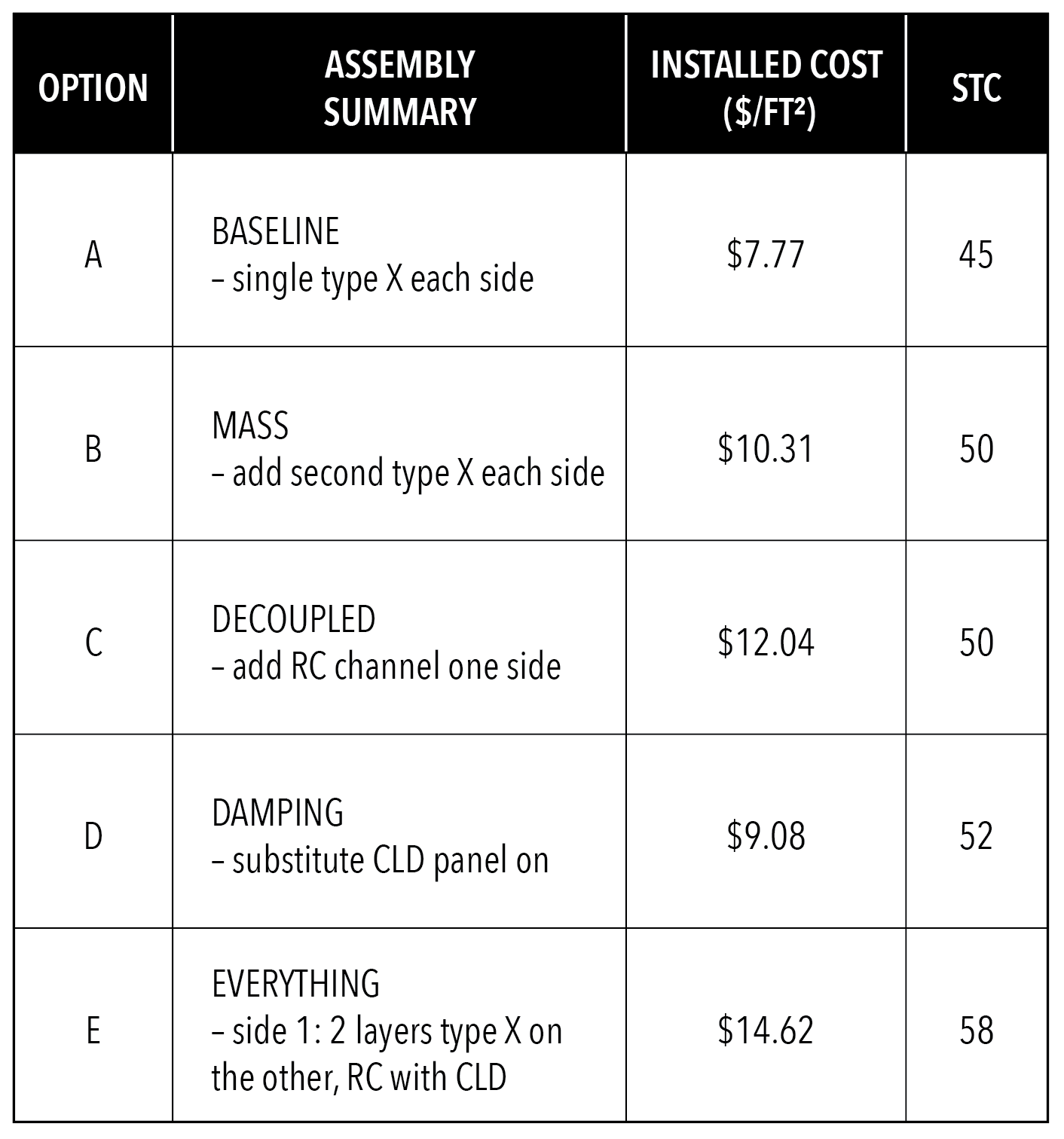
Step 3 – Calculate Δ Cost, Δ STC, and Cost per STC Point
Δ Cost = Total installed Cost of Assembly (Option B) - Total installed Cost of Baseline (A)
Δ STC = STC of Option Assembly (Option B) – STC of Baseline (A)
Cost per STC = Δ Cost ÷ ΔSTC
Despite being one of the more expensive materials, Option D (Damping) delivers the lowest cost per STC point— roughly 20 cents of investment for each incremental point of acoustic improvement.
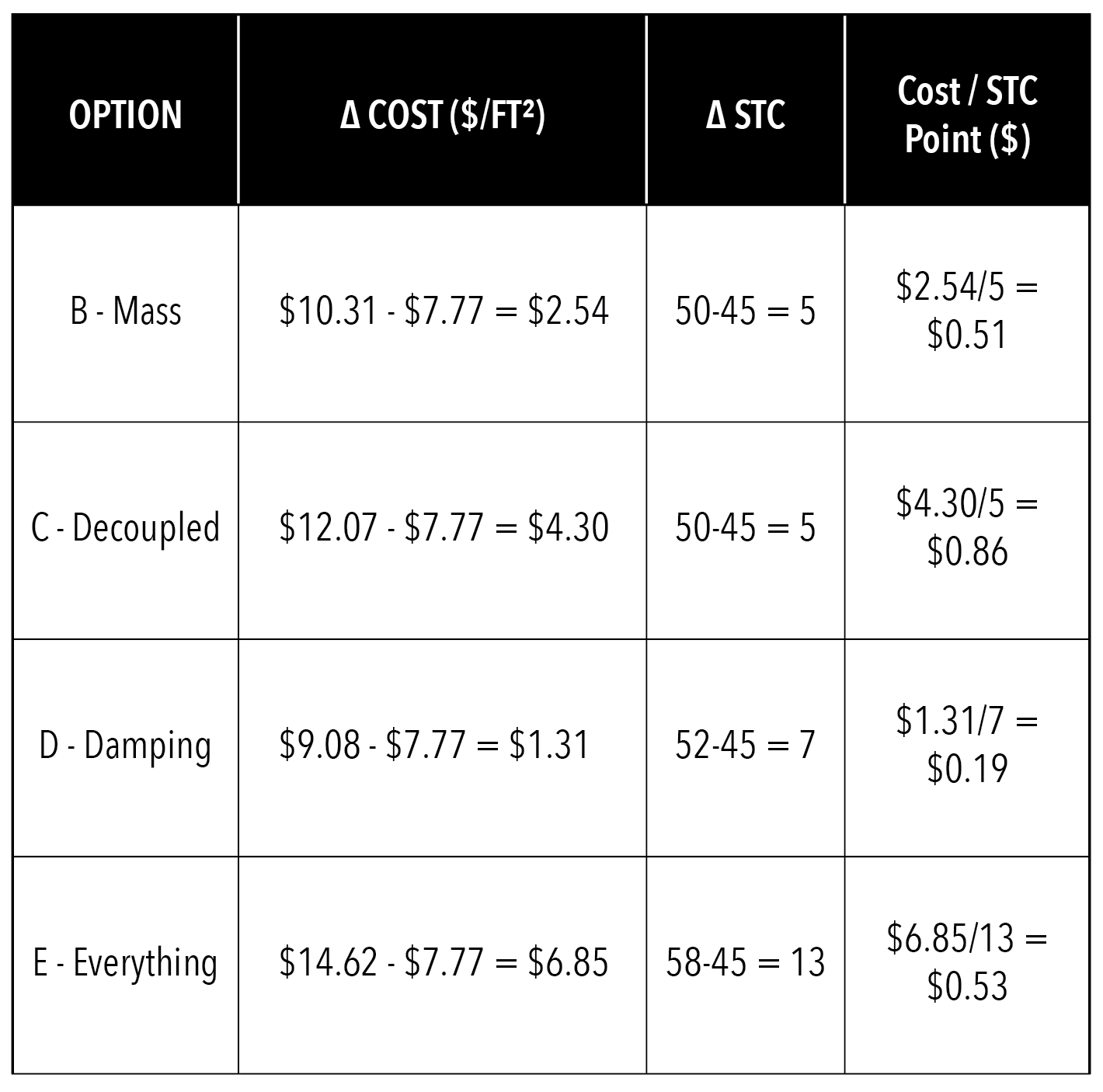
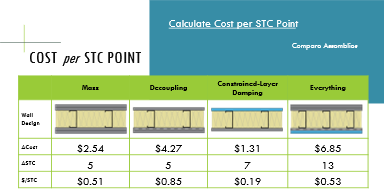
Chart courtesy of PABCO Gypsum, The Sound Design Guide, RS Means Construction Data, Q3 2025, US National Average, Union Labor
Comparison calculations of Cost per STC Point for the 4 options.
Step 4 – Translate the Numbers into Narrative
That is the key insight for architects: not all dollars are equal. Some dollars buy small incremental gains; others buy large jumps in real-world performance. A cost-per-STC-point comparison turns that intuition into a clear, rational argument you can share with owners and contractors.
This framing changes acoustics from a soft comfort issue to a measurable return on investment.
Step 5 – Include Soft Value
While the ratio covers direct cost, architects should articulate indirect value:
- Reduced callbacks and tenant complaints
- Schedule compression from simpler installation
- Brand differentiation for developers marketing “quiet living” or “wellness workspace”
By coupling quantitative and qualitative value, acoustics become part of a project’s financial logic rather than its decoration.
Redefining Architectural Value
Traditional project metrics—first cost, cost per square foot, construction schedule—are not going away. But owners are increasingly looking at lifecycle performance, occupant satisfaction, and ESG metrics as equally important. Acoustics touches all three.
Performance, Economy, and Well-Being
A useful way to think about this is as a triangle:
- Performance – Measured STC, predicted speech privacy, compliance with standards
- Economy – First cost, cost per STC point, impact on rentable area and operating costs
- Well-being – Productivity, stress, satisfaction, and perception of quality
A wall assembly that sits at a sweet spot between these three forces is a high-value design strategy. CLD systems often land in that zone, but the principle extends to any solution that simultaneously:
- Meets or exceeds the STC target
- Uses materials and labor efficiently
- Supports occupant comfort and organizational outcomes
The Architect’s Role
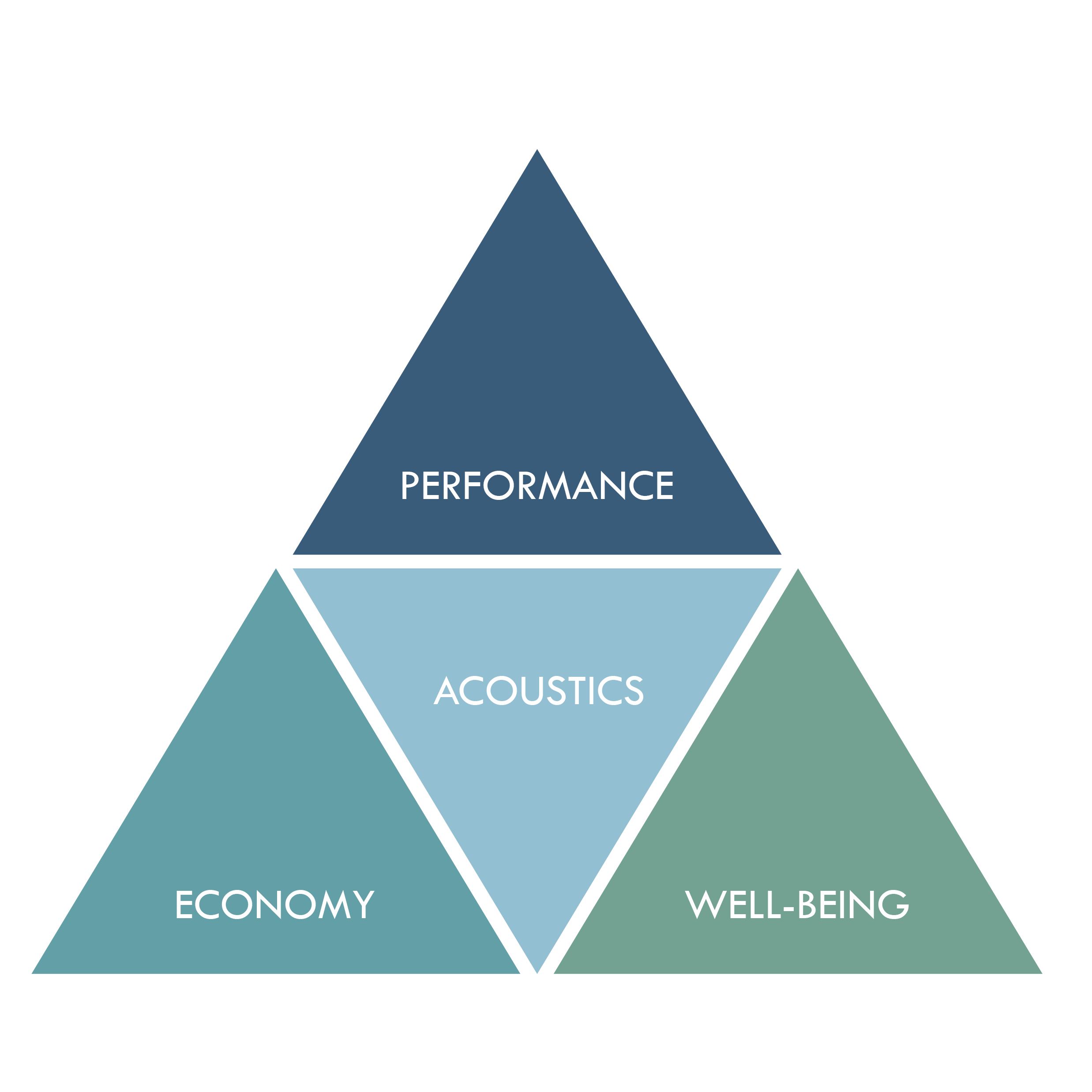
Image courtesy of PABCO Gypsum
The architectural value triangle, showing acoustics at the intersection of performance, economy, and well-being.
Acoustics is too often treated as a specialist’s domain or a late-stage add-on. Yet it is fundamentally architectural: it Architects are uniquely positioned to:
- Set realistic STC targets for each space type based on program and expectations
- Select assemblies that achieve those targets economically
- Coordinate detailing so that what is drawn is buildable and testable
- Defend acoustic intent during value engineering by showing the cost and benefit of each option
By bringing acoustics into the same early conversation as daylight, energy, and structure, architects help owners see sound control as a central part of design quality, not a dispensable luxury.
Conclusion – Quiet as an Investment
Noise is invisible, but its effects are measurable—in productivity, sleep quality, stress, tenant turnover, and online reviews. STC-rated walls are the primary tool architects have to manage airborne sound. The question is not whether acoustics matters; it is how to design and pay for it intelligently.
Looking at walls through the lens of economics reveals that:
- Some acoustic improvements are much more cost-effective than others when properly measured in cost per STC point
- Labor, not materials, often dominates installed cost, so simplifying construction can outweigh unit-price differences
- Smarter assemblies can reduce material volume, improve sustainability, and capture valuable floor area
- Guarding against uncontrolled substitutions is essential to preserve both performance and economic value
When an owner says, “Show me the money,” the architect who understands the economics of STC-rated walls can respond with clarity: here is what this wall will cost, here is what it will do, and here is how it will pay you back—in comfort, satisfaction, and long-term value.
References:
- RS Means Construction Data, Q3 2025, National Average Open Shop and Union labor rates
- RS Means Construction Data, Q3 2025, New York City, Kansas City, and Dallas, Materials and labor with overhead and profit for gypsum wallboard, on walls, fire resistant, 5/8” thick, finish excluded; Open Shop and Union labor rates.
- ASTM C919-21: Standard Practice for Use of Sealants in Acoustical Applications. ASTM International, West Conshohocken, PA. https://www.astm.org/c0919-21.html
- Average National Average rent data sourced from Apartment. com, “Apartment Rent Reports & Trends,” Apartment.com, accessed November 2025.
- Average New York City rent data sourced from Apartment. com, “Apartment Rent Reports & Trends,” Apartment.com, accessed November 2025.
- Average Kansas City rent data sourced from Apartment. com, “Apartment Rent Reports & Trends,” Apartment.com, accessed November 2025.
- Average Dallas rent data sourced from Apartment.com, “Apartment Rent Reports & Trends,” Apartment.com, accessed November 2025.
- LEED v4 BD+C: Indoor Environmental Quality (EQ) — Acoustic Performance, EQc9 emphasizes reduction of background noise and sound transmission in occupied spaces. The WELL Building Standard v2: Comfort — Acoustics (C01–C06) promotes measures that reduce noise pollution and improve occupant well-being. Material reduction and transportation efficiency contribute indirectly by lowering environmental impacts associated with construction activities.
Author Bio
QuietRock Product Manager Mike Amaral, a founding QuietRock team member, brings over 20 years of gypsum experience and valuable industry expertise.