Designing for Access: ADA Compliance in K–12 and Higher Education Facilities
Navigating accessibility requirements to create inclusive, code-compliant learning environments for students of all ages
Sponsored by Inpro | Presented by Doug Anderson and Elizabeth Zaverdas and Tatiana Baglioni
Webinar On-Demand
Educational environments must be designed to ensure equitable access for all students, faculty, staff, and visitors. From early learning classrooms to complex university campuses, ADA compliance plays a critical role in promoting health, safety, and welfare while supporting inclusive educational experiences.
This webinar explores ADA considerations specific to K–12 schools and college/university facilities, including accessible routes, classrooms, laboratories, assembly spaces, housing, restrooms, athletic facilities, and site design. Presenters will examine common compliance challenges, evolving interpretations, and best practices for integrating accessibility seamlessly into both new construction and renovation projects.
Through real-world examples and code-based analysis, attendees will gain practical strategies to design educational environments that are safe, inclusive, and fully compliant.
The first presentation, Doug Anderson and Elizabeth Zaverdas from LCM Architects will present projects on ADA on university campuses. They not only help universities achieve compliance, but also help them maintain compliance and limit exposure. Construction and renovations on campuses are never complete. It’s an ongoing process as facilities are maintained and upgraded to meet educational needs. As improvements are made, it’s important that accessibility be an integral part of the process. An excellent way to begin is to develop a framework for a campus audit. Many universities elect to follow a phased approach to existing facility assessments, including prioritizing facilities where programs and services are provided.
Integrating accessibility so people experience the building and space in a similar way is key. Through facility improvements there are opportunities to improve accessibility and incorporate universal design strategies. Often, this requires changing the mindsets of designers, campus planners, maintenance staff, and contractors, so that accessibility is considered at the outset of the design and process. Accessibility standards and best practices are evolving and subject to interpretation by knowledgeable accessibility professionals. LCA will provide real life examples from various campus projects around the country.
Presented by Tatiana Baglioni of KieranTimberlake, the renovation and expansion of the historic Sackett Building at Pennsylvania State University offers a compelling case study in reimagining legacy academic infrastructure to meet contemporary accessibility standards. Originally constructed in 1930, the building is undergoing a comprehensive transformation that includes a full interior renovation, the addition of two contextually scaled wings, and improved site connections, including an accessible pedestrian route.
The project balances historic preservation with forward-looking design strategies while addressing evolving programmatic needs. The updated facility will include flexible classrooms, a knowledge commons, and collaborative spaces that support equitable access for a diverse campus population.
This webinar explores how ADA requirements are integrated into complex higher education renovations. Attendees will gain insight into aligning circulation, entrances, and interior environments with inclusive best practices, and reconciling historic constraints with modern accessibility expectations.
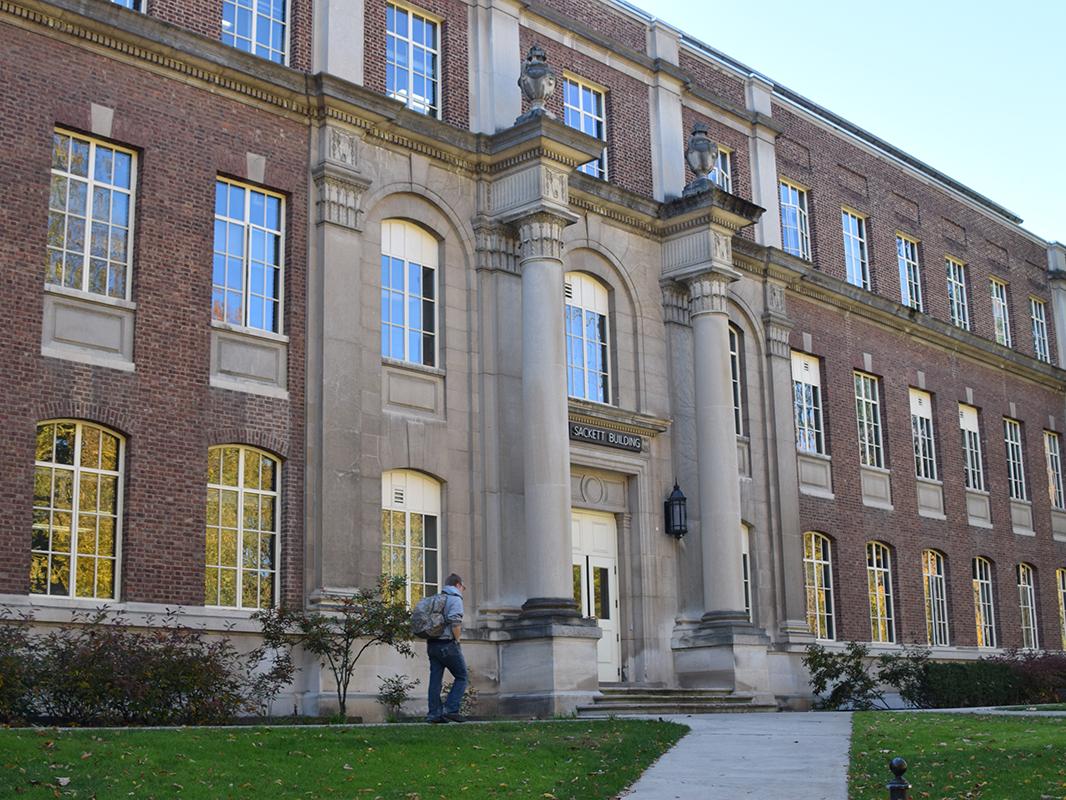
Originally called the Main Engineering Building when it opened in 1930, the building was later renamed for Robert L. Sackett, who served as dean of engineering from 1915 to 1937. More modern wings were added to Sackett in 1951 and 1958, followed by additional expansion in 1979 with the opening of Kunkle Lounge as a connector to Hammond Building.
Photo courtesy of Penn State
 |
Douglas Anderson, CASp, RAS , is a Partner at LCM Architects, a Chicago-based full-service architectural practice specializing in accessibility and inclusive design consulting. With 36 years of experience in the accessibility field, Doug is nationally recognized for his knowledge and interpretation of accessibility laws, standards, and codes. He leads LCM’s ADA group that provides consulting services in strategic accessibility planning and compliance for ADA Title II and Title III organizations, including public and private universities and K-12 schools throughout the U.S. Doug serves as a subject matter expert and testifying expert for accessibility related litigation and trains building industry professionals on accessibility laws and surveying methods. By presidential appointment he served for two terms on the U.S. Access Board, the federal agency responsible for developing ADA guidelines. On the American National Standards Institute (ANSI) A117.1 Accessibility Committee he contributes to the development of standards for future model building codes. |
 |
Elizabeth Zaverdas, ADAC, Associate AIA , is a Senior Associate and Senior Project Manager at LCM Architects, a full-service, Chicago-based architecture firm with a specialty in inclusive design and accessibility. Certified as an ADA Coordinator, Liz leads LCM’s higher education, government, and cultural accessibility practices and consults on inclusive design for a variety of project types. She manages accessibility planning and improvement initiatives that help organizations, including universities, comply with requirements of Title II and Title III of the Americans with Disabilities Act (ADA) and other accessibility regulations. With a deep understanding of the practical and societal implications of exterior and interior environmental barriers, she leverages her architecture degree, multi-disciplinary management experience, and 40-year career to guide the implementation of people-centered spaces that enable people of all abilities to experience their environments more fully. |
 |
Tatiana Baglioni, is a licensed architect at KieranTimberlake. She is the project architect for the Sackett Building Renovation & Additions at Penn State’s University Park Campus, which is currently under construction. Since joining KieranTimberlake in 2018, Tatiana has contributed to a diverse range of higher education new build and renovation projects, including interdisciplinary research and lab facility Henley Hall Institute for Energy Efficiency at the University of California, Santa Barbara; 675-unit residence hall Graduate Junction at MIT; and undergraduate residence hall Lowell House at Harvard University (as one of the four Harvard River House Renewal projects KieranTimberlake completed). She thrives at the nexus of complex problems, working to balance performance goals, institutional priorities, and stakeholder needs while remaining committed to design excellence. Tatiana holds a Master of Architecture from the University of Texas at Austin and a Bachelor of Arts in Geography & Urban Development from Clark University. |

Founded in 1979, Inpro® is a global provider of high-performance, design-forward architectural products for building professionals. Inpro's product categories include door + wall protection, washroom systems, expansion joint systems, cubicle curtain + privacy systems, elevator interiors, architectural signage, and commercial window treatments.
Originally published in Architectural Record
Originally published in February 2026
LEARNING OBJECTIVES
- Identify key ADA requirements that apply specifically to K–12 and higher education facilities, including accessible routes, classroom layouts, restrooms, and assembly areas.
- Evaluate design strategies that support equitable access in educational environments while maintaining life safety, security, and functional performance.
- Analyze common accessibility challenges on school and university campuses, such as historic renovations, multi-building sites, and specialized learning spaces, and identify compliant design solutions.
- Apply ADA standards and related codes to support the health, safety, and welfare of students, faculty, and visitors across a range of educational building types.