All photos courtesy of Huber Engineered Woods
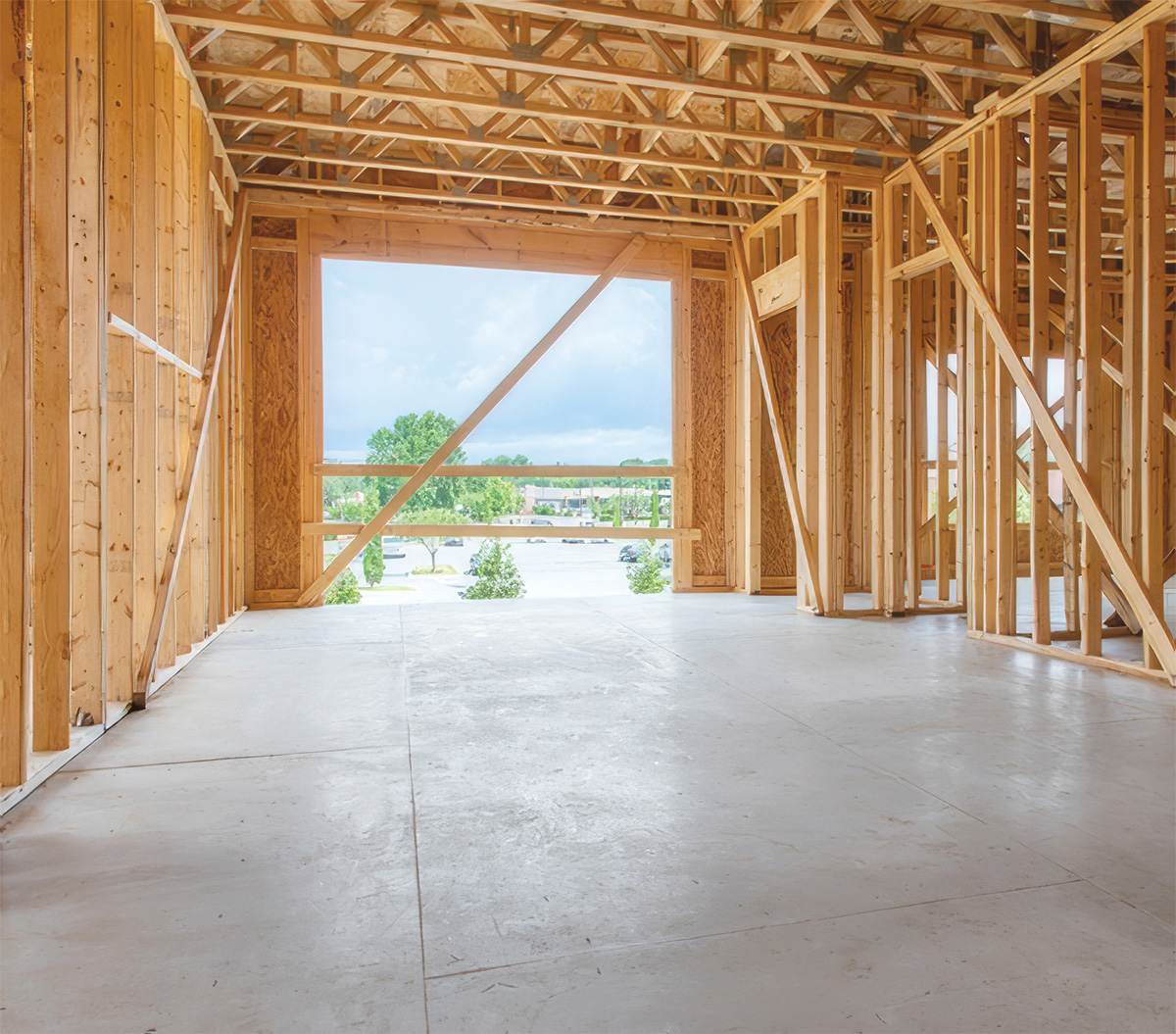
Wood-framed multifamily floor assembly prepared for underlayment installation. Construction sequencing and floor system selection can influence schedule, acoustical performance, and moisture management.
Picture this: The building is framed and dried in, and it feels like progress is happening. But then, progress slows. A new crew shows up and stages their equipment. Hoses are pulled through the building, and a wet gypsum underlayment mixture is pumped across the subfloor. It’s a familiar process, and one that works. Still, it slows down the job.
Now, picture a different approach. The same floor assembly is installed as part of the framing process, using dry magnesium oxide panels. That means there is no on-site mixing, no pumping, and no cure time. The panels are laid by framers with standard tools, and once the panels are in place, interior work continues.
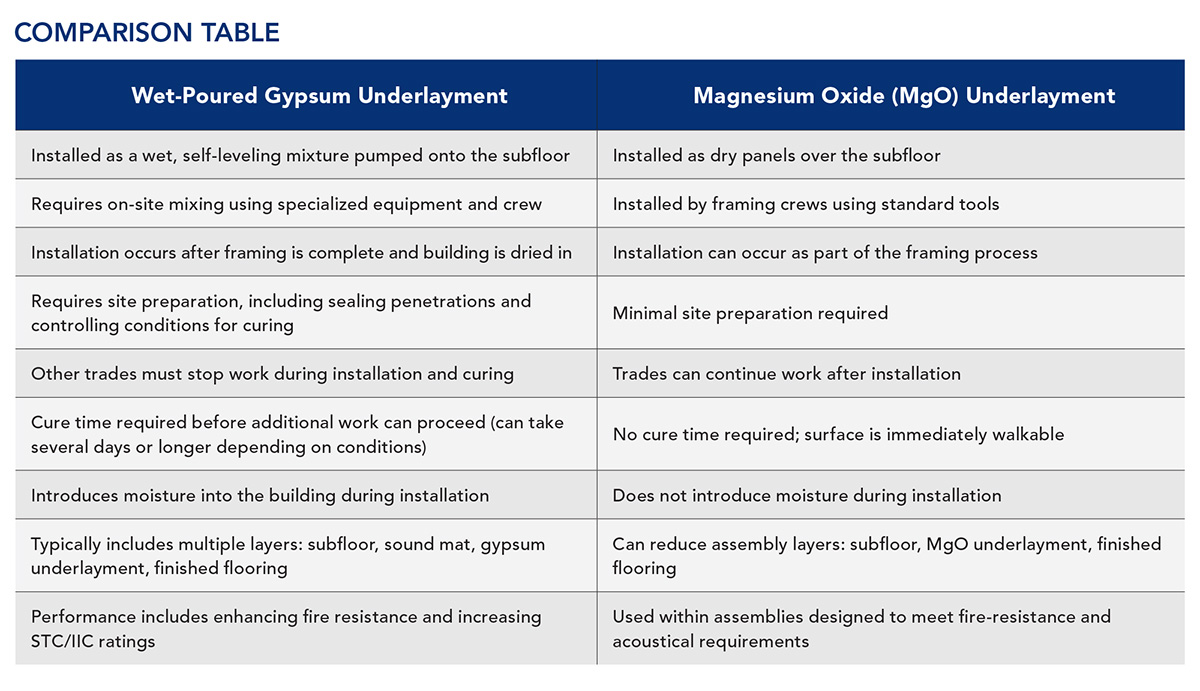
Both approaches can meet fire-resistance and acoustical requirements. But they do not affect logistics the same way. And for builders and developers, that difference can impact the entire construction schedule. That is what’s driving current interest.
Installation Sequencing and Schedule Impacts
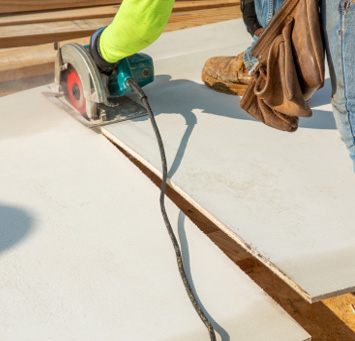
MgO underlayment panels can be cut and installed using standard framing tools, allowing floor assemblies to move forward without curing delays or wet-applied installation staging.
So, what happens when architects, engineers, and builders discover an alternative building system that promises to speed installation time, simplify scheduling, and ease reliance on skilled labor? At first, there may be resistance, then select implementation, and finally widespread adoption. Consider the transitions from lath and plaster to drywall, from stick framing to roof trusses, and from hand drafting to BIM.
The design community is mostly at the discovery stage for magnesium oxide (MgO) panels as an alternative to wet-poured gypsum flooring. As with all change, alternatives get considered when the growing pain points of “the way we’ve always done it” become too great to ignore. The process of wet-poured gypsum installation is labor-intensive, can create scheduling challenges, and introduces significant moisture into the building.
The work is typically dependent on a separate crew that is scheduled in advance. The timing of that installation can influence the overall construction schedule. Other trades must leave the area and return after the material has been installed and allowed to set. Temperature and humidity can affect the duration of curing, and the timeline may be extended when conditions are not ideal.
In contrast, installation that occurs as part of the framing process simplifies the timing. Panels are installed as part of the floor assembly, so work can continue without the same interruption. Trades do not need to leave and return, and the process does not require the same staging or curing period. This difference is especially visible in multifamily construction, where the same floor assembly is repeated across multiple units.
Take the case of MgO underlayment adopter Ryan Carrier, owner and construction manager of By Carrier Homebuilders and Developers, when he embarked on the Centre Square Village, a mixed-use luxury apartment community in Bristol, Connecticut’s bustling North Main Street district. The high-profile project demanded both speed and craftsmanship.
Carrier was particularly concerned about the drawn-out process of the wet-poured gypsum underlayment that can take days or longer to set up, denying any other trades access to the space. While this flooring method is common in multifamily units, there’s no denying the challenges.
“With gypsum, logistically, it’s a little bit more complicated because you can’t have anybody else working inside at the same time,” Carrier said, “so you’re losing some really valuable time.”
Losing time during construction was unacceptable for Carrier, and he thought there must be a different way. In his search for a more efficient and reliable alternative, Carrier turned to MgO underlayment panels.
What Is Magnesium Oxide?
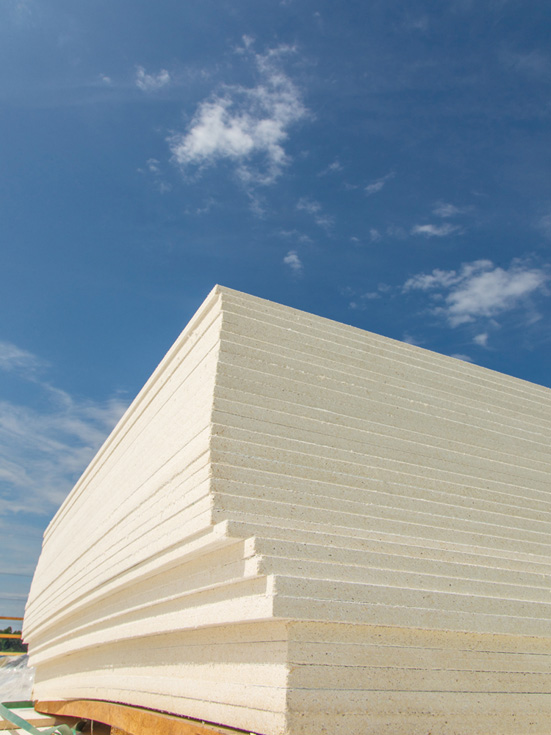
Magnesium oxide panels are manufactured as durable cementitious boards used in tested floor-ceiling assemblies for fire resistance, acoustical performance, and construction coordination.
Magnesium oxide is a cementitious material derived from a naturally occurring mineral and used to form durable construction boards. Visualize a cementitious board similar to Portland cement-based products, where the material is mixed with other ingredients and water to form a slurry that cures into a solid panel.
Magnesium oxide has been used worldwide for some time and in the United States since at least the early 2000s. It has long been used as a refractory material because it retains its strength and composition at high temperatures, which has led to its use in building applications.
In panel form, the material is produced through a controlled formulation process. Ingredients are combined to create a cementitious mixture. Layers of mesh are incorporated within the panel to provide strength and dimensional stability. These layers are placed at specific locations. This ensures that the final board maintains its integrity and does not delaminate or crumble. Once formed, panels cure under controlled conditions. The curing process allows the material to harden into a stable board. While the process may appear straightforward, manufacturers rely on controlled formulations and quality control practices to ensure consistency and performance.
There are many different mixes of magnesium oxide cement boards on the market. Product composition can vary between manufacturers. Each formulation may influence performance characteristics such as strength, durability, and fire resistance. As with other construction materials, designers should evaluate products based on tested performance and published data. In terms of physical characteristics, magnesium oxide panels are strong and dimensionally stable. They are not prone to mold and mildew growth due to their inorganic composition, and they contain limited organic material. They also exhibit permeability characteristics that are suitable for many assemblies and climates.
Panels are typically produced in standard sizes, though dimensions may vary by manufacturer. One consideration is weight. A typical panel may weigh approximately 2 to 2.75 pounds per square foot, making it heavier than some wood-based panels but still manageable within standard construction practices.
Magnesium oxide panels are available in different forms and for different applications. Some are designed and tested to function as structural subfloor panels, while others are manufactured specifically as underlayment installed over a structural wood subfloor. These underlayment panels are used as part of a layered floor-ceiling assembly and are not meant to replace the structural subfloor itself. While some products may undergo structural testing, manufacturers can differ in span limitations, fastening requirements, assembly design, and support requirements. Designers should verify that the selected product and assembly are appropriate for the intended application.
In handling and installation, panels are cut and fastened using tools similar to those used for wood structural panels. Cutting can be performed with a circular saw, and fastening typically requires corrosion-resistant fasteners, such as galvanized steel. Specific fastening requirements vary by manufacturer and should be verified prior to installation. Panels are typically installed over a structural subfloor rather than spanning between joists. They function as part of a layered assembly and are not intended to replace the structural subfloor; they must be used within assemblies designed to meet fire-resistance and acoustical requirements. Magnesium oxide panels are not intended as finished surfaces and must be covered by an appropriate finished flooring material.
As with other materials, support from the manufacturer may vary. Designers and builders should evaluate product support, availability of technical data, and access to training or field support when selecting materials. Product adoption remains at a relatively early stage in the United States, and performance and support may not be consistent across all manufacturers.
Installation of Wet-Poured Gypsum Underlayment
Gypsum underlayment is commonly used in both new construction and renovation work to create a smooth surface for finished flooring. Some products are described as self-leveling, but the finished result still depends on the material itself, jobsite conditions, and the experience of the installer. Many gypsum underlayment products are designed to flow and spread after they are poured, but achieving a smooth, consistently level floor still requires proper preparation and careful installation.
These systems are typically made from water-based mixtures of gypsum or hydraulic cement, combined with fillers, binders, and other additives that help control how the material flows, sets, and performs once installed. The material is mixed with water on site using specialized equipment and then poured over the wood subfloor to create a continuous surface for finished flooring. Obtaining consistent results still depends on careful surface preparation and installation, particularly in areas with uneven framing, tight corners, or complex room layouts. When used as part of tested floor-ceiling assemblies, gypsum underlayment can also add to fire resistance and acoustical performance in multifamily buildings.
Installation requires coordination between the crew performing the work and other trades working within the building. Preparation of the subfloor and surrounding conditions is necessary before installation can begin. Once the process starts, access to the space is limited until the material has cured. Because the installation introduces moisture into the building, conditions must be monitored to ensure proper curing. Elevated moisture levels can remain within the space for several days, and additional time may be required before finish flooring can be installed.
The work is therefore influenced not only by the installation itself, but by the time required for curing and drying. This can affect when other trades can return to the space and continue work.
Using gypsum underlayment can impact a construction schedule. The separate crew required for installation is often booked months in advance, and the construction timeline is frequently built around their availability. Site preparation requires cleaning, sealing openings, caulking penetrations, and ensuring proper conditions for curing. Once the site is prepared and installation begins, other trades must stop working until the gypsum underlayment has been poured, cured, and sealed.
Gypsum installation typically occurs after framing is complete and the building is dried in. In ideal conditions, it can require up to seven days to cure. This timeline may be extended by heat, humidity, or cold temperatures, which can delay curing or require additional measures to maintain proper conditions. If those conditions are not maintained, the underlayment is prone to cracking and may require rework before finish flooring can be installed.
All photos courtesy of Huber Engineered Woods
Wood-framed multifamily floor assembly prepared for underlayment installation. Construction sequencing and floor system selection can influence schedule, acoustical performance, and moisture management.
Picture this: The building is framed and dried in, and it feels like progress is happening. But then, progress slows. A new crew shows up and stages their equipment. Hoses are pulled through the building, and a wet gypsum underlayment mixture is pumped across the subfloor. It’s a familiar process, and one that works. Still, it slows down the job.
Now, picture a different approach. The same floor assembly is installed as part of the framing process, using dry magnesium oxide panels. That means there is no on-site mixing, no pumping, and no cure time. The panels are laid by framers with standard tools, and once the panels are in place, interior work continues.
Both approaches can meet fire-resistance and acoustical requirements. But they do not affect logistics the same way. And for builders and developers, that difference can impact the entire construction schedule. That is what’s driving current interest.
Installation Sequencing and Schedule Impacts
MgO underlayment panels can be cut and installed using standard framing tools, allowing floor assemblies to move forward without curing delays or wet-applied installation staging.
So, what happens when architects, engineers, and builders discover an alternative building system that promises to speed installation time, simplify scheduling, and ease reliance on skilled labor? At first, there may be resistance, then select implementation, and finally widespread adoption. Consider the transitions from lath and plaster to drywall, from stick framing to roof trusses, and from hand drafting to BIM.
The design community is mostly at the discovery stage for magnesium oxide (MgO) panels as an alternative to wet-poured gypsum flooring. As with all change, alternatives get considered when the growing pain points of “the way we’ve always done it” become too great to ignore. The process of wet-poured gypsum installation is labor-intensive, can create scheduling challenges, and introduces significant moisture into the building.
The work is typically dependent on a separate crew that is scheduled in advance. The timing of that installation can influence the overall construction schedule. Other trades must leave the area and return after the material has been installed and allowed to set. Temperature and humidity can affect the duration of curing, and the timeline may be extended when conditions are not ideal.
In contrast, installation that occurs as part of the framing process simplifies the timing. Panels are installed as part of the floor assembly, so work can continue without the same interruption. Trades do not need to leave and return, and the process does not require the same staging or curing period. This difference is especially visible in multifamily construction, where the same floor assembly is repeated across multiple units.
Take the case of MgO underlayment adopter Ryan Carrier, owner and construction manager of By Carrier Homebuilders and Developers, when he embarked on the Centre Square Village, a mixed-use luxury apartment community in Bristol, Connecticut’s bustling North Main Street district. The high-profile project demanded both speed and craftsmanship.
Carrier was particularly concerned about the drawn-out process of the wet-poured gypsum underlayment that can take days or longer to set up, denying any other trades access to the space. While this flooring method is common in multifamily units, there’s no denying the challenges.
“With gypsum, logistically, it’s a little bit more complicated because you can’t have anybody else working inside at the same time,” Carrier said, “so you’re losing some really valuable time.”
Losing time during construction was unacceptable for Carrier, and he thought there must be a different way. In his search for a more efficient and reliable alternative, Carrier turned to MgO underlayment panels.
What Is Magnesium Oxide?
Magnesium oxide panels are manufactured as durable cementitious boards used in tested floor-ceiling assemblies for fire resistance, acoustical performance, and construction coordination.
Magnesium oxide is a cementitious material derived from a naturally occurring mineral and used to form durable construction boards. Visualize a cementitious board similar to Portland cement-based products, where the material is mixed with other ingredients and water to form a slurry that cures into a solid panel.
Magnesium oxide has been used worldwide for some time and in the United States since at least the early 2000s. It has long been used as a refractory material because it retains its strength and composition at high temperatures, which has led to its use in building applications.
In panel form, the material is produced through a controlled formulation process. Ingredients are combined to create a cementitious mixture. Layers of mesh are incorporated within the panel to provide strength and dimensional stability. These layers are placed at specific locations. This ensures that the final board maintains its integrity and does not delaminate or crumble. Once formed, panels cure under controlled conditions. The curing process allows the material to harden into a stable board. While the process may appear straightforward, manufacturers rely on controlled formulations and quality control practices to ensure consistency and performance.
There are many different mixes of magnesium oxide cement boards on the market. Product composition can vary between manufacturers. Each formulation may influence performance characteristics such as strength, durability, and fire resistance. As with other construction materials, designers should evaluate products based on tested performance and published data. In terms of physical characteristics, magnesium oxide panels are strong and dimensionally stable. They are not prone to mold and mildew growth due to their inorganic composition, and they contain limited organic material. They also exhibit permeability characteristics that are suitable for many assemblies and climates.
Panels are typically produced in standard sizes, though dimensions may vary by manufacturer. One consideration is weight. A typical panel may weigh approximately 2 to 2.75 pounds per square foot, making it heavier than some wood-based panels but still manageable within standard construction practices.
Magnesium oxide panels are available in different forms and for different applications. Some are designed and tested to function as structural subfloor panels, while others are manufactured specifically as underlayment installed over a structural wood subfloor. These underlayment panels are used as part of a layered floor-ceiling assembly and are not meant to replace the structural subfloor itself. While some products may undergo structural testing, manufacturers can differ in span limitations, fastening requirements, assembly design, and support requirements. Designers should verify that the selected product and assembly are appropriate for the intended application.
In handling and installation, panels are cut and fastened using tools similar to those used for wood structural panels. Cutting can be performed with a circular saw, and fastening typically requires corrosion-resistant fasteners, such as galvanized steel. Specific fastening requirements vary by manufacturer and should be verified prior to installation. Panels are typically installed over a structural subfloor rather than spanning between joists. They function as part of a layered assembly and are not intended to replace the structural subfloor; they must be used within assemblies designed to meet fire-resistance and acoustical requirements. Magnesium oxide panels are not intended as finished surfaces and must be covered by an appropriate finished flooring material.
As with other materials, support from the manufacturer may vary. Designers and builders should evaluate product support, availability of technical data, and access to training or field support when selecting materials. Product adoption remains at a relatively early stage in the United States, and performance and support may not be consistent across all manufacturers.
Installation of Wet-Poured Gypsum Underlayment
Gypsum underlayment is commonly used in both new construction and renovation work to create a smooth surface for finished flooring. Some products are described as self-leveling, but the finished result still depends on the material itself, jobsite conditions, and the experience of the installer. Many gypsum underlayment products are designed to flow and spread after they are poured, but achieving a smooth, consistently level floor still requires proper preparation and careful installation.
These systems are typically made from water-based mixtures of gypsum or hydraulic cement, combined with fillers, binders, and other additives that help control how the material flows, sets, and performs once installed. The material is mixed with water on site using specialized equipment and then poured over the wood subfloor to create a continuous surface for finished flooring. Obtaining consistent results still depends on careful surface preparation and installation, particularly in areas with uneven framing, tight corners, or complex room layouts. When used as part of tested floor-ceiling assemblies, gypsum underlayment can also add to fire resistance and acoustical performance in multifamily buildings.
Installation requires coordination between the crew performing the work and other trades working within the building. Preparation of the subfloor and surrounding conditions is necessary before installation can begin. Once the process starts, access to the space is limited until the material has cured. Because the installation introduces moisture into the building, conditions must be monitored to ensure proper curing. Elevated moisture levels can remain within the space for several days, and additional time may be required before finish flooring can be installed.
The work is therefore influenced not only by the installation itself, but by the time required for curing and drying. This can affect when other trades can return to the space and continue work.
Using gypsum underlayment can impact a construction schedule. The separate crew required for installation is often booked months in advance, and the construction timeline is frequently built around their availability. Site preparation requires cleaning, sealing openings, caulking penetrations, and ensuring proper conditions for curing. Once the site is prepared and installation begins, other trades must stop working until the gypsum underlayment has been poured, cured, and sealed.
Gypsum installation typically occurs after framing is complete and the building is dried in. In ideal conditions, it can require up to seven days to cure. This timeline may be extended by heat, humidity, or cold temperatures, which can delay curing or require additional measures to maintain proper conditions. If those conditions are not maintained, the underlayment is prone to cracking and may require rework before finish flooring can be installed.
Installation of MgO panels
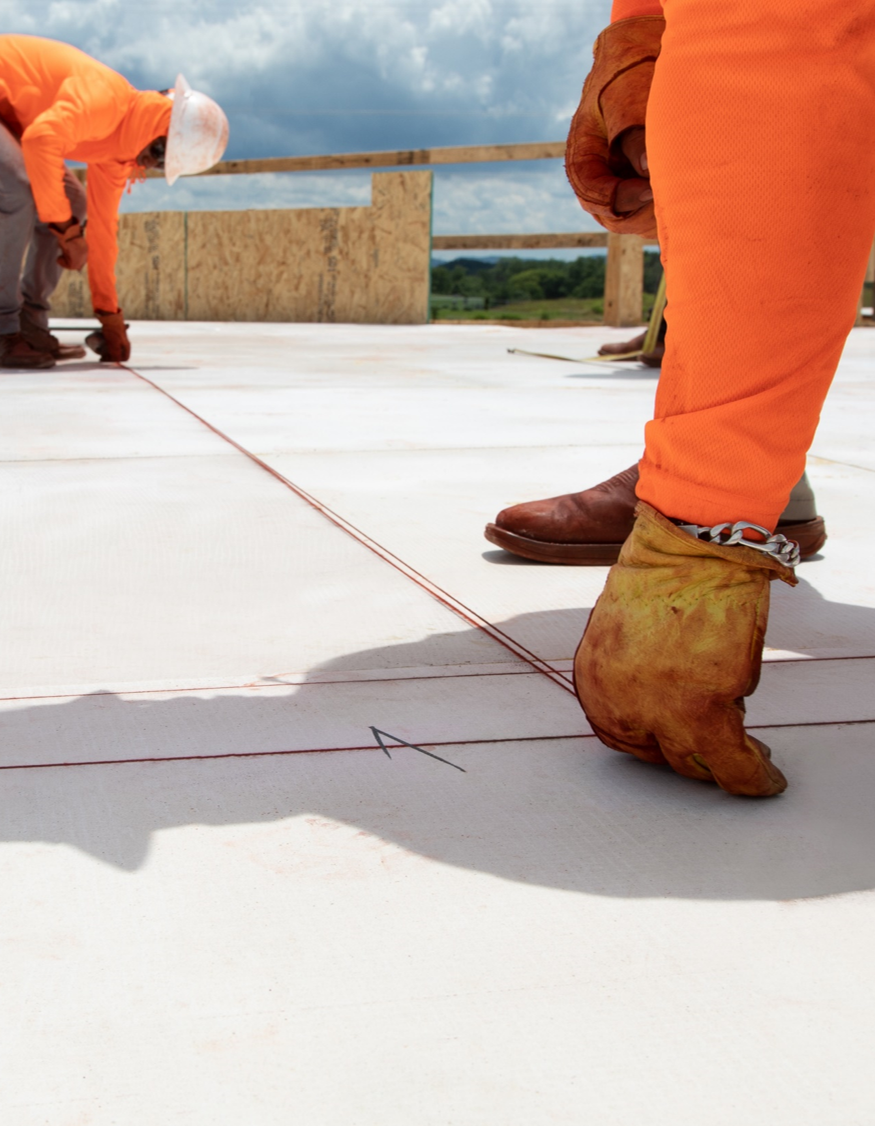
MgO underlayment panels are installed using standard framing tools and fastening methods as part of the floor assembly construction process.
By comparison, MgO panels are installed by framing crews as they install the subfloor, using standard tools and fastening methods. No extended preparation or cure time is required. The panels must still be measured, cut, and properly fastened. Installation requires coordination with the framing.
Because installation occurs as part of the framing process, panels are installed over the subfloor as the structure is being assembled. This allows the floor assembly to be completed without introducing a separate installation phase later in the schedule.
This approach reduces the need for additional coordination and allows work to continue without interruption. Unlike wet-applied systems, installation does not introduce moisture into the building. As a result, the space does not require the same curing period, and other trades can continue work after installation.
This allows the building to move forward without the same delay associated with curing. The floor assembly becomes part of the ongoing construction process rather than a separate step. This can save time in the overall construction schedule, eliminate the need for a separate trade, and reduce the scheduling constraints associated with gypsum underlayment installations.
In practice, a similar experience has been reported on multifamily projects in the Midwest and Southwest, where MgO panels were evaluated as an alternative to wet-poured gypsum.
“We saw the time and cost savings firsthand,” said one project lead. “Using the panels instead of gypsum reduced installation time and simplified the process for the framing crew.”
The team also noted that eliminating drying time and reducing jobsite moisture contributed to fewer delays and more predictable timing.
Installation performance is also influenced by fastening and joint treatment. Like other underlayment panel products installed over wood subfloors, MgO panels must be installed in accordance with tested assembly requirements, including fastener type and spacing. These details contribute to the overall performance of the floor assembly, particularly in relation to sound transmission and long-term stability.
Attention to panel joints and transitions is also important, as gaps or discontinuities can create paths for sound transmission or affect finish flooring performance. While installation is typically handled by framing crews, coordination with manufacturers’ requirements remains critical to achieving the intended fire and acoustical ratings.
Construction Types and Application
Building code requirements vary by construction type and occupancy, and these distinctions shape where different floor underlayment systems are appropriate.
Type I and Type II construction are typically used for high-rise and high-occupancy buildings and require noncombustible materials such as steel or concrete. Type IV construction, commonly referred to as heavy timber, relies on the charring behavior of wood to maintain structural integrity during a fire.
MgO panels are most often used in Type III and Type V construction, where wood framing is permitted but fire-resistance requirements still apply. In Type III construction, exterior walls must be fire-rated, while floor and roof requirements vary between Type IIIA and Type IIIB. Type V construction, which is common in multifamily residential buildings, allows combustible materials and includes both protected (Type VA) and unprotected (Type VB) configurations.
These construction types are commonly used in multifamily residential buildings, where floor-ceiling assemblies are repeated across multiple units. Because these assemblies are used throughout the building, performance and coordination are important considerations in design and construction.
Fire-resistance and acoustical requirements must be met within these assemblies, and the selection of materials is influenced by both code requirements and construction practices.
In these building types, floor assemblies must support both life-safety performance and occupant comfort, and design decisions related to materials and assembly configuration can affect how these requirements are achieved.
Moisture and Jobsite Conditions
Wet-applied underlayment also brings some real-world jobsite risks that go well beyond curing time. Because the material is poured on as a liquid, crews must carefully seal every subfloor penetration, gap, and transition before installation begins. Any openings left around plumbing pipes, framing intersections, or mechanical penetrations can allow the material to leak through to the floors below.
Getting a smooth, level floor can take extra care, especially in smaller spaces like bathrooms, closets, and utility rooms where edges, corners, and transitions are harder to finish consistently. Some gypsum products are designed to level better than others, but the final result still depends heavily on good prep work and experienced installers. Underlayment can help create a smooth surface, but it should not be expected to correct uneven framing or poorly prepared subfloors.
By comparison, dry-installed panel systems avoid many of these variables because the assembly is installed mechanically rather than placed in liquid form.
Fire Performance and Tested Assemblies
Fire resistance is a function of the assembly, not an individual product. The level of fire-resistance for each assembly is determined through testing of a specific configuration of materials. Assemblies are tested and evaluated in accordance with ASTM E119 or ANSI UL 263, which measure how long a building assembly can resist fire exposure under load conditions.
A carefully assembled wall, floor-ceiling, or roof-ceiling configuration is constructed in a laboratory and exposed to a controlled fire. Loads are applied to simulate real conditions, and the assembly is evaluated over time. The rating reflects how long that specific assembly maintains its integrity when exposed to fire. It is critical to understand that this is a rating on an assembly, not an individual product. Only the specific materials and configuration used in the tested assembly meet that recorded performance. Changes in materials, spacing, or installation can affect the rating and must be evaluated accordingly.
Fire-resistance rated assemblies are commonly documented through ICC Evaluation Service (ICC-ES), UL Design Listings, or similar published reports. These listings provide the full assembly details, requirements, and options. These must be followed to achieve the intended performance. Designers should refer to these listings for complete information and verify that the selected assembly aligns with project requirements. In multifamily construction, fire-resistance requirements are closely tied to construction type. Type 3 and Type 5 construction are commonly used for wood-framed multifamily buildings, where fire-rated floor-ceiling and wall assemblies may be required depending on occupancy and building height. Exterior walls in Type 3 construction must be fire rated, while Type 5 construction may require rated floor-ceiling assemblies in certain conditions.
Within these assemblies, materials contribute to fire performance as part of the overall system. Magnesium oxide has long been used as a refractory material because it retains its strength and composition at high temperatures. This characteristic has led to its use in construction assemblies where fire resistance is required.
At the product level, materials may also be evaluated using ASTM E84 or UL 723, often referred to as the tunnel test. This test measures flame spread and smoke developed when a material is exposed to flame under controlled conditions. Results are expressed as a classification, with lower values indicating better performance. However, product-level testing does not replace assembly testing. Fire performance in buildings is determined by how materials work together within a complete system. Floor-ceiling and wall assemblies include structural framing, sheathing, insulation, and finish materials, all of which contribute to overall performance.
Assemblies may provide one-hour or two-hour fire-resistance ratings depending on configuration. For example, tested assemblies may include wood trusses or joists, structural panels, insulation, resilient channel, and multiple layers of gypsum board to achieve the required rating.
A floor-ceiling assembly only performs as well as it is built in the field. Openings for plumbing, lighting, ductwork, and other building systems can create unwanted paths for sound or fire if they are not carefully coordinated with the tested assembly design. Small changes in insulation, resilient channel spacing, fasteners, or ceiling layout can also affect how the assembly performs. Because several trades work on these assemblies at different stages of construction, good coordination during both design and installation is important to maintain the performance of the tested system.
As with sound performance, fire-resistance testing represents controlled laboratory conditions. Actual performance may vary depending on material substitutions, installation quality, and project-specific conditions. Designers should verify that assemblies are constructed in accordance with tested configurations and applicable code requirements.1
Acoustical Performance in Multifamily Construction
From dulling heavy footsteps to mitigating the sound of conversations, floor underlayment plays a pivotal role in multifamily construction. In multifamily buildings, sound transmission between dwelling units is a significant design issue, and selecting floor systems that reduce sound transmission between dwelling units is a key part of design.
Having a floor assembly with adequate ratings for Sound Transmission Class (STC) and Impact Insulation Class (IIC) is essential. The higher the rating, the more noise is reduced between units. Code minimums are typically STC 50 and IIC 50 for dwelling unit separations, though these code minimums may not satisfy residents or occupants regarding noise control in their spaces.
STC measures how well a building assembly reduces airborne sound, such as voices or television noise. IIC measures how well a floor assembly reduces impact sound, such as footsteps or dropped objects. STC is a measure of how an assembly performs when exposed to airborne sound, and IIC measures structure-borne sound using a tapping machine on the floor side of the assembly with sound measurement on the ceiling side.
Sound performance is based on the full floor-ceiling assembly. Assemblies include structural panels, framing, insulation, resilient channel or furring, and gypsum board. Sound transmission testing is conducted on an assembly of materials intended to represent field construction, and testing reflects the performance of a specific configuration.
Assemblies are tested under controlled conditions, and results are used to evaluate and compare systems. Testing is conducted at multiple frequencies and then fit to a transmission loss curve to determine the final STC rating. In some cases, assemblies are tested without floor coverings to establish a base level of performance. This information is meant to represent the base level of performance for the given assembly, and finished flooring systems can influence final results depending on the material and installation.
Depending on the configuration, assemblies can achieve STC and IIC ratings that meet code requirements. Higher values are achieved through additional layers, insulation, resilient channel spacing, and floor finishes. Traditional systems may rely on multiple layers, including sound mats and increased thickness, to achieve these ratings.2 Sound performance may vary depending on material selections and substitutions, the quality of installation, and flanking paths. Performance is not a guarantee but a representation of what sound performance results are achievable, and this information is intended to be used for design evaluation and comparison only.
Performance is based on the specific configuration used, and only the specific products and configuration meet that recorded performance. Assemblies are tested under controlled conditions, and testing reflects the performance of a specific configuration intended to represent field construction. Assemblies include structural panels, framing, insulation, resilient channel or furring, and gypsum board. These components work together to control airborne and impact sound. Depending on the configuration, assemblies can achieve STC and IIC ratings that meet code requirements.
Designers have more control over types of sound transmission when a few key principles are applied. Sound-deadening material can be added, insulation can be incorporated, components can be offset, resilient channel can be spaced appropriately, and structural transmission can be monitored. Thicker floor coverings, such as thicker LVT or carpet, can also be selected, as these are among the best performers for sound control. In evaluating different systems, project teams consider how sound performance is achieved within the assembly and how that performance is maintained during construction.
Practical Considerations for Specification
Support and experience from the manufacturer are also important considerations when evaluating newer material categories. Designers may want to consider the manufacturer’s track record in construction materials, availability of technical documentation, familiarity with multifamily construction requirements, and ability to provide field support during design and installation. Because adoption of MgO underlayment systems is still developing in parts of the U.S. market, access to technical guidance and published assembly information can be particularly important during specification and construction coordination.
Questions to consider include:
Does the manufacturer have an established presence in the U.S. or Canadian construction market?
Are tested assemblies and technical documentation readily available?
Is technical support available if questions arise during design or installation?
Can the manufacturer provide training, preconstruction coordination, or field support when needed?
Evaluation of materials also includes consideration of how products are installed and how they perform within the assembly. Requirements for fastening, joint treatment, and compatibility with finish flooring should be reviewed to ensure that the system performs as intended.
Project teams also need to think about how the selected assembly connects to the rest of the building. Details such as stair transitions, floor height changes, waterproofing at wet rooms, and compatibility with flooring adhesives or underlayment can all affect how the assembly performs in the field. Coordination between structural, acoustical, and interior finish requirements is important because even small changes in flooring materials, ceiling systems, or framing depth can influence the performance of a tested assembly. Addressing these details early can help reduce substitutions and field changes that may affect acoustical or fire-resistance ratings.
Because performance is based on tested assemblies, it is important to confirm that the selected configuration aligns with published data and code requirements. Variations in installation or material substitutions may affect results. Coordination between design and construction teams is also important, as the performance of the assembly depends on how materials are installed in the field.
While MgO panels are gaining attention, adoption in the U.S. is still relatively early, and support for some products may not match that of more established materials.
Evolving Approaches to Floor Systems
As builders place greater emphasis on efficiency, coordination, and resource use, floor underlayment is being evaluated for fire resistance and acoustical performance. It is also being evaluated for its impact on construction sequencing and jobsite conditions. The increasing use of MgO panels reflects a broader shift toward systems that reduce installation time, limit moisture introduced into the building, and simplify floor assemblies.
For architects and builders, these shifts reflect a broader rethinking of how floor systems contribute to overall project delivery, influencing not only performance, but also schedule, labor coordination, and long-term building operation.
Conclusion
Magnesium oxide (MgO) underlayment panels provide an alternative approach to floor assemblies in multifamily construction, where fire-resistance and acoustical performance are based on tested configurations and code requirements. By comparing MgO panels with wet-poured gypsum systems, architects can evaluate how installation sequencing, moisture conditions, and assembly design influence performance and construction. Understanding these factors supports more informed specification decisions that align with project requirements for safety, comfort, and building performance.
ENDNOTES
Fire Resistance References:
ASTM E119 – Standard Test Methods for Fire Tests of Building Construction and Materials
ANSI/UL 263 – Standard for Fire Tests of Building Construction and Materials
ASTM E84 – Standard Test Method for Surface Burning Characteristics of Building Materials
UL 723 – Test for Surface Burning Characteristics of Building Materials
International Code Council (ICC). International Building Code, Section 703 – Fire-Resistance Ratings
Acoustic References:
ASTM E90 – Standard Test Method for Laboratory Measurement of Airborne Sound Transmission Loss of Building Partitions and Elements
ASTM E413 – Classification for Rating Sound Insulation
ASTM E492 – Standard Test Method for Laboratory Measurement of Impact Sound Transmission Through Floor-Ceiling Assemblies Using the Tapping Machine
ASTM E989 – Classification for Determination of Impact Insulation Class
International Code Council (ICC). International Building Code, Section 1206 – Sound Transmission