Parapet Perplexities Solved
Detailing the Critical Roof-to-Wall Interface
Sponsored by GAF | Siplast | Presented by Benjamin Meyer, AIA, NCARB, LEED AP and Michael Popeck, RRC, REWC
Webinar On-Demand
This course explores one of the most technically challenging intersections of the building enclosure: the roof-to-wall transition. Participants start with an overview of building science fundamentals: the four control layers (water, air, thermal, and vapor) and mitigating the energy loss and moisture issues associated with air leakage. We will also discuss wind resistance requirements.
Through the use of specific examples, the presentation evaluates how different building types, interface types, and maintenance requirements can impact the design of the transition. The course provides guidelines to follow when designing, specifying and constructing these details to ensure design and code requirements are met while ensuring the long-term performance of the building enclosure.
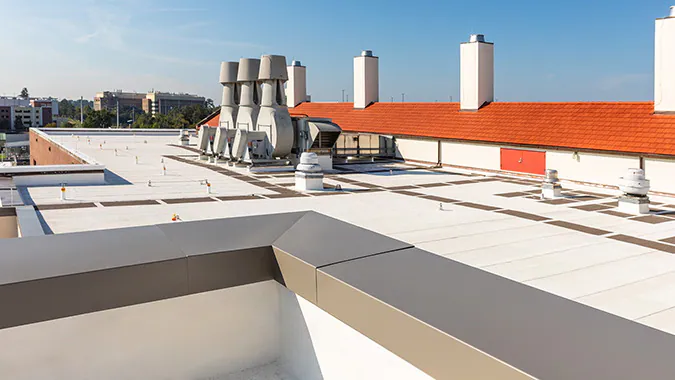
Photo courtesy of GAF
 |
Benjamin Meyer, AIA, NCARB, LEED AP is the Building Enclosure Business Director with Siplast. Previous experience includes: enclosure consultant principal, technical management for enclosure products, architecture, real-estate development and construction management. Serves as a past Member of the LEED Technical Committee, Chair of the ASHRAE 90.1 Envelope Committee, and a past Director of ABAA. |
 |
Michael Popeck, RRC, REWC is the Northeast Design Manager of Building & Roofing Science for GAF. Michael is a Registered Roof Consultant (RRC) & Register Exterior Wall Consultant (REWC) with over 20 years of experience specializing in low-slope roofing & general building enclosure consulting (roofing, walls, windows, doors, etc.) and will use this experience to interact with other design professionals (Architects, Engineers, Consultants, etc.) to help promote best roofing & design practices throughout the industry. Michael possesses a proficiency with forensic architecture, assessment, testing, and design remediation of existing structures in a wide variety of different sectors (K-12, Higher Education, State, Residential, Commercial). |
The Building and Roofing Science team offers regional expert building enclosure collaboration through design, specification, and educational support for customers of GAF and Siplast, both Standard Industries companies. GAF is North America’s largest roofing manufacturer with more homes and businesses in the U.S. protected by a GAF roof than any other product. Siplast, a leader in building enclosure systems, offers a portfolio of advanced, high-performance SBS-modified bitumen, PMMA liquid-applied, PVC KEE, lightweight insulating concrete, wall air & water barrier systems, and amenity/vegetated systems.
Originally published in Building Enclosure
Originally published in April 2026
LEARNING OBJECTIVES
- Describe the requirements for managing moisture, air, vapor, and thermal continuity at building interfaces.
- Design interface details that meet air, water, and thermal control requirements for current and future projects.
- Compare the performance characteristics and chemical compatibility of roofing and wall membranes to support durable adhesion and long-term material integrity at transitions.
- Develop design and specification criteria that define performance standards for roof-to-wall details.