Leckie/Leckie Studios
Primary: Project Planning & Design – Building Design
Sponsored by Architectural Record | Presented by Michael Leckie
This course explores the design thinking, material strategy, and experiential intent behind Lantern House, a custom single-family residence by Michael Leckie Studio in Vancouver, recognized as a 2025 Architectural Record House. Through an in-depth conversation with the architect, participants examine how architecture can move beyond stylistic conventions to become a framework for living—shaped by light, sound, privacy, and ritual.
The discussion addresses how site conditions, climate, client values, and neighborhood context informed decisions around massing, transparency, landscape, and program efficiency. Particular focus is placed on the central “lantern” volume as a spatial, acoustic, and daylighting device, as well as broader themes of restraint, durability, adaptability, and the role of architects in shaping both bespoke homes and the everyday built environment.
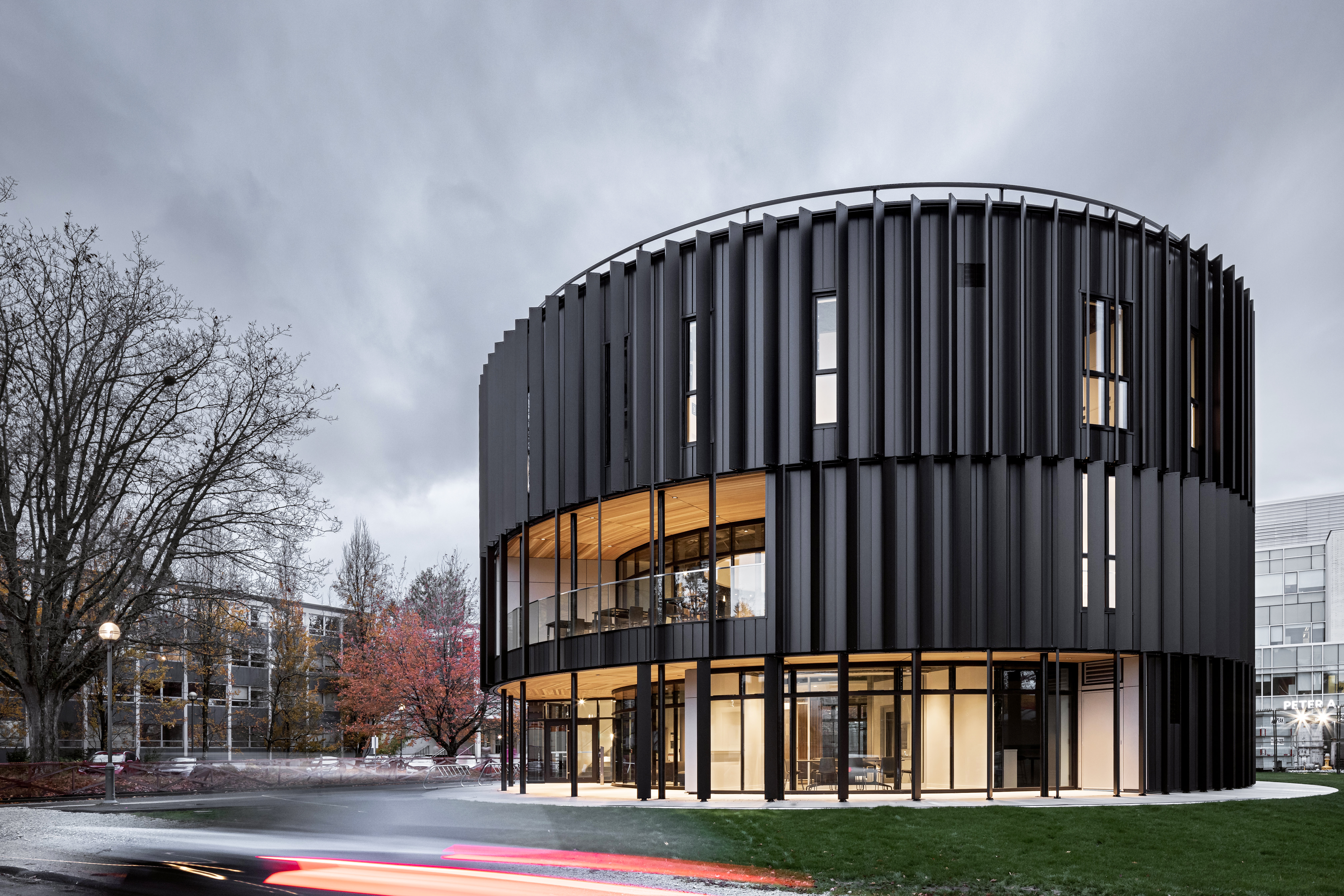
Photo courtesy of Ema Peter
Leckie Arts Student Centre.
 |
Aaron Prinz is the host of the Design:ED Podcast and holds a Masters of Architecture degree from the University of Texas at Austin. He was born and raised in the rural Northern California town of Red Bluff, just two hours south of the Oregon border. After one year of college, Prinz relocated to San Francisco to pursue a career in stand-up comedy. At age 26, he began studying architecture at Portland State University while interning at Studio Petretti Architecture led by Amanda Petretti. His professional contributions while at Studio Petretti were focused on a portion of the new Multnomah County Courthouse which is a prominent addition to the Portland skyline. He currently resides in Austin, Texas with his wife Roxanne where he continues to work as a designer. |

Architectural Record is the #1 source for design news, architect continuing education, and info on sustainability, houses, projects, and architectural products.
Originally published in Architectural Record
Originally published in February 2026
LEARNING OBJECTIVES
- Analyze how client values, lifestyle patterns, and site context can shape architectural form beyond conventional residential typologies.
- valuate strategies for daylighting, acoustics, and spatial sequencing using voids and vertical volume as primary design drivers.
- Assess how modest building size, material restraint, and program efficiency can enhance experiential quality and long-term sustainability.
- Identify ways architectural coherence—across form, material, and detail—supports durability, adaptability, and lasting civic presence.