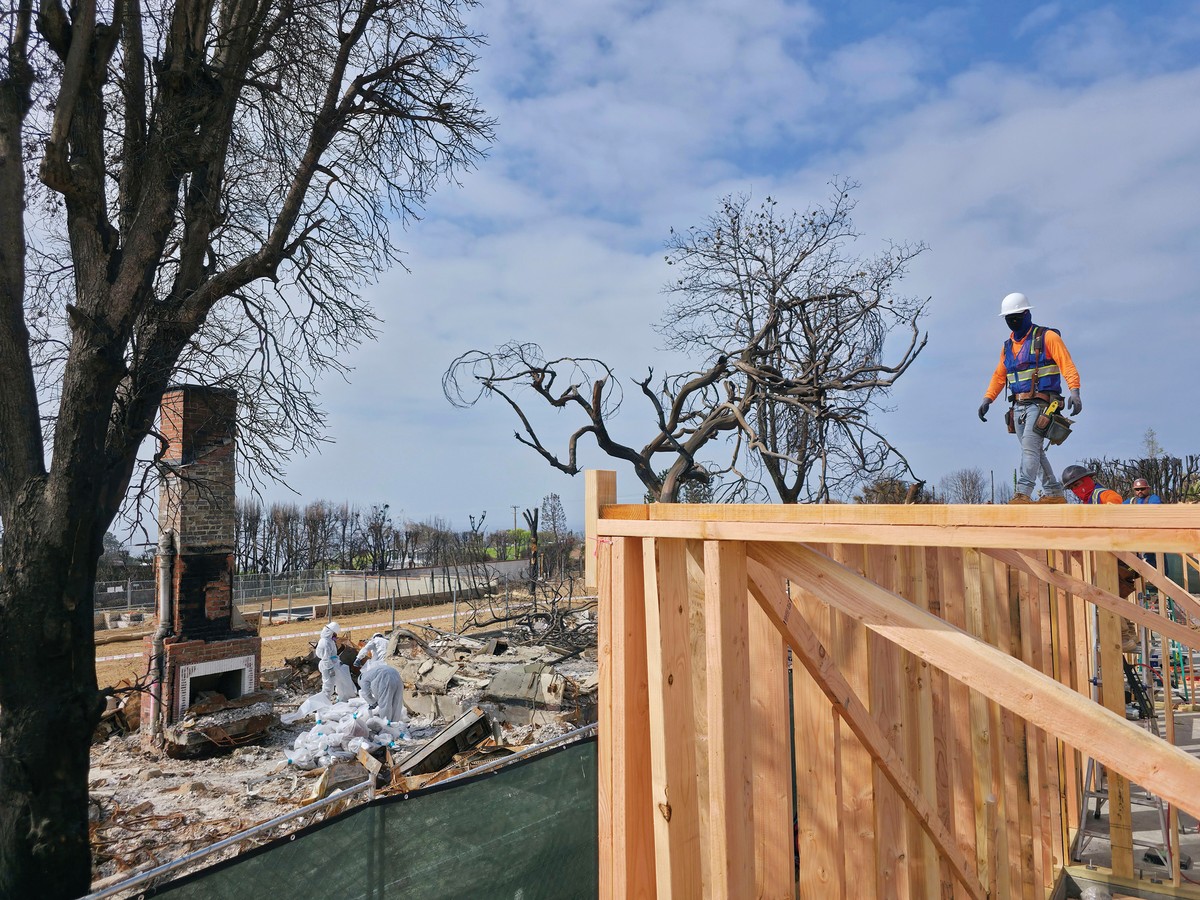
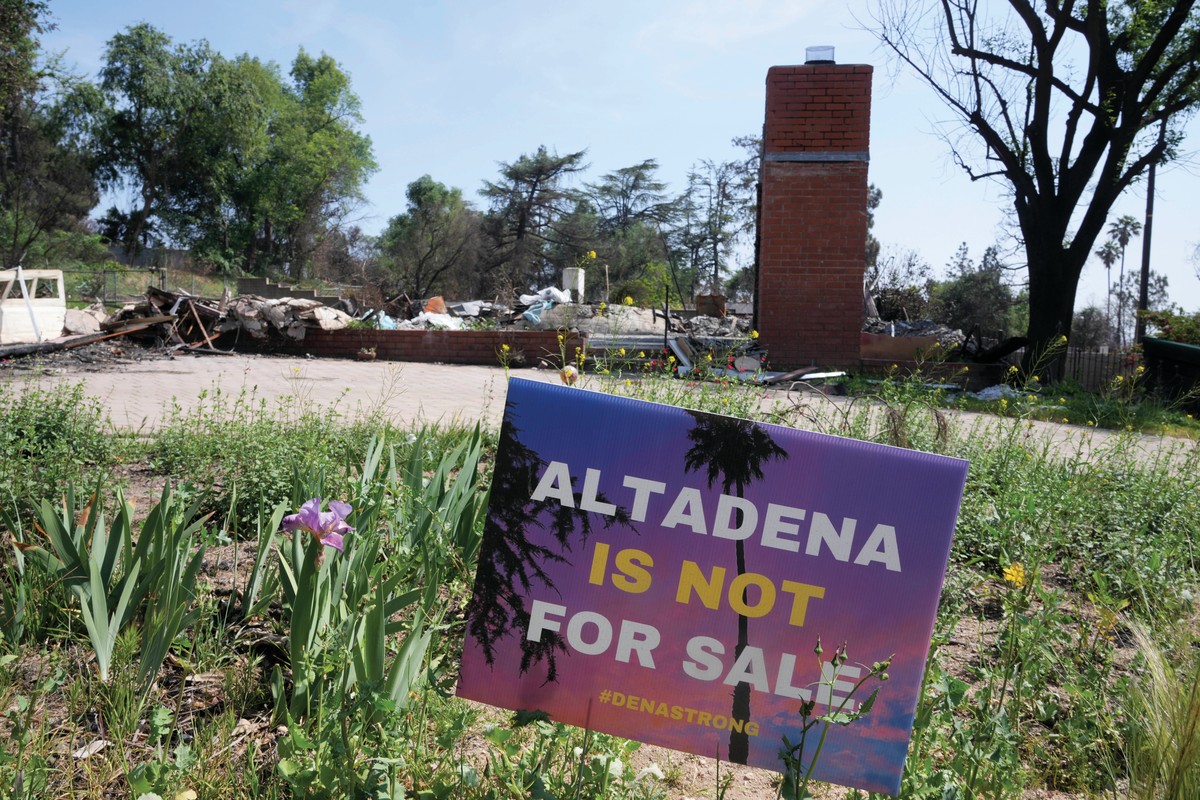
Architectural Record explores the challenges to rebuilding—and the progress made—in the neighborhoods devastated by last January’s fires.
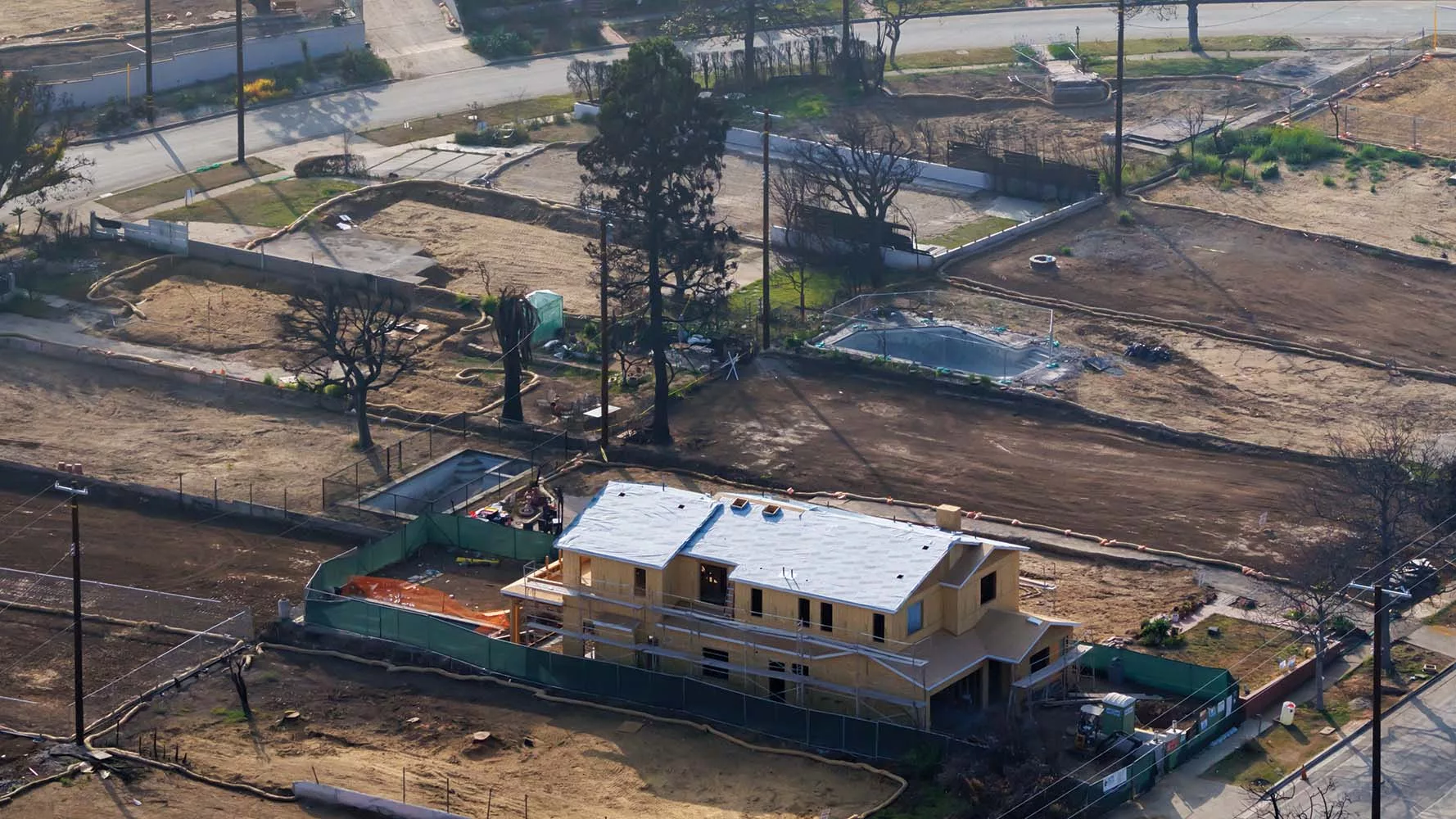
Pacific Palisades, Los Angeles.
Select an article to read more. Click course title to be directed to architecturalrecord.com
The Case Study Program Gets a Reboot
By Sarah Amelar
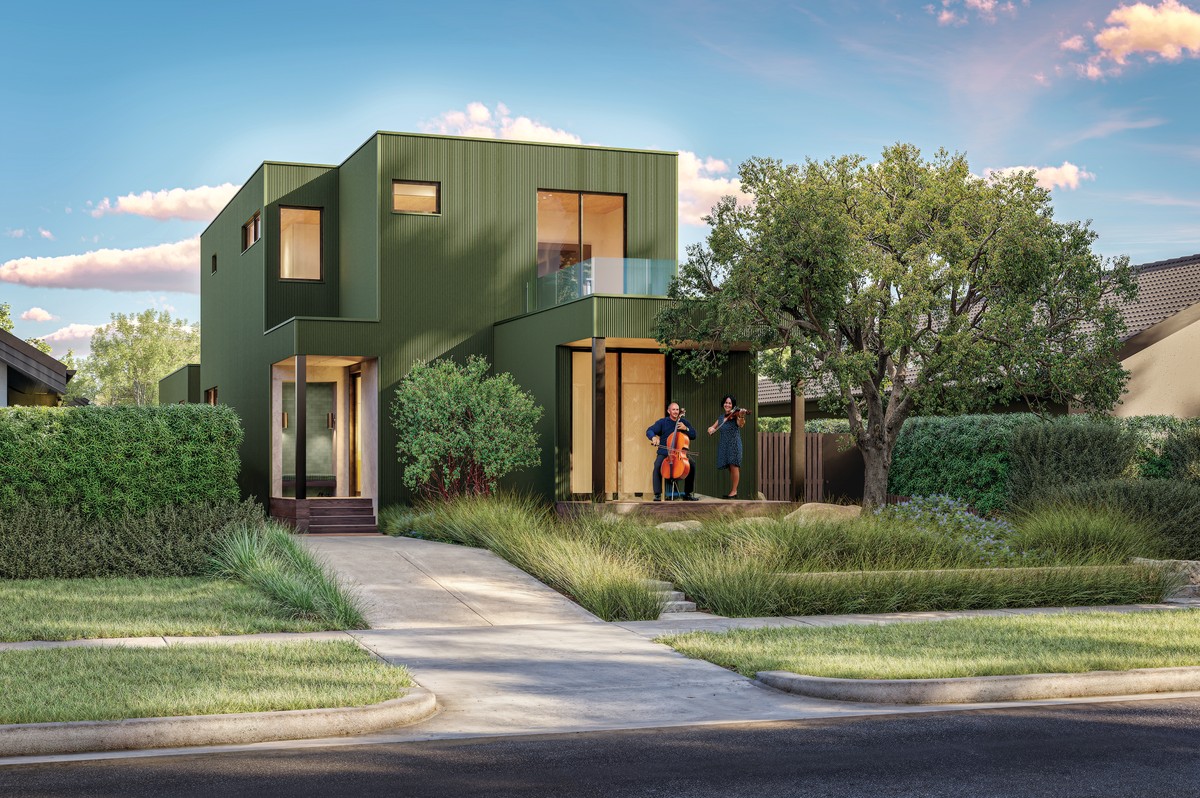
Images: © Marmol Radziner
Marmol Radziner’s CSA #2 is one of many metal-clad house schemes in the two new Case Study programs.
Like thousands of fellow residents of Los Angeles’ Pacific Palisades and Altadena neighborhoods, Dustin Bramell and his family hastily evacuated on January 7, 2025, as raging wildfire encroached. By the next day, their beloved midcentury-modern home was gone, reduced to ash and rubble, along with nearly their entire Pacific Palisades neighborhood.
Bramell had barely begun processing the loss when, that same day, an idea came to him: Could he revive the Case Study Houses program (1945–66) to help rebuild after the fires? Within three months, he and his friend Leo Seigal—a fellow tech entrepreneur and architecture enthusiast—had self-funded and launched Case Study: Adapt (CSA), a nonprofit that would, like the original program, pair clients with architects to create innovative houses to address personal and far-reaching challenges. From its inception, in L.A., the Case Study experiment aspired to tackle the post–World War II housing shortage, and now the most urgent issues were the many displaced Palisades and Altadena residents, along with the global threat of wildfire and other climate-change fallout.
Where the first Case Study program was inextricably linked to Arts & Architecture magazine, CSA joined with Architectural Digest to reach a wide audience. “We realized that what began as just a cool idea was actually a chance to make fire-resilient design inspirational for the public at large,” says Bramell (who comes from a family of firefighters and fire chiefs). His venture also partnered with the Eames Foundation, whose 1949 Case Study House #8 and Studio—which barely escaped the Palisades Fire—has hosted CSA’s idea-generating meetings.
Around the same time, another (somewhat different) initiative emerged, independently, from the Case Study legacy. Called Case Study 2.0 (CS 2.0), it’s the brainchild of brothers Steven and Jason Somers, cofounders of Crest Real Estate, an L.A. land-use and architectural-expediting company experienced in the now fire-torn neighborhoods. “The overwhelming devastation left so many people in shock and unsure what to do next,” recalls Steven. “We realized that our expertise with regulations, permitting, and construction—with bringing architectural ideas to fruition—put us in a unique position to help.”
They also recognized the concern, within the affected communities, that developers might buy up lots, resulting, as Steven puts it, “in many practical homes without any distinctive architectural qualities.” So CS 2.0 set out to create an online catalogue of designs that could simplify and streamline the process for homeowners while, ideally, yielding architectural richness and diversity at costs competitive with standardized construction.
The Somerses reached out to architects they admired and had worked with—established and lesser-known local talent, plus practices worldwide that had built in L.A. Unlike the pure modernism of Case Study Houses, their program offers eclectic styles, recalling, says Steven, “the unique character and variety of these neighborhoods.” By December, CS 2.0 had 50 participating firms, 12 projects in contract, and many under discussion. Click here to read more...
Is the Passive House Standard the Answer?
By Joann Gonchar, FAIA
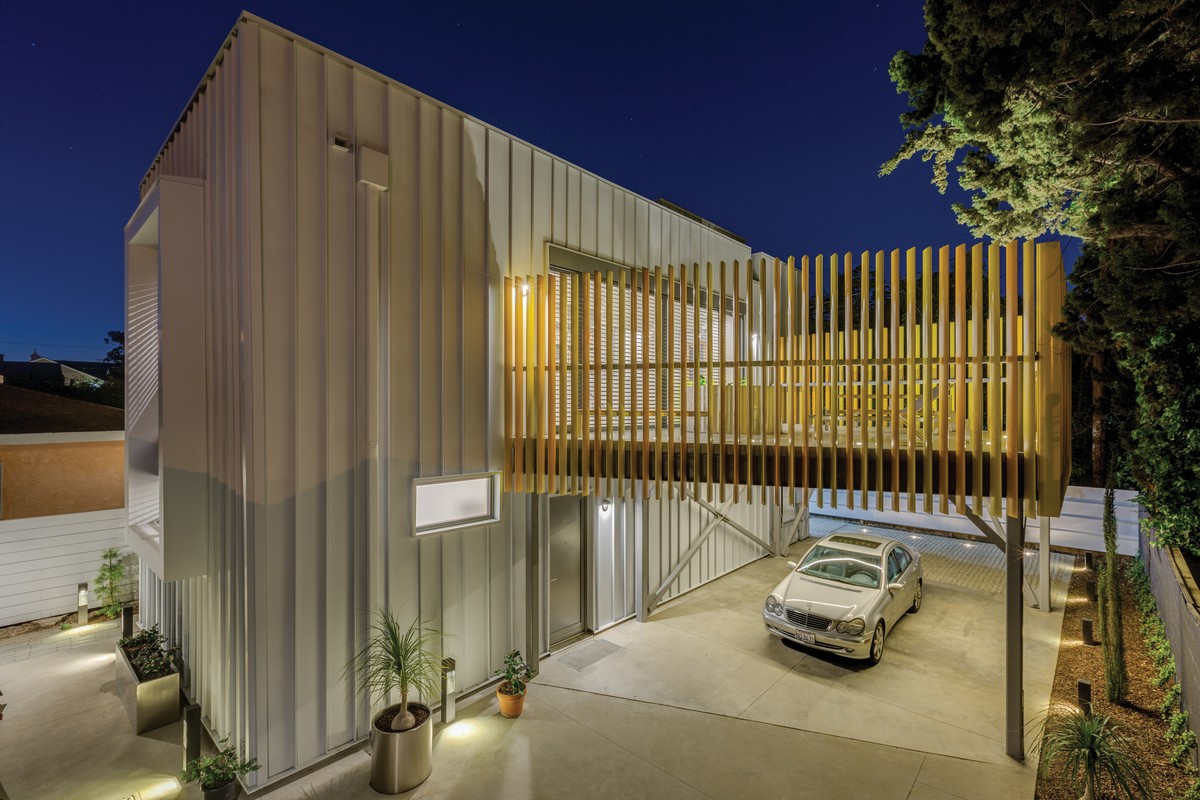
Culver City–based Paravant Architects designed the first certified Passive House in L.A. County.
In the aftermath of the wildfire that swept through Los Angeles’ Pacific Palisades last January, reports circulated of a house, designed to the Passive House standard, that was still standing, seemingly unscathed, while its immediate neighbors had been reduced to charred rubble. It turns out that the house is not a true Passive House, but instead borrows some of the construction methodology’s principles. The residence’s architect, Santa Monica–based Greg Chasen, credits the structure’s survival to those features—along with good fortune. “Some of the design choices we made here helped,” he said in a January 12, 2025, Instagram post. “But we were also very lucky.”
What exactly is Passive House? It was not created as a fire-resilience program but rather as a performance-based certification system focused almost exclusively on energy efficiency. Nevertheless, many Passive House proponents see the program and its strategies as having great potential for the rebuilding of L.A.’s devastated neighborhoods. “Passive House and wildfire design have significant synergies,” says Christian Kienapfel, co-founder of Paravant Architects. Kienapfel designed his own Culver City residence to the standard, completing the metal-clad 1,750-
square-foot, net zero, all-electric structure in 2018, making it L.A. County’s first certified Passive House.
Known as Passivhaus in Germany, where the program originated in the early 1990s, the certification system is applicable to any building type (not just residential construction, as the name would seem to suggest). It seeks to minimize energy expended for heating and cooling, with tenets that include an extra-insulated, airtight building envelope with minimal thermal bridging, ultra-high-performance windows, and mechanical ventilation with heat recovery.
Passive House designers say that the aspect of the program providing the most benefit
in wildfire-prone regions is the continuous air-sealing of the envelope. Passive House International (one of two certifying bodies) permits only 0.6 air changes per hour at 50 Pascals of pressure through leakage—a tough performance bar that must be confirmed with a blower door test. “The point is to prevent energy loss,” says Timothy Lock, management partner at OPAL, a Belfast, Maine–based architecture firm specializing in Passive House projects. However, the envelope’s robustness, he says, also protects against extreme heat and the intrusion of wind-borne embers—the chief cause of building ignition in a wildfire. OPAL recently won first place in the “contemporary” category of a California Rebuilds competition organized by the non-profits Passive House Network and Passive House California.
Kienapfel, whose firm also won a first-place prize in the same competition—in the “midcentury modern” category—elaborates, noting that glazing can be a vulnerability. But the high-performance windows required by Passive House provide an added defense, he says. He also points to a secondary fire-resilience-related benefit of the program—excellent indoor-air quality. His own house has a heat-recovery-ventilation unit, which effectively removes outdoor pollutants including pollen, smoke, and ash, although, during wildfire events, the filters require frequent replacement, he says. Click here to read more...
Three Palisades Schools Rebuild for the Future
By Matt Hickman
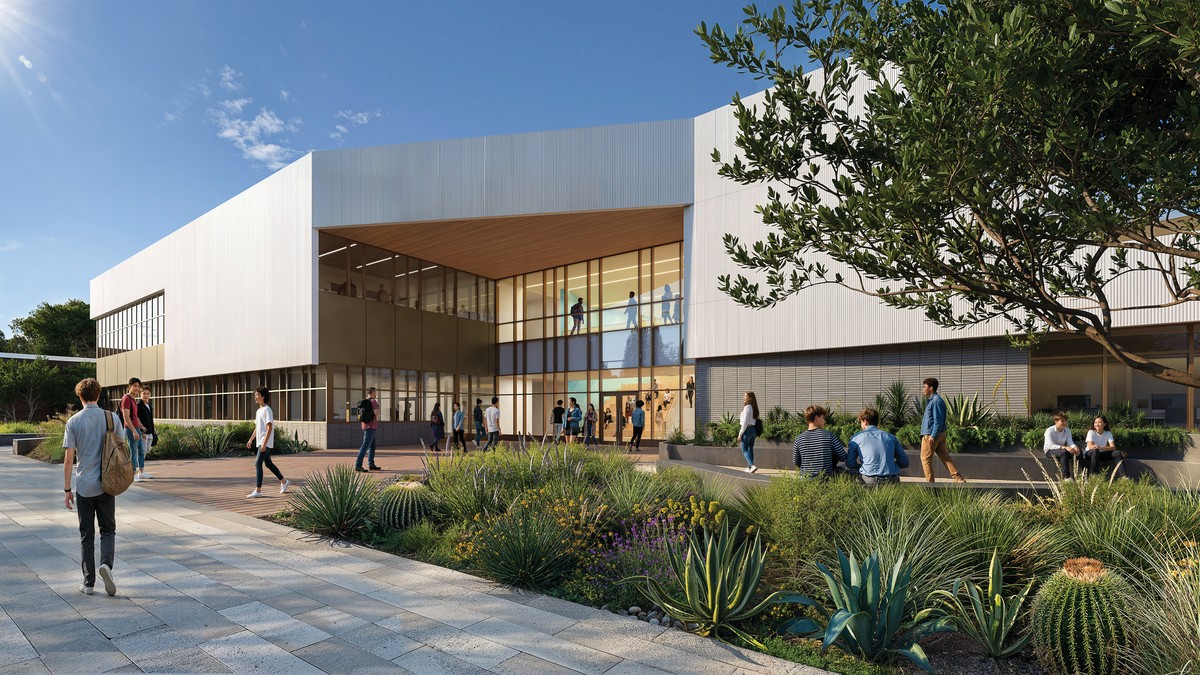
The future academic building at Palisades Charter High School interweaves indoor-outdoor spaces to foster community and connect with the landscape.
IN THE AFTERMATH of a May 22, 2011, tornado that leveled large swaths of Joplin, Missouri, DLR Group played a key role in rebuilding as the designer, with CHGA Architects, of interim and permanent public high schools to replace the one lost on that date—in a cruel twist, the same day as graduation. “The school became the center of the community and helped, in the rebuilding process, as a social anchor,” says Alenoush Aghajanians, principal and senior design leader at DLR Group, emphasizing the school’s role as an essential civic presence as the city gradually emerged from the rubble.
The urgency and breakneck mobilization involved in building Joplin’s new high school, along with the opportunity to reimagine educational strategies and build back better, provided DLR Group with a sturdy foundation to embark on a project currently under way in Los Angeles: a new two-story classroom building on the campus of Palisades Charter High School. Colloquially known as Pali High, the school suffered damage during the Palisades Fire in January 2025, which decimated coastal L.A.’s Pacific Palisades neighborhood and surrounding communities as it raged for nearly a month. The school, however, was somewhat lucky, as much of its campus—established in 1961 in a filled-in canyon below Sunset Boulevard and famed as a filming location for many movie and television productions—was largely spared from the widespread destruction. An aging 1950s shop building, which the fire-resilient new academic hub replaces, and several portable classroom buildings were the only structures completely lost to the inferno, with roughly 70 percent of the classroom inventory surviving.
The reimagined Pali High campus is one of three school rebuilding projects in progress in the fire-ravaged Palisades as part of a
$604 million initiative led by the Los Angeles Unified School District (LAUSD). Just to the east of Pali High, near the commercial core of the neighborhood, is Palisades Elementary Charter School. Heavily damaged by the wildfires and losing multiple buildings, that compact campus, which features a surviving historic main administration/classroom building, is being redeveloped with local firm Practice (formerly GGA+) serving as project architect. To the west, Marquez Charter Elementary, which suffered a total loss (save for three portables), is being rebuilt as a 53,000-square-foot building with a design by NAC Architecture.
Each of the three LAUSD projects is slated to be completed by the end of 2028. With varying budget sizes, they employ fire-adaptive materials and resilient landscaping, along with rigorous sustainability measures, as mandated by the district.
Meanwhile, the Marquez and Pali High campuses have since reopened—in September and later this year, respectively—following extensive clean-up efforts and environmental testing. While rebuilding is in progress, modular classroom units have been installed, and, at Pali High, surviving, smoke-remediated buildings are being repopulated to get students back on campus as soon as possible. (Palisades Charter Elementary students and staff will remain at Brentwood Science Magnet School for the foreseeable future, while their campus is fully reconstructed.) Click here to read more...