Greening Building Product Libraries  

A Material Shift: To design healthier buildings with smaller carbon footprints, firms are making systematic changes

Sponsored by Architectural Record | By Katharine Logan

View course on architecturalrecord.com

 

Photo © Anice Hoachlander 

Whitman-Walker Max Robinson Center

Architect: Perkins&Will

At this health-care and research center in Washington, D.C., materials such as PVC-free flooring without antimicrobials support optimized indoor air quality.


For the first two decades of efforts to select more benign building materials, the challenge centered on a lack of information. What was in a material or product; how did ingredients affect environmental and human health; and how did alternatives compare? Now the center of the materials challenge has shifted. Environmental product declarations, health disclosures, and certification systems have brought impacts of materials into the open. The AIA Materials Pledge, a call to evaluate materials across five key impact categories, has established shared priorities. The Com­mon Materials Framework, under development by the nonprofit initiative Mindful Materials, is emerging as essential infrastructure for organizing and comparing materials disclosures. For practitioners, the question now is how to apply rapidly accumulating data to make materials choices more effectively. In other words, how best should project teams organize their decision-making?

Architecture and design firms are answering that question in a variety of ways. Some have developed explicit standards and prohibitions; others rely on structured processes or in-house culture. It may help to think of these approaches as a continuum—from values-based guidance through formalized process to gatekeeping, in which certain products or material classes are restricted
or excluded altogether. Along this continuum, firms are developing the decision-making models that best advance their priorities in terms of consistency, flexibility, impact, and practicality.

What follows is a look at four examples: two gatekeeping models, exemplified by Perkins&Will and Gensler, and two structured-process models, from LMN Architects and ZGF Architects. (Values-based guidance, in which greening materials is left to project teams, is self-explanatory and needs no discussion here.) It’s important to note that the continuum isn’t a hierarchy. These different models are less about levels of ambition or best practices than they are about workable, firm-specific decision frameworks. It’s a matter of fit.

Among large firms, Perkins&Will was an early adopter of gatekeeping as a way to translate environmental values into day-to-day materials choices. In 2008, even before product disclosures became commonplace, the firm developed its Precautionary List, a free, publicly accessible database of building-material constituents with known or suspected impacts on human or ecological health. In 2025, it rolled out the Switch List, a compilation of 12 categories of substances and products that the firm is no longer specifying.

Examples of Switch List items include wallboard and ceiling panels that contain halogenated flame retardants or antimicrobials, fluorescent lighting, and resilient flooring that contains any of a number of prohibited substances. The Switch List doesn’t specify preferred alternatives; rather, its purpose is to highlight categories for which the ease and impact of finding better options warrants designers’ effort. “Increasingly, the market is solving for the Precautionary List,” says Mary Dickinson, researcher and regional director of regenerative design in the firm’s Dallas studio. “The Switch List is intended to share with our design teams categories where they can readily substitute with options that remove these substances.”

The awareness that the Precautionary List calls for and the substitutions that the Switch List mandates are complementary. Together they address a core challenge of greening a materials library: advancing standards without overwhelming project teams. To help designers implement the two lists, the firm requires that products held in studios’ physical libraries have publicly accessible Health Product Declarations (HPDs), which disclose ingredients and their associated health hazards, and, on request, Environmental Product Declarations (EPDs), which report quantified life-cycle environmental impacts; items complying with the Precautionary List are typically specially tagged. Supplier presentations may include only products that are Switch List compliant. In-house “material champions” help with the legwork, curating information, identifying alternatives, meeting with design teams early in a project to advise on materials under consideration, sharing information across studios, and reviewing the two lists for periodic updates.

Both the Precautionary and Switch lists are designed to evolve, reflecting advances in science, shifts in market conditions, and lessons from project experience. Substances migrate from one to the other only once alternatives are readily available and reliable—and when they don’t introduce new cost or code issues. “We have to be very careful,” Dickinson says. “If we ask a client to use these alternate products and one of them fails, we sure do lose their trust.”

In some cases, a project encounters constraints on Switch List substitutions—client standards or building codes, for example. Even so, “we ask teams to have a conversation to identify underlying concerns,” Dickinson says. “Quite often, it’s performance and cost, so if we can solve for those two, sometimes we can open that door.”

Where Perkins&Will focuses on prohibiting substances of concern, Gensler focuses on setting standards by which a material or product will be admitted. The Gensler Product Sustainability (GPS) Standards, launched in 2023, define green performance criteria for the top 18 most commonly used high-impact product categories in architecture and interiors. For each category, a publicly accessible table lists the criteria required for inclusion in a Gensler project. Examples include both batt and board insulation, which must provide EPDs reporting Global Warming Potential (GWP) below certain limits, percentages of various types of recycled content, and location of manufacturing facility; VOC emissions must also be certified. Among the requirements for carpet tile and broadloom is a manufacturer take-back program as an end-of-life option. Glass demountable partitions are required to include at least 50 percent recycled content, be designed for disassembly and reuse, and use FSC-certified lumber for any wood components. Criteria are grouped under five headings—organizational commitments, multi-attribute certifications, life-cycle impacts, indoor-air impacts, and material health and transparency, with impact areas cross-referenced to the AIA Materials Pledge.

Image courtesy Gensler

Hennepin County Westonka Library

Architect: Gensler

This Minnesota library, slated for completion in December, is on track for a 49 percent embodied-carbon reduction. 


With its global operations, Gensler has been careful to prioritize product categories where market conditions allow for consistency. Ancillary furniture, for example, where small, local manufacturers might be heavily disadvantaged by certification requirements, is not governed by the standard. “It’s a very big challenge to get a standard that hits the mark, raises the bar, but still is accessible,” says David Briefel, global leader of Gensler’s Climate Action & Sustainability practice and sustainability director in the firm’s New York City office.

The GPS emerged from a confluence of challenges. The first was manufacturer confusion: “Even though there were a whole lot of criteria publicly available to them, they still didn’t know, specific to their product, what was most important to the AEC industry and owners,” Briefel says. Which third-party certifications should they prioritize, for instance? Second was in-house uncertainty, when not every team necessarily had the expertise to set criteria project by project: “We were getting a lot of questions,” he says. “Sustainability is a huge value of the company, but individual design teams weren’t sure what conferred value.”

Adopting a standard is one thing; implementing it across thousands of projects is another. Dedicated teams support manufacturer outreach, vet and curate materials for firm-wide libraries, and ensure that only compliant products are displayed and specified. Others work directly with contractors to translate the standards into project specifications, while technical specialists focus on refining and evolving the criteria themselves. Regular training and internal communication ensure that design teams understand what the standards require and how to apply them. Gensler has so far vetted more than 8,500 materials for GPS compliance; products that fall short effectively disappear from everyday consideration.

Looking ahead, Briefel sees coordinating data across the industry as the central challenge. This will require shared data infrastructure—common schemata, interoperable databases, and coordinated requests—so that firms can set their own thresholds while working from the same underlying information. “Having a really clear market signal—where manufacturers understand exactly what’s being asked of them, and design teams have the resources to evaluate their options—is going to be so, so important,” he says.

Prohibitions and prerequisites represent different yet overlapping approaches to greening materials selections through gatekeeping. As the Perkins&Will and Gensler examples show, they involve hefty investments in research, education, communication, and administration. For smaller firms, approaches based on structured processes offer another path to optimizing materials choices.

Over the past few years, Seattle-based LMN Architects, a single-office firm of about 100 people, has been applying a structured process to its materials decision-making—normalizing embodied-carbon analysis across its portfolio and building from project-based experimentation toward firm-wide carbon caps. There’s some gatekeeping, but it’s secondary. “The process leads to the outcomes,” says Kjell Anderson, LMN’s director of sustainable design. “You do the process and you’re much more likely to get the results.”

Image courtesy LMN / Page Joint Venture

Austin Convention Center Redevelopment

Architect: LMN / Page Joint Venture

The new convention center, slated for completion in 2029, will incorporate multiple materials salvaged from the old building, including steel trusses. 


Early embodied-carbon modeling is part of the firm’s basic service; in addition, each project includes a sustainable-materials kickoff. The firm’s 2024 Sustainability Action Plan identifies highest-impact materials under the AIA Materials Pledge categories, focusing research on a manageable list of frequently specified products. Teams track selections using standardized procedures; weekly interiors meetings share findings, and choosing better options becomes standard. Specifications in both general requirements and technical sections require embodied-carbon reductions across product categories. “If we present four products to a client, we want all four of them to be better than the average,” Anderson says. “That way, even if they pick the least desirable one, we’re still in good shape.”

As a caveat, Anderson notes that requirements for documentation and certification tend to favor large manufacturers who can afford them, a gap LMN hasn’t yet figured out how to address at scale but is “very careful about” as it moves forward.

The firm also pilots innovative and biogenic materials in its in-studio shop, working with manufacturers to explore new materials and understand how best to use them. “The process-driven approach is experiment, experiment,” Anderson says, “and, once we get to a certain point with a product, we’ll add it to our standard options.” That certain point encompasses performance, procurement, and cost, as well as the environment and health.

In addition to iteratively improving new product selections, each of LMN’s projects has a goal of using at least two materials that are salvaged. Notable successes include flooring from a warehouse of material that purchasers bought but never picked up, a feature wall made from wood offcuts that were slated to be burned, art glass reused in exterior shading devices, and in situ carpet tile that LMN’s designer recontextualized on a materials board and the client then chose. If a project entails demolition, designers identify candidate materials early, working closely with contractors to determine what’s feasible and cost-effective. Critically, Anderson says, recovery that’s already part of the contractor’s business model doesn’t count toward the minimum salvage requirement, as the intent is to drive additional effort and understanding. Over time, salvage and reuse have become another of LMN’s iterative processes, generating know-how that scales from interior renovations to large civic projects.

LMN shows how a greener materials library can emerge through an iterative process with centralized decision-making. At ZGF, a seven-office firm, stewardship is distributed instead. A culture of care for the natural environment imbues the firm’s work, says Arathi Gowda, a principal in ZGF’s Washington, D.C., office and a firm-wide sustainability lead, but outcomes rely on more than shared values: “There is structure behind this.”

ZGF’s materials governance is shared among members of a task force that meets monthly, a smaller leadership group convening every two weeks, and the firm’s Project Performance Team, which provides sustainability input project by project. Over time, this network has generated a set of internal tools: a Sustain­ability Action Plan; a “Green Dot” material-vetting program; division-specific Product Guides aligned with industry initiatives such as the Common Materials Framework; and specification language addressing health, embodied carbon, and emissions. Together, these mechanisms shape the firm’s materials choices. “Our libraries represent the top 25 percent [most ecologically responsible] materials in the market,” Gowda says. “If a product doesn’t meet those criteria, it simply isn’t there.”

Underpinning these resources is a 150-plus-­page Materials Playbook. Designed as a set of entry points rather than a required process, it explains why materials matter, outlines the firm’s climate and health commitments, demystifies disclosure tools, and offers guidance on high-impact products common to most projects. What Gowda calls a “burn the haystack” strategy clears away all but the most significant considerations, reducing designers’ decision fatigue while leaving room for their judgement. “We’re not trying to frustrate anyone—we’re trying to connect them to resources,” she says.
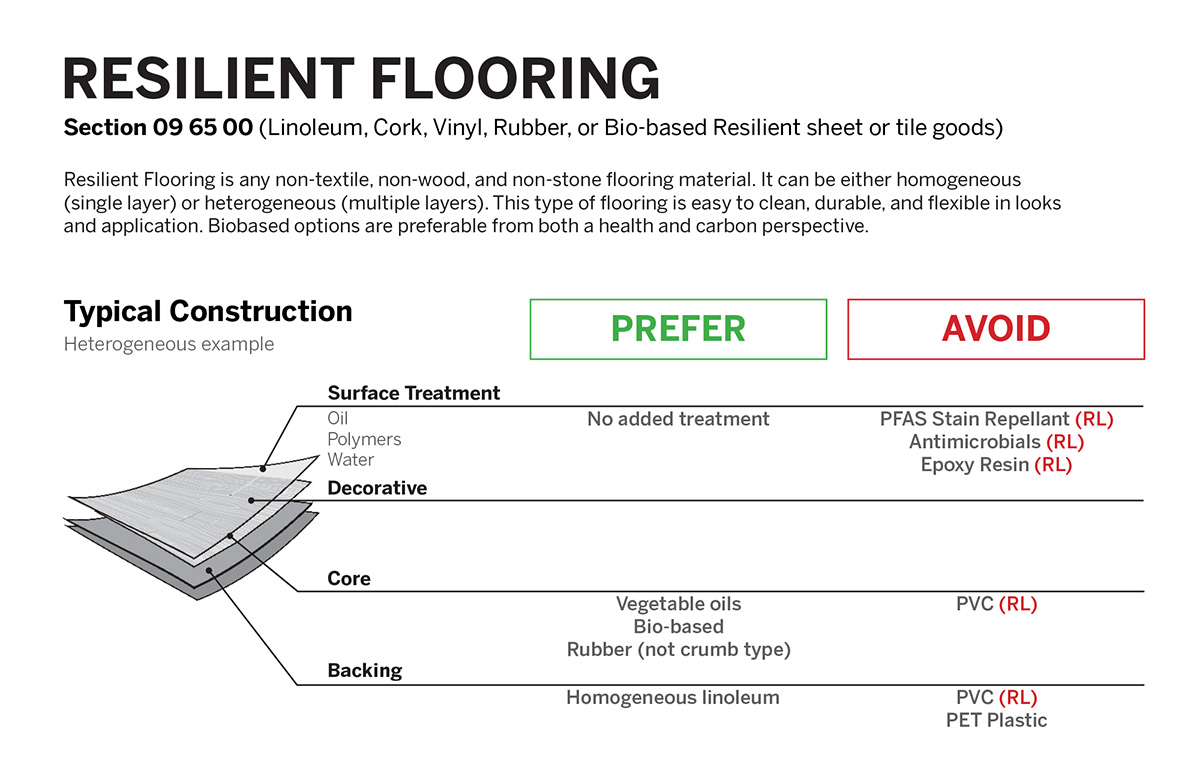
Image courtesy ZGF

As part of its materials governance, ZGF has developed a set of internal tools, including a division-specific set of product guides.


The firm’s culture does much of the remaining work. Sustainability is less about compliance than design excellence, Gowda says, a value that’s strengthened in weekly project conversations as well as formal strategic reviews. Firm leadership endorses industry pledges; younger staff often arrive expecting rigorous environmental performance. The result is “a culture of commitment, not a culture of punishment,” she says. Teams rely on a combination of technical savvy and well-informed questions at key project junctures. The firm’s processes for materials improvement may not be mandatory, but they’re effective because they’re widely understood.

Rather than publishing its materials resources externally, ZGF is contributing to industry-wide efforts: the Common Materials Framework, LEED technical committees, and the AIA Materials Pledge. “Our goal is to have a collective ask,” Gowda says, “to reduce market confusion while advancing the industry and streamlining material choices.”

Whether a firm leans toward gatekeeping or a structured process (or informal, values-led guidance) depends less on ambition than on circumstances: firm size, sustainability expertise, administrative capacity, and how effectively values translate into results. A variety of models can lead to a greener materials library, and what matters is the decision to engage deliberately with the challenge. “This feels like where we were with operational energy 15 or 20 years ago—we’re approaching the moment where it will be much easier to align doing the right thing with actual design,” Gowda says. “It’s a really exciting time for materials.”


Supplemental Materials

AIA Materials Pledge Starter Guide

 

View course on architecturalrecord.com


Photo © Anice Hoachlander 

Whitman-Walker Max Robinson Center

Architect: Perkins&Will

At this health-care and research center in Washington, D.C., materials such as PVC-free flooring without antimicrobials support optimized indoor air quality.


For the first two decades of efforts to select more benign building materials, the challenge centered on a lack of information. What was in a material or product; how did ingredients affect environmental and human health; and how did alternatives compare? Now the center of the materials challenge has shifted. Environmental product declarations, health disclosures, and certification systems have brought impacts of materials into the open. The AIA Materials Pledge, a call to evaluate materials across five key impact categories, has established shared priorities. The Com­mon Materials Framework, under development by the nonprofit initiative Mindful Materials, is emerging as essential infrastructure for organizing and comparing materials disclosures. For practitioners, the question now is how to apply rapidly accumulating data to make materials choices more effectively. In other words, how best should project teams organize their decision-making?

Architecture and design firms are answering that question in a variety of ways. Some have developed explicit standards and prohibitions; others rely on structured processes or in-house culture. It may help to think of these approaches as a continuum—from values-based guidance through formalized process to gatekeeping, in which certain products or material classes are restricted
or excluded altogether. Along this continuum, firms are developing the decision-making models that best advance their priorities in terms of consistency, flexibility, impact, and practicality.

What follows is a look at four examples: two gatekeeping models, exemplified by Perkins&Will and Gensler, and two structured-process models, from LMN Architects and ZGF Architects. (Values-based guidance, in which greening materials is left to project teams, is self-explanatory and needs no discussion here.) It’s important to note that the continuum isn’t a hierarchy. These different models are less about levels of ambition or best practices than they are about workable, firm-specific decision frameworks. It’s a matter of fit.

Among large firms, Perkins&Will was an early adopter of gatekeeping as a way to translate environmental values into day-to-day materials choices. In 2008, even before product disclosures became commonplace, the firm developed its Precautionary List, a free, publicly accessible database of building-material constituents with known or suspected impacts on human or ecological health. In 2025, it rolled out the Switch List, a compilation of 12 categories of substances and products that the firm is no longer specifying.

Examples of Switch List items include wallboard and ceiling panels that contain halogenated flame retardants or antimicrobials, fluorescent lighting, and resilient flooring that contains any of a number of prohibited substances. The Switch List doesn’t specify preferred alternatives; rather, its purpose is to highlight categories for which the ease and impact of finding better options warrants designers’ effort. “Increasingly, the market is solving for the Precautionary List,” says Mary Dickinson, researcher and regional director of regenerative design in the firm’s Dallas studio. “The Switch List is intended to share with our design teams categories where they can readily substitute with options that remove these substances.”

The awareness that the Precautionary List calls for and the substitutions that the Switch List mandates are complementary. Together they address a core challenge of greening a materials library: advancing standards without overwhelming project teams. To help designers implement the two lists, the firm requires that products held in studios’ physical libraries have publicly accessible Health Product Declarations (HPDs), which disclose ingredients and their associated health hazards, and, on request, Environmental Product Declarations (EPDs), which report quantified life-cycle environmental impacts; items complying with the Precautionary List are typically specially tagged. Supplier presentations may include only products that are Switch List compliant. In-house “material champions” help with the legwork, curating information, identifying alternatives, meeting with design teams early in a project to advise on materials under consideration, sharing information across studios, and reviewing the two lists for periodic updates.

Both the Precautionary and Switch lists are designed to evolve, reflecting advances in science, shifts in market conditions, and lessons from project experience. Substances migrate from one to the other only once alternatives are readily available and reliable—and when they don’t introduce new cost or code issues. “We have to be very careful,” Dickinson says. “If we ask a client to use these alternate products and one of them fails, we sure do lose their trust.”

In some cases, a project encounters constraints on Switch List substitutions—client standards or building codes, for example. Even so, “we ask teams to have a conversation to identify underlying concerns,” Dickinson says. “Quite often, it’s performance and cost, so if we can solve for those two, sometimes we can open that door.”

Where Perkins&Will focuses on prohibiting substances of concern, Gensler focuses on setting standards by which a material or product will be admitted. The Gensler Product Sustainability (GPS) Standards, launched in 2023, define green performance criteria for the top 18 most commonly used high-impact product categories in architecture and interiors. For each category, a publicly accessible table lists the criteria required for inclusion in a Gensler project. Examples include both batt and board insulation, which must provide EPDs reporting Global Warming Potential (GWP) below certain limits, percentages of various types of recycled content, and location of manufacturing facility; VOC emissions must also be certified. Among the requirements for carpet tile and broadloom is a manufacturer take-back program as an end-of-life option. Glass demountable partitions are required to include at least 50 percent recycled content, be designed for disassembly and reuse, and use FSC-certified lumber for any wood components. Criteria are grouped under five headings—organizational commitments, multi-attribute certifications, life-cycle impacts, indoor-air impacts, and material health and transparency, with impact areas cross-referenced to the AIA Materials Pledge.

Image courtesy Gensler

Hennepin County Westonka Library

Architect: Gensler

This Minnesota library, slated for completion in December, is on track for a 49 percent embodied-carbon reduction. 


With its global operations, Gensler has been careful to prioritize product categories where market conditions allow for consistency. Ancillary furniture, for example, where small, local manufacturers might be heavily disadvantaged by certification requirements, is not governed by the standard. “It’s a very big challenge to get a standard that hits the mark, raises the bar, but still is accessible,” says David Briefel, global leader of Gensler’s Climate Action & Sustainability practice and sustainability director in the firm’s New York City office.

The GPS emerged from a confluence of challenges. The first was manufacturer confusion: “Even though there were a whole lot of criteria publicly available to them, they still didn’t know, specific to their product, what was most important to the AEC industry and owners,” Briefel says. Which third-party certifications should they prioritize, for instance? Second was in-house uncertainty, when not every team necessarily had the expertise to set criteria project by project: “We were getting a lot of questions,” he says. “Sustainability is a huge value of the company, but individual design teams weren’t sure what conferred value.”

Adopting a standard is one thing; implementing it across thousands of projects is another. Dedicated teams support manufacturer outreach, vet and curate materials for firm-wide libraries, and ensure that only compliant products are displayed and specified. Others work directly with contractors to translate the standards into project specifications, while technical specialists focus on refining and evolving the criteria themselves. Regular training and internal communication ensure that design teams understand what the standards require and how to apply them. Gensler has so far vetted more than 8,500 materials for GPS compliance; products that fall short effectively disappear from everyday consideration.

Looking ahead, Briefel sees coordinating data across the industry as the central challenge. This will require shared data infrastructure—common schemata, interoperable databases, and coordinated requests—so that firms can set their own thresholds while working from the same underlying information. “Having a really clear market signal—where manufacturers understand exactly what’s being asked of them, and design teams have the resources to evaluate their options—is going to be so, so important,” he says.

Prohibitions and prerequisites represent different yet overlapping approaches to greening materials selections through gatekeeping. As the Perkins&Will and Gensler examples show, they involve hefty investments in research, education, communication, and administration. For smaller firms, approaches based on structured processes offer another path to optimizing materials choices.

Over the past few years, Seattle-based LMN Architects, a single-office firm of about 100 people, has been applying a structured process to its materials decision-making—normalizing embodied-carbon analysis across its portfolio and building from project-based experimentation toward firm-wide carbon caps. There’s some gatekeeping, but it’s secondary. “The process leads to the outcomes,” says Kjell Anderson, LMN’s director of sustainable design. “You do the process and you’re much more likely to get the results.”

Image courtesy LMN / Page Joint Venture

Austin Convention Center Redevelopment

Architect: LMN / Page Joint Venture

The new convention center, slated for completion in 2029, will incorporate multiple materials salvaged from the old building, including steel trusses. 


Early embodied-carbon modeling is part of the firm’s basic service; in addition, each project includes a sustainable-materials kickoff. The firm’s 2024 Sustainability Action Plan identifies highest-impact materials under the AIA Materials Pledge categories, focusing research on a manageable list of frequently specified products. Teams track selections using standardized procedures; weekly interiors meetings share findings, and choosing better options becomes standard. Specifications in both general requirements and technical sections require embodied-carbon reductions across product categories. “If we present four products to a client, we want all four of them to be better than the average,” Anderson says. “That way, even if they pick the least desirable one, we’re still in good shape.”

As a caveat, Anderson notes that requirements for documentation and certification tend to favor large manufacturers who can afford them, a gap LMN hasn’t yet figured out how to address at scale but is “very careful about” as it moves forward.

The firm also pilots innovative and biogenic materials in its in-studio shop, working with manufacturers to explore new materials and understand how best to use them. “The process-driven approach is experiment, experiment,” Anderson says, “and, once we get to a certain point with a product, we’ll add it to our standard options.” That certain point encompasses performance, procurement, and cost, as well as the environment and health.

In addition to iteratively improving new product selections, each of LMN’s projects has a goal of using at least two materials that are salvaged. Notable successes include flooring from a warehouse of material that purchasers bought but never picked up, a feature wall made from wood offcuts that were slated to be burned, art glass reused in exterior shading devices, and in situ carpet tile that LMN’s designer recontextualized on a materials board and the client then chose. If a project entails demolition, designers identify candidate materials early, working closely with contractors to determine what’s feasible and cost-effective. Critically, Anderson says, recovery that’s already part of the contractor’s business model doesn’t count toward the minimum salvage requirement, as the intent is to drive additional effort and understanding. Over time, salvage and reuse have become another of LMN’s iterative processes, generating know-how that scales from interior renovations to large civic projects.

LMN shows how a greener materials library can emerge through an iterative process with centralized decision-making. At ZGF, a seven-office firm, stewardship is distributed instead. A culture of care for the natural environment imbues the firm’s work, says Arathi Gowda, a principal in ZGF’s Washington, D.C., office and a firm-wide sustainability lead, but outcomes rely on more than shared values: “There is structure behind this.”

ZGF’s materials governance is shared among members of a task force that meets monthly, a smaller leadership group convening every two weeks, and the firm’s Project Performance Team, which provides sustainability input project by project. Over time, this network has generated a set of internal tools: a Sustain­ability Action Plan; a “Green Dot” material-vetting program; division-specific Product Guides aligned with industry initiatives such as the Common Materials Framework; and specification language addressing health, embodied carbon, and emissions. Together, these mechanisms shape the firm’s materials choices. “Our libraries represent the top 25 percent [most ecologically responsible] materials in the market,” Gowda says. “If a product doesn’t meet those criteria, it simply isn’t there.”

Underpinning these resources is a 150-plus-­page Materials Playbook. Designed as a set of entry points rather than a required process, it explains why materials matter, outlines the firm’s climate and health commitments, demystifies disclosure tools, and offers guidance on high-impact products common to most projects. What Gowda calls a “burn the haystack” strategy clears away all but the most significant considerations, reducing designers’ decision fatigue while leaving room for their judgement. “We’re not trying to frustrate anyone—we’re trying to connect them to resources,” she says.

Image courtesy ZGF

As part of its materials governance, ZGF has developed a set of internal tools, including a division-specific set of product guides.


The firm’s culture does much of the remaining work. Sustainability is less about compliance than design excellence, Gowda says, a value that’s strengthened in weekly project conversations as well as formal strategic reviews. Firm leadership endorses industry pledges; younger staff often arrive expecting rigorous environmental performance. The result is “a culture of commitment, not a culture of punishment,” she says. Teams rely on a combination of technical savvy and well-informed questions at key project junctures. The firm’s processes for materials improvement may not be mandatory, but they’re effective because they’re widely understood.

Rather than publishing its materials resources externally, ZGF is contributing to industry-wide efforts: the Common Materials Framework, LEED technical committees, and the AIA Materials Pledge. “Our goal is to have a collective ask,” Gowda says, “to reduce market confusion while advancing the industry and streamlining material choices.”

Whether a firm leans toward gatekeeping or a structured process (or informal, values-led guidance) depends less on ambition than on circumstances: firm size, sustainability expertise, administrative capacity, and how effectively values translate into results. A variety of models can lead to a greener materials library, and what matters is the decision to engage deliberately with the challenge. “This feels like where we were with operational energy 15 or 20 years ago—we’re approaching the moment where it will be much easier to align doing the right thing with actual design,” Gowda says. “It’s a really exciting time for materials.”


Supplemental Materials

AIA Materials Pledge Starter Guide


Originally published in Architectural Record

Originally published in April 2026

LEARNING OBJECTIVES
  1. Describe the role of such programs as EPDs, health disclosures, the AIA Materials Pledge, and the Common Materials Framework.
  2. Discuss the differences among gatekeeping, structured processes, and values-based guidance for product selection.
  3. Outline the methodologies for materials selection of the four firms profiled.
  4. Describe the performance criteria each of these firms consider when deciding if a particular product should be included in its materials library.