This CE Center article is no longer eligible for receiving credits.
There is a quiet revolution taking place within the design community. After a prolonged emphasis on concrete and steel for buildings other than homes, design professionals are using wood to great effect in a growing number of non-residential and multi-family building types—in applications that range from traditional to innovative, even iconic. Some are driven by wood's cost effectiveness1 while others cite its versatility or low carbon footprint,2 but their collective path has been made possible by building codes that increasingly recognize wood's structural and performance capabilities, and the continued evolution of wood building systems and techniques.
When the International Building Code (IBC) was introduced in 2000, it consolidated three regional model building codes into one uniform code that has since been adopted by most jurisdictions. It increased the possibilities for wood construction by (among other things) recognizing additional fire protection techniques, consolidating the maximum allowable areas and heights from the three legacy codes into one (thus increasing what's allowable in some jurisdictions), and allowing the use of wood in a wider range of building types. In subsequent versions of the IBC, even more opportunities have been created where additional fire protection features are used.
Even so, the pioneering nature of building design is such that there are always architects and engineers seeking to push beyond the conventional, and it is common for project teams to require—and be granted—variances for designs not covered in the code that can nonetheless be justified on a case-by-case basis.
This CEU will examine the use of wood both within the current IBC and through building projects that have further pushed the boundaries of wood design and construction.
 |
CASE STUDY
Pushing the Boundaries of Wood Design |
 |
|
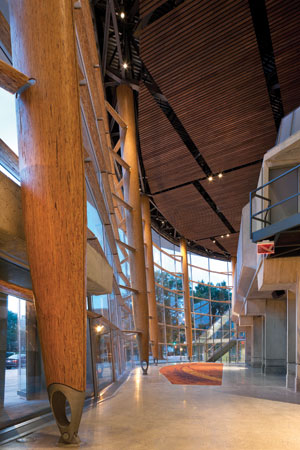
Photo by Nic Lehoux; courtesy of Bing Thom Architects |
Project: Arena Stage at the Mead
Center for American Theater
Location: Washington, D.C.
Architect: Bing Thom Architects
Structural Engineer: Fast+Epp
Structural Engineers
Specialty Timber Façade Design-
Builder: StructureCraft Builders Inc.
Size: 200,000 square feet
Completion Date: 2010
When Arena Stage at the Mead Center
for American Theater reopened in 2010,
it was the first modern building of its
size to use heavy timber components in
the United States capital. It was also the
first project in the U.S. to use a hybrid
wood and glass enclosure to envelop two
existing structures.
The design includes 18 parallel
strand lumber (PSL) columns around
the perimeter of the glass façade,
each measuring 45 to 63 feet tall and
supporting steel roof trusses, which
cantilever beyond the envelope to
create an overhang that runs around
the structure. Designed to brace the
façade against wind loads and to carry
roof loads up to 400,000 pounds, the
columns have no internal steel support.
Local code authorities were
skeptical about allowing wood and
about fire safety in particular, so the
design team presented an in-depth
fire report along with the results of a
smoke study undertaken by a code
consultant. “Through computer
modeling, we showed that effects of a
fire on the structure would be minimal,
and there would be plenty of time for
safe building evacuation,” says Julien
Fagnan, associate and project manager
for Fast+Epp Structural Engineers. The
design team also did a char analysis,
and showed District of Columbia code
officials how char actually protects the
interior of the wood. While charring
would leave a column of reduced size,
calculations showed that, because
the column was sized mainly for
deflection, it already had additional
strength capacity. |
Fire Protection
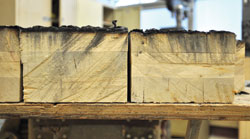
| Large Beams, Cross Laminated Timber Perform Better in Fire |
Some wood products, such as the
large beams used in heavy timber
construction and cross laminated timber
(CLT), may perform better in a fire
situation than noncombustible materials.
Because they are thick and solid, these
products char at a slow and predictable
rate. This char protects the wood from
further degradation, helping to maintain
the building’s structural integrity and
reducing its fuel contribution to the fire,
which in turn lessens the fire’s heat and
flame propagation.4 Section 602.4 of
the 2009 IBC has prescriptive provisions
for wood members which meet the
definition of heavy timber.
Recent fire resistance testing
conducted by the American Wood
Council confirmed that CLT exterior
walls exceed the requirements for heavy
timber construction.
 |
|
Photo courtesy of FPInnovations |
|
Building codes require all building systems to perform to the same level of safety regardless of material used, and wood-frame construction has a long history of fire-safe performance.3 In fact, the IBC allows larger wood structures in a greater range of building types than designers may think possible.
Using tabular allowable areas as a starting point, the IBC allows designers to increase the floor area and building height of wood-frame structures with the addition of sprinkler systems, fire walls, augmented exiting, fire-resistive materials and open perimeter spaces.
For example, it permits low-rise, two-story business and mercantile buildings of wood construction to be unlimited in area if they have a fire sprinkler system and 60 feet of fire separation distance from property lines. Residential wood buildings with sprinklers and exterior walls made from fire-retardant-treated wood (FRTW) can be up to five stories tall and have additional “levels” when mezzanines are included. Under the 2009 IBC, mezzanines are permitted to be 33 percent of the floor area below and considered part of that story, though local jurisdictions may allow a greater percentage. The code also permits the use of wood for many features in buildings required to be of a noncombustible construction type, often even whole roof structures.
Under the IBC, designers can use fire walls to separate a building into smaller fire areas when additional size is needed and sprinklers either aren't an option or they don't afford the necessary increases for the use and site characteristics of the building. In a Type V building, fire walls are permitted to be wood-frame construction, allowing designers to divide the structure into separate buildings for purposes of size, each subject to its own height and area limits.
In addition to the sprinkler and open frontage trade-offs, a designer's options also include fire-resistance rating the entire structure, using fire-retardant-treated wood in the exterior walls, and heavy timber construction:
Rated assemblies consist of specific wall/floor/ceiling component combinations that are used to prevent the spread of fire for a specific time period—typically one or two hours.5 Assembly ratings are normally established through standardized tests that approximate actual fire conditions. The standard for measuring fire resistance of building assemblies is ASTM Test Method E-119, Standard Test Methods for Fire Tests of Building Construction and Materials. For exposed beams and columns of heavy timber dimensions, the IBC also permits fire resistance to be established by methods of calculation. Chapter 7 of the IBC references Chapter 16 of the National Design Specification® (NDS®) for Wood Construction for designing exposed wood members for a specific fire resistance. In this way, buildings can take advantage of the larger areas and heights of rated construction types. FRTW, covered under IBC Section 2303.2, can be used in roof assemblies of Types I and II construction—construction types which are otherwise required to be noncombustible. Fire-retardant treatment limits flame spread and prevents progressive combustion over time. Heavy timber roofs without fire-retardant treatment are also permitted in all construction types except Type 1A.
Heavy timber construction combines the beauty of exposed wood with the strength and fire resistance of heavy timbers.6 Modern versions include sawn stress-grade lumber, tongue and groove decking, and glued laminated (glulam) timber. Under the code, fire resistance is achieved by using wood structural members of specified minimum size and wood floors and roofs of specified minimum thickness and composition; by providing the required degree of fire resistance in exterior and interior walls; by avoiding concealed spaces; and by using approved fastenings, construction details and adhesives for structural members. Heavy timber construction is classified as Type IV—a special class that recognizes the inherent fire resistance of large timber and its ability to retain structural integrity in fire situations. Since large wood members char when exposed to fire, surface char insulates the member so it can continue to support its load, increasing the amount of time before the member fails.
CASE STUDY
Designing for Fire Protection |
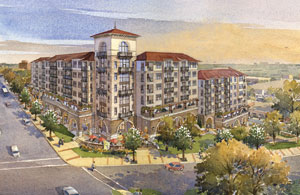 |
Rendering courtesy of Cline Design Associates, Pa. |
Project: Gallery at Cameron Village
Location: Raleigh, N.C.
Architect: Cline Design Associates, Pa.
Engineer: SCA Consulting Engineers
Size: Five stories, 550,000 square feet
Completion Date: Fall 2013
Slated for completion next fall, this
mixed-use project includes five stories
of wood-frame construction over a concrete
podium deck. Designed as Type
IIIA construction, the wood portion will
include fire-retardant-treated structural
wood products on the exterior, plated
wood floor and roof trusses, and a mix
of plywood and/or fire-retardant-treated
oriented strand board (OSB) sheathing.
Designers achieved a 2-hour rating on
exterior walls using double layers of
fiberglass mat gypsum sheathing over
FRT wood studs and a double layer of
Type X gypsum wall board on the interior
supported by 6x9 PSL beams rated
for 180 minutes. Using this unusual approach,
the wood trusses are supported
by PSL at the 2-hour bearing exterior
walls. By engineering the building with
holdowns that eliminated shear on the
exterior walls, while also using interior
shear walls, designers were not required
to use plywood on the exterior.
The project team utilized the potential
for wood in the code to the fullest,
by designing a one-story above-grade
concrete podium for retail and leasing,
and three subterranean levels that are
separate from the Type III wood structure
above, as allowed by section 509
of the 2009 IBC.
Adding a fire wall allowed them
to split the structure into two separate
buildings for code purposes
and therefore take advantage of the
maximum building height for each as
they step down the sloped site. The
higher building is two levels above the
lower building, and this vertical offset
allowed both buildings to stay under
the maximum height allowed in Type III
wood-frame construction. |
| Wood is Allowed in Noncombustible Construction |
Although perhaps counter-intuitive,
the IBC allows the use of wood in
“noncombustible” buildings and
construction types that require
noncombustible exterior walls.
• Type I and II construction require
noncombustible materials, but Section
603.1 of the IBC allows use of
FRT W for a number of applications;
it also lists other typically non-structural
uses of wood permitted in these
buildings.
• While Type III construction requires
noncombustible materials for exterior
walls, Section 602.3 allows FRT W in
wall assemblies with a 2-hour rating
or less.
• Type IV (heavy timber) construction
includes noncombustible materials
for exterior walls and timber for
interior framing; Section 602.3 also
allows FRT W for exterior wall assemblies
with a 2-hour rating or less.
• Table 601 permits heavy timber roof
structures in all construction types
except Type 1A. |
Seismic Performance
Years of research and building code development have proven that wood-frame and hybrid structures can meet or exceed the most demanding earthquake design requirements.7
Forces generated in an earthquake are proportional to the structure's weight and wood is substantially lighter than other common building materials.8 The fact that wood buildings tend to have numerous nail connections means they also have more load paths, and less chance the structure will collapse should some connections fail. This is also why they have inherent ductility, with multiple load paths to dissipate energy when faced with the sudden loads of a seismic event.
The correct design of elements such as frames, shear walls, diaphragms and their connections to each other is of utmost importance as earthquake forces “search out” the weak links between structural members. Where there is serious damage or collapse, research shows it is often the result of connection failure.
Demonstrating wood's performance in a seismic event, an assessment of the damage to California schools in the 1994 Northridge earthquake was summarized as follows:
“Considering the sheer number of schools affected by the earthquake, it is reasonable to conclude that, for the most part, these facilities do very well. Most of the very widespread damage that caused school closure was either non-structural, or structural but repairable and not life threatening. This type of good performance is generally expected because much of the school construction is of low rise, wood-frame design, which is very resistant to damage regardless of the date of construction.”9
In 2002, the California Dept. of Government Services completed a legislated inventory and earthquake worthiness assessment of schools. School buildings that were constructed of steel, concrete, reinforced masonry or mixed systems designed between 1933 and July 1, 1979 were required to be evaluated. Older wood-frame schools were exempted on the basis that “wood-frame buildings are known to perform well in earthquakes.”10
CASE STUDY
Designing for Seismic Forces |
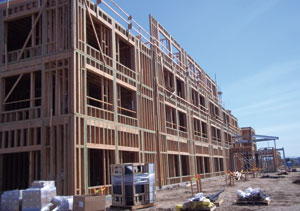 |
Photo courtesy of Thorson Baker & Associates |
Project: Hyatt Place El Segundo
Location: El Segundo, Calif.
Architect: Braun & Steidl Architects
Engineer: Thorson Baker & Associates
Size: 83,900 square feet
Completion Date: December 2012
Seismic forces presented the greatest
engineering challenge for this Hyatt Place
hotel in California, which includes five
stories of wood-frame construction. To
accommodate the large windows that
are typical of the Hyatt prototype, the
exterior walls are designed as segmental
shear walls so the force is transferred
around the window. Because the ground
floor includes large meeting rooms where
walls are taller and fewer, designers used
eccentric inverted V-braces and moment
frames with unique reduced-beam
sections where the beam is weakened
on purpose. Developed in the 1990s
based on lessons learned from previous
earthquakes, this technique allows the
weak spot to fail slowly if the building
exceeds the design loads during a seismic
event, thus preventing the moment
connection from brittle failure. The
placement of shear walls also required
some ingenuity. “Like most hotels, the
Hyatt Place El Segundo is long and
narrow, so seismic weight in the long
direction is a challenge,” says Donald
Schehl, PE, LEED AP, of Thorson Baker
& Associates, Inc. “Given the number of
large windows, we had to use pretty well
every inch of exterior wall and every inch
of corridor. The panel edge fasteners on
the plywood sheathing were spaced 2
inches on center (o.c.) on each side of the
walls on the lower levels.”
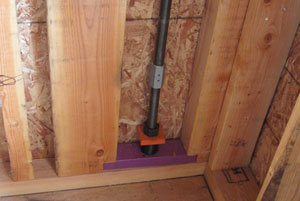 |
Photo courtesy of Ingraham/DeJesse Associates Above: Continuous rod holdown system in the Telegraph Apartments. |
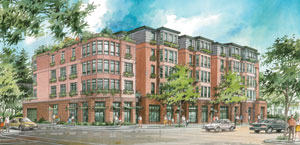 |
Rendering courtesy of Rolnizky Architect |
Project: Telegraph Apartments
Location: Berkeley, Calif.
Architect: Rolnizky Architects
Engineer: Ingraham/DeJesse Associates
Size: 37,885 residential square feet
Completion Date: 2013
Located close to the Hayward Fault in an
area with extremely high seismic forces,
the Telegraph Apartments includes four
stories of wood-frame construction over
a one-story post tensioned concrete
podium—and an exterior façade that’s
almost entirely glass. In general, seismic
forces pose a particular challenge for
the bottom floor of a four-story multifamily
wood-frame building because the
length of the required solid shear wall
often means minimizing the exterior
glazing—which is programmatically
challenging with narrow, deep living
units. To meet these challenges, the
design team used the rigid diaphragm
analysis approach, which allowed
long interior corridor shear walls to
transfer a larger percentage of the
seismic load than is typically the case. A
combination of dimension lumber and
engineered wood products, including
2x/3x framing, OSB sheathing on the
floors, walls and roof, and a continuous
rod holdown system at the ends of the
shear walls provided an efficient design
that allowed the framing to proceed in
a standard manner. The engineering
firm is currently using this design for
structures with up to five stories of
wood-frame construction. |
Wind Resistance
In addition to superior seismic performance, wood buildings can be designed to effectively resist high winds. Wood's elastic limit and ultimate strength are higher when loads are applied for a short time, which tends to be the case in high wind events. When structural panels such as plywood or OSB are properly attached to lumber framing and used to form diaphragms and shear walls, they also form some of the most solid and stable roof, floor and wall systems available.11
However, in order for the diaphragms and shear walls to be effective, all of the related components—including framing, structural panel sheathing and inter-element fastening details—must be designed and installed correctly.
For the structural system to work as intended, the roof diaphragm must be able to transfer lateral loads to the shear walls and the shear walls themselves must transfer these loads to the foundation. The success of the entire system is only as good as the quality and quantity of the connections. Therefore, the key to constructing a building that can resist lateral loads is understanding how forces are transferred and how to design and install proper connections.
In hurricanes, the loss of roofing materials and sheathing is the leading cause of structural failure in wood-frame buildings. The most common reasons behind these failures are improper connection detailing between structural systems and inadequate fastening of sheathing to supporting members. Most local building codes require a minimum of 33 fasteners for a standard 4×8 panel installed over roof supports 24 inches o.c. Fasteners, such as 8d common nails (2.5 inches x 0.131 inch) or other code-approved options, should be placed a maximum of 6 inches o.c. along panel edges and 12 inches o.c. at intermediate supports. Following Hurricane Andrew in Florida, damage assessment teams found roof sheathing panels with as few as four fasteners. Once the roof sheathing has been pulled off its framing, the load path is interrupted and the diaphragm ceases to function.
Sound Transmissions and Acoustics
The IBC requires multi-family residential buildings to have a minimum Sound Transmission Class (STC) rating of 50 and a minimum Impact Insulation Class (IIC) rating of 50 for partitions and floor/ceiling assemblies between adjacent dwelling units or between dwelling units and adjacent public areas. Acoustical problems arise when sound transmits through the structure or when reverberation occurs via hard reflective surfaces.
Wood-frame construction is particularly efficient in residential buildings where sound insulation is required. Attaching gypsum board to walls and ceilings using resilient metal channels significantly reduces sound transmission, as does placing glass-fiber or rock-fiber insulation within wood-frame floor and wall assemblies. Wood-frame construction does not present the impact noise transmission issues commonly noted with concrete construction.12
That said, the design of any functional and safe building is difficult if not impossible without considering acoustics, and wood has a proven record in this regard. Wood is not as acoustically lively as other surfaces and can offer acoustically absorptive qualities, hence its widespread use in performance and musical venues. At the Arena Stage at the Mead Center for American Theater, for example, a small theater called “The Cradle” posed a challenge because of the sound reflections caused by its oval shape. In response, Bing Thom Architects developed a wood slat wall system made from poplar, designed to look like a basket weave, which could absorb and disperse sound.
CASE STUDY
Designing for Acoustics |
Project: Duke School
Location: Durham, N.C.
Architect: DT W Architects & Planners/Fielding Nair International
Engineer: GKC Associates
Size: 79,204 square feet
Completion Date: 2009
When DTW Architects & Planners and
Fielding Nair International signed on to
design Duke School, they faced the same
challenge school boards and design
teams face across the country: how to
balance cost and functionality objectives
while creating an enriching space that
inspires learning. “To create a positive
learning environment, we used exposed
wood as the main design element,” says
DT W’s Robert Sotolongo, AIA , LEED
AP. Glulam columns, girders, purlins
and arches comprise the main structural
frames, while exposed tongue-andgroove
wood roof decking is used as a
design element. However, no building
design is without its challenges and the
desire for large, open rooms dominated
by exposed wood decking meant
consideration to acoustics. “At first
we planned to use dropped acoustical
ceilings in select areas, but the owner
loved the wood so much we changed our
minds,” says Sotolongo. “We put down
carpet and suspended ceiling baffles in
select areas. We also constructed wall
panels—essentially wood framing
with batt insulation covered with
fabric—which turned out to be a cost-effective
solution.”
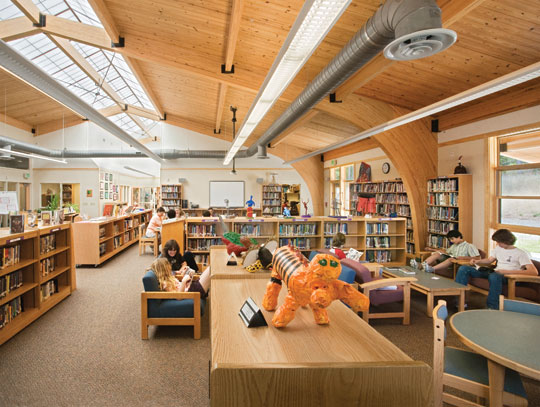 |
Photo by Jerry Markatos; courtesy of DTW Architects & Planners |
|
The Evolution of Wood Construction
Growing recognition of wood's benefits continues to increase its appeal in specific building types, while new products and technologies expand the possibilities for how and where wood is used.
Mid-rise/multi-family—Mid-rise buildings are typically Type V construction, which allows the use of untreated wood throughout, or Type III, which allows wood roof and floor systems as well as interior wood-frame walls. (FRTW is required for exterior wood-frame walls in Type III buildings.)
Many developers and design teams default to wood for mid-rise buildings up to four stories because it's the most economical choice; however, with five-story wood buildings (and potentially higher) permitted in the IBC, there has been a marked interest among those who see taller wood buildings as a way to achieve greater density at lower cost. Podium structures in particular, which include multiple stories of residential wood-frame construction over a podium deck, are common among design professionals seeking to incorporate parking, retail or restaurants into their designs.
CASE STUDY
Beyond Five Stories with the IBC |
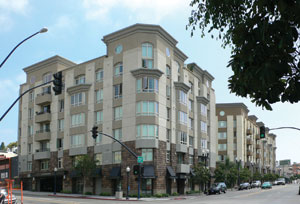 |
Photo courtesy of Togawa Smith Martin, Inc. |
Project: Union Square Condominiums
Location: San Diego, Calif.
Architect: Togawa Smith Martin, Inc.
Engineer: Edmond Babayan and
Associates
Size: 263 condominium units
Completion Date: 2005
Architects for the Union Square
condominium project in San Diego
made use of code provisions to
increase the height of the project
by adding two levels for residential
use. First, utilizing IBC Section 505,
designers added a mezzanine, which
increased the number of wood-frame
levels to six. Second, since the project
was not located in a retail neighborhood,
the Type IA concrete level at
grade was designed to incorporate
residential “stoop units,” each with
access to the street. The building was
thus able to achieve seven levels of
residential use with a density of 143
units per acre. |
Schools—The IBC has well-established parameters for wood-frame schools, which is good news for school districts trying to accommodate increasing enrollment on a limited budget. However, many who turn to wood-frame construction for its cost effectiveness find that wood also offers other advantages—such as speed of construction, design versatility and the ability to meet green building goals. Increasingly, research is also supporting the idea that exposed wood in a room promotes the well-being of occupants, reduces stress and creates a positive environment for learning.
For example, a study13 at the University of British Columbia and FPInnovations found that the presence of visual wood surfaces in a room lowered activation of the sympathetic nervous system (SNS) in an office environment. The SNS is responsible for physiological stress responses in humans such as increased blood pressure and heart rate while inhibiting the parasympathetic system responsible for digestion, recovery and repair functions. Study author David Fell says research on wood and schools is underway, but the results of the office study apply to any interior environment. “The stress-reducing effects we found for wood in office environments are in theory transferable to any building type as these are innate reactions to natural materials.”
At the 322,500-square-foot El Dorado High School in Arkansas, designers used exposed wood and natural light to create an environment that would motivate students to stay in school. “We used exposed wood products in structural systems and in elements such as doors, millwork and trim to provide a unique architectural aesthetic that helps to naturally soften and warm the spaces,” says project architect Blakely C. Dunn, AIA, NCARB and principal of CADM Architecture, Inc. From a code perspective, this project is noteworthy because it was one of the first schools in Arkansas to make extensive use of wood following a change in school board policy that had previously prohibited wood in school construction. In 2008, recognition of wood's safety and performance attributes led the Arkansas School Board to modify its School Facilities Manual to reflect the IBC. It is also noteworthy from a cost perspective. Originally designed in steel and masonry, the school was changed to wood-frame construction for budget reasons—a move that saved the school board $2.7 million.
 |
At the 322,500-square-foot El Dorado High School in Arkansas, the use of exposed
wood and natural light creates a welcoming environment.
Photo by WI Bell; courtesy of WoodWorks |
Mass timber—Since the invention of modern day plywood in the early 1900s, a succession of engineered wood products have offered increasing strength and stability, expanding the options for (among other things) taller walls and longer unsupported spans in wood buildings.
In the latest development, mass timber products such as glulam, laminated veneer lumber, laminated strand lumber and now cross laminated timber (CLT) are inciting much discussion (and press) around the safety, feasibility and economics of constructing high-rise wood buildings.
Sometimes referred to as “plywood on steroids,” CLT typically consists of three, five or seven layers of solid dimensional lumber, kiln-dried and layered perpendicular to one another and then glued to create full-depth solid wood, wall and floor panels up to 12 feet by 60 feet. This cross lamination provides exceptional strength, stability and rigidity, allowing CLT to be used as a low-carbon alternative to concrete and steel in many applications. Benefits of CLT also include quick installation, minimal on-site waste, light weight and (as a result) reduced foundation requirements, thermal performance, and design versatility.
In Europe, there are examples of eight- and nine-story CLT buildings, and a 10-story CLT building has just been completed in Australia. In the U.S., recent changes to the IBC place CLT of a certain thickness within Type IV construction. Fire-resistance testing has confirmed that it performs at least as well as heavy timber while providing for even greater fire resistance by eliminating concealed spaces in wall and floor assemblies of traditional dimensions.14
In May 2012, APA published ANSI/APA PRG 320-2011 Standard for Performance-Rated Cross-Laminated Timber, an American National Standard that provides requirements and test methods for qualification and quality assurance of CLT. CLT products manufactured to the standard will be recognized as code-compliant in the 2015 iteration of the IBC.
CASE STUDY
Designing with New Materials |
 |
|
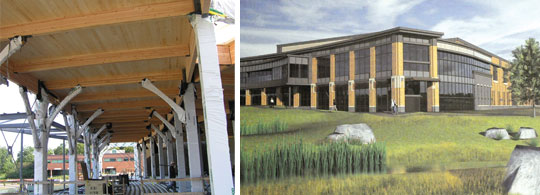
Photo courtesy of StructurLam Products Ltd.; rendering courtesy of Promega |
Project: Promega GMP Facility
Location: Fitchburg, Wis.
Building design: Uihlein-Wilson Architects;
EwingCole; Archemy Consulting
CLT Engineer: Equilibrium
Consulting Inc.
Size: 260,000 square feet
Completion Date: October 2012
Building codes are flexible enough to accommodate new materials and it’s common for building projects to require—and be granted—variances for designs not in the code that can be justified on a case-by-case basis. Such was the case for the new Promega biotechnology production facility, which features an innovative mix of glulam and CLT. Building department approval was achieved through use of the newly completed ANSI/APA PRG 320-2011 Standard for Performance-Rated Cross-Laminated Timber. “The design team discussed the standard with building officials early in the process,” says Kris Spickler of StructurLam Products Ltd. “Engineering information was then submitted under the “alternate designs” section of the code. IBC Section 104.11 states that ‘An alternative material, design or method of construction shall be approved where the building official finds that the proposed design is satisfactory and complies with the intent of the provisions of the code.’ Local building officials accepted both the AN SI/APA standard and the design.”
Most of the new Promega facility will be dedicated to manufacturing with committed (fixed) production lines and flexible manufacturing areas. It will also feature a customer experience center for employees and guests that will include spaces for training, laboratory demonstrations, conferences, an exercise and fitness center, and dining. |
Green Building Codes, Standards and Rating Systems
In addition to requirements designed to ensure safety and structural performance, there are a growing number of codes, standards and rating systems that seek to minimize a building's environmental impact.
The most recent example is the International Green Construction Code (IgCC), released in March 2012. Adopted by eight jurisdictions so far, it is the latest phase in an evolution that's included two American National Standards (covering residential and non-residential construction), the California Green Building Standards Code (CALGreen), and ASHRAE 189.1, a code-intended commercial green building standard published by the American Society of Heating, Refrigerating, and Air-Conditioning Engineers (ASHRAE) in cooperation with the Illuminating Engineering Society of North America (IES) and US Green Building Council.
The IgCC covers subject areas typically found in any green building effort, including site, materials, energy, water, and indoor environment. Although a voluntary code that some jurisdictions have adopted to provide guidance regarding public or publicly funded buildings, it includes 'mandatory' provisions within all subject areas as well as recommended provisions and electives. It is potentially applicable to almost every commercial building project, including additions and repairs.
In terms of material use, the IgCC's key mandatory requirement is that at least 55 percent of materials (based on mass, volume or cost) be used, recycled, bio-based, and/or indigenous in any combination. However, this rule need not be met when a whole building life cycle assessment (LCA) is performed.15
LCA is a scientific approach to evaluation that considers the impact of materials over their entire life cycle, from extraction or harvest through manufacturing, transportation, installation, use, maintenance and disposal or recycling. When integrated into green building codes, standards and rating systems, LCA encourages design professionals to compare different building designs based on their true environmental impacts and to make informed choices about the materials they use. It replaces the prescriptive approach to material selection that's been common until now, which assumes that certain prescribed practices—such specifying products with recycled content—are better for the environment regardless of the product's manufacturing process or disposal. LCA studies consistently show that wood is better for the environment than steel or concrete in terms of embodied energy, air and water pollution, and greenhouse gas emissions.16
In the U.S., LCA is included in the Green Globes rating system and the American National Standard based on Green Globes, ANSI/GBI 01-2010: Green Building Assessment Protocol for Commercial Buildings, as well as the ICC 700 National Green Building Standard. It's part of both CALGreen and ASHRAE 189.1, and is included as a pilot credit in the Leadership in Energy and Environmental Design (LEED) rating system. Although LCA isn't mandatory in the IgCC, elimination of the “55 percent requirement” is a powerful incentive for its use.
Wood: The Sensible Revolution
Today's building codes recognize wood's safety and structural performance capabilities and allow its use in a wide range of building applications, from the light duty repetitive framing common in small structures to the larger and heavier framing systems used to build mid-rise/multi-story buildings, schools and arenas. This hasn't been lost on design professionals seeking to have it all—cost effectiveness, functionality, design flexibility, beauty and environmental performance—who, through their collective projects, are leading a revolution toward the greater use of wood in non-residential and multi-family buildings.
| Wood and Carbon Footprint |
Using wood can significantly reduce
the carbon footprint of a building
project. As trees grow, they absorb
carbon dioxide (CO2) from the
atmosphere, release the oxygen (O2),
and incorporate the carbon into their
wood, leaves or needles, roots and
surrounding soil. One of three things
then happens:
• When the trees get older, they
start to decay and slowly release the
stored carbon.
• The forest succumbs to wildfire
insects or disease and releases the
carbon quickly.
• The trees are harvested and
manufactured into products, which
continue to store much of the carbon.
In the case of wood buildings, the
carbon is kept out of the atmosphere
for the lifetime of the structure,
longer if the wood is reclaimed at the
end of the building’s service life and
manufactured into other products.
In all of these cases, the cycle begins
again as the forest regenerates and
young seedlings once again begin
absorbing CO2.17
To illustrate the impact of just one
project, El Dorado High School in
Arkansas used 153,140 cubic feet of
lumber, panels and engineered wood.
These products store an estimated
3,660 metric tons of carbon dioxide
equivalent (CO2e), while the use of
wood instead of fossil fuel-intensive
materials means that another 7,780
metric tons of CO2e emissions were
avoided during manufacturing.
According to the U.S. EPA Greenhouse
Gas Equivalencies Calculator, this is
equivalent to the annual emissions from
2,100 cars or the energy to operate an
average home for 970 years.18 |
| ENDNOTES |
| 1 |
reThink Wood |
| 2 |
Carbon 101: Understanding
the Carbon Cycle and the Forest-
Carbon Debate, Dovetail Partners
Inc. |
| 3 |
American Wood Council offers a
number of publications related to the
fire design of wood buildings for code
acceptance |
| 4 |
Calculating the Fire Resistance of
Exposed Wood Members, American
Wood Council |
| 5 |
Fire Rated Wood Floor and Wall
Assemblies, American Wood Council |
| 6 |
Design of Fire-Resistive Exposed
Wood Members, American Wood
Council |
| 7 |
ANSI/AF&PA SDPWS-2005 –
Special Design Provisions for Wind and
Seismic Standard with Commentary,
American Wood Council; Design Concepts for Building in High Wind and Seismic Zones, APA |
| 8 |
American Wood Council |
| 9 |
The January 17, 1994 Northridge, CA Earthquake An EQE Summary
Report, March 1994 |
| 10 |
Seismic Safety Inventory of
California Public Schools, California
Department of Government Services,
2002 |
| 11 |
ANSI/AF&PA SDPWS-2005 –
Special Design Provisions for Wind and
Seismic standard with Commentary,
American Wood Council; Design Concepts for Building in
High Wind and Seismic Zones, APA |
| 12 |
Fire Resistance and Sound
Transmission in Wood-Frame
Residential Buildings |
| 13 |
Wood and Human
Health, FPInnovations |
| 14 |
American Wood Council |
| 15 |
More information on the International Green Construction Code is available from Dovetail Partners,
Inc. |
| 16 |
Life Cycle Environmental
Performance of Renewable Building
Materials in the Context of Building
Construction, Consortium for
Research on Renewable Industrial
Materials, Phase I 2005, Phase II
2010; A Synthesis of Research
on Wood Products and Greenhouse
Gas Impacts, Sarthre, R. and J.
O’Connor, 2010, FPInnovations; Wooden
building products in comparative
LCA: A literature review, Werner, F.
and Richter, K., 2007, International
Journal of Life Cycle Assessment, 12(7):
470-479 |
| 17 |
Carbon 101: Understanding the
Carbon Cycle and the Forest Carbon
Debate, Dovetail Partners, Inc., 2012 |
| 18 |
El Dorado High School Students
Get the ‘Wow’ They Deserve, US
WoodWorks, 2012 |

 |
The reThink Wood initiative is a coalition of interests representing North America's wood products industry and related stakeholders. The coalition shares a passion for wood and the forests they come from. Innovative new technologies and building systems have enabled longer wood spans, taller walls, and higher buildings, and continue to expand the possibilities for wood use in construction. www.rethinkwood.com
|